Where to buy
Check the latest price, availability and delivery on Amazon. Orders are placed on Amazon. We may earn a commission from qualifying purchases.
- Best overall: puredown Goose Down Duvet Insert, Full/Queen Oversized 98×90 — Check on Amazon
- Globon Winter White Goose Down Duvet Insert, Queen 90×90 — Check on Amazon
- Beautyrest Hungarian White Goose Down Duvet Insert, Full/Queen 90×98 — Check on Amazon
- APSMILE All Season Down Comforter Duvet Insert, Queen 90×90 — Check on Amazon
See 2 more Amazon options
- Brooklinen All Season Down Alternative Duvet Insert, Full/Queen 90×90 — Check on Amazon
- Egyptian Bedding Luxurious Goose Down Fiber Duvet Insert, Queen 90×90 — Check on Amazon
Read the full guide ↓
Disclosure: As an Amazon Associate, topratedkitchenware.com earns from qualifying purchases. Links to Amazon on this page are affiliate links; they cost you nothing extra. Listing details such as price and availability change often, so check the current Amazon listing before you buy.
The best duvet inserts under $400 are where genuine down — real clusters, not the shredded “down fiber” that fills most cheaper inserts — finally becomes the normal expectation rather than the exception. At this budget a queen insert can carry a maker-rated 800 fill power, a 93% down fill, a high-thread-count cotton shell and proper baffle-box construction, and those are exactly the things that decide whether an insert lofts like a hotel duvet or slumps like a padded blanket. This guide leads with that kind of insert, and it is equally direct about the places where the $400 label is doing marketing work: two of the six picks below are filled with down fiber, which is a different, cheaper material than cluster down, and we say so in their reviews rather than letting the word “down” blur the difference.
Because an insert lives inside a cover, this guide judges insert-specific hardware as seriously as fill: corner tabs and loops that keep the insert anchored, baffle walls that stop the down migrating to the foot of the bed, and dimensions that actually match the covers people own — one pick here is an oversized 98×90 cut and another runs 90×98, and both facts matter more than a few points of fill power. Below you will find a quick picks table, detailed notes on each of the six inserts, a comparison table, a buying checklist, an honest account of what $400 still does not buy, and answers to the questions that come up again and again at this price.
In this guide
Quick Picks
Short on time, or comparing several options at once? Each row below names a buyer type and the insert that suits it, with a link to the listing.
| Buyer type | Pick | Why it stands out | Link |
|---|---|---|---|
| Best overall | puredown Goose Down Duvet Insert, Full/Queen 98×90 | 93% down clusters, maker-rated 800 fill power | Check on Amazon |
| Best value in genuine down | Globon Winter White Goose Down Duvet Insert, Queen 90×90 | Cluster down in a mid-tier position in this tier | Check on Amazon |
| Best named-origin down | Beautyrest Hungarian White Goose Down Duvet Insert, Full/Queen 90×98 | 75% Hungarian down, US-grown cotton, made in USA | Check on Amazon |
| Best warmth per dollar | APSMILE All Season Duvet Insert, Queen 90×90 | 46 oz of fiber fill — check price on Amazon | Check on Amazon |
| Best no-animal-fill insert | Brooklinen All Season Down Alternative Duvet Insert, Full/Queen 90×90 | Recycled fill, cotton sateen, corner loops | Check on Amazon |
| Best attachment hardware | Egyptian Bedding Luxurious Duvet Insert, Queen 90×90 | 8 corner loops and tabs, 48 oz fill | Check on Amazon |
How These Picks Were Chosen
The first filter was the budget, applied to the queen or full/queen size specifically, because insert listings headline whichever size is cheapest. Every product below is a real Amazon listing sold as a duvet insert or comforter-duvet insert in that size at or under $400. This guide does not print static prices for any pick — prices change often, so check the current price on Amazon at the listing before you decide.
We did not use these inserts ourselves. We read the maker listings and specification pages and compared the things that decide how an insert behaves inside a cover: what the fill actually is (down clusters, down fiber, feather fiber or synthetic — the single most blurred distinction in this category), the maker’s fill-power and fill-weight figures, shell fabric and thread count, baffle-box versus sewn-through construction, the number and placement of corner tabs or loops, and the finished dimensions. Fill-power, warmth and loft figures are maker claims throughout this guide; no independent lab verified them in the sources we checked, and we flag them as claims wherever they appear.
One overlap deserves stating openly: duvet inserts and comforters are largely the same products under two names on Amazon, and several picks here also appear in our comforter guides. That reuse is deliberate — each product below is genuinely titled or sold as a duvet insert, and this guide re-judges them on insert criteria (attachment hardware, shell behavior inside a cover, sizing against standard covers) rather than repeating the comforter verdicts. If you will use the product bare, without a cover, the comforter guide is the better read; this one assumes a cover goes over it.
The 6 Best Duvet Inserts Under $400
puredown Goose Down Duvet Insert, Full/Queen Oversized 98×90 (800 Fill Power)
Who it suits: Buyers who want the genuine premium-down insert at this budget — maximum cluster content, maximum stated loft — and who use a duvet cover every night.
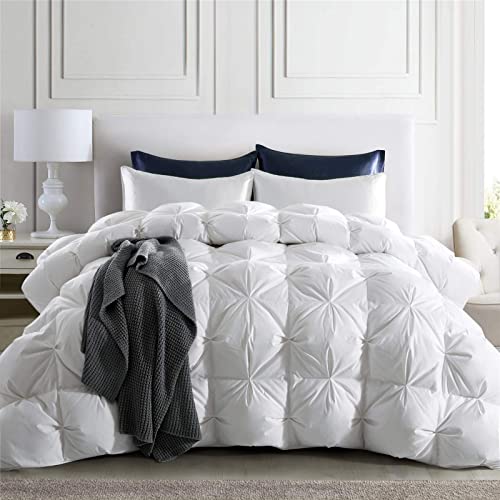
This is the insert the tier exists for. The listing specifies 93% white goose down — clusters, not fiber — at a maker-rated 800 fill power, with 40 oz of fill in the full/queen size, inside a 100% cotton shell at a stated 700 thread count. The fill carries RDS and OEKO-TEX Standard 100 certifications per the listing, the construction is a 3D baffle box under a pinch-pleat face, and the listing’s own copy confirms corner tabs for anchoring a duvet cover, which is the detail that turns a premium comforter into a proper insert. It sits at the premium end of this tier — check the current price on Amazon before you order.
Two sizing and care facts shape who should buy it. The cut is oversized — 98×90 inches against the 90×90 of a standard queen insert — which drapes generously and fills an oversized cover properly, but can bunch inside a true-to-size 90×90 cover; measure your cover before assuming. And roundup coverage of this model consistently reports dry clean only, which is normal for high-cluster down but does mean the cover is not optional equipment: it is what stands between the insert and every spill, and it is why the corner tabs matter.
- 93% goose down clusters — the highest genuine down content in this guide.
- Maker-rated 800 fill power with 40 oz of fill in the full/queen size.
- Corner tabs for the duvet cover, baffle-box construction, RDS and OEKO-TEX certified fill per the listing.
Honest limitation: It sits at the premium end of this tier, the oversized cut can bunch in a standard 90×90 cover, and care is dry clean only — check the current price on Amazon before you order.
Choose it if you want the best genuine-down insert under $400 and your cover is oversized or generously cut. Skip it if your cover is exactly 90×90 and closely fitted, or if machine washing is non-negotiable.
Globon Winter White Goose Down Duvet Insert, Queen 90×90
Who it suits: Buyers who want real cluster down and baffle-box construction without spending near the cap — the value route into genuine down.
Globon’s winter queen pairs a maker-claimed 800+ fill power with roughly 37 oz of goose down fill (per detailed comparison coverage of the line) in a 3D baffle-box build, with corner tabs listed for cover attachment. It is positioned in the lower-mid part of this tier — a striking position for cluster down with these stated specifications, and the reason this insert is the guide’s value pick: it delivers the same construction class as the hero while sitting well below the premium end of the tier — check the current price on Amazon. The brand reports RDS and OEKO-TEX certifications and a Texcote-Nano moisture treatment, the latter printed here as what it is — a maker claim, not a measured property.
The trade sits in the shell. Where the puredown wraps its down in pure cotton, Globon’s shell is a 68% cotton / 32% polyester blend at a stated 420 thread count. Inside a duvet cover that matters less than it would for a bare comforter — your skin meets the cover, not the shell — but the blend is less breathable than pure cotton and it is the clearest sign of where the money was saved. The fill-power figure also deserves its flag: 800+ is the maker’s number, not independently lab-verified in the sources we checked, and Globon sells several near-identical variants, so confirm the live listing still resolves to the winter queen 90×90 before ordering.
- Genuine goose down clusters with a maker-claimed 800+ fill power and ~37 oz fill weight.
- 3D baffle-box construction and corner tabs for the cover.
- Positioned well under the cap in this tier — check price on Amazon.
Honest limitation: The shell is a cotton-polyester blend rather than pure cotton, and the 800+ fill-power figure is a maker claim that no source we checked verified independently.
Choose it if you want real down on a mid-tier budget and your insert will live inside a cover. Skip it if a pure cotton shell is a hard requirement,.
Beautyrest Hungarian White Goose Down Duvet Insert, Full/Queen 90×98
Who it suits: Buyers who care about named-origin down and domestic making — Hungarian down, US-grown cotton, assembled in the USA — and who will check the current price on Amazon themselves.
Beautyrest’s Hungarian insert is the provenance pick. Per the maker’s product description, the fill is 75% Hungarian white goose down with 25% white goose feather — that 75% figure matters, because it meets the US labeling threshold at which a fill may be sold simply as “down,” and it is clusters rather than fiber. The maker rates it at 750 fill power, the shell is 100% US-grown cotton at 500 thread count in a damask stripe, the construction is baffle box with self-piping, and the listing confirms 4 corner tabs for securing a duvet cover. The full/queen cut runs 90×98 — longer than the standard 90×90 — which suits taller beds and covers cut with extra length. The model is made in the USA.
Check the current price on Amazon for this listing before you decide — it is positioned as a premium pick in this tier, and if it sits beyond what you want to spend, the Globon above covers similar ground in a lower-mid position in the tier. What we can say is that nothing in its specification sheet is second-rate: named-origin clusters, a real cotton shell, baffle boxes and proper tabs are the full premium checklist.
- 75% Hungarian white goose down clusters — meets the US “down” labeling threshold — with a maker-rated 750 fill power.
- 500 thread count US-grown cotton damask shell; made in USA; OEKO-TEX certified per the maker.
- Baffle-box construction with 4 corner tabs and a longer 90×98 cut.
Honest limitation: Check the current price on Amazon before you order, and note that the 90×98 length will swamp a short cover.
Choose it if named-origin down and US making top your list and you will check the current price on Amazon. Skip it if your cover is a standard 90×90.
APSMILE All Season Down Comforter Duvet Insert, Queen 90×90
Who it suits: Buyers who want the warmth and weight of a natural fill at a mid-tier price, and who understand exactly which natural fill they are getting.
Read this pick’s label the way this guide reads every label: APSMILE’s own materials line for this listing reads “down fibers & feathers fibers.” That is processed fiber fill — down and feather material broken down into fiber form — not the intact clusters in the puredown, Globon and Beautyrest above, and no fill-power figure belongs to it: the “750 fill power” number attached to APSMILE’s line in some roundups is brand marketing for the range, and it is not printed for this listing in the sources we could verify. Judged on its own honest terms, though, the insert is well specified: 46 oz of fill weight — more ounces than the hero — in a 90×90 queen, baffle-box construction, corner tabs for the cover — check the current price on Amazon; the listing checked was fulfilled by Amazon.
Fiber fill has real virtues in this tier. It is warm for its position in the tier, it lofts evenly without the delicate handling clusters ask for, and it sits in the mid-tier of this budget, leaving headroom against the cap. What it will not do is match the cluster picks’ loft-per-ounce or their lifespan — fiber compresses sooner and recovers less. Buy it as what it is, a generously filled fiber insert positioned in the mid-tier, and it is a good purchase; buy it believing the roundup headline that it is a 750 fill power down comforter, and you have paid cluster expectations for a fiber product.
- 46 oz fill weight — the heaviest fill in this guide — check price on Amazon.
- Baffle-box construction and corner tabs; fulfilled by Amazon in the listing checked.
- Natural fiber warmth without the premium positioning or delicacy of cluster down.
Honest limitation: The fill is down and feather fiber, not clusters, and any “750 fill power” figure attached to this brand’s line should not be attributed to this listing.
Choose it if warmth per dollar is the priority and you are content with fiber fill honestly labeled. Skip it if you are specifically shopping for cluster down — that is the Globon or the puredown.
Brooklinen All Season Down Alternative Duvet Insert, Full/Queen 90×90
Who it suits: Buyers who want a premium insert with no animal fill at all — for preference, household rules or easier care — from a brand with a real track record.
Brooklinen’s down alternative is the synthetic pick that earns its place on construction rather than apology. The fill is recycled polyester formed to mimic down clusters, the shell is 100% cotton sateen, the construction is baffle box, and — the insert-specific detail — it carries corner loops for tying into a duvet cover, confirmed in independent review coverage of the model. It is positioned in the upper-mid part of this tier — check the current price on Amazon. Most of this model’s sales live on the brand’s own site, which is worth knowing before you read the Amazon page as the full picture of its track record.
As an insert it behaves well: the baffle boxes keep the synthetic fill distributed, the loops do the one job an insert must do inside a cover, and the cotton sateen shell slides into covers without the static grab of microfiber shells. Synthetic fill also tolerates machine washing in a way the cluster-down picks do not — follow the listing’s care label, but this is the pick for households that wash the insert itself regularly rather than relying on the cover. One terms note: Brooklinen’s generous brand-store trial and warranty apply to brand-store purchases; an Amazon purchase follows Amazon’s return policies, and this guide recommends it on the product, not the perks.
- No animal fill: recycled polyester fill in a 100% cotton sateen shell.
- Baffle-box construction with corner loops for the duvet cover.
- The most wash-friendly pick in this guide — check price on Amazon.
Honest limitation: Synthetic fill will not match the loft-per-ounce of genuine cluster down, and most sales happen direct through the brand’s own store, so check the current price on Amazon before you order.
Choose it if you want premium construction without down, or an insert you can machine wash. Skip it if genuine down loft is the point of spending at this tier.
Egyptian Bedding Luxurious Goose Down Fiber Duvet Insert, Queen 90×90
Who it suits: Buyers whose last insert bunched into a corner of its cover every night — this one has the best attachment hardware in the guide — and who sleep warm-seasoned rather than cold.
Egyptian Bedding has sold this insert since 2009, and its specification is a study in insert-first design: 48 oz of fill in a 90×90 queen, a 100% Egyptian cotton shell, baffle-box construction with double-needle stitching and rope piping, and 8 corner loops and tabs — double the anchor points of most inserts — to hold a duvet cover exactly where you tied it. The fill, stated plainly on the listing, is 80% goose down fiber and 20% waterfowl feather fiber: fiber again, not clusters, and the listing publishes no fill-power figure. The certifications are real ones — RDS, Downpass and OEKO-TEX Standard 100 are all stated on the listing — and the long sales history is its own kind of evidence in a category full of listings that vanish in a year.
Two disciplines apply. First, price: check the current price on Amazon, and if it is positioned near the cluster-down picks in this tier, the guide’s own advice is to buy the Globon or puredown instead. Second, warmth: the brand’s own language for this product contradicts itself, describing it as both lightweight and extra warm in different places, and independent coverage of the line notes that 48 oz of fiber fill runs warm in practice. Buy it as a substantial, warm, exceptionally well-anchored fiber insert — not as the featherlight summer layer some of its copy implies.
- 8 corner loops and tabs — the most attachment points in this guide.
- 48 oz fill, Egyptian cotton shell, baffle box with rope piping; on sale since 2009.
- RDS, Downpass and OEKO-TEX certifications stated on the listing.
Honest limitation: The fill is down fiber rather than clusters, the brand’s warmth language contradicts itself (lightweight in one line, extra warm in another) — check the current price on Amazon before you order.
Choose it if cover-shifting is your chief complaint and you want a warm, well-anchored insert. Skip it if you sleep hot, or if you want cluster down for this tier’s money.
Comparison Table
| Product | Fill (queen) | Construction & attachment | Link |
|---|---|---|---|
| puredown Goose Down Duvet Insert, 98×90 | 93% down clusters, 40 oz, maker-rated 800 FP | 3D baffle box, pinch pleat, corner tabs | Check on Amazon |
| Globon Winter Duvet Insert, 90×90 | Goose down clusters, ~37 oz, maker-claimed 800+ FP | 3D baffle box, corner tabs | Check on Amazon |
| Beautyrest Hungarian Duvet Insert, 90×98 | 75% Hungarian down clusters, maker-rated 750 FP | Baffle box, 4 corner tabs | Check on Amazon |
| APSMILE All Season Duvet Insert, 90×90 | Down & feather fiber, 46 oz | Baffle box, corner tabs | Check on Amazon |
| Brooklinen Down Alternative Duvet Insert, 90×90 | Recycled polyester, no animal fill | Baffle box, corner loops | Check on Amazon |
| Egyptian Bedding Luxurious Duvet Insert, 90×90 | 80% down fiber / 20% feather fiber, 48 oz | Baffle box, 8 corner loops and tabs | Check on Amazon |
How to Choose a Duvet Insert Under $400
- Read the fill line before the headline. “Down” in a title can mean clusters, down fiber or a blend. The materials line tells the truth: clusters loft most per ounce and last longest; fiber is warmer per dollar but compresses sooner.
- Know the 75% rule. Under US labeling practice a fill sold simply as “down” must be at least 75% down clusters. The Beautyrest’s stated 75% and the puredown’s 93% both clear it; anything labeled “down fiber” is a different material by definition.
- Treat fill power as a maker claim. Fill power (the volume an ounce of down occupies) is the best single proxy for loft quality, but no figure in this guide was independently lab-verified — compare claims within the guide, and weigh fill weight alongside them.
- Match the insert’s dimensions to your cover, not your bed. A standard queen cover is usually cut near 90×90. The puredown’s 98×90 oversized cut fills a generous cover and bunches in a tight one; the Beautyrest’s 90×98 adds length. Measure the cover’s inside dimensions first.
- Count the anchor points. Four corner tabs are the premium-tier minimum; side tabs or eight loops (the Egyptian Bedding) hold the middle edges too. If your cover has only corner ties, four tabs are enough; if it has eight ties, buy an insert that can use them.
- Prefer baffle box at this price. Sewn-through stitching pinches the fill at every seam and caps loft; baffle walls let clusters expand fully and stop migration. Every pick in this guide is baffle box — at $400, accept nothing less.
- Decide the care question before the warmth question. High-cluster down here is dry clean only in practice, which makes the duvet cover mandatory equipment. If the insert itself must go in a home machine, the Brooklinen is the pick designed for that life.
- Check the current price on Amazon for every pick. This guide does not print static prices, because they change often. Compare the current figure for the queen or full/queen size against this tier before you decide.
- Buy the cover for the insert you chose. Oversized and extra-long inserts need covers cut for them; a premium insert wadded into a standard cover lofts worse than a mid-tier insert in a cover that fits.
Down Clusters, Down Fiber and Feather Fiber: The Fill Ladder at $400
Everything in this guide turns on one distinction, so it deserves plain words. A down cluster is the intact, three-dimensional plume from the bird’s breast — thousands of filaments radiating from a point, trapping air in a structure that springs back after compression. Fill power measures how much space an ounce of those clusters occupies: a maker-rated 800 means lofty, resilient clusters that insulate heavily at low weight. Down fiber is what happens when down and feathers are processed into loose fiber — the clusters are broken down, the structure is gone, and what remains insulates more like a natural batting: warm, soft and inexpensive, but flatter per ounce and quicker to stay flattened. Feather fiber is the same idea applied to feathers, with more quill in the mix.
At $400 this distinction is the whole buying decision, because the tier contains both materials at overlapping positions. The puredown (93% clusters), Globon (clusters) and Beautyrest (75% clusters) sell the genuine article. The APSMILE and Egyptian Bedding sell fiber — honestly labeled on their own listings, whatever the roundup headlines say — and the Brooklinen sells a synthetic engineered to imitate clusters. None of the fiber or synthetic picks is a scam; each is in this guide because its construction, hardware or value earns the slot. But a shopper who buys a fiber fill expecting cluster loft, or who reads a brand-line fill-power figure onto a fiber listing, will be disappointed in a way no amount of fluffing fixes. Read the materials line first, then check the current price on Amazon, in that order.
Baffle Boxes, Tabs and Loops: The Insert Hardware That Matters at This Price
An insert has one job a standalone comforter does not: it must stay spread evenly inside a cover it cannot be seen through. Three construction details decide whether it does. The first is the baffle box — fabric walls sewn between the shell’s two faces, forming chambers the fill can fully expand in. Sewn-through construction, standard at lower prices, stitches the faces directly together and strangles the fill at every seam; at $400 every pick here uses baffles, and the difference shows up as loft that survives the night instead of migrating to whichever corner gravity prefers.
The second is attachment. Corner tabs or loops tie the insert to the cover’s internal ties, and four corners is the workable minimum — it stops the wholesale slide, though a restless sleeper can still work the middle loose. Eight anchor points, as on the Egyptian Bedding, add the side edges and are the better design for anyone who has ever woken to find the insert balled at the foot of the cover. The third detail is the one shoppers most often skip: dimensions. Inserts at this tier are cut generously — 98×90, 90×98 — because loft needs room, and a cover cut to a flat 90×90 will compress an oversized insert back toward the loft of a cheaper one. The premium move is to buy the insert and cover as a matched pair of measurements, not as two separate bargains.
What $400 Does Not Buy: The Ceiling Above This Guide
Four hundred dollars buys excellent down, but it does not buy the top of the down market, and the guide is clearer for naming what sits above it. Fill powers of 900 and beyond, heritage European houses and made-to-order duvets live higher: Lincove’s 800 fill power Canadian down queen sits above this tier at Target and on the brand’s own site, and The Company Store’s Legends Hungarian line for full/queen sits well above this tier on the brand’s site. Neither is an Amazon-verifiable purchase at this budget, and both are named here unlinked as ceiling markers rather than stretched into picks.
Two nearer misses deserve the same honesty. Brooklinen’s genuine Down Comforter in all-season full/queen is positioned inside this budget on the brand’s Amazon storefront, but its exact full/queen ASIN could not be verified and crawls of its sibling listings showed no featured offers, so it is named here unlinked; if its listing carries a live featured offer when you shop, check the current price on Amazon and it belongs in this guide’s top tier. Casper’s Down Duvet in full/queen is positioned in the upper-mid part of this tier, but its ASIN likewise could not be verified this session, so it is named here unlinked. And the Serta Luxury European Down Comforter — 75% European down, positioned in the mid-tier on Amazon — is the first swap-in for this guide if its ASIN verifies, since searches repeatedly surfaced only its feather-fiber siblings. The pattern is the point: at this tier the limiting factor is often not money but verifiability, and a guide that links only what it can verify will sometimes leave a good product named in this section instead of linked in the picks.
Common Buying Mistakes
- Reading “down” in a title and never checking the materials line — then paying cluster expectations for down fiber.
- Attributing a brand-line fill-power figure (such as APSMILE’s marketed 750) to a specific fiber-filled listing that publishes no fill power at all.
- Buying an oversized 98×90 or extra-long 90×98 insert for a standard 90×90 cover, and blaming the insert for bunching the cover’s cut caused.
- Skipping the duvet cover on a dry-clean-only down insert to save money, then paying the savings back in cleaning bills and stained shell fabric.
- Judging loft in the first hour. Vacuum-packed down needs a day of airing and fluffing — some brands specify up to 24 hours — before it reaches its real height.
- Counting only corner tabs when your cover has eight ties, or buying eight loops for a cover with four — anchor hardware only works in matched pairs.
- Treating a brand-store trial or warranty as if it covered an Amazon purchase; Amazon purchases follow Amazon’s return terms.
- Comparing prices across sizes — insert listings headline the smallest size, and the queen is routinely positioned higher. Always check the current price on Amazon for the queen or full/queen size specifically.
Final Recommendation
- Most buyers: puredown Goose Down Duvet Insert, Full/Queen 98×90.
- Genuine down on a budget: Globon Winter White Goose Down Duvet Insert.
- Named-origin down: Beautyrest Hungarian White Goose Down Duvet Insert (check price on Amazon).
- Warmth per dollar: APSMILE All Season Duvet Insert.
- No animal fill: Brooklinen All Season Down Alternative Duvet Insert.
- Cover-shifting sufferers: Egyptian Bedding Luxurious Duvet Insert (check price on Amazon).
Our top two are the puredown for anyone whose cover can take its oversized cut — it is the only pick here combining 93% clusters, a maker-rated 800 fill power, a 700 thread count cotton shell and proper corner tabs in one listing — and the Globon for everyone else, because genuine cluster down in a baffle box in a lower-mid position in this tier is the best value in the guide even allowing for its blended shell. The Beautyrest is the connoisseur’s alternative — check its current price on Amazon. What this tier rewards is label literacy: read the fill line, match the dimensions to your cover, count the anchor points, and the $400 buys an insert that will loft properly for years. Spend it on a headline instead, and it buys a very expensive lesson in vocabulary.
Frequently Asked Questions
Is a $400 duvet insert really better than a $100 one?
In fill, yes, measurably: at $100 the honest offer is down-alternative and feather/down-fiber inserts, while $400 buys intact down clusters at high stated fill powers, which loft more per ounce, compress and recover for more years, and insulate at lower weight. In construction the gap is smaller — good baffle boxes and corner tabs exist at $100 too. The premium is for the clusters, and it is worth paying only if you have read the materials line and confirmed clusters are what you are getting.
What is the difference between down clusters and down fiber?
Clusters are the intact three-dimensional plumes; they trap air in a springy structure and are graded by fill power. Down fiber is down and feather material processed into loose fiber — the structure is broken down, so it insulates like a natural batting: warm and soft, but flatter per ounce and faster to stay flat. Both are legitimate fills in the right position in the tier; the mistake is paying cluster-level money for fiber, which is why this guide names the material in every review.
Will these inserts fit my queen duvet cover?
Check your cover’s inside dimensions against the insert, not the bed size. A standard queen cover is usually cut near 90×90 inches, which matches the Globon, APSMILE, Brooklinen and Egyptian Bedding. The puredown is oversized at 98×90 and the Beautyrest runs long at 90×98; both are deliberate cuts that drape and fill generously, but either can bunch in a closely fitted standard cover. Oversized covers exist for both — buy the pairing deliberately.
How many corner tabs or loops does an insert need?
Four corner anchors is the workable minimum and what most premium inserts, including three picks here, provide. Eight anchor points — corners plus sides, as on the Egyptian Bedding — hold noticeably better for restless sleepers and large covers. What matters most is matching: your cover’s internal ties and the insert’s tabs must exist in the same places, or the extra hardware does nothing.
Can I machine wash a down insert?
The high-cluster picks in this guide should be treated as dry clean only — roundup coverage of the puredown reports exactly that — which is why the duvet cover is not optional: it takes the washing so the insert does not have to. The Brooklinen down alternative is the pick designed for regular machine washing; follow its listing’s care label. Whatever you buy, never judge or wash a vacuum-packed insert in its first day — let it air and reach full loft first.
Why does this guide not print prices?
Because listing prices change often, this guide does not print static figures for any pick. Check the current price on Amazon for the queen or full/queen size before you decide, and apply the guide’s own test: a fiber pick positioned near the cluster-down picks in this tier is hard to justify, while a cluster pick positioned well inside the $400 budget is the value this tier is for.
Does a down insert help with allergies?
An insert is a comfort product, not a medical one, and this guide makes no health claims for any pick. Where a maker labels a product “hypoallergenic,” we report it only as the maker’s label. Down is washed and certified under standards such as RDS and OEKO-TEX by the brands here, and a washable duvet cover is the practical hygiene layer for any sleeper; if allergies are a medical concern in your household, the synthetic Brooklinen removes animal fill from the equation entirely, and a clinician’s advice comes before any bedding purchase.
Is baffle-box construction worth paying for?
At this tier it should not cost extra — it should be the baseline, and every pick in this guide has it. Baffle walls let down clusters expand to their full loft and keep them in their chamber instead of migrating; sewn-through stitching is cheaper to make and permanently pinches the fill at every seam. If a $300-plus insert is sewn-through, that alone is a reason to choose a different one.
- Best Duvet Cover Sets to Protect a Premium Insert
- Best Duvet Insert Under $200
- Best Comforter Under $400
- Best Duvet Insert For Side Sleepers
- Best Cooling Pillow Under $100
- Best Bed Sheet Set Under $200