Disclosure: topratedkitchenware.com is reader-supported. When you buy through links on our site, we may earn an affiliate commission from Amazon and other retailers, at no extra cost to you.
Where to buy
The honest starting point for the best eco friendly coffee makers is that not every machine sold as convenient deserves an eco label, and this guide refuses to pretend otherwise. Of the six verified machines in our pool, three earn a linked recommendation because they can brew from loose grounds — the single biggest step a small electric brewer can take away from throwaway plastic. The other three are pod-only designs. They are reviewed in full further down, marked prose-only, with no purchase link and no product photo, because a pod-only routine is not an eco friendly routine and we will not dress it up as one. The linked picks are sold on Amazon; check the latest price on Amazon on each listing. Read the full guide ↓
- Elite Gourmet Single-Serve Coffee Maker (EHC111A) — reusable filter for grounds and loose-leaf tea
- Keurig K-Mini Mate — prose-only pick, reviewed in full below (pod-only design)
- Tastyle Mini Single Serve Hot and Iced Coffee Maker (K310IC) — brews K-Cup pods or grounds
- Keurig K-Express (Evergreen) — prose-only pick, reviewed in full below (pod-only design)
- Keurig K-Express (Mint) — prose-only pick, reviewed in full below (pod-only design)
- Hamilton Beach FlexBrew Advanced 4-in-1 Single Serve Coffee Maker — brews pod packs or grounds
Why does the grounds question matter so much? Because the footprint of a coffee maker is only partly the machine itself. The plastic and electronics in the brewer are bought once and used for years. The consumables are bought every week, and that is where the waste piles up: a sealed plastic pod for every single cup, a paper filter for every pot, packaging around all of it. A household that drinks two cups a day sends roughly seven hundred and thirty pods a year to landfill if it brews pod-only, and no recycling programme changes the fact that most small mixed-plastic pods are not recycled in practice, whatever the packet promises. Switch the same household to loose grounds in a reusable filter and the daily waste becomes coffee grounds — which compost — plus the bag the beans arrived in. That is the whole logic of this guide, and it is why the rankings below reward machines that make the low-waste routine the easy routine, not an awkward workaround.
There is a second, quieter side to eco friendly brewing: energy and water. A single-serve machine heats only the water it is about to brew with, cup by cup, instead of keeping a full pot hot on a warming plate for hours. It also brews the amount you will actually drink, which matters more than it sounds — coffee poured away is water, energy, and beans wasted three times over. The machines here are all single-serve designs, so all six score well on that front. Where they differ, sharply, is the consumables. Read the reviews with that split in mind: the linked picks win on waste, the prose-only picks are here so you can see exactly what you give up, environmentally, when you choose pure pod convenience — and what it would take to soften that choice if you already own one.
One more thing before the rankings. Eco friendly is a spectrum, not a badge, and this guide will keep using the word honestly. None of these machines is impact-free: they are plastic-bodied electrical appliances shipped in packaging, and the greenest brewer ever made is arguably a kettle and a steel filter you already own. What we can do is rank the verified options in front of us by how much avoidable waste and wasted energy each one builds into your daily routine, and be plain about the ones that build in the most. Readers comparing running costs as well as waste may also want our guide to Best Economy Coffee Makers, which looks at the same class of machine through a budget lens.
Key Takeaways
- The consumable decides the footprint: a reusable filter or a grounds basket removes a plastic pod from every cup you brew, which dwarfs any other eco difference between these machines.
- Three of the six verified picks can brew loose grounds — the Elite Gourmet with its reusable filter, and the Tastyle and Hamilton Beach with grounds options — and those three are the linked recommendations.
- The three Keurig pod-only picks are reviewed prose-only, without links or photos, because a pod-only routine cannot honestly be called eco friendly.
- Single-serve brewing already helps on energy and waste: you heat one cup of water at a time and brew only what you will drink, with no warming plate running for hours.
- Coffee grounds compost; spent pods mostly do not get recycled in practice. The daily habit matters more than the machine’s marketing.
- If you already own a pod machine, the eco upgrade path is a reusable pod accessory where the manufacturer supports one — but none of the picks here is credited with accessories that are not in its verified listing.
In this guide
Quick Picks
| Pick | Badge | Why it is here | Link |
|---|---|---|---|
| Elite Gourmet Single-Serve Coffee Maker (EHC111A) | Best Overall | Reusable filter for grounds and loose-leaf tea, auto shut-off, dishwasher-safe parts — the lowest-waste routine in the pool. | Check on Amazon |
| Keurig K-Mini Mate | Best for Small Spaces (prose-only) | Tiny one-cup-at-a-time Keurig, but pod-only in its verified listing, so it is reviewed without a link. | Prose-only — no link |
| Tastyle Mini Single Serve Hot and Iced Coffee Maker (K310IC) | Most Versatile | Brews K-Cup pods or grounds, hot or iced, across 6 to 14 oz sizes — the grounds path keeps waste down. | Check on Amazon |
| Keurig K-Express (Evergreen) | Best Reservoir Convenience (prose-only) | 42 oz removable reservoir and three brew sizes, but pod-only, so it is reviewed without a link. | Prose-only — no link |
| Keurig K-Express (Mint) | Best Style Pick (prose-only) | The same K-Express design in a Mint finish; pod-only, so it is reviewed without a link. | Prose-only — no link |
| Hamilton Beach FlexBrew Advanced 4-in-1 | Best for Mixed Households | Pod packs or grounds, hot or iced, with a removable 45 oz reservoir — one machine for both habits. | Check on Amazon |
A note on the three K-Express-style entries: the pool contains the same Keurig K-Express design in different finishes across this guide’s lists, and where two finishes appear here — Evergreen and Mint — they are the same machine underneath. We review them as separate pool entries because they were verified separately, but nothing about the eco assessment changes with the colour: both are pod-only, both are prose-only, and the finish is purely a kitchen-matching decision.
How These Picks Were Chosen
This is a research-led guide, not a hands-on test report, and the method matters more than usual here because the keyword itself is a claim. We started from the verified pick pool for this group: six machines whose Amazon listings were checked against the Creators API on 2026-11-20, with the exact titles, ASINs, and images recorded in the sources file that accompanies this article. Every specification mentioned in the reviews below comes from those verified titles and nowhere else — if a feature is not in the listing, we do not credit the machine with it, however likely it seems.
Each machine was then scored against an eco checklist built for this keyword. First and heaviest: can it brew without a disposable pod or a paper filter, using a reusable filter or a grounds basket that is part of the verified listing? Second: does it avoid keeping water or coffee hot for long periods, through auto shut-off or brew-on-demand design? Third: does it brew realistic single servings, so coffee is not made and thrown away? Fourth: are the parts that touch coffee easy to clean and, where the listing says so, dishwasher-safe, which extends the machine’s working life? Fifth: how much machine is there per cup — compact designs use less material and less counter energy over a life of one-cup brewing.
The results split the pool cleanly in two. Three machines passed the first and most important test and are linked. Three failed it — all pod-only Keurigs — and under this site’s rules a pick that misses the keyword’s core attribute is written prose-only: a full, honest review, but no Amazon link and no image, and the reason recorded in the sources file. We did not drop them from the article entirely, because many readers will arrive owning or considering exactly these machines, and an eco guide that ignores the most popular pod brewers would be useless. Instead you get the full picture, with the environmental cost stated plainly in each review. If your priority is a bigger batch format rather than single cups, our guide to Best Eight Cup Coffee Makers covers the next size class up.
The 6 Best Eco Friendly Coffee Makers

Elite Gourmet Single-Serve Coffee Maker (EHC111A)
Badge: Best Overall
Strengths
- Reusable filter for grounds and loose-leaf tea — no pod and no paper filter per cup
- Auto shut-off, so the machine is not left drawing power after brewing
- Dishwasher-safe parts, which makes the reusable routine easy to keep up
Trade-offs
- 14 oz maximum per brew — strictly one mug at a time
- No reservoir in the verified listing, so you add water for each cup
- Grounds-only eco route means no pod convenience at all
Mini spec box
- Format: single-serve, grounds and loose-leaf tea
- Brew size: 14 oz
- Power: 600W
- Controls: one-touch operation
- Filter: reusable filter included in the listing
- Extras: auto shut-off, dishwasher-safe parts, travel mug friendly, compact design
- Model: EHC111A
The Elite Gourmet is the only machine in this pool whose verified listing leads with the feature this keyword is actually about: a reusable filter. You brew with loose grounds — or loose-leaf tea, which the listing explicitly includes — and when the cup is done, the waste is a spoonful of grounds for the compost and nothing else. No pod shell, no foil lid, no paper filter. Over a year of daily brewing that is the difference between a small bag of packaging waste and hundreds of individual plastic pods, and it is why this modest machine takes the Best Overall badge in an eco guide ahead of bigger names.
The supporting details line up with the same philosophy. Auto shut-off means the 600W element is not left on by a distracted morning. Dishwasher-safe parts matter more than they sound: reusable filters only stay reusable if cleaning them is effortless, and a filter that needs fussy hand-washing is a filter that quietly gets replaced by pods within a month. Here the routine is rinse, rack, done. The one-touch operation and fast brew positioning in the listing suit the way this machine will actually be used — one person, one mug, before leaving the house — and the travel-mug-friendly design means that mug can be the one that goes out the door, skipping the disposable café cup too.
The honest limitation is capacity and patience. Fourteen ounces is one mug, and with no reservoir mentioned in the listing you are adding water each time, so a household of four coffee drinkers brews in turns and refills as it goes. If your mornings are a queue, a reservoir machine from the linked picks below will feel kinder. But judged on the keyword’s own terms — least waste per cup, least fuss per day — this is the pick to beat.
Best for: solo drinkers and couples who want the lowest-waste daily routine / Not suited for: households brewing several mugs back to back
Keurig K-Mini Mate
Badge: Best for Small Spaces (prose-only)
Strengths
- Compact, portable body that suits dorms, desks, and small counters
- Brews one cup at a time, up to 12 oz — no pot of coffee wasted
- One-cup-at-a-time water use: you add roughly what you drink
Trade-offs
- Pod-only in its verified listing — a plastic pod of waste per cup
- No grounds or reusable-filter option stated in the listing
- No reservoir, so every cup starts with a refill
Mini spec box
- Format: single serve K-Cup pod coffee maker
- Brew size: up to a 12 oz cup
- Design: compact and portable, for small spaces, dorms, and offices
- Colour in listing: Black
This pick is prose-only, and the reason is simple: its verified listing describes a K-Cup pod machine and nothing else. There is no grounds basket, no reusable filter, no second brewing path. Every cup it makes produces a spent pod, and on the eco checklist that defines this guide, that is the core attribute missed. So the K-Mini Mate gets a full review — it is a genuinely popular little machine and readers deserve an honest account of it — but no purchase link and no photo, and we will not call it an eco friendly coffee maker.
What can be said in its favour is about scale rather than consumables. It brews a single cup of up to 12 oz, so unlike a full pot brewer it does not tempt you to make coffee that gets poured away, and its one-cup water routine means you heat roughly the water you drink. The compact, portable design also uses a small amount of material for the machine itself and fits the dorm and desk settings its listing names, where a big brewer would be absurd. If a reader already owns one, the kindest environmental advice is to keep it for years — a machine used for a long life spreads its manufacturing footprint thin — and to look at whether Keurig supports a reusable pod accessory for the model through official channels, rather than assuming third-party accessories fit.
But if you are buying new, specifically because you searched for eco friendly machines, this is not the purchase that matches the intention, and the review would be dishonest if it pretended otherwise. The linked Elite Gourmet above occupies a similar small footprint while removing the pod from the equation entirely.
Best for: readers who already own one and want to use it for years / Not suited for: anyone buying new with waste reduction as the priority
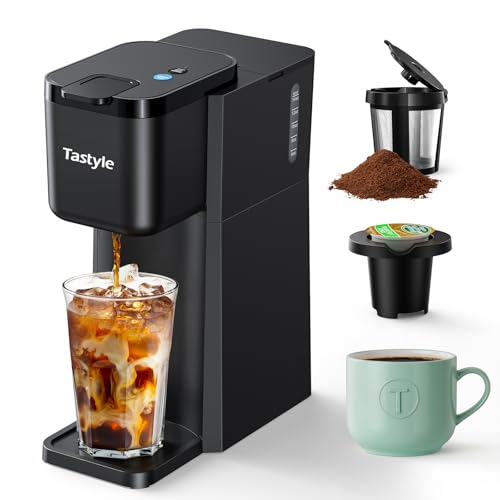
Tastyle Mini Single Serve Hot and Iced Coffee Maker (K310IC)
Badge: Most Versatile
Strengths
- Brews from grounds as well as K-Cup pods — the grounds path removes pod waste
- Hot and iced brewing in one compact machine
- Wide 6 to 14 oz brew-size range, so you brew the amount you will drink
Trade-offs
- The eco benefit depends on you choosing grounds; the pod path is still there
- Mini format means one cup at a time, with water added per brew
- Iced mode still starts from a hot brew over ice, per its listing style
Mini spec box
- Format: single serve, for K-Cup pods and ground coffee
- Brew sizes: 6 to 14 oz
- Modes: hot and iced coffee
- Power: 120V
- Extras: recipe book included
- Settings named in listing: home, travel, RV, office, dorm
- Model: K310IC, 2.0 version, Classic Black
The Tastyle earns its link the same way the Hamilton Beach does: by giving you a real choice at the moment of brewing. Its verified listing covers both K-Cup pods and ground coffee, and that second path is the eco story. Brew with grounds on an ordinary weekday and the pod drawer becomes the exception — for a guest who brought their own pods, say — rather than the rule. Add hot and iced modes and a 6 to 14 oz range, and this little machine covers more of a coffee drinker’s actual year than most single-serve brewers: small strong cups on winter mornings, tall iced glasses in summer, brewed in the quantity that will actually be finished.
That brew-what-you-drink range deserves emphasis in an eco guide, because portion waste is the invisible waste. A machine that only makes one fixed large cup trains you to pour the last third away; a machine that lets you dial down to 6 oz when that is what you want saves coffee, water, and energy on every small cup. The listing’s settings — home, travel, RV, office, dorm — also hint at a genuine second eco angle: a compact machine that travels with you replaces disposable café cups in the places where they are hardest to avoid.
The honest limitation is discipline. Unlike the Elite Gourmet, which is grounds-only by design, the Tastyle keeps the pod path open, and on a rushed morning the pod is always the easier reach. Its eco performance is therefore a habit, not a guarantee — best for a buyer who knows they will default to grounds and wants iced coffee and size flexibility from the same small machine. The included recipe book, per the listing, at least nudges you toward using the machine’s full range rather than treating it as a one-button pod dispenser.
Best for: grounds-first drinkers who also want iced coffee and flexible cup sizes / Not suited for: anyone who knows the pod drawer will win every rushed morning
Keurig K-Express (Evergreen)
Badge: Best Reservoir Convenience (prose-only)
Strengths
- 42 oz removable reservoir — several cups between refills
- Three brew sizes and a Strong Brew button for control over the cup
- Travel mug friendly, which can replace a disposable takeaway cup
Trade-offs
- Pod-only in its verified listing — a spent pod for every cup
- No grounds or reusable-filter brewing path stated in the listing
- Reservoir convenience encourages a pod routine, which is the waste problem
Mini spec box
- Format: single serve K-Cup pod coffee maker
- Brew sizes: 3 brew sizes
- Reservoir: 42 oz, removable
- Extras: Strong Brew button, travel mug friendly, works with all K-Cup pods
- Colour in listing: Evergreen
The K-Express in Evergreen is prose-only for the same reason as the K-Mini Mate: the verified listing is a pod-only specification. Three brew sizes, a Strong Brew button, a generous 42 oz removable reservoir, compatibility with all K-Cup pods — it is a well-judged convenience machine, and none of that changes the arithmetic that every cup leaves a pod behind. In a general convenience guide this machine would be linked without hesitation. In an eco friendly guide, linking it as a recommendation would contradict the keyword, so it is reviewed here in full, without a link or image, and with the reason stated openly.
Its genuine environmental credits are second-order ones. A reservoir machine that brews on demand still beats a pot sitting on a warmer, and the travel-mug-friendly clearance means the morning cup can go straight into a reusable mug rather than a café’s disposable one — a real saving if the alternative was a takeaway stop. The Strong Brew button can also stretch flavour from a smaller brew size, which trims a little coffee waste at the margins. These are mitigations, not a case.
For a reader who already owns a K-Express, the advice mirrors the K-Mini note: use it for a long life, and investigate manufacturer-supported reusable pod options through official channels rather than assuming compatibility. For a reader buying new on eco grounds, the reservoir convenience is available in this same guide in a grounds-capable form — the Hamilton Beach below carries a 45 oz removable reservoir and brews grounds as well as pods — so there is no need to trade the waste away to get the convenience.
Best for: existing owners weighing whether to replace it / Not suited for: a new eco-motivated purchase
Keurig K-Express (Mint)
Badge: Best Style Pick (prose-only)
Strengths
- Same practical K-Express layout: 42 oz reservoir, three brew sizes
- Strong Brew button and travel mug friendly clearance
- Mint finish suits kitchens where the machine stays on display
Trade-offs
- Pod-only in its verified listing, exactly like the Evergreen version
- A colour finish does not change the machine’s waste profile at all
- No grounds brewing path stated in the listing
Mini spec box
- Format: single serve K-Cup pod coffee maker
- Brew sizes: 3 brew sizes
- Reservoir: 42 oz, removable
- Extras: Strong Brew button, travel mug friendly, works with all K-Cup pods
- Colour in listing: Mint
Everything said about the Evergreen K-Express applies to the Mint one, because underneath the finish they are the same verified machine: same 42 oz removable reservoir, same three brew sizes, same Strong Brew button, same all-K-Cup compatibility — and the same pod-only limitation that makes it a prose-only pick in this guide. We list it separately because the pool verified it separately, and because a reader comparing finishes deserves to hear plainly that the colour is the only decision here. There is no eco version of the K-Express hiding in a different paint.
There is one small, real point in favour of choosing a finish you like, and it is worth stating in an eco guide: people keep machines they like looking at. A brewer bought in a colour that suits the kitchen tends to stay on the counter and in service for years, while an appliance that irritates you gets replaced sooner — and replacement is the biggest environmental cost in any appliance’s life. So if a household has weighed the pod question and chosen this machine anyway, choosing the finish that will be lived with longest is, oddly, the greener choice between the two.
That said, the ranking logic of this guide does not bend: pod-only means prose-only, whatever the finish. Readers drawn to this machine’s size and reservoir should look first at the Hamilton Beach FlexBrew, which keeps the reservoir and adds the grounds path that this keyword is about, or at the Elite Gourmet if the smallest waste footprint matters most.
Best for: buyers set on a K-Express who want the finish they will keep longest / Not suited for: anyone expecting the colour choice to change the eco assessment

Hamilton Beach FlexBrew Advanced 4-in-1 Single Serve Coffee Maker
Badge: Best for Mixed Households
Strengths
- Brews pod packs or grounds — a grounds default with a pod exception
- Removable 45 oz reservoir, the largest linked reservoir in this guide
- Hot and iced brewing covers both household habits in one machine
Trade-offs
- Like the Tastyle, its eco record depends on which input you reach for
- Bigger reservoir footprint than the mini machines in this list
- 4-in-1 flexibility means more modes to learn than a one-button brewer
Mini spec box
- Format: 4-in-1 single serve coffee maker
- Inputs: pod packs and grounds
- Modes: hot and iced coffee
- Reservoir: 45 oz, removable
- Brewing: fast brewing, per listing
- Colour in listing: Black
The FlexBrew Advanced is the linked pick for the household that cannot go grounds-only because it does not agree with itself. One partner drinks pods, the other buys beans; a teenager wants iced coffee, a parent wants a hot mug. In most homes that disagreement ends with two machines or with the pod machine winning by default. This Hamilton Beach settles it in one body: its verified listing covers pod packs and grounds, hot and iced, with a removable 45 oz reservoir feeding the whole routine. The eco strategy it enables is realistic rather than pure — grounds as the household default, pods as the declared exception — and realistic strategies are the ones still in force a year later.
The reservoir deserves a word in an eco context, because it cuts both ways and here it lands positive. A 45 oz tank means fewer trips and less water spilled and re-run at the sink across a morning of staggered cups, and removable means it can be emptied and dried rather than left to go stale — stale reservoir water is a hidden source of poured-away water and of descaling cycles. Brew-on-demand from a tank still beats a warming plate for energy, which keeps the machine on the right side of this guide’s second checklist item.
The honest limitation is the mirror of the Tastyle’s: the pod path is present and easy, so the machine’s footprint is a household negotiation, not a specification. It is also the largest linked machine here, so the solo drinker in a tiny kitchen pays counter space for flexibility they may never use — the Elite Gourmet serves that reader better. But for a mixed household that would otherwise run a pod machine full-time, this is the single most effective waste reduction on the list, because it meets the household where it actually is. Households also weighing batch capacity for guests should compare our guide to Best Economy 12 Cup Coffee Makers before deciding that single-serve is the right format at all.
Best for: mixed households splitting pods and grounds, hot and iced / Not suited for: solo drinkers who want the smallest, simplest grounds-only machine
Comparison Table
| Pick | Brewing inputs (verified) | Reservoir | Eco position | Link |
|---|---|---|---|---|
| Elite Gourmet EHC111A | Grounds and loose-leaf tea, reusable filter | None in listing — fill per cup | Lowest waste per cup | Check on Amazon |
| Keurig K-Mini Mate | K-Cup pods only | None in listing — fill per cup | Prose-only: pod waste per cup | Prose-only — no link |
| Tastyle Mini K310IC | K-Cup pods or grounds | None in listing — fill per cup | Low waste on the grounds path | Check on Amazon |
| Keurig K-Express (Evergreen) | K-Cup pods only | 42 oz, removable | Prose-only: pod waste per cup | Prose-only — no link |
| Keurig K-Express (Mint) | K-Cup pods only | 42 oz, removable | Prose-only: pod waste per cup | Prose-only — no link |
| Hamilton Beach FlexBrew Advanced 4-in-1 | Pod packs or grounds | 45 oz, removable | Low waste on the grounds path | Check on Amazon |
How to Choose an Eco Friendly Coffee Maker
Start with the consumable, not the machine. Write down what will actually pass through the brewer every day for the next three years, because that stream — not the appliance — is most of its footprint. If the stream is loose grounds in a reusable filter, almost any efficient single-serve machine qualifies as a reasonable eco choice. If the stream is a sealed pod per cup, no machine design can rescue the maths. This is why our linked picks are the three machines whose verified listings include a grounds path, and why the first question to ask of any brewer you are considering elsewhere is simply: what do I throw away after each cup?
Second, match brew size to real drinking. Waste hides in the gap between what a machine makes and what a person finishes. A flexible size range — the Tastyle’s 6 to 14 oz, for instance — or a modest fixed cup like the Elite Gourmet’s 14 oz keeps that gap small. Households that regularly host should think about whether a single-serve format will lead to wasteful workarounds, and readers in that position may find the batch formats in our guide to Best Electric Coffee Makers a better environmental fit than a single-serve machine pressed into party service.
Third, look at idle behaviour. Auto shut-off, as on the Elite Gourmet, and brew-on-demand designs generally, beat any machine that holds temperature for hours. A warming plate under a pot is the worst offender in home coffee; none of these six machines uses one, which is a quiet point in favour of the whole single-serve class. Fourth, consider cleanability and lifespan: dishwasher-safe parts and simple, repairable-feeling construction keep a machine in service, and years in service is the denominator that makes any appliance’s manufacturing footprint small. Fifth, be sceptical of eco vocabulary that is not tied to a mechanism. “Eco friendly” printed on a box means nothing; a reusable filter in the listing means something. Judge the mechanism, never the adjective.
Finally, count the machine itself honestly. A compact brewer uses less material, less packaging, and less shipping volume than a large one, and for a one- or two-person household it is also the right-sized tool. Buying a big machine “just in case” is its own kind of waste. The greenest purchase is usually the smallest machine that genuinely covers your routine — which is why this guide’s Best Overall is also one of its smallest.
How to Brew Lower-Waste Coffee, Day to Day
Owning a grounds-capable machine is step one; the routine is step two. Here is the daily practice that makes the linked picks perform as advertised. First, dose by the cup you are making: use roughly one to two tablespoons of ground coffee per six ounces of water as a starting point, then adjust to taste over a few days rather than overfilling the filter “to be safe” — over-dosing is grounds wasted on coffee you do not enjoy more. Second, fill the machine or reservoir with the water you need for the morning, not a full tank out of habit, so water is not sitting, staling, and being dumped. Third, empty the reusable filter while it is still warm, straight into a compost caddy or the garden; grounds left sitting in the filter go mouldy and make the next clean harder, which is how reusable routines die. Fourth, rinse the filter daily and run it through the dishwasher regularly if the listing allows, as the Elite Gourmet’s does. Fifth, descale on the manufacturer’s schedule for your water hardness — a scaled heating element works harder and heats slower, wasting energy on every cup, and a machine killed early by scale is the least eco outcome of all.
Troubleshooting, in the pattern of problem and response. Problem: coffee from the reusable filter tastes weak or watery → the grind is likely too coarse for a small filter basket, or the dose too small; grind a little finer, dose a little more, and change one variable at a time. Problem: grounds overflow or gritty sediment in the cup → the grind is too fine or the filter is overfilled; back the dose down and leave headroom at the top of the filter. Problem: the machine has slowed down and the cup tastes flat → scale is the usual suspect in a single-serve brewer; run a descaling cycle with the maker’s recommended solution, then rinse through a full cycle of plain water before brewing again.
What Actually Happens to a Coffee Pod?
It is worth following one pod through its life, because the answer explains this guide’s whole structure. A pod is a small mixed-material object: plastic cup, aluminium or foil lid, paper filter, coffee grounds, all bonded together. That bonding is the problem. Recycling systems are built for single materials in reasonable sizes; a pod is several materials in an unreasonably small size, and it arrives contaminated with wet coffee. Some manufacturers run take-back schemes, and a diligent household can collect pods and use one — but the pods that go in the general bin or, worse, hopefully into the recycling bin where they act as a contaminant, go to landfill or incineration. Multiply by two cups a day and a household is manufacturing a small landfill of its own, one cup at a time. Compare the grounds path: the coffee goes to compost or soil, the reusable filter goes back in the machine, and the only recurring packaging is the bag the coffee arrived in, shared across dozens of cups. No guide that understands this arithmetic can rank a pod-only machine as an eco friendly recommendation, which is why three of our six reviews are prose-only — a standard we also apply when readers ask about pod-heavy formats in our guide to Best Electric Espresso Coffee Makers Home Use, where the same consumables question decides the rankings.
Energy, Water, and the Warming-Plate Problem
The second environmental ledger is the one on your electricity bill. Home coffee energy waste is dominated by one habit: keeping coffee hot. A warming plate holding a pot for two or three hours uses energy continuously to fight cooling, and it cooks the coffee while it does it, which is why the last cup from a pot tastes stewed. Every machine in this guide brews on demand instead — energy in short bursts, exactly when a cup is wanted — and the Elite Gourmet adds auto shut-off so even the burst cannot be left running by accident. Water tells a similar story: single-serve machines heat cup-sized quantities, while a pot brewer encourages full-tank habits. None of this makes a single-serve machine virtuous by itself — the pod question still dominates — but it does mean that a grounds-capable single-serve brewer, used with a reusable filter, is a genuinely strong combination: low consumable waste and low standby waste in the same small appliance. That combination, not any label, is what “eco friendly” means in this guide’s title.
Common Buying Mistakes
The first mistake is believing the adjective. Machines are marketed as eco friendly for having a small footprint, a recycled-plastic panel, or an energy mode, while their daily consumable goes unmentioned; judge the waste stream, not the packaging copy. The second mistake is buying a pod machine with the intention of “using grounds in it somehow” when the verified listing offers no grounds path — intentions do not brew coffee, and the pod drawer wins. The third is ignoring portion size, then pouring a third of every large cup away. The fourth is neglecting descaling until the machine dies early; a short-lived appliance is never the eco choice, whatever it brewed. The fifth is replacing a working machine purely for a greener image: the footprint of manufacturing a new brewer is real, and running a serviceable machine for more years is often the better environmental decision — upgrade when the old machine fails or when its consumable waste is large and daily, as with a pod-only routine you are ready to leave.
Final Recommendation
Buy the Elite Gourmet Single-Serve Coffee Maker if you want the clearest conscience in this guide: a reusable filter, grounds and tea, auto shut-off, and dishwasher-safe parts make the low-waste routine the default rather than a project. Choose the Hamilton Beach FlexBrew Advanced 4-in-1 if your household is split between pods and grounds — its grounds path and 45 oz reservoir make it the realistic waste-reduction machine for real families. Pick the Tastyle Mini if you want grounds brewing plus iced coffee and flexible cup sizes in the smallest linked package. And if you came here planning to buy one of the prose-only Keurigs, take the hint the rankings are giving: the convenience is real, but it is not eco friendly, and the three linked machines prove you do not have to give the convenience up entirely to leave the pods behind.
Frequently Asked Questions
Are pod coffee makers ever eco friendly?
Not in any strong sense, on the evidence of how pods are actually disposed of. A pod-only machine creates a mixed-material waste item for every cup, and most of those items are not recycled in practice even where schemes exist. That is why this guide reviews its three pod-only picks prose-only, without links: they can be good machines, but recommending them under an eco friendly title would be misleading. A pod machine you already own is a different question — using it for a long life and checking manufacturer-supported reusable options is better than replacing it impulsively.
What makes a coffee maker eco friendly?
Three things, in order of importance: a consumable stream that does not generate per-cup waste, ideally loose grounds in a reusable filter; brew-on-demand operation with no warming plate and, ideally, auto shut-off; and a size and build that will stay in service for years. The Elite Gourmet in this guide is the clearest example because its verified listing includes the reusable filter, the auto shut-off, and dishwasher-safe parts that keep the routine sustainable.
Can I compost coffee grounds from these machines?
Yes — grounds from a reusable filter or grounds basket are the same coffee grounds produced by any brewer, and they compost readily or can be dug into garden soil in modest quantities. This is one of the quiet advantages of the grounds-capable picks: their daily “waste” is a soil input, while a pod’s daily waste is a bonded plastic-and-foil object that has to be taken apart before any part of it can be recycled.
Do single-serve coffee makers use less energy than pot brewers?
Generally yes for typical home use, because they heat a cup-sized amount of water on demand instead of brewing a full pot and then running a warming plate to keep it hot. The saving depends on habits — a household that drinks a whole pot quickly wastes little either way — but for one- and two-cup households the on-demand pattern is both the energy winner and the coffee-quality winner, since nothing sits stewing.
Why are some picks in this guide shown without links or photos?
Because they missed the keyword’s core attribute. The three Keurig picks are pod-only in their verified listings, with no grounds or reusable-filter path, so under this site’s rules they receive a full prose review but no Amazon link and no image, and the reason is recorded in the article’s sources file. We would rather show you the whole pool honestly than quietly drop the most popular machines or, worse, link them under a title they do not fit.
Is a reusable filter hard to live with?
No, and the machines here are designed to make it easy: empty the warm grounds into a caddy, rinse, and — where the listing says dishwasher-safe, as the Elite Gourmet’s does — let the dishwasher do the deeper clean. The routine adds seconds per cup. The failure mode to avoid is letting grounds sit in the filter all day, which makes cleaning unpleasant and is the main reason reusable routines get abandoned.
Should I replace my working pod machine with a grounds machine?
It depends on volume. If you brew one occasional pod, the manufacturing footprint of a new machine may outweigh years of your pod waste; run the old machine until it fails. If you brew pods daily, the waste stream is large and continuous, and switching to a grounds-capable machine like the linked picks here pays its environmental cost back steadily — and the old machine can go to a new home rather than a bin, extending its life elsewhere.


