Disclosure: topratedkitchenware.com is reader-supported. When you buy through links on our site, we may earn an affiliate commission from Amazon and other retailers, at no extra cost to you.
Where to buy
For the best electric cooktops under 1000 dollars, the portable induction class is where a generous ceiling buys the most cooktop, and this shortlist spends that headroom on control quality, construction, and capability rather than decoration. All six picks are electric induction burners confirmed against verified listing data. This guide prints no individual prices, in line with site policy; the under $1000 figure is the keyword’s own tier framing, and the listings carry the live figures to check against it.
- AAOBOSI Portable Induction Cooktop — Best Overall. Check on Amazon
- OneSetNuf 1800W Portable Induction Cooker — Best Heavy-Duty Pick. Check the listing for current availability.
- ChangBERT Induction Cooktop (Commercial Grade) — Best Professional Standard. Check the listing for current availability.
- Nuwave Double Pro Induction Cooktop (Double Burner) — Best Double Burner. Check the listing for current availability.
- Duxtop 9100MC Portable Induction Cooktop — Best Simple and Proven. Check the listing for current availability.
- Duxtop 9610LS Portable Induction Cooktop — Best Touch Controls. Check the listing for current availability.
Read the full guide ↓
Shopping for the best electric cooktops under 1000 dollars is really an exercise in spending headroom wisely. In the portable induction class, a generous ceiling does not buy more raw wattage, since every serious contender already runs at the 1800W class a household outlet supports. What it buys is everything around the power: finer control steps, longer timers, stainless commercial-grade construction, third-party certification, a second burner, and interfaces that make precision feel effortless. The six verified picks in this guide map that value landscape from a 20-level AAOBOSI to a certified ChangBERT and the double-burner Nuwave Double Pro.
Two honest notes frame the whole guide. First, this site does not print static product prices, because they change too often to state truthfully in an article; the under $1000 band in the keyword is used only as the tier framing you asked for, and each listing carries its current figure for you to verify against that ceiling. Second, all six picks are portable countertop induction burners, because that is what the verified pool for this group contains at this tier. Shoppers expecting built-in decks at this budget should treat these portables as the high-value alternative the market actually offers: full power, no installation cost, and capability that installed units at similar total outlay rarely match once an electrician’s visit is added.
The reviews below therefore judge value the way a careful buyer should: what each additional layer of specification does for your cooking, and where the sensible stopping point sits for different households. Readers working with half this ceiling will find the companion tier guide to the Best Electric Cooktops Under $500 a useful contrast.
Key Takeaways
- At the under $1000 tier, spend on control, construction, and capability; wattage is already maxed at the 1800W household class across this pool.
- The value ladder here runs from proven simplicity (Duxtop singles) through fine control (AAOBOSI, 20 levels) to certified commercial construction (ChangBERT).
- The Nuwave Double Pro is the capability ceiling: two burners and adaptive 900W, 1500W, or 1800W settings for different circuits.
- Long timers are a real tier divider: 4-hour and 10-hour timers separate casual burners from slow-cooking stations.
- No individual prices are printed; verify each model’s live listing against your under $1000 ceiling before buying.
In this guide
Quick Picks
The value map in one table. Badges show what each model does with the tier’s headroom, and the detailed reviews explain where the sensible stopping point sits for different cooks.
| Pick | Badge | Why it earns its place | Listing |
|---|---|---|---|
| AAOBOSI Portable Induction Cooktop | Best Overall | 20 control levels and a 4-hour timer deliver the tier’s best balance of finesse and everyday practicality. | Check on Amazon |
| OneSetNuf 1800W Portable Induction Cooker | Best Heavy-Duty Pick | Stainless commercial-grade build, dual IGBT control, 18 settings, and a 10-hour timer for heavy daily use. | Check on Amazon |
| ChangBERT Induction Cooktop (Commercial Grade) | Best Professional Standard | NSF certification and professional stainless construction make it the build-quality leader of the pool. | Check on Amazon |
| Nuwave Double Pro Induction Cooktop (Double Burner) | Best Double Burner | The only double burner, with a 50 to 575-degree range and wattage that adapts to your circuit. | Check on Amazon |
| Duxtop 9100MC Portable Induction Cooktop | Best Simple and Proven | The proven, simple end of the tier: full power and a flat glass top with nothing superfluous to pay for. | Check on Amazon |
| Duxtop 9610LS Portable Induction Cooktop | Best Touch Controls | An LCD touch panel adds observable, repeatable control to the proven Duxtop platform. | Check on Amazon |
How These Picks Were Chosen
This is a research-led guide built on a verified pool. Each model’s identity and headline specifications were confirmed against verified listing data on 2026-11-20, and spec boxes quote only that data. Consistent with site policy, no static prices are printed anywhere in the article. The keyword’s own under $1000 band is the one money figure used, as a tier label; whether a given listing sits inside that band on the day you shop is for the live listing to confirm, and checking it takes seconds.
Selection within the tier weighted marginal value: what does the next step up actually add? The pool was ordered by control resolution, timer length, construction evidence, and format capability, and the six picks were chosen to give a genuine ladder rather than six versions of the same burner. A model earns its place here by adding something the one below it lacks: levels, hours, steel, certification, or a second zone. Features that add cost without changing cooking, such as decorative finishes beyond a simple color choice, were weighted last. Budget-tier readers may also want the cookware-pairing view in the Best Electric Cooktops Using Ceramic Cookware guide, which evaluates part of this same family from the pan side rather than the price side.
A note on pool composition, for transparency: the verified pool at this tier is portable because that is where this budget buys verified quality. Rather than pad the guide with unverified built-in models, it maps the portable ladder completely and says so. A buyer set on a built-in should treat this guide as the value benchmark their installed quote has to beat once installation is included.
The 6 Best Options for Best electric cooktops under 1000

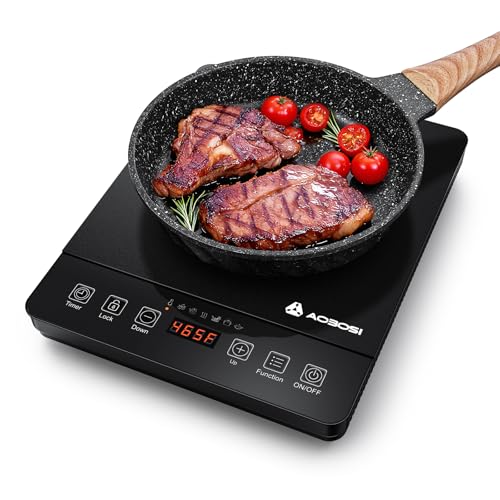
AAOBOSI Portable Induction Cooktop
Badge: Best Overall
Strengths
- 20 temperature and power levels give finer adjustment than basic 10-step burners
- 4-hour timer supports long, unattended simmers and slow jobs
- Explicitly compact and portable positioning suits apartments and RV use
Trade-offs
- Preset count is modest at 4 modes
- Single burner, so multi-pan meals need planning
- Induction cookware compatibility rules apply in full
Key specs (from the verified listing)
- Type: Portable induction cooktop (single burner)
- Power: 1800W
- Control range: 20 temperature and power levels
- Programs: 4 preset modes
- Timer: 4-hour timer
- Positioning: Compact and portable; apartments, RVs, and outdoor cooking
The AAOBOSI portable induction cooktop spreads its 1800W across 20 temperature and power levels, which puts it a step above the basic 10-step burners for control feel: the jump between neighboring settings is smaller, so finding the exact point where a sauce holds a lazy simmer is easier. It adds 4 preset modes and a 4-hour timer, and the timer length is the detail that changes its role. A four-hour window covers stocks, braises started on the counter, and keep-warm duty through a long meal, none of which a short kitchen timer handles gracefully. AAOBOSI positions the unit explicitly for apartments, RVs, and outdoor cooking, and the compact portable format supports that claim: it is a burner designed to be carried to the cooking, not installed and forgotten.
On the value ladder, the AAOBOSI Portable Induction Cooktop is the rung where control stops feeling basic. The difference shows up in held temperatures and repeatable results rather than in any single dramatic dish, which is exactly where money in this tier should go. If your cooking is mostly weeknight and varied, this is the level of specification that keeps paying you back quietly, meal after meal, without demanding you use features you never wanted.
Its honest limitation is that it remains a single portable burner with a modest preset library; cooks who want a built-in look or several zones will outgrow it, however well it performs its portable role.
Best for: cooks who want finer control and a long timer without stepping into commercial-grade hardware / Not suited for: cooks who need two zones or professional certification

OneSetNuf 1800W Portable Induction Cooker
Badge: Best Heavy-Duty Pick
Strengths
- Push-button controls stay decisive with wet or busy hands, unlike touch panels
- 10-hour timer is the longest in this pool, built for stocks and slow cooking
- Stainless-steel commercial-grade housing shrugs off hard daily use
Trade-offs
- Push buttons look and feel more utilitarian than sleek touch glass
- Commercial-grade build is heavier-duty than casual users need
- Single burner despite the heavy-duty construction
Key specs (from the verified listing)
- Type: Portable induction cooker (single burner), commercial-grade
- Power: 1800W, dual IGBT power control
- Coil: 8-inch
- Controls: Push-button, 18 temperature settings
- Timer: 10-hour timer
- Housing: Stainless steel
The OneSetNuf induction cooker is the workhorse entry in this pool: a stainless-steel, commercial-grade portable unit with an 8-inch coil, dual IGBT power control, 18 temperature settings, push-button controls, and a 10-hour timer. Every element of that verified specification points the same direction, toward durability and long jobs. Push buttons are a deliberate choice here. They click positively, they work with damp fingers, and they do not care about a film of steam, which is why commercial-style units keep them. The 10-hour timer is the longest in this group by a wide margin and turns the burner into a genuine slow-cooking station for stocks and braises. Dual IGBT power control is the internal hardware behind steadier power delivery, particularly relevant at the low settings where cheaper induction units pulse noticeably.
The OneSetNuf 1800W Portable Induction Cooker makes its case on construction and stamina. In this tier, the honest question is not what a burner does in week one but what it is like in year three, and heavier housings, sealed surfaces, and serious timers are the specifications that predict that answer. Buy this rung if your kitchen works hard daily, if the unit will live on the counter, or if it will double for batch cooking and preserving days.
Its limitation is presentation and focus: it looks like equipment rather than decor, and its strengths are wasted on a household that only ever boils pasta water for twelve minutes at a time.
Best for: heavy daily users who value stainless construction, push buttons, and the longest timer class / Not suited for: buyers who want the sleekest possible countertop look

ChangBERT Induction Cooktop (Commercial Grade)
Badge: Best Professional Standard
Strengths
- NSF certification signals a build aimed at professional sanitation and durability standards
- Large 8-inch coil and 1800W output handle big pans with authority
- 10-hour timer matches the longest jobs in this pool
Trade-offs
- Professional positioning brings a utilitarian look and footprint
- Single burner, however heavy-duty
- Feature set is overbuilt for occasional use
Key specs (from the verified listing)
- Type: Commercial-grade portable induction cooker (single burner)
- Power: 1800W
- Heating coil: Large 8-inch
- Housing: Premium stainless steel
- Certification: NSF certified (per verified title)
- Timer: 10-hour timer
The ChangBERT induction cooktop is the explicitly professional entry here: a commercial-grade portable cooker with a large 8-inch heating coil, a premium stainless-steel body, NSF certification noted in its verified title, 1800W of power, and a 10-hour timer. NSF certification is worth pausing on, because it is not a marketing adjective; it indicates the unit was built to meet sanitation and construction standards used in professional food service, which translates at home into sealed surfaces, durable materials, and a design that expects to be cleaned hard and often. The big coil and full power output suit large pans, and the long timer supports the stockpot duty that professional-style burners are bought for. If your cooking leans toward batch cooking, canning support, or feeding a crowd from one strong burner, this is the pool’s purpose-built answer.
Think of the ChangBERT Induction Cooktop (Commercial Grade) as the sensible end of the tier’s headroom. Not every household needs certification or a second zone, and the money this model does not ask for is money available for the pans that induction cooking rewards. It still delivers full power and a clean, flat surface, which is most of the experience. Value, judged properly, is capability per commitment, and by that measure this pick is difficult to criticize.
The honest limitation is that professional virtues come with professional trade-offs: a more industrial appearance, and a feature set whose value only shows up under heavy, frequent use.
Best for: buyers who weight certification and professional build most heavily within the tier / Not suited for: occasional cooks for whom commercial-grade hardware is unnecessary commitment

Nuwave Double Pro Induction Cooktop (Double Burner)
Badge: Best Double Burner
Strengths
- Two burners in one portable unit, the only double in this pool
- Dynamic Watt Technology lets it adapt to different circuit capacities (900W, 1500W, or 1800W)
- Very wide 50°F to 575°F range covers warming through searing
Trade-offs
- Two zones share one unit’s total power envelope, so both burners at full tilt is not the same as two separate 1800W burners
- Larger counter footprint than any single-burner unit here
- Touch panel controls both zones, which takes a little practice
Key specs (from the verified listing)
- Type: Portable double-burner induction cooktop
- Temperature range: 50°F to 575°F
- Power: 900W / 1500W / 1800W with Dynamic Watt Technology
- Heating coil: 8-inch
- Surface: Shatter-proof ceramic glass, seamless IMD touch panel
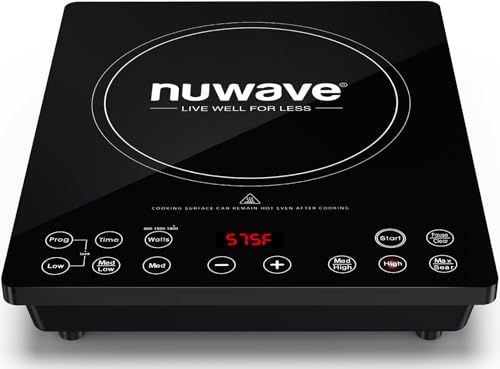
The Nuwave Double Pro solves the single-burner ceiling that limits every other pick in this guide: it puts two induction zones in one portable countertop unit. Its verified specification lists a 50°F to 575°F range, an 8-inch heating coil, shatter-proof ceramic glass, a seamless IMD touch panel, and Dynamic Watt Technology with 900W, 1500W, and 1800W settings. The wattage flexibility is more practical than it first sounds, because it lets the unit adapt to the circuit it is plugged into, a real consideration in older homes, dorms, and RVs where a full-draw appliance can trip a breaker. Two zones change meal planning fundamentally: a sauce can hold on one side while pasta water works on the other, and the wide temperature range reaches from gentle warming to a serious sear. For cooks who have been stacking portable singles side by side, this is the tidy version of that idea.
On the value ladder, the Nuwave Double Pro Induction Cooktop (Double Burner) is the rung where control stops feeling basic. The difference shows up in held temperatures and repeatable results rather than in any single dramatic dish, which is exactly where money in this tier should go. If your cooking is mostly weeknight and varied, this is the level of specification that keeps paying you back quietly, meal after meal, without demanding you use features you never wanted.
Its limitation is physics: two burners share the unit’s power envelope and one counter footprint, so it does not replace a full-size multi-burner cooktop for a big family dinner, and it needs more counter room than a single.
Best for: households that cook two pans at once and homes whose circuits suit adaptive wattage / Not suited for: small counters and buyers who only ever cook one pan
Duxtop 9100MC Portable Induction Cooktop
Badge: Best Simple and Proven
Strengths
- Full 1800W induction power in a single portable burner, so it behaves like a serious cooking zone rather than a warmer
- Flat glass surface wipes clean in seconds and leaves no grate or coil to scrub around
- Portable format plugs in where you need it and stores upright in a cabinet between uses
Trade-offs
- Single burner only, so a second pan means a second unit or cooking in sequence
- Induction only heats magnetic cookware; aluminum or pure ceramic pans without a magnetic base will not register
- Portable burners sit on top of the counter, so very tall stockpots sit higher than on a built-in cooktop
Key specs (from the verified listing)
- Type: Portable induction countertop burner (single burner)
- Power: 1800W
- Finish: Black
- Model: 9100MC / BT-M20B
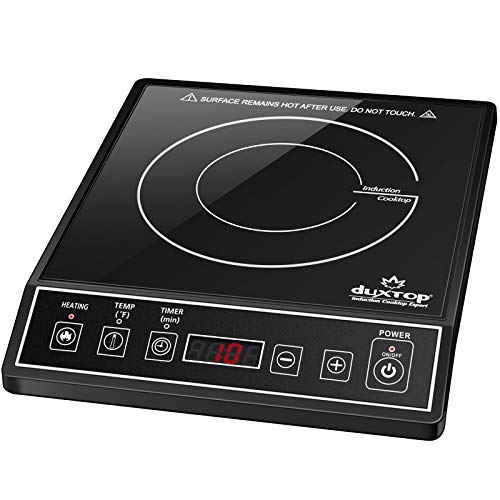
The Duxtop 9100MC is the straightforward reference point in this pool: a single 1800W induction burner in a black housing, sold under the BT-M20B model code. There is no exotic feature list to decode, and that is exactly its appeal. Induction puts the energy into the pan itself, so the surface responds quickly when you raise the setting and eases off just as quickly when you lower it, which makes it forgiving for sauces and reliable for a hard sear. Because the glass around the pan stays comparatively cool, splashes do not bake on the way they do on a radiant element, and cleanup is a wipe rather than a soak. As a countertop unit it asks for nothing more than a standard outlet and a flat stretch of counter, and when the meal is done it can go back in a cabinet, which is more than any built-in cooktop can offer.
The Duxtop 9100MC Portable Induction Cooktop makes its case on construction and stamina. In this tier, the honest question is not what a burner does in week one but what it is like in year three, and heavier housings, sealed surfaces, and serious timers are the specifications that predict that answer. Buy this rung if your kitchen works hard daily, if the unit will live on the counter, or if it will double for batch cooking and preserving days.
The honest limitation is capacity: one burner is one burner. Households that routinely run three pans at once will feel the ceiling immediately, and this unit works best as a primary burner for one- and two-pan cooking or as a powerful extra zone beside an existing range.
Best for: buyers who want proven full-power induction and the simplest possible ownership at this tier / Not suited for: cooks who want displays, presets, or very fine temperature steps
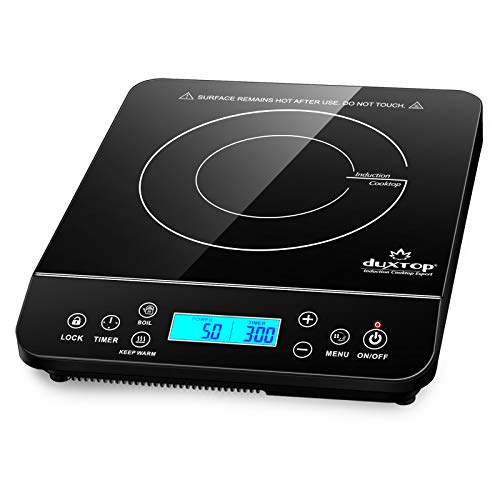
Duxtop 9610LS Portable Induction Cooktop
Badge: Best Touch Controls
Strengths
- LCD sensor-touch panel gives a clear readout and precise, repeatable settings
- 1800W induction output matches the strongest single burners in this pool
- Smooth touch surface has no knobs to trap grease and wipes down fast
Trade-offs
- Touch controls can be less convenient with wet or floury hands than a physical dial
- Single-burner format limits simultaneous pans
- Like every induction unit here, it needs magnetic cookware to work at all
Key specs (from the verified listing)
- Type: Portable induction countertop burner (single burner)
- Power: 1800W
- Controls: LCD sensor touch
- Finish: Black
- Model: 9610LS / BT-200DZ
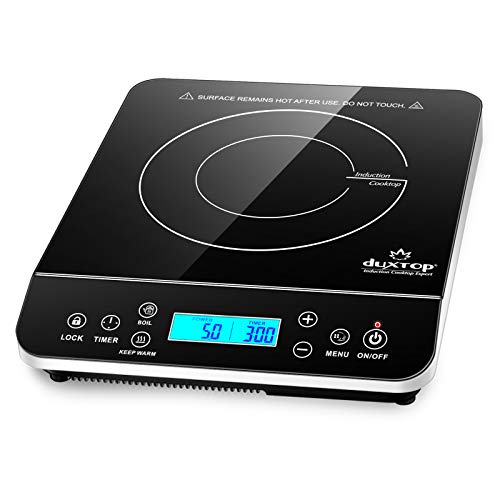
The Duxtop 9610LS (BT-200DZ) takes the same 1800W portable induction formula as its sibling and upgrades the interface: an LCD sensor-touch panel replaces simpler controls, giving you a legible display and tap-or-slide adjustments that are easy to repeat from one meal to the next. Repeatability is the quiet virtue of induction done well. Once you learn which setting holds a gentle simmer for your pan, you can return to it exactly, and the LCD makes that number visible instead of guessed. The flat panel also seals the front of the unit, so a boil-over runs across glass instead of into knob stems. For cooks who value a tidy counter and a modern control feel, this is the more polished of the two Duxtop singles in this guide.
Think of the Duxtop 9610LS Portable Induction Cooktop as the sensible end of the tier’s headroom. Not every household needs certification or a second zone, and the money this model does not ask for is money available for the pans that induction cooking rewards. It still delivers full power and a clean, flat surface, which is most of the experience. Value, judged properly, is capability per commitment, and by that measure this pick is difficult to criticize.
Its limitation is the touch interface itself in messy, real cooking: wet fingertips and heavy steam can make sensor panels less decisive than a knob, and the single-burner layout still caps how much you can run at once.
Best for: cooks who want visible, repeatable settings from an LCD panel on a proven platform / Not suited for: cooks who prefer physical buttons with wet hands
Comparison Table
Compare what the tier buys you, in verified terms: control levels, timer length, construction, and format. Prices are deliberately absent; check the live listing of any finalist against your ceiling.
| Model | Badge | Format notes | Listing |
|---|---|---|---|
| AAOBOSI Portable Induction Cooktop | Best Overall | Portable induction, single burner, 1800W, 20 levels, 4-hour timer | Check on Amazon |
| OneSetNuf 1800W Portable Induction Cooker | Best Heavy-Duty Pick | Portable induction, single burner, 1800W, stainless, 18 settings, 10-hour timer | Check on Amazon |
| ChangBERT Induction Cooktop (Commercial Grade) | Best Professional Standard | Portable induction, single burner, 1800W, stainless, NSF certified, 10-hour timer | Check on Amazon |
| Nuwave Double Pro Induction Cooktop (Double Burner) | Best Double Burner | Portable induction, DOUBLE burner, 50-575F, 900/1500/1800W adaptive | Check on Amazon |
| Duxtop 9100MC Portable Induction Cooktop | Best Simple and Proven | Portable induction, single burner, 1800W, black, classic format | Check on Amazon |
| Duxtop 9610LS Portable Induction Cooktop | Best Touch Controls | Portable induction, single burner, 1800W, LCD sensor touch, black | Check on Amazon |
How to Choose the Best Electric Cooktops Under 1000
Start by deciding what the ceiling is for. Under $1000 as a total kitchen budget is different from under $1000 for the cooktop alone, and the portable format flatters both readings because it carries no installation cost: no electrician, no cutout, no ventilation work. The entire budget lands on the appliance itself, which is why this tier of portables competes so well against installed alternatives whose sticker is only part of their true cost.
Then climb the value ladder deliberately. The first rung is proven power: a long-running 1800W single with a flat glass top, represented here by the Duxtop models, one simple and one with an LCD panel. The second rung is control: more levels, a display you can read at a glance, and a timer measured in hours, which is where the AAOBOSI sits. The third rung is construction: stainless commercial-grade housings, power-delivery hardware such as dual IGBT control, and certification, represented by the OneSetNuf and the ChangBERT. The fourth rung is capability: a second zone and adaptive wattage, which only the Nuwave Double Pro offers in this pool. Most households should stop at the rung their cooking actually reaches; buying two rungs above your menu buys specifications you will admire rather than use.
Two cross-checks protect the budget. First, cookware: induction requires magnetic pans, so if your current set fails the magnet test, reserve part of the ceiling for at least one excellent skillet and one pot, because a fine burner under a poor pan cooks poorly. Second, the circuit: full-power portables assume a healthy outlet, and older homes may reward the Double Pro’s ability to run at reduced wattage rather than tripping a breaker at full draw.
Finally, verify the tier at the moment of purchase. Prices move in both directions, and this guide’s discipline is to frame the tier, not to freeze a figure. Open the finalist’s listing, confirm it sits within your ceiling, and buy with the confidence that the specification ladder, not a stale number, drove the decision. For the built-in formats this portable pool does not cover, the Best Electric Cooktops With Downdraft Ventilation guide shows the installed end of the market.
How to Set Up and Use a Premium-Tier Portable Cooktop
Setup. Place the unit on a level, heat-safe counter with its vents unobstructed, and plug it directly into a wall outlet. On double-burner and commercial-grade models, check the manufacturer’s circuit guidance before the first full-power session, especially in older homes. Run the magnet test across your pans, and designate the two or three pans that will live with the burner; a premium cooktop earns its tier only when paired with cookware that couples well.
Using the control range. The point of finer levels and temperature modes is repeatability, so build a small personal chart: the setting that boils your usual pot, the setting that holds your simmer, the setting that fries without smoking. Premium-tier burners repay this fifteen-minute investment every day afterward, because you stop cooking by guesswork. Use long timers deliberately for stocks and braises, and let the burner’s low end, not a second appliance, handle holding and warming.
Care. Wipe glass once cool, keep vents brushed clear, and clean stainless housings along the grain with a damp cloth. Avoid abrasive pads on any surface in this tier; the finishes are part of what the budget bought. Store portables without weight on the glass, and inspect cords periodically on high-draw appliances as a matter of routine.
Troubleshooting.
Problem: The breaker trips at full power. → Another appliance is likely sharing the circuit. Move the burner to an outlet on a different circuit, or, on the adaptive-wattage double burner, select a lower wattage setting designed for exactly this situation.
Problem: The fine settings seem to make no difference. → The pan may be the bottleneck: thin or warped bases respond unevenly to any control. Test with your heaviest flat-based pan before judging the burner’s resolution.
Problem: A long timer job stopped early. → Check for a boil-dry shutdown, a blocked vent, or an accidental panel touch; long unattended cooking still deserves a full pot, clear airflow, and a locked panel where the model offers one.
Where the Money Goes: A Tier Anatomy
It helps to name what each layer of this tier actually purchases, because the differences are real but unevenly distributed. Control electronics are the first destination: more levels, temperature modes, and displays cost money to engineer well, and they are the layer a cook feels most often. Construction is the second: stainless housings, heavier coils, and shatter-resistant glass cost more than plastic and standard glass, and they pay out over years rather than meals. Certification is the third, and the easiest to undervalue: an NSF listing represents testing and build discipline that a specification sheet alone cannot prove. Format is the fourth: a second zone with its own coil, panel, and power management is effectively a second appliance sharing one housing.
What the tier does not buy is equally instructive. It does not buy more than 1800W-class power from a standard outlet, because physics and wiring set that ceiling. It does not buy freedom from the magnet test, and it does not buy a pan collection. A buyer who understands the anatomy can allocate the ceiling like an investor: control first for most cooks, construction first for heavy users, format first for two-pan households. The picks in this guide were ordered to make that allocation visible. Readers pairing this tier with a design-led kitchen should also weigh the surface analysis in the Best Electric Flat Cooktops guide.
Portable Versus Built-In at This Budget, Honestly
The obvious objection to this entire guide is that a four-figure ceiling should buy a built-in cooktop, so the comparison deserves a straight answer. A built-in’s true cost is its price plus installation: electrical work, cabinet modification, and sometimes ventilation, and at this tier those additions consume much of the budget before any cooking happens. A portable induction burner at the same total outlay spends everything on the cooking itself, arrives today, and can migrate to a second-zone or RV role later. For renters, remodelers mid-project, and households whose primary range still works, that arithmetic is decisive.
The honest counterweight is permanence and scale. A built-in offers multiple full zones in a fixed, flush surface and becomes part of the home’s value; no portable matches a four-burner dinner for six. This guide’s position is narrower than a verdict: within the verified pool and this tier framing, the six portables are the value answer for the majority of shoppers who use that ceiling, and the built-in path is a renovation decision that deserves its own budget conversation, including the flat-format options in the Best Electric Flat Cooktops guide.
Ownership Costs and Longevity: The Tier’s Second Ledger
The purchase price, whatever the live listing shows within your ceiling, is only the first ledger entry. The second is longevity, and this tier’s construction spread writes it plainly. A proven consumer platform with a glass top and a simple interface has few failure points and a long service history behind it. A stainless commercial-grade unit costs its tier premium in materials that resist the daily insults, heat cycling, hard cleaning, and constant handling, that age appliances. Certification adds a different kind of assurance: a design reviewed against external standards rather than only the maker’s own. None of this guarantees a lifespan figure, and this guide prints none, but as a ranking of probable years per purchase, construction evidence is the best available proxy.
The third ledger entry is adaptability. A portable burner is not stranded when a kitchen changes: it becomes the second zone after a remodel, the RV or dorm unit when a household member moves, the outdoor-cooking burner its makers sometimes name explicitly. A built-in’s value, by contrast, stays in the house it was installed in. For buyers whose next five years include a move, a renovation, or a student leaving home, that portability is a financial feature, not a lifestyle garnish, and it belongs in the tier calculation beside control steps and timers.
The fourth entry is the running cost of attention. Fine controls and long timers return small amounts of the cook’s time and focus every day: fewer scorched pans to replace, fewer ruined reductions, fewer meals restarted. Valued honestly across years of dinners, that return rivals the specification differences buyers agonize over. It is also why this guide keeps steering readers to the rung their cooking reaches rather than the top of the ladder: the best allocation is the one whose benefits you actually collect, daily, in the currency of easier meals.
Resale, Hand-Me-Down, and Second-Life Value
An under-acknowledged line in this tier’s ledger is what the appliance is worth when your life changes. Portable induction burners hold their usefulness unusually well because their next role is always obvious: the second zone in a bigger kitchen, the dorm or first-apartment unit for a child, the RV burner, the holiday overflow station at a relative’s house. A proven-platform model with a clean glass top and a working panel is a welcome hand-me-down in a way that a built-in, married to a cutout, can never be. Buyers at this ceiling are often funding a decade of cooking across two or three households without realizing it.
That second-life logic also argues for the tier’s construction rung more strongly than first-use logic does. A unit destined to be moved, stored, lent, and re-deployed benefits from a stainless housing and a sealed surface every time it changes hands, and it arrives at each new kitchen still presenting as a serious appliance. When you allocate the ceiling, it is worth asking not only what your cooking needs this year, but what the burner could still be doing, and for whom, in year six. Few purchases at any tier answer that question as well as a well-built portable does.
The Ceiling Is a Tool, Not a Target
A final discipline for this tier: treat the ceiling as a filter, not a spending obligation. The under $1000 frame exists to exclude what you do not need, and a buyer who finds their right rung in the middle of the ladder has not under-bought; they have allocated. The remainder is not leftover, it is the pan budget, the knife budget, or simply savings, all of which cook more meals than an unused specification would. Guides that push every reader to the top of a tier serve sellers. This one would rather serve the cook who stops at the right rung and spends the difference on dinner.
Common Buying Mistakes
- Spending the whole ceiling on the burner and nothing on pans. Induction needs magnetic cookware; reserve budget for at least one excellent skillet and pot.
- Climbing rungs you will never use. Certification and a second zone are worth paying for only if your cooking reaches them.
- Assuming a higher tier means higher wattage. Household outlets cap this class; the tier buys control and construction, not raw power.
- Freezing the budget check. Prices move; verify the live listing against your ceiling on the day you buy, not from any article’s framing.
- Ignoring installation when comparing built-ins. A built-in’s sticker is not its cost; electrical and cabinet work belong in the comparison.
- Overlooking the circuit. Full-power draw on an old or shared circuit causes trips that adaptive wattage or a different outlet would have prevented.
Final Recommendation
Within this tier, the AAOBOSI Portable Induction Cooktop is the balanced buy: finer control and a long timer at the point where the ladder’s value is steepest. Heavy daily users should move one rung to the stainless heavy-duty pick or the certified ChangBERT, and two-pan households should put the OneSetNuf 1800W Portable Induction Cooker at the top of their list, since it is the only pick that changes the format rather than refining it. The Duxtop pair remain the sensible floor of the tier: proven, full-power, and honest. Whichever rung you choose, confirm the live listing against your under $1000 ceiling, run the magnet test on your pans, and the purchase will hold up.
Frequently Asked Questions
Does under $1000 buy a noticeably better portable cooktop?
Yes, but the improvement is in control, construction, and capability rather than power. Finer levels, hour-scale timers, stainless housings, certification, and a second zone are what the tier adds, and cooks feel those differences daily even though wattage stays in the same household class.
Why are no prices printed in this guide?
Site policy prohibits static prices because they change constantly and a printed figure would mislead. The under $1000 band is the keyword’s own tier framing; each product’s live listing shows its current price so you can verify it against your ceiling at the moment you buy.
Should I buy a built-in cooktop instead at this budget?
Only if you are renovating and have accounted for installation costs on top of the appliance. A portable at this tier spends the whole budget on cooking performance, needs no installation, and can serve later as a second zone. The built-in path is a home project, not just a purchase.
What does NSF certification add for a home buyer?
It indicates the unit meets sanitation and construction standards used in professional food service: sealed surfaces, durable materials, and a design meant to be cleaned hard and often. For a heavy home user, that translates into longevity you can verify rather than assume.
Is the double burner worth choosing over a premium single?
If you regularly cook two pans at once, yes; it is the only pick that changes what meals are possible rather than refining how they cook. Its adaptive wattage is an added argument in older homes. If your cooking is one pan at a time, a premium single is the better allocation.
Do I need new pans within this budget?
Only if your current pans fail the magnet test. Induction requires a magnetic base; cast iron and most stainless steel qualify. If you need pans, reserve part of the ceiling for one excellent skillet and one lidded pot rather than spending everything on the burner.
Is it worth spending near the top of the under $1000 ceiling, or is the middle of the tier the sweet spot?
For most households the middle, fine control and a long timer, is the sweet spot, because those features pay out daily. Spend toward the top when a specific top-rung attribute matches your life: certification for very heavy use, or a second zone for genuinely two-pan cooking.