Disclosure: topratedkitchenware.com is reader-supported. When you buy through links on our site, we may earn an affiliate commission from Amazon and other retailers, at no extra cost to you.
Where to buy
Short on time? These are the six machines this guide recommends for anyone searching for the best espresso machines sold at walmart — each name links to its Amazon listing, where you can check the latest price on Amazon and confirm current availability before you buy.
- De’Longhi PrimaDonna Aromatic — Best Overall
- Philips 5500 Series — Best for Milk Drinks
- Philips 2300 Series — Best for Variety
- De’Longhi Rivelia (White) — Best for Small Households
- De’Longhi Magnifica Duo — Best Premium Pick
- De’Longhi Magnifica Evo — Best for Beginners
Read the full guide ↓ for the detailed reviews, the comparison table, and the buying and care advice that will help you pick the right one.
The best espresso machines sold at Walmart is a search made by practical shoppers: Walmart’s reach means a machine bought there is easy to return almost anywhere in the country, and its marketplace and store ranges carry the big fully automatic brands. This guide gives you the six machines we recommend in this category — each linked to its Amazon listing for a current price check — plus an honest framework for comparing Walmart’s channel against it, because model-level availability at Walmart varies between stores, the website and marketplace sellers.
Let us be precise about that from the start: assortments rotate and marketplace listings come and go, so we will not pretend every model below is on a Walmart shelf this week. What we can do — and what actually helps — is help you choose the right machine on verified specs and ownership criteria, then show you how to check Walmart’s channels for that exact model and judge what you find there, including the difference between Walmart itself and third-party marketplace sellers.
All six picks are fully automatic bean-to-cup machines with built-in grinders from the category’s major makers. Take this shortlist into your channel comparison and you will buy well, wherever the box ultimately comes from.
Key Takeaways
- Choose the machine first on criteria; then check Walmart stores, Walmart.com and the linked Amazon listings for that model.
- Distinguish Walmart-sold items from third-party marketplace listings — return paths and support differ.
- Premium fully automatic models rotate through Walmart’s range; exact-model availability is a check-at-purchase fact.
- Walmart’s store network is a genuine return convenience — factor it in if you live near one.
- Keep packaging until the machine has passed a full first week of drinks and cleaning cycles.
In this guide
Quick Picks
| Badge | Machine | Why it stands out |
|---|---|---|
| Best Overall | De’Longhi PrimaDonna Aromatic | 38 one-touch recipes — the deepest menu in this group by a wide margin |
| Best for Milk Drinks | Philips 5500 Series | 20 hot and iced pre-sets with strength, milk and cup-size adjustment |
| Best for Variety | Philips 2300 Series | LatteGo milk system at the simplest tier of the Philips range |
| Best for Small Households | De’Longhi Rivelia (White) | Removable bean hoppers make regular/decaf switching genuinely practical |
| Best Premium Pick | De’Longhi Magnifica Duo | The widest hot-and-cold milk range in this group, so iced lattes and cold-foam drinks are one touch away |
| Best for Beginners | De’Longhi Magnifica Evo | Personalized signature-drink function lets one household member save exactly their drink |
Every machine below is a fully automatic bean-to-cup model with a built-in grinder. They differ in menu size, milk-system design and how much personalization they offer — the detailed reviews explain exactly who each one suits.
How These Picks Were Chosen
This guide is research-led. We compared fully automatic espresso machines on the things that decide daily satisfaction: how the milk system works and how hard it is to clean, how the grinder is built, how much of the menu is genuinely one-touch, how drinks can be adjusted, and how much routine maintenance the design asks of its owner. Every product recommended here was cross-checked against the manufacturer’s listing data before it earned a link, and the specifications in each mini spec box come only from that verified listing information — nothing is guessed, and where a detail was not in the verified data, we left it out rather than invent it.
For the Walmart edition the scoring method did not change — same criteria, same verified listing data — because a machine’s quality does not depend on which truck delivers it. What we added is channel guidance: how Walmart’s store, web and marketplace offers differ, and how to verify an exact model and seller before buying, since those details decide the ownership experience when anything goes wrong.
We did not run a laboratory and we do not pretend otherwise. What this guide does is the homework most buyers actually need: reading across model lines, comparing milk-system designs, weighing recipe counts against real drinking habits, and flagging the honest limitation of every pick — including the top recommendation. Prices move constantly on machines like these, so instead of printing figures that would be stale within weeks, each pick links out with a “Check on Amazon” prompt so you always see the current number. Star ratings and review counts shift just as fast, so we describe build, design and ownership patterns rather than quoting numbers that will not age well.
One structural note: every machine in this roundup is a fully automatic, bean-to-cup design with a built-in grinder. That is deliberate. The shoppers this guide serves want café-style drinks at home without a separate grinder, a scale and a tamping routine, and within that category these six machines represent the most sensible spread of menus, milk systems and simplicity levels we found.
Best espresso machines sold at walmart: The 6 Best Picks in Detail

De’Longhi PrimaDonna Aromatic
Badge: Best Overall
The PrimaDonna Aromatic is the maximalist option: 38 one-touch recipes behind a touchscreen, with a frother that works hot and cold. This is the machine for the household that treats the drinks menu like a café’s — flat whites on weekdays, something iced and foamy on weekends, and a rotating cast of specialty drinks when guests come over and start making requests.
The honest caveat is that breadth has diminishing returns. Most owners of any machine end up with three to five regular drinks, and the PrimaDonna’s extra depth mostly pays off in households with several drinkers whose tastes genuinely differ, or in homes that entertain coffee drinkers often. If that describes your kitchen, nothing else in this group matches it. If it does not, you are paying in complexity for recipes you will open twice.
Living with the PrimaDonna is living with a drinks menu on the counter: visitors scroll it like a café board, and the household’s repertoire quietly expands because experimenting costs one touch. The discipline it asks in return is the standard one — milk rinses, prompted descaling, a wiped touchscreen — applied to a machine with more settings worth learning properly in the first fortnight.
Strengths
- 38 one-touch recipes — the deepest menu in this group by a wide margin
- Hot and cold frothing covers everything from cappuccino to cold-foam iced drinks
- Touchscreen keeps a very long menu navigable
Trade-offs
- Most households will settle on a handful of the 38 recipes
- Flagship breadth comes with flagship complexity in settings
- Touchscreen is one more surface to keep clean in a working kitchen
Key specs (from the verified listing)
- Type: Fully automatic espresso machine
- Recipes: 38 one-touch recipes
- Milk system: Hot and cold milk frother
- Grinder: Built-in grinder
- Display: Touchscreen display
Best for: multi-drinker households and entertainers who want the deepest café-style menu / Not suited for: one-drink households that value simplicity over range

Philips 5500 Series
Badge: Best for Milk Drinks
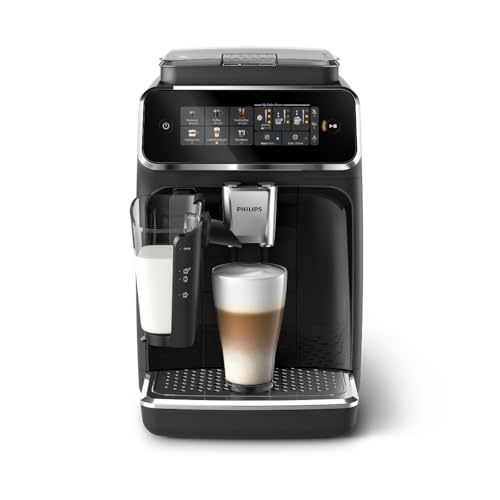
The Philips 5500 Series sits at the top of the Philips side of this group, pairing the LatteGo milk system with 20 hot and iced pre-sets and adjustment over strength, milk amount and cup size. That combination is the point: the menu is wide, but each drink can still be tuned, so a household is not stuck choosing between variety and control.
QuickStart trims the morning friction, and the ceramic grinder with a 15-bar pump covers the fundamentals. As with its smaller sibling, the LatteGo design is the long-term ownership argument — milk systems are where fully automatic machines live or die, and a system with few parts that rinses clean in moments is one you will keep using for lattes in year three, not just month one.
The 5500’s daily rhythm is quick starts and tuned drinks: it wakes fast, remembers how each drink should be adjusted, and its LatteGo system keeps the milk side of life to a rinse. Households with both hot-latte and iced-coffee drinkers feel its breadth most. It rewards owners who spend one early session dialing in their preferences — after that, it simply repeats them.
Strengths
- 20 hot and iced pre-sets with strength, milk and cup-size adjustment
- LatteGo system keeps milk cleanup to a quick rinse of few parts
- QuickStart shortens the wake-up-to-first-drink wait
Trade-offs
- Twenty pre-sets plus three adjustment axes is a lot of choice for beginners
- Iced pre-sets still require ice in the glass
- Customization rewards a few sessions of experimentation before it feels automatic
Key specs (from the verified listing)
- Type: Fully automatic espresso machine
- Model: EP5544/94
- Pre-sets: 20 hot and iced coffee pre-sets
- Milk system: LatteGo milk system
- Grinder: Ceramic grinder
- Pressure: 15 bars
- Extras: QuickStart, customizable strength, milk and cup size
Best for: households that want a wide hot-and-iced menu with per-drink tuning and easy milk cleanup / Not suited for: set-and-forget buyers who find multi-axis adjustment fussy

Philips 2300 Series
Badge: Best for Variety
The Philips 2300 Series is the entry rung of the LatteGo ladder: three coffee pre-sets, a ceramic grinder, 15-bar pressure, and the same easy-cleaning milk philosophy as its bigger siblings. For a single drinker or a couple whose order is espresso, coffee and one milk drink on rotation, that is a complete machine rather than a stripped one.
Adjustable strength and cup size keep the three pre-sets flexible, and hot water covers tea and americanos. What you do not get is the iced-drink programming or the deep menu of the 3300 and 5500 — the step-up question in the Philips line is mostly about menu breadth. If your drinking is simple and you value the easiest milk cleanup in the business, the 2300 makes a strong case for not paying for range you will not use.
The 2300 keeps ownership deliberately light: three drinks done well, strength and size adjustable, milk cleanup on the LatteGo pattern, and a footprint of features a single drinker or couple can fully use. It is the machine in this group least likely to intimidate a first-time owner, and the one whose limits are easiest to predict before buying — which many households will count as a virtue.
Strengths
- LatteGo milk system at the simplest tier of the Philips range
- Three pre-sets with adjustable strength and cup size covers daily drinking
- Ceramic grinder and 15-bar pump match the bigger Philips models’ basics
Trade-offs
- Three pre-sets is the joint-shortest menu in this group
- No iced-drink pre-sets, unlike the 3300 and 5500
- Fewer personalization options than the step-up Philips models
Key specs (from the verified listing)
- Type: Fully automatic espresso machine
- Model: EP2330/14
- Pre-sets: 3 coffee pre-sets
- Milk system: LatteGo milk system
- Grinder: Ceramic grinder
- Pressure: 15-bar pressure
- Extras: Customizable coffee strength and cup size, hot water
Best for: singles and couples with a simple daily order who still want LatteGo cleanup / Not suited for: iced-drink fans or households wanting a long preset menu

De’Longhi Rivelia (White)
Badge: Best for Small Households
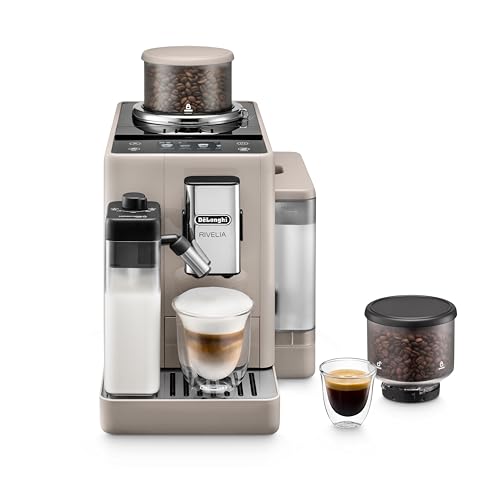
This is the Rivelia in white — the same swappable-hopper idea as its beige sibling, finished for kitchens built around light colors and bright counters. The removable bean hoppers remain the functional story: lift one hopper, seat the other, and the machine moves from the morning’s regular beans to evening decaf without scooping, purging or waste.
Eighteen one-touch recipes and a milk frother give it the full café repertoire, and the white finish is a legitimate buying factor in a category dominated by black and stainless boxes — a machine this size lives on your counter permanently, so how it looks at 7 a.m. matters. Just budget a moment for wiping: white shows every drip, and this machine will keep you honest about it.
In white, the Rivelia becomes part of the kitchen’s look as much as its routine — bright, deliberate, and visibly clean when it is clean. The hopper system works exactly as in its beige sibling, making the two-bean household practical, and the 18-recipe menu covers daily drinking plus guests. Budget the wipe-down habit and it is a deeply satisfying machine to live with.
Strengths
- Removable bean hoppers make regular/decaf switching genuinely practical
- 18 one-touch recipes covers a broad café menu
- White finish brightens darker kitchens and matches light appliance suites
Trade-offs
- White housing shows coffee drips and grounds dust immediately
- Second hopper needs dry storage space
- Frother workflow is a step more hands-on than sealed carafe systems
Key specs (from the verified listing)
- Type: Automatic espresso machine
- Recipes: 18 one-touch recipes
- Bean system: Removable bean hoppers
- Milk system: Milk frother
- Grinder: Built-in grinder
- Finish: White (one of 4 colors)
Best for: light, bright kitchens and two-bean households that switch beans often / Not suited for: anyone who knows a white appliance will not get wiped down

De’Longhi Magnifica Duo
Badge: Best Premium Pick
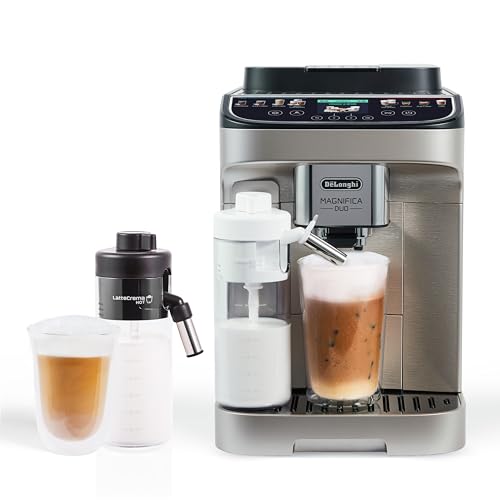
The Magnifica Duo is built for households where the drink order changes every morning. One person wants a hot cappuccino, the next wants an iced latte with cold foam, and the machine handles both from the same menu because its frother works hot and cold. That dual-temperature milk system is the real headline here: most fully automatic machines in this roundup froth hot milk only, so cold drinks usually mean pouring espresso over ice and accepting a thinner result. The Duo closes that gap.
Day to day, the touchscreen is the interface you will judge it by, and it is a sensible one — recipes are laid out as selectable drinks rather than buried in settings menus. The built-in grinder means beans go in the top and a finished drink lands in the cup, with the usual fully automatic trade-off that you give up the hands-on control a manual portafilter machine offers. For a busy kitchen that values variety and speed over ritual, that is the right trade.
In daily use, the Duo’s ownership story is about the cold-milk capability changing habits: households that buy it for hot drinks often find iced drinks becoming the summer default, because the machine removes the planning from them. Keep the touchscreen wiped and the frother rinsed, and its routine is otherwise the standard fully automatic rhythm of tray, grounds and prompted descaling.
Strengths
- The widest hot-and-cold milk range in this group, so iced lattes and cold-foam drinks are one touch away
- A touchscreen that makes the 20-recipe menu easy to browse without memorizing button combinations
- Built-in grinder keeps the whole bean-to-cup process inside one footprint
Trade-offs
- Twenty recipes is more menu than a straight-espresso drinker will ever open
- Touchscreen controls need a wipe-down in steamy kitchens to stay responsive
- Silver finish shows coffee splashes more readily than darker housings
Key specs (from the verified listing)
- Type: Fully automatic espresso machine
- Recipes: 20 one-touch recipes
- Milk system: Hot and cold milk frother
- Grinder: Built-in grinder
- Display: Touchscreen display
- Finish: Silver
Best for: households that split between hot and iced milk drinks and want maximum one-touch variety / Not suited for: drinkers who want manual control over every extraction variable

De’Longhi Magnifica Evo
Badge: Best for Beginners
The Magnifica Evo takes a different route from the big-menu machines: instead of dozens of presets, it gives you seven one-touch recipes and a way to craft and save a personalized signature drink. That matters in real kitchens, because most people do not rotate through twenty drinks — they find the one latte or long coffee they love and make it every single day. The Evo is designed around that habit.
The frother handles the milk side of the core menu, and the built-in grinder keeps beans fresh shot to shot compared with pre-ground coffee. Expect the standard fully automatic compromise: you trade fine manual control for repeatability. If your household has one or two favorite drinks and wants them identical every morning with almost no thought, the Evo’s focused design fits better than a sprawling recipe library you will never finish exploring.
Ownership of the Evo tends to settle into a satisfying groove: each person saves or learns their drink, mornings become wordless, and the machine disappears into the routine — which is the highest praise a kitchen appliance can earn. Its seven-recipe focus means guests with exotic orders may need the manual milk route, but for the household itself, the Evo covers the real menu completely.
Strengths
- Personalized signature-drink function lets one household member save exactly their drink
- Seven recipes covers the core menu without menu fatigue
- Built-in grinder and frother keep the full routine in one machine
Trade-offs
- Fewer preset recipes than the wider-menu models in this group
- Personalization takes a few rounds of tasting to dial in
- Silver housing needs regular wiping to look its best
Key specs (from the verified listing)
- Type: Fully automatic espresso machine
- Recipes: 7 one-touch recipes
- Milk system: Milk frother
- Grinder: Built-in grinder
- Special feature: Craft a personalized signature drink
- Finish: Silver
Best for: households with one or two favorite drinks they want saved and repeated exactly / Not suited for: variety seekers who want the longest possible preset menu

It also helps to compare across recommendation styles: our roundup of Best Espresso Machines Sweet Home looks at this same category through a different lens, and the contrasts are instructive.
Comparison Table
| Machine | Menu | Milk / bean system | Badge | Listing |
|---|---|---|---|---|
| De’Longhi PrimaDonna Aromatic | 38 one-touch recipes | Hot and cold milk frother | Best Overall | Check on Amazon |
| Philips 5500 Series | EP5544/94 | 20 hot and iced coffee pre-sets | Best for Milk Drinks | Check on Amazon |
| Philips 2300 Series | EP2330/14 | 3 coffee pre-sets | Best for Variety | Check on Amazon |
| De’Longhi Rivelia (White) | 18 one-touch recipes | Removable bean hoppers | Best for Small Households | Check on Amazon |
| De’Longhi Magnifica Duo | 20 one-touch recipes | Hot and cold milk frother | Best Premium Pick | Check on Amazon |
| De’Longhi Magnifica Evo | 7 one-touch recipes | Milk frother | Best for Beginners | Check on Amazon |
Read the table as a map of philosophies rather than a league ladder: the top row is not “better” than the bottom for every kitchen. Menu size, milk-system cleaning and bean flexibility are the three axes that separate these machines in daily life.
If you are still narrowing the field, the guide to Best Espresso Machines That Can Be Customized is a useful companion read before you commit to one machine.
How to Choose the Right Fully Automatic Espresso Machine
Start with your actual drink order, not the menu you admire. Write down what your household drank last week. If it was espresso and one kind of latte, a three-to-seven-recipe machine covers your life, and the extra presets on a flagship are decoration. If four people drink four different things and guests regularly put in café orders, a deep menu earns its counter space. Recipe counts in this group run from 3 to 38, and the right number is the one that matches your written list — plus a little headroom, not triple it.
Judge the milk system by its cleaning, not its foam. Almost every modern milk system can make decent foam. They differ enormously in what happens afterwards. Systems built from a few large parts that rinse quickly get cleaned every time; systems with narrow tubes and many seals get cleaned eventually, and “eventually” is how milk residue, off flavors and service calls begin. If you drink milk daily, put milk-system design at the top of your list — it is the single best predictor of whether you still love the machine in year three.
Think about beans as a household policy. A built-in grinder means fresh grounds for every shot, which is the core quality argument for this whole category. The follow-up question is whether one hopper is enough. Households split between regular and decaf, or between a daily blend and a weekend single-origin, should look hard at swappable-hopper designs; everyone else can ignore the feature and save the complexity.
Match the interface to the least technical user. Touchscreens make long menus navigable and look great, but a simple button layout with three recipes can be the better machine for a household where one person just wants coffee without a tutorial. Consider who makes the first drink of the day, half awake, and choose the interface that person will succeed with.
Plan the maintenance before you buy. Every fully automatic machine asks for the same rhythm: empty the drip tray and grounds container, rinse the milk system, run cleaning and descaling cycles when prompted. Designs that combine or simplify those cycles reduce the burden meaningfully over years of ownership. Also check the basics of placement: you need clearance to lift the bean lid, access to the water tank, and a counter position where the machine can stay permanently — these machines are heavy enough that “put it away after use” is a fantasy.
Finally, budget the whole habit, not just the machine. Beans, descaler, water filters where used, and the occasional replacement seal are the running costs of this category. None of them are large, but a machine bought at the very top of a budget sometimes gets fed stale, cheap beans — and no machine in this roundup can make a great drink from bad beans. Leave room in the budget for good coffee.
Shoppers who started with a broader search often land here from Best Espresso Machines That Use Ground Coffee — the two guides share this pick pool but weight the criteria differently.
How to Use, Clean, and Troubleshoot a Fully Automatic Espresso Machine
First-week setup. Rinse the water tank, fill it with fresh water, load beans into the hopper, and run the machine’s initial rinse or setup cycle before your first real drink. Pull two or three plain espressos and taste them before judging anything: new machines and new beans both need a short settling period. Set the grinder conservatively at first — change one variable at a time, in small steps, and only while the grinder is running, which is the safe way to adjust any built-in grinder.
Dialing in your daily drink. Work in this order: dose strength first, then drink volume, then milk amount. Make one change, taste, and only then change the next thing. When you find the combination you love, write it down or save it if your machine offers a personalized drink — future-you, at 6 a.m., will be grateful. Fresh beans make a bigger difference than any setting: beans roasted weeks ago, stored in a warm spot, will taste flat through the best machine in this group.
Daily routine (two minutes). Empty and rinse the drip tray when the machine asks — or before it asks. Rinse the milk system after the last milk drink of the day, without exception; dried milk is the number-one cause of both bad flavors and blocked frothers. Wipe the drip area and, on touchscreen models, the screen.
Weekly routine. Remove the brew group if your machine’s design allows it, rinse it under lukewarm water, let it dry, and refit it. Wash the milk container parts properly rather than only rinsing. Empty the grounds container fully and wipe the compartment. This short weekly habit is what separates machines that run for years from machines that develop mysterious faults.
Monthly and prompted maintenance. Run cleaning and descaling cycles when the machine prompts — the prompts exist because internal scale genuinely affects temperature and flow. Machines with combined cleaning-and-descaling programs make this a single routine. Never ignore a descale prompt for weeks; scale problems compound quietly and then arrive all at once.
Troubleshooting: three common problems
Problem: The espresso tastes weak or watery → what to do: Increase the strength setting one step, check that the beans are fresh, and make sure the grind has not been set very coarse. Weak shots are almost always a settings-or-beans issue before they are a machine fault.
Problem: The milk froth is thin or the frother sputters → what to do: Clean the milk system thoroughly, including every removable part, and use cold, fresh milk. Sputtering is the classic symptom of partial milk residue narrowing the air path.
Problem: The machine asks for the drip tray or grounds container constantly, or stops mid-cycle → what to do: Empty both fully, dry the container sensors’ area, and reseat everything firmly. Most “faults” at this level are a container that is nearly full or seated slightly out of place.
Before You Buy: The Four Systems Inside Every Pick
Strip away the finishes and menus and every machine in this roundup is four systems working together. The grinder turns beans into grounds; its consistency sets the ceiling for extraction quality, and its placement inside the machine is why this category needs no separate counter space for grinding. The brew system doses, compacts and extracts; it is the part the weekly rinse looks after, and the part descaling protects.
The milk system is the third system and the one with the widest design spread in this group — from few-parts LatteGo assemblies that rinse in seconds to frother systems that also handle cold foam. It is also the system whose hygiene decides whether milk drinks stay delicious across years of ownership. The fourth system is the interface: buttons, dials or touchscreens that translate a household’s wishes into the other three systems’ work, plus the maintenance prompts that keep everything on schedule.
When a machine disappoints an owner, it is almost never the brew system that failed — it is a milk system that became a chore, an interface a family member avoided, or maintenance that quietly lapsed. That is why the detailed reviews in this guide give those systems at least as much attention as the drinks themselves, and why our verdicts are written in terms of households rather than specifications.
Walmart, Walmart.com and Marketplace: Know Which One You Are Buying From
Three different offers hide under one name. A machine stocked in a Walmart store is the simplest purchase and the simplest return. Walmart.com’s own online range adds delivery and a wider assortment. The marketplace adds third-party sellers whose shipping, returns and support run through their own policies — sometimes excellent, sometimes not. Before buying a machine at this level through any of the three, confirm who the seller is and what the return route looks like; on a heavy appliance, that homework is the purchase.
Model discipline matters just as much. Fully automatic ranges use close model names across tiers — a 2300, 3300 and 5500 are different machines with different menus, and a Rivelia is not a Magnifica. When you find a promising listing, match the full model name against the picks in this guide before comparing prices; a lower price on a lower-tier model is not a deal, it is a different machine.
Making the Value Calculation Like a Walmart Shopper
The value frame Walmart shoppers apply instinctively — total cost over the product’s life, not the sticker — is exactly right for this category. Add the running costs: beans, descaler and the occasional filter. Spread over years of daily drinks, even the flagship-tier machine here costs little per cup against café prices, and the simplest models reach that point fastest. The calculation favors whichever machine your household will actually use daily, which loops back to the real criteria: menu fit and milk-system livability.
One more practical note: extended protection plans get offered hard in this category at every retailer. Read what they actually cover before deciding — and remember that the maintenance rhythm in this guide (milk rinses, prompted descaling, weekly brew-group care) prevents the majority of the failures owners ever meet. Prevention you control beats a plan you have to claim on.
For a second opinion with a different emphasis, see our coverage of Best Espresso Machines That Won T Drip and compare which criteria matter more to your kitchen.
A note on espresso extraction in fully automatic machines. These machines handle dosing, tamping and extraction timing internally, which removes the variables a manual barista controls by hand. The practical consequence for buyers is that consistency is the category’s promise: once a drink is set the way you like it, the machine repeats it. If you are coming from a café habit, give any new machine a week of drinks before judging it — palates calibrate to a new routine, and settings usually need one or two small adjustments as beans change.
About noise, honestly. Built-in grinders make noise for a few seconds per drink; that is physics, not a defect, and every machine in this group does it. If the machine will live near a sleeping baby’s room or an early-shift worker’s wall, plan placement accordingly and prefer models whose daily drinks can be queued quickly in the morning. No fully automatic machine is silent, and any guide that implies otherwise is selling something.
Decaf drinkers deserve a plan. In most fully automatic machines, switching between regular and decaf beans in a single hopper means scooping and purging — wasteful and fiddly. That is why the swappable-hopper design in this group matters so much to mixed households, and why everyone else should keep a small amount of the second bean for the pre-ground option if their machine offers one, rather than contaminating the main hopper.
Think about the second year, not the second week. Seals, brew-group care and descaling are the whole long-term story of this category. None of it is difficult, and all of it is cheaper than a service visit. When comparing two finalists, the one whose maintenance you can picture yourself actually doing — prompts you will obey, parts you will rinse — is the one that will still be making great drinks when the other is in a repair queue.
Cup temperature is a free upgrade. Espresso poured into a cold cup loses heat and aroma immediately, which is why cafés keep cups on warmers and why the cup-warmer feature on one pick in this group is more than a luxury. At home, rinsing a cup with hot water before pulling the shot achieves most of the same effect. It costs ten seconds and improves every single drink, whatever machine you choose.
Grind settings move in small steps for a reason. When you adjust a built-in grinder, change one step, pull a shot, and taste before changing another. Big swings make it impossible to know what helped. And because the grounds already in the path belong to the previous setting, judge the second shot after a change, not the first. Patience here is the closest thing fully automatic ownership has to a barista skill.
Milk choice changes the drink more than most settings. Fresh, cold milk foams best, and different milks texture differently — whole milk is the most forgiving, while plant-based alternatives vary widely by brand and formulation. If a milk drink disappoints, changing the milk is a legitimate first troubleshooting step before touching the machine. Keep milk cold until the moment it is used; warm milk will not texture properly in any system in this group.
Placement is a feature. A machine squeezed where the bean lid cannot open fully, or where the drip tray cannot slide out without moving the machine, will slowly train its owner to skip maintenance. Give the machine a permanent home with working room on the sides it needs, a nearby bin for the grounds container, and the water supply within easy reach. The best-placed modest machine outperforms the best machine in a bad spot, every week of the year.
Common Buying Mistakes
Buying the longest menu for the simplest household. A 38-recipe machine in a two-drink home is not a treat; it is settings you will never open and a price tier you did not need. Match the menu to the written drink list.
Choosing by touchscreen instead of by milk system. The screen is what you see in the store; the milk system is what you live with. Daily milk drinkers should reverse those priorities.
Ignoring counter geometry. Fully automatic machines need vertical clearance for the bean lid and water tank access. Measure your under-cabinet space before ordering, not after delivery.
Feeding a premium machine stale beans. The most common reason a good machine “underperforms” is old beans from a warm cupboard. Buy smaller amounts, store them sealed and cool, and the same machine will taste noticeably better.
Skipping the descale prompts. Postponing descaling is borrowing against the machine’s heating system. When it prompts, run the cycle that week.
Assuming every household member wants the same drink. If tastes genuinely differ, personalization features and swappable hoppers stop being luxuries and become the features that prevent a second machine — or a daily compromise nobody enjoys.
Before you buy, it is worth a quick detour through Best Espresso Machines Tirecutter, which approaches the same machines from another common search angle.
Final Recommendation
Start with the De’Longhi PrimaDonna Aromatic if you want the safest all-round answer in this group — it balances menu, milk handling and everyday ease better than any other single machine here. If milk drinks dominate your household and cleanup is your deciding factor, choose the Philips 2300 Series instead. And if you would rather keep things as simple as possible — or you are buying a first fully automatic machine — the De’Longhi Magnifica Evo is the pick that respects that priority.
Buy the machine, not the channel: pick from this list on the merits, verify the exact model and seller wherever you buy, and let return convenience break any tie. For most readers that will be a short, satisfying comparison between Walmart’s channels and the Amazon listings linked above.
And if your shortlist is still moving, Best Espresso Machines Tools rounds out the picture with a related set of priorities.
Frequently Asked Questions
Is it safe to buy a premium espresso machine through a marketplace seller?
It can be, with checks: confirm the seller’s identity and ratings history on the platform, verify the full model name matches the machine you chose, and read the return terms before paying — especially who pays return shipping on a heavy appliance. If any of those are unclear, the direct listings linked in this guide are the lower-risk route.
Do fully automatic machines make real espresso?
Yes — they grind fresh beans, tamp automatically and extract under pressure, which is the espresso process. What they trade away versus a manual machine is fine control: you cannot adjust every variable the way a barista with a portafilter can. What you gain is repeatability — the same drink, at one touch, every morning.
How long do fully automatic espresso machines last?
With the daily, weekly and prompted maintenance described in this guide, a well-kept machine serves for years of daily use. The two habits that shorten life most are neglected milk systems and ignored descaling. The two that extend it are fresh water and the short weekly brew-group rinse where the design allows it.
Is a ceramic or steel grinder better?
Both grind well. Ceramic burrs are known for running without transferring heat to the beans and for long-term consistency, which is why several machines here use them. In daily taste terms, bean freshness matters far more than burr material — buy the machine whose other features fit your household.
Can these machines use pre-ground coffee?
Most fully automatic machines offer a pre-ground option for an occasional decaf or a guest’s beans, but the category is designed around whole beans and the built-in grinder. If pre-ground is your main plan, you are paying for a grinder you will not use — a different machine style would suit you better.
What water should I use?
Fresh, good-tasting water. If your tap water is heavily chlorinated or very hard, you will taste it in the cup and you will descale more often. Filtered water is the simple upgrade that improves both flavor and maintenance intervals.
How many drinks a day can a home machine handle?
These are home machines designed around household volumes — a family making drinks through the morning and a few more across the day is exactly their brief. They are not built for café queues or office floors of fifty people; if your setting looks like that, you are shopping in the wrong category.