Disclosure: topratedkitchenware.com is reader-supported. When you buy through links on our site, we may earn an affiliate commission from Amazon and other retailers, at no extra cost to you.
Where to buy
Discussions gathered under the heading best gas cooktops forum tend to end in the same place: two or three installable models that owners keep recommending, surrounded by a long tail of alternatives people argue about. This guide follows that shape honestly. The two built-in gas cooktops below carry Amazon links; the four portable induction burners that forums constantly compare against gas are listed in plain text and reviewed prose-only, with no link, because they are electric appliances in a gas guide. Each linked name goes to its listing, where you can check the latest price on Amazon and confirm current specifications.
- Nuwave Pro Chef Induction Cooktop (covered prose-only in this guide — see its review below for why)
- ISILER 1800W Portable Induction Cooktop (covered prose-only in this guide — see its review below for why)
- VEVOR Gas Cooktop 30 Inch, 5 Burners, NG LPG Convertible
- ThermoMate 36 Inch Gas Cooktop with 5 Sabaf Burners
- Duxtop 1800W Portable Induction Cooktop 8100MC (Gold) (covered prose-only in this guide — see its review below for why)
- Duxtop Portable Induction Cooktop 9600LS (Silver, LCD Sensor Touch) (covered prose-only in this guide — see its review below for why)
Read the full guide ↓ for the reasoning behind every position, the honest limitations of each pick, and the checks that matter more than any headline claim.
Typing best gas cooktops forum into a search box is a different act from typing a plain product search. It means you do not fully trust polished buying guides — maybe including this one — and you want to hear from people who have lived with a cooktop through burnt sauces, holiday dinners, a conversion to propane, and the morning the igniter started clicking. This guide is written for that reader: it organises what forum discussions actually surface, tests the claims against the verified picks, and is explicit about where community wisdom is gold and where it misleads.
Three themes dominate owner forums for gas cooktops. The first is layout honesty: whether five burners in 30 inches is a feature or a trap depends entirely on your pans, and owners say so bluntly. The second is conversion reality: threads about switching between natural gas and LPG are full of half-finished jobs and the sooty flames that followed. The third is the permanent background argument — gas versus induction — which is why four of the six verified picks in this guide are portable induction burners. Forums never let a gas discussion stay purely about gas, and neither does this page.
What follows is a forum-literate guide: the picks, the arguments for and against each, a buying section built from the questions owners actually ask, and a how-to layer covering installation checks and the troubleshooting threads that repeat every winter. For the narrower ventilation version of the debate, Best Gas Cooktops With Down Vents collects the island-kitchen side of the conversation.
Key Takeaways
- Forum consensus is most reliable on layout and ownership pain, and least reliable on headline output numbers quoted from memory.
- Only two picks here are installable gas cooktops, and both are linked; the four induction burners are prose-only comparison points.
- The five-burners-in-30-inches argument has no universal winner — it is decided by the diameter of your two largest pans.
- Conversion threads teach one lesson repeatedly: orifices and regulator together, leak-tested, or do not start.
- Named components (the ThermoMate’s Sabaf burners) earn forum trust in a way generic specifications never do.
- Read owner complaints for patterns, not volume: a repeated specific failure is signal; scattered one-off frustration is weather.
In this guide
Quick Picks
| Pick | Badge | Why it earns its place | Listing |
|---|---|---|---|
| Nuwave Pro Chef Induction Cooktop | Most Debated Alternative | The induction benchmark that forum comparisons keep measuring gas against. | Prose-only — see review |
| ISILER 1800W Portable Induction Cooktop | Best Small-Space Alternative | The small-space, preset-driven electric option that forum threads suggest for studios and dorms. | Prose-only — see review |
| VEVOR Gas Cooktop 30 Inch, 5 Burners, NG LPG Convertible | Best Overall | The linked gas answer most forum readers in a standard kitchen would actually buy. | Check on Amazon |
| ThermoMate 36 Inch Gas Cooktop with 5 Sabaf Burners | Best for Enthusiasts | The enthusiast-grade linked pick: named burners, full width, and conversion for either gas type. | Check on Amazon |
| Duxtop 1800W Portable Induction Cooktop 8100MC (Gold) | Best Budget Alternative | The veteran portable that forum members recommend as an extra burner, not a cooktop replacement. | Prose-only — see review |
| Duxtop Portable Induction Cooktop 9600LS (Silver, LCD Sensor Touch) | Best Touch-Control Alternative | The polished portable in the pool, included because forum comparisons always include it. | Prose-only — see review |
How These Picks Were Chosen
The method here mirrors how a careful forum reader actually shops. First, the verified pool for the Cooktops group was screened on 2026-11-20 against each listing title, and every specification quoted in this guide comes from those titles and nothing else. Two picks are built-in gas cooktops with stated NG/LPG conversion and thermocouple protection — the VEVOR at 30 inches and the ThermoMate at 36 — and they carry the links. Four picks are portable induction burners, kept in the guide prose-only because forum comparisons always include them, and excluding them would make the guide less honest, not more.
Second, the arguments were weighted the way experienced forum members weight them. Recurring, specific, mechanically plausible complaints — crowded burner geometry, conversion shortcuts, touch controls with wet hands — shaped the trade-offs in each review. Vague enthusiasm and vague outrage did not. No ratings, scores, or owner counts are printed anywhere in this guide, because numbers like that go stale and forums themselves are the first place to mock a guide that quotes them as if they were current.
This is research-led guidance, not a hands-on test, and it does not claim to quote or reproduce any specific forum, thread, or poster. Where the guide describes what owners discuss, it describes the well-known recurring themes of gas-cooktop ownership in general terms. Readers who want the width question treated as its own topic can continue to Best Gas Fired 36 Cooktops after this page.
The 6 Best Gas Cooktops Forum Readers End Up Debating
The reviews are ordered as the verified pool assigns them, which conveniently mirrors a typical thread: the induction alternatives get their hearing first, the two installable gas cooktops anchor the middle, and the veteran portables close the argument. Badges mark each pick’s role in the debate, and only the two gas built-ins carry links.
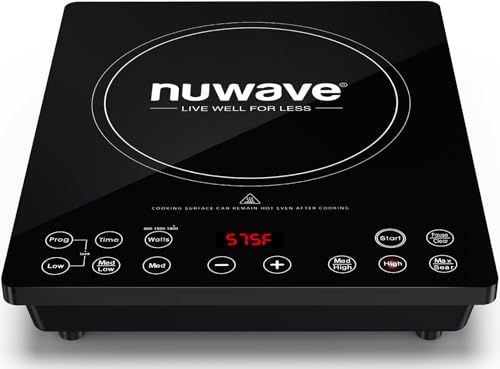
Nuwave Pro Chef Induction Cooktop
Badge: Most Debated Alternative
Prose-only pick: an induction burner, not a gas cooktop. Forum threads compare this kind of burner against gas constantly, so it is discussed here — without an Amazon link, because it does not answer a gas cooktop search on its own.
Strengths
- Temperature steps fine enough to end the forum argument about holding a gentle simmer
- Flat ceramic glass wipes clean in seconds, a point even gas loyalists concede
- Portable, so it can audition in your kitchen before you commit to any built-in
Trade-offs
- It is not gas: no flame, no LP or natural gas option, no use in a power cut
- Single burner, so it cannot host the multi-pan cooking built-ins exist for
- Needs magnetic cookware, which forum threads flag as a hidden second cost
| Specification (from the verified listing title) | Detail |
|---|---|
| Fuel / type | Electric induction, commercial-grade portable burner |
| Power | 1800W |
| Heating coil | 8-inch |
| Temperature control | Settings from 100°F to 575°F in 5°F steps (per listing title) |
| Surface | Shatter-proof ceramic glass (per listing title) |
Every gas cooktop thread eventually summons this burner, or one like it, as the prosecution’s exhibit: an induction unit with temperature settings fine enough — the verified title claims steps of five degrees across a wide range — to hold a sauce at a bare simmer without the cycling that makes gas owners defensive. Add a shatter-proof ceramic glass surface that wipes clean and a commercial-grade label, and the induction side of the forum has its champion.
The defence, as forum regulars will tell you, is equally simple: it is one burner, it needs magnetic pans, and it goes dark in a power cut. A household that cooks Sunday sauce in a stockpot while frying cutlets and boiling pasta is not replacing a five-burner gas cooktop with a portable plate, however precise that plate is. The Pro Chef wins arguments about temperature control and loses arguments about capacity, and both verdicts are fair.
Its role in a gas shopper’s life is as a benchmark and possibly a sidekick. If your simmering frustration is real, a burner like this beside your gas cooktop is the combination many forum households quietly end up with. If your frustration is layout, output, or an ageing built-in, keep reading — the gas answers are two reviews away.
Best for: Precision-focused cooks curious about the induction side of the forum debate / Not suited for: Anyone whose decision is already made in favour of flame
ISILER 1800W Portable Induction Cooktop
Badge: Best Small-Space Alternative
Prose-only pick: a compact induction burner with presets and a timer. It appears in forum discussions as the small-kitchen workaround, and it is covered here in that spirit — prose-only, with no Amazon link.
Strengths
- Presets, timer, and safety lock make it the set-and-check option forum parents recommend to students
- Compact enough to store away, which matters in the small kitchens that start many forum threads
- Even-heating claims in the title speak to the hot-spot complaint common with cheap hot plates
Trade-offs
- Electric only; it settles nothing for a reader committed to gas
- Preset-driven control frustrates cooks who want immediate, analogue response
- One burner and an 8-inch plate cap the size of every meal
| Specification (from the verified listing title) | Detail |
|---|---|
| Fuel / type | Electric induction, portable |
| Power | 1800W |
| Heating plate | 8-inch |
| Controls | Touch control; power and temperature settings; cooking presets; timer and safety lock (per listing title) |
The ISILER is the pick forum members suggest to the poster with the studio apartment, the dorm room, or the in-law suite: compact, preset-driven, with a timer and a safety lock, and an 8-inch plate that matches the one-pot cooking those spaces actually produce. In thread after thread, the small-kitchen question is not really about power; it is about whether cooking can happen safely in a space never designed for a range, and this burner is a coherent answer.
Its limits are the ones the same forums state plainly. Presets are a convenience until the moment you want to disobey them, single burners cap ambition, and induction’s pan requirements surprise buyers who did not read the thread to the end. None of that makes it a bad product; it makes it a specific product, for a specific kitchen that is not the kitchen this keyword is mainly about.
So treat the ISILER as the guide’s small-space footnote: genuinely useful where it fits, honestly labelled as electric, and no threat to the two linked gas cooktops below, which serve the standard kitchens most forum shoppers are actually equipping.
Best for: Studio apartments, dorms, and anyone needing a storable extra burner / Not suited for: Gas cooktop shoppers with a cutout to fill
VEVOR Gas Cooktop 30 Inch, 5 Burners, NG LPG Convertible
Badge: Best Overall
Strengths
- A true built-in gas cooktop with stated NG/LPG conversion — the configuration forum owners actually install
- Five burners at 30 inches answers the forum’s favourite layout question in the affirmative
- Thermocouple protection covers the flame-failure scenario safety threads worry about
Trade-offs
- Five burners in 30 inches is the crowded layout forum threads also warn about for big pans
- Built-in means cutout, gas line, and leak check — not the plug-in simplicity of the portables
- Value positioning invites forum scepticism about long-term parts availability; check the listing and warranty terms
| Specification (from the verified listing title) | Detail |
|---|---|
| Fuel / type | Gas, built-in; NG LPG convertible (per listing title) |
| Size | 30 inch |
| Burners | 5 burners; 12250 BTU total figure in listing title |
| Material | Stainless steel |
| Safety | Thermocouple protection (per listing title) |
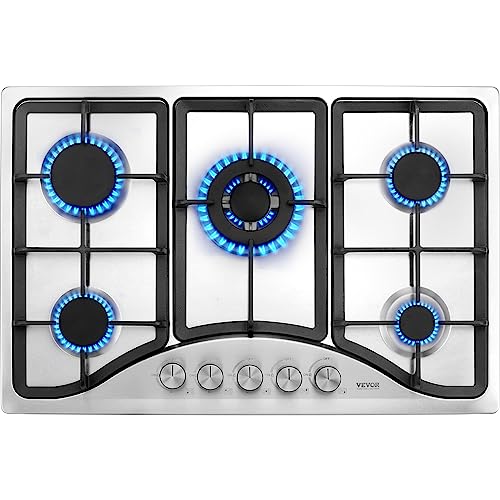
If forum threads have a hero configuration, it is this one: a built-in gas cooktop that fits the standard 30-inch opening, offers five burners instead of four, converts between natural gas and LPG for households whose fuel changes, and includes thermocouple protection for the flame-failure scenario. The VEVOR’s verified title states each of those points, which is why it carries the Best Overall badge here and the first of this guide’s two sets of links.
The forum counter-argument is geometry, and it deserves respect. Five burners in 30 inches means the burners are close, and owners of wide skillets and stockpots learn to stage their cooking — the big pan gets the centre, the second pan waits or shrinks. Whether that trade is worth it depends on your cookware shelf, and this guide’s advice is the advice pinned in every good thread: trace your two largest pans on paper at the burners’ spacing before you order anything.
The second counter-argument is about value brands generally: check parts availability and warranty terms on the listing, and keep the manual and conversion paperwork. Those are fair cautions for any appliance, and they are the price of the VEVOR’s positioning. For a standard kitchen that wants flame, five burners, and conversion flexibility, the forum-shaped verdict is that this is the sensible default. Readers planning an island around it sometimes extend the thread into Best Gas Cooktops With Down Vents And 5 7 Burners territory, but the cooktop itself starts here.
Best for: Standard 30-inch kitchens wanting five gas burners and conversion flexibility / Not suited for: Anyone needing 36-inch pan spacing or a no-install portable

ThermoMate 36 Inch Gas Cooktop with 5 Sabaf Burners
Badge: Best for Enthusiasts
Strengths
- Sabaf burners give forum enthusiasts a component name they recognise and respect
- 36 inches of width ends the pan-crowding argument that dominates 30-inch threads
- 304 stainless, thermocouple protection, and stated CSA certification cover the build-quality checklist
Trade-offs
- Demands a true 36-inch cutout; forum regret posts often start with a measurement that was assumed
- A permanent, heavier install that deserves a licensed gas fitter
- Enthusiast layout is wasted on households that rarely run more than two burners
| Specification (from the verified listing title) | Detail |
|---|---|
| Fuel / type | Gas hob, built-in; NG/LPG convertible (per listing title) |
| Size | 36 inch |
| Burners | 5 Italy Sabaf power burners (per listing title) |
| Material | 304 stainless steel |
| Safety | Thermocouple protection; CSA certified (per listing title) |
The ThermoMate is the pick forum enthusiasts defend with component names: Sabaf burners, made in Italy per the listing title, in a 36-inch body of 304 stainless steel, with thermocouple protection and CSA certification stated, and the same NG/LPG convertibility as its smaller sibling. In forum culture, named components matter because they imply serviceability and a supply chain — a burner from a known maker is a part you can plausibly replace in ten years, and owners think in those terms even when marketers do not.
The 36 inches matter just as much. This is the layout that ends the crowding argument: a stockpot, a wide skillet, and a saucepan can share the surface without the choreography a 30-inch five-burner demands. For households that cook in batches, preserve, or feed a crowd regularly, forum owners describe the wider cooktop the way drivers describe a longer wheelbase — not a luxury, a different category of calm.
The cautions are the usual ones, stated plainly: confirm your cutout is truly 36 inches, budget for a licensed installer, and do not buy width your cooking will never use. A two-burner household gains nothing here but cleaning area. For the enthusiast kitchen it is aimed at, though, this is the linked pick the forum side of the internet would argue for longest — and, on the evidence of its verified title, with reason.
Best for: Serious home cooks with a 36-inch opening and several large pans / Not suited for: 30-inch kitchens, renters, or two-burner households
Duxtop 1800W Portable Induction Cooktop 8100MC (Gold)
Badge: Best Budget Alternative
Prose-only pick: the long-running portable induction design that forum veterans mention as a cheap second burner. It is electric, not gas, and carries no Amazon link in this guide.
Strengths
- A mature, widely owned design, which is why forum archives are full of answers about it
- Portable and simple: an outlet and a magnetic pan are the whole setup
- Useful as the holiday-overflow burner beside a real gas cooktop
Trade-offs
- Not a gas appliance in any sense; it cannot fill a cooktop cutout or run on LP
- Single burner with a portable build that will not satisfy built-in expectations
- Gold finish divides opinion, as forum threads about it cheerfully demonstrate
| Specification (from the verified listing title) | Detail |
|---|---|
| Fuel / type | Electric induction, portable countertop burner |
| Power | 1800W |
| Colour / model | Gold, 8100MC (BT-180G3) |
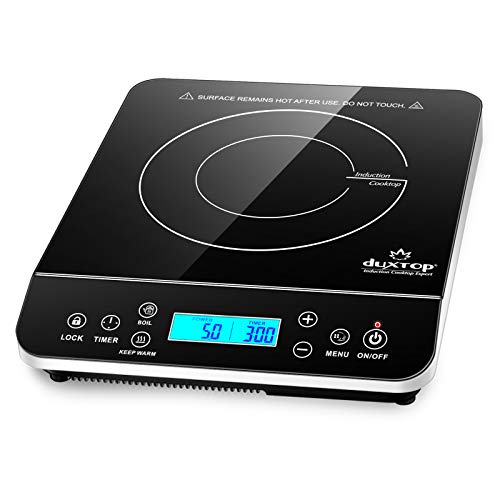
The gold Duxtop 8100MC is a forum veteran: a portable induction design that has been owned, lent, dropped, and discussed for so long that archives answer most questions about it before a new poster finishes typing. Its 1800W element and dead-simple proposition — an outlet, a magnetic pan, a burner anywhere — make it the default recommendation when a thread asks for a cheap extra burner for holidays or a hot plate for a workshop or office kitchen.
Veteran status cuts both ways in the reviews that matter. Owners know its ceiling precisely: one burner, portable build, no path to being a built-in, and a gold finish that households either enjoy or tolerate. Nobody in a forum mistakes it for a gas cooktop replacement, and this guide follows their example by reviewing it prose-only, without a link, in a gas guide.
Its honest job in your kitchen, if you buy one, is auxiliary: the overflow burner at Thanksgiving, the induction experiment before a bigger decision, the backup when a burner on the main cooktop is awaiting a part. Judged as that tool, its long forum life is the strongest endorsement in this entire pool.
Best for: A low-commitment extra burner or a first taste of induction / Not suited for: Replacing a built-in gas cooktop
Duxtop Portable Induction Cooktop 9600LS (Silver, LCD Sensor Touch)
Badge: Best Touch-Control Alternative
Prose-only pick: a silver touch-control induction hot plate. Forum threads treat it as the polished portable option; it is still electric, so it is discussed here without an Amazon link.
Strengths
- Touch controls and a flat surface make cleanup the easiest in this pool
- Portable format suits renters, offices, and temporary kitchens that forums hear from constantly
- Consistent electronic power steps help with melting and gentle reheating
Trade-offs
- Electric only — no flame, no gas conversion, no power-cut cooking
- Touch controls can be fussy with wet or floury hands mid-recipe
- Single burner; a household solution only for genuinely small-scale cooking
| Specification (from the verified listing title) | Detail |
|---|---|
| Fuel / type | Electric induction, portable countertop burner |
| Power | 1800W |
| Controls | LCD sensor touch (BT-200DZ) |
| Colour | Silver |
The silver 9600LS closes the pool the way it closes many threads: with the cleanup argument. Its flat glass surface and LCD sensor touch controls make it the easiest appliance in this guide to wipe down after a messy meal, and forum members who cook daily in small spaces rate that quality higher than visitors expect — a cooktop that is annoying to clean quietly stops being used, whatever its specifications say.
The counterpoints are familiar by now and still true. Touch controls and wet hands are uneasy partners mid-recipe. A single portable burner cannot anchor a family kitchen. And as an electric appliance it offers nothing to the reader whose question is specifically about gas — which is why, like the other induction picks, it is reviewed here in prose with no link and no photograph dressed up as a gas recommendation.
Where it earns its badge is the renter-and-small-household corner of the forum world, where a built-in is not on the table at all. For that reader, a polished, storable, touch-control burner is a complete answer. For the reader with a cutout and a gas line, the answer remains the two linked cooktops in the middle of this guide.
Best for: Renters and small households that value cleanup and control over flame / Not suited for: Gas loyalists or anyone filling a built-in opening
Comparison Table
Read this table the way a forum moderator would summarise a thread: the fuel column first, the layout second, and everything else after that.
| Pick | Badge | Key verified attributes | Listing |
|---|---|---|---|
| Nuwave Pro Chef Induction Cooktop | Most Debated Alternative | Electric induction; portable single burner; 1800W; 8-inch coil; fine temperature steps | Prose-only — see review |
| ISILER 1800W Portable Induction Cooktop | Best Small-Space Alternative | Electric induction; portable single burner; 1800W; 8-inch plate; presets, timer, safety lock | Prose-only — see review |
| VEVOR Gas Cooktop 30 Inch, 5 Burners, NG LPG Convertible | Best Overall | Gas built-in; 30 inch; 5 burners; NG/LPG convertible; stainless steel; thermocouple protection | Check on Amazon |
| ThermoMate 36 Inch Gas Cooktop with 5 Sabaf Burners | Best for Enthusiasts | Gas built-in; 36 inch; 5 Sabaf burners; NG/LPG convertible; 304 stainless steel; CSA certified | Check on Amazon |
| Duxtop 1800W Portable Induction Cooktop 8100MC (Gold) | Best Budget Alternative | Electric induction; portable single burner; 1800W | Prose-only — see review |
| Duxtop Portable Induction Cooktop 9600LS (Silver, LCD Sensor Touch) | Best Touch-Control Alternative | Electric induction; portable single burner; 1800W; LCD sensor touch | Prose-only — see review |
How to Choose a Gas Cooktop: The Forum-Tested Questions
Question one, from every thread ever posted: how many burners do you actually use at once? Be honest about your real Tuesday dinner, not your imaginary dinner party. Households that rarely exceed two pans gain little from five burners and lose counter calm to a bigger appliance; households that regularly run three or four should treat burner count and spacing as the whole decision. Both linked picks here offer five burners, at 30 and 36 inches respectively, so the real question this pool asks is not how many, but how far apart.
Question two: what fuel do you have, and what fuel might you have next? Forum conversion stories divide into happy ones, where the cooktop was convertible and the installer did orifices and regulator together, and unhappy ones, where one of those words was missing. Both linked picks state NG/LPG conversion in their verified titles. If there is any chance your home changes fuel — a move, a tank installation, a line extension — convertibility is cheap insurance bought at the only moment it is available.
Question three: what do your pans demand? Trace them. A 12-inch skillet and a stockpot are the standard test pair, and their combined footprint decides the 30-versus-36 argument more reliably than any specification. Wok cooks should additionally think about flame contact and stability on the grate, a topic where forum experience is genuinely useful because it is geometric, not mystical: a round-bottom wok wants a burner and grate arrangement that holds it close to the flame without wobbling.
Question four: how do you feel about cleaning? Gas cooktops ask you to lift grates, wipe around burners, and occasionally clear a blocked port; induction glass asks you to wipe a flat surface and keep the right pans. Forum members who switched fuels cite cleaning as often as cooking performance, and they are not wrong to. The four prose-only induction picks in this guide keep that trade in view deliberately — including for readers whose island plans involve Best Gas Cooktops With Grill features that add their own cleaning burden.
Question five: what breaks, and can you fix it? Igniters, thermocouples, and burner caps are the wear items of gas cooking. Named components and stated certifications — the pattern the ThermoMate’s title follows — suggest a manufacturer thinking about service. Before buying any cooktop, forum veterans advise downloading the manual, checking the parts diagram exists, and confirming the warranty terms on the listing. Ten minutes of that homework prevents the angriest category of thread there is.
And the meta-question, the one this keyword literally asks: how much should you trust forums at all? Trust them on patterns of ownership — geometry, cleaning, conversion, service — where hundreds of kitchens generate real data. Discount them on laboratory questions — exact thermal efficiency, precise output at altitude — where memory and enthusiasm substitute for instruments. Used that way, the forum is the best pre-purchase tool a cooktop buyer has, and this guide has tried to use it exactly that way.
How to Set Up a Gas Cooktop Without Becoming a Forum Horror Story
The cautionary tales in installation threads share a structure: a skipped measurement, a skipped test, a skipped professional. The sequence below is the homeowner-level outline of a proper built-in gas cooktop installation, written so you can recognise a complete job when you see one. The gas work itself belongs to a licensed installer wherever local rules require it.
- Measure three things, twice. The counter cutout, the cabinet interior beneath it, and the clearances to walls, tall units, and overhead cabinets or microwaves, all against the new cooktop’s manual — before the old appliance comes out.
- Confirm the fuel setup. Natural gas or LP, regulator position, and whether a conversion is part of this job. If it is, the orifices for every burner and the regulator setting are both on the checklist, in writing.
- Shut off, disconnect, and ventilate. Supply closed at the appliance valve (and at the tank for LP), old unit out, work area aired.
- Set and connect the new cooktop. The unit is seated per the manual, connected with approved fittings, and every disturbed joint is leak-tested with an approved method. No exceptions, no ‘it was fine last time’.
- Light and judge every burner. Blue, stable flames at full power and at simmer, caps seated, ignition reliable across repeated tries. A burner that lights only sometimes is a defect to resolve now, not a personality trait.
- Run the ventilation and file the paperwork. Hood performance checked with actual cooking steam, conversion label attached if applicable, manual and installer documents stored together.
Ownership, afterwards, is mostly small habits. Keep burner caps seated and dry after cleaning. Clear a blocked burner port with the method the manual allows rather than improvised tools. Once a season, lift the grates and look at the flame pattern with all burners lit; changes in flame shape are the cooktop’s way of filing a report before anything actually fails.
Troubleshooting. Problem: one burner clicks repeatedly and lights late → what to do: dry and reseat the burner cap and check the port area for spills; moisture and misalignment cause most delayed ignition, and a burner that still misbehaves after drying earns a service call. Problem: flames look fine alone but weaken when all burners run → what to do: suspect supply, not burners — ask your installer or gas supplier to check regulator capacity and line sizing against the cooktop’s total demand. Problem: a burner lights but goes out when you release or lower the knob → what to do: hold the flame a moment longer per the manual so the thermocouple heats; if it still drops out, the thermocouple or its seating needs professional attention, because that device is your flame-failure protection.
What Forum Consensus Gets Right — and Wrong — About Output
Output is the number forums argue about most and measure least. Threads quote BTU figures from memory, from marketing, and from other threads, and the figures inflate as they travel. The verified titles in this guide offer a useful discipline: the VEVOR states a total figure for its five burners, and the ThermoMate’s title emphasises its burner maker rather than a number at all. Both approaches tell you something real — one about whole-appliance scale, one about component pedigree — and neither licenses the fantasy that every burner delivers headline power simultaneously.
What owners can judge reliably, and forums therefore report well, is behaviour: whether a stockpot of water feels brisk or sluggish, whether a simmer holds without constant adjustment, whether lighting a second burner visibly steals from the first. Read forum output claims as behaviour reports and they are valuable. Read them as laboratory data and you will buy the wrong cooktop confidently, which is the specific failure this keyword’s searchers are trying to avoid by asking the crowd in the first place. The related hunt for built-in extras, in Best Gas Cooktops With Downdraft And Griddle And Conversions, suffers from the same number-inflation and deserves the same scepticism.
The Gas Versus Induction Argument, Settled as Far as It Settles
No forum thread has ever ended this argument, but the terms of the truce are well mapped. Gas offers flame visibility, universal pans, power-cut resilience, and a control feel many cooks refuse to surrender. Induction offers precision at low temperatures, a cooler kitchen, flat-surface cleaning, and no indoor combustion. The four prose-only picks in this guide — the Nuwave with its fine temperature steps, the ISILER with its presets, the two Duxtop portables — are the induction case stated in products rather than slogans.
The households forums describe as happiest are often the hybrids: a gas cooktop for the cooking that wants fire, and a portable induction burner for the sauce, the simmer, and the summer afternoon when heating the kitchen is the last thing anyone wants. If this guide leaves you with one forum-grade insight, let it be that the fuels are tools with different strengths — and that buying either one while believing it is the other is the only genuinely wrong answer on the page.
One more forum habit is worth borrowing before the mistakes section: read the threads that are two or three years old, not only the newest ones. Fresh threads capture unboxing impressions, delivery experiences, and first-meal enthusiasm, which are real but shallow. Older threads capture the ownership curve — the igniter that started clicking in the second winter, the grate finish after a year of cast iron, the conversion that behaved perfectly until the tank and regulator were changed. A cooktop is a decade-scale appliance, and the posts written in year three are the closest thing a buyer gets to a long-term test that no review programme can afford to run. Weight those posts accordingly, especially when they are specific about model, fuel, and the fix that eventually worked, because that specificity is what separates a useful archive from a pile of opinions.
The same archive logic applies in reverse when a thread is angry. A furious post written the day an installation failed is data about a bad day and possibly a bad installer; the follow-ups, where they exist, tell you whether the cooktop itself was ever the problem. Forum regulars learn to scroll to the resolution before forming a view, and product researchers should do the same. Several of the trade-offs in this guide’s reviews — conversion completeness, pan geometry, touch controls with wet hands — are themes precisely because they survive that follow-up test: they appear, they are confirmed by other owners, and they are still being discussed seasons later by people who kept the appliance and cook on it daily.
Common Buying Mistakes
The classic forum-inspired mistake is buying from a single glowing thread. One owner’s perfect cooktop is another owner’s pan-crowding regret, and the difference is usually in their kitchens, not in the appliance. Weight patterns across many owners, match them against your pans and your fuel, and treat any lone rave — or lone rant — as a hypothesis, not a verdict.
Second: assuming five burners means five usable burners for your cookware. Burner count is a layout claim before it is a capacity claim. The pan-tracing exercise in the buying section takes ten minutes and has prevented more returns than any other advice in the forum canon.
Third: treating conversion as a footnote. Threads about sooty pans and lifting flames almost always trace back to a conversion that changed orifices but not the regulator, or skipped the leak test. If your household is on LP now or might be later, the convertible wording in a title — present in both linked picks here — is a headline feature, and the installer’s checklist is part of the product you are buying.
Fourth: dismissing the induction alternatives without understanding what they are for, or — the mirror error — letting a good portable talk you out of a built-in you actually need. Forums are full of both regrets. The burners are excellent auxiliaries and small-space answers; the built-ins are kitchen infrastructure. Buy each for its own job.
Final Recommendation
If the forum search brought you here for a decision, here it is in thread-summary form. For a standard kitchen, the VEVOR 30-inch is the default recommendation: five gas burners, stated NG/LPG conversion, thermocouple protection, and a footprint that fits the opening most kitchens already have. It is the pick the widest range of owners would land on after the argument settles. Check on Amazon for the current listing, warranty terms, and conversion details before ordering.
For the enthusiast kitchen — 36-inch opening, large pans, batch cooking, an eye for components — the ThermoMate is the pick to defend in the thread, with its Sabaf burners and 304 stainless build. And if the discussion has genuinely moved you toward induction, the portable picks reviewed above are the honest starting points, bought as electric burners with clear eyes. That, in the end, is all the forum was ever asking for: the right appliance, bought for the reasons it is actually good.
Frequently Asked Questions
Why do people search for gas cooktops on forums instead of just reading reviews?
Because ownership reveals things a review cycle cannot: how a burner layout treats your actual pans, how a conversion behaves six months later, how cleaning feels in month three. Forum patterns on those topics are genuinely informative. This guide organises those recurring themes and checks them against verified product information, without printing stale ratings or invented owner statistics.
Are five burners in a 30-inch cooktop worth it?
For households that cook several small-to-medium pans at once, yes; for households whose cooking centres on one or two large pans, the crowding can outweigh the extra burner. Both linked picks here have five burners, at 30 and 36 inches, so the practical question is spacing. Trace your two largest pans at the burner positions before deciding.
What is the most common complaint in gas cooktop forums?
Layout and conversion problems recur most: pans that do not fit together, and flames that burn wrong after a fuel change. The first is prevented by measuring and pan-tracing; the second by choosing a cooktop that states convertibility — as both linked picks do — and having the conversion done completely, orifices and regulator together, with a leak test.
Should I trust forum BTU claims?
Treat them as behaviour reports, not measurements. Owners reliably report whether a burner feels brisk or weak and whether burners steal power from each other; they do not reliably report exact output figures. This guide quotes only the output figure printed in a verified listing title and otherwise describes behaviour in words.
Why are induction cooktops reviewed in a gas cooktop forum guide?
Because no real forum discussion of gas cooktops avoids them. The four induction burners in the verified pool are reviewed prose-only, with no Amazon link, as the comparison points they are. They cannot run on gas, and each review says so; they are here so the fuel decision is made with both sides visible.
What does it mean that the ThermoMate uses Sabaf burners?
Sabaf is an established maker of gas burner components, and the listing title names them. Forum readers treat named components as a serviceability signal: parts from a known maker are easier to source years later than anonymous components. It is one factor among several — layout, conversion, and certification matter as much — but it is a real one.
How do I spot bad advice in a cooktop forum thread?
Be wary of absolute claims from single experiences, output numbers quoted without a source, and any suggestion to skip leak testing or professional gas work. Good forum advice is specific, mechanical, and conditional: it tells you what was measured, what pan was used, and what would change the answer. This guide has tried to hold itself to the same standard.