Disclosure: topratedkitchenware.com is reader-supported. When you buy through links on our site, we may earn an affiliate commission from Amazon and other retailers, at no extra cost to you.
Where to buy
The honest starting point for anyone shopping for the best ground coffee makers is that not every compact brewer actually accepts loose grounds. Three of the six machines in this guide brew ground coffee natively — through a reusable filter or a grounds basket — and those three carry purchase links below. The other three are pod-only brewers: they are reviewed in full further down because many shoppers compare them side by side, but they are listed here without links, because linking them as ground coffee makers would be misleading. If your priority is a bag of beans you grind yourself, or a tin of pre-ground coffee from the grocery store, start with the first group.
- Elite Gourmet Single-Serve Coffee Maker (EHC111A)
- Keurig K-Mini Mate Single Serve Coffee Maker — pod-only, reviewed in full below without a purchase link
- Tastyle Mini Single Serve Hot and Iced Coffee Maker (K310IC)
- Keurig K-Express Single Serve Coffee Maker, Evergreen — pod-only, reviewed in full below without a purchase link
- Keurig K-Express Single Serve Coffee Maker, Mint — pod-only, reviewed in full below without a purchase link
- Hamilton Beach FlexBrew Advanced 4-in-1 Single Serve Coffee Maker
Read the full guide ↓ for the badge for each machine, the strengths and trade-offs that matter with loose grounds, and the cleaning routine that keeps a reusable filter tasting fresh.
Introduction: Why the Best Ground Coffee Makers Are a Different Shopping Problem
Searching for the best ground coffee makers sounds simple until you notice how much of the compact-coffee shelf is built around sealed pods. A pod machine is a closed system: the coffee is pre-portioned, the water path is fixed, and your only real choices are which capsule to buy. A ground coffee maker is the opposite. You choose the coffee, the dose, and often the filter style, which means the machine has to do three jobs a pod brewer never worries about — hold loose grounds evenly, shower them with water consistently, and then let you empty and rinse the whole brew basket without a mess. That is the lens this guide uses from the first pick to the last.
There are practical reasons so many households still prefer grounds. A bag of whole-bean or pre-ground coffee gives you access to local roasters, decaf blends, half-caffeine mixes, and loose-leaf tea in machines that allow it — none of which depend on a capsule catalogue. Grounds also produce less packaging waste per cup, and the per-cup ingredient cost is driven by the coffee you choose rather than a proprietary format. The trade-off is effort: measuring, filling a filter, and cleaning up after each brew. The machines below sit on a spectrum between those two worlds. Some brew grounds only, some brew grounds and pods in the same housing, and some — included here as clearly labelled pod-only alternatives — brew pods alone.
One warning before the picks: manufacturers use the phrase “works with grounds” loosely. On some machines it means a proper reusable filter basket is in the box. On others it means a separate reusable pod accessory exists somewhere in the catalogue. Every linked pick in this guide was checked against its verified product title, and only machines whose title confirms grounds brewing — a reusable filter for grounds, a K Cup and ground design, or an explicit “uses pod packs and grounds” claim — received a link. Machines whose verified title describes pods only are covered as prose-only comparisons. If you are also weighing a full carafe brewer for weekend batches, the companion research behind Best High End Drip Coffee Makers covers that larger format separately.
Key Takeaways
- Only three of the six verified machines here brew loose grounds natively: the Elite Gourmet EHC111A, the Tastyle K310IC, and the Hamilton Beach FlexBrew Advanced. Those are the three linked picks.
- The three Keurig models in this pool are pod-only according to their verified titles, so they appear as prose-only comparisons with no link and no image — useful context, wrong tool if grounds are the point.
- Reusable filters are the heart of a ground coffee maker: they save buying paper filters, but they demand a rinse-after-every-brew habit to avoid stale oils.
- Brew size ranges in this group run from a single 14 oz travel mug down to small 6 oz cups; match the machine’s range to the mug you actually use.
- Grounds give you coffee choice and lower packaging waste; pods give you speed and zero measuring. Hybrid machines like the Tastyle and the FlexBrew let a household split the difference.
In this guide
Quick Picks
| Pick | Badge | Brews grounds? | Brew sizes from verified title | Link |
|---|---|---|---|---|
| Elite Gourmet Single-Serve (EHC111A) | Best Pure-Grounds Pick | Yes — reusable filter for grounds and loose-leaf tea | 14 oz single serve | Check on Amazon |
| Keurig K-Mini Mate | Most Compact Pod Alternative | No — K-Cup pods only (prose-only) | Up to 12 oz | — |
| Tastyle Mini (K310IC) | Best Grounds-and-Pods Hybrid | Yes — K Cup and ground | 6 to 14 oz, hot and iced | Check on Amazon |
| Keurig K-Express, Evergreen | Best Pod Reservoir Pick | No — K-Cup pods only (prose-only) | 3 brew sizes, 42oz reservoir | — |
| Keurig K-Express, Mint | Best Pod Pick for Shared Desks | No — K-Cup pods only (prose-only) | 3 brew sizes, 42oz reservoir | — |
| Hamilton Beach FlexBrew Advanced 4-in-1 | Best Overall | Yes — pod packs and grounds | Single serve, hot and iced, 45 oz reservoir | Check on Amazon |
Badges are used consistently through the detailed reviews below, so the machine called Best Overall in this table is the same machine carrying that badge in its review heading area.
How These Picks Were Chosen
This is a research-led guide, not a hands-on lab test, and it is written to be honest about that. The pick pool for this keyword was verified against Amazon’s product data on 2026-11-20: each machine’s title, brand, and image were confirmed before a single word was drafted. The decisive check for this particular keyword was the grounds question. Each title was read for explicit grounds support — wording such as “Reusable Filter for Grounds,” “for K Cup and Ground,” or “Uses Pod Packs and Grounds.” Three machines passed that check and earned links and images. Three machines, all Keurigs, describe K-Cup pods only in their verified titles, so they were demoted to prose-only status: full review sections, because shoppers genuinely cross-shop them, but no purchase link and no product image, because presenting them as ground coffee makers would misrepresent what they brew.
Beyond the grounds check, machines were compared on the factors that decide daily satisfaction with loose coffee: brew-size range, reservoir capacity (which decides how often you refill), whether the filter system is reusable or disposable, how the parts clean up, and how much counter the machine claims. Colour variants were treated as one machine — the two K-Express finishes in this pool are the same brewer in different colours, and the reviews say so rather than pretending they are different products. Prices and star ratings were deliberately excluded from the comparison: prices move, ratings drift, and neither tells you whether a brew basket rinses clean. Readers who want the brand-specific view of the hybrid end of this pool will find the related shortlist at Best Hamilton Beach Coffee Makers useful alongside this guide.
The 6 Best Ground Coffee Makers, Reviewed

Elite Gourmet 14 oz Single-Serve Coffee Maker (EHC111A)
Badge: Best Pure-Grounds Pick
Strengths
- Brews loose grounds through an included reusable filter — no pods, no paper filters to keep buying.
- The same reusable filter handles loose-leaf tea, which almost no pod machine can claim.
- Dishwasher-safe parts and an auto shut-off make it the lowest-maintenance grounds brewer in this group.
Trade-offs
- One brew size: the 14 oz format suits a travel mug, not a small espresso-style cup.
- No reservoir — you add water for each brew, which is slower on busy mornings.
- 600W heating is modest, so it is a steady brewer rather than the fastest here.
Mini spec box
- Capacity: 14 oz single serve
- Power: 600W
- Filter: reusable filter for grounds and loose-leaf tea
- Features: one-touch operation, auto shut-off, dishwasher-safe parts, travel mug included format
- Model: EHC111A
If the phrase “ground coffee maker” means one thing to you — a machine that takes the coffee you already buy, in the form you already buy it — this is the purest expression of it in the pool. There is no pod holder competing for the brew chamber and no capsule catalogue standing between you and a local roaster’s beans. You spoon grounds into the reusable filter, add water, press one button, and the machine does the rest. The one-touch control scheme is genuinely beginner-proof, and because the filter is reusable, the ongoing routine is rinse, dry, and refill rather than a standing order of paper filters.
The 14 oz ceiling is the design’s centre of gravity. It is sized for a travel mug, which makes it a natural fit for commuters, students, and anyone whose morning coffee leaves the house with them. Brew a smaller cup and you will need to adjust the dose down carefully, because a grounds brewer rewards a consistent coffee-to-water ratio. The honest limitation is throughput: with no reservoir and one cup per cycle, this is a one-person machine. A household of three coffee drinkers will queue at it. It also asks a little more of you on grind consistency — very fine grounds can slow the drip through a reusable mesh filter, so a medium grind is the reliable choice.
Best for: solo drinkers who buy ground coffee or loose-leaf tea and want the simplest possible reusable-filter routine / Not suited for: multi-cup households or anyone who wants a reservoir.
Keurig K-Mini Mate Single Serve Coffee Maker
Badge: Most Compact Pod Alternative
Strengths
- Extremely compact footprint aimed at dorms, offices, and small counters.
- Brews up to a 12 oz cup, covering most mug sizes.
- Single-cup water input means the water in the machine is always fresh.
Trade-offs
- Pod-only according to its verified title — it does not brew loose grounds, which is why this review carries no purchase link.
- No reservoir, so every cup starts with a refill.
- Your coffee choice is limited to the K-Cup catalogue.
Mini spec box
- Format: single serve K-Cup pod brewer
- Capacity: up to 12 oz per brew
- Positioning from verified title: compact and portable, for small spaces, dorms and offices
- Colour: Black
The K-Mini Mate earns its place in this article as a comparison point, and the comparison is instructive. It is the machine many shoppers land on first when they search for a small coffee maker, and it is genuinely well judged for tiny spaces: a narrow body, a one-cup water well, and a brew size that tops out at 12 oz. For a dorm desk or a camper counter, that minimalism is a real virtue, and the fresh-water-every-time design avoids the stale-reservoir taste that plagues neglected machines.
But this guide is about ground coffee makers, and on the verified evidence of its product title the K-Mini Mate brews K-Cup pods — full stop. There is no grounds basket, no reusable filter for loose coffee in the title, and therefore no honest way to present it as a grounds brewer. If you already own one and want to use your own coffee, you would be relying on accessories outside the verified product description, and this guide does not build recommendations on accessories it cannot confirm. Treat it as the convenience benchmark: the machine the true grounds brewers below have to beat on cup quality and coffee choice, because they will never beat it on sheer set-and-forget simplicity.
Best for: pod drinkers in very small spaces who value footprint above coffee choice / Not suited for: anyone whose goal is brewing loose ground coffee.
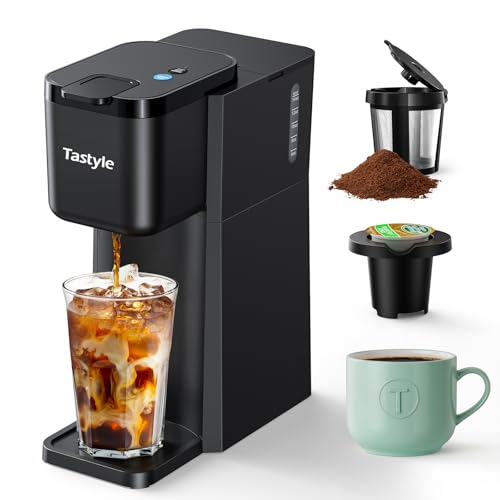
Tastyle Mini Single Serve Hot and Iced Coffee Maker (K310IC)
Badge: Best Grounds-and-Pods Hybrid
Strengths
- Brews both K-Cup pods and loose ground coffee, so one machine serves both habits.
- Widest brew-size range in this group: 6 to 14 oz, for hot and iced coffee.
- Includes a recipe book, a small but real help when dialling in iced coffee ratios.
Trade-offs
- Mini format means a small water capacity and one cup at a time.
- Switching between the pod holder and the grounds basket is an extra step on busy mornings.
- 120V design is for North American outlets, relevant if you travel internationally with it.
Mini spec box
- Format: single serve, K Cup and ground
- Brew sizes: 6 to 14 oz
- Modes: hot and iced coffee
- Power: 120V
- Model: K310IC, 2.0 version, Classic Black
- Included: recipe book
The Tastyle Mini is the answer to the most common household argument in this category: one person wants the freedom of ground coffee, the other wants a pod in hand before they are fully awake. Its verified title states the dual format plainly — “for K Cup and Ground” — and that dual citizenship shapes everything about how it should be judged. As a grounds brewer it covers a sensible 6 to 14 oz span, which means a small strong cup and a full travel mug are both in range, and as a pod brewer it accepts the same capsules the Keurigs in this guide use.
The iced coffee mode deserves a mention because it changes the grounds conversation. Iced coffee from loose grounds is where home brewers most often go wrong, over-diluting as the ice melts; a machine designed to brew hot and iced, shipped with a recipe book for ratios, lowers that learning curve. The honest limitation is scale. This is a mini machine aimed at homes, travel, RVs, offices, and dorms, and its one-cup-at-a-time rhythm suits one or two drinkers, not a breakfast rush. The grounds basket also needs the same rinse discipline as any reusable filter — hybrid convenience does not exempt you from washing the part that touched the coffee. Households researching the health side of the grounds-versus-pods choice will find the companion angle at Best Healthy Coffee Makers worth reading next.
Best for: mixed households that want grounds freedom and pod convenience in one small machine, including iced coffee / Not suited for: anyone brewing for a crowd or wanting a large reservoir.
Keurig K-Express Single Serve Coffee Maker, Evergreen
Badge: Best Pod Reservoir Pick
Strengths
- 42oz removable reservoir — the feature the reservoir-free minis in this guide cannot match.
- Three brew sizes plus a Strong Brew button for a bolder pod cup.
- Travel mug friendly drip tray arrangement for taller cups.
Trade-offs
- Pod-only per its verified title — no loose grounds brewing, so no purchase link in this grounds-focused guide.
- The Evergreen finish is the same machine as the other K-Express colours; you are choosing a colour, not an upgrade.
- A reservoir needs regular washing, or it becomes the part of the machine you taste.
Mini spec box
- Format: single serve K-Cup pod brewer
- Reservoir: 42oz, removable
- Brew sizes: 3, plus Strong Brew button
- Compatibility from verified title: works with all K-Cup pods, travel mug friendly
- Colour: Evergreen
Judge the K-Express on what it is: the mainstream Keurig formula executed with the two features pod drinkers ask for most, a multi-cup reservoir and a strength button. The 42oz removable tank means a solo drinker refills every few days rather than every cup, and because it lifts off, it can actually be washed at the sink — a hygiene point that matters more than most spec sheets admit. Three brew sizes cover the standard mug progression, and the Strong Brew button slows the extraction profile of a pod to pull a bolder cup from the same capsule.
None of that changes the central fact for this keyword: the verified title describes a K-Cup pod machine, and loose ground coffee is not part of its confirmed specification. It appears here, without a link or image, because shoppers comparing “small coffee maker” options will meet it constantly, and because its reservoir is the benchmark the grounds-capable minis are implicitly compared against. If your household is split between pods and grounds, the honest routes are the hybrid Tastyle above or the Hamilton Beach below — both verified for grounds — rather than assuming a pod brewer will improvise with loose coffee. Readers set on this exact format in a combination layout can compare the shortlist logic at Best Hamilton Beach Coffee Makers Pot And Single Cup Combination.
Best for: committed pod drinkers who want a reservoir and a strength option / Not suited for: brewing loose ground coffee.
Keurig K-Express Single Serve Coffee Maker, Mint
Badge: Best Pod Pick for Shared Desks
Strengths
- Same 42oz removable reservoir and three brew sizes as the Evergreen version.
- Strong Brew button gives some control over pod strength.
- A light Mint finish that suits shared kitchens and office counters where black appliances dominate.
Trade-offs
- Pod-only per its verified title — no loose grounds brewing, so no purchase link here.
- Identical internals to the other K-Express colours in this pool; the difference is cosmetic.
- Pod format locks your coffee choice to the capsule catalogue.
Mini spec box
- Format: single serve K-Cup pod brewer
- Reservoir: 42oz, removable
- Brew sizes: 3, plus Strong Brew button
- Compatibility from verified title: works with all K-Cup pods, travel mug friendly
- Colour: Mint
This review exists to make one point clearly, because colour-variant confusion is a quiet tax on coffee shoppers: the Mint K-Express is the same brewer as the Evergreen K-Express reviewed above. Same reservoir, same three brew sizes, same Strong Brew button, same travel-mug-friendly layout. If you are choosing between them, you are choosing a finish for your counter, and the right way to decide is by which colour you want to look at every morning — not by hunting for a performance difference that is not there.
It carries the same prose-only status for the same reason: its verified title is a K-Cup pod specification with no grounds brewing. In a shared-desk setting — the scenario where this finish tends to get bought — the pod format’s zero-measuring convenience is a genuine social feature, since nobody has to learn anyone else’s dose or clean anyone else’s filter. But a guide to the best ground coffee makers would fail its readers if it linked a pod-only machine as though it brewed grounds, so the Mint K-Express is documented, compared, and deliberately left unlinked. If the shared space in question is a home kitchen rather than an office, Best Healthy Coffee Makers To Use At Home explores the at-home version of this same grounds-versus-pods decision.
Best for: pod drinkers choosing a finish for a shared counter / Not suited for: brewing loose ground coffee, or buyers expecting a different machine from the Evergreen version.

Hamilton Beach FlexBrew Advanced 4-in-1 Single Serve Coffee Maker
Badge: Best Overall
Strengths
- Brews both pod packs and loose grounds — verified in the title — with a removable 45 oz reservoir, the largest tank among the linked picks.
- Hot and iced coffee from the same machine, a genuine four-way flexibility (pods or grounds, hot or iced).
- Fast brewing positioning suits weekday mornings better than reservoir-free minis.
Trade-offs
- Still a single-serve machine: one cup per cycle, however flexible the format.
- More parts than a grounds-only brewer — pod holder and grounds basket both need washing.
- Larger counter presence than the mini machines in this guide.
Mini spec box
- Format: 4-in-1 single serve — pod packs and grounds, hot and iced
- Reservoir: 45 oz, removable
- Colour: Black
- Positioning from verified title: fast brewing
The FlexBrew Advanced takes Best Overall because it is the only machine in this pool that removes the grounds-versus-pods decision entirely while also removing the refill chore. The verified specification — “Uses Pod Packs & Grounds” — is backed by the largest reservoir among the linked picks at 45 oz, so the weekday pattern becomes: fill the tank once, then choose per cup whether today is a measured scoop of your own coffee or a grab-and-go pod. For ground coffee specifically, that reservoir matters more than it first appears, because consistent water supply is what lets you keep your dose and ratio stable from cup to cup instead of brewing each mug as a fresh experiment.
The iced mode extends the same logic. Ground coffee brewed for iced drinks needs a stronger starting concentration, and a machine built to serve both temperatures encourages you to learn one grounds routine and apply it twice. The honest limitation is mechanical: flexibility means components. The pod holder and the grounds basket are separate parts, both touch coffee, and both need rinsing; owners who let the grounds basket sit with wet coffee in it will taste that neglect in the next pod cup, because the brew path is shared. Keep both parts on the daily rinse cycle described in the how-to section and the FlexBrew is the most complete answer this pool offers to the grounds question. The brand-focused companion shortlist at Best Hamilton Beech Single Cup Coffee Makers covers the wider single-cup family this machine belongs to.
Best for: households that want verified grounds brewing, pod backup, iced coffee, and a real reservoir in one machine / Not suited for: buyers who want the absolute smallest counter footprint.
Comparison Table
| Machine | Brews loose grounds | Reservoir | Brew sizes | Hot and iced | Link |
|---|---|---|---|---|---|
| Elite Gourmet EHC111A | Yes — reusable filter | None (fill per brew) | 14 oz | No | Check on Amazon |
| Keurig K-Mini Mate | No — pods only | None (fill per brew) | Up to 12 oz | No | — |
| Tastyle K310IC | Yes — grounds basket | Mini format | 6 to 14 oz | Yes | Check on Amazon |
| Keurig K-Express, Evergreen | No — pods only | 42oz removable | 3 sizes | No | — |
| Keurig K-Express, Mint | No — pods only | 42oz removable | 3 sizes | No | — |
| Hamilton Beach FlexBrew Advanced | Yes — grounds basket | 45 oz removable | Single serve range | Yes | Check on Amazon |
How to Choose a Ground Coffee Maker
Start with the filter question. A ground coffee maker lives or dies by how it holds coffee. A reusable mesh filter, like the Elite Gourmet’s, costs nothing to run and produces a full-bodied cup, but passes a little fine sediment and demands rinsing. A grounds basket in a hybrid machine works the same way with the added option of pods. Paper filters — where a machine accepts them — give a cleaner cup and compostable cleanup at the cost of a permanent consumable. Decide which routine you will actually keep up, because the best filter is the one that gets cleaned.
Do the dose math once. A reliable starting ratio for drip-style brewing is roughly one to two tablespoons of ground coffee per six ounces of water, adjusted to taste. That means a 14 oz travel mug wants about three to four tablespoons, and a 6 oz small cup wants about half that. Machines with a wide brew-size range, like the Tastyle’s 6 to 14 oz span, only deliver on that flexibility if you scale the dose with the size — the most common reason a big cup tastes weak is that it was dosed like a small one. Write your preferred dose for each size on a note inside the coffee tin for the first two weeks; after that it is muscle memory.
Reservoir or no reservoir is a lifestyle choice. Reservoir-free machines (Elite Gourmet, K-Mini Mate) guarantee fresh water and tiny footprints, and charge you a refill for every cup. Reservoir machines (the K-Express pair at 42oz, the FlexBrew at 45 oz) trade a weekly wash for weekday speed. Neither is better in the abstract; the right answer depends on whether your mornings have thirty spare seconds or not.
Grind and freshness beat machine features. Pre-ground coffee stales measurably faster than whole beans because grinding multiplies the surface area exposed to air. If you buy pre-ground, buy smaller bags more often and store them airtight away from heat. If you grind at home, a medium grind suits the reusable filters in this guide; very fine grinds slow the drip and can turn the cup bitter, while very coarse grinds under-extract and taste thin. No button on any machine here can rescue stale coffee — which is precisely why the grounds format, with its open choice of coffee, outperforms pods on ceiling if not on convenience.
Check the cup clearance and the drip tray. Travel-mug drinkers should confirm the machine is described as travel mug friendly or has a removable tray; a mug that does not fit turns a single-serve machine into a two-step pour. The K-Express models state travel mug friendliness in their titles, and the Elite Gourmet is built around a 14 oz travel mug format.
How to Brew and Care for a Ground Coffee Maker
The daily brew routine. Step 1: rinse the reusable filter or grounds basket and shake it dry. Step 2: add fresh water — to the reservoir, or measured per cup on reservoir-free machines. Step 3: dose the grounds level, not heaped, so water spreads evenly instead of channelling through the mound. Step 4: brew immediately; grounds sitting in a damp basket for an hour before brewing lose aroma. Step 5: empty the filter as soon as the cup is done and rinse it under the tap. That last step, done daily, is worth more than any monthly deep clean.
The weekly routine. Wash removable parts — filter, basket, drip tray, reservoir — in warm soapy water; the Elite Gourmet’s parts are dishwasher-safe, which removes the last excuse. Wipe the brew head area where spray and steam deposit coffee oils. If your water is hard, watch for slower brewing or a thinner stream, both early signs of scale.
Descaling. Every few months, run a descaling cycle with the manufacturer’s recommended solution or a citric-acid based descaler, followed by two full cycles of plain water. Scale insulates the heating element, the brew temperature drifts down, and ground coffee — which needs properly hot water to extract — shows the problem as sour, weak cups before pod drinkers would notice anything.
Troubleshooting. Problem: coffee tastes weak and watery → check the dose first (scale it to the brew size), then the grind (too coarse), then scale build-up. Problem: coffee tastes bitter or the brew overflows the filter → the grind is likely too fine for a mesh filter, or the dose is heaped so high that water pools and over-extracts the top layer; level the dose and coarsen the grind slightly. Problem: grounds in the cup → a small amount of sediment is normal with reusable mesh filters; a lot means the filter was overfilled or the grind is fine enough to pass the mesh, so reduce the dose and grind coarser.
Ground Coffee vs Pods: An Honest Accounting
The grounds format wins on choice, per-cup ingredient cost control, and packaging waste: a bag or tin of coffee and a reusable filter generate a fraction of the refuse of a capsule habit, and the entire world of roasted coffee — decaf, single origins, local blends — is open to you. It wins on ceiling, too: fresh coffee, dosed to your taste, brewed at the right ratio, is simply better coffee than a sealed portion ground months earlier. Pods win on speed, consistency, and cleanliness: no measuring, no loose grounds on the counter, no filter to rinse, and the same result on a groggy Tuesday as on a careful Sunday. Neither victory is total, which is why the hybrid machines in this guide — the Tastyle and the FlexBrew — exist, and why they earned two of the three links. The mature way to shop is to decide which morning you actually live: the measured one or the rushed one, and buy for that morning rather than the one you imagine.
Building a Ground-Coffee Routine That Actually Sticks
The difference between people who love their ground coffee maker and people who abandon it for pods within a month is rarely the machine. It is the station. Loose grounds ask for four small acts — measure, brew, empty, rinse — and the routine survives only when those acts are frictionless. Set the machine beside the coffee storage, keep the scoop inside the tin or bag so measuring never requires a drawer hunt, and keep a small compost or trash receptacle within arm’s reach of the brew basket so emptying the filter is a two-second tip rather than a walk across the kitchen with a dripping filter. A microfiber cloth living next to the machine handles the inevitable dusting of grounds on the counter; loose coffee is a slightly messy medium, and pretending otherwise is how routines die.
Storage deserves its own paragraph because it quietly decides cup quality more than any feature in this guide. Ground coffee’s enemies are air, light, heat, and moisture, and the worst common storage spot — a clear canister on a sunny counter beside a steaming kettle — combines all four. An opaque, airtight container in a cool cupboard is the correct home, and buying in quantities you finish within a few weeks matters more than the container itself. If you grind beans at home, grind per brew where patience allows, or per day at most; the aroma difference between coffee ground this morning and coffee ground last week is the entire argument for the grounds format, and it evaporates if the grinding happens long before the brewing.
Finally, calibrate once, properly. Pick one coffee, one brew size, and one dose, and brew it five days running without changing anything. Then change exactly one variable — dose up, dose down, or grind one step — and brew again. This boring discipline is how you find the cup you actually like, and it protects you from the classic grounds-owner error of changing three things after one disappointing mug and never learning which change mattered. The machines in this guide are simple; the routine is the product. Build the station, store the coffee properly, calibrate once, and the daily act shrinks to the ninety seconds of measuring and rinsing that separate a grounds household from a pod household.
Common Buying Mistakes
- Assuming every single-serve machine brews grounds. Three of the six machines in this very pool do not. Read the title for explicit grounds wording before you buy.
- Counting colour variants as different machines. The two K-Express finishes here are one brewer. Compare features, not finishes.
- Keeping one dose for every brew size. A 14 oz cup dosed like a 6 oz cup will taste weak no matter how good the machine is.
- Letting the reusable filter sit dirty. Old coffee oils turn rancid and flavour the next cup; rinse after every brew.
- Buying pre-ground coffee in bulk. Grounds stale fast; smaller bags bought more often taste better than a bargain sack.
- Ignoring water. A neglected reservoir or heavy scale will undermine any grounds routine; wash and descale on schedule.
Decaf, Half-Caffeine, and Flavoured Grounds: Where the Format Shines
One advantage of grounds rarely makes the feature lists, yet it decides real households: blending freedom. A drinker cutting caffeine can mix regular and decaf grounds in any proportion — half and half this month, a quarter regular next month — inside the same filter, a titration no pod catalogue sells. Flavoured grounds, from a roaster’s seasonal blend to a supermarket hazelnut, slot into the same routine with no new hardware. Even households split between coffee and tea are served at the pure end of this pool, since the Elite Gourmet’s reusable filter is verified for loose-leaf tea as well as grounds. None of this requires a special machine mode; it is simply what an open format means. When you evaluate the linked picks, weigh this quiet flexibility alongside reservoirs and brew sizes — for many buyers it is the reason the grounds format wins, and it never appears in a specification table.
Final Recommendation
For most readers, the Hamilton Beach FlexBrew Advanced 4-in-1 is the first choice: it is verified for grounds and pods, carries the largest reservoir in the linked group, and covers hot and iced coffee in one footprint. If you want grounds and nothing else — the purest, cheapest-to-run routine — the Elite Gourmet EHC111A is the pick, with its reusable filter and dishwasher-safe parts. If counter space is tight but you still want both formats plus iced coffee, choose the Tastyle Mini K310IC. The three Keurig models remain sensible pod machines, but they are not ground coffee makers, and this guide has deliberately left them unlinked so the recommendation stays honest. Whichever linked machine you choose, spend the first week on the calibration routine described above — one coffee, one dose, one change at a time — before judging the cup. Ground coffee rewards that small patience with a level of control over flavour, cost, and waste that no sealed pod can offer, and it is the reason this format keeps its loyalists decade after decade.
Frequently Asked Questions
Can a Keurig brew loose ground coffee?
On the verified evidence used for this guide, the Keurig models in this pool are specified for K-Cup pods only, with no grounds basket or reusable filter for loose coffee in their titles. That is why they are reviewed as prose-only comparisons. If grounds matter to you, choose a machine whose specification states grounds brewing explicitly, as the Elite Gourmet, Tastyle, and Hamilton Beach titles do.
What grind works best in a reusable filter?
A medium grind is the reliable starting point for the mesh reusable filters in this guide. Very fine grinds can slow the drip, over-extract, and pass sediment into the cup; very coarse grinds under-extract and taste thin. Adjust in small steps from medium based on taste: bitter points finer or slower, sour and weak points coarser or under-dosed.
How much ground coffee should I use per cup?
Start with one to two tablespoons per six ounces of water and scale with the brew size — roughly double for a 12 to 14 oz mug. Then adjust to taste and keep the dose consistent for a week before changing it, so you are judging the ratio rather than daily variation.
Are reusable filters better than paper filters?
They are better on cost and waste — nothing to rebuy, nothing to throw away — and they let more of the coffee’s oils into the cup, which many drinkers read as body. Paper gives a cleaner, sediment-free cup and throwaway cleanup. The practical decider is habit: a reusable filter only wins if you rinse it after every brew.
Can these machines brew loose-leaf tea?
The Elite Gourmet’s verified title explicitly includes loose-leaf tea through its reusable filter. For the other machines, tea is not part of the verified specification used here, so this guide does not claim it — another reason the Elite Gourmet is the purist’s pick.
Is a hybrid machine worse at grounds than a grounds-only machine?
Not inherently. The Elite Gourmet’s advantage is simplicity — one filter, one job — while the Tastyle and FlexBrew add a pod path alongside the grounds basket. What decides cup quality in both designs is the same trio: fresh coffee, a level dose matched to the brew size, and a clean filter. Where hybrids do demand more is housekeeping, because two coffee-contact parts need rinsing instead of one. If you will keep both parts clean, the hybrid’s flexibility costs you nothing in the cup.
How often should I descale a ground coffee maker?
Every few months for typical tap water, sooner if your water is hard or the brew slows and cups start tasting sour and weak. Ground coffee is sensitive to brew temperature, and scale drags that temperature down, so descaling protects flavour as much as it protects the machine.


