Where to buy
Check the latest price, availability and delivery on Amazon. Orders are placed on Amazon. We may earn a commission from qualifying purchases.
- Best overall: Homemate Bed Wedge Pillow for Headboard, Twin Size (White) — Check on Amazon
- Simpledad Bed Wedge Pillow Headboard with Side Pockets, Twin Size — Check on Amazon
- Vekkia Bed Wedge Pillow for Headboard Gap, Queen Size — Check on Amazon
- Homemate Bed Wedge Pillow for Headboard, King Size (White) — Check on Amazon
- Vekkia Wedge Pillow Headboard for Bed Gap, Full Size (54 Inch) — Check on Amazon
See 1 more Amazon option
- EUHAMS Bed Wedge Pillow, Mattress Gap Filler for Headboard, Queen Size — Check on Amazon
Read the full guide ↓
Disclosure: As an Amazon Associate, topratedkitchenware.com earns from qualifying purchases. Links to Amazon on this page are affiliate links; they cost you nothing extra. Listing details such as price and availability change often, so check the current Amazon listing before you buy.
The best headboards for small bedrooms under $30 are not headboards, and in a small bedroom that turns out to be a virtue. A real headboard — a framed panel of wood, metal or upholstered foam that bolts to your bed frame or hangs on the wall — needs materials, hardware and freight, and on Amazon the genuine article starts far above this budget: the cheapest frame-mounted twin headboard we could verify anywhere was a basic metal spindle model in a higher price tier, the cheapest peel-and-stick panel pack that actually looks like a headboard sits in a mid-range tier well above this budget, and a proper bolster headboard pillow is a premium-tier purchase in twin size. But even if one of those fit this budget, a small bedroom would argue against it. A framed headboard has thickness, and thickness pushes the bed further into a room that has no inches to spare. A panel on the wall still leaves the bed standing off it. In a small room, the bed almost always ends up shoved against a wall or into a corner — and that is exactly where the gap problem lives.
What $30 genuinely buys is the product family that has quietly taken over this end of the market: the bed wedge gap filler. These are firm foam triangles, sized to the width of a twin, full, queen or king mattress, that sit inside the gap between the top edge of your mattress and the wall behind it. They occupy space that is already wasted — the trench behind the bed — so they are the only headboard substitute that costs literally zero floor space. They stop pillows, phones, books and remotes sliding down behind the bed, and they give your pillow a backed edge instead of a void. They do not give you a backrest, a style statement or anything to bolt to a frame, and the reviews below say so plainly for each pick. For most small bedrooms we would begin with the Homemate twin wedge, because twin and full beds dominate small rooms and it is cheap, correctly sized and honestly specified. If your bed has no room beside it for a nightstand, look at the Simpledad wedge next — its side pockets do a nightstand’s job in zero extra space. Below you will find a quick picks table, detailed notes on each of the six products, a comparison table, a buying checklist, the mistakes small-room shoppers make most at this price, and answers to the questions that come up again and again.
In this guide
Quick Picks
Short on time, or comparing several options at once? Each row below names a buyer type and the product that suits it, with a link to the listing.
| Buyer type | Pick | Why it stands out | Link |
|---|---|---|---|
| Best overall | Homemate Bed Wedge Pillow for Headboard, Twin Size (White) | Fills gaps up to 8 inches on a twin bed, at zero floor space | Check on Amazon |
| Best when there is no room for a nightstand | Simpledad Bed Wedge Pillow Headboard with Side Pockets, Twin Size | Oversized side pockets store a phone, book or remote at the head of the bed | Check on Amazon |
| Best for queen beds | Vekkia Bed Wedge Pillow for Headboard Gap, Queen Size | Full 60-inch width, rated for gaps up to 6 inches | Check on Amazon |
| Best value, and best for king beds | Homemate Bed Wedge Pillow for Headboard, King Size (White) | Full king width in a single piece — the widest size in the guide | Check on Amazon |
| Best for full beds | Vekkia Wedge Pillow Headboard for Bed Gap, Full Size (54 Inch) | The correct 54-inch width most guides forget | Check on Amazon |
| Best for deal hunters | EUHAMS Bed Wedge Pillow, Mattress Gap Filler for Headboard, Queen Size | Queen-width gap filler; prices move a lot, so check the live price on Amazon | Check on Amazon |
How These Picks Were Chosen
The first filter was the budget itself, applied honestly. Every product below is a real Amazon listing in this budget tier in the United States; where a pick normally sits a little above the line and dips below it on sale, we say so in its review rather than quietly rounding it down. Anything that called itself a headboard but turned out to be a framed panel well above the budget was left out of the picks, however good it might be, because it does not answer the search you actually made — those products are named in the sections below, positioned by tier, so you can see exactly where the genuine floor sits.
The second filter was the room. A small bedroom changes what a good pick looks like in three ways. First, the bed is almost never floating in the middle of the floor: it is pushed against a wall, tucked into a corner, or both, so the gap behind it is created by skirting boards, radiator standoff and frames that cannot sit flush — and it tends to be wider and less even than the gap behind a bed in a big room. Second, floor space is the scarcest resource in the room, so a solution that lives inside the existing gap beats one that adds thickness at the head of the bed and pushes everything six inches toward the door. Third, small rooms often have no nightstand, or room for only one, so storage at the head of the bed stops being a gimmick and becomes a genuine feature. The ranking below reflects all three: correctly sized wedges with stated gap ranges first, and the one pocketed wedge ranked far higher than it would be in a big-room guide.
We did not use these products ourselves. We read the maker listings and specification pages, compared widths, gap ranges and prices across the trackers, and favored products whose listings state the two numbers that decide whether a gap filler works at all: the width of the wedge and the width of the gap it is built to fill. A wedge that is narrower than your mattress leaves open corners at both ends; a wedge built for a 6-inch gap will not close an 8-inch one. Where a listing was vague about a dimension, we say so in the review rather than guess, and the buying checklist below tells you exactly what to measure before ordering — including how to measure when the bed is wedged into a corner and you cannot get behind it.
One thing we looked at closely was price behavior, because this family swings more than most. Prices for these wedges move a lot depending on the week, so check the live price on Amazon on the day you buy. At this budget, when you buy matters almost as much as what you buy, and a wedge that looks overpriced today may sit in a lower tier next week.
The 6 Best Headboards for Small Bedrooms Under $30
Homemate Bed Wedge Pillow for Headboard, Twin Size (White)
Who it suits: Small-bedroom sleepers in twin beds — box rooms, kids’ rooms, studio corners and spare beds — whose pillows keep vanishing behind the mattress.
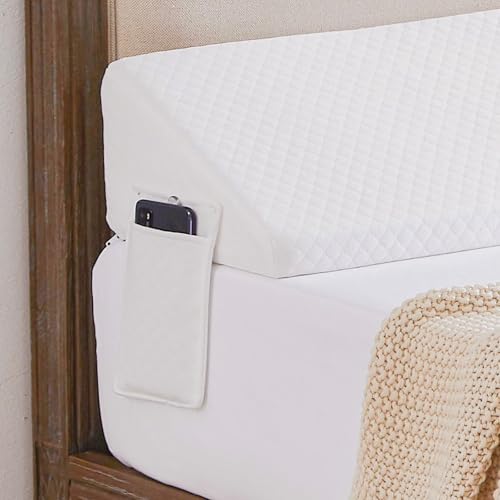
This is the wedge that defines the category at this price, and the twin is the size small bedrooms run on. It is a firm foam triangle 39 inches wide, the full width of a twin mattress, built to close the gap between the mattress and the wall behind it, and the listing rates it for gaps from 0 to 8 inches — the widest stated range in this guide, which matters in small rooms because the gap there is rarely the tidy two inches of a bed standing in open floor. Skirting boards hold the frame off the wall, radiators hold it off further, and in a corner the bed often cannot be pushed fully home at all. An 8-inch rating forgives all of that. Nothing bolts, sticks or straps: the wedge simply rests in the gap, held in place by the mattress behind it and the wall in front of it, and once it is there the nightly migration of pillows, phones and paperbacks down the back of the bed simply stops. Check the live price on Amazon before you buy — this is a budget-tier pick, and prices in this family move often.
The footprint argument deserves emphasis, because it is the whole case for this product in a small room. A framed twin headboard is typically two to four inches thick and mounts to the frame, so the mattress starts that much further from the wall; in a room where the bed already touches two walls, those inches come straight out of the walkway at the foot or the side. The wedge adds nothing. It lives entirely inside the gap that the skirting board and frame standoff created anyway, converting dead space into a sealed edge. It also arrives compressed and needs a day or two to expand to its full shape, a family trait noted in deal coverage of the Homemate line — in a small room, unbox it on the bed itself, since there may be nowhere else to lay it out while it opens.
- Full 39-inch twin width — no open corners for pillows to escape through.
- Widest stated gap range in the guide: fills gaps from 0 to 8 inches, forgiving skirting boards and radiator standoff.
- Zero footprint — it occupies the gap itself, not the room.
- Budget-tier pricing — check the current price on Amazon.
Honest limitation: It is a 6-inch-class foam wedge, not a backrest — it supports your pillow at the head end, but there is nothing tall to lean your back against for reading, and in a small room where the bed doubles as the only seat, that absence is felt more, not less.
Choose it if your twin bed sits against a wall with no headboard and the gap behind the mattress eats pillows. Skip it if you want something to sit up against — that is the bolster class, a premium-tier option well above this budget, and it will cost you leaning depth a small bed can ill afford.
Simpledad Bed Wedge Pillow Headboard with Side Pockets, Twin Size
Who it suits: Twin-bed sleepers in rooms with no nightstand — or no room for one — who need somewhere at the head of the bed for a phone, book, glasses and remote.
First, the disclosure this pick owes you: at recent readings this wedge has sat just over this guide’s budget line. It lives on the line rather than under it, and we include it as a disclosed straddler: buy it only when the live price on Amazon dips into budget, not at any price. In a general guide that would park it near the bottom of the list. In a small-bedroom guide it earns second place, because its one genuinely different feature — oversized side pockets built into the wedge, sized for a book or tablet, a phone, a remote or glasses — solves the second problem of the small bedroom, not just the first. Where there is no nightstand, the things a nightstand would hold end up on the floor, on the mattress, or down the gap behind the bed. The pockets give them a home that takes up no space the room does not already have, because the wedge itself was going into the gap anyway.
The wedge follows the family pattern: 39 inches wide for a twin, rated for gaps from 0 to 8 inches, firm foam that arrives compressed and expands over a day or two. The pockets change how the product ages in a way worth thinking about — a plain wedge is forgotten once installed, but a wedge you reach into every night gets pulled, tugged and leaned on, so treat the pocket stitching as the wear point and do not overload it with hard, heavy objects. Note, too, that the pockets sit at the sides of the head end: if your twin is pushed into a corner with one long side hard against a wall, the pocket on that side is the one you will use least, so plan which way round the wedge goes before it expands. A note on the category’s marketing: wedges like this are often sold with positioning and health language in their titles. This guide makes no such claim for any of them. A gap filler is a foam cushion that closes a gap and holds a phone; it is a comfort and convenience product, not a medical device, and it should be bought on those terms.
- Oversized side pockets — the only storage feature in the guide, and storage that costs no floor space.
- Twin width with the full 0 to 8 inch gap rating.
- It dips under budget regularly — check the live price on Amazon and buy on a dip.
Honest limitation: It often sits just over the budget line, and it only earns its place when bought on one of its frequent dips; the pockets are also soft storage, not a shelf — nothing heavy, nothing breakable.
Choose it if you have a twin bed, no nightstand, and the patience to buy it when it dips into budget. Skip it if it is sitting above budget when you shop, or if a nightstand already stands beside the bed — the Homemate twin does the same wedge job without the straddler risk.
Vekkia Bed Wedge Pillow for Headboard Gap, Queen Size
Who it suits: Queen-bed owners in small primary bedrooms — a queen in a tight room is common — who want the gap closed at the correct width.
A queen bed in a small bedroom usually touches at least one wall and often sits in a corner, which means the head gap is joined, in many rooms, by a side gap along the wall — more on that in the sections below. This Vekkia wedge handles the head end: a foam triangle spanning the full 60 inches of a queen mattress, rated by the maker for gaps from 0 to 6 inches. Check the live price on Amazon — it sits in the budget tier, and it is one of the picks that is both correctly sized and priced for this guide.
Where the Vekkia earns its place over the cheaper queen alternatives is the stated gap range. Six inches covers the great majority of real queen setups, where the gap is usually the depth of a skirting board plus the frame’s own standoff. In a small room, though, measure rather than assume: a queen shoehorned into a room often cannot be pushed fully against the wall because a radiator, a window sill or an awkwardly placed outlet is in the way, and the resulting gap can run past 6 inches — in which case the 8-inch-rated Homemate picks are the safer buy. The white sibling of this same wedge, rated for gaps up to 5.5 inches, is a near-identical fallback if the grey is out of stock — check the price on Amazon for both colorways on the day and take the one in budget.
- Full 60-inch queen width, the size most shoppers actually need.
- Maker-rated for gaps from 0 to 6 inches, the most common real-world span.
- Budget-tier queen pick — check the current price on Amazon.
Honest limitation: If your queen bed stands more than 6 inches off the wall — a real possibility when a radiator dictates the bed’s position — this wedge will not close the gap. Measure first, and look at the 8-inch-rated picks if your gap is wider.
Choose it if you have a queen bed and a gap of 6 inches or less. Skip it if your gap is wider than 6 inches or your bed is a king — the wedges above and below are sized for those jobs.
Homemate Bed Wedge Pillow for Headboard, King Size (White)
Who it suits: King-bed owners — rare in small bedrooms, but not unknown in studio flats where the bed is the room — who assumed everything in their size costs more.
Pricing in this family does not follow the usual bigger-costs-more logic, and this pick is the proof. The king version of the Homemate wedge measures 76 by 10 by 6 inches — the full width of a king mattress — and is rated for the same 0 to 8 inch gaps as the twin, yet it sits in the same budget tier as the smaller sizes — check the live price on Amazon. Prices for this size swing widely, so if it is showing in budget when you read this, it is not a price to hesitate over.
A king bed without a headboard has the worst version of the gap problem: two pillows, two sleepers, and six feet of open trench behind the mattress for things to fall into, usually at 3 a.m. — and in a small room, retrieving them means climbing over the bed, because there is no space to walk behind it. A single 76-inch wedge closes the whole span in one piece, which matters more than it sounds — two narrower wedges butted together always develop a seam in the middle, exactly where the gap between two pillows already invites trouble. Like the rest of the family it arrives compressed, needs 24 to 48 hours to expand, and asks for nothing in the way of fitting: unbox, wait, slide it in.
- Full 76-inch king width in a single piece — no center seam.
- Budget-tier pricing even at king size — check the current price on Amazon.
- Same wide 0 to 8 inch gap rating as the twin pick.
Honest limitation: Its price is among the most volatile in the guide, so the deal is the timing, not the product; at its high readings it leaves this budget entirely.
Choose it if you have a king bed, a gap of 8 inches or less, and the live price is in budget. Skip it if the listing has swung back up above budget — wait, or take the queen-width advice above and check the Vekkia king wedge on Amazon.
Vekkia Wedge Pillow Headboard for Bed Gap, Full Size (54 Inch)
Who it suits: Full-bed (double-bed) owners — the classic small-bedroom compromise size — which wedge makers most often forget to make.
Shop for gap fillers and you will find twins and queens everywhere and fulls almost nowhere, which is odd, because the full is the bed of the small spare room, the teenager’s room and the first double in a flat that cannot fit a queen. This Vekkia is the properly sized answer: 54 inches wide, 10 inches deep and 6 inches tall, matching a full mattress corner to corner. Check the live price on Amazon — it sits in the same budget tier as the rest of the family. One disclosure: the listing title for this size does not state a gap range the way the queen version does, so check the specification section on the listing against your measured gap before ordering — the checklist below explains how, including how to measure when the bed is against the wall and staying there.
The reason the correct width matters more than any other number is the corners, and in a small room the corners are usually against walls, where a mistake cannot be reached to fix it. A queen wedge on a full bed overhangs by three inches at each end, where it catches on bedding and slowly works itself sideways; a twin wedge on a full bed leaves seven inches of open gap at each side, which is where the pillow goes. The 54-inch wedge simply disappears into the job: it spans the bed, fills the trench, and leaves no edge to catch, migrate or leak pillows.
- True 54-inch full width — the hard-to-find size, correctly made.
- Same 10 by 6 inch wedge profile as the family’s queen and king versions.
- Budget-tier pricing, in line with the family — check the current price on Amazon.
Honest limitation: The listing does not publish a gap range for this size in its title, so the one measurement that matters most has to be confirmed in the listing’s details before you buy.
Choose it if your bed is a full and the gap behind it is in the usual few-inches range. Skip it if your gap is unusually wide — measure, and favor an 8-inch-rated pick if it is.
EUHAMS Bed Wedge Pillow, Mattress Gap Filler for Headboard, Queen Size
Who it suits: Patient deal hunters with a queen bed in a small room, who would rather watch a price for a week than pay the first number they see.
On paper this is a straightforward queen-width gap filler of the same foam-triangle pattern as the Vekkia above, and it belongs in this guide on merit as a budget-tier queen option — check the live price on Amazon. What makes it a separate pick is how much its price moves: the same wedge can sit in very different tiers depending on the week, and the entire skill in buying it is timing. Bought low, it is strong value in this guide; bought at the top of its swing, it is not a pick at all, and no review should pretend otherwise.
That volatility cuts both ways, and the honest way to use this listing is as your benchmark. If the Vekkia queen above is out of stock or has drifted up, check this one; if this one has drifted up, check the Vekkia. Between the two of them, one is almost always sitting in the mid-twenties. What we cannot give you for the EUHAMS is a verified gap range or dimensions beyond its queen sizing — its listing is thinner on specifications than the two brands above — so it suits a buyer whose gap is modest and typical. In a small room, that caveat bites a little harder than usual: small-room gaps are the ones most likely to be widened by a radiator or a corner that will not square, so if your measured gap is anywhere near the top of the usual range, take a pick with a stated rating instead.
- Queen width in the budget tier — check the current price on Amazon.
- One of the widest price swings in the guide — timing matters.
- A useful second source for the queen size when the Vekkia is out of stock.
Honest limitation: Its listing publishes fewer specifications than the Homemate and Vekkia listings — no stated gap range was verifiable — and at its high price readings it leaves this budget entirely.
Choose it if you catch it in budget and your queen’s gap is a typical few inches. Skip it if it is showing well above budget, or if you need a guaranteed 8-inch fill — the Homemate picks state their range.
Comparison Table
| Product | Type | Size | Gap filled | Price | Link |
|---|---|---|---|---|---|
| Homemate Bed Wedge Pillow, Twin (White) | Foam gap-filler wedge, freestanding | Twin, 39 in | 0–8 in | Check price on Amazon | Check on Amazon |
| Simpledad Bed Wedge Pillow with Side Pockets | Foam gap-filler wedge with storage pockets, freestanding | Twin, 39 in | 0–8 in | Check price on Amazon — often just over budget | Check on Amazon |
| Vekkia Bed Wedge Pillow for Headboard Gap | Foam gap-filler wedge, freestanding | Queen, 60 in | 0–6 in | Check price on Amazon | Check on Amazon |
| Homemate Bed Wedge Pillow, King (White) | Foam gap-filler wedge, freestanding | King, 76 in | 0–8 in | Check price on Amazon | Check on Amazon |
| Vekkia Wedge Pillow Headboard for Bed Gap | Foam gap-filler wedge, freestanding | Full, 54 in | Check listing | Check price on Amazon | Check on Amazon |
| EUHAMS Bed Wedge Pillow, Mattress Gap Filler | Foam gap-filler wedge, freestanding | Queen, 60 in | Check listing | Check price on Amazon | Check on Amazon |
How to Choose a Headboard for a Small Bedroom Under $30
- Name the real problem first. Things falling behind the bed, nowhere to put a phone at night, a wall getting scuffed, nothing to lean against, or a room that looks unfinished — the wedges in this guide solve the first problem completely, the second if you take the pocketed pick, and the last two barely or not at all. Buy for the problem you have.
- Measure the gap before anything else. Push the mattress firmly toward the foot of the bed and measure the space between its head edge and the wall at its widest point. That number, not your bed size, decides which wedge works. In a small room, expect skirting boards and radiators to have made it wider than you guess.
- Measure from the side when the bed is in a corner. If you cannot get behind the bed — and in a small room you usually cannot — measure at the exposed end and add the depth of the skirting board or radiator standoff you can see along the side wall. The gap is rarely smaller than that.
- Match the wedge width to the mattress. Twin is 39 inches, full 54, queen 60, king 76. A wedge narrower than the mattress leaves open corners; a wider one overhangs and migrates. In a tight room there is no spare width at either end to hide a mistake.
- Check the gap rating against your measurement. The stated ranges in this guide run from 0–6 inches to 0–8 inches. A wedge rated below your gap will sit on top of the mattress edge instead of down in the trench, and will wander.
- Count the walls, not just the gap. A bed in a corner has a head gap and often a side gap. A wedge fixes the head end only. If the side gap is where things fall, no headboard-width wedge solves it — that is a different, smaller purchase, or a reason to rearrange the room.
- Decide whether pockets matter. If the room has no nightstand — a box room, a dorm bed, a child’s room — the pocketed wedge earns its small premium. If a nightstand exists, pockets are decoration.
- Give the foam its expansion time. These wedges ship vacuum-compressed and need 24 to 48 hours to reach full shape. Unbox it on the bed if floor space is short, judge the fit on the second night, and keep the packaging until then.
- Check the live price on the day you buy. This family’s prices swing unusually hard. A wedge that looks overpriced today may be the best-value pick in the guide next week, and vice versa — always check the live price on Amazon.
- Read the return terms. Foam goods are awkward to send back once expanded — doubly so if returning means hauling it through a room with no working space. If your gap measurement is uncertain, favor the listing whose return terms you have actually read.
The Zero-Footprint Headboard: Why a Wedge Suits a Small Room
Every piece of bedroom furniture is a negotiation with the floor plan, and in a small bedroom the floor plan always wins. A framed headboard costs two to four inches of bed length in frame thickness alone, and because a frame-mounted panel cannot sit flush to the wall, the practical cost is higher: the whole bed — mattress, bedding, sleepers — stands that much further into the room, and the walkway at the side or the clearance at the foot shrinks by the same amount. A wall-mounted panel avoids the thickness but not the standoff, since the mattress still has to clear the skirting board. A bolster pillow, the one product in the staircase that gives a real backrest, sits on top of the mattress and takes its depth out of your sleeping length instead — on a twin bed in a small room, that is a fifth of the bed given over to a cushion.
The wedge is the only product in this guide that takes nothing. It does not stand on the floor, hang on the wall or sit on the mattress. It fills a space that already exists and serves no purpose: the gap between the mattress and the wall, created by the skirting board, the frame’s legs and, in many small rooms, a radiator that dictates exactly where the bed can go. Filling it changes the room’s usable dimensions not at all, while changing the bed’s behavior completely — the trench that swallowed pillows, chargers and paperbacks becomes a sealed, backed edge. That is why the small-bedroom version of this guide ranks these products without apology. In a big room, a wedge is the cheap substitute for a headboard. In a small room, it is arguably the correct tool outright, and the framed panel is the compromise — one that costs money the budget does not have and space the room does not have.
Corners, Baseboards and Radiators: Why Small Rooms Have Worse Gaps
The gap behind a bed is not an accident; it is a sum. The skirting board contributes its depth, usually around half an inch to an inch. The frame contributes its own standoff, because legs and rails rarely sit flush. Bedding contributes a little, since a tucked duvet pushes the mattress forward over time. In a large room those small numbers stay small, because the bed can be pulled square to the wall and pushed home. In a small room the sum grows teeth. The bed goes into a corner, and corners are rarely square, so the head end sits at a slight angle and the gap runs from two inches at one corner to five at the other. A radiator behind the bed — a classic small-room layout, because the radiator wall is the wall nothing else can use — holds the whole frame off by the radiator’s depth plus a working clearance, and the gap becomes a uniform six or seven inches. A window sill, a sloping ceiling, an outlet exactly where the frame wants to be: each one is paid for in gap.
Two practical consequences follow. The first is that small-room shoppers should measure the widest point of the gap, not the average, and should favor the widest stated rating their budget allows — which is why the 0 to 8 inch picks lead this guide. A wedge that seals the narrow end and perches at the wide end will migrate toward the wide end and reopen the narrow one. The second is the corner problem: a bed pushed into a corner often has a gap along its side as well as its head, and things fall down both. Be honest about which gap is actually losing your belongings. The wedges here are head-end products, mattress-width by design; a side gap is a narrower trench, and stuffing a headboard wedge along it is the wrong shape at the wrong price. If the side gap is the real thief, the fix is usually free — move the bed the few inches the room allows — and the wedge budget belongs at the head, where the pillows are.
What a Headboard Actually Does — and Which of Its Jobs $30 Can Buy in a Small Room
A headboard does four jobs, and it is worth separating them, because the products at this price do them very unequally. The first job is mechanical: it closes the space behind the mattress so pillows, phones, books and toys stop falling into it. The second is protective: it keeps pillows and bedding from rubbing the wall paint, and keeps your head off a cold wall in winter. The third is postural: it gives you something firm and tall to lean against for reading, working or watching television in bed. The fourth is visual: it finishes the room, and it is the job in every photograph that made you want one.
The foam wedges in this guide do the first job completely — arguably better than a real headboard, because they close the gap at mattress level, which is where things actually fall. They do the second job only at mattress height; the wall above the bed is as exposed as ever. They do the third job barely: a wedge about 6 inches tall backs your pillow, but your back still meets the wall — and in a small bedroom, where the bed is frequently the only comfortable seat in the room, that limitation deserves to be stated at full strength rather than softened. They do the fourth job not at all — nobody has ever walked into a bedroom and admired a gap filler. None of that makes them bad products. It makes them honest ones, bought for the right reason. If your problem is the 3 a.m. pillow retrieval — performed, in a small room, by climbing across the bed because there is no way around it — a budget-tier wedge solves it tonight. If your problem is that the room looks unfinished, no product in this guide will fix it, and the staircase is worth knowing: the gap filler sits in the budget tier, the simplest real headboard (a basic metal twin) sits a tier above, the peel-and-stick panelled look sits higher still, and the leaning bolster cushion is a premium-tier purchase. A $30 budget stands on the first step. That is not a failure of the budget — for the commonest problem, it is the only step that matters — but no honest guide should let you believe the staircase is flat.
Common Buying Mistakes
- Searching for a framed headboard at a foam price, then feeling cheated by honest wedges that never claimed to be furniture.
- Forgetting what the headboard would have cost in space: ordering a framed panel for a room where its thickness pushes the bed into the only walkway.
- Ordering a wedge without measuring the gap, and discovering a 6-inch wedge cannot close an 8-inch trench left by a radiator.
- Measuring the gap at its narrowest point in a corner setup, where the gap widens across the bed’s width.
- Buying the wrong width — a queen wedge overhanging a full bed, or a twin wedge leaving both corners of a queen open, with no room at the sides to adjust it later.
- Expecting a head-end wedge to fix a side gap along a corner wall; it is the wrong shape for that trench.
- Judging a vacuum-packed wedge in its first hour, before it has expanded to its real shape and firmness.
- Expecting a 6-inch wedge to work as a reading backrest in a room where the bed is also the sofa; it backs a pillow, not a person.
- Paying the top of a wedge’s price swing because the listing was open in a tab; this family’s prices move by tens of dollars between weeks.
- Overloading the pocketed wedge’s side pockets with hard, heavy objects until the stitching gives — the pockets are for a phone, a book and a remote, not a water bottle and a tablet in a hard case.
Final Recommendation
- Most small bedrooms (twin bed): Homemate Bed Wedge Pillow for Headboard, Twin Size (White).
- No nightstand beside the bed: Simpledad Bed Wedge Pillow Headboard with Side Pockets, Twin Size — bought on a dip.
- Queen beds: Vekkia Bed Wedge Pillow for Headboard Gap, Queen Size.
- King beds and best value: Homemate Bed Wedge Pillow for Headboard, King Size (White).
- Full beds: Vekkia Wedge Pillow Headboard for Bed Gap, Full Size (54 Inch).
- Deal hunters with a queen: EUHAMS Bed Wedge Pillow, Mattress Gap Filler for Headboard, Queen Size — bought low.
Our top two are the Homemate twin for the beds small rooms actually contain and the Simpledad for the rooms that cannot fit a nightstand, because between them they cover the two problems that define the small bedroom: the gap behind the bed and the missing surface beside it. Both solve their problem inside space the room has already written off, which is the only kind of solution a small room can accept for free. If your bed is a queen, take the Vekkia; if it is a king, take the Homemate king while its live price sits in budget — it is the rare case of the biggest size sitting in the same tier as the smallest. None of these products will finish a room, hold your back up or impress a guest, and they do not try to. They are small, honest foam fixes for a nightly annoyance — measure your gap at its widest point, match your width, check the live price on Amazon, and order the one that fits the bed and the room you have.
Related guides
Frequently Asked Questions
Can you really buy a headboard for under $30?
Not a genuine one. No frame-mounted, wall-mounted or freestanding headboard — metal, wood or upholstered — verifiably sells at or near $30 on Amazon; a basic metal twin headboard sits in a higher tier, and peel-and-stick panel packs that imitate the look sit higher still. What $30 honestly buys is a gap-filler wedge, which does a headboard’s most practical job — sealing the space behind the mattress — without being furniture, and without taking up any of your room.
Why is a wedge a better fit for a small bedroom than a cheap framed headboard?
Space. A framed headboard has thickness and standoff, so the bed stands further into the room and the walkway shrinks; a bolster backrest takes its depth out of your sleeping length. A wedge lives inside the gap that already exists behind the mattress, so it costs zero floor space, zero wall space and zero bed length — the only headboard substitute of which that is true.
What does a bed wedge gap filler actually do?
It fills the space between the top edge of your mattress and the wall behind it, so pillows, phones, books and other small items stop sliding down behind the bed. It also gives your pillow a backed edge to rest against. It is a comfort and convenience product: it does not attach to anything, support your back for sitting up, or change how the room looks.
How do I measure the gap if my bed is pushed into a corner?
Measure at whichever end of the head of the bed you can reach, then add what you can see along the side wall: the depth of the skirting board, plus the depth of a radiator and its clearance if the bed stands off one. Corner gaps also widen across the bed’s width because corners are rarely square, so measure both ends if you can and buy for the widest reading. When in doubt, favor a wedge with the widest stated rating — the 0 to 8 inch picks in this guide.
My bed has a gap along the side as well as the head. Will one wedge fix both?
No. These wedges are mattress-width triangles made for the head end. A side gap is a different, narrower trench, and a headboard wedge is the wrong shape for it. If things mainly fall down the side, first try moving the bed the few inches the room allows; spend the wedge money at the head end, where the pillows are.
There is a radiator behind my bed. Does that change the choice?
It changes the measurement, not the product. A radiator holds the frame off the wall by its own depth plus clearance, so the gap is wider and more uniform — often six or seven inches. Measure it honestly and choose a wedge rated to cover it; the 0 to 8 inch picks exist for exactly this setup. Do not push the bed hard against a radiator to shrink the gap, and do not rest foam directly on a hot radiator surface.
Will a gap filler work if I have no headboard at all?
Yes — that is its most common use, and the standard small-bedroom setup. The wedge sits between the mattress and the wall itself, so a bed with no headboard is exactly what it was designed for. It also works in front of an existing headboard when the frame stands the mattress a few inches away from it.
Do these wedges attach to the bed or the wall?
No. Every pick in this guide is freestanding: the wedge rests in the gap and is held in place by the mattress on one side and the wall or headboard on the other. There is no adhesive, no straps and no hardware, which is why correct width and gap sizing matter — a well-fitted wedge has nowhere to go.
How long does the foam take to expand?
These wedges ship vacuum-compressed, and coverage of the family puts full expansion at 24 to 48 hours after unboxing. In a small room, unbox it on the bed itself if floor space is short. Fit and judge the wedge after that window, not straight out of the packet, and keep the packaging until the first two nights have passed.
Can a wedge replace a headboard for sitting up and reading?
Only partly. A wedge about 6 inches tall supports your pillow at the head of the bed, which helps, but it is not a backrest — your back still leans on the wall. That matters more in a small bedroom, where the bed often doubles as the only seat. If reading in bed is the main job, the honest product is a bolster headboard pillow, and the benchmark twin model sits in a premium tier, well above this budget — and it will take its depth out of your sleeping length, so measure the bed before choosing that route.
What if my gap is wider than 8 inches?
Then no wedge in this guide will seal it, and you should not stack two wedges and hope. First check whether the bed can simply be moved closer to the wall — an oversized gap is often just a frame standing on its own standoff, though in a small room a radiator or a corner may make the gap structural. If it is structural, the money is better spent toward the simplest genuine headboard, which sits in a higher tier, than on foam that cannot span the space — accepting that the headboard will cost the room a few inches the wedge would not have.
- Best Bed Frame Under $100
- Best Adjustable Bed Frame Under $30
- Best Dresser Under $30
- Best Bed Sheet Set Under $75