Disclosure: topratedkitchenware.com is reader-supported. When you buy through links on our site, we may earn an affiliate commission from Amazon and other retailers, at no extra cost to you.
Where to buy
This guide to best imersion stick blenders is built around six verified picks, each documented from its own Amazon listing so you can check the latest price on Amazon and confirm the current configuration before you decide. The shortlist below reflects this guide’s angle — the classic stick format — reach, grip and in-pot control (keyword spelling kept as searched) — and every name links to the listing used for this review.
- KitchenAid Variable Speed Hand Blender with Attachments KHBV83 — Best Overall. Check on Amazon for the current listing details.
- Bonsenkitchen Immersion Hand Blender — Best Simple Pick. Check on Amazon for the current listing details.
- Cuisinart Smart Stick 2-Speed Hand Blender CSB-175 — Best for In-Pot Reach. Check on Amazon for the current listing details.
- KOIOS Immersion Blender 1000W 3-in-1 — Best High-Watt Pick. Check on Amazon for the current listing details.
- OVENTE Electric Corded Hand Blender HS560B (Black) — Best Minimalist Pick. Check on Amazon for the current listing details.
- Braun MultiQuick 5 Hand Blender — Best Ergonomics Pick. Check on Amazon for the current listing details.
Read the full guide ↓ for the evidence behind each badge, the honest limitations of every pick, and the checks that matter more than any headline claim.
Finding the best imersion stick blenders is really a search for a tool that disappears into your cooking: powerful enough for the jobs you actually make, controlled enough not to redecorate the kitchen, and quick enough to clean that you reach for it without thinking. This guide compares six verified immersion blenders side by side, states plainly what each product title does and does not prove, and gives every pick a full review — strengths, trade-offs, a spec box drawn only from its listing, and a clear statement of who should skip it. If you are weighing neighbouring searches at the same time, our guide to Best Immersion Blenders Americas Test Kitchen covers the closest overlapping question.
A note on the words first, because the search itself contains a common misspelling: “imersion” is how many shoppers type “immersion”, and the tool both spellings point to is the same — a stick blender whose guarded blade end immerses directly in the food. This guide keeps the keyword exactly as searched in its title and headings, and uses the standard spelling in the body where clarity matters. What defines the format is the stick: a motor in the handle, a shaft, and a blade guard that works inside your pot, pan or beaker instead of asking the food to come to it.
Stick format shopping turns on a handful of physical specs, and the good news is that several are stated plainly in this pool: 8-inch arms and shafts on the KitchenAid KHBV83 and both Cuisinart designs, stainless blades on most picks, and speed systems from simple two-speed layouts to twelve speeds with turbo. Reach decides whether in-pot blending is comfortable or a steam-dodging exercise; grip decides whether minute three of a thick puree feels controlled or tiring. The reviews below weight those physical facts heavily, because for a stick blender they are the performance.
What follows is organised the way careful shoppers actually decide: key takeaways first, then the quick picks, the method behind them, and the detailed reviews. After that come a comparison table, a full buying guide, a practical how-to layer with troubleshooting, guidance specific to this keyword’s angle, the mistakes that waste the most money, and a final recommendation with the questions buyers ask most. Nothing in this guide relies on a fixed price or a fixed rating figure, because both change; what does not change is the design evidence in each listing, and that is what the rankings rest on.
Key Takeaways
- Start with control, not wattage: for best imersion stick blenders, the speed system decides how usable any motor feels at the pot.
- Our first-listed pick, the KitchenAid Variable Speed Hand Blender with Attachments KHBV83, earns its place on the balance of its stated evidence — No wattage is stated in the title.
- Where a title states no wattage, this guide says so; undocumented power is treated as unknown, never upgraded by reputation.
- Reach matters: stated 8-inch arms and shafts keep the blade guard submerged and your hand clear of steam in a full pot.
- Attachments are worth paying for only when they match your week — choppers for small prep, whisks for eggs and cream, beakers for small batches.
- Technique beats specification: submerged guard, gentle start, slow passes and short bursts will improve any pick in this guide.
In this guide
Quick Picks
All six picks at a glance. Badges are used identically here and in the detailed reviews, and each row links to the same Amazon listing documented in this guide’s sources.
| Pick | Badge | Why it stands out | Listing |
|---|---|---|---|
| KitchenAid Variable Speed Hand Blender with Attachments KHBV83 | Best Overall | Variable speed trigger; Not stated in title motor evidence; Blending pitcher; whisk; chopper; removable 8-inch blending arm | Check on Amazon |
| Bonsenkitchen Immersion Hand Blender | Best Simple Pick | 2 mixing speeds; Not stated in title motor evidence; Stainless steel blades; portable stick format | Check on Amazon |
| Cuisinart Smart Stick 2-Speed Hand Blender CSB-175 | Best for In-Pot Reach | 2-speed with one-touch slide control; 300W motor evidence; 8-inch reach for in-pot blending | Check on Amazon |
| KOIOS Immersion Blender 1000W 3-in-1 | Best High-Watt Pick | 12 speeds with turbo mode; 1000W motor evidence; Whisk; milk frother; anti-scratch design; stainless steel blade; non-BPA note | Check on Amazon |
| OVENTE Electric Corded Hand Blender HS560B (Black) | Best Minimalist Pick | 2 mixing speeds; 300W motor evidence; Stainless steel blades; slim stick format; black finish | Check on Amazon |
| Braun MultiQuick 5 Hand Blender | Best Ergonomics Pick | Dual speed; 350W motor evidence; Beaker; whisk; stainless steel blades; slip-proof ergonomic handle | Check on Amazon |
How These Picks Were Chosen
This guide is research-led. We did not hands-on test these blenders, and no sentence in it pretends otherwise. Instead, every pick comes from a verified pool in which the product’s identity, Amazon listing and image were confirmed against the retailer’s own data, and every factual claim in the reviews — wattage, speed system, shaft or arm length, blade material, included attachments — traces to the product’s own title. When a title is silent on a spec, the review leaves the spec out rather than filling it from memory or from a different model’s listing. Readers comparing our shortlist with Best Immersion Blenders And Hand Blenders will find the same evidence standard applied there.
The pool was then ranked for this keyword’s specific angle: the classic stick format — reach, grip and in-pot control (keyword spelling kept as searched). That ranking is a judgement, and it is labelled as one — badges summarise the judgement, while the spec boxes and the strengths and trade-offs lists show the evidence it rests on, so a reader who weights the criteria differently can re-rank the same six tools with confidence. Picks whose titles state their wattage are credited with exactly that figure and no more; maximum figures are reported as maximums; and two otherwise strong designs in many of these line-ups state no wattage at all, which their reviews flag rather than hide.
Finally, the guide applies three standing editorial rules. No static prices appear anywhere, because prices move and a printed figure would mislead within weeks; linked picks say “check on Amazon” and prose refers only to qualitative tiers. No fixed star ratings or review counts appear, for the same reason. And no pick is described with a test result, award or endorsement it does not carry in its own listing — a discipline that matters most for the editorial-lens keywords in this series, where borrowed authority would be easy to fake and wrong to imply.
The 6 Picks for best imersion stick blenders, Reviewed in Detail

KitchenAid Variable Speed Hand Blender with Attachments KHBV83
Badge: Best Overall
- Speed control: variable speed trigger
- Blending arm: removable, 8 inch
- Included: blending pitcher, whisk and chopper attachments
- Finish: black matte
- Power source: corded
The KHBV83 is KitchenAid’s fuller-kit answer to the simpler KHBV53: the same removable 8-inch arm and trigger-style variable speed, extended with a blending pitcher, a whisk and a chopper. That trio maps neatly onto a real cooking week — pitcher for smoothies and dressings, whisk for eggs and cream, chopper for the onion-and-herb jobs that are too small for a food processor and too tedious for a knife. The trigger control earns its place at the soup pot, where the first press decides whether dinner stays in the pot. As with its sibling, the title states no wattage, so the honest comparison is about control, reach and kit completeness rather than a power figure. For households replacing several small appliances with one motor body, this is the KitchenAid configuration to look at first.
As a stick, KitchenAid Variable Speed Hand Blender with Attachments KHBV83 is judged here on reach, grip and control. Its title evidence includes blending pitcher; whisk; chopper; removable 8-inch blending arm, and its speed system — variable speed trigger — decides how gracefully it starts in a full pot. Those physical facts, more than any headline, predict whether it will feel right across a three-minute soup blend.
Strengths
- The full attachment trio — pitcher, whisk and chopper — covers most small prep jobs
- Removable 8-inch arm gives in-pot reach and separates for washing
- Trigger variable speed maps pressure to power for splash-free starts
Trade-offs
- No wattage appears in the title, limiting headline power comparison
- Three attachments mean three things to wash after a full prep session
- Corded operation ties you to an outlet, as with every pick in this guide
Best for: cooks who want overall in an immersion blender, matched to the jobs its title actually claims. / Not suited for: shoppers whose priorities contradict its stated evidence — read the trade-offs above before deciding.

Bonsenkitchen Immersion Hand Blender
Badge: Best Simple Pick
- Speed control: 2 mixing speeds
- Blades: stainless steel
- Format: electric handheld stick mixer
- Stated uses: smoothies, purees, baby food, soup, emulsions
Bonsenkitchen’s stick is the minimalist entry in this pool: an electric handheld blender with stainless steel blades and two mixing speeds, aimed squarely at smoothies, purees, baby food, soup and emulsions. There is a real virtue in that restraint. A two-speed stick has almost nothing to learn, almost nothing to store, and a rinse-under-the-tap cleanup that encourages daily use in a way a five-part kit sometimes does not. The honest limits are equally clear: the title states no wattage, so nobody should buy it expecting high-power behaviour, and two speeds give you a start gear and a finish gear rather than a dial. For small households, first apartments, and cooks whose blending is a pot of soup and a morning smoothie, that trade can be exactly right.
The stick-format case for Bonsenkitchen Immersion Hand Blender rests on its stated design: No wattage is stated in the title, with 2 mixing speeds control. Where the title states an arm or shaft length, the review treats it as a primary spec; where it does not, no length is assumed. In-pot comfort is a geometry question before it is a power question.
Strengths
- Two speeds and a stick format keep the learning curve at nearly zero
- Stainless steel blades cover the hot-soup and puree basics
- The stated use list spans smoothies, soup, baby food and emulsions honestly
Trade-offs
- No wattage appears in the title, so power expectations must stay modest and design-based
- No attachments are listed — this is a blender only
- Two speeds cannot match trigger-variable picks for delicate emulsions
Best for: cooks who want simple pick in an immersion blender, matched to the jobs its title actually claims. / Not suited for: shoppers whose priorities contradict its stated evidence — read the trade-offs above before deciding.

Cuisinart Smart Stick 2-Speed Hand Blender CSB-175
Badge: Best for In-Pot Reach
- Motor: 300W quiet DC motor (per title)
- Speed control: 2-speed, one-touch slide
- Reach: 8-inch shaft for in-pot blending
- Brand line: Smart Stick
The Cuisinart CSB-175 Smart Stick makes its case on two stated facts: a 300W quiet DC motor and an 8-inch reach built for in-pot blending. The reach is the underappreciated spec in this category — a longer shaft keeps the motor body and your hand clear of steam and splashes while the blade guard sits properly submerged in a deep pot, and Cuisinart states the figure plainly. The DC motor’s quiet positioning matters in real kitchens at real hours: baby food before the house wakes, soup finished while a call runs in the next room. One-touch slide control suits that same practical spirit. Judge it honestly on power: 300W is the pool’s lowest stated figure, so frozen-fruit smoothies and thick bean purees are patience jobs here, while soups, sauces and emulsions are home ground.
Shoppers comparing sticks should place Cuisinart Smart Stick 2-Speed Hand Blender CSB-175 by its working end: the blade and guard design described in its title, the handle it asks you to hold, and the 2-speed with one-touch slide control system that meters the work. A stick lives in your hand for minutes at a time, and this pick’s stated ergonomics are part of its performance, not decoration.
Strengths
- The 300W DC motor is described as quiet in the title — relevant for early-morning use
- An 8-inch reach is stated, which is the spec that decides in-pot blending comfort
- One-touch slide control is simple to operate with a wet or busy hand
Trade-offs
- 300W is the lowest stated wattage in this pool; dense loads will take longer
- Two speeds limit fine control compared with variable-trigger rivals
- No whisk or chopper is listed for this configuration in the title
Best for: cooks who want for in-pot reach in an immersion blender, matched to the jobs its title actually claims. / Not suited for: shoppers whose priorities contradict its stated evidence — read the trade-offs above before deciding.

KOIOS Immersion Blender 1000W 3-in-1
Badge: Best High-Watt Pick
- Motor: 1000W (per title)
- Speed control: 12 speeds plus turbo mode
- Blade: stainless steel, anti-scratch design (per title)
- Included: whisk and milk frother
- Materials note: non-BPA (per title)
- Kit format: 3-in-1
KOIOS pairs a stated 1000W motor with the control range to use it properly: twelve speeds and a turbo mode, so the same stick can creep through the first seconds of a mayonnaise and then finish a fibrous soup firmly. The anti-scratch design note will matter to anyone blending in coated pots or the included-style beakers, where a bare aggressive blade guard can mark surfaces over time. Stainless steel blade construction and the non-BPA note round out a title that is unusually specific about materials. The kit stops at three-in-one — whisk and frother, no chopper — which keeps washing simpler than the big sets while covering drinks and batters. This is the high-watt pick for cooks who blend in good cookware and want speed granularity more than attachment count.
As a stick, KOIOS Immersion Blender 1000W 3-in-1 is judged here on reach, grip and control. Its title evidence includes whisk; milk frother; anti-scratch design; stainless steel blade; non-BPA note, and its speed system — 12 speeds with turbo mode — decides how gracefully it starts in a full pot. Those physical facts, more than any headline, predict whether it will feel right across a three-minute soup blend.
Strengths
- A stated 1000W with twelve speeds plus turbo gives both headroom and fine steps
- Anti-scratch blade design is aimed at protecting coated pots and beakers
- Whisk and frother cover eggs, cream and drinks without a second appliance
Trade-offs
- No chopper is included, unlike the 5-in-1 kits in this guide
- High wattage in a small beaker will splash if you start at full speed
- Twelve speeds reward cooks who will actually use the middle settings
Best for: cooks who want high-watt pick in an immersion blender, matched to the jobs its title actually claims. / Not suited for: shoppers whose priorities contradict its stated evidence — read the trade-offs above before deciding.

OVENTE Electric Corded Hand Blender HS560B (Black)
Badge: Best Minimalist Pick
- Motor: 300W (per title)
- Speed control: 2 mixing speeds
- Blades: stainless steel
- Finish: black (HS560B)
- Stated uses: smoothies, purees, baby food
The OVENTE HS560B in black is a back-to-basics corded stick: 300W stated in the title, two mixing speeds, stainless steel blades, and a stated brief of smoothies, purees and baby food. Nothing here pretends to be a food processor or a high-watt specialist, and that honesty is the point — this is the format that lives in a drawer, comes out for a pot of soup or a single smoothie, rinses in seconds and goes back. The modest wattage sets expectations correctly: soft and cooked ingredients are its home ground, and frozen blends will need liquid and patience. For small kitchens, dorms, offices and second-home drawers, a simple stick that gets used beats a powerful kit that stays in its box, and the HS560B is built squarely on that logic.
The stick-format case for OVENTE Electric Corded Hand Blender HS560B (Black) rests on its stated design: 300W, stated in the title, with 2 mixing speeds control. Where the title states an arm or shaft length, the review treats it as a primary spec; where it does not, no length is assumed. In-pot comfort is a geometry question before it is a power question.
Strengths
- A stated 300W and two speeds make the proposition simple and honest
- Stainless steel blades handle the everyday soup-and-puree rotation
- Slim stick format stores in a drawer where countertop blenders cannot
Trade-offs
- 300W is modest on paper for frozen or very dense mixtures
- No attachments are listed in the title
- Two speeds mean starting gently is a technique, not a setting
Best for: cooks who want minimalist pick in an immersion blender, matched to the jobs its title actually claims. / Not suited for: shoppers whose priorities contradict its stated evidence — read the trade-offs above before deciding.
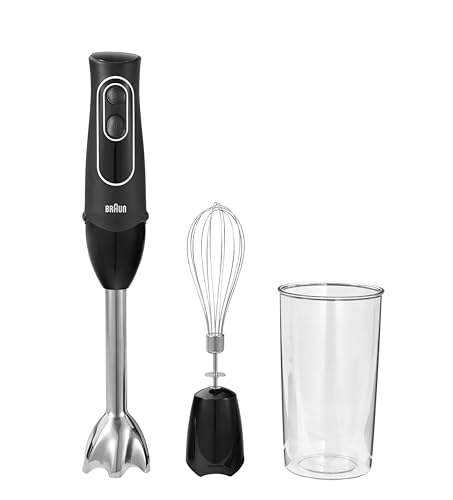
Braun MultiQuick 5 Hand Blender
Badge: Best Ergonomics Pick
- Motor: 350W (per title)
- Speed control: dual speed
- Blades: stainless steel
- Handle: slip-proof, ergonomic (per title)
- Included: beaker and whisk
- Stated tasks: blend, chop, whisk, mash, crush, puree
Braun’s MultiQuick 5 is the ergonomics-first entry: a stated 350W motor, dual speed, stainless steel blades, and a slip-proof ergonomic handle that the title calls out directly, with a beaker and whisk in the box. Braun has built hand blenders for decades and the MultiQuick line’s design priorities show in that handle — blending a big pot of soup is a sustained grip against resistance, and a handle shaped and surfaced for it is a performance feature, not a comfort extra. The stated task list is the widest in this pool: blend, chop, whisk, mash, crush and puree, which reflects a system designed around one motor doing the week’s small jobs. Dual speed is the honest limit; cooks who want a dozen fine steps should look at the KOIOS or Ganiza, but for balanced everyday work this remains a benchmark design.
Shoppers comparing sticks should place Braun MultiQuick 5 Hand Blender by its working end: the blade and guard design described in its title, the handle it asks you to hold, and the dual speed system that meters the work. A stick lives in your hand for minutes at a time, and this pick’s stated ergonomics are part of its performance, not decoration.
Strengths
- A stated 350W with dual speed keeps the power story honest and simple
- The slip-proof ergonomic handle addresses the real fatigue point in long blends
- Beaker and whisk are included, and the stated task list is the broadest here
Trade-offs
- Dual speed cannot match the fine steps of 12- or 16-speed rivals
- 350W sits mid-pool on paper; it is a control pick, not a wattage pick
- Chopping happens in the beaker format rather than a dedicated chopper bowl
Best for: cooks who want ergonomics pick in an immersion blender, matched to the jobs its title actually claims. / Not suited for: shoppers whose priorities contradict its stated evidence — read the trade-offs above before deciding.
Comparison Table
The six picks on the attributes their titles actually document. “Not stated in title” is information, not an omission — it tells you exactly how much power evidence a pick offers a comparison shopper.
| Model | Motor evidence | Speed control | Included extras | Listing |
|---|---|---|---|---|
| KitchenAid Variable Speed Hand Blender with Attachments KHBV83 | Not stated in title | Variable speed trigger | Blending pitcher; whisk; chopper; removable 8-inch blending arm | Check on Amazon |
| Bonsenkitchen Immersion Hand Blender | Not stated in title | 2 mixing speeds | Stainless steel blades; portable stick format | Check on Amazon |
| Cuisinart Smart Stick 2-Speed Hand Blender CSB-175 | 300W | 2-speed with one-touch slide control | 8-inch reach for in-pot blending | Check on Amazon |
| KOIOS Immersion Blender 1000W 3-in-1 | 1000W | 12 speeds with turbo mode | Whisk; milk frother; anti-scratch design; stainless steel blade; non-BPA note | Check on Amazon |
| OVENTE Electric Corded Hand Blender HS560B (Black) | 300W | 2 mixing speeds | Stainless steel blades; slim stick format; black finish | Check on Amazon |
| Braun MultiQuick 5 Hand Blender | 350W | Dual speed | Beaker; whisk; stainless steel blades; slip-proof ergonomic handle | Check on Amazon |
How to Choose the Right Blender for Best imersion stick blenders
Choose in the order the work demands. First decide the jobs — soup in the pot, smoothies in a beaker, emulsions, baby food, small chopping — because the job list, not the marketing, determines which specs matter. Then read speed control, reach, and stated motor evidence in that order, and only then compare kits. A shopper cross-reading Best Immersion Blenders At Walmart will notice the same order applied there, because it reflects how these tools succeed and fail in real kitchens rather than how they are advertised.
Speed control is the daily-driver spec
Every blend begins at low speed or goes wrong immediately, so the control system is the spec you will feel most. Trigger variable designs meter power by finger pressure and excel at gentle starts. Multi-step systems — five speeds, twelve speeds, sixteen modes in this pool — give repeatable settings you can note and reproduce. Two-speed designs are honestly simple: a start gear and a finish gear, adequate for soups and purees, limiting for emulsions. Match the system to your most delicate job, not your most powerful one; top speed is easy to sell and rarely the constraint.
Motor evidence: read the figure, then read its wording
Where a title states a wattage, note both the number and its framing. A plain rating and a maximum figure are different kinds of evidence, and this guide reports them differently on purpose. Where a title states nothing, treat power as undocumented and lean on control, construction and the jobs the title claims. Remember what wattage cannot tell you: blade and guard design, container fit and your own burst technique decide how much of any motor becomes smooth food. A well-controlled mid-watt pick will out-blend a careless high-watt one in most home jobs.
Reach, blades and the pot you actually own
Measure your deepest everyday pot and compare it with the stated arm and shaft lengths — around 8 inches is the proven home standard in this pool. Stainless steel blades, stated on most picks here, suit hot, acidic and fibrous work and rinse clean without fuss. Guard design matters for your cookware: anti-scratch designs, where a title states them, are aimed at coated pots and beakers. Finally, check the vessel story: a pick with a jar, pitcher, beaker or measuring cup included gives small batches the tall, narrow container they need from day one.
Attachments: buy the week you live, not the brochure
Whisks earn their place for eggs, cream and dressings; choppers for the daily onion, herb and nut jobs too small for a food processor; frothers for drinks; beakers and pitchers for smoothies, emulsions and storage. Each attachment is also a washing commitment, so the right kit is the largest one whose every piece you will genuinely use weekly. If your blending is soup and smoothies alone, a bare stick with excellent control beats a five-piece kit that lives in a cupboard — a trade several picks in this guide are built around.
How to Use, Clean and Troubleshoot Your Immersion Blender
For stick blenders, technique is mostly depth discipline: keep the blade guard fully submerged, start at low speed, and move the stick in slow passes — down through the centre, across the base, up the far side — so the whole pot circulates. Lift only when the motor is off, or the guard will throw food as it breaks the surface.
- Set up: choose a vessel with depth to spare — the pot the soup cooked in, or a tall beaker for small batches — and plug in with dry hands, cord routed clear of heat.
- Submerge first: lower the switched-off stick until the blade guard is fully covered by the mixture. Starting exposed is the splash mistake; avoid it every time.
- Start low: press the lowest speed or feather the trigger until a gentle vortex forms and the mixture begins to circulate as one body.
- Work in passes: move the stick slowly — down the centre, across the base, up the far side — in bursts of twenty to thirty seconds, repositioning between presses so corners and walls circulate through the blade.
- Finish deliberately: add power only for the final texture, taste, and adjust seasoning after blending, since pureeing changes how salt and acid read.
- Clean immediately: unplug, detach the arm if your design allows, and rinse the guard and blade under hot water at once; for a deeper clean, blend a beaker of warm soapy water for a few seconds, then rinse and dry.
Troubleshooting. Problem: the blend splashes over the pot rim → the guard is too near the surface or the start was too fast; submerge fully and restart at the lowest speed. Problem: chunks survive in the corners → the batch is too still, not too strong; slow the passes down, tilt the vessel slightly, and give the mixture time to circulate. Problem: the motor labours and smells warm on a thick mixture → stop, rest the tool, add a little liquid, and finish in smaller sections rather than one continuous run.
Shaft Length and Reach: The Spec That Decides In-Pot Comfort
A stick blender works with its blade guard submerged and its motor in your hand, so shaft length is the distance between comfort and a scalded wrist. The stated 8-inch arms and shafts in this pool — KitchenAid’s removable arm, Cuisinart’s 8-inch reach and 8-inch shaft — are sized for standard stockpots: deep enough to keep the guard under the surface of a full pot while your hand and the motor body stay clear of rising steam. Shorter sticks force you to blend shallower, tilt the pot, or accept splashing as the guard nears the surface.
Removability is the companion spec. A removable arm, as on the KitchenAid picks, separates the food-contact part for washing and lets the whole tool store shorter. Fixed sticks rinse fine under a tap but carry the motor body to the sink every time. Neither is automatically better — what matters is matching the design to your pots and your washing habits, and this pool lets you choose either with the reach question answered in the titles themselves. Readers working through the neighbouring question in Best Immersion Blenders Canada will find the same evidence-first approach applied to that shortlist.
Grip, Balance and the Three-Minute Test
Nobody blends for three seconds. A pot of soup takes minutes of sustained grip against resistance, moving the stick through the volume in slow passes, and that is where handle design stops being a comfort feature and becomes a texture feature: a tired hand rushes, and a rushed blend leaves chunks. Braun calls out a slip-proof ergonomic handle in its title — a direct answer to the grip problem, and one worth weighting if you blend big pots often — while the other picks in this line-up should be judged by the handle and operation details their own titles state.
Balance matters alongside grip. A stick that is motor-heavy at the top wants to tip out of a beaker between presses; a balanced one stands in the pot while you reach for seasoning. When you compare picks, imagine the whole job — gripping, moving, pausing, scraping — not just the first press. The detailed reviews flag handle and operation notes from each title so that imagined test is grounded in stated design rather than showroom impressions.
Motor Heat: Reading the Tool’s Signals During Long Jobs
A handheld motor tells you how it is coping, if you know the signals. Rising warmth in the handle during thick work is normal within limits; a hot smell, a labouring change in pitch, or speed that fades under load are instructions to stop, rest the tool and thin or split the batch. Most home blending jobs never approach these limits, because soups and smoothies are minutes of intermittent work. The jobs that do — big puree batches, thick bean mixtures, back-to-back meal prep — are managed by the burst rhythm described in this guide: twenty to thirty seconds on, reposition, brief rest. Treat heat as information rather than failure and a mid-priced stick will serve for years.
Emulsions: The Technique Behind Mayonnaise and Vinaigrettes That Hold
A stick blender makes emulsions almost unfairly well, provided the setup respects the physics. The ingredients must cover the blade guard, the vessel should be barely wider than the guard so the vortex pulls everything through the blades, and the first seconds must be still: let the emulsion form at the base before slowly tilting and lifting the stick to draw the remaining oil down. This is why the marked measuring cups and right-sized beakers included with some picks matter — they are emulsion vessels as much as containers. If an emulsion splits, the fix is rarely more power; it is a fresh yolk or a spoon of water in a clean vessel, with the broken mixture drizzled in under the running stick.
Texture Troubleshooting: Flecks, Foam and the Last Few Chunks
Three texture faults cover most disappointing blends, and each has a specific cure. Leaf or herb flecks in a smoothie mean the greens never entered the vortex: blend greens with the liquid alone first, until the base is uniformly coloured, before adding fruit or ice. Foam on top of a soup means air was whipped in at the surface — the guard rode too high — so finish with the stick deep and slow, then let the pot rest a minute before serving. The stubborn last chunks, usually potato or squash hiding in corners, yield to movement rather than power: slow passes along the base and walls, with the pot’s contents given time to circulate into the blade’s path.
Blending Hot Liquids Without the Volcano
Hot soup is the immersion blender’s home job and its one real hazard, because a sealed countertop jar of hot liquid can erupt while an immersed stick, used properly, cannot build that pressure. Properly is the operative phrase: pot off the fiercest heat, liquid below the two-thirds line, guard fully submerged before the motor starts, and the first press at the lowest speed. Steam will rise around the shaft — an argument for the longer 8-inch reaches in this pool, which keep your hand further from it. Move slowly, because hot liquid circulates faster and splashes further than cold. Done this way, in-pot blending is the safest method ever devised for soup, which is precisely why the tool exists.
Baby Food and Small Batches: Where Control Beats Capacity
Small-batch blending inverts the usual priorities: the problem is not power but contact, because a quarter-pot of puree barely covers a blade guard in a wide pot. The included beakers, jars and measuring cups in this pool earn their place here — a tall, narrow vessel keeps a small batch deep enough to blend smoothly. Cook vegetables until genuinely soft, keep some cooking liquid to adjust texture in spoonfuls, and blend in short presses, scraping once midway. For baby food specifically, smoothness standards are higher and batches are weekly, which favours picks with fine low-speed control and vessels sized to the job over raw wattage.
Whisk and Chopper Attachments: Using the Kit You Paid For
Attachments only justify themselves if they leave the box, so it helps to know their genuine strong jobs. The whisk — included with the Braun, both larger KitchenAid and Cuisinart kits, the Ganiza and the KOIOS here — excels at eggs, cream, pancake batter and dressings, at low speed, in a tall vessel. The chopper bowls, where included, are at their best on onions, herbs, nuts and breadcrumbs in small quantities: pulse rather than run, and stop before herbs turn to paste. Neither attachment replaces its full-size counterpart for volume work, but both replace the knife-and-board or the second appliance for the small, frequent jobs that dominate real cooking weeks.
Common Buying Mistakes
- Buying on wattage alone — especially treating a maximum figure as a sustained rating, or assuming an unstated motor must be powerful because the brand is famous.
- Starting every blend at full speed, then blaming the tool for splashing that the first three seconds caused.
- Choosing the biggest attachment kit for a cooking week that is soup and smoothies, and washing five pieces to do one piece’s job.
- Ignoring reach: a stick too short for your deepest pot makes in-pot blending a steam-dodging exercise no motor can fix.
- Comparing configurations by family name instead of exact model, so the whisk, chopper or jar in the review is missing from the box that arrives.
- Letting the first rinse wait: dried food under a blade guard converts a twenty-second cleanup into the worst job in the kitchen.
Final Recommendation
For most shoppers searching best imersion stick blenders, start with the KitchenAid Variable Speed Hand Blender with Attachments KHBV83: it leads this guide because its stated evidence — No wattage is stated in the title; Variable speed trigger — balances the jobs this keyword is really about. If your priorities lean toward the biggest documented kit or the widest speed range, the Cuisinart Smart Stick 2-Speed Hand Blender CSB-175 is the alternative this guide’s evidence supports most strongly, and shoppers who want the premium-leaning or most specialised option should examine the Braun MultiQuick 5 Hand Blender before deciding. Whichever direction you lean, the cross-check in Best Immersion Blenders Cooks Illustrated is worth a read before you buy, because the two shortlists overlap heavily.
Buy the pick whose trade-offs you can live with weekly, not the one whose headline is largest. Every pick here is documented to the same evidence standard, linked to the same listings used to write its review, and honest about what its title does not prove. Match it to your pots, your recipes and your washing tolerance, use the technique in the how-to layer from the first day, and the tool will repay the decision every time soup season — or smoothie season — comes around.
Related guides
Frequently Asked Questions
What is the most important spec in an immersion blender?
Speed control, for most cooks. It decides whether you can start gently in a full pot, build an emulsion without splitting it, and finish a puree firmly. Stated wattage matters for thick and frozen work, reach matters for deep pots, and blade material matters for hot food — but control is the spec your hand feels in every single blend.
Can an immersion blender crush ice or frozen fruit?
It depends on the stated motor and on technique. The higher stated wattages in this pool handle frozen fruit in bursts with enough liquid to circulate; the lower stated figures will manage small amounts patiently and are better suited to cooked and soft ingredients. No stick matches a countertop blender for big frozen drinks — that remains the jar machine’s home job.
Is an “imersion” stick blender different from an immersion blender?
No — it is the same tool with a misspelled search term, which is why this guide keeps the searched spelling in its title and headings while reviewing standard immersion stick blenders. If a listing or guide uses either spelling, check the same specs: shaft reach, speed control, blade material and attachments.
How long should an immersion stick be for soup pots?
Look for a stated shaft or arm around 8 inches, as several picks here offer, for comfortable work in standard stockpots: the guard stays submerged in a full pot while your hand clears the steam. Very deep commercial pots may want more, but for home pots the 8-inch class is the proven middle ground.
How do I stop my immersion blender splashing?
Keep the blade guard fully submerged, start at the lowest speed until a vortex forms, and switch off before lifting the stick out. Fill hot pots no more than two-thirds, and prefer a tall, narrow vessel for small batches. Nearly every splash traces back to one of those four points, and all four are technique, not equipment faults.
Are attachments like whisks and choppers worth it?
When they match your week, yes. A whisk covers eggs, cream and dressings; a chopper covers the small onion, herb and nut jobs; a beaker or jar makes small batches blend properly. If none of those are weekly jobs for you, a bare stick with excellent control is the better buy — and the better wash. Readers comparing kit sizes may also find Best Immersion Blenders For Liqued Soap Making useful.


