Disclosure: topratedkitchenware.com is reader-supported. When you buy through links on our site, we may earn an affiliate commission from Amazon and other retailers, at no extra cost to you.
Where to buy
This guide to the best induction cooktops for rv cooking brings together six verified portable induction burners, each checked through the Creators API, with Amazon links so you can check the latest price on Amazon for the exact model before it takes up precious storage space in your rig. RV cooking is a special discipline: power is rationed, the counter is tiny, the whole kitchen moves at highway speed between meals, and an open flame in a small sealed box is a compromise many travellers are happy to leave behind. Every pick below was judged against that reality — electrical appetite, storability, control with limited power, and surfaces that survive life on the road. Read the full guide ↓ for badges, honest trade-offs, a comparison table and the power-planning advice that matters more than any feature list.
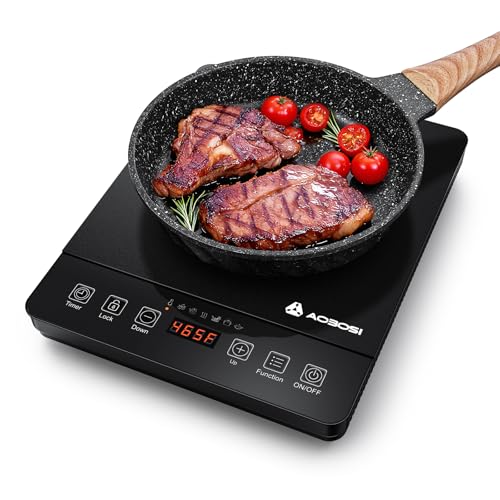
- AAOBOSI Portable Induction Cooktop, 1800W — Best Overall for RV Life. Best for most RV cooks, with 20 levels, 4 presets and a 4-hour timer; the listing itself names RVs among its uses.
- 1800W Portable Induction Cooker, Stainless Steel — Best Push-Button Durability. Best for travellers who want tactile buttons and a 10-hour timer in a stainless body.
- ChangBERT Induction Cooktop, Commercial Grade — Best Heavy-Duty Build. Best for full-timers whose burner works daily and must shrug off hard use.
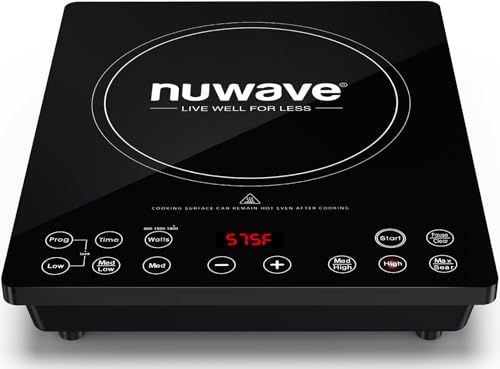
- Nuwave Double Pro Cooktop, Induction Countertop Burner — Best for Two-Pot Meals. Best for couples cooking real two-pan dinners, with dynamic wattage for power management.
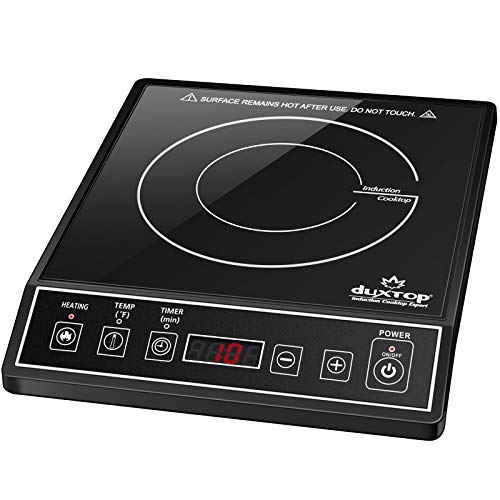
- Duxtop 1800W Portable Induction Cooktop, Black 9100MC — Best Simple Compact Pick. Best for minimalists wanting the proven Duxtop platform in black, without fuss.
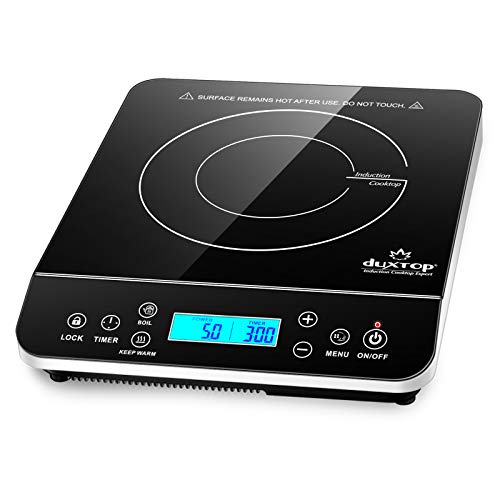
- Duxtop Portable Induction Cooktop, Black 9610LS — Best Touch Panel for Small Galleys. Best for tidy cooks who want an LCD touch surface that wipes clean in seconds.
Searching for the best induction cooktops for rv use usually starts with a frustration: the factory propane cooktop in most rigs is slow, heats the whole cabin, struggles in wind when its burners are exposed, and makes a pot of pasta water feel like a long-term project. Induction answers almost every part of that complaint. It boils fast, it puts heat into the pan instead of into a small living space you are also trying to keep cool, it works identically at a windy lakeside site because there is no flame to blow out, and when you switch it off, the heat stops — a meaningful safety property in a kitchen measured in inches, with curtains, paper towels and bedding all closer than any house kitchen would allow.
The trade is electrical, and this guide refuses to hide it. A portable induction burner at full power draws like a serious appliance, because it is one. On shore power at a campground pedestal, that is usually a non-event. On an inverter running from a house battery bank, it becomes a budgeting exercise: how much battery capacity you carry, how your inverter is rated, and whether the microwave, air conditioner or coffee maker wants the same circuit at the same moment. The good news is that induction is unusually cooperative in this budgeting — power levels are adjustable in fine steps, so a burner can be run gently at a fraction of its maximum while still cooking perfectly well, something a flame or a basic hotplate does far less gracefully. Every review below therefore discusses not just cooking, but living within an RV’s electrical means.
Format matters as much as power. All six picks are portable countertop units, which is the right shape for RV life for three reasons. They stow — in a cabinet, under a dinette bench, in a padded sleeve in a storage bay — instead of permanently consuming the scarcest resource in an RV, which is counter space. They move: the same burner that cooks inside on a rainy night can cook on the picnic table at a powered site the next evening. And they ask nothing of the rig’s propane system, leaving that fuel for the furnace and water heater where it is hardest to replace. Travellers comparing several rigs or outfitting a larger motorhome will also find the companion shortlist in Best Induction Cooktops For Rvs useful, where the emphasis shifts slightly toward bigger households on wheels.
Key Takeaways
- Power planning is the whole game: every pick can run at reduced levels, which is how induction fits inverter and battery budgets.
- All six picks are portable countertop burners that stow away — the only format that respects an RV’s counter scarcity.
- No flame means no combustion moisture or carbon monoxide concerns inside a small sealed cabin, and no wind-blown burners at outdoor setups.
- The AAOBOSI’s own listing names RVs and apartments among its uses; its 20 levels and 4-hour timer suit rationed-power cooking well.
- Push-button models forgive wet hands and bumpy, improvised cooking setups; touch panels win on wipe-clean tidiness.
- Your pans must be magnetic — and in an RV, dual-purpose cookware that works on induction and over a campfire earns its storage space twice.
In this guide
Quick Picks
| Pick | Badge | Controls / Timer | Why RV travellers shortlist it | Check |
|---|---|---|---|---|
| AAOBOSI Portable Induction Cooktop, 1800W | Best Overall for RV Life | 20 levels, 4 presets, 4-hour timer | Fine power steps for battery-friendly cooking, explicitly aimed at RVs and apartments | Check on Amazon |
| 1800W Portable Induction Cooker, Stainless Steel | Best Push-Button Durability | Push-button, 18 settings, 10-hour timer | Tactile control with gloves or wet hands, stainless body for road life | Check on Amazon |
| ChangBERT Induction Cooktop, Commercial Grade | Best Heavy-Duty Build | Countertop controls, 10-hour timer | Stainless, NSF-named commercial build for full-time daily use | Check on Amazon |
| Nuwave Double Pro Cooktop | Best for Two-Pot Meals | Touch panel, dynamic wattage options | Two zones for real dinners, with 900/1500/1800W options to manage draw | Check on Amazon |
| Duxtop 1800W Portable Induction Cooktop, Black 9100MC | Best Simple Compact Pick | Standard controls | The proven Duxtop single burner in black, model 9100MC, for minimalists | Check on Amazon |
| Duxtop Portable Induction Cooktop, Black 9610LS | Best Touch Panel for Small Galleys | LCD sensor touch | A flat, wipe-clean face that keeps a tiny galley feeling tidy | Check on Amazon |
Choosing from this table is mostly choosing your travel style. Solo travellers and couples in vans will live happily on a single compact burner. Full-timers cooking daily should weight durability and control forgiveness. Couples who cook proper two-pan dinners — pasta in one pot, sauce in the other — should look hard at the double burner, provided their electrical system and counter can host it. The detailed reviews now take each pick on the road, one at a time.
How These Picks Were Chosen
This is a research-led guide, not a hands-on road test, and it is honest about that distinction. The six burners come from a verified pool checked through the Creators API on 2026-11-20, with each ASIN, official title and image recorded before drafting. Every specification in this article — wattage, level and setting counts, timer lengths, coil size, control type, wattage options on the double burner — is taken from those verified titles. Where a listing is silent, for example on a unit’s exact weight or dimensions, this guide discusses the consideration in practical terms without inventing figures.
The evaluation lens was RV life, applied in a deliberate order. First, electrical manners: can the burner be run at partial power gracefully, because that is what makes induction viable off-grid. Second, control survivability: how the interface behaves with wet hands, in a moving-around small space, and under the minor chaos of camp cooking. Third, stowability and toughness: stainless versus cosmetic finishes, flat faces versus dust-trapping details. Fourth, cooking range: timers for slow camp stews, fine levels for gentle reheating, and enough top-end responsiveness for a proper sear at a picnic table. Kitchen-showroom appeal was considered last, on purpose.
All six pool picks are genuine portable induction burners, so no pick required a prose-only demotion for a fuel mismatch in this guide. The competition was therefore about fit for the road, and the reviews below are frank about which traveller each burner does not suit — because in an RV, the wrong appliance is not just disappointing, it is dead weight you carry for thousands of miles.
The 6 Best Induction Cooktops for RV Cooking in Detail

AAOBOSI Portable Induction Cooktop, 1800W
Badge: Best Overall for RV Life
Strengths
- The listing explicitly names apartments, RVs and outdoor cooking — this burner was designed with exactly your use case in view.
- 20 temperature and power levels let you cook at genuinely low draw when the battery bank, not the recipe, is in charge.
- 4 preset modes and a 4-hour timer cover the slow camp meals — stews, rice, reheats — that RV cooking leans on.
Trade-offs
- Single burner: two-pot meals are sequential unless you pair it with a second cooking method.
- A newer brand name than Duxtop or Nuwave, so the long-term owner community to consult is smaller.
- At full power it draws like any 1800W appliance; small inverter setups must plan around it, as with every pick here.
Spec box (verified listing data only): Power: 1800W. Levels: 20 temperature and power levels. Presets: 4 modes. Timer: 4 hours. Type: portable induction cooktop. Named uses in listing: apartments, RVs, outdoor cooking.
The AAOBOSI takes Best Overall because its specification reads like it was written after interviewing RV owners. The twenty levels are the heart of it: off-grid cooking is a negotiation between the meal and the battery gauge, and fine steps let you find the lowest draw that still keeps a stew at a lazy bubble or rice gently steaming. On shore power you simply use the whole range and enjoy the speed; on the inverter you dial down, cook a few minutes longer, and arrive at dinner with lights and water pump still in your future. That flexibility, more than any headline number, is what makes an induction burner a citizen of an RV rather than a guest.
The four-hour timer quietly changes camp evenings. A stew started in the afternoon can hold its gentle programme while you walk the dog, watch the light change, or deal with the small logistics of a site, returning to a meal that minded itself. Its honest limitation is the single zone: this is a one-pot-at-a-time kitchen unless the campground fire or a second appliance joins in. For the way most RV travellers actually cook — one-pot meals, skillet dinners, breakfast on a single pan — that limitation rarely binds, and the storage you save is real.
Best for: most RV travellers, especially mixed shore-power and off-grid itineraries / Not suited for: cooks who routinely need two pans at full power simultaneously
Check on Amazon to check the latest price on Amazon for the AAOBOSI portable induction cooktop.

1800W Portable Induction Cooker, Stainless Steel (OneSetNuf)
Badge: Best Push-Button Durability
Strengths
- Push-button controls with 18 temperature settings: positive, tactile operation with wet hands, gloves, or in low evening light.
- A 10-hour timer — the longest here — for all-day slow cooking at a base camp or powered site.
- Stainless steel body with dual IGBT power control named in the listing, and commercial-grade positioning for hard use.
Trade-offs
- The stated 8-inch coil suits small-to-mid pans; a very large family skillet will overhang and heat less evenly at its rim.
- Buttons and seams collect a little more grime than a sealed touch face over a dusty season.
- Commercial-grade intent can mean a more utilitarian look in a carefully styled van interior.
Spec box (verified listing data only): Power: 1800W. Heating coil: 8 inch. Temperature settings: 18. Timer: 10 hours. Controls: push-button. Build: stainless steel. Power control: dual IGBT. Positioning: commercial-grade.
Road life is hard on interfaces. Hands are wet from washing up in a basin, dusty from a trail, or gloved against a cold morning — and a touch panel that demands a clean, dry fingertip becomes a small daily negotiation. This stainless cooker avoids the negotiation entirely: you press a physical button, it responds, and the setting is the setting. Travellers who cook outside at a picnic table, where dew, drizzle and camp-kitchen chaos are normal, tend to become loyal to exactly this kind of control.
The ten-hour timer suits the base-camp rhythm — a slow braise started after breakfast at a powered site, ready when the day’s exploring is done — while the stainless body shrugs off the knocks of being stowed and retrieved daily. Its geometry is its main caveat: pack pans that respect the 8-inch coil, which most RV-sized cookware naturally does, since compact pans are already the rule in a galley where every item must justify its cupboard.
Best for: outdoor-table cooks, full-timers, and anyone who prefers buttons they can feel / Not suited for: design-led van builds wanting a seamless glass touch face
Check on Amazon to check the latest price on Amazon for the stainless portable induction cooker.

ChangBERT Induction Cooktop, Commercial Grade Portable Cooker
Badge: Best Heavy-Duty Build
Strengths
- Premium stainless steel countertop construction with a large 8-inch heating coil, built for commercial-style duty cycles.
- NSF certified according to the listing — a sanitation and construction standard that suits a burner used every single day.
- A 10-hour timer on an 1800W platform, matching the longest supervision window in this guide.
Trade-offs
- Heavy-duty intent usually trades away some portability elegance; plan a dedicated stowage spot rather than casual handling.
- The 8-inch coil class still applies: oversized pans overhang, as with the other stainless pick.
- Its utilitarian brief offers fewer lifestyle presets than the AAOBOSI’s programme-led approach.
Spec box (verified listing data only): Power: 1800W. Heating coil: large 8 inch. Build: premium stainless steel. Certification named in listing: NSF. Timer: 10 hours. Type: commercial grade portable cooker, countertop burner.
Full-time RVers are not occasional users of anything — a burner in a full-timer’s rig may work twice a day, every day, for years, in conditions from desert heat to mountain cold, stowed and deployed hundreds of times. That duty cycle is closer to a food truck’s than to a suburban kitchen’s, and it is precisely the cycle the ChangBERT’s commercial framing addresses: stainless construction, a certification callout in its listing, and electronics specified for sustained work. If your RV is your home rather than your holiday, this is the pick that thinks about year three.
The same honesty applies as with its stainless sibling: an 8-inch coil wants right-sized pans, and commercial toughness is bought with a more workmanlike presence. Travellers who cook seasonally may never stress a lighter unit enough to need this one. Travellers who cook daily will understand the proposition immediately, the way professional drivers understand a heavier-duty tyre.
Best for: full-timers and daily cooks who value build toughness above all / Not suited for: occasional weekend travellers who prioritise the lightest stowage
Check on Amazon to check the latest price on Amazon for the ChangBERT induction cooktop.

Nuwave Double Pro Cooktop, Induction Countertop Burner
Badge: Best for Two-Pot Meals
Strengths
- Two induction zones in one unit: pasta and sauce, rice and curry, kettle and skillet — real dinners, cooked in parallel.
- Dynamic wattage options of 900, 1500 and 1800W in the listing, a power-management feature tailor-made for RV electrical systems.
- A wide stated temperature span from 50°F to 575°F, shatter-proof ceramic glass and a seamless touch panel.
Trade-offs
- The largest footprint here; in a small van galley it may claim the entire usable counter when deployed.
- Two zones share one appliance’s power story — simultaneous full-power performance is governed by the wattage options, not magic.
- More unit to stow: it needs a proper home in the rig, not a casual corner.
Spec box (verified listing data only): Type: double induction cooktop, portable countertop. Temperature range in listing: 50°F–575°F. Wattage options in listing: 900 / 1500 / 1800W with Dynamic Watt Technology. Heating coil: 8 inch. Surface: shatter-proof ceramic glass. Controls: seamless IMD touch panel.
Most RV cooking compromises trace back to a single burner: the sauce waits while the pasta cooks, the vegetables steam in the microwave, dinner arrives in shifts. The Double Pro is the pick for travellers who refuse that compromise and have the counter and electrical system to support the refusal. Its dynamic wattage options deserve special attention from RV readers, because they formalise what savvy off-grid cooks do manually — cap the appliance’s appetite to what the pedestal, inverter or battery bank can comfortably feed, and cook within that ceiling.
Judged as road equipment, its size is both its power and its price. In a Class C or a fifth wheel with a real counter run, it deploys like a proper cooktop and stows like a large cutting board. In a compact camper van, it may simply be too much appliance, and the honest traveller will measure before falling in love. The shatter-proof glass claim in its listing will also resonate with anyone who has heard a rig’s contents shift on a mountain descent.
Best for: couples and families in larger rigs who cook two-pan dinners / Not suited for: compact vans with minimal counter and modest electrical systems
Check on Amazon to check the latest price on Amazon for the Nuwave Double Pro.
Duxtop 1800W Portable Induction Cooktop, Black 9100MC
Badge: Best Simple Compact Pick
Strengths
- The proven Duxtop 1800W portable platform (9100MC, BT-M20B) in a black finish that hides road grime gracefully.
- A straightforward single-burner brief: no programme library to learn, just dependable induction heat.
- Compact countertop format that stows in the small, awkward cabinets RV designers specialise in.
Trade-offs
- No long-timer or preset story in its listing to rival the AAOBOSI or the stainless picks.
- Single burner, single pot — the familiar sequencing compromise.
- Black glass shows dust on bright travel days, a cosmetic note for the fastidious.
Spec box (verified listing data only): Power: 1800W. Type: portable induction cooktop, countertop burner. Model: 9100MC, BT-M20B. Finish: black. Burners: 1.
There is a traveller for whom the best appliance is the one with the least to explain, and the 9100MC is built for them. It is the Duxtop platform in its simplest black form: set it down, plug it in, cook. In rental RVs, in a first rig being equipped on a learning curve, or as the dependable second burner beside a camp stove, that simplicity compounds — guests can use it, partners can use it, and it asks for no manual consultations at altitude after a long drive.
Its trade-offs are omissions rather than flaws. If your cooking leans on timers and presets, the AAOBOSI serves it better; if you want a touch panel’s tidiness, its sibling below does. What the 9100MC offers instead is the category’s most travelled road: a huge base of owner experience behind the Duxtop name, and a design that has been packed into more storage bays than most rivals combined.
Best for: minimalists, first rigs, and anyone wanting the proven simple option / Not suited for: preset-and-timer cooks or two-pot dinner routines
Check on Amazon to check the latest price on Amazon for the Duxtop 9100MC.
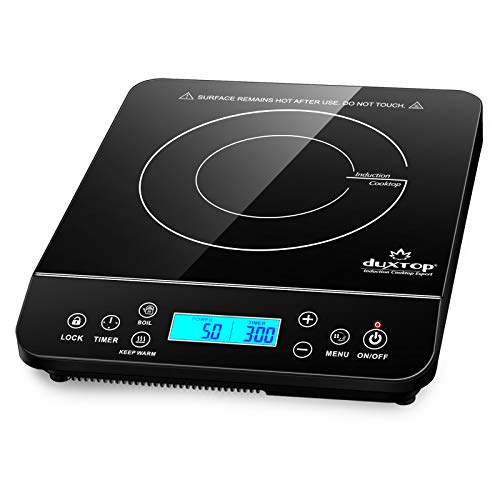
Duxtop Portable Induction Cooktop, Black 9610LS
Badge: Best Touch Panel for Small Galleys
Strengths
- LCD sensor-touch panel (9610LS, BT-200DZ): a completely flat face with nothing to trap crumbs, grease or road dust.
- The same 1800W Duxtop induction platform, in black, for cooks who want tidiness without giving up the proven base.
- A galley that wipes clean in one pass matters disproportionately in a space where the kitchen is also the lounge and bedroom.
Trade-offs
- Touch controls want dry fingertips; a hand towel living beside the burner becomes part of the system.
- Single burner with the usual sequencing limits.
- Wiping the panel mid-cook can nudge settings — clean it when it is off, or learn its lock behaviour.
Spec box (verified listing data only): Power: 1800W. Type: portable induction cooktop, countertop burner. Controls: LCD sensor touch. Model: 9610LS, BT-200DZ. Finish: black. Burners: 1.
In an RV, cleaning is not a chore category, it is a lifestyle variable: the kitchen surface you cook on is inches from where you sit, sleep and store everything you own. The 9610LS earns its badge on that reality. A seamless touch face means a spilled breakfast in a bouncing, compact galley is a one-wipe event, with no knob stems or button rims harbouring yesterday’s cooking in a space that never fully airs out. Owners of small rigs consistently rate this kind of tidiness higher than visitors to the category expect.
The discipline it asks in return is modest: dry hands for adjustments, and cleaning done deliberately rather than mid-simmer. Travellers who cook outdoors in all weather may still prefer the push-button stainless model, but for interior galley cooking — the majority of RV meals across a year — the touch panel’s cleanliness argument is strong and honest.
Best for: tidy cooks in small rigs who cook mainly inside the galley / Not suited for: all-weather outdoor-table cooks who need glove-friendly buttons
Check on Amazon to check the latest price on Amazon for the Duxtop 9610LS.
Comparison Table
| Pick | Burners | Power story | Timer | Road-life edge | Check |
|---|---|---|---|---|---|
| AAOBOSI Portable | 1 | 1800W, 20 levels | 4 hours | Fine low-draw steps for battery budgets | Check on Amazon |
| Stainless Induction Cooker | 1 | 1800W, 18 settings | 10 hours | Push buttons, stainless toughness | Check on Amazon |
| ChangBERT Commercial Grade | 1 | 1800W | 10 hours | Commercial-style build for full-timers | Check on Amazon |
| Nuwave Double Pro | 2 | 900/1500/1800W options | See listing | Two pots plus wattage management | Check on Amazon |
| Duxtop 9100MC Black | 1 | 1800W | See listing | Simple, proven, compact | Check on Amazon |
| Duxtop 9610LS Black | 1 | 1800W | See listing | Wipe-clean touch face for tiny galleys | Check on Amazon |
Notice what the table cannot show: your electrical system. Two travellers can buy the same burner and have opposite experiences, because one cooks on a generous shore-power pedestal and the other on a modest inverter. The next section is therefore the most important in the guide.
How to Choose an Induction Cooktop for Your RV
Start at the pedestal, the inverter and the battery — in that order. At a powered site, your limit is the site’s supply shared with everything else in the rig; an 1800W burner at full tilt plus air conditioning plus a microwave is how breakers get introduced to their purpose. Cook sequentially with other big loads, or run the burner at a reduced level, which induction makes painless. On an inverter, know its continuous rating and your battery bank’s usable capacity, and treat full-power boiling as a deliberate spend: fine for a kettle’s worth of pasta water, wasteful for an afternoon of simmering that a low level handles identically. The picks with the finest low-end steps — the AAOBOSI’s twenty levels above all — are the natural citizens of battery-powered kitchens, a theme the budget-conscious shortlist at Best Induction Cooktops Under $200 also respects from the cost side.
Measure the stowage, not the counter. Every portable looks small on a product page. In the rig, it lives in a specific cabinet with a specific door swing, possibly sharing space with the pans it must fit beside. Measure that space, then check the burner’s footprint class against it, and decide its travel position: flat, upright in a padded divider, or in its box in a bay. The double burner especially must pass this test before purchase, because a two-zone unit with no home becomes a permanent counter resident, and RV counters are already spoken for.
Choose cookware that moonlights. Space discipline says every pan should do two jobs. Magnetic stainless and cast iron work on induction tonight and over a campfire or on the propane hob tomorrow, which makes them the correct RV metals. Run the magnet test on what you already carry before buying replacements, and favour lids that fit multiple pans. A single well-chosen skillet and a mid-size pot with a lid will cover the overwhelming majority of road meals on any single-burner pick here.
Match the interface to your cooking venue. Mostly inside, in a controlled galley? Touch panels reward you with effortless cleaning. Mostly outside at the picnic table, in weather and gloves? Physical buttons forgive everything. This single question separates the Duxtop 9610LS from the stainless push-button cooker more honestly than any specification sheet, and it is the same fork in the road explored for fixed kitchens in Best Induction Electric Cooktops.
How to Cook Safely and Efficiently on Induction in an RV
- Level and stabilise first. Park as level as you reasonably can, set the burner on a hard, flat, heat-safe surface, and confirm it cannot slide when the rig is bumped or a door slams.
- Plug directly into the rig’s outlet. Avoid extension leads and power strips for a high-draw appliance, and know which other loads share that circuit before you start.
- Budget the meal’s power before you begin. Decide the level you will cook at based on shore power or battery state, rather than discovering the budget via a tripped breaker mid-dinner.
- Use lids for boiling, remove them for reducing. A lid is the fastest legal performance upgrade on limited power; it also keeps steam — moisture your cabin does not want — out of the air for longer.
- Ventilate anyway. Induction adds no combustion moisture, but cooking itself releases steam and smells into a small volume; crack the vent or window as you would with any cooking.
- Mind the cool-down fan. Let the burner finish its cooling cycle before stowing it, especially into a closed cabinet, and never stow it with a hot pan still sitting on the glass.
- Secure it for travel. Glass surfaces and road vibration are enemies; stow the burner padded, flat or in its divider, with nothing heavy stacked on top.
Troubleshooting. Problem: the breaker trips when cooking starts → too many heavy loads are sharing the supply; switch off the air conditioner or microwave during cooking, or run the burner at a lower level. Problem: the burner reports no pan or cycles on and off → the pan is non-magnetic, too small for the coil, or the rig is unlevel enough that the pan sits oddly; test with a flat cast-iron skillet. Problem: cooking drains the battery faster than expected → you are simmering at a higher level than the food needs; drop several steps, use a lid, and let insulation and time do the work that watts were doing.
Propane Versus Induction on the Road: An Honest Comparison
This guide recommends induction, but not by pretending propane has no case. Propane works with no electrical infrastructure at all, which still matters for long off-grid stays far from hookups, and it heats any pan ever made. Its costs are the ones that push travellers to induction: combustion moisture condensing on cold windows and walls, carbon monoxide vigilance, heat dumped into a small cabin in summer, wind sensitivity outdoors, and the slow boil that makes a simple pasta night feel like a project. Induction’s costs are the mirror image: it is hungry for a resource — electricity — that an RV generates and stores in limited amounts, and it demands magnetic pans.
Most experienced travellers land on a hybrid: induction as the daily driver wherever power allows, propane retained for the furnace, water heating and the deepest off-grid cooking. That is why a portable, rather than a built-in replacement, is the smart first step — it joins the system without removing anything, and it can be judged over a season of real trips. Readers outfitting alternative small-space kitchens, from boats to tiny homes, will find the same hybrid logic throughout the Best Inductive Cooktops discussion, because the physics and the trade-offs travel well.
Across the Seasons: Summer Heat, Winter Condensation and Shoulder-Season Power
Season changes the induction equation in ways worth planning for. In summer, induction’s greatest RV gift is what it does not do: it does not pour flame heat and combustion moisture into a cabin you are simultaneously paying battery or shore power to air-condition. Evening cooking stops being a choice between dinner and a tolerable sleeping temperature. This is also the season of full campgrounds and shared pedestals, where a considerate traveller runs the burner at sensible levels during the early-evening peak when every rig on the row is cooking, microwaving and cooling at once.
Winter reverses some of the logic. Condensation is the cold-season enemy inside any RV, and while induction adds far less moisture than propane cooking — no combustion water vapour at all — boiling pasta still steams, so the vent habit matters more, not less, when windows are shut against the cold. Power planning tightens too: furnace fans, battery heaters and shorter solar days all draw on the same reserves your cooking wants. The fine low levels on picks like the AAOBOSI, and the discipline of lids and one-pot meals, stop being efficiency garnish in January and become the difference between cooking comfortably and managing a battery anxiety spiral. Shoulder seasons, with their mild weather and emptier sites, are when induction feels effortless — which is precisely when to build the habits the harder seasons will demand.
One more seasonal note belongs to altitude and travel days. Induction does not care about altitude the way boiling points do — water still boils at a lower temperature in the mountains, whatever heats it — but travellers notice the difference in cooking times for rice, pasta and dried foods, and a burner with a generous timer and fine control makes those adjustments calmly. On travel days themselves, the winning routine is boring: cook, let the fan finish, wipe the cool glass, stow the burner padded in its assigned place, and confirm the cabinet latch. The travellers who love their induction setup after fifty nights are not the ones with the fanciest model; they are the ones whose routine survived contact with real roads.
What the First Month on the Road Teaches
Almost every RV induction owner reports the same learning curve, and knowing it in advance flattens it. In the first week, the surprise is speed: water boils and pans respond faster than propane habits expect, and a couple of scorched first attempts at breakfast are nearly universal tuition. By the second week, the power habits form — lids appear without thinking, big loads stop competing with the burner, and the cook develops a feel for which level a given meal actually needs rather than defaulting to maximum. By the end of the first month, the burner has usually migrated from “new gadget” to “the way we cook”, and the propane hob’s role quietly shrinks to backup duty and the deepest off-grid stretches.
The other first-month lesson is organisational. The burner acquires a home, a towel, a designated pan or two, and a place in the departure checklist between the vent fan and the cabinet latches. Travellers who build that routine early describe their setup with the word “ours”; travellers who leave the burner homeless describe it, eventually, with the words “for sale”. Choose the pick in this guide that fits the routine you will actually keep — that fit, far more than any specification, is what the first month is really testing.
Common Buying Mistakes
- Ignoring the electrical budget. An 1800W burner is a major appliance. Buy it with your pedestal, inverter and battery numbers in hand, not in hope.
- Forgetting the magnet test on pans you already own. Discovering at a campsite that your one pot is aluminium is a special kind of trip memory. Test at home.
- Buying the double burner for a van counter. Measure deployed space and stowage space. Ambition is not a unit of measurement.
- Stowing the burner loose. Unpadded glass plus road vibration equals a cracked top and a ruined trip. Give it a padded, dedicated home.
- Running it on an extension lead. High-draw appliances belong in the wall outlet directly, with the circuit’s other loads understood.
- Cooking at full power by default. Most meals need a fraction of maximum. Lower levels are kinder to batteries, breakers and the food itself.
Final Recommendation
For most RV travellers, start with the AAOBOSI Portable Induction Cooktop, 1800W — its twenty levels make it the most fluent speaker of the language RV electrical systems speak, its timer suits camp cooking rhythms, and its own listing names RV life as a design brief. Outdoor-table cooks and full-timers should choose between the push-button stainless cooker and the heavy-duty ChangBERT Induction Cooktop, Commercial Grade on how hard their burner will work, while couples in larger rigs who cook real two-pan dinners should seriously consider the Nuwave Double Pro Cooktop, Induction Countertop Burner and its wattage management. Minimalists cannot go wrong with the Duxtop 9100MC, and tidy galley cooks will love the 9610LS. Whichever you pack, test your pans, know your power budget, and give the burner a padded home — it will repay you at every site.
Cooking for Guests at the Campsite
Entertaining is where a portable earns applause, because it moves to where the people are. Set it on a stable outdoor table at a powered site, cook in view of your guests, and lean on the format’s strengths: fast boils for corn or pasta, a skillet that responds instantly when a crowd gathers early, and no flame to guard when chairs crowd close. Cook in generous one-pan batches rather than attempting restaurant choreography on one burner, keep a second method — the rig’s propane hob or a campfire grill — for overflow, and let the burner’s timer discipline the side dishes. Guests remember the food and the evening, never the sequencing compromises behind them.
Frequently Asked Questions
Can I run an 1800W induction burner on my RV’s inverter?
It depends on the inverter’s continuous rating and your battery bank, and the honest answer is to check both numbers before relying on it. Many travellers run these burners at reduced power levels for most cooking — simmering, reheating, gentle frying — which induction handles gracefully, reserving full power for short boiling jobs on shore power or a generous battery setup. The fine level steps on picks like the AAOBOSI exist precisely for this kind of budgeting.
Is induction safer than propane inside an RV?
In the ways that matter most in a small sealed space, yes. There is no open flame near curtains and bedding, no combustion producing carbon monoxide or water vapour, and heat stops the moment you switch off or lift the pan. Normal electrical and hot-surface care still applies — the glass gets hot from the pan — but the category of risk changes from fire-and-gas vigilance to ordinary appliance sense.
What pans should I pack for induction in an RV?
Magnetic ones that also work on other heat sources, so each earns its space twice: a cast-iron or magnetic stainless skillet, a mid-size pot with a lid, and optionally a small saucepan. Run the fridge-magnet test on the base of anything you already own before buying new, and favour flat bases sized near the burner’s coil for even heating.
Will the burner survive road vibration?
The burners themselves are solid-state appliances with no delicate moving parts beyond a cooling fan, but their glass tops deserve respect. Stow the unit padded, flat or in a divided slot, with nothing heavy on top, and let it cool before packing it away. The Nuwave Double Pro’s listing specifically names shatter-proof ceramic glass, which is a comforting phrase for anyone who has driven a washboard road.
Can I cook outside at the picnic table with a portable induction burner?
Yes, at powered sites or wherever your rig’s exterior outlet and power budget allow, and it is one of portable induction’s great pleasures: no wind-blown flame, fast setup, and the kitchen smells stay outside. Keep the surface stable and level, protect the unit from rain, and prefer push-button models if you cook with wet hands or gloves outdoors.
How much slower is cooking at reduced power on battery?
Boiling is noticeably slower at low levels, because bringing water to a boil is pure energy delivery. Simmering, reheating and holding, by contrast, need very little power once the food is hot, and a lid closes most of the remaining gap. The practical strategy is to spend full power briefly — ideally on shore power — for the boil, then drop to gentle levels for the long, cheap part of cooking.