Disclosure: topratedkitchenware.com is reader-supported. When you buy through links on our site, we may earn an affiliate commission from Amazon and other retailers, at no extra cost to you.
Where to buy
This guide to best kitchen faucets no electronic brings together six verified picks you can order online today. Each name below links to its Amazon listing, and every detailed review further down carries its own Check on Amazon link so you can check the latest price on Amazon for the exact model you are reading about. Prices in this category move often, which is why this guide links out instead of printing figures that would age badly.
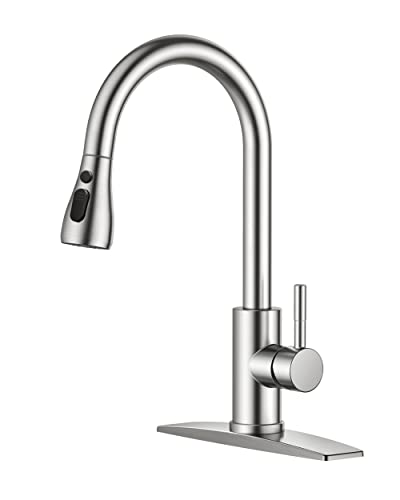
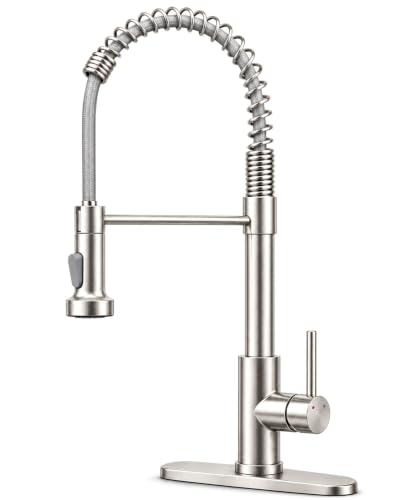
- OWOFAN Spring Pull-Down Kitchen Faucet — Best Overall. Best for spring flexibility for deep farmhouse sinks.
- WEWE Pull-Down Kitchen Faucet with Braided Hoses — Best for DIY Install. Best for a tool-free swap on 1-hole sinks.
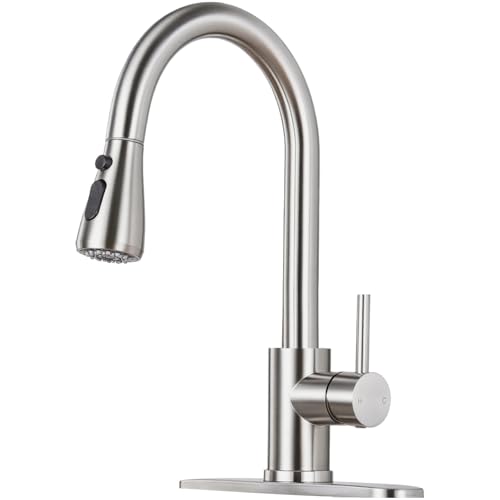
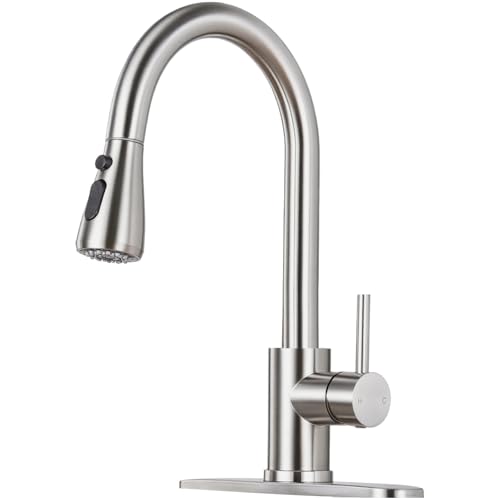
- LUFG Brushed Nickel Pull-Down Kitchen Faucet — Best Certified Internals. Best for certification-led stainless construction.
- Moen Adler Pulldown Kitchen Faucet 87233SRS — Best Brand Support. Best for spot-resistant finish and easy parts sourcing.
- Lufeidra Pull-Down Kitchen Faucet — Best Flexible Fit. Best for ceramic-cartridge value for 1 or 3-hole decks.
- FEELSO Pull-Down Kitchen Faucet — Best High-Arc Value. Best for tall-pot clearance with lead-free certification.
Read the full guide ↓ for badges, honest trade-offs, a comparison table and the buying advice that helps you choose between them.
If you are searching for the best kitchen faucets no electronic features involved, you are not behind the times — you are making a deliberate engineering choice. A purely mechanical faucet has no sensor to misread a passing pan, no batteries quietly dying under the sink, and no control box competing for cabinet space. It turns on when you lift the handle and off when you set it down, in a power cut, with wet hands, twenty years from now, exactly the same way. This guide is built only from manual, single-handle pull-down faucets, and we deliberately excluded every touchless model from the shortlist, even good ones, because a sensor faucet is by definition an electronic faucet.
What separates the six picks below is not gadgetry but the things that decide whether a faucet is still drip-free and pleasant in a decade: cartridge design, body material, certifications, hose reach and finish behaviour. Every pick here is a pull-down design, because that is where the manual market is strongest, and each one earned its place on internals and fit rather than novelty. Whether you are replacing a tired faucet in a farmhouse kitchen or fitting out an RV galley, the right no-electronic faucet is simply the one whose mechanics match your sink and your water.
Key Takeaways
- Every pick in this guide is fully mechanical: no sensors, no batteries, no control box under the sink.
- Ceramic cartridges and stainless steel bodies are the two internals most closely tied to long, drip-free service.
- Certifications worth checking are NSF/ANSI 61 and 372 and cUPC, which cover material safety and lead content.
- Pull-down heads with a stated hose reach make rinsing and pot filling easier than any electronic feature does.
- Manual faucets keep working during power cuts and are the simplest type for any plumber to service.
In this guide
Quick Picks
Six picks, six distinct jobs. The badges below are used again in the detailed reviews, so you can track a favourite from this summary straight to its full assessment, its strengths and trade-offs, and its honest limitation.
| Pick | Badge | Who it suits |
|---|---|---|
| OWOFAN Spring Pull-Down Kitchen Faucet | Best Overall | Best for spring flexibility for deep farmhouse sinks |
| WEWE Pull-Down Kitchen Faucet with Braided Hoses | Best for DIY Install | Best for a tool-free swap on 1-hole sinks |
| LUFG Brushed Nickel Pull-Down Kitchen Faucet | Best Certified Internals | Best for certification-led stainless construction |
| Moen Adler Pulldown Kitchen Faucet 87233SRS | Best Brand Support | Best for spot-resistant finish and easy parts sourcing |
| Lufeidra Pull-Down Kitchen Faucet | Best Flexible Fit | Best for ceramic-cartridge value for 1 or 3-hole decks |
| FEELSO Pull-Down Kitchen Faucet | Best High-Arc Value | Best for tall-pot clearance with lead-free certification |
How These Picks Were Chosen
We built this shortlist from the verified pick pool for kitchen faucets, cross-checking every model against its Creators API listing data so that names, finishes and headline specifications in this guide match what the listing actually says. From that pool we applied three filters. First, relevance: each pick had to serve the specific angle of this guide, not just the category in general. Second, internals: cartridge type, body material and certifications were weighed more heavily than styling, because those are the parts that decide how a faucet behaves in year five. Third, fit: mounting configuration, spout geometry and hose behaviour had to suit real sinks, not showroom ones.
This is research-led guidance, not a lab test. We compared manufacturer specifications, listing documentation and the patterns that recur in owner experience, and we are honest about the limits of that method: we did not install these faucets side by side. Where a listing is quiet about a specification, we say so in the review rather than filling the gap with a guess. Prices and ratings are deliberately excluded throughout, because both change constantly; every pick links to its live listing so you can check the current position before you buy.
Best kitchen faucets no electronic: all 6 picks in detail

OWOFAN Spring Pull-Down Kitchen Faucet
Badge: Best Overall
Strengths
- Exposed spring spout gives the spray head a wide, flexible working arc for filling tall stockpots and rinsing sheet pans.
- Lead-free, NSF certified stainless steel construction suits buyers who put water-contact materials first.
- Deck plate covers 1 or 3-hole sinks, so it adapts to most existing drillings without extra parts.
Trade-offs
- The open spring silhouette is a strong farmhouse-industrial look that can dominate a small, traditional kitchen.
- Spring-style heads rely on the coil for support, so the head feel is springier and less rigid than a docked magnetic design.
- Brushed nickel shows water spots more readily than spot-resistant finishes and rewards a quick wipe-down.
Key specs
- Finish: Brushed Nickel
- Handle: Single handle
- Sprayer: Pull-down, exposed spring design
- Material: Stainless steel
- Certification: Lead-Free, NSF Certified
- Mounting: 1 or 3-hole, deck plate included
The OWOFAN is the pick that looks least like a standard faucet and, for the right kitchen, that is exactly the point. The exposed spring wraps the hose in a commercial-style coil, so the spray head moves with a loose, generous swing and can be aimed down into a deep pot or across a wide farmhouse sink without fighting a stiff neck. In daily use that flexibility matters most at cleanup time, when you are chasing crumbs and pan residue into the corners of the basin. The single handle keeps temperature and flow control simple, with no electronics, no batteries and nothing to program. OWOFAN builds the body in stainless steel and lists lead-free NSF certification, which is the paperwork you want to see on any faucet whose internals touch drinking water all day. The included deck plate means the same faucet covers a single-hole modern sink or an older three-hole drilling, a small detail that saves a return trip when your sink predates the faucet. It is a honest, mechanical design: what you see is the whole mechanism, and that simplicity is easy to live with and easy to service.
With no electronics anywhere in the design, the OWOFAN’s spring head will behave identically in year ten and during a blackout.
Ownership of the OWOFAN revolves around the spring. Keep the coil free of the grease film that kitchen air deposits, because a clean spring flexes smoothly while a gummed one starts to feel reluctant, and check that the head seats back into its coil cradle with the same easy motion it had on day one. The deck plate should be inspected at the first under-sink check: a plate that was seated on a clean, flat deck stays silent, while one mounted over old debris can rock almost imperceptibly and worry its seal over time. None of this is demanding — it is the ordinary attention any exposed-mechanism design rewards — and the payoff is a faucet whose moving parts you can see, understand and maintain without a manual in one hand.
Best for: Farmhouse and industrial-style kitchens, deep single-bowl sinks, and buyers who want a fully mechanical faucet with a commercial spring look / Not suited for: Small kitchens where a tall spring silhouette would overwhelm the sink area, or buyers who want a spot-resistant finish

WEWE Pull-Down Kitchen Faucet with Braided Hoses
Badge: Best for DIY Install
Strengths
- Ceramic cartridge and SUS 304 stainless body are the two internals most associated with long, drip-free service.
- Tool-free installation and included braided supply hoses shorten the swap for confident DIYers.
- Three spray modes plus easy-clean nozzles cover both gentle filling and firm rinsing, and scale wipes off the nozzle face.
Trade-offs
- Listed as a 1-hole fit, so three-hole sinks need a deck plate solution confirmed before ordering.
- High-arc profile needs cabinet clearance above the sink that low-shelf kitchens may not have.
- As a value-tier brand, long-term parts support depends on the seller rather than a national service network.
Key specs
- Finish: Brushed Nickel
- Spray modes: 3 modes
- Swivel: 360°
- Material: SUS 304 stainless steel
- Cartridge: Ceramic cartridge
- Mounting: 1-hole fit
- Extras: Easy-clean nozzles, tool-free install, 304 braided supply hoses
This WEWE model is built around the internals-first formula: a SUS 304 stainless steel body, a ceramic cartridge doing the sealing work, and braided supply hoses in the box. That combination is what you look for when the goal is a faucet that simply keeps working. The high arc clears tall pitchers and stockpots, the spout swivels a full circle for double-bowl sinks, and the pull-down head offers three spray modes so you can fill gently, rinse firmly, or sweep the basin clean. WEWE also leans into installation: the listing highlights a tool-free install and easy-clean nozzles you can clear with a fingertip when mineral buildup starts to bend the spray pattern. Because it is a purely mechanical faucet, there are no sensors to feed with batteries and no control box under the sink competing for space with your cleaning supplies. For a straightforward one-hole sink, it is one of the most complete packages in this pool, and the brushed nickel finish pairs easily with stainless appliances.
WEWE’s tool-free install suits the no-electronic brief perfectly: the whole job is mechanical, right down to the fittings.
Living with this WEWE means enjoying how little there is to manage. The braided supply hoses remove one whole category of install anxiety, and the easy-clean nozzles turn hard-water maintenance into a fingertip habit rather than a vinegar production. What owners should watch is the single-hole mounting: confirm your deck suits it before ordering, and if you are adapting a wider deck, solve the plate question at purchase time rather than at install time. The ceramic cartridge should give years of smooth, progressive handle feel; if that feel ever turns gritty, flush the inlet screens first, because debris, not wear, is the usual author of a rough handle in a young faucet.
Best for: DIY installers with a 1-hole sink who want ceramic-cartridge internals and a 3-mode pull-down head / Not suited for: Three-hole sinks without a confirmed deck plate option, or buyers who prioritise a big-brand service network
LUFG Brushed Nickel Pull-Down Kitchen Faucet
Badge: Best Certified Internals
Strengths
- Triple certification listing (NSF372, NSF61 and cUPC) is the strongest compliance paperwork in this pool.
- SUS 304 stainless construction with a 360-degree swivel suits both kitchen sinks and utility, RV and bar installs.
- Deck plate is included in the box, easing 1 or 3-hole changeovers.
Trade-offs
- A newer value brand, so the long-term track record is thinner than the legacy names in this guide.
- Three spray modes are switched at the head, which some cooks find less intuitive than a rocker switch.
- Brushed nickel needs routine wiping in hard-water homes to stay looking even.
Key specs
- Finish: Brushed Nickel
- Material: SUS 304 stainless steel
- Handle: Single handle
- Spray modes: 3 spray modes
- Swivel: 360° swivel spout
- Certification: NSF372, NSF61, cUPC
- Mounting: Deck plate included
LUFG leads with paperwork, and for a kitchen faucet that is a genuinely good place to start. The listing carries NSF372 and NSF61 certification plus cUPC, which speaks to lead content and material safety testing rather than marketing language. Underneath, the body is SUS 304 stainless steel with a single-handle control and a pull-down sprayer offering three modes. The spout swivels a full 360 degrees, which makes this one of the more flexible picks for double sinks, laundry tubs and the RV and bar sinks LUFG names in its own listing. A deck plate is included, so the same unit can land on a single-hole or three-hole deck without a second purchase. Nothing here is electronic: flow and temperature are set by the handle and the ceramic sealing surfaces inside do the long-term work. If your shortlist starts with certifications and stainless construction, LUFG makes a strong, plain-spoken case for itself.
LUFG’s triple certification matters more here because a manual faucet’s safety story is entirely about materials and seals.
The LUFG rewards owners who keep its paperwork. Save the certification and model documentation somewhere findable, because a faucet bought partly for its compliance story should be able to prove that story to a future plumber, landlord or home buyer. In daily life, the full-circle swivel invites one good habit: return the spout to centre after washing up, which keeps the hose loop hanging in its natural path and the head docked squarely. The three spray modes are worth learning with wet hands in the first week, so that switching becomes muscle memory rather than a mid-wash experiment conducted through soapy fingers.
Best for: Certification-focused buyers, and households wanting one faucet pattern that also suits laundry, bar or RV sinks / Not suited for: Buyers who want a decades-long brand track record or a spot-resistant finish

Moen Adler Pulldown Kitchen Faucet 87233SRS
Badge: Best Brand Support
Strengths
- Moen is a legacy plumbing brand with broad parts availability through normal retail channels.
- Spot Resist Stainless finish is designed to hide fingerprints and water spots between cleanings.
- The Adler line is a mainstream, widely installed design, so plumber familiarity is high.
Trade-offs
- The verified listing data for this model is lean, so confirm spray modes and mounting details on the listing before ordering.
- Legacy-brand pricing position is generally above the value brands in this pool for similar headline features.
- Pulldown head style is conventional rather than spring or high-design, which style-led buyers may find plain.
Key specs
- Finish: Spot Resist Stainless
- Type: Pulldown kitchen faucet
- Model: 87233SRS (Adler collection)
The Moen Adler is the establishment choice in this group: a pulldown kitchen faucet from one of the most widely installed plumbing brands in North America. The practical advantage of that position shows up years later, when a cartridge or hose eventually needs attention and parts, documentation and plumber familiarity are all easy to find. The Spot Resist Stainless finish is the other headline: it is formulated to shrug off the fingerprints and water spots that show quickly on plain brushed finishes, which matters in busy family kitchens where nobody wipes the faucet after every use. The Adler design itself is deliberately mainstream, a curved pulldown silhouette that sits comfortably in transitional and traditional kitchens rather than making a statement. Operation is fully manual, with a single handle setting temperature and flow, and the pulldown head covering rinsing and filling at the sink. Buyers who rank long-term serviceability and finish behaviour above novelty will find the Adler easy to justify.
The Adler shows why legacy manual faucets endure: a cartridge swap is the only ‘update’ this design will ever need.
Adler ownership is deliberately boring, and that is the compliment it deserves. The finish wipes clean without ceremony, the handle action stays familiar to every guest, and when the cartridge eventually asks for attention, the replacement is a mainstream part that competent DIYers and every plumber already know. Keep the model number — 87233SRS — recorded with your home documents, because that string is the key that unlocks the correct cartridge, hose and trim parts years from now without guesswork. Beyond that, the Adler asks only for the standard courtesies: a soft cloth, a descaled aerator, and an under-sink glance whenever you are down there for the bin bags anyway.
Best for: Buyers who value brand support, parts availability and a spot-resistant finish in a family kitchen / Not suited for: Buyers chasing the longest feature list for the money, or a bold designer silhouette


Lufeidra Pull-Down Kitchen Faucet
Badge: Best Flexible Fit
Strengths
- Ceramic cartridge and SUS304 stainless body cover the two internals that matter most for drip-free years.
- Fits both 1 and 3-hole decks, which simplifies matching an existing sink.
- Lufeidra positions it for kitchen, laundry, RV and bar use, reflecting a compact, adaptable footprint.
Trade-offs
- The listing’s ‘pot filler’ phrasing is loose language for a sink faucet; treat it as a pull-down sink faucet, not a stove-mounted pot filler.
- Value-brand documentation is thinner than the legacy brands, so keep the listing details saved after purchase.
- No spot-resistant finish technology is claimed, so hard-water spotting needs routine wiping.
Key specs
- Finish: Brushed Nickel
- Material: SUS304 stainless steel
- Cartridge: Ceramic cartridge
- Mounting: Fits 1- or 3-hole
- Sprayer: Pull-down sprayer
Lufeidra’s entry covers the fundamentals in the right order: a SUS304 stainless steel body, a ceramic cartridge at the sealing heart of the faucet, and a pull-down sprayer on a brushed nickel finish that matches most stainless kitchens. It fits 1 or 3-hole decks, which removes the most common ordering mistake in this category, and the brand positions the same faucet for kitchen sinks, laundry tubs, RVs and bar sinks, a hint that the footprint is compact and the installation undemanding. One wording note, in the interest of honesty: the listing calls it a ‘classic pot filler faucet’, but this is a deck-mounted sink faucet with a pull-down sprayer, not a wall-mounted stove pot filler, and it should be bought as the former. Used that way, it is a sensible mechanical faucet with no electronics to maintain, a cartridge design associated with drip resistance, and the flexible reach that makes pull-down heads so much easier to live with than fixed spouts.
Lufeidra’s ceramic cartridge is the whole technology story, and for this brief that restraint is a feature, not a gap.
Lufeidra ownership starts with buying it for what it is: a deck-mounted pull-down sink faucet with a ceramic cartridge and a stainless body, whatever extra phrases the listing borrows. Owners who make that mental note get a straightforward machine in return. The 1 or 3-hole flexibility means the faucet can follow you from one sink to another — main kitchen today, laundry or bar sink after a remodel — which quietly extends its useful life beyond a single installation. Keep the listing’s specification page saved, since value-brand documentation lives online rather than in a printed archive, and photograph the under-sink connections at install for the same reason.
Best for: Buyers wanting ceramic-cartridge, stainless construction that fits either 1 or 3-hole sinks, including secondary sinks / Not suited for: Anyone actually shopping for a stove-mounted pot filler, or buyers who want maximum published documentation

FEELSO Pull-Down Kitchen Faucet
Badge: Best High-Arc Value
Strengths
- Lead-free NSF certification is stated up front, which simplifies safety-focused shortlisting.
- High-arc spout clears tall pots and pitchers that frustrate low-arc owners.
- 1 or 3-hole compatibility plus farmhouse, laundry, RV and bar positioning makes it a flexible spare-sink option too.
Trade-offs
- High-arc designs splash more in shallow sinks if the spray head is used carelessly at full flow.
- The verified listing does not headline a ceramic cartridge, so check the listing internals before ordering if that is a must-have.
- Brushed nickel finish is not a spot-resistant formulation.
Key specs
- Finish: Brushed Nickel
- Certification: Lead-Free, NSF Certified
- Spout: High arc
- Material: Stainless steel
- Handle: Single handle
- Mounting: 1 or 3 hole
FEELSO keeps its pitch simple: a high-arc, single-handle pull-down faucet in brushed nickel stainless steel, listed as lead-free and NSF certified. The high arc is the functional headline, because vertical clearance is the quiet frustration of kitchen sinks: the stockpot that will not fit under the spout, the pitcher that has to be tilted, the baking tray that cannot sit flat. A pull-down head on a high arc solves all three, letting you bring the water to the vessel instead of the other way round. Mounting covers 1 or 3-hole sinks, and FEELSO positions the faucet beyond the main kitchen as well, naming farmhouse, laundry, RV and bar use. Everything is manual, with the single handle blending temperature as you lift and turn, so there is nothing electronic to configure or power. For shoppers who want certification stated plainly and generous clearance over the basin, FEELSO is a tidy, uncomplicated candidate.
FEELSO keeps its electronics count at zero while still delivering high-arc clearance for tall cookware.
FEELSO ownership is dominated by one pleasant fact: tall things fit. Stockpots slide under the arc, pitchers stand upright, and the pull-down head covers the rest. The corresponding habit is splash discipline — in a shallow basin, start fills with the head lowered and the handle opened gradually, and the high arc never gets the chance to misbehave. Because the headline data does not dwell on cartridge specifics, owners who care about that detail should confirm it on the listing before purchase and save the answer with their records. The lead-free NSF certification, by contrast, is stated plainly, and it is the line that will matter most if the faucet is ever questioned by a landlord, inspector or buyer.
Best for: Cooks who regularly fill tall vessels, and buyers who want lead-free NSF certification stated on the listing / Not suited for: Shallow sinks prone to splashing under high arcs, or buyers who need cartridge details confirmed in the headline specs
Comparison Table
The table below lines the six picks up on the attributes buyers compare most: badge, headline finish or format, and the job each one does best. Use it with the detailed reviews rather than instead of them, because the trade-offs that decide ownership rarely fit in a cell.
| Pick | Badge | Finish / Format | Who it suits | Listing |
|---|---|---|---|---|
| OWOFAN Spring Pull-Down Kitchen Faucet | Best Overall | Brushed Nickel | Best for spring flexibility for deep farmhouse sinks | Check on Amazon |
| WEWE Pull-Down Kitchen Faucet with Braided Hoses | Best for DIY Install | Brushed Nickel | Best for a tool-free swap on 1-hole sinks | Check on Amazon |
| LUFG Brushed Nickel Pull-Down Kitchen Faucet | Best Certified Internals | Brushed Nickel | Best for certification-led stainless construction | Check on Amazon |
| Moen Adler Pulldown Kitchen Faucet 87233SRS | Best Brand Support | Spot Resist Stainless | Best for spot-resistant finish and easy parts sourcing | Check on Amazon |
| Lufeidra Pull-Down Kitchen Faucet | Best Flexible Fit | Brushed Nickel | Best for ceramic-cartridge value for 1 or 3-hole decks | Check on Amazon |
| FEELSO Pull-Down Kitchen Faucet | Best High-Arc Value | Brushed Nickel | Best for tall-pot clearance with lead-free certification | Check on Amazon |
How to Choose the Right Kitchen Faucet
Start with the deck, because compatibility errors cause more returns than any quality issue. Count the holes in your sink or countertop, including any hidden under an existing deck plate, and note whether a separate sprayer or soap dispenser occupies one of them. Measure the distance from the faucet’s centreline to the backsplash, and the clearance above the sink if cabinets or a window sill overhang. Then measure your basin: its depth decides how much spout height you can use gracefully, and its width decides how much hose reach is genuinely useful.
Next, choose your internals before your finish. A ceramic cartridge is the sealing technology with the longest expected drip-free life, and a stainless steel or solid-metal body resists the internal corrosion that eventually undermines seals in plated budget bodies. Certifications give you paperwork for what you cannot inspect: NSF/ANSI 61 covers material safety for drinking-water contact, NSF/ANSI 372 addresses lead content, and cUPC indicates code compliance recognised across North America. None of these guarantee a great faucet, but their absence on a primary kitchen faucet should give you pause.
Spout geometry is the third decision. High arcs clear tall cookware and look generous, but in shallow basins they need a pull-down head used properly, lowered into the vessel. Spring designs trade rigidity for a wide, flexible working arc. Fixed-spout traditionalists aside, a pull-down head is the most forgiving format for mixed households because it adapts to the vessel instead of forcing the vessel to adapt. Check the stated hose reach against your sink’s diagonal, and think about the under-sink path the hose loop will travel every day.
Finish is a maintenance decision disguised as a style decision. Spot-resistant stainless hides the daily evidence of a working kitchen. Brushed nickel is the versatile middle: warm, common and easy to match. Matte black is a commitment to wiping, especially in hard-water homes, rewarded with the strongest visual statement. Whichever you choose, confirm the finish name on the listing matches the rest of your kitchen’s hardware family, because ‘brushed nickel’ from two brands is rarely the same colour in daylight.
Finally, plan the ownership, not just the purchase. Is the cartridge a standard, replaceable part? Can the hose be swapped without replacing the faucet? Does the box include the deck plate and supply lines your install needs, or are those extra trips? A faucet is a ten-year, fifty-touches-a-day appliance; the right choice process spends ten minutes on those questions now rather than a weekend on them later.
Because you have ruled out electronics, spend your decision energy on the cartridge and the body. A ceramic cartridge in a stainless body is the longest-lived combination in this guide; plated zinc bodies and unnamed cartridges are where early drips come from. Then check the deck: count your sink holes, measure the clearance above the spout arc, and confirm the hose can retract without meeting a shelf or a disposal unit under the sink.
How to Install and Care for Your Kitchen Faucet
Installation follows the same rhythm for every pick in this guide. The night before, confirm your angle stops — the small valves under the sink — actually close; a stop that will not shut off turns a faucet swap into a whole-house water shutdown. Clear the cabinet, lay down a towel, and photograph the existing connections. On the day: water off, lines drained by opening the old faucet, old supply lines disconnected, mounting nuts freed (a basin wrench earns its price here), and the old faucet lifted away. Clean the deck thoroughly; new seals deserve a flat, grit-free surface.
Seat the new faucet with its gasket or deck plate aligned, snug the mounting hardware evenly rather than fully on one side, then connect supply lines hand-tight plus a modest wrench turn — these fittings seal on washers, and force cracks nuts. Attach the pull-down hose and its counterweight at the position the manual marks, route the loop clear of the disposal and stored bottles, and only then open the stops slowly while a helper watches each connection. Flush the faucet for a minute before fitting the aerator, so installation debris never reaches it.
Daily care is mostly water discipline. Wipe finishes with a soft cloth and mild soap; never abrasive pads or vinegar-based sprays on specialty finishes. Rub silicone nozzles with a fingertip weekly in hard-water homes, and soak the aerator in vinegar whenever the stream starts to look ragged. Exercise the handle through its full temperature range regularly, which keeps cartridge seals supple and moving.
Problem: the spout drips after shutoff → the cartridge is the prime suspect; shut the stops, and plan a cartridge replacement with the model documentation in hand. Problem: the spray pattern splays sideways → descale the nozzle face and aerator before suspecting anything mechanical. Problem: moisture appears under the sink → dry everything, run the faucet, and watch each connection in turn; most under-sink water is a connection weep, not a failed faucet, and reseating the fitting with the water off is the usual cure.
Manual faucets reward one habit above all: exercise the full handle range weekly, sweeping from cold to hot and back, which keeps cartridge seals lubricated and moving freely. If the faucet will sit unused in a holiday home or RV, run water through it on arrival to clear standing water from the lines, and consider shutting the angle stops for long absences.
Why a Faucet With No Electronics Ages Better
Every electronic component in a kitchen is a future failure point living in the worst possible neighbourhood: heat, steam, splashed water and under-sink knocks. Sensor faucets manage that risk well enough for many buyers, but a manual faucet deletes the risk category entirely. There is no solenoid to stick, no sensor window to film over, no battery tray to corrode. The moving parts that remain — a cartridge, a hose, a spray head — are the same parts plumbers have serviced for decades, with spares on ordinary shelves.
There is also a behavioural argument. A handle gives you proportional control: a trickle for a delicate rinse, full flow for a stockpot, and any temperature blend your hand can find. Sensor faucets decide flow for you, which is convenient until it is not. Readers comparing drip behaviour should also look at our guide to Best Kitchen Faucets Non Leaking, because cartridge quality, not electronics, is what keeps a sink dry overnight.
Finally, consider the outage test and the guest test. A manual faucet works in a power cut without a thought, and every visitor already knows how to use it. In a rental, a holiday home or a hard-working family kitchen, that predictability is worth more than a wave-activated start.
No Electronic Does Not Mean No Features
It is easy to assume that giving up electronics means giving up everything modern, but the useful advances in faucets over the last decade have mostly been mechanical. Ceramic disc cartridges seal better and longer than the compression washers they replaced. Pull-down hoses grew longer and smoother. Silicone nozzles let you rub limescale away with a thumb. Spot-resistant finishes hide the evidence of a busy sink. Every one of those improvements appears in the picks above, and none of them needs a circuit board.
Spray behaviour is mechanical too. If a gentle, tidy stream matters to you, our roundup of Best Kitchen Faucets Non Splashing designs explains how aerators and spray modes keep water in the basin. And if budget timing matters, the patterns in Best Kitchen Faucets On Sale coverage apply to manual models just as much, since value brands compete hardest in this segment.
What you genuinely give up is hands-free activation and nothing else of substance. Temperature memory, flow quality, reach and sealing have all been solved mechanically. That is why this category keeps a loyal following among cooks, landlords and anyone who has ever changed sensor batteries at midnight.
Manual Faucets in Rentals, RVs and Second Homes
The no-electronic case gets stronger the further a kitchen sits from its owner. In a rental, a manual faucet removes an entire category of tenant support calls: there are no batteries to replace, no sensor behaviour to explain, and no control box for a tenant to unplug while hunting for an outlet. When something does wear, it is a cartridge — a part any handyman recognises — rather than a proprietary electronic module with a lead time. Landlords who standardise on one mainstream manual model across units also gain a quiet superpower: one spare cartridge on the shelf fits every kitchen they own.
RVs, boats and second homes make the same argument from the other direction. These kitchens sit unused for weeks, live on stored water or shore power, and punish anything that draws standby current or sulks after disuse. A mechanical faucet asks for one thing on arrival — run the water for a minute — and then works exactly as it did when you left. The pull-down picks in this guide suit these spaces well because several are also positioned by their makers for RV, bar and laundry use, with compact footprints and flexible 1 or 3-hole mounting that matches the nonstandard decks small sinks often have.
There is a resilience point too. Storm outages, tripped breakers and drained house batteries all leave a manual faucet untouched, still delivering water the moment supply pressure exists. In a primary home that is a convenience; in a cabin, a rental or a motorhome it can be the difference between a working kitchen and a bucket. When the use case involves distance, intermittency or other people’s hands, simple is not a compromise. Simple is the specification.
Common Buying Mistakes
The most expensive mistake in this category is ordering by photograph. Hole count, deck thickness, backsplash clearance and basin depth are unglamorous measurements that decide whether the beautiful faucet fits at all, and they take four minutes with a tape measure. The second mistake is ignoring your water: hard-water homes that buy delicate finishes and fixed nozzles spend years fighting scale that a rub-clean design would have shrugged off. Buy for your water first and your taste second, and the faucet will still look good in year five.
Third, shoppers routinely over-tighten supply connections, cracking nuts and deforming the washers that were supposed to seal them; snug is a specification, not a challenge. Fourth, the under-sink cabinet gets restocked like a pantry the day after install, crushing the pull-down hose loop against bottles and bins until retraction fails and the hose abrades. Leave the loop its space. Fifth, buyers chase the deepest discount into unverifiable listings whose cartridge and materials cannot be confirmed — a saving that evaporates at the first drip. And finally, many people replace a faucet to cure a problem that lives elsewhere: a scaled aerator, a failing regulator, a kinked hose. Diagnose first; the guide above shows how, and sometimes the best purchase is no purchase.
Final Recommendation
Start with the WEWE pull-down with braided hoses if your sink is a 1-hole deck: ceramic cartridge, stainless body, three spray modes and a tool-free install make it the most complete mechanical package here. Choose the Moen Adler instead if finish behaviour and effortless parts sourcing matter more than the longest feature list, and pick the OWOFAN when your kitchen wants the spring silhouette and the flexible reach that comes with it.
Whichever you choose, you are buying the same promise: a faucet with nothing to charge, pair or program, whose entire technology is a well-made cartridge and a good hose. Readers in Central Florida comparing local water conditions may also find our Best Kitchen Faucets Orlando guide useful, since hard water, not electronics, is the real long-term opponent of any faucet.
Our three headline picks to compare first: OWOFAN Spring Pull-Down Kitchen Faucet WEWE Pull-Down Kitchen Faucet with Braided Hoses LUFG Brushed Nickel Pull-Down Kitchen Faucet. Open each listing, confirm the variant and configuration against your sink, and let the detailed reviews above settle the rest.
Frequently Asked Questions
Are manual kitchen faucets less hygienic than touchless ones?
They ask more of your hands, since you touch the handle to start and stop water. In practice, a quick handle wipe during cleanup closes most of the gap, and single-handle designs can be nudged with the back of a wrist or a knuckle when your fingers are covered in dough or marinade. What manual faucets return for that small effort is total reliability: no sensor lag, no dead batteries, and no accidental activation when you reach past the sink.
How long should a good mechanical faucet last?
The body and finish should serve for well over a decade, while the cartridge is the wear item you may refresh once in that span. Ceramic cartridges are the longest-lived common design because the discs are extremely hard and resist the grit that scores softer seals. When a drip eventually appears at the spout, it is almost always the cartridge asking for replacement, not the faucet reaching the end of its life.
Do no-electronic faucets save water?
Flow is governed by the aerator and spray head, not by whether a sensor is present. A manual faucet with a well-designed aerator uses water just as efficiently, and arguably wastes less in one respect: it never runs because a sensor misread movement near the sink. Your own habits, like shutting off during scrubbing, matter more than the activation method.
Can I replace a touchless faucet with a manual one on the same sink?
Yes, and it is usually straightforward. The sensor faucet’s control box and power leads come out with the old unit, and the manual faucet connects to the same hot and cold angle stops. Check your deck holes against the new faucet’s mounting pattern, and if the old setup left an extra hole, a deck plate or a soap dispenser covers it neatly.
What should I check first if a manual faucet starts dripping?
Start by identifying where the water appears. A drip from the spout with the handle off points to the cartridge. Moisture around the handle base suggests cartridge seals or O-rings. Water under the sink usually means a supply connection or the pull-down hose needs attention. Shut the angle stops before any investigation, and photograph the setup before loosening anything so reassembly is easy.
Are pull-down hoses a weak point on mechanical faucets?
The hose is a wear item on any pull-down faucet, electronic or not, because it flexes daily. Quality hoses with smooth liners and a clear, unobstructed path under the sink last for years. Keep the under-sink cabinet from pressing stored bottles against the hose loop, and make sure the counterweight can travel freely, since snagging is what shortens hose life fastest.