Disclosure: topratedkitchenware.com is reader-supported. When you buy through links on our site, we may earn an affiliate commission from Amazon and other retailers, at no extra cost to you.
Where to buy
Finding the best kitchen sinks for sale is less about hunting a headline and more about comparing listings like-for-like: size, gauge, and what is actually in the box. The six bowls below are this guide’s current shortlist for buyers shopping now. Each is linked so you can check the latest price on Amazon — prices move, which is exactly why this guide compares specifications instead — and read the full review before you buy.
- Oxwiser 32×18 Inch Undermount Sink Set — Best Overall
- Kraus KHU640-33 33 Inch Undermount Sink — Best for Deal Hunters
- Miuara 30 Inch Fireclay Farmhouse Sink — Best Farmhouse Pick
- Miuara 33 Inch Fireclay Farmhouse Sink — Best Large Farmhouse
- SANYCASA 30 Inch Undermount Workstation Sink — Best Heavy-Gauge Pick
- Kraus KHU100-30 30 Inch Undermount Sink — Best Trusted Classic
Read the full guide below for the reasoning, the trade-offs, and the fitting advice behind each pick.
The search for the best kitchen sinks for sale lands at two very different moments. Sometimes it is planned: a remodel with a fabricator booked, a cabinet measured, and a shortlist to settle. Sometimes it is urgent: the old sink has cracked, rusted at the drain, or finally become unbearable, and a replacement must be chosen this week from whatever is listed and deliverable. This guide serves both moments the same way — by comparing the six bowls on the things a listing cannot fudge: verified dimensions, steel gauge or fireclay construction, bowl design, and box contents — and by being explicit that the right sink bought calmly beats the available sink bought in a panic.
One discipline matters more in sale shopping than anywhere else: compare totals, not headlines. A bare bowl and a bundled set are different purchases wearing similar photographs. The Oxwiser set in this guide includes its grid and drain assembly; the Kraus and SANYCASA listings sell the bowl and its own included pieces; the fireclay bowls are cabinet projects as much as products. Judging them against each other fairly means pricing the whole installation in your head — bowl, parts, support work — in qualitative tiers rather than chasing a single figure. Compact-project shoppers will recognise the same total-cost thinking in Best Kitchen Sinks For Tiny Homes, where every included part saves a trip a small build cannot spare.
The shortlist deliberately spans the market’s real shape: two complete stainless sets and classics at 30 to 33 inches, the heaviest-gauge workstation listed in this cluster, and two fireclay farmhouse bowls for buyers whose kitchen is ready for an apron. Every pick is a current, verified listing with its specification stated — no discontinued mysteries, no sizes that exist only in a headline. If your remodel pairs the new sink with a new stone counter, remember that sale timing must bow to fabrication timing: the sink has to exist, physically, before the counter is cut.
Key Takeaways
- Compare whole purchases, not headline listings: a bundled grid and drain assembly change what a sink really includes.
- Specifications do not go on sale: gauge, dimensions, and box contents are the honest basis for comparing any two offers.
- Measure the cabinet before buying anything — the best-listed sink in the world is worthless at the wrong width.
- Buy to the fabrication calendar, not the promotion calendar: counters are cut to a sink that is physically present.
- Heavy sinks punish hasty delivery and fitting plans; fireclay especially wants a two-person, prepared installation.
- Keep the old sink working until the new one is unboxed and inspected — never demolish on a delivery estimate.
In this guide
Quick Picks
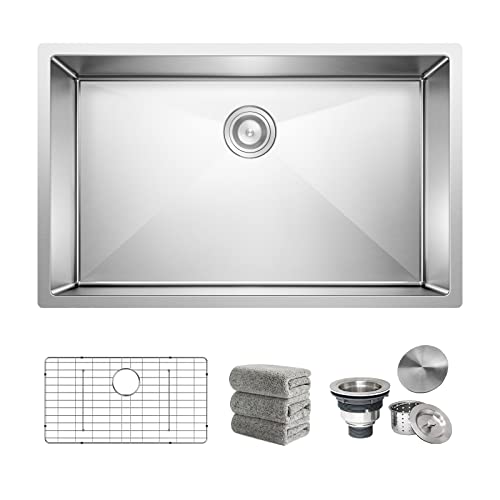
Oxwiser 32×18 Inch Undermount Sink Set — Best Overall
The complete big set: 32 x 18, 16 gauge, with grid, drain assembly, cap, and towel in one box. Key specs: Size: 32 x 18 inch; Mount: Undermount; Material: Stainless steel, 16 gauge. Check on Amazon
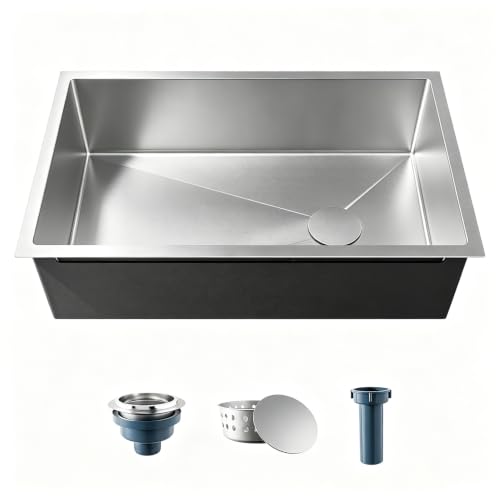
Kraus KHU640-33 33 Inch Undermount Sink — Best for Deal Hunters
The width buy: 33 inches of bowl with rounded corners and channel drainage — compare listings on size first. Key specs: Size: 33 inch; Mount: Undermount; Material: 18-gauge stainless steel. Check on Amazon
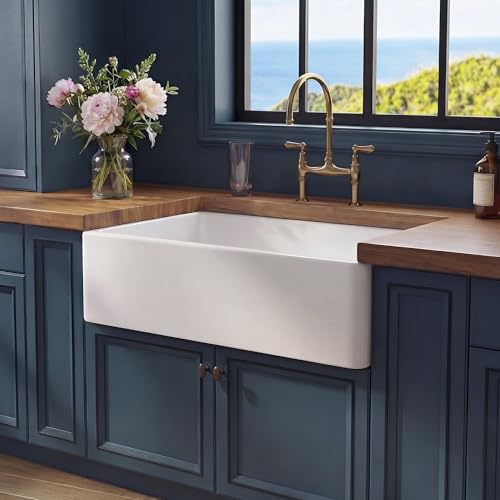
Miuara 30 Inch Fireclay Farmhouse Sink — Best Farmhouse Pick
The farmhouse standard: 30 x 18 white fireclay, reversible apron, stain-resistant glaze. Key specs: Size: 30 x 18 inch; Type: Farmhouse apron front; Material: White fireclay. Check on Amazon
Miuara 33 Inch Fireclay Farmhouse Sink — Best Large Farmhouse
The farmhouse statement: the same fireclay virtues at 33 x 18 for designed-around-it kitchens. Key specs: Size: 33 x 18 inch; Type: Farmhouse apron front; Material: White fireclay. Check on Amazon
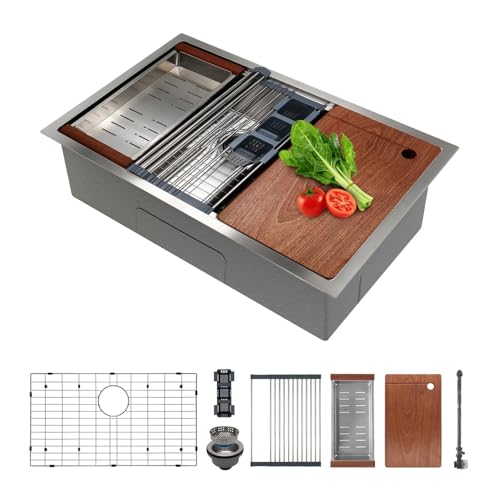
SANYCASA 30 Inch Undermount Workstation Sink — Best Heavy-Gauge Pick
The specification buy: 11 gauge (3mm) steel workstation — the heaviest build on this list. Key specs: Size: 30 inch; Mount: Undermount; Material: Stainless steel, 11 gauge (3mm). Check on Amazon
Kraus KHU100-30 30 Inch Undermount Sink — Best Trusted Classic
The safe buy: Kraus’s 30 inch, 16-gauge classic with rounded corners and NoiseDefend pads. Key specs: Size: 30 inch; Mount: Undermount; Material: 16-gauge TRU16 stainless steel. Check on Amazon
How These Picks Were Chosen
This shortlist was built the way a careful buyer shops. First, only current listings with fully verified specifications were admitted — every dimension, gauge, and included item in these reviews traces to the listing’s own verified data, because sale shopping is where vague listings do their damage. Second, the pool was balanced across the genuine choice axes a buyer faces: bundled set versus bare bowl, classic versus workstation, stainless versus fireclay, standard 30 inch versus wide 32 and 33 inch formats. Third, each pick had to represent its category honestly — the pick that leads its class on a specification a buyer can verify.
What was excluded matters too. No pick is here because of a claimed discount, a rating figure, or a star count — this guide does not print fixed ratings or prices, because both change and neither describes the sink. Where a listing’s contents are limited, the review says so; where a bundle is generous, the review names every item. The ranking therefore reflects specification value: completeness, build, and fit for the most common buying situations. It is research-led guidance for a purchase decision, not a claim of hands-on testing.
The practical consequence is a list you can shop in any order that suits your project. The remodel buyer starts at the set that matches their cabinet and works outward; the urgent replacement buyer starts at the classic that matches their existing cutout. Both are served, because the specifications are stated plainly enough to check against a tape measure in under a minute. Brand-focused shoppers arriving from Best Kitchen Sinks Franke should apply the same listing discipline there: verify the specification, not the badge, before comparing any two sinks for sale.
Our Picks for best kitchen sinks for sale, Reviewed One by One

Oxwiser 32×18 Inch Undermount Sink Set
Badge: Best Overall
Strengths
- All the completeness of the 30 inch Oxwiser set — grid, drain assembly, cap — scaled to a 32 inch bowl.
- 32 inches of single bowl flattens the biggest pans and still arrives with its floor protected by the included grid.
- 16 gauge steel keeps the larger bowl rigid and resistant to the flex a big span of thin steel can show.
Trade-offs
- The wide format needs a wide base cabinet; measure before falling for the capacity.
- No ledge system, so workstation fans should look at the Kraus KWU110-32 instead.
- A bigger bowl is a bigger cleaning surface and takes more water to fill for a full soak.
| Size | 32 x 18 inch |
| Mount | Undermount |
| Material | Stainless steel, 16 gauge |
| Bowl | Single bowl |
| Bundle | 5 items: sink, bottom grid, drain assembly, drain cap, towel |
Take the Oxwiser formula — a correctly specified stainless bowl with its working parts bundled — and widen it to 32 x 18 inches, and you get this set. The verified bundle mirrors its smaller sibling: sink, bottom grid, drain assembly, drain cap, and towel. At 32 inches the grid stops being a nicety and becomes close to essential, because a floor this wide collects more pan traffic, more cutlery drops, and more opportunities for scratches; having it fitted and included from day one protects the finish when it is newest and most vulnerable.
Capacity is the reason to choose it. The extra two inches over the 30 inch sets are the difference between a roasting tin lying flat and a roasting tin propped at an angle shedding water down your front. Batch cooks, bakers with full-size sheet pans, and households washing up after gatherings will use that width weekly. The 16 gauge steel matters at this span too — a wide bowl floor in thin steel can flex and drum, while 16 gauge keeps the structure composed.
The limits mirror the 30 inch set, scaled up: no ledge for sliding accessories, a cabinet-width requirement that must be verified rather than assumed, and the simple physics that a larger bowl takes more water and more wiping. Buyers with the cabinet for it get the most complete big-bowl package in this guide; buyers without it should step down to the 30 inch set and lose nothing but width.
As a purchase, this set is the fewest-transactions route to a big new sink: one order delivers the bowl, its floor protection, and its drain hardware, matched by the maker. For sale shoppers that completeness is the comparison to beat — any rival listing must be judged with its grid and drain added to the mental basket before the two can be called equivalent.
Best for: buyers who want a big, complete set — sink, grid, and drain parts — in a single purchase / Not suited for: cabinets too narrow for a 32 inch bowl

Kraus KHU640-33 33 Inch Undermount Sink
Badge: Best for Deal Hunters
Strengths
- At 33 inches it is the widest bowl in this guide — maximum flat capacity for oversize cookware.
- Rounded corners and channel grooves keep even this large floor draining fully and cleaning easily.
- NoiseDefend pads tame the acoustics that a very large steel bowl would otherwise amplify.
Trade-offs
- 18 gauge steel in the widest bowl here is the combination most likely to feel lively; heavy pans should be set down, not dropped.
- Needs the widest base cabinet of any pick in this guide — verify the cabinet before anything else.
- Its scale dwarfs small kitchens and short counter runs; proportion is a real constraint, not a taste question.
| Size | 33 inch |
| Mount | Undermount |
| Material | 18-gauge stainless steel |
| Corners | Rounded, resist buildup |
| Drainage | Channel grooves |
| Sound | NoiseDefend pads |
The KHU640-33 is the maximum-capacity entry: 33 inches wide, the broadest bowl in this guide, built for kitchens where the sink is a genuine workstation for volume cooking. Turkey roasters, double batches of sheet-pan vegetables, the preserving pot that appears twice a year and defeats every normal sink — this is the bowl that takes them flat and upright respectively. If your recurring frustration is cookware that does not fit, width is the cure and this is the widest dose available here.
Kraus equips the big bowl with the detailing that keeps large sinks liveable. Rounded corners resist the buildup that plagues wide floors, channel grooves give a broad sheet of water a directed exit so the bowl drains rather than ponds, and NoiseDefend pads work hardest exactly here, because a 33 inch steel box under a running tap would otherwise be the loudest object in the kitchen. The design intent is clear: capacity without the maintenance penalty.
The compromise is in the verified gauge. At 18 gauge, this widest bowl is also built from the lighter steel class, so it asks for reasonable handling — set heavy cookware down rather than dropping it, and let the pads do the sound work. It also demands the largest cabinet in the guide. Kitchens that can house it and cooks who will fill it get an unmatched working volume; everyone else is better served by the thicker 32 inch Kraus.
The KHU640-33 is the listing to watch if width is your non-negotiable: 33 inch bowls are the least common format in this cluster, so when one is listed and available it deserves a prompt decision from buyers whose cabinets fit it. Its 18 gauge build is the stated trade — you are buying maximum width with drainage and corner detailing, in the lighter steel class.
Best for: shoppers prioritising maximum bowl width when comparing current listings / Not suited for: buyers who need the dent resistance of thicker steel
Miuara 30 Inch Fireclay Farmhouse Sink
Badge: Best Farmhouse Pick
Strengths
- Fireclay’s glazed surface resists staining in a way stainless never quite matches — tomato, turmeric, and red wine wipe off a sound glaze.
- The reversible bowl lets you choose the apron face that suits the kitchen at installation time.
- At 30 x 18 it brings the farmhouse look to the standard cabinet size rather than demanding a remodel around it.
Trade-offs
- Fireclay is heavy and unforgiving of installation shortcuts; the cabinet needs proper support built for the apron load.
- A hard glaze can chip if heavy cast iron strikes the rim or apron edge — it resists scratches, not impacts.
- The white apron front is a strong style statement that commits the kitchen’s look; it does not blend quietly like steel.
| Size | 30 x 18 inch |
| Type | Farmhouse apron front |
| Material | White fireclay |
| Bowl | Reversible single bowl |
| Resistance | Stain, crack, heat and scratch resistant |
| Install | Apron front or drop-in (undermount) |
The Miuara 30 inch brings the material argument into a guide dominated by steel. Fireclay is ceramic fired at high temperature until the glaze and body fuse, producing the dense, glassy surface that made farmhouse sinks a fixture of working kitchens long before they were a style trend. The verified claims are the practical ones: resistance to stain, crack, heat, and scratch. In daily terms that means the sauces and spices that shadow stainless — turmeric, tomato, coffee, red wine — sit on a glaze they cannot penetrate and leave with a wipe.
The apron front format changes the ergonomics as well as the look. With no counter strip between you and the bowl, you stand closer to the work, which tall cooks and anyone washing large items feel immediately in their back. The bowl is reversible, so the apron face presented to the room is a choice made at fitting time, and the 30 x 18 footprint keeps that farmhouse presence within the standard cabinet class rather than forcing a bespoke build.
Respect the material’s terms and it repays you for decades. Fireclay is heavy, so the cabinet must be framed to carry it, with the apron load supported rather than hung. The glaze resists scratching and heat superbly but can chip under a sharp, heavy impact — a dropped cast-iron rim on the apron edge is the classic accident — so heavy pans are carried, not swung. Owners who accept those two disciplines get the easiest-cleaning, most characterful bowl in this guide.
Fireclay rarely appears in impulse-buy territory, and rightly: this is a considered purchase whose value sits in decades of glaze performance. As a listed buy it suits the planned farmhouse remodel, where the cabinet support is part of the project and the 30 inch standard size keeps every other element of the build conventional.
Best for: farmhouse-style kitchens buying a 30 inch fireclay bowl at the standard cabinet size / Not suited for: cabinets without an apron-support build

Miuara 33 Inch Fireclay Farmhouse Sink
Badge: Best Large Farmhouse
Strengths
- The widest fireclay bowl here: 33 inches of apron-front capacity for the largest roasters and gatherings.
- All the glaze advantages of the 30 inch Miuara — stain, heat, crack and scratch resistance — at statement scale.
- Reversible bowl keeps the installation choice open until the apron is actually being fitted.
Trade-offs
- The heaviest proposition in this guide: a 33 inch fireclay apron sink demands serious cabinet support and a two-person lift.
- Needs a wide farmhouse-ready cabinet; retrofitting it into a standard sink base is a project, not a swap.
- White fireclay at this width dominates the kitchen visually — commit to the look before committing to the sink.
| Size | 33 x 18 inch |
| Type | Farmhouse apron front |
| Material | White fireclay |
| Bowl | Reversible single bowl |
| Resistance | Stain, crack, heat and scratch resistant |
| Install | Apron front or drop-in (undermount) |
Everything the 30 inch Miuara argues, the 33 inch version argues at full scale. This is the widest fireclay bowl in the guide, an apron-front statement for kitchens built around gathering: the roaster that feeds a table of twelve, the canning pot, the drinks tub pressed into service at a party. The verified fireclay specification is identical — reversible single bowl, resistance to stain, crack, heat, and scratch — so the choice between the two Miuaras is purely about cabinet width and appetite for presence.
The glaze is the working advantage that survives the honeymoon. Stainless bowls, however well kept, develop a patina of fine marks; a sound fireclay glaze keeps its depth of shine and its refusal to hold stains year after year, provided it is cleaned with non-abrasive products. The apron front at 33 inches also delivers the ergonomic benefit at scale — standing close to a very wide bowl, reaching its centre without leaning across a counter strip, matters when the bowl is full of water and crockery.
The costs are structural and absolute. A 33 inch fireclay sink is among the heaviest fixtures a kitchen takes, the cabinet must be built or rebuilt to carry it with the apron supported, and installation is a planned two-person job. The white apron will also be the first thing every visitor sees, which is either the point or the problem. Kitchens designed around it will love it; kitchens merely accommodating it should choose the 30 inch.
The 33 inch Miuara is the considered purchase at statement scale. Sale shoppers should treat it as a project decision, not a product decision: the listing is the beginning of a cabinet conversation. Buyers whose kitchens are genuinely designed around an apron front will find few listed alternatives at this width in fireclay; buyers improvising should step down to the 30 inch.
Best for: large kitchens buying a statement 33 inch fireclay apron sink / Not suited for: small kitchens or simple like-for-like swaps
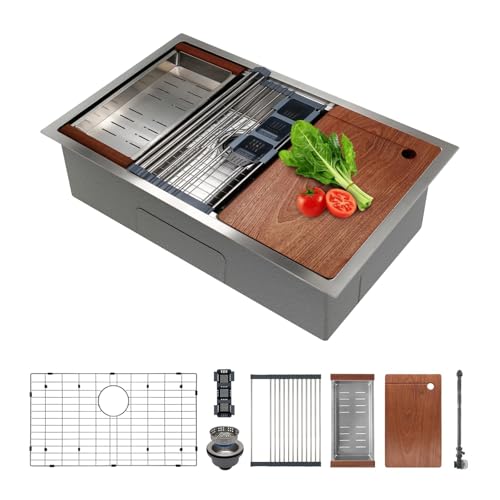
SANYCASA 30 Inch Undermount Workstation Sink
Badge: Best Heavy-Gauge Pick
Strengths
- The 11 gauge (3mm) steel in the verified title is substantially thicker than the 16 and 18 gauge bowls elsewhere in this guide, which means a denser feel and less flex when a loaded stockpot lands in the bowl.
- The integrated ledge turns the rim into a working surface, so boards and racks sit level with the counter instead of wobbling on the bowl edge.
- A single uninterrupted bowl swallows sheet pans, roasting tins, and large cutting boards flat, with no centre divider forcing you to angle them in.
Trade-offs
- Thick steel is heavy steel: the cabinet and mounting hardware carry more weight, and the undermount clips and support framing need to be planned, not improvised.
- A 30 inch workstation format needs a generously sized base cabinet, so it rules itself out of narrow sink bases.
- Workstation ledges reward owners who actually use ledge accessories; if you never slide anything along the rim, you are paying in complexity for a feature that sits idle.
| Size | 30 inch |
| Mount | Undermount |
| Material | Stainless steel, 11 gauge (3mm) |
| Bowl | Single bowl |
| Work surface | Integrated ledge, multifunctional workstation |
The SANYCASA is the heavyweight of this line-up in the most literal sense. Most residential stainless sinks are built from 16 or 18 gauge sheet, and the verified specification here is 11 gauge at 3mm, a figure you can feel the moment a cast-iron pan is set down rather than lowered carefully. That mass does two useful things: it deadens the hollow drumming that thin bowls produce under a running tap, and it resists the small dents and oil-canning flex that show up over years of heavy cookware. If your kitchen works hard — big pots, stacked roasting tins, a household that cooks from scratch — this is the bowl that shrugs that workload off.
The second defining feature is the integrated ledge, which makes this a workstation rather than a plain bowl. The ledge is a stepped shelf formed into the rim, and accessories sized to it slide front to back so food preparation can happen directly over the sink: produce is washed, moved onto a board, chopped, and swept into the bowl without crossing the counter. In practice the ledge matters most for cooks who prep in volume, because it converts dead air above the bowl into usable work surface and keeps the mess contained over a drain instead of spread across the worktop.
As a single bowl it takes the modern approach to capacity: one wide, uninterrupted volume. A half-sheet pan lies flat for soaking, a tall stockpot stands upright under most faucets, and there is no divider to chip pan corners against. The honest limitation is the flip side of that openness — there is no second compartment, so soaking and rinsing happen in sequence or with a separate tub placed inside the bowl, and households wedded to a dedicated wash-and-rinse split will feel the adjustment. The undermount fitting keeps the surrounding counter wipeable straight into the bowl, with no rim lip to trap crumbs.
Specification shoppers: this is your listing. The 11 gauge (3mm) figure is verifiable, unusual, and consequential — it is the heaviest build in the guide — and the workstation ledge is formed into the product rather than bundled as an afterthought. If you comparison-shop by spec sheet, this bowl wins arguments on paper that it also wins in the hand.
Best for: buyers who shop by specification and want the heaviest gauge steel in the guide / Not suited for: narrow cabinets or buyers who will not use a workstation ledge

Kraus KHU100-30 30 Inch Undermount Sink
Badge: Best Trusted Classic
Strengths
- 16-gauge TRU16 steel is the proven residential standard: thick enough to feel solid and resist denting, without the extra weight of heavier specialty gauges.
- Rounded corners genuinely clean faster than tight handmade corners, because a sponge follows the curve instead of digging into a seam.
- Channel grooves in the bowl floor steer standing water toward the drain, so the bowl dries instead of puddling.
Trade-offs
- No integrated ledge, so workstation accessories sit on the rim or the counter rather than sliding in a dedicated track.
- Rounded corners trade a little flat floor space for cleanability; very large pans sit slightly less squarely than in a zero-radius bowl.
- The 30 inch format still needs a mid-size or larger base cabinet, so it is not a small-kitchen shortcut.
| Size | 30 inch |
| Mount | Undermount |
| Material | 16-gauge TRU16 stainless steel |
| Corners | Rounded, for easy cleaning |
| Drainage | Channel grooves |
| Sound | NoiseDefend pads |
The Kraus KHU100-30 is the classic done properly. Its verified specification reads like a checklist of what a decade of stainless sink design settled on: 16-gauge TRU16 steel, rounded corners, channel grooves in the floor, and NoiseDefend sound-absorbing pads underneath. None of that is exotic, and that is precisely the appeal. This is a sink for buyers who want the known quantity — a bowl that behaves predictably, cleans predictably, and does not ask them to learn a new way of working.
The rounded corners deserve more credit than they usually get. Tight, square handmade corners look sharp in photographs and then spend their lives collecting a dark line of residue that needs a brush and patience. A rounded radius lets a sponge or cloth sweep the corner in the same motion as the wall, so the daily wipe-down actually finishes the job. Combined with the channel grooves, which give water a guided path to the drain instead of letting it sheet and settle, the bowl tends to dry cleaner between uses — a small, unglamorous advantage you notice every single morning.
NoiseDefend padding addresses the other stainless stereotype, the echoing clang. Pads under the bowl absorb the vibration of running water and clattering cutlery, keeping the sink sounding like a fixture rather than a drum. The honest limitation is scope: this is a single-purpose bowl with no ledge and no bundled workstation system, so buyers who want to prep over the sink will be adding rim-sitting accessories rather than sliding ones. For everyone else, the restraint is the point.
The KHU100-30 is the replacement buyer’s friend: the standard 30 inch size, the established Kraus line, the specification — 16-gauge TRU16, rounded corners, channel grooves, NoiseDefend — that a decade of kitchens has validated. When the old sink has failed and the decision must be right the first time, this is the listing with the fewest unknowns.
Best for: buyers who want the established, easy-clean 30 inch classic from a proven sink line / Not suited for: buyers wanting a ledge or bundled workstation accessories
Comparison Table
The table below lines the six best kitchen sinks for sale picks up on the attributes that decide daily use — size, build, and the design details that affect drainage and cleaning. Prices and ratings are deliberately absent: both change constantly, and neither describes the sink. Use the table to shortlist, then read the full reviews before deciding.
| Pick | Badge | Size | Build | Standout detail | Check |
|---|---|---|---|---|---|
| Oxwiser 32×18 Inch Undermount Sink Set | Best Overall | 32 x 18 inch | Stainless steel, 16 gauge | 5-item bundle with bottom grid | Check on Amazon |
| Kraus KHU640-33 33 Inch Undermount Sink | Best for Deal Hunters | 33 inch | 18-gauge stainless steel | Widest bowl, channel grooves | Check on Amazon |
| Miuara 30 Inch Fireclay Farmhouse Sink | Best Farmhouse Pick | 30 x 18 inch | Farmhouse apron front; White fireclay | Reversible fireclay apron front | Check on Amazon |
| Miuara 33 Inch Fireclay Farmhouse Sink | Best Large Farmhouse | 33 x 18 inch | Farmhouse apron front; White fireclay | Reversible fireclay apron front | Check on Amazon |
| SANYCASA 30 Inch Undermount Workstation Sink | Best Heavy-Gauge Pick | 30 inch | Stainless steel, 11 gauge (3mm) | Integrated ledge workstation | Check on Amazon |
| Kraus KHU100-30 30 Inch Undermount Sink | Best Trusted Classic | 30 inch | 16-gauge TRU16 stainless steel | Rounded corners, channel grooves | Check on Amazon |
How to Choose a Kitchen Sink When Shopping the Listings
Start every listing comparison with the tape measure, in this order: cabinet interior width, existing cutout if you are replacing rather than remodeling, bowl depth your plumbing allows, and the largest pan you own. Those four numbers eliminate most listings instantly and turn a page of offers into a shortlist of two or three. Only then compare what the survivors offer — gauge, design, contents — because a sink that fits and is merely good beats a magnificent sink that does not fit, every single time.
Read listings for what they include with the same care as what they are. The vocabulary matters: a sink sold with a drain assembly is a different purchase from a sink that merely fits one; a grid included is a grid you do not order separately; a workstation with accessories in the box is a station on day one, while a bare ledge is a project. This guide’s reviews state contents exactly as verified, and your own listing reading should demand the same precision — scroll past the photographs to the specification and contents lines before forming any impression.
Finally, place the purchase in its tier honestly. The market divides into qualitative tiers — entry handmade bowls in lighter steel, the 16 gauge mainstream where most of this guide lives, and specialty builds like the 11 gauge workstation and the fireclay aprons — and a listing that seems to offer a higher tier’s specification at a lower tier’s position deserves scrutiny, not celebration. Check the gauge figure, check the dimensions, check the contents. The sinks in this guide were chosen because their listings survive that scrutiny. Shoppers outfitting a small or mobile kitchen should carry the same checklist to Best Kitchen Sinks For Van, where the size filter eliminates even faster.
How to Buy a Sink Online Without Buying the Wrong One
The buying process that protects you has five steps. One: measure and write down your four numbers — cabinet width, cutout or counter plan, depth allowance, largest pan. Two: shortlist only listings whose verified dimensions fit those numbers, and note each one’s contents line. Three: decide your tier and type — steel gauge class or fireclay, classic or workstation, set or bare bowl. Four: order with the installation calendar in view, allowing delivery and inspection time before any fabricator or installer appointment. Five: on arrival, unbox and inspect before anything is demolished.
The inspection step is the one buyers skip and regret. Check the bowl against its template if one is included, run a hand along the rim for true, look the finish over in daylight, and for fireclay, examine the glaze and apron edges for transit chips before the delivery is signed off as accepted. A sink is a heavy, fragile-in-transit object; discovering damage at fitting time, with the old sink already out, converts a simple return into a kitchenless week. Keep the packaging until the bowl is fitted — returns of large fixtures are markedly easier in their original protection.
Then the fitting itself, briefly: undermount bowls are sealed and mechanically supported to the counter’s underside, apron bowls are set on their cabinet support, drains are assembled with the parts the listing included or the ones you planned, and everything is water-tested before the cabinet is filled with the household’s stored clutter. Problems buyers report most: Problem: the new bowl does not match the old cutout → nominal sizes vary by maker; this is why the template and the tape measure outrank the headline size. Problem: missing drain or grid at fitting → the contents line was skimmed; re-read it at shortlist stage. Problem: a fireclay chip found late → inspect at the door, in daylight, before signing. The mobile-kitchen version of this discipline appears in Best Kitchen Sinks For Van Life, where a wrong delivery cannot be solved with a quick drive anywhere.
What a Sink Listing Includes — and What It Quietly Leaves Out
Listings photograph the bowl and list the bowl; the installation lives in the margins. Across this guide’s six picks the contents range from a full five-item set to a bowl with a drain kit and an explicit statement that nothing else is included — and both are honest listings, because both tell you. The danger is never the stated contents; it is the assumed ones. Grids, drain assemblies, caps, mounting hardware, and templates are each included by some makers and sold separately by others, with no industry standard to protect the assumptive buyer.
The habit that protects you is a two-column note for every listing you seriously consider: what the verified contents say is in the box, and what your installation needs that is not in it. The second column is your true comparison — it is where a seemingly simpler purchase reveals its errands, and where a complete set quietly justifies itself. This guide’s reviews keep that second column short by stating contents exactly, but the habit is yours to keep for every listing beyond this page.
Buying Around a Remodel Calendar: When the Sink Must Arrive
A sink purchase inside a remodel is a scheduling object before it is a product. Counter fabricators template to the physical bowl; installers book against confirmed deliveries; plumbers finish against fitted sinks. The sink therefore belongs early in the order sequence — chosen when the cabinets are chosen, delivered before templating, inspected on arrival. Buyers who reverse that order, seduced by a later promotion, gamble the whole calendar on a delivery estimate and a cardboard box.
The calmer sequence costs nothing: decide the bowl with the kitchen design, order it with the cabinets, store it safely, and let every later trade work to a fixture that exists. Urgent replacement buyers have the opposite calendar — the kitchen is already wounded — and for them the in-stock classic at the correct size, like the KHU100-30 here, is the rational buy even when a slower listing tempts. Fit the buying strategy to the calendar you actually have.
Common Buying Mistakes
The costliest sale-shopping mistake is buying to the photograph: falling for a bowl’s look and discovering at fitting that its width, depth, or mounting does not match the kitchen it was bought for. Photographs do not show cabinets. The tape measure is the first shopping tool, the listing’s specification the second, and the photograph a distant third.
Second is comparing a set against a bare bowl as if they were the same purchase. Third is demolishing the old sink on a delivery estimate — keep the kitchen working until the new bowl is unboxed, inspected, and confirmed. Fourth is ignoring the cabinet implications of fireclay: an apron front bought as casually as a steel bowl arrives as a construction project nobody scheduled.
Fifth is chasing a listing’s framing instead of its specification. Gauge, dimensions, material, and contents describe the sink you will own for decades; the circumstances of its sale describe a week. Buy the decades.
Final Recommendation
If you are buying now and want one recommendation to anchor the shortlist, take the Oxwiser 32 x 18 set where the cabinet allows it: the complete bundle at a big, useful size is the purchase with the fewest loose ends. Where the cabinet is the standard 30 inch, the same logic in classic form points to the Kraus KHU100-30 — the established specification with nothing left to chance.
Choose the SANYCASA if you shop by specification and will use its workstation ledge, the Kraus KHU640-33 if width is your headline requirement, and either Miuara — 30 inch for the standard farmhouse build, 33 inch for the statement — if your project is ready for fireclay. In all cases: measure first, read the contents line, inspect at the door. Shoppers who want a second lens on the same bowls can cross-check their shortlist against the functional priorities in Best Kitchen Sinks Functional, which rank these same bowl families by how they work rather than how they are sold.
Start your shortlist here: Oxwiser 32×18 Inch Undermount Sink Set, Kraus KHU640-33 33 Inch Undermount Sink, and Miuara 30 Inch Fireclay Farmhouse Sink cover the strongest combinations of fit, build, and everyday usability in this guide — check the latest price on Amazon for each and confirm the dimensions against your own cabinet before ordering.
One More Consideration
Keep every document the purchase generates: the listing’s specification, the template, and the fitting notes. Sinks outlive memories, and the next person to work on your kitchen — possibly you, in ten years, replacing a drain — will be grateful for a folder that states exactly what is under the counter.
Frequently Asked Questions
What should I check first when comparing kitchen sinks for sale?
Cabinet fit. Measure the sink-base interior, then compare verified bowl dimensions against it — before gauge, before style, before anything in a photograph. After fit, compare contents: whether a grid and drain assembly are included changes what the purchase really is. Those two checks eliminate most wrong buys.
Is a bundled sink set better value than a bare bowl?
It is more complete, which is a different and more useful claim. A set like the Oxwiser’s arrives with grid, drain assembly, and cap matched to the bowl, removing separate orders and compatibility risk. A bare bowl from a maker like Kraus suits buyers who already own compatible parts or prefer to choose each component. Compare whole installations, not headlines.
Should I buy a sink before my countertop is fabricated?
Yes — before templating, not merely before fabrication day. Fabricators cut to the physical bowl and its template, and a substituted sink at the same nominal size can differ enough to spoil a reveal. The sink should be delivered and inspected while the schedule can still absorb a problem.
How do I inspect a sink when it arrives?
Unbox it in daylight before signing off. Check the rim for true by hand, the finish for marks, the bowl against its template, and — for fireclay — every glaze edge for transit chips. Keep the packaging until fitting is complete. Damage found at the door is a return; damage found at fitting is a crisis.
Does steel gauge matter when choosing between listings?
Yes — it is one of the few specifications that predicts daily feel. Sixteen gauge is the solid mainstream standard in this guide; 18 gauge bowls are lighter and livelier; the 11 gauge SANYCASA is a specialty heavyweight. Gauge cannot be judged from photographs, which is exactly why listings that state it plainly deserve your trust.
Can I replace my sink with a different size?
Only within what the cabinet and counter allow. A like-for-like width is a swap; a wider bowl under an existing counter usually means a new cutout, which in stone means a fabricator, and in a finished kitchen often means a new counter run. Measure the existing cutout and cabinet before assuming any listed size is a replacement rather than a remodel.