A meat thermometer takes the guesswork out of roasts, steaks and chicken, and it helps you pull food at the right moment. The best kitchen thermometer for meat is fast, easy to read and sturdy enough for regular use, whether you choose an instant-read probe or a wireless one.
The six thermometers below cover instant-read, dual-probe and wireless models from familiar brands. We have not used these products ourselves, so please confirm sizes, finishes and details on the current listing before you buy. Speed, range and battery claims are the makers’ own. Follow safe food temperature guidance from official sources for each type of meat, and replace the batteries before they run low.
As an Amazon Associate we earn from qualifying purchases. Links below are affiliate links, and they do not change the product information we give.
What to Look For
| Feature | Why it matters |
|---|---|
| Response time | Faster readings help when the grill lid is open |
| Probe type | Instant-read probes are handheld; leave-in probes track a roast |
| Display | A backlit or large display helps in dim light |
| Water resistance | A splash-resistant body copes with kitchen mess |
| Calibration | Check whether you can adjust accuracy |
In this guide
Specs at a Glance
| Thermometer | Type | Display | Notes |
|---|---|---|---|
| ThermoWorks Thermapen ONE | Instant-read | Rotating display | Fast reading; check the listing |
| ThermoPro TP03 | Instant-read | Digital | Simple and compact |
| Lavatools Javelin PRO Duo | Instant-read | Digital | Folding probe |
| MEATER Plus | Wireless | App-based | Leave-in probe |
| ThermoPro TP20 | Dual probe with alarm | Digital receiver | Wireless range varies; check the listing |
| Alpha Grillers instant-read | Instant-read | Digital | Check the version |
The 6 Best Kitchen Thermometers for Meat

Top pickBest for serious cooks
1. ThermoWorks Thermapen ONE
A fast instant-read thermometer that many cooks regard as a benchmark, with a display that rotates for easy reading. The brand also sells simpler options. It is built for repeated daily use in busy kitchens.
Suits: serious cooks. Strengths: speed and a sturdy build. Weaknesses: a premium-leaning range. Skip it if you want a basic probe.


Best for everyday cooking
2. ThermoPro TP03 Digital Instant Read Meat Thermometer
A compact instant-read thermometer with a folding probe and a simple display. It is a well-known value option for home cooks. It suits steaks, chops and chicken, and it slips easily into a drawer. Check the listing for battery and range details.
Suits: everyday cooking. Strengths: a simple design and fast reading. Weaknesses: less rugged than premium models. Skip it if you want to leave a probe in the oven.

Best for grilling
3. Lavatools Javelin PRO Duo Digital Meat Thermometer
A folding-probe instant-read thermometer with a bright display. Popular among grillers who want quick checks on steaks, burgers and chicken. The probe folds away to protect the tip. Check the listing for the water resistance.
Suits: grilling. Strengths: a clear display and a folding probe. Weaknesses: needs gentle handling. Skip it if you want a wireless probe.
View Lavatools Javelin PRO Duo on Amazon

Best for long roasts
4. MEATER Plus Wireless Smart Meat Thermometer
A wireless probe that stays in the meat and sends readings to an app. It suits long roasts and smoking, because you can track the temperature from another room. Check the listing for the app and range details.
Suits: long roasts. Strengths: wireless tracking. Weaknesses: relies on a phone app. Skip it if you want a simple handheld.

Best for roasts with a long cook time
5. ThermoPro TP20 Wireless Meat Thermometer
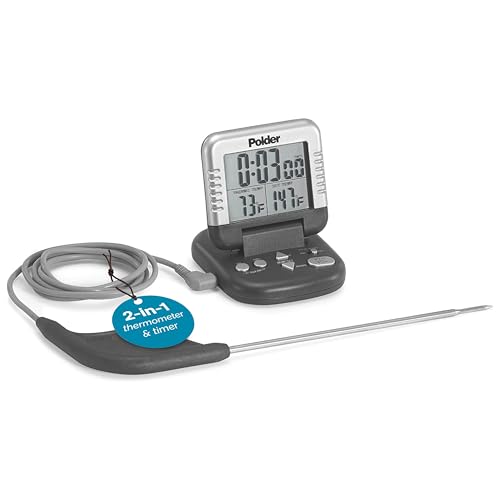
A dual-probe thermometer with a wireless receiver and alarms, suited to roasts and the oven or grill. The receiver lets you step away from the kitchen. The alarms alert you when the meat reaches your target, so you can check other dishes. Check the listing for range details.
Suits: roasts with a long cook time. Strengths: dual probes and alarms. Weaknesses: range varies indoors. Skip it if you prefer a handheld probe.
View ThermoPro TP20 Thermometer on Amazon

Best for casual grilling
6. Alpha Grillers Instant Read Meat Thermometer
A digital instant-read thermometer with a backlit display, often packaged as a gift for grillers. The backlit display helps for evening cooks, and it is a simple handheld tool. Check the listing for the specs.
Suits: casual grilling. Strengths: a backlit display and easy use. Weaknesses: less known than major brands. Skip it if you want proven calibration tools.

Care and Setup
- Wipe the probe clean after each use.
- Insert the probe into the thickest part of the meat, away from bone.
- Check batteries before a big cook.
- Test accuracy occasionally, for example in ice water, as the maker advises, and let large roasts rest after you pull them.
Mistakes to Avoid
- Touching bone with the probe.
- Leaving the thermometer in direct flame.
- Skipping a second reading in thick cuts.
- Washing a non-waterproof thermometer under a tap.
Why Temperature Beats Cooking Times
Recipes give times, but times only estimate. The thickness of a cut, the starting temperature of the meat, how hot your oven or grill really runs and whether the meat was patted dry all change how long it takes to cook. The internal temperature is the one measurement that tells you what is happening inside, which makes a thermometer the most dependable guide to doneness and food safety.
That matters in two directions. Undercooked poultry and ground meat can be a food safety concern, so you need to confirm they have reached the safe temperature recommended by your local food safety authority. Overcooked steaks, roasts and chops go dry and tough. With a thermometer you can pull the food at the temperature you want rather than guessing and cutting into it to check.
Use the temperature guidance from a reputable food safety source or your recipe, and keep in mind that meat continues to rise in temperature for a few minutes after leaving the heat, which is called carryover. Larger roasts tend to carry over more than thin steaks. Many cooks pull the meat a little before the target and let it rest. A thermometer lets you learn how your own oven, grill and cuts behave, so you get consistent results over time.
Instant-Read, Leave-In and Wireless Styles Compared
Meat thermometers come in a few broad styles, and each suits a different way of cooking.
- Instant-read: a handheld probe you insert for a few seconds to take a reading. Good for steaks, chops, burgers, chicken pieces and checking several spots. The speed is useful when the grill lid is open and heat is escaping.
- Leave-in probe with a cable: the probe stays in the meat while a cord connects to a display outside the oven or grill, often with an alarm. Good for long roasts and smoking, where you want to track progress without opening the lid.
- Wireless probe: a probe with no cable that sends readings to a base or a phone. Convenient for rotisserie and large cuts, but you rely on battery life and a signal that can be affected by metal and distance.
Many serious cooks own both an instant-read and a leave-in type, because they do different jobs. If you can only choose one, think about what you cook most. Quick weeknight meals suit instant-read, while holiday roasts and slow cooking suit a leave-in. Check the listing for the heat limits of probes and cables before using them in an oven or on a grill, and follow the maker’s instructions about what part can go inside and what part must stay outside.
Reading Speed, Range and Display
When you compare thermometers, check three practical features. First is response time: how long it takes to settle on a reading. Faster is convenient, especially at a hot grill, but it is also a matter of how long you are willing to hold your hand near the heat. The claimed speeds come from the makers, so treat them as a guide.
Second is temperature range. Make sure the thermometer covers the temperatures you need, including low temperatures for slow cooking and high ones for deep frying if you plan to use it that way. Not every meat thermometer is designed for oil, so check the instructions.
Third is the display. A large, high-contrast screen is easier to read in a bright kitchen or at dusk on the patio. A backlight helps in dim conditions, and a display that rotates or auto-flips is handy for left-handed users or when the probe is held at an odd angle. Some models include a hold function that freezes the reading so you can step away from the heat before looking.
- Check whether the unit shows both Fahrenheit and Celsius and how you switch between them.
- Look at probe length, especially for large roasts or deep grill grates.
- Consider an auto-off feature that saves battery, and check the battery type and how easy it is to replace.
Probe Placement and Technique
Even an excellent thermometer gives bad information if the probe is in the wrong place. Aim for the thickest part of the meat, away from bone, fat and gristle. Bone conducts heat differently and can give a falsely high reading. For poultry, a common approach is to insert into the thickest part of the breast or thigh without touching the bone. For burgers and thin cuts, insert from the side so the tip ends up in the center.
For large roasts, check in more than one spot, since heat is not uniform. Take a second reading in a different area if the first seems off. Keep the probe tip in the center of the thickest part, not near the surface, where the temperature is higher than inside.
- Insert the probe deep enough that the sensing area is fully in the meat. Check the manual, as the sensor location varies by design.
- Wait for the reading to settle before you decide.
- Wipe the probe clean between checks, especially between raw and cooked foods, to avoid spreading bacteria.
- Let meat rest after cooking and check once more if safety is a concern.
Avoid leaving a probe on a hot pan or in direct flame, which can damage it. If you are using a leave-in probe, route the cable so it does not touch heating elements or hot surfaces.
Accuracy, Care and Battery Habits
A thermometer is only helpful if it is accurate, so check it from time to time. A simple method many cooks use is an ice-water test: fill a glass with crushed ice and a little water, stir, and insert the probe without touching the glass. It should read close to the freezing point. Follow the maker’s instructions for checking and, if possible, adjusting the unit. If it is far off and cannot be corrected, replace it.
Care is simple but important. Wipe the probe with warm soapy water after each use, but do not submerge the whole unit unless the maker says it is waterproof. Check the water resistance rating on the listing and treat claims as the maker’s own. Store the thermometer in its sleeve or case so that the tip is protected, and avoid dropping it.
- Check batteries before a big cook, and keep spares for wireless models.
- Keep the probe cable from kinking or being pinched in oven doors.
- Do not leave the main unit in a hot oven or on a hot grill unless it is designed for that.
Consider replacement when readings drift, the display fails, the probe is bent or the cable frays. For wireless models, check whether the maker supports the app and battery replacement over the long term.
A Pre-Cook Routine for Any Thermometer
A thermometer only helps if you use it the same way every time. Build a short routine and the readings begin to feel trustworthy. Here is a routine you can adapt to whichever model from the list above sits in your drawer.
- Wipe the probe clean and dry before you reach for the meat, so old residue does not affect the reading.
- Look at the display and confirm the unit setting is the one you want, Fahrenheit or Celsius, to avoid a confusing moment mid-cook.
- Check the battery indicator if your model has one, and keep a spare nearby for wireless units.
- Find the thickest part of the cut and plan your insertion path before the meat comes off the heat.
- Take the reading, hold still until the number settles, and then record it in your head or on a note.
- Wash and dry the probe after use, following the maker instructions for what can be submerged.
The target temperature for each kind of meat should come from the maker of your thermometer, official food safety guidance or a trusted cooking source. Use those figures rather than relying on memory or a rule of thumb from a friend. A repeatable routine also helps you spot a thermometer that begins to behave oddly.
Wired, Wireless and Probe-Only Options Side by Side
Deciding between a fast handheld probe and a leave-in wireless unit is mostly a question of how you cook. This table puts the main trade-offs in one place so you can see where each style shines.
| Feature | Instant-read handheld | Wireless leave-in |
|---|---|---|
| Best moment to use | Quick checks on steaks, chops and chicken | Long roasts and slow cooks |
| Hands needed | One hand and short attention | Set it once and walk away |
| Power | Small battery, long life in many designs | Needs charging or fresh cells, plus a base or app |
| Learning curve | Almost none | A bit of setup the first time |
| Examples above | Thermapen ONE, ThermoPro TP03, Alpha Grillers | MEATER Plus, ThermoPro TP20 |
Neither style is better in every kitchen. Many cooks keep one of each, using the quick probe for spot checks and the wireless unit for roasts where opening the door repeatedly would let heat escape.
Common Slip-Ups When Reading a Thermometer
Even a good tool can give a misleading number when it is used carelessly. The most common slip is pushing the tip into fat or touching bone, which can read hotter or cooler than the meat around it. Aim for the center of the thickest muscle and give the reading a moment to settle.
Another slip is reading too soon. Some probes need a few seconds to catch up, and a number that is still climbing is not the final answer. Wait until it holds steady before you decide.
People also forget about carryover, the way meat keeps rising in temperature after leaving the heat. Whether to pull early is a question for the thermometer maker or your trusted cooking guide, since the right gap depends on the cut and the method.
Finally, avoid using a damaged cable or a bent probe. If a display flickers, the reading jumps or the probe will not seat properly, check the instructions that came with the unit and consider replacing it. A reliable reading is the whole point of owning one.
Keeping Readings Honest Over Time
Thermometers can drift, and the best defense is a regular check against a known reference. Many makers describe a simple way to confirm accuracy using an ice bath or boiling water, and some models include a calibration feature. Look for those steps in the manual for your specific unit rather than improvising.
Storage matters too. Keep the probe in its sleeve or case so the tip stays protected, and avoid tossing it loose into a drawer with sharp tools. Fold or coil any cable gently to avoid kinks near the connector.
Wipe the body with a damp cloth and keep water away from any part the maker says is not waterproof. Replace batteries on a schedule you can remember, perhaps at the same time you check smoke alarms in your home. A little care keeps a handy tool dependable for years.
Instant-Read, Leave-In and Wireless: Three Different Jobs
The six picks above look like variations on one tool, but they actually do three different jobs, and choosing well starts with knowing which job you need done. An instant-read thermometer, like the Thermapen ONE, the ThermoPro TP03, the Javelin PRO Duo and the Alpha Grillers model, is a spot-check tool. You open the oven or lift the grill lid, insert the probe, read the number within moments, and put the tool away. It answers the question: is it done now?
A leave-in probe answers a different question: how is it progressing? A wired or dual-probe unit such as the ThermoPro TP20 stays in the meat while it cooks, with the display or receiver outside the heat. You watch the temperature climb, get an alarm at your target, and never open the door to check. That matters for large roasts and smokers, where every peek costs heat and adds time, and where the inside of the cut is invisible for hours.
A fully wireless probe like the MEATER Plus removes the cable as well, sending readings to a phone app. It suits rotisserie cooking, where a cable would tangle, and long smokes where you want to follow the cook from the garden or the sofa. The trade-offs are the ones the review names: it relies on the app, on a charged probe, and on a wireless connection behaving itself through a metal cooker lid.
Many serious cooks end up owning two types: a leave-in probe for roasts and a fast instant-read for final checks and for thin cuts. If you only buy one, buy for the cooking you actually do most. A steak-and-chicken household gets more from a good instant-read; a household that smokes brisket on weekends gets more from a leave-in system. Buying the other kind first is the most common reason a thermometer ends up unused in a drawer.
Thin cuts deserve a special note. On a chicken breast, a pork chop or a fish fillet, the probe must measure the center of a shallow target, and a thick probe tip can overshoot into the pan or the far side. This is where the slim, fast instant-read models earn their place, used with the probe inserted sideways into the thickest part so the sensing tip sits in the middle of the meat.
Where to Probe: Placement Is Half the Skill
A thermometer is only as honest as its placement. The rules are simple but they decide whether the number on the display means anything. Always aim for the thermal center: the thickest part of the cut, away from bone, gristle and large pockets of fat. Bone conducts heat differently from meat and sits near hotter or cooler zones, so a probe touching bone can read high or low compared with the meat you will actually eat. Fat pockets insulate and read differently from lean muscle.
On a whole chicken or turkey, check the thickest part of the thigh without touching the bone, and ideally confirm at the breast as well, since the two finish at different rates. On a roast, push the probe in from the end or the side so the tip lands in the center of the mass, not just under the surface. On burgers and sausages, go in from the side. On a steak, the center of the thickest edge is the honest spot.
Take more than one reading when the stakes are high. Meat does not heat evenly, especially on a grill with hot spots, and a single reading can catch a cool pocket or a hot edge. Two or three quick checks with an instant-read take seconds and turn a guess into a pattern. If the readings disagree, trust the lowest one for safety decisions and give the food a little more time, then check again.
Depth matters as much as position. The sensing element sits near the probe tip, and that tip needs to be fully surrounded by meat. In a thin cut, insert the probe sideways so more of the tip is inside the food. In a thick roast, a shallow insertion reads the outer layer, which is always hotter than the center during cooking and cooler during resting.
Finally, remember that the hole you make is small and the juice loss from a probe check is minor compared with the loss from cutting a steak open to look at the color. Probing is the least invasive check there is, which is another reason to reach for the thermometer first and the knife second.
The Picks Above, Compared in Plain Terms
Within the instant-read group, the Thermapen ONE is the reference point: the fastest readings and the rotating display that reads from any angle, aimed at cooks who temp food daily and want the check over with quickly. The ThermoPro TP03 covers the same job in a simpler, compact form with a folding probe, suited to everyday cooking and easy drawer storage. The Javelin PRO Duo sits between them in spirit, a folding-probe model with a bright display that grillers favor for quick checks across several pieces at once. The Alpha Grillers model leans on its backlit display for evening cooking and a gift-friendly presentation.
The practical differences among those four show up in small moments. A rotating or backlit display matters at a dim grill in the evening and hardly at all in a bright kitchen at noon. A folding probe protects the tip in a drawer and makes the tool shorter to store; a fixed probe is one less thing to unfold with greasy hands. Speed matters most when the lid is open and heat is escaping, or when you are checking eight chicken thighs in a row.
The two leave-in options split by connection. The TP20 uses a dedicated receiver, which keeps the readings independent of your phone and gives you alarms on a unit you can carry around the house. The MEATER Plus puts everything in an app, which suits cooks who already run their smoker or rotisserie with a phone nearby and who want a graph of the cook rather than a single number. Neither is better in the abstract; they fit different habits.
A sensible pairing strategy emerges from the list: the TP20 or MEATER for the long cook, and any of the instant-reads for the final confirmation. If the budget stretches to one purchase now, start with the instant-read, because it serves every kind of cooking, then add a leave-in system when roasts and smokes become regular events.
Whichever you choose, treat maker claims about speed, range and battery life as the listing’s own figures and confirm them there, as the introduction to this guide advises. What you can judge from the start is the type, the display and how the tool fits your hand and your cooking.
Resting, Carryover and the Final Few Degrees
The thermometer’s job is not finished when the meat leaves the heat. During resting, the temperature inside a roast continues to climb for a few minutes as heat from the hotter exterior moves inward; this is carryover cooking, and larger, thicker cuts carry over more than thin ones. Cooks who ignore it pull a roast at the final target temperature and watch it overshoot while it rests. Cooks who plan for it pull the meat a little early and let the rest finish the work.
Resting does more than even out temperature. It lets juices redistribute through the meat instead of flooding the board at the first cut, which keeps slices moist. Tenting loosely with foil holds warmth without steaming the crust you worked for on a roast or a steak. Use the thermometer during the rest as well: a quick check after several minutes confirms the center landed where you intended, and builds your sense of how your oven, your grill and your usual cuts behave.
That learning loop is the quiet benefit of owning a thermometer. After a few cooks, you know that your grill runs hot on the left, that your chicken breasts finish faster than the recipe suggests, and that your favorite roast needs to come out a few degrees earlier than the book says. The tool turns those lessons into numbers you can repeat, which is what consistent cooking actually is.
For food safety, follow the guidance of your local food safety authority for each type of meat, and remember that resting time is part of many official recommendations. The thermometer gives you the measurement; the guidance tells you what the measurement should be. Keep the two together and you cover both safety and quality, which is the whole point of the tool.
Keeping a Thermometer Accurate for Years
Most thermometers drift slowly rather than failing outright, which is why an occasional accuracy check matters. The ice-water test described in the care notes is the classic home check: a properly made ice bath gives the probe a known reference, and a reading that has wandered tells you it is time to recalibrate if the model allows it, or to replace the unit. Boiling water is the other reference, though its exact temperature shifts with altitude, so ice water is the simpler standard for most kitchens.
Storage shapes lifespan more than use does. Folding probes should be folded; fixed probes should live in a sheath or a drawer where the tip is not bent against other tools. Keep the body away from the heat of the stove between checks, since electronics and displays dislike being left on a hot grill shelf, and never leave an instant-read unit in the oven or closed grill unless it is a leave-in probe designed for exactly that.
Batteries are the dull but decisive detail. A thermometer that dies mid-roast is worse than none, because you planned around it. Keep spares for the model you own, replace them at the first sign of a dim display, and for app-based probes, make charging part of the setup routine before a long cook rather than a discovery during it.
Cleaning is simple but not optional. Wipe the probe after every use, wash it with care around the joint where the probe meets the body, and respect the water resistance of your model rather than assuming it. A probe that carried raw chicken should never go straight into a cooked roast. Treat the thermometer like a knife: cleaned after each job, stored protected, and checked now and then to confirm it is still true.
Cooking Different Meats: What Changes and What Does Not
The thermometer does not change between proteins, but the habits around it do. Poultry rewards checking in two places, thigh and breast, because the dark and white meat finish at different rates and the bird is done only when both are satisfied. Pork chops and roasts reward a little patience: they are at their best pulled promptly at the safe temperature and rested, since they dry out quickly beyond it. Beef and lamb are where the thermometer serves preference rather than safety for whole cuts, letting you hit rare, medium or well with repeatability instead of hope.
Seafood is the timing game. Fish and shellfish have a narrow window and strong carryover for their size, so check early, check the thickest piece, and expect the center to keep moving after the pan leaves the heat. Ground meats, as the FAQ notes, are the safety game: no pink-center preference applies, and the thermometer is the only check that counts.
Large roasts and smoked cuts are the patience game, where a leave-in probe and an alarm spare you hours of door-opening. Vegetables and baked goods are rarely temped by home cooks, but the same tool confirms a casserole or a loaf’s center when a recipe gives a target. The through-line is that the thermometer replaces a different unreliable cue in each case: the clock, the color, the poke test, the clear juices. Learn which cue you used to trust for each food, and you will know exactly what the thermometer is improving.
A Short Routine for Grill Days and Big Roasts
For a grill session, set up before the food goes on: thermometer in hand or pocket, batteries confirmed, a small towel for wiping the probe between pieces. Work in a pattern across the grill so no piece is checked twice and none is missed, and wipe the probe after any piece that is still underdone before it touches a finished one. When everything reads right, the tool goes back in its sheath, not down on the hot grill shelf.
For a big roast, the routine starts earlier. Insert the leave-in probe before the meat goes into the oven or smoker, routing any cable away from burners and door seals, and set the alarm for a few degrees below your target so carryover is accounted for. Confirm the final number with an instant-read in a second spot before resting. That two-tool confirmation, thirty seconds of work, is the difference between confidence and hope on the most expensive cut of the year.
Reading the Display Like a Cook, Not a Stopwatch
A thermometer reading is a moment in a process, and experienced cooks read the trend as much as the number. A temperature that is climbing steadily through the last checks tells you the food is moving and roughly how fast; a reading that stalls on a long smoke is the well-known plateau where connective tissue and moisture do their slow work, and the right response is patience rather than more heat. Watching the number behave over a cook teaches you your equipment’s personality in a way no single reading can.
It also pays to temp with a plan for what you will do with the answer. Before you insert the probe, know your target and your pull temperature, accounting for carryover on larger cuts. A cook who probes without a number in mind ends up probing again and again, opening the door each time, while the food drifts past its best point. Decide first, measure second, act once.
Keep a rough log for the cooks you repeat: the cut, its weight, the cooking temperature, the pull temperature and how it ate. A few lines per cook, kept on paper or in a phone note, turn the thermometer from a safety device into a teaching tool. Within a few months you will have your own reliable timings for your oven and grill, checked against real temperatures, and recipes become starting points instead of instructions you follow blindly.
That is the mature way to think about every pick in this guide. The tool is simple; the skill is in placement, timing and interpretation. Choose the type that matches your cooking, place it carefully, read it with a plan, and the results will be more consistent than any gadget upgrade could make them.
Meat Thermometer FAQ
Instant-read or leave-in?
Instant-read suits quick checks. Leave-in suits long roasts.
How do I check accuracy?
Test in ice water and compare with the maker’s guidance.
Where do I insert the probe?
Into the thickest part, away from bone and fat.
Are wireless probes safe in the oven?
Check the maker’s guidance on heat limits for the probe.
Do I need a thermometer if I can cut into the meat to check?
Cutting in lets juices escape and the color is not a reliable sign of safety or doneness. A thermometer gives a more dependable reading and keeps the meat intact.
What temperature is safe for chicken?
Follow your local food safety authority for the recommended minimum internal temperature for poultry. Check the thickest part without touching bone, and verify in more than one spot for large pieces.
Can I leave an instant-read thermometer in the oven?
Usually not. Most instant-read models are meant for quick checks, and the body can be damaged by sustained heat. Use a leave-in probe made for ovens if you want to monitor continuously, and check the maker's instructions.
Why do two thermometers give different readings?
Differences in accuracy, response time and probe position can all play a part. Test both in ice water and compare, and follow the maker's guidance for checking or adjusting.
How should I clean a meat thermometer?
Wash the probe with hot soapy water after each use, taking care to avoid immersing the body unless it is waterproof. Dry it and store it in a case so the probe is protected.
Is a wireless probe worth it?
It is helpful for long roasts and rotisserie cooking, where a cable would get in the way. It costs more and depends on batteries and a signal, so an instant-read may be enough for quick meals.
How far in should I insert the probe?
Far enough that the sensing area, which may extend a good way up the probe, is in the center of the thickest part. Check your manual for where the sensor sits.
How long should an instant-read thermometer take?
Fast enough that the grill lid or oven door is not open long. The models in this guide are sold on their speed, and the makers state their own figures on the listings, so check there for the numbers. In practice, the difference you will feel is between a reading that settles almost at once and one that leaves you holding a probe while heat escapes. For occasional checks either is fine; for checking many pieces in a row, speed becomes the feature you notice most.
Can I leave an instant-read thermometer in the oven?
No. Instant-read models are handheld tools for spot checks, and their bodies and displays are not built for sustained oven heat. For a roast you want to monitor continuously, use a leave-in probe such as the dual-probe or wireless options in this guide, which are designed so the probe stays in the meat while the electronics stay outside the heat.
Why do my two thermometers disagree?
Usually placement, not accuracy: two probes in different spots of the same roast are measuring genuinely different temperatures. Check both in the same ice bath to compare the tools themselves. If they agree there but disagree in the meat, the meat is uneven, which is normal, and the lower reading is the one to act on for safety. If they disagree in the ice bath too, one of them has drifted and needs recalibration or replacement.
Do I need to temp ground meat differently?
Yes, in one respect: because grinding mixes surface bacteria through the meat, ground meat should be cooked through to the safe temperature recommended by your food safety authority, with no rare center. Insert the probe into the thickest part of the patty or loaf, from the side for patties, and check more than one piece, since thickness varies. Color is not a reliable guide with ground meat, which is exactly why the thermometer matters here.
What is the best way to temp a thin fish fillet?
Insert a slim instant-read probe sideways into the thickest part so the tip sits in the center, and check early and often, because fish moves from underdone to overdone quickly and continues to cook off the heat. A fast, thin-tipped model from the instant-read group above is the right tool; a leave-in probe is generally too bulky for a fillet.
How do I know if my thermometer can be recalibrated?
Check the listing and the maker’s instructions for your model. Some thermometers have a calibration adjustment, others are fixed and should be replaced when they drift. Either way, the ice-water check tells you where you stand, and doing it a few times a year, and before a big cook like a holiday roast, keeps surprises away.
Is a wireless probe worth it if I only roast occasionally?
Probably not as a first thermometer. Occasional roasting is well served by an instant-read, which also covers steaks, chicken and grilling. A wireless or dual-probe leave-in system earns its place when long cooks are a habit, because that is when walking away from the oven with an alarm in your pocket changes the day. Buy in the order of your habits: instant-read first, leave-in when the roasts become regular.
How should I store a folding probe thermometer?
Folded, clean and dry, in a drawer where the tip is protected and the body is not crushed under heavier tools. Folding models are built for drawer life, but the hinge lasts longer if the probe is folded gently rather than snapped. Keep it somewhere you can find it with one hand while the other holds a tray, because a thermometer buried in a cluttered drawer gets used less.
Should I temp meat before it goes on the heat?
It is not necessary for doneness, but a starting reading can be informative: meat that goes on still cold in the center from the refrigerator cooks less evenly than meat that has stood briefly at room temperature. The more useful habit is deciding your target and pull temperatures before cooking starts, so every reading during the cook has a meaning. Let the thermometer guide the finish, which is where it changes the result.
Can one thermometer serve both the oven and the grill?
Yes. Every type in this guide moves between oven and grill, because the probe does not care where the heat comes from. The practical differences are about you, not the tool: a backlit display helps at a dark grill, and a leave-in probe helps more in a smoker than in an oven you stand beside. One good instant-read covers both for most households.
What should I do if the display is slow to settle?
Hold the probe still in the thickest part and give it a moment; moving it around gives you a tour of temperatures rather than a reading. If it never settles, check the battery and try the ice-water test. A probe that wanders in still ice water is telling you it needs attention.
The Short Version
For speed, the ThermoWorks Thermapen ONE. For value, the ThermoPro TP03. For grilling, the Lavatools Javelin PRO Duo. For wireless roasts, the MEATER Plus. For dual probes, the ThermoPro TP20. For a gift-style pick, the Alpha Grillers.
Related Guides
- 6 Best Meat Thermometers: Instant Read and Wireless (2026)
- 6 Best Leave-In Oven Thermometers for Roasts and Baking (2026)
- 6 Best Mushroom Coffee Options: Instant, Ground, Blends (2026)
- 6 Best Wireless Charging Alarm Clocks for the Nightstand (2026)
- 6 Best Alarm Clocks With Phone Dock: USB and Wireless (2026)