A first apartment needs a few good knives, not a drawer full of gadgets. The best knife set for a first apartment covers chopping, slicing and trimming, includes somewhere safe to store blades, and fits in a small kitchen with limited counter space.
The six picks below are block sets and bundles from familiar brands. We have not used these products ourselves, and details such as piece counts, steel type and what is included should be confirmed on the current listing before buying. Treat each description as a starting point, not a verified spec sheet.
As an Amazon Associate we earn from qualifying purchases. Links below are affiliate links, and they do not change the product information we give.
What to Look For
| Feature | Why it matters |
|---|---|
| Storage | A compact block or sleeve keeps knives safe and counters tidy |
| Core pieces | A chef knife, bread knife, utility knife and paring knife cover most tasks |
| Sharpening | A built-in sharpener or a honing rod keeps edges usable |
| Care | Dishwasher-safe claims help, but hand washing keeps blades sharper |
In this guide
Specs at a Glance
| Set | Style | Material | Notes |
|---|---|---|---|
| Cuisinart C77SS-15PK | Block set | Stainless steel, hollow handles | Includes a block and shears |
| Amazon Basics Premium Block Set | Block set | Stainless steel | Check the listing for pieces |
| Farberware Edgekeeper Block Set | Block set | Stainless steel | Sharpening block included |
| Chicago Cutlery Insignia Block Set | Block set | Stainless steel | Check the listing for pieces |
| McCook MC25 Block Set | Block set | Stainless steel | Built-in sharpener |
| Emojoy Knife Block Set | Block set | Stainless steel | Check the listing for pieces |
The 6 Best Knife Sets for a First Apartment
Top pickBest for new households
1. Cuisinart C77SS-15PK 15-Piece Knife Set
A widely seen stainless set with hollow handles, a wooden block and shears. A decent starting point for a household getting its first kitchen kit.
Suits: new households. Strengths: lots of pieces and a long track record. Weaknesses: hollow handles that some find light. Skip it if you prefer forged knives.
View Cuisinart C77SS-15PK 15-Piece Knife Set on Amazon

Best for shoppers who want a simple set
2. Amazon Basics Premium Knife Block Set
A stainless knife set in a wooden block, sold under Amazon’s own brand. Intended for general home use without much fuss.
Suits: shoppers who want a simple set. Strengths: an easy all-in-one purchase. Weaknesses: less well known as a knife maker. Skip it if you want a specialist brand.
Best for people who never sharpen
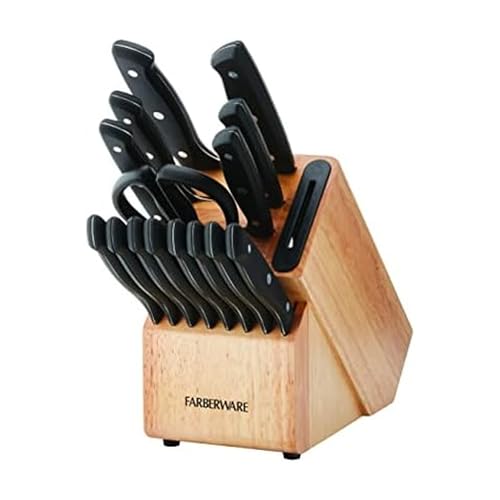
3. Farberware Edgekeeper Knife Block Set
A block set with slots that sharpen the blades each time you pull them out. A handy feature if you do not own a honing rod.
Suits: people who never sharpen. Strengths: built-in sharpening. Weaknesses: sharpening wears blades faster than careful honing. Skip it if you plan to hone by hand.

Best for small kitchens
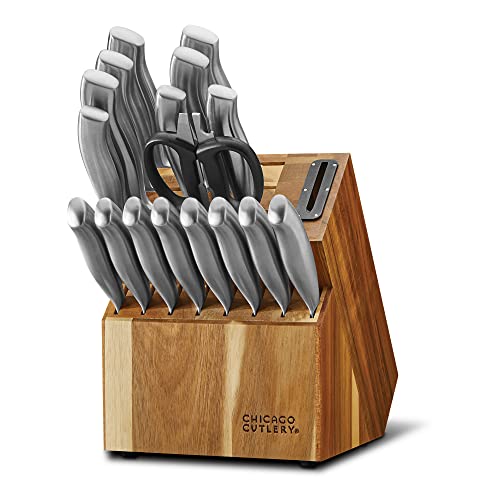
4. Chicago Cutlery Insignia Block Set
A classic kitchen set from an American brand known for budget-friendly cutlery. The block holds the knives and shears in one tidy stack.
Suits: small kitchens. Strengths: a familiar brand and a compact block. Weaknesses: details vary by listing. Skip it if you want a modern look.

Best for new cooks needing everything
5. McCook MC25 Knife Block Set
A stainless block set with a built-in sharpener in the block. It is a popular all-in-one pick for new households.
Suits: new cooks needing everything. Strengths: a built-in sharpener. Weaknesses: the brand has a smaller track record. Skip it if you prefer a heritage name.
View McCook MC25 Knife Block Set on Amazon

Best for budget-focused shoppers
6. Emojoy Knife Block Set
A knife block set from a value-focused brand with a range of blades for general kitchen use. Appeals to shoppers who want many pieces in one box.
Suits: budget-focused shoppers. Strengths: many pieces in one box. Weaknesses: details vary by listing. Skip it if you want a famous brand.

Care and Setup
- Wash blades by hand and dry them right away.
- Keep the block away from the stove and sink.
- Wipe the slots occasionally to clear crumbs.
- Hone the chef knife once a week.
- Use a cutting board and avoid stone or glass.
Mistakes to Avoid
- Buying more knives than you will ever use.
- Putting knives in the dishwasher.
- Using the knife as a screwdriver or can opener.
- Skipping a solid cutting board.
- Leaving wet knives in the block.
How Many Pieces a Small Kitchen Really Needs
Block sets are often sold by piece count, and bigger numbers look like better value. In a first apartment, that is rarely true. Many pieces in a large set are steak knives, shears, a sharpener and the block itself, all counted separately. The number of actual cooking knives may be only a handful.
A realistic daily kit includes a chef knife for most chopping and slicing, a paring knife for small trimming, a serrated knife for bread and tomatoes, and perhaps a utility knife for medium tasks. Add kitchen shears if you cook poultry or open packaging. Anything beyond those pieces will see occasional use at best.
Count what you will use before you decide:
- How often do you cook from scratch each week?
- Do you cook for yourself, or regularly for guests?
- Will you serve steak at the table?
Small kitchens have little counter and drawer space, so a big block can become a burden. If you share the space with roommates, consider that more knives may mean more mix-ups, and more maintenance. A set with fewer, better knives is easier to store and care for. You can fill gaps later by buying a single knife that matches how you actually cook.
Storage Options for Limited Counter Space
Apartment counters are often short on space, so where the knives live matters. A traditional block is quick and keeps edges covered, but it can take up a surprising amount of room. Measure the area where you plan to place it, and compare the footprint with the listing. Take into account clearance under cabinets, because tall blocks may not fit.
Slimmer blocks, angled blocks and ones that stand on end save room. Some are designed to sit in the corner of a counter. If counter space is very limited, consider storing knives elsewhere, such as in a drawer tray, in sheaths or on a magnetic strip fixed to the wall, though rentals may not permit drilling. Check your lease before mounting anything.
Safety is part of the equation. A block on the edge of a counter can be knocked off, and a block at child height invites curiosity. Keep it toward the back of the counter, away from the stove and sink, where heat and moisture can harm wood and blades.
- Choose a block with a non-slip base.
- Make sure handles are easy to grab without moving other items.
- Consider whether the block’s wood will fit your kitchen style.
A set that comes with its own storage saves one purchase, but only if the storage fits the space you have.
What Quality Means in an Entry-Level Set
A first-apartment budget means trade-offs, but you can still look for signs of decent construction. Examine how the handle joins the blade. Riveted handles that sit flush with the metal tend to be more durable than ones with gaps where food and moisture can collect. Hollow handles reduce weight but can feel unbalanced, while solid ones feel heavier and more stable.
Blade steel is described in different ways. Stainless steel is resistant to rust and low-maintenance, which suits beginners. Some sets advertise high-carbon steel, which can hold an edge but varies by maker. Do not rely on marketing terms alone; read the actual material description on the listing, and be wary of vague claims.
The spine and edge should be straight and even, and the blade should be well finished. A chef knife with a comfortable balance point near the bolster will tire your hand less. If you can hold a knife in a store, test its grip and weight.
Think about durability expectations:
- Low-cost blades usually dull faster and need regular honing.
- Mid-range sets often have better steel and handle fit.
- No set stays sharp without care, regardless of price.
Look for a clear description of what is covered by any warranty, and check the listing for care instructions before you buy.
Starter Habits for Knife Skills and Safety
New cooks benefit from a few habits that prevent accidents and keep knives sharp. Use a stable cutting board, and put a damp towel or a non-slip mat underneath to stop it from sliding. Cut on wood or plastic, not on glass, stone or ceramic plates. Keep the board large enough that food does not hang over the edge.
Learn a safe grip. Pinch the blade just ahead of the handle with thumb and forefinger, and curl the fingertips of your other hand into a claw so the knuckles guide the blade. Cut with a smooth rocking motion rather than hacking. Slow, controlled work is faster than recovering from a slip.
Sharp knives are safer than dull ones, since they need less force. Learn what honing does, and do it often. If you notice the knife slipping off a tomato skin, it needs attention.
- Never catch a falling knife; step back and let it drop.
- Pass knives handle-first, or set them down for the other person.
- Do not leave knives in a sink full of water.
- Do not use the knife to open cans, pry lids or tighten screws.
Cook with a calm pace, and keep your workspace tidy. Roommates and visitors should also know where knives are kept.
Shopping Checks Before You Commit
When you reach the shopping stage, run through a short checklist. Confirm the list of included pieces, rather than assuming. Count the knives, shears, sharpener and block separately. Check the handle material and the care instructions, including whether the maker recommends hand washing.
Compare the dimensions of the block with your counter. Measure width, depth and height. Consider whether the block’s slots can accommodate additional knives later. Some are filled to the brim, leaving no space for growth.
Think about built-in sharpeners. They are convenient but remove metal each time you use them, and results vary. A separate honing steel and an occasional professional sharpening are generally gentler on edges. If a sharpening block is included, treat it as a bonus rather than a reason to skip proper care.
Finally, consider the long view. A first-apartment set may not be the knife set you keep for decades, and that is fine. Many people use a starter set for several years, then upgrade the chef knife first.
Signs it is time to replace or upgrade:
- The knife does not regain a sharp edge after honing and sharpening.
- Handles are loose, cracked or have gaps at the rivets.
- Blades are chipped, bent or rusted beyond cleaning.
- The block slots are damaged or damp.
Keep the receipt and the packaging until you are sure the set suits your kitchen.
First-Kitchen Knife Terms Explained
If you are furnishing your first apartment, knife listings can feel like a foreign language. The glossary below explains the terms, so you can pick a set that fits your cooking without paying for pieces you will never use.
- Chef knife: the main all-purpose knife, usually 8 inches long. It handles most chopping and slicing.
- Paring knife: a small knife for peeling and detailed work.
- Serrated or bread knife: a knife with a toothed edge for bread and soft-skinned produce.
- Utility knife: a mid-size knife between a paring knife and a chef knife.
- Block: a wooden or composite holder that keeps knives within reach on the counter.
- Honing steel: a rod used to realign an edge between sharpenings.
- Steak knives: table knives for meat, sold in sets or separately.
Building a First Set Around How You Cook
You are cooking for one or two
Three knives are enough: a chef knife, a paring knife and a bread knife. A compact set saves counter space and money.
You share an apartment with roommates
Think about durability and ease of cleaning. A set in a block keeps knives from being thrown in drawers, and a clear care card helps everyone treat them well.
You like to host dinner
Add steak knives or a carving knife later. Begin with a solid core set, then expand as your cooking evolves.
You are on a tight budget but want durability
Prioritize one good chef knife, and add other pieces slowly. A single quality knife often outperforms a large set of mediocre ones.
Set Size Compared
| Question | Small set | Large block set |
|---|---|---|
| Counter space | Minimal | A bulky block |
| Coverage | Core jobs | Many specialty knives |
| Maintenance | Few edges to keep sharp | Many edges to keep sharp |
| Flexibility | Add pieces later | Complete from day one |
Knife Safety for New Cooks
A sharp knife is safer than a dull one, because it requires less force. Always cut on a stable board, placed on a damp cloth or a mat so it cannot slide. Use the claw grip with your guiding hand, curling your fingertips back. Never try to catch a falling knife, and never leave knives in a sink full of water where hands can find them. Carry a knife with the point down and the edge facing away from you.
Wash knives by hand, one at a time, and dry them immediately. Store them in a block, on a magnetic strip or in a sheath, away from small children. Keep them out of the dishwasher unless the maker explicitly says it is fine.
Mistakes First-Time Buyers Make
The most common slip is judging a set by its piece count. A block with many knives may include shears, a honing rod and duplicates, while only a few knives do the real work. Another is ignoring the handle: a knife that feels awkward will discourage you from cooking. Skipping a cutting board or using a glass one dulls blades fast. Finally, neglecting honing and sharpening leads to a dull set that makes cooking a chore.
Reading a Knife Set Listing
Count the actual knives and check the types. Look at the steel description, the handle material and whether the set is hand wash only. Check the dimensions of the block against your counter. Read about the warranty and the return terms. Look for sharpening advice from the maker. A modest set that you care for will serve you better than a large one left to dull, so choose what fits your cooking and your space.
Keep the care card, and write the purchase date on it. As your skills grow, you will know exactly which knife to add next.
Setting Up a Safe Knife Station in a Small Kitchen
Small kitchens leave little room for error. Choose a spot for knives that is away from the sink and the edge of the counter, such as a block against the wall or a magnetic strip at a comfortable height. Keep a stable cutting board nearby with a mat beneath it, and a towel for wiping hands. If you share the space, agree that knives are washed and returned to their place right away.
Keep knives out of reach of young visitors, and never leave them in a sink of soapy water. A tidy, predictable station makes cooking smoother and keeps everyone safe.
Whichever set you choose, keep the receipt and care card together in a folder, so you can handle a warranty claim quickly if something goes wrong.
First Apartment Knife Set FAQ
How many knives do I need?
A chef knife, paring knife and bread knife cover most home tasks. Anything beyond that is optional.
Do block sets include shears?
Many do, but check the listing before buying.
Should I buy forged or stamped knives?
Forged knives feel heavier and more balanced. Stamped knives are lighter and often suit smaller budgets, and both can work well in a first kitchen.
Where should I put the block?
Keep it on a dry counter away from the stove, with the handles angled for easy reach and the sharp edges facing away from you.
Is a built-in sharpener good?
It is convenient, but it removes more metal than careful honing and sharpening. A separate honing rod is usually kinder to the edge.
Is a bigger knife set better value for a first apartment?
Not necessarily. Large sets often count steak knives, shears and the block as pieces. A smaller set with the knives you will actually use is usually more practical.
Do I need steak knives in my first set?
Only if you serve steak regularly. If not, a set without them or a few extra serrated knives may be enough for the table.
What cutting board should I buy with the set?
Wood or plastic boards are gentler on edges than glass or stone. Choose one large enough for your work and stable on the counter.
Can roommates share a knife set safely?
Yes, with a few shared rules: hand wash promptly, never soak knives, return them to the block and tell everyone how to hold and hone them properly.
How can I tell if a knife is stamped or forged?
Forged knives typically have a bolster and feel heavier, while stamped knives are cut from sheet steel and are lighter. The listing usually states the method.
Should I keep knives in the drawer if I have no counter space?
Use a tray or sheaths so edges do not rub against other utensils, and keep the drawer organized so you do not reach blindly.
How often should I replace my starter knives?
There is no fixed time. Replace them when they will not hold an edge, when handles loosen or when blades are damaged beyond repair.
The Short Version
For a long-standing all-in-one, the Cuisinart C77SS-15PK. For a simple Amazon pick, the Amazon Basics. For built-in sharpening, the Farberware Edgekeeper. For a classic block, the Chicago Cutlery Insignia. For a sharpener in the block, the McCook. For many pieces, the Emojoy.
How the Picks Differ for a First Kitchen
The six sets in this guide all promise to equip a first apartment, but they make different bets about what a new cook needs. Some sets bet on breadth, including many pieces so that every imaginable task has a dedicated tool. Others bet on depth, fewer pieces of better quality, on the theory that a first cook uses a chef’s knife, a paring knife, and a serrated knife for nearly everything and deserves those three to be genuinely good. Experience sides mostly with depth: the steak knives and specialty pieces in broad sets often sit untouched while the core trio does the daily work, so a set whose core knives are strong usually serves a first apartment better than a set whose count is high but whose main knife is mediocre.
Storage format is the second dividing line, and in a first apartment it is not a detail. A countertop block looks organised but consumes scarce counter space and commits you to its footprint; in-drawer and compact formats suit small kitchens where every surface is also a work surface. Magnetic strips need wall space and landlord permission, which renters may not have. Read each pick’s storage with your actual kitchen in mind: measure the counter corner a block would occupy and ask what food preparation would be displaced. Many first-apartment cooks discover the set they want and the storage they can house are different decisions that must be made together.
Maintenance demands form the third line. Some sets ask for hand washing and honing to stay at their best; others tolerate more casual treatment. Be honest about the habits of the household, including flatmates. A set that needs care it will not receive deteriorates into the dull drawer of knives every shared house seems to own, while a slightly humbler set that matches real habits stays sharp and pleasant. The best first set is the one that fits the cook’s actual life, and this guide’s range exists because first lives vary.
The Core Trio and What Each Must Do Well
The chef’s knife is the set. It will dice onions, slice chicken, smash garlic, and portion everything from watermelons to winter squash. In a first apartment it must be comfortable for the main cook’s hand, balanced so long sessions do not tire the wrist, and easy to keep sharp, because a new cook’s sharpening skills are developing alongside their knife skills. When comparing the picks, weight the chef’s knife’s reviews and descriptions most heavily; a set lives or dies by this one blade, and compromises elsewhere are far more forgivable.
The paring knife handles the in-hand work: hulling strawberries, segmenting citrus, peeling, trimming, and opening the packaging that modern groceries insist on. It should be small, light, and precise, and its edge should be easy to restore, because paring knives meet ceramic plates and board edges in ways that dull them faster than their size suggests. The serrated knife is the quiet workhorse: bread, tomatoes, citrus, cakes, and anything with a tough skin and soft interior. A good serrated knife also covers for a dull chef’s knife in an emergency, which in a first apartment is not a rare event, and it needs no sharpening skill to stay effective for a long time.
Everything beyond the trio is a bonus with a job to justify itself. Kitchen shears justify themselves constantly, for herbs, packaging, spatchcocking, and pizza. A utility knife bridges the gap for sandwiches and medium produce. Steak knives matter only if steak, or at least foods needing a table knife with an edge, feature in the household’s real eating habits. Judge each set’s extras by your menu, not by the photograph, and the set you choose will feel tailored rather than generic.
Small-Kitchen Storage and Daily Workflow
First kitchens reward systems that keep counters clear. If your set lives in a block, place it where the knives can be drawn without reaching over the stove or sink, and where the block will not sit in a puddle zone; blocks near sinks collect moisture at their base and can harbour grime in their slots. If your set lives in a drawer, use guards or an in-drawer tray from the start, because a first apartment’s single utensil drawer is a crowded, jangling place that chips edges within weeks. The small cost of guards at the beginning prevents the slow damage that makes new cooks think their knives were never good.
Workflow matters as much as storage. Set up a simple pattern: board on a stable surface, knives within one step, a bowl for scraps, and the habit of washing and putting away each knife as its job finishes rather than in a pile at the end. In a small kitchen, a pile of knives in the sink is both a hazard and a traffic jam. The pattern takes a week to become automatic and then quietly upgrades every meal you cook, because a tidy small kitchen feels twice its size.
Flatmates and partners are part of the workflow whether invited or not. Agree on the basics early: knives are hand washed, never left in the sink, never used to pry cans or as screwdrivers, and always returned to their storage. These four rules, kept kindly, preserve a first set for years. Most knife damage in shared first apartments is social, not culinary, and a two-minute conversation when the set arrives prevents nearly all of it.
Growing From a First Set Without Replacing It
A well-chosen first set is a foundation, not a life sentence. As cooking habits develop, most cooks add individual pieces: a larger board first, almost always, then perhaps a boning knife if whole chickens become routine, a nakiri if vegetable prep becomes a passion, or a better serrated knife when bread baking takes hold. Buying sets whose makers sell matching individual knives keeps these additions coherent in feel and storage, so check that before choosing if you suspect you will grow the collection. The set’s block or tray should ideally have a spare slot or room to adapt; if not, guards let additions live happily in a drawer alongside.
Skills should grow on the same schedule as equipment. Learn to hone in the first month, since honing keeps a new set feeling new with almost no effort. Learn basic whetstone sharpening in the first year, when the first real dullness arrives; a single combination stone and a video’s worth of practice restores edges that many first cooks wrongly assume require professional rescue or replacement. Many sets are discarded as worn out when they are merely dull, and the cook who can sharpen owns their first set for a decade instead of a year.
Eventually a first set may be outgrown, and that is a success, not a failure. It happens when the main cook’s skills and ambitions exceed the core knives’ comfort or edge life, usually after years, not months. At that point the first set becomes the backup set, the camping set, or the gift that equips someone else’s first apartment, which is a fitting second life for tools that taught you to cook. Choose from this guide with that arc in mind: strong core trio, storage that fits the kitchen you have, care demands that match your real habits, and room to grow. A first set chosen that way rarely disappoints.
First Apartment, First Mistakes: A Field Guide
Every first kitchen teaches the same lessons, usually by damaging something. The most common is the dishwasher lesson: a good knife left in the cutlery basket emerges with a dulled, knocked edge and a handle that will never feel the same, and the cook concludes the set was poor when the process was at fault. The second is the sink lesson, where a knife buried under washing-up water finds a hand, teaching everyone in the household why knives are washed separately and immediately. The third is the wrong-job lesson: the can opened with a tip, the frozen chicken attacked with the chef’s knife, the jar pried with a paring knife, each leaving a bend or chip that no sharpening fully forgives. Knowing these three lessons in advance, as you now do, is most of what separates a first set that lasts from one that limps.
Storage mistakes form the quieter second wave. The block left beside the stove collects grease film that migrates into its slots; the drawer set without guards dulls itself by contact; the magnetic strip mounted where a cupboard door swings knocks a knife to the floor once a year. Each is fixable in minutes once recognised: move the block, add guards, remount the strip. First apartments are experiments, and the cook who audits their storage after the first month, asking where the knives actually live versus where they were planned to live, catches these issues while they are still free to fix.
The final common mistake is buying twice for the wrong reason: replacing a dull set with a new set instead of sharpening the first. Dullness feels like failure and is actually maintenance, and a first cook who learns that distinction early saves real money across a lifetime of kitchens. Before any first set is declared disappointing, give it a proper sharpening, by hand on a stone or by a professional, and cook with it for a week. Most sets are reborn by this simple test, and the ones that are not have genuinely taught you what to buy next, which is the other honest outcome.
Cooking More With the Set You Have
A first set’s real purpose is to make cooking at home easier than ordering in, and small workflow upgrades matter more than additional pieces. Learn five knife-based preparations deeply, a chopped salad, a stir-fry, a soup, a roast chicken with vegetables, and a fruit dessert, and the core trio will feel like old friends within a month. Repetition builds the grip, the claw, and the sharpening instinct faster than variety does, and confidence at the board is what turns cooking from a project into a habit. The set that gets used daily for simple food outperforms, in every way that matters to a first apartment, the elaborate set waiting for special occasions.
Batch cooking suits first kitchens and first budgets alike, and it is where a set proves itself. A Sunday session that produces grains, roasted vegetables, a sauce, and prepped raw vegetables for the week asks an hour of steady knife work: exactly the practice a new cook needs and exactly the workload that reveals whether the chef’s knife’s handle and weight were well chosen. If your hand is fresh at the end of that hour, your set fits you. If it is not, adjust grip and honing first, technique explains most fatigue, and only then consider whether the knife itself is wrong for your hand.
Keep a small notebook, physical or on your phone, of what you cooked and what annoyed you about the tools. Three months of these notes is the most reliable buying guide ever written for your kitchen, because it records your cooking, not a stranger’s. When the first addition or upgrade comes, it will come from those notes: the board that felt small every Sunday, the serrated knife that tore the bread you now bake weekly, the boning knife whose absence you felt at every whole chicken. A first set chosen from this guide and grown by your own notes becomes, piece by piece, a personal kit that no single purchase could have given you on day one.
First Apartment Knife Set Questions Answered in Depth
How many pieces should a first set have?
Count functions, not pieces. A first set needs the core trio, chef’s, paring, and serrated, plus shears if the household cooks regularly, plus table knives only if meals at a table with proper settings are a real habit. That usually lands between five and nine genuinely used pieces, whatever the box claims. Listings inflate counts with items like individual steak knives counted separately and small accessories of little value, so translate any set into its functional list before comparing it with the picks here. A set whose functional list matches your cooking, with quality concentrated in the trio, will feel complete in daily use even if its headline number is modest, while a set with double the count and a weak chef’s knife will feel incomplete every single day.
Is a block worth it in a small kitchen?
Only if the counter can spare its footprint without displacing food preparation, which in many first apartments it cannot. Measure the corner honestly, including the clearance to draw the longest knife upward and out, and then imagine your largest regular prep session sharing that counter. If the block survives that imagination comfortably, it offers tidy, visible storage that many new cooks enjoy. If it does not, in-drawer storage with guards or a compact tray preserves both the knives and the workspace, and the set will be reached for more often because the kitchen still works. Storage that fights the room is abandoned within months, and abandoned storage is how first sets end up loose in drawers, dulling themselves and endangering hands.
Can I put my first set in the dishwasher occasionally?
Occasionally is how handles loosen and edges dull ahead of schedule, because the damage is cumulative and invisible until it is not. The dishwasher combines three things knives dislike: prolonged heat, aggressive detergent, and rattling contact with racks and other items. A single cycle rarely ruins a knife outright, which is exactly why the habit forms, but a year of occasional cycles leaves a set looking and cutting years older than it is. Hand washing a knife takes under half a minute, and the drying and putting away that follow are the same motions that keep it out of the dangerous sink pile. Protect the set with that half minute; it is the cheapest maintenance in the entire kitchen.
When is a first set actually worn out?
Later than most owners think. Dullness is not wear; it is maintenance deferred, and a professional sharpening restores most sets dramatically. Genuine wear looks like handles that no longer sit tight, blades thinned by years of sharpening until their profiles have changed, serrations flattened beyond a specialist’s help, and pitting or cracks in the steel. A set reaches that state after years of real use, not after a disappointing month. Before replacing a first set, spend a small amount on one proper sharpening and cook with the result for two weeks. If the set still frustrates you, you have learned precisely what its replacement must do better, and the purchase that follows will be one of the best-informed of your cooking life.
A Buying Sequence That Rarely Goes Wrong
Begin with the room, not the catalogue. Measure the counter corner a block would occupy, the drawer a tray would fill, and the wall a strip would need, and decide which storage your first kitchen can genuinely house before falling for any particular set. Next, write down the five meals you actually cook most, and walk each one through the core trio: if a set’s chef’s knife, paring knife, and serrated knife cover those meals comfortably, the set fits your life, and everything else in the box is a bonus to be weighed lightly. Then check the care contract honestly against your household: hand washing, honing, and proper storage are the terms, and a set whose terms match your flatmates’ real behaviour will outlast a superior set whose terms are violated weekly.
With those three filters applied, the picks in this guide narrow quickly, and the remaining differences, handle feel, weight, storage style, the exact extras included, can be decided by preference, which is where preference belongs. Order the set with its guards or tray at the same time if they are not included, because the first week sets the household’s habits and a set that begins life loose in a drawer rarely gets reorganised later. On arrival, wash everything, set up the storage, and cook the most familiar meal you know; the set should feel like an upgrade in competence from that first session, not like equipment you need to grow into before dinner becomes easy.
Then give the set a fair season before judging it. Learn its honing rhythm, let the household’s four rules become automatic, and keep the small notebook of annoyances that this guide suggested, because three months of real cooking will tell you more than any review, including this one, about what your kitchen needs next. Most first sets chosen this way are still serving happily years later, their owners having added a board here and a specialty knife there, building a personal kit on a foundation that never needed replacing. That is the outcome this guide’s picks were assembled to deliver: not the thrill of the largest box, but the quiet satisfaction of tools that fit the apartment, the cook, and the meals, from the very first dinner onward.
A Note on the First Dinner and Everything After
Every first set has an inaugural meal, usually cooked with more ceremony than the recipe deserves: the knives are washed before and after, the board is centred like an altar, and the cook notices the edge’s bite with a pleasure that later becomes background. That pleasure is worth protecting from the slow erosion of bad habits, because it is the feeling that brings people back to the stove on tired evenings when takeaway glows from the phone. The protection is nothing exotic: the four household rules, the honing rhythm, the storage that was set up on day one and never allowed to lapse. First sets rarely die by catastrophe; they fade by exception, the one dishwasher cycle, the one week loose in the drawer, and the cook who refuses the exceptions keeps the inaugural feeling available for years.
So choose the set whose core trio fits your hand and your five real meals, house it in storage your kitchen can actually spare, and then cook the first dinner with full ceremony. Photograph it if you like; first kitchens deserve their archives. Then cook the second dinner, and the fiftieth, and let the set settle into the honourable invisibility of tools that simply work. When the day comes to add or upgrade, your notebook and your hands will know exactly why, and the first set will take its place in the story of how you learned to feed yourself well, which is a story that starts, as this guide hopes yours will, with the right knives in the right first home.
One More Consideration Before You Decide
Before you settle on any option in this guide, run one final, practical test in your own kitchen: clear the exact space the new item will occupy, handle the tool it will replace or join through one complete, ordinary task, and notice precisely where friction appears, in the grip, in the storage, in the washing, or in the moment of putting it away. That friction point is your true buying criterion, more predictive than any feature list, because daily tools are judged by the worst second of their routine, not the best. The picks gathered here were compared with that standard in mind, favouring designs whose worst second is still acceptable: a handle that stays kind when wet, a surface that scrubs without a battle, a closure that works with cold or greasy fingers, a fit that does not demand a ritual to achieve.
It is also worth deciding, in advance, what would make you replace the item rather than repair or adapt to it, and writing that condition down somewhere you will find it in a year. Owners who set that line early avoid both errors: discarding a sound tool at the first annoyance, and nursing a failed one long past its honest life out of inertia. Most tools in this category announce their real condition slowly, through loosening, dulling, staining, or small damages that accumulate, and a written line turns that slow announcement into a clear decision when it arrives. Until then, maintain the item as this guide describes, use it for the work it was designed for, and let it earn its place the only way kitchen tools ever do: meal after meal, without drama, until reaching for it feels like the most natural thing in the room.