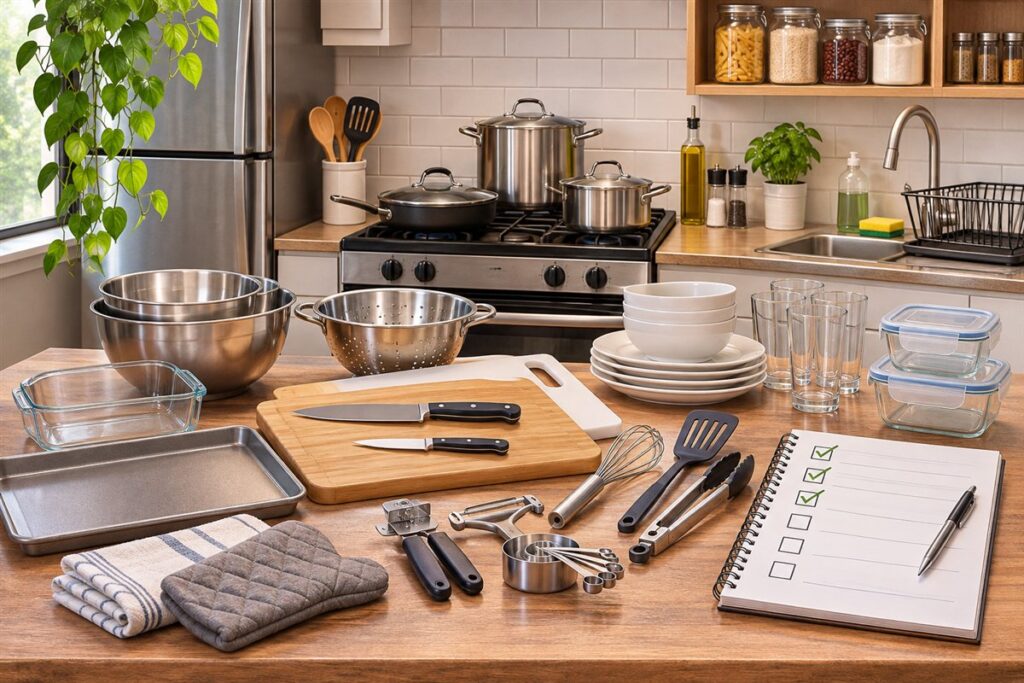
A first apartment kitchen needs fewer items than most people expect. Cover cooking, cutting, measuring, serving, and cleanup, and you can make nearly any simple meal. Use the checklist below as a guide and adjust it for the way you eat.
Cookware and Bakeware
Begin with a few versatile pieces. Check the maker’s guide for your stove type, since some pans do not work on every cooktop.
- One medium skillet with a lid.
- One saucepan with a lid.
- One large pot for pasta and soup.
- One or two sheet pans.
- One baking dish for casseroles and roasted vegetables.
Tools for Cutting and Prep
- A chef’s knife and a paring knife, stored with care.
- Two cutting boards, one kept for raw meat.
- Mixing bowls in a few sizes.
- Measuring cups and spoons.
- A colander, a whisk, tongs, and a spatula.
- A can opener and a peeler.
Serving, Storage, and Cleanup
- Plates, bowls, glasses, and flatware for four people.
- Food storage containers with matching lids.
- Dish soap, a sponge or brush, and a drying rack.
- Kitchen towels and oven mitts.
- A trash bin with a lid and a small compost or recycling bin if local rules need one.
What to Buy First and What to Wait On
| Buy right away | Wait and see |
|---|---|
| Skillet, saucepan, knife, board | Specialty pans and molds |
| Measuring tools and mixing bowls | Large appliances |
| Storage containers | Extra serving pieces |
| Cleaning supplies | Decorative items |
A Few Safety Basics
Find the smoke alarm and test it as the maker advises. Keep a lid or sheet pan nearby to smother small pan fires, and never leave hot oil unattended. Read the manuals for your oven and stove, and use official food-safety guidance for doneness and storage.
Setting Up the Space
Before unpacking, wipe down shelves and drawers and decide where each category will live. Put everyday items between waist and shoulder height, and heavier pots lower down. Keep knives, boards, and pans near the stove and prep area, and store rarely used items higher up. Line drawers if you like, and use a few simple dividers to keep tools from sliding together.
Take photos of your setup once you feel happy with it. They make it easy to put things back in the same place after a deep clean.
Walkthrough: Your First Week
A calm order of tasks beats a frantic day of unpacking.
- Day one: clean the inside of cabinets, the fridge and the oven with a mild cleaner. Check that the stove and oven heat properly, and note anything to report to your landlord.
- Unpack cookware, knives and boards first. Everything else can wait in a box until you need it.
- Stock a small pantry: oil, salt, pepper, rice or pasta, canned tomatoes, onions, and a few spices. Cook two or three simple meals that use the same ingredients.
- Set up cleanup: soap, sponge, towels, trash and recycling. A kitchen that is easy to reset gets used more.
- Write a short list of what you wished you had during the week, and buy only those items.
- Make a habit of washing up right after meals, so dishes do not pile up in a small sink.
Common Scenarios
A shared apartment
Agree on who owns which pots and label personal items. A shared set of basics, such as a pot and a few knives, avoids duplicate purchases.
A very small kitchen
Choose nesting bowls, stackable containers and pans with removable or foldable handles. Use wall hooks, a rail or the inside of cabinet doors for tools.
A rental with an old stove
Buy a stand-alone oven thermometer. Dials on older ovens can be off, and a thermometer tells you the real temperature.
Cooking mostly in a microwave
Add microwave-safe bowls with vented lids, and a few containers labeled for microwave use. A skillet can wait until you are ready for stovetop meals.
Mistakes to Avoid
- Buying a large boxed set before you know what you cook. Many pieces go unused, and a set may not fit your storage.
- Storing sharp knives loose in a drawer. They dull and can injure a hand that reaches in, so use a block, strip or guards.
- Skipping a second cutting board. Raw meat juices should stay away from foods you eat uncooked, in line with food-safety guidance.
- Ignoring the stove type. A warped pan on a glass cooktop heats unevenly, and some pans do not work on induction.
- Forgetting basic safety items such as oven mitts, a working smoke alarm and a lid for pan fires.
- Buying decorative items before you have working basics.
Care and Upkeep Over Time
Establish a rhythm. Wipe counters daily, empty and rinse the sink strainer, and clean the stovetop while it is still slightly warm. Once a month, check the fridge for old food, clean the oven spills, and look over your cookware for loose handles or worn coatings. Replace sponges when they smell or fall apart. Seasonal tasks, such as washing storage containers and checking the smoke alarm battery, keep the space working well.
Quick Troubleshooting
| Symptom | Likely cause | What to try |
|---|---|---|
| Cabinets feel cluttered | Too many seldom-used items at eye level | Move rare items high or low and keep daily tools within reach |
| Food burns in the oven | Oven runs hotter than its dial | Use an oven thermometer and adjust the setting |
| Dishes pile up | Too few tools for a quick reset | Add a drying rack and wash right after meals |
| Containers smell or stain | Sauces absorbed into plastic | Wash soon after use, air them out, and replace if the odor stays |
| Pans slide on the stove | Wrong size for the burner | Match pan base to burner and use a flat, stable pan |
Remember that your needs will change after the first month. A quick note in your phone about what you reach for and what you miss will guide every later purchase.
Glossary
- Sheet pan: a flat, rimmed baking tray for roasting and baking.
- Dutch oven: a heavy lidded pot for braises, soups and bread.
- Mise en place: having ingredients prepared and measured before cooking.
- Induction: a cooktop that heats magnetic cookware directly.
- Cross-contamination: the transfer of germs from raw food to ready-to-eat food.
- Nesting: designed to stack inside each other to save space.
FAQ
Should I buy everything before I move?
No. Buy the basics, cook for a few weeks, and note what you miss. Your habits will show you what to add.
Is a cookware set worth it?
It can be, if every piece in the set matches something you would use. Otherwise, individual pieces let you choose sizes that fit your stove and storage.
How many plates and glasses do I need?
Plan for the number of people you expect to feed, plus a few extras for guests. If you wash dishes daily, a smaller set is enough.
Do I need a food thermometer?
It is a useful tool for meat, poultry and leftovers, because color alone is not a reliable sign of doneness. Use the target temperatures in official food-safety guidance.
What can I borrow or inherit?
Family and friends often have spare pots, bowls and tools. Check cookware for damage, such as cracked glass or flaking coating, before you use hand-me-downs.
The Short Version
Gather a skillet, saucepan, pot, knife, board, measuring tools, and storage containers, then add more as you learn how you cook. Read the manuals and safety basics so your new kitchen is ready from day one.