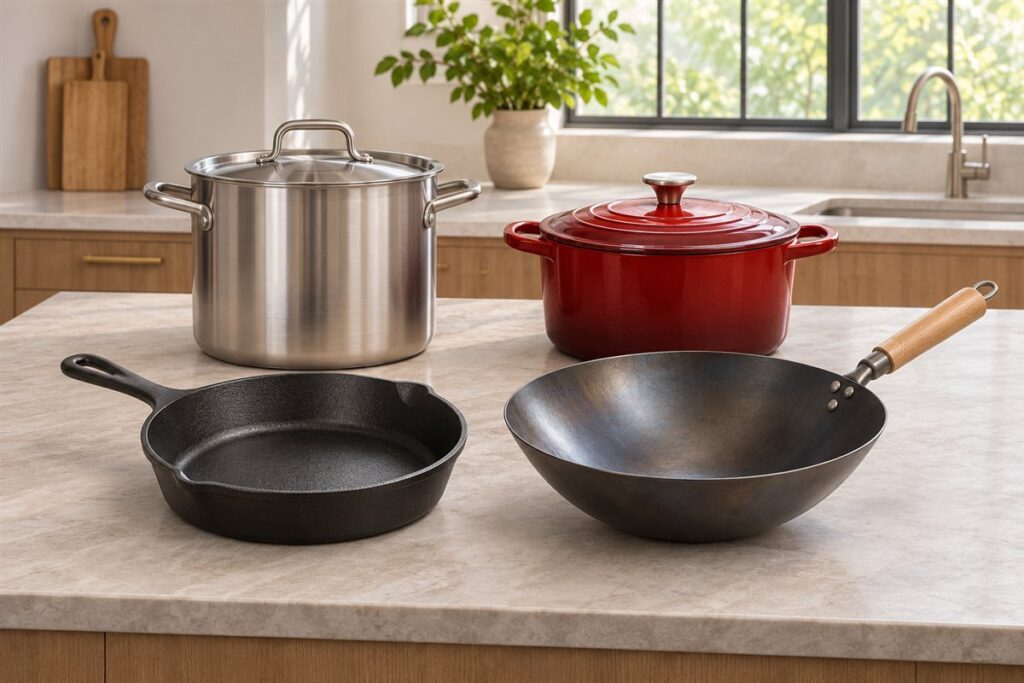
A first kitchen needs only a handful of pieces: a skillet, a saucepan with a lid, a larger pot, a baking sheet and a few basics. This short checklist covers most everyday recipes without filling your cabinets.
The Core Pieces
| Piece | Typical Size | Used For |
|---|---|---|
| Skillet or frying pan | 10 to 12 inch | Eggs, searing, vegetables, one-pan meals |
| Saucepan with lid | 2 to 3 quarts | Rice, oats, sauces, reheating |
| Stockpot or large pot | 6 to 8 quarts | Pasta, soup, boiling |
| Baking sheet | Half sheet size | Roasting vegetables, cookies, sheet-pan dinners |
| Baking dish | 9 by 13 inch | Casseroles, roasts, desserts |
Sizes vary by maker, so check the maker’s guide and your oven dimensions.
Choosing Materials Sensibly
- Skillet: Stainless steel suits searing, while a nonstick pan is gentler for eggs. If you can only buy one, think about the food you cook most.
- Saucepan and pot: Stainless steel with a thick base is a flexible choice.
- Baking sheet: A sturdy rimmed aluminum or steel sheet works for most tasks.
Handy Extras
- A second skillet in a different material, for variety.
- A colander for draining pasta.
- A wooden spoon, a spatula and tongs that suit your pan surfaces.
- Oven mitts or pot holders, which are essential for hot cookware.
- A lid that fits the skillet.
How to Build Over Time
Cook for a few weeks and watch what you reach for. If you keep wishing for a deep pan for braising, consider a Dutch oven. If you make many stir fries, think about a wok. Let your habits tell you what to add rather than buying a lot at once.
Check that each piece works with your stove, including induction if you have it, and note oven limits for handles and lids. Hot cookware can burn, so follow the maker’s manual and safety instructions.
Think about the size of your household and the food you enjoy. A single person who eats mostly eggs, rice and pasta may do well with a small skillet and a medium saucepan. A family that roasts and bakes often will use the baking sheet and dish more than the pots. Check for lids that fit more than one pan, since a single well-fitting lid can serve several sizes. Look at storage space as well, because nesting pieces take less room. If you share a kitchen, note any pieces that need special care, such as a coated pan that should not meet metal tools or a cast iron skillet that should stay dry.
Stove Type and Pan Fit
Your stove decides which pots and pans will work, so check it before you shop. Gas burners suit nearly any material, though handles can heat up near the flame. Electric coil and radiant glass tops want a flat, smooth base that touches the heating surface evenly. Induction needs magnetic material in the base, which you can test by holding a magnet to the bottom or by reading the product listing.
Match the pan base to the burner. A small pan on a large burner wastes heat and can scorch handles, while a large pan on a small burner heats unevenly in the middle. Look for a base that is flat and does not rock when set on a countertop.
On glass tops, lift rather than slide, and avoid pans with rough or damaged bottoms. If you are not sure what kind of cooktop you have, check the appliance manual or ask the landlord before buying anything heavy.
Lids, Handles and Comfort
Small details decide whether a pan is pleasant to use every day. Handles should feel secure and not get too hot on the stovetop. Riveted metal handles generally cope with the oven better than plastic ones, but check the stated oven limit for any pan and its lid. Long handles give leverage but take up space, and helper handles on big pots make lifting full pots safer.
Lids should sit snugly. A glass lid lets you watch food without lifting it, though some glass lids have a lower oven rating than the pot. A vented lid reduces boil-overs. If one lid fits several pans, you save cabinet space.
- Pick up the pan in a shop if possible and hold it as you would to pour.
- Check that the handle does not tip the pan when it is empty.
- Look for a pouring edge or rim that does not drip.
Comfort matters more than a long feature list, so choose what feels right in your hand.
Pan Sizes and Who They Suit
A single cook can often get by with smaller pieces, such as a smaller skillet and a modest saucepan. Couples and families usually want a larger skillet, a bigger pot and a full-size baking sheet. If you often cook for guests, a large stockpot and a roasting dish become more useful.
Oversized pans can be awkward in a small kitchen, in a small sink or on a narrow stove, so measure your space. A pan that cannot fit in the dishwasher or sink is a nuisance to clean. If you meal prep in bulk, deeper sides help.
Capacity labels vary by maker, and the true usable volume is less than the brim measure. Check the dimensions on the listing and compare them to your usual recipes. When in doubt between two sizes, many people choose the smaller one for daily cooking and add a larger pot later.
Budget Tiers Without Numbers
A first kitchen does not need premium cookware. Entry-level pieces often work well for light use, though thin bases may heat unevenly and coated surfaces may wear sooner. Mid-range pieces usually add thicker bases, sturdier handles and better lids. Premium sets offer extras such as heavier construction and longer warranties, but they are not required to cook well.
A good plan is to spend more on the pieces you will use daily, such as the skillet and saucepan, and less on those you use rarely. Nonstick pans are often treated as replaceable, since coatings wear over time, while a stainless or cast iron piece can last a long time with care.
Secondhand shops and hand-me-downs can be useful, but inspect each piece. Look for warped bottoms, loose handles, deep scratches in coatings and rust. A piece that wobbles on the stove will frustrate you every time.
Care Habits for Longer Life
Basic care protects any cookware. Let hot pans cool before washing to avoid warping. Use wood, silicone or nylon tools on coated pans. Do not heat an empty nonstick pan for long, and keep the heat moderate. Stainless pans are tougher, but they respond to soaking if food sticks.
Dry cast iron right away and wipe it with a thin coat of oil. Check the maker’s guide on dishwashers, since some finishes and handles are not meant for them. Store pots with a cloth between stacked pieces so bases and coatings stay smooth.
Replace pans when coatings flake, handles loosen, bases bend or surfaces become pitted. Cookware that is damaged can cook unevenly and may be unsafe, so retire it rather than hoping it will hold up.
FAQ
Do I need a matching set?
No. A few well-chosen pieces often work better than a large set.
What is the one item to buy first?
A 10 or 12 inch skillet covers the most meals.
Do I need a nonstick pan in my first kitchen?
Not required, but it is helpful for eggs and delicate fish. Many cooks keep one nonstick skillet and one stainless or cast iron pan for searing.
Is a Dutch oven worth buying early?
It is useful if you braise, make soups or bake bread, but it can wait. Cook for a few weeks and see whether a deep covered pot would solve a problem.
How do I know if a pan is oven safe?
Read the product listing or manual for the stated temperature limit. Check the handle and lid separately, because they often have lower limits than the pan body.
Should I buy a set or individual pieces?
Individual pieces let you choose the right size and material for each job. Sets can offer convenience, but check that you will use every piece in it.
What size lid do I need for a skillet?
Choose a lid that matches the pan's diameter, measured across the top. Some lids fit several sizes, so check the listing for the range it covers.
When should I replace old cookware?
Replace pans that wobble, have flaking coatings, loose handles or deep pits. Those problems affect cooking results and may affect safety.
The Short Version
Begin with a skillet, a saucepan, a larger pot, a baking sheet and a baking dish. Add specialty pieces only when your cooking calls for them.