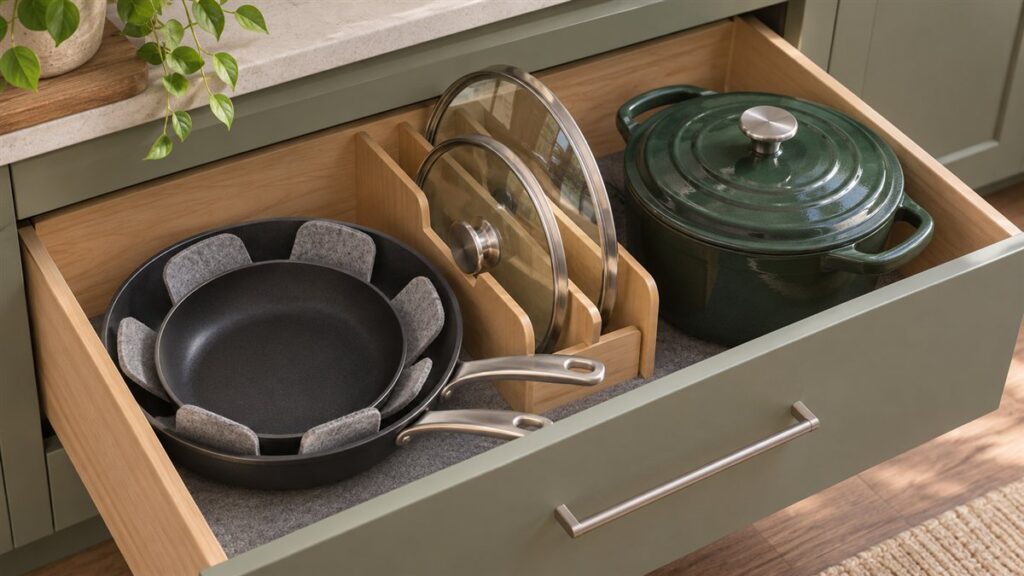
Good pot and pan storage protects coatings, saves space and makes cooking faster because you can reach what you need. The main options are stacking with protection, hanging, and storing upright in a divider. The best choice depends on cabinet size, weight and how often you cook.
Clear Out and Sort First
- Take everything out of the cabinet and group by type: skillets, saucepans, stock pots, lids.
- Set aside pieces you no longer use or that are damaged beyond safe use.
- Place the items you use weekly within easy reach, between hip and shoulder height.
- Keep heavy cast iron or Dutch ovens low, so you do not lift them overhead.
Four Storage Approaches
| Method | Works well for | Watch out for |
|---|---|---|
| Nesting with liners | Cabinets with limited height | Scratches on coated surfaces without protection |
| Wall or ceiling rack | Frequently used pans, open kitchens | Weight limits and strong fixing into studs |
| Vertical divider | Skillets, baking sheets and lids | Needs a deep cabinet |
| Deep drawers | Heavy pots near the stove | Drawer runners that cannot take the load |
Protecting Your Cookware
- Place a paper towel, felt pad or cloth between stacked nonstick or enameled pans.
- Dry everything completely before storing, especially cast iron and carbon steel, to avoid rust.
- Store lids in a rack or on the inside of a cabinet door, or hang them from rail hooks.
- Do not pile too many heavy pans in one tall stack.
- Hang racks only if the maker and your wall can support the weight, and use proper anchors.
Making the Most of Tight Spaces
Use risers to create a second level inside a cabinet. Choose cookware with removable or folding handles if space is a challenge. Nested sets save room, though you should check that each piece is easy to pull out. Keep items you use rarely, such as a large roasting pan, on a high shelf or in a pantry.
Revisit your setup every few months. Cookware collections change, and an arrangement that suited you last year may not work now. If you find yourself moving the same pan every time you reach for another, give the pan a better spot. Label shelves or use simple dividers if several people share the kitchen, so that everything returns to the same place. Wipe down shelves when you reorganize, and check for any rust or grease marks. A tidy cabinet takes a few minutes to maintain and makes weeknight cooking noticeably smoother.
Zoning Storage Around the Stove
The most useful storage plan puts each pan where you first reach for it. Stand at the stove and notice what you pick up in the first few minutes of a typical meal. Skillets, a saucepan and a pot for boiling usually come first, followed by lids and a spatula. Those pieces should live within a step or two of the burners, ideally in the cabinet or drawer directly beside or below the cooktop.
A simple way to organize the kitchen is to think in zones:
- Cooking zone: everyday skillets, the main saucepan and the lids that match them.
- Prep zone: mixing bowls, colanders and anything you use before heating begins, which may sit nearer the sink or counter.
- Occasional zone: roasting pans, large stockpots and specialty items such as a steamer insert or griddle.
Putting items in the wrong zone causes small daily annoyances. If you carry a pot across the kitchen each time you boil water, or lean over a stack of heavy pans to reach a skillet, the storage plan is working against you. It is worth moving things around for a week or two and seeing what feels natural before you buy any organizers.
Check your kitchen layout as well. In a galley kitchen, a narrow cabinet may suit a vertical divider, while a larger corner cabinet may suit a rotating tray or pull-out. The best arrangement is usually the one that lets you grab a pan with one hand without moving anything else. If you share the kitchen, agree on zones with the other cooks so everything returns to a predictable place.
Odd Shapes and Long Handles
Standard saucepans and skillets are easy to stack, but a kitchen also holds awkward pieces that do not fit neatly. Woks, griddles, roasting pans, sauté pans with tall sides and pans with long handles each create their own storage puzzle.
- Long handles: They waste cabinet width because they stick out sideways. Store them pointing the same direction, or hang them on a rail so the handle becomes the hanging point.
- Woks and curved pans: A round shape does not stack well with flat pans. Store a wok on its own, upright against a cabinet side, or on a low shelf where it will not tip.
- Griddles and flat plates: Slide them vertically in a divider or place them flat at the bottom of a stack, so they are not supporting a lot of weight.
- Roasting pans and big stockpots: These are used less often and are heavy, so they suit a low shelf or an out-of-the-way cabinet.
- Removable-handle sets: These save space, but keep the handle with the pan or in a labeled spot so it does not go missing.
If a piece never fits comfortably, ask whether you use it enough to justify its footprint. A pan used once a year might be better stored in a garage shelf, a pantry or a high cupboard. Measure the tallest and widest items before you buy dividers or racks, since sizes vary between makers and sets. The goal is to keep the everyday cabinet for pieces you actually reach for, and to move rarely used items out of the way.
Weight, Mounting and Safety
Cookware is heavier than it looks, and a full set can put real load on shelves, rails and drawer slides. Before adding any organizer, think about how much weight you are asking it to carry and how securely it is fixed in place.
- Wall and ceiling racks: Check the maker’s stated load limit, and fix the rack into studs or use anchors rated for the weight and the wall type. Do not trust plain screws in thin drywall. If you rent, ask what is allowed before drilling.
- Drawers: Look at the drawer’s weight rating, which is often listed in the cabinet maker’s guide. Heavy pots in a light drawer can bend the slides or cause the drawer to stick.
- Shelves: Adjustable shelves can sag if overloaded. Put the heaviest items on the lowest shelf and keep a little height clearance so you can lift a pot straight out.
- Risers and racks inside cabinets: Choose ones with a firm base that will not slide, and avoid stacking so tall that pans could topple when you pull one out.
Hanging cookware overhead calls for extra caution. Keep it where nobody will bump into it, and make sure heavy pieces cannot swing into a person or a cooktop. Keep hanging pans clear of the stove so grease does not collect on them.
When lifting heavy pots from a low shelf, bend your knees and keep the load close to your body. If a piece is too heavy to lift comfortably when full, consider a smaller size. Always follow the maker’s manual and safety instructions for both the cookware and any storage hardware you buy.
Material-Specific Storage Habits
Different materials need slightly different treatment between uses, and the storage space can help or hurt them. A few habits make cookware last longer.
- Nonstick: Keep the coating away from hard contact. Use felt liners, paper towels or a pan protector between stacked pans, and avoid sliding them against rough racks.
- Cast iron and carbon steel: Dry fully, apply a very thin layer of oil if the maker advises it, and store in a dry cabinet. Damp air and trapped moisture lead to rust, so avoid sealing the pan in a lidded stack.
- Enameled pieces: The enamel can chip if pans knock together. Space them out or add a soft layer between them.
- Stainless steel: More forgiving, but heavy stacks can scratch the finish. Wipe off any residue before storing so spots do not set.
- Copper and clad cookware: Keep the exterior dry and follow the maker’s care instructions to avoid tarnish or marks.
Cabinets near the dishwasher or sink can carry more moisture than other spots, so avoid placing rust-prone pans there if you can. Make sure each pan is cool and dry before it goes away, because trapped heat or damp can damage a coating or cause odors. If a pan has a plastic or wooden handle, check the manual for any storage limits, since these parts can be affected by heat or humidity in some conditions.
Choosing Storage Accessories Wisely
Dividers, racks, risers and liners are useful, but they are easy to buy in the wrong size. Before you shop, measure the cabinet interior and the pans you plan to keep. Note the height, the depth and the door opening, and remember that hinges and frames can narrow the space.
Here are some questions to ask when comparing accessories:
- Does it fit the cabinet, including the door swing, once installed?
- Can it handle the weight of your heaviest pan, according to the maker?
- Is the finish gentle on cookware, or could it scratch coatings?
- Can you adjust it later if your collection changes?
- Is it easy to clean, and does it resist rust?
Budget tiers differ mainly in material and adjustability. Simpler, lower-cost options are often plain wire or thin plastic, which can work well for light pans but may bend under heavier loads. Mid-range products typically offer sturdier frames and more adjustment. Higher-end systems may include full-extension drawers or custom fits, which are most useful in a kitchen you plan to keep for a long time. Whatever tier you pick, rely on the stated specifications on the listing rather than assumptions.
Avoid buying everything at once. Try one or two accessories, live with them for a few weeks, and add more only if the setup works for you.
FAQ
Should lids stay on pots?
Storing them on can trap moisture. A separate lid rack lets air circulate.
Is hanging cookware better?
It saves cabinet space and is easy to reach, but pans collect dust and grease, so wash them before use.
Where should I store the pan I use every day?
Keep it within easy reach of the stove, between hip and shoulder height if possible. Putting it on top of a stack or at the front of a shelf saves you from moving other pieces.
Is it okay to stack nonstick pans without liners?
It is better to add a soft layer between them, such as a felt pad or paper towel. Direct contact can scratch the coating, and scratches shorten the pan's useful life.
How do I store a pan with a long handle in a small cabinet?
Point the handles in one direction or hang the pan from a rail. A vertical divider can also help, because the pan stands on its edge and the handle sits at the top.
Can cast iron go in a cabinet with other cookware?
Yes, as long as it is fully dry and the cabinet does not trap moisture. Place it low because of its weight, and separate it from coated pans with a liner.
Do I need an organizer, or can I just rearrange?
Rearranging is a good first step and costs nothing. Add an organizer only if you still struggle to reach items, or if pieces are rubbing against each other.
How often should I reorganize cookware storage?
Review it whenever you add or retire pans, and give it a quick check every few months. Small changes keep the space working for how you cook now.
The Short Version
Sort first, keep heavy items low, protect surfaces with liners and dry everything before it goes away. Match the method, whether nesting, hanging or dividers, to your space.