Disclosure: topratedkitchenware.com is reader-supported. When you buy through links on our site, we may earn an affiliate commission from Amazon and other retailers, at no extra cost to you.
Where to buy
This guide to the best low energy toasters is built on the only honest foundation an energy guide can have: stated wattage. Energy use starts with how much power an appliance draws, and in our verified pool of six toasters, exactly one title states a wattage — the Amazon Basics 2 Slice, at 900W. That is a modest figure for a two-slice toaster, and it makes the Amazon Basics this guide’s one linked pick: you can check the latest price on Amazon for it throughout the page. The other five machines state no wattage and no energy-efficiency claim in their verified titles, so they are reviewed in full as prose-only picks, with their energy-relevant features — an auto shutoff here, a four-slice batch capacity there — analysed for what they are worth and their missing figures flagged as missing. An energy guide that invented wattages for five machines would be fiction; this one would rather teach you the arithmetic and show you the one firm number the pool provides, then hand you the protocol for finding the other five figures yourself, in the one place they are actually published.
- Elite Gourmet ECT1027B Cool-Touch Toaster — Cool-Touch Pick, No Wattage Stated (prose-only). A measured 1.25-inch slot and six shades, but no energy figure in its title.
- Hamilton Beach 22634 Extra-Wide Slot Toaster — Auto Shutoff Pick, No Wattage Stated (prose-only). The pool’s one energy-relevant function, without a wattage to pair it with.
- bella Fits-Anywhere Slim Toaster — Four-Slice Batch Pick, No Wattage Stated (prose-only). Batch capacity is an energy argument, but its draw is unstated.
- BLACK+DECKER 2-Slice Toaster with Extra-Wide Slots — Classic Pick, No Wattage Stated (prose-only). Seven shades and an extra lift lever; no energy data in the title.
- Hommater 2 Slice Wide Slot Smart Toaster — Display Pick, No Wattage Stated (prose-only). A countdown can help energy habits, but its wattage is not stated.
- Amazon Basics 2 Slice Toaster — Best Low Energy Pick, and the Only Stated Wattage. 900W, six settings, cord wrap, removable crumb tray.
Read the full guide ↓ for the simple arithmetic of toaster energy, an honest review of all six machines, and the habits that save more electricity than any model choice.
The best low energy toasters question sounds simple and is mostly misunderstood. A toaster is a short-burst appliance: it draws a lot of power for a few minutes and then stops, which means its energy story is written by two numbers — the wattage while it runs, and how often and how long it runs — rather than by the standby dramas that dominate other appliances’ footprints. Shoppers nonetheless face listings that almost never state the first number, as this pool proves: five of six titles offer shades, slots and finishes, and say nothing about power at all. This guide therefore does three things. It links the one machine with a verified figure and explains what that figure means in practice. It reviews the five silent machines for the energy-relevant traits their titles do establish. And it gives you the arithmetic and the habits — batch thinking, right-sizing, defrost discipline — that decide a toaster’s real energy footprint more than any badge could, a framework that also informs our Best Luxury Toasters coverage when premium machines claim efficiency as a virtue.
Key Takeaways
- Only the Amazon Basics states a wattage in this pool — 900W, modest for a two-slice toaster — so it is the only linked pick in an energy guide that refuses to invent figures.
- Toaster energy is wattage multiplied by time: a 900W element running a three-minute cycle uses about 0.045 kilowatt-hours, which is why toasters are small energy citizens however often they run.
- The biggest energy lever is not the model but the match: toasting four slices in one four-slice round beats two rounds in a two-slice machine, and a toaster oven used for two slices wastes a whole cavity’s heat.
- Auto shutoff, on the Hamilton Beach, is the pool’s one energy-relevant function — it prevents the forgotten-cycle waste — but with no wattage stated it cannot be ranked by draw, so it stays prose-only.
- Mechanical toasters draw essentially nothing on standby; the energy waste in toaster ownership is failed toast, second rounds and oversized appliances, not vampire load.
- For the five unstated machines, the listing’s specification table is the only honest source of wattage — check it there before making any energy claim of your own.
In this guide
Quick Picks
Badges match the detailed reviews. In this guide a pick is linked only when its verified title states a low wattage or an explicit energy-efficiency claim; silence on energy means prose-only, however good the machine.
| Pick | Badge | Energy evidence in title | Capacity | Link |
|---|---|---|---|---|
| Elite Gourmet ECT1027B Cool-Touch Toaster | Cool-Touch Pick, No Wattage Stated | None — no wattage, no efficiency claim | 2 slice | Prose-only — see review |
| Hamilton Beach 22634 Extra-Wide Slot Toaster | Auto Shutoff Pick, No Wattage Stated | Auto shutoff function; no wattage | 2 slice | Prose-only — see review |
| bella Fits-Anywhere Slim Toaster | Four-Slice Batch Pick, No Wattage Stated | None — batch capacity only | 4 slice | Prose-only — see review |
| BLACK+DECKER 2-Slice Toaster with Extra-Wide Slots | Classic Pick, No Wattage Stated | None — no wattage, no efficiency claim | 2 slice | Prose-only — see review |
| Hommater 2 Slice Wide Slot Smart Toaster | Display Pick, No Wattage Stated | None — countdown aids habits, draw unstated | 2 slice | Prose-only — see review |
| Amazon Basics 2 Slice Toaster | Best Low Energy Pick — The Only Stated Wattage | 900W stated in title | 2 slice | Check on Amazon |
How These Picks Were Chosen
This is a research-led guide, not a laboratory report, and its method is dictated by its subject. The pool was verified through Amazon’s own catalogue tools on 2026-11-20, and the reviews work only from those verified titles. For most keywords that method yields plenty of comparable data; for an energy keyword it yields one wattage figure and five silences, and the guide’s structure follows that reality rather than papering over it. The link rule is the strictest in this toaster coverage: a pick is linked only if its title states a wattage that can be judged low for its format, or explicitly claims energy efficiency. The Amazon Basics states 900W — at the modest end for a two-slice machine — and qualifies alone.
The five prose-only machines are not accused of being energy hogs; they are accused of nothing. Their titles simply do not carry the data an energy ranking requires, and this guide will not estimate, borrow or infer a wattage for them — the figures exist, in each listing’s specification details, and the reviews direct you there. What the reviews do analyse is everything energy-relevant that the titles do establish: a shutoff function that prevents wasted cycles, a four-slice capacity that changes batch arithmetic, a countdown that disciplines timing, and the simple mechanical nature of the classic designs, which draw no standby power worth measuring. That combination — one firm number, five honest unknowns, and a framework for thinking — is the most useful thing an evidence-based energy guide can offer, and it is the same standard applied in our Best Made Toasters coverage, where unstated construction details are likewise treated as unknowns rather than filled in from imagination.
The 6 Best Low Energy Toasters in Detail
Elite Gourmet ECT1027B Cool-Touch Toaster
Badge: Cool-Touch Pick, No Wattage Stated (prose-only)
Strengths
- A measured 1.25-inch slot means thick slices toast in one correct pass rather than being squeezed, under-toasted and re-run — re-runs are an energy cost.
- Cool-touch body keeps the machine’s heat story about the bread rather than the room, and suits family kitchens.
- Cancel is listed, and a cancel is an energy tool: it ends cycles that have already done their work.
Trade-offs
- No wattage and no efficiency claim appear in the verified title, so it cannot be linked or ranked by draw in this guide.
- Six shades is the joint-narrowest range here.
- Standard-length slots mean long slices need extra passes, each with its own energy cost.
Mini spec box
- Format: 2 slice, cool-touch body
- Slot width: 1.25 inches, extra-wide
- Shades: 6
- Named feature: Cancel
- Model: ECT1027B, Black
- Wattage: not stated in title — check the listing
The Elite Gourmet’s energy review is a study in indirect evidence. Its title gives an energy guide three genuinely relevant facts — a quantified slot, a cool-touch body and a listed cancel — and withholds the one fact that matters most. Take them in turn. A slot that fits your bread properly is an efficiency feature in disguise: slices that fit toast once, while slices that squeeze or slump come out uneven and go back for a second pass, and a second pass is a whole cycle’s energy spent fixing the first. A cancel function is the manual version of the same virtue, ending the cycle at the moment of doneness rather than at the programme’s guess. Even the cool-touch body has an energy footnote — heat that stays in the toasting chamber is heat doing work, though this guide will not pretend the effect is large. What none of it permits is a ranking: without a wattage, this machine’s draw is unknown, and it is reviewed prose-only with its indirect virtues noted and its central figure honestly blank. If its listing’s specification table reveals a modest wattage, it becomes a strong all-round energy pick; this guide’s discipline is to let you discover that there rather than assert it here.
Best for: families who value its cool-touch body and measured slot, and will verify its wattage on the listing / Not suited for: buyers who need a verified energy figure before ordering
Prose-only pick: no Amazon link and no image, because the verified title states no wattage and no energy-efficiency claim.
Hamilton Beach 22634 Extra-Wide Slot Toaster
Badge: Auto Shutoff Pick, No Wattage Stated (prose-only)
Strengths
- Auto shutoff is the pool’s one explicitly energy-relevant function: a cycle that cannot run forgotten cannot waste a cycle’s power.
- Toast Boost retrieves small slices without re-running or fishing, both of which have their own small energy and safety costs.
- Seven shades and a slide-out crumb tray support first-time-right toasting — and toast done once is the cheapest toast.
Trade-offs
- No wattage is stated in the title, so its draw cannot be compared with the one firm figure in this guide; prose-only here.
- Auto shutoff saves the forgotten cycle, not the ordinary one — its benefit is insurance, not efficiency per slice.
- No cancel function is named, so mid-cycle energy discipline is less direct than on the cancel-equipped picks.
Mini spec box
- Format: 2 slice, extra-wide slot
- Browning control: 7 shades
- Buttons named: Bagel, Defrost
- Features: auto shutoff, Toast Boost, slide-out crumb tray
- Finish: Kitchen Makeover Blue
- Model: 22634
- Wattage: not stated in title — check the listing
The Hamilton Beach poses this guide’s most interesting judgement call, so it gets the fullest prose-only reasoning. Auto shutoff is a real energy feature: the worst toaster-energy event in any kitchen is not an inefficient cycle but a forgotten or jammed one, and a machine that cuts its own power closes that event off. Toast Boost contributes at the margins, ending the era of re-running a cycle to warm a muffin that was merely hard to reach. And seven shades with an easy-clean tray support the deepest energy truth in this whole guide, which is that toast browned correctly the first time is the only truly efficient toast. Why, then, no link? Because this keyword ranks by energy, energy ranking begins with draw, and the 22634’s title states no wattage and claims no efficiency — only a protective function whose savings are occasional and unquantifiable from the data given. To link it on that basis would be to rank a safety net as if it were a consumption figure. It is reviewed in full, its shutoff praised precisely, and its missing wattage left for its listing to supply — where, if the figure is modest, this becomes arguably the most complete energy story in the pool. The smaller-format angle on the same arithmetic appears in our Best Mini Toasters guide, where capacity and draw shrink together.
Best for: households prone to forgotten cycles, and small-slice eaters who will verify wattage on the listing / Not suited for: buyers who need a stated energy figure up front
Prose-only pick: no Amazon link and no image, because the verified title states no wattage and no energy-efficiency claim (auto shutoff alone does not meet this guide’s link rule).
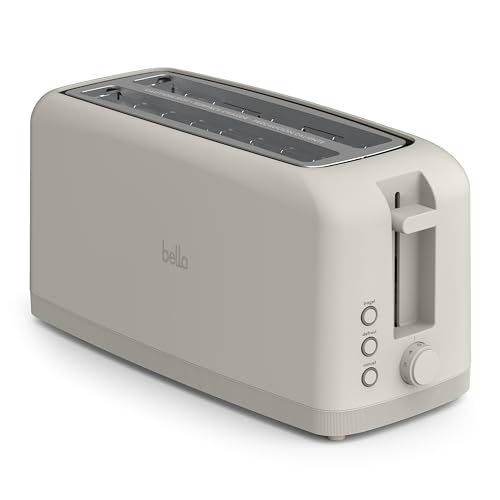
bella Fits-Anywhere Slim Toaster
Badge: Four-Slice Batch Pick, No Wattage Stated (prose-only)
Strengths
- Four-slice capacity is a genuine energy structure: one round for a family replaces two rounds in a two-slice machine, and the second round’s reheat of an already-hot chamber is where batch waste hides.
- An extra long slot means artisan slices toast in a single pass — no flip, no second partial cycle, no dried-out redo.
- Slim body and a designed finish make it a permanent, used-daily appliance rather than a stored one.
Trade-offs
- No wattage is stated in the title, so its per-cycle draw is unknown and it is prose-only in an energy ranking.
- A four-slice machine used for one slice is the batch argument reversed — capacity saves energy only when it is used as capacity.
- No shade count is stated in the title either, so first-time-right calibration data is incomplete from verified sources.
Mini spec box
- Format: 4 slice, slim body
- Slot: extra long and wide
- Design line: Fits-Anywhere
- Finish: Oatmilk
- Wattage: not stated in title — check the listing
The bella’s energy case is architectural rather than numerical, and it deserves to be made carefully. Batch structure is the largest controllable factor in a family’s toast energy: four slices in one round of a four-slice machine avoid the second round entirely, and while a hot chamber reheats quickly, the second round still draws a full cycle’s power for bread that could have shared the first. Add the long slot’s single-pass virtue — artisan slices that elsewhere need a flip and a finishing pass are done once — and the bella’s design reads, in energy terms, like a machine built to minimise cycles per breakfast. What it does not provide is the number that would let this guide rank it: no wattage appears in its title, and a four-slice machine’s draw could be anything from efficient to extravagant. The honest review therefore holds both truths at once — the strongest batch structure in the pool, attached to an unknown draw — and leaves the multiplication to the reader and the listing. Households whose breakfast is genuinely four slices at once should do that multiplication seriously; households of one slice should note the reverse warning in the trade-offs, because an under-filled large machine is its own kind of waste. Its surface and finish story, for readers weighing the object as well as the arithmetic, is covered in our Best Metal Toasters discussion of what to check in a listing’s materials details.
Best for: families who toast in full rounds and bake long loaves, and will confirm wattage on the listing / Not suited for: single-slice households, or buyers who need a stated figure first
Prose-only pick: no Amazon link and no image, because the verified title states no wattage and no energy-efficiency claim.
BLACK+DECKER 2-Slice Toaster with Extra-Wide Slots
Badge: Classic Pick, No Wattage Stated (prose-only)
Strengths
- A purely mechanical classic format — lever, dial, carriage — carries no display or electronics drawing standby power worth the name.
- Seven shades and an extra lift lever support first-time-right toasting and safe retrieval without re-runs.
- Bagel mode directs the cycle at the food that needs it rather than running a generic full programme.
Trade-offs
- No wattage and no efficiency claim in the title, so it cannot be ranked by draw; prose-only in this guide.
- No cancel function is named for mid-cycle energy discipline.
- Extra-wide slots only — long slices need extra passes or a different machine.
Mini spec box
- Format: 2 slice, extra-wide slots
- Shade settings: 7
- Mode: bagel
- Features: extra lift lever, removable crumb tray
- Wattage: not stated in title — check the listing
The BLACK+DECKER’s energy review is the shortest story in this guide, and its brevity is itself instructive. A classic mechanical toaster has exactly one energy behaviour: it draws its element’s wattage while the carriage is down, and nothing when it is up. There is no standby worth measuring, no display sipping power, no control board awake at 3 a.m. That purity is a genuine, if modest, energy virtue, and it pairs with the practical virtues of seven shades and a lift lever — tools for getting toast right once, which is where the real savings live. But purity is not a figure. The title states no wattage, so this machine’s draw while it runs — the only number that could rank it — is unknown to this guide, and it takes its prose-only place with the other four silent machines. Its review stands as the category’s reminder that “low energy” has two halves, the draw and the discipline, and that a guide can verify a classic’s discipline from its design while remaining honestly ignorant of its draw until the listing speaks.
Best for: traditionalists whose energy priority is zero standby and first-time-right simplicity, and who will check wattage on the listing / Not suited for: buyers who need a verified consumption figure in advance
Prose-only pick: no Amazon link and no image, because the verified title states no wattage and no energy-efficiency claim.
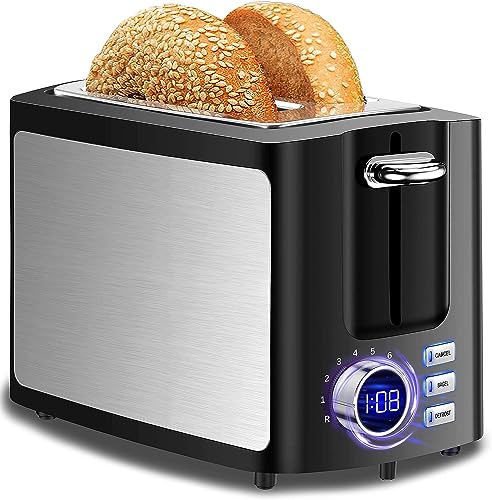
Hommater 2 Slice Wide Slot Smart Toaster
Badge: Display Pick, No Wattage Stated (prose-only)
Strengths
- The LCD countdown is an energy-discipline instrument: knowing the remaining seconds prevents the lift-and-peek that dumps heat and extends cycles.
- Nine shade settings give the finest calibration in the pool, and precise calibration is how toast gets done once.
- Reheat function warms cooled toast gently instead of subjecting it to a second full browning cycle.
Trade-offs
- No wattage is stated in the title, so the draw behind all that discipline is unknown; prose-only here.
- A display and its electronics are the one design in this pool with any standby question at all, however small.
- Wide slot only — long slices will need extra handling and extra energy.
Mini spec box
- Format: 2 slice, wide slot
- Display: LCD digital countdown timer
- Shade settings: 9
- Functions: Bagel, Defrost, Cancel, Reheat
- Wattage: not stated in title — check the listing
The Hommater is the discipline candidate in an energy guide: a machine whose entire interface is about knowing where the cycle stands. The countdown’s energy value is real but behavioural — it stops the peeking that wastes heat, enables the precise cancel, and turns calibration from folklore into repeatable numbers across its nine shades. Its Reheat function is the other quiet saver, warming a cooled slice at a gentler level than a fresh full cycle would use. Against that, two honest debits: its electronics make it the pool’s only machine with even a theoretical standby draw, and — decisively for this guide — its title states no wattage, so the consumption underneath the discipline cannot be compared with the one firm figure on this page. A countdown cannot substitute for a number in an energy ranking. It is therefore prose-only, with its behavioural virtues recorded in full and its missing figure left, like the others, to its listing — where the mid-tier positioning explored in our Best Mid Range Toasters coverage may help you judge whatever figure you find there.
Best for: precision households whose energy savings will come from timing and calibration, and who will verify wattage on the listing / Not suited for: buyers who need a stated consumption figure before anything else
Prose-only pick: no Amazon link and no image, because the verified title states no wattage and no energy-efficiency claim.

Amazon Basics 2 Slice Toaster
Badge: Best Low Energy Pick — The Only Stated Wattage
Strengths
- 900W stated in the title — a modest draw for a two-slice toaster, and the only verifiable energy figure in this pool.
- A purely functional control set (Defrost, Cancel, Bagel buttons) with no display electronics drawing standby power.
- The Cancel button is a working energy tool, ending cycles at doneness rather than at the programme’s estimate.
Trade-offs
- Six browning settings is the joint-narrowest range here, so calibration is coarser than on seven- or nine-step machines.
- Extra wide slots address thickness only; long slices need extra passes that spend the savings.
- Two-slice capacity means family breakfasts run in two rounds — batch thinking applies.
Mini spec box
- Format: 2 slice, extra wide slots
- Power: 900W (stated in title)
- Browning settings: 6
- Buttons: Defrost, Cancel, Bagel
- Extras: removable crumb tray, cord wrap
- Finish: Black and Silver
Here is the one machine this guide can rank on evidence, and the evidence is genuinely good. A 900W element sits at the modest end of two-slice toaster power, and the arithmetic that follows from it is reassuring: at that draw, a typical few-minute cycle consumes only a few hundredths of a kilowatt-hour, so even a daily two-round family habit amounts to a small line in a household’s energy story — smaller than the same breakfast cooked under an oven’s grill by an order of magnitude. The machine around the element supports the figure rather than undermining it: no display to sip standby, a cancel button to end finished cycles early, a defrost programme that spends its extra time only when frozen bread actually requires it, and a cord wrap that suits the stored-between-uses life in which an appliance draws nothing at all. Its limits are the familiar ones — six settings, standard length, two-slice rounds — and they are stated in its trade-offs without varnish. But on the question this keyword asks, it is the pool’s only witness that showed up with a number, and the number is a good one. That is what a link looks like in an honest energy guide, and it is why the affordability discussion in our Best Most Affordable Toasters coverage so often ends at this same machine: modest to buy, modest to run, and specified like it has nothing to hide.
Best for: energy-conscious households that want a verified modest wattage and zero standby fuss / Not suited for: long-slice bakers, or large families who will run it in constant double rounds
Comparison Table
| Pick | Wattage in title | Energy-relevant feature | Capacity | Link |
|---|---|---|---|---|
| Elite Gourmet ECT1027B | Not stated | Cancel listed; measured slot fit | 2 slice | Prose-only |
| Hamilton Beach 22634 | Not stated | Auto shutoff | 2 slice | Prose-only |
| bella Fits-Anywhere Slim | Not stated | Four-slice batch structure; single-pass long slot | 4 slice | Prose-only |
| BLACK+DECKER 2-Slice | Not stated | Fully mechanical; no standby electronics | 2 slice | Prose-only |
| Hommater 2 Slice Smart | Not stated | Countdown discipline; Reheat function | 2 slice | Prose-only |
| Amazon Basics 2 Slice | 900W | Cancel button; no display standby | 2 slice | Check on Amazon |
How to Choose a Low Energy Toaster: The Arithmetic and the Match
Learn the one equation this category runs on: energy equals power multiplied by time. In practical units, a toaster drawing 900 watts for three minutes uses 900 × 0.05 hours, which is 45 watt-hours, or 0.045 kilowatt-hours. Run that daily and the monthly total stays in the region of a single kilowatt-hour — a rounding error beside a home’s heating, laundry or oven use. Two conclusions follow, and both are liberating. First, the difference between a modest-draw toaster and a hungry one, while real, is small in absolute terms; choose the modest one when the evidence offers it, as it does here, but do not pay a large premium or sacrifice your bread’s fit for a wattage gap. Second, the larger savings live in time and waste: cycles not run, rounds not repeated, and big cavities not heated for small jobs. A toaster used instead of an oven grill for two slices is an energy decision worth more than any model swap in this guide.
Then match the machine to the household’s shape. One or two slices at a time: a two-slice machine with a stated modest wattage is the efficient answer, and the Amazon Basics is this pool’s verified example. A family round of four: a four-slice machine’s batch structure can beat two rounds — but only compare honestly once you have its wattage from the listing, because capacity without a figure is a hypothesis. Frozen-bread households: a defrost function spends a little extra time to avoid the waste of a ruined, re-run slice, and is worth having. Forgetful households: auto shutoff is your feature, an insurance policy against the one truly wasteful cycle. In every case, the method is the same — demand the figure, do the small multiplication, and let habits and matching carry the rest.
How to Toast With Less Energy: Habits and Troubleshooting
Habits, in rough order of value. Toast in the toaster, not the oven: a slot heats a hand’s breadth of air around the bread, an oven heats a cupboard of it. Batch deliberately: if the household eats within the same half hour, run rounds back-to-back while the elements are hot and the second round can drop a shade and a few seconds. Get it right once: calibrate your shade per loaf in the first week, because every re-run doubles a slice’s energy. Use defrost for frozen bread rather than two improvised cycles. Cancel at doneness when you are standing there — the programme is an estimate, your eyes are the instrument. And maintain the machine: a crumb-clogged toaster with a reluctant carriage wastes cycles on faults, so keep the tray on its weekly rhythm and the slots clear.
- Problem: toast needs a second cycle to reach your shade → the setting is calibrated for a different loaf or a cold start; recalibrate per loaf, and remember batch two on hot elements needs less, not more.
- Problem: the energy bill concern is really about a big household’s volume → the lever is batching and capacity-matching, not the model; run full rounds, avoid half-empty large machines, and keep the oven out of toast duty.
- Problem: a cycle was left running and forgotten → clear the cause (a jammed carriage wants crumbs emptied, unplugged and cooled), and put auto shutoff at the top of your next machine’s checklist.
Standby, Displays and the Vampire-Load Question
A short section to retire a common worry. The vampire-load story — appliances sipping power around the clock — belongs mainly to devices with screens, clocks, network connections and power supplies that never sleep. A classic mechanical toaster has none of that: its circuit is open until the carriage goes down, and its standby draw is effectively zero, which is one of the classic format’s quiet virtues and applies to most of this pool. The exception in kind, if barely in degree, is the display machine: the Hommater’s LCD and electronics must be powered to show a countdown, and any such design may draw a small standby amount to keep its face alive. Small is the operative word — the annual cost of such a draw is a footnote — but the tidy-minded can eliminate it entirely by switching at the wall or unplugging, a habit that suits stored machines like the cord-wrapped Amazon Basics naturally. The proportionate conclusion: worry about standby for your entertainment stack and your network gear; for your toaster, worry about wasted cycles and oven substitution, which is where its energy story is actually written.
Toaster vs Oven vs Grill: Where Toast Energy Really Goes
Put the toaster in its kitchen context and its energy virtue becomes obvious. Browning bread requires heating the bread’s surfaces for a few minutes. A slot toaster does that with elements centimetres from the slice, in a chamber barely bigger than the bread itself — nearly all its draw becomes browning. An oven asked to toast must heat a large insulated cavity, its racks and its own walls before the bread sees serious heat, and a grill element spreads its output across that whole cavity whether two slices sit beneath it or twelve. Even without quoting any oven’s wattage — none is in this pool’s data, and this guide invents none — the geometry alone settles the ranking: smallest heated volume wins, and the slot is the smallest volume in the kitchen that browns bread. The air fryer sits between the two, a compact cavity that toasts acceptably and uses far less than an oven, though rarely better than a slot at the slot’s own job. The practical hierarchy for an energy-conscious kitchen is therefore: slot toaster for toast, air fryer for toast-adjacent jobs in small batches, oven only when the food genuinely needs an oven. Households that move their morning toast from the oven to any machine in this guide will save more energy in a month than a lifetime of wattage-gap shopping between toasters — which is why this guide spends as many words on the match and the habits as on its one verified number.
The Unstated Five: A Buyer’s Protocol for Missing Wattages
Five of this pool’s six titles withhold the figure this keyword needs, and that situation is common enough across the whole category to deserve a protocol. Step one: go to the listing and find the specification table or the product details section, where wattage is normally declared for the exact model — use only the figure attached to the precise variant you are buying, since a model line can span several. Step two: sanity-check the figure against the format: a two-slice toaster’s draw should sit in the familiar modest band for its class, and a figure wildly outside it is a reason to re-read which variant the table describes. Step three: do the multiplication for your own household — wattage times your realistic cycle minutes times your weekly rounds — and look at the result in kilowatt-hours before letting it influence you, because the honest outcome for almost every household is that the number is small, and the decision can return to fit, features and price with a clear conscience. Step four: if the figure cannot be found anywhere on the listing, treat that absence as a soft negative — not proof of a hungry machine, but a sign the maker does not consider energy part of its pitch, which in an energy-led purchase is information in itself. Follow those four steps and the five prose-only machines in this guide can each be promoted, on evidence, into your own private ranking — which is all this guide ever asked: that energy claims, including its own, rest on numbers somebody actually stated.
Common Buying Mistakes
- Trusting an energy claim with no wattage behind it. If the title and listing give no figure, the claim is marketing. This guide links exactly one machine for exactly that reason.
- Paying a premium for a small wattage gap. Do the multiplication: at toaster cycle lengths, modest differences in draw are pennies of energy a year. Fit and habits matter more.
- Toasting in the oven. The single largest energy error in this category — a whole cavity heated for two slices.
- Ignoring batch structure. Two rounds in a small machine, or one slice in a large one, both waste the match between capacity and household.
- Blaming standby. Mechanical toasters draw effectively nothing at rest. The waste is in re-runs, forgotten cycles and wrong appliances.
- Skipping calibration. An uncalibrated shade setting is an energy policy of trial and error, paid for one burnt or pale slice at a time.
Final Recommendation
The Amazon Basics 2 Slice Toaster is this guide’s recommendation: the pool’s only verified wattage, a modest 900W, in a simple mechanical machine with a cancel button, a defrost programme and no standby story to manage. Pair it with the habits in this guide — batch your rounds, calibrate your shade, keep the oven out of it — and your toast’s energy footprint becomes what it should be: a rounding error with good browning. If your household’s shape points elsewhere — four-slice rounds, forgotten-cycle insurance, countdown discipline — the prose-only reviews above tell you exactly which machine holds which part of the answer, and exactly which figure to demand from its listing before you let it into an energy ranking. That demand, politely but firmly made, is how the next pool of titles learns to state its wattage — and how energy guides like this one eventually get to link more than a single, lonely, well-specified machine.
Frequently Asked Questions
How much energy does a toaster actually use?
Less than its reputation suggests. Energy is wattage multiplied by time: the one verified figure in this pool, the Amazon Basics’ 900W, running a three-minute cycle uses about 0.045 kilowatt-hours. Even daily use at that level totals roughly a kilowatt-hour a month — trivial beside an oven, a kettle habit or laundry, and the reason habits and appliance choice matter more than small wattage differences.
Why is only one toaster linked in this guide?
Because only one verified title states a wattage — the Amazon Basics at 900W — and this guide links energy picks only on stated figures or explicit efficiency claims. The other five machines may well be reasonable draws, but their titles do not say, and an energy guide that guessed would be inventing its own subject. Their listings’ specification tables are the place to find the figures.
Does auto shutoff make the Hamilton Beach the most efficient pick?
It makes it the best insured pick. Auto shutoff prevents the forgotten or jammed cycle, which is the largest single waste event in toaster ownership — but it says nothing about the machine’s draw during normal cycles, and its title states no wattage. Insurance and efficiency are different virtues; this guide credits the first without pretending it is the second.
Is a four-slice toaster more energy efficient for a family?
Structurally, it can be: one four-slice round replaces two two-slice rounds, avoiding a second cycle entirely. But the saving depends on the four-slice machine’s wattage, which in this pool’s case — the bella — is not stated in its title. Confirm the figure on the listing and multiply by your real cycle time before claiming the win.
Do toasters use power when they are off?
Mechanical toasters, effectively no: with the carriage up, the circuit is open and there is no display or supply to feed. Display models like the Hommater may draw a very small standby amount to power their electronics. Either way, standby is the least important line in a toaster’s energy story; wasted cycles and oven use dominate it.
Does a lower wattage mean slower, paler toast?
Not within the normal range for a format. Browning depends on element design, distance to the bread and cycle timing as much as on raw draw, and a modest-wattage two-slice machine like the 900W Amazon Basics is engineered as a complete system — its settings assume its element. What a lower draw does mean is a slightly gentler ramp, which many users experience as a wider window between done and overdone. Judge any machine by its toast at its own settings, and treat wattage as the energy figure it is, not as a proxy for performance.
Should I replace a working toaster just to save energy?
Almost never on energy grounds alone: the savings available from a model swap are measured in kilowatt-hour fractions per month, while a replacement spends money and embodied resources immediately. Replace when the old machine browns badly, fails mechanically or no longer fits your bread — and let the energy evidence in this guide shape the replacement’s selection rather than trigger it.
What saves more energy: a lower-wattage toaster or better habits?
Habits, by a wide margin. Toasting in the toaster rather than the oven, batching rounds, calibrating so slices are done once, and cancelling at doneness each outweigh the difference between plausible wattages at toaster cycle lengths. Choose the verified modest wattage when it is offered — as the Amazon Basics offers it — and then let the habits do the heavy lifting.