Disclosure: topratedkitchenware.com is reader-supported. When you buy through links on our site, we may earn an affiliate commission from Amazon and other retailers, at no extra cost to you.
Where to buy
The models below are the verified picks for this guide to small-footprint toasting. Linked names lead to their Amazon listings, where you can check the latest price on Amazon and confirm dimensions before committing scarce counter space. One pick is reviewed prose-only, without a link or image, for a reason its review explains plainly: it is slim, but it is not mini.
- Hommater 2 Slice Smart Toaster with LCD Display
- Amazon Basics 2 Slice Toaster
- Elite Gourmet ECT1027B 2-Slice Cool-Touch Toaster
- Hamilton Beach 22634 Extra-Wide Slot 2 Slice Toaster
- bella Fits-Anywhere Slim Toaster, 4 Slice (reviewed prose-only below — a slim four-slice design, not a mini toaster)
- BLACK+DECKER 2-Slice Toaster with Extra-Wide Slots
Read the full guide ↓ for what “mini” honestly means in this pool, which small-space features matter, and how to measure your counter before you choose.
The best mini toasters are bought by people who measure first: the studio tenant with one short run of counter, the student in a dorm room, the couple in a small flat whose kitchen doubles as a hallway, the office manager fitting a break room corner. This guide begins with an honest definition. No listing in the verified pool claims to be a novelty mini or a single-slice toy, and this guide will not pretend otherwise. The small end of the real toaster market is the standard two-slice format — compact next to any four-slice or long-slot machine, sized for one or two people, and still capable of bagels and thick bread. Five of the six picks below are exactly that, linked and imaged as usual. The sixth, a slim four-slice design, is reviewed prose-only as the contrast case: it is the pool’s space-saving specialist, but four-slice capacity is not mini, and a guide about small toasters should say so rather than stretch the word.
Small-space toasting has its own priorities, and they reorder the usual feature list. Cord storage jumps from nice-to-have to essential, because a small counter cannot spare room for a cable tail. Housing temperature matters more, because a small kitchen puts the toaster within everyone’s reach. Retrieval matters more, because small households toast small items — muffin halves, mini bagels, the ends of loaves. And storage matters most of all: in a small home, a toaster that cannot be put away easily is a toaster that owns the counter permanently. Readers whose space problem is specifically about budget should cross-check our guide to Best Most Affordable Toasters, and readers who simply want the standard-size field should start from our guide to Best Pop Up Toasters instead.
Every linked pick is drawn from verified listing information checked on 2026-11-20, with specifications quoted only as stated. No listing here states its footprint dimensions in its title, so this guide judges smallness by format — slice count and body style — and urges you to confirm the exact measurements on the listing page against your own counter before ordering.
Key Takeaways
- In the real market, “mini” means a standard two-slice format — compact, honest, and still bagel-capable.
- The Amazon Basics is the small-space storage pick: cord wrap plus a removable crumb tray.
- The Elite Gourmet’s cool-touch housing suits counters where everything is within reach.
- The Hamilton Beach’s Toast Boost solves the small-slice retrieval problem small households meet daily.
- The bella slim four-slice is reviewed prose-only: clever for narrow counters, but not a mini toaster.
- Measure your counter and your cupboard before ordering; no listing here states dimensions in its title.
In this guide
Quick Picks
Five linked two-slice picks and one prose-only contrast. If your household actually needs four slices at once, our guide to Best Prices On 4 Slice Toasters covers that format on its own terms.
| Pick | Badge | Best for | Listing |
|---|---|---|---|
| Hommater 2 Slice Smart Toaster | Best Overall Small Pick | Small households wanting full-size control in a two-slice body | Check on Amazon |
| Amazon Basics 2 Slice Toaster | Best for Dorms and Offices | Shared small spaces that need tidy storage | Check on Amazon |
| Elite Gourmet ECT1027B | Best for Tight Family Counters | Small kitchens where a hot housing is a hazard | Check on Amazon |
| Hamilton Beach 22634 | Best for Small Slices | Muffins, mini bagels and short loaf ends | Check on Amazon |
| bella Fits-Anywhere Slim Toaster | Best Slim Alternative (Not Mini) | Narrow counters with four-slice demand — reviewed prose-only | Prose-only — see review |
| BLACK+DECKER 2-Slice Toaster | Best Classic Compact | Buyers wanting a simple lever machine in two-slice form | Check on Amazon |
How These Picks Were Chosen
The pool is the verified slot-toaster field, checked against Amazon’s listing data through the Creators API on 2026-11-20. For this guide the first filter was format: two-slice models form the linked shortlist because they are the smallest full-function class in the pool, while the pool’s only four-slice model — slim-bodied though it is — was held to prose-only status so the guide’s definition of mini stays honest. The second filter was small-space evidence in the listing: cord storage, cool-touch housing, lift help for small items, tray designs that suit small sinks and small bins, and control sets complete enough that a small household needs no second appliance.
A note on what could not be filtered: dimensions. None of the six listings states a footprint in its title, so no pick is credited with a specific size in inches, and the reviews rank by format and features rather than by invented measurements. That restraint matters, because “mini” is the most abused word in small appliances; a guide that prints dimensions it was never given would be manufacturing the very fact you came to check. Confirm the measurements on the listing page, against the gap you measured at home.
This is a research-led guide with no hands-on claims and no printed prices. Each review states what its pick offers a small household, names one honest limitation, and ends with a verdict. If your real constraint is a motorised carriage in a small body, note that no pick in this pool states one — our guide to Best Motorized Toasters explains that field and its size implications.
The 6 Best Mini Toasters, Reviewed
Badges match the Quick Picks table. The prose-only pick carries no link and no image, by design, and its review explains why it still belongs in a small-space conversation.
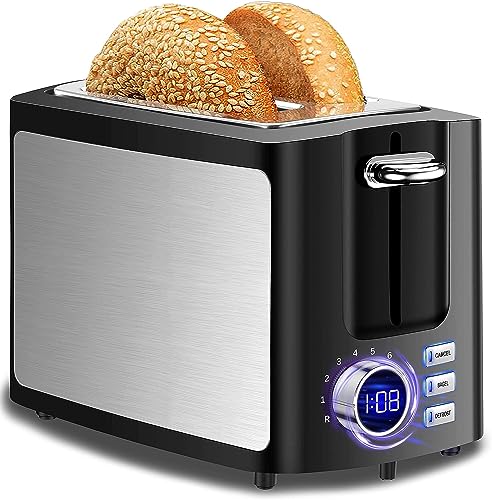
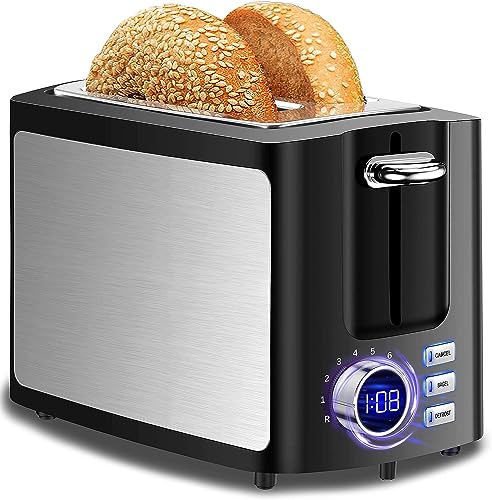
Hommater 2 Slice Smart Toaster with LCD Display
Badge: Best Overall Small Pick
Strengths
- Two-slice format with a full-size control set — nine shade settings and an LCD countdown — so small does not mean basic.
- Wide slots still take bagel halves and thick slices, unusual generosity in the small class.
- Bagel, Defrost, Cancel and Reheat functions cover a small household’s whole routine in one compact body.
Trade-offs
- The listing describes no crumb tray, so clean-out design is unconfirmed.
- No cord storage is stated, a missed detail for small counters.
- A display-led interface is more than a one-setting user needs.
Mini spec box
- Format: 2 slice, wide slot
- Controls: LCD digital countdown timer
- Shade settings: 9
- Functions: Bagel / Defrost / Cancel / Reheat
Small households are often told to accept small features, and the Hommater refuses that bargain. Its two-slice body is the compact format this guide is built around, but the control set is the widest in the pool: nine shade settings stepped finely enough for a household that keeps several breads, and a countdown display that tells you exactly when a cycle ends. In a studio or a small flat, where the toaster shares a counter with everything else you own, that combination — full capability, half the footprint of a four-slice machine — is the strongest interpretation of mini done properly.
The functions matter at small scale too. A small household freezes bread more, because a loaf outlasts two people; defrost is therefore a daily cycle, not a luxury. Bagel mode serves the weekend; reheat rescues the slice that waited while a small kitchen’s one cook did three other things; cancel ends mistakes instantly. Wide slots mean the compact body never forces you to trim a bakery slice, which is where lesser small toasters quietly fail.
The honest limitations are storage details. No crumb tray is described and no cord storage is stated, so a buyer whose counter is truly tiny should weigh the Amazon Basics below, which states both its tray and its cord wrap. On capability per slice-slot, though, this is the small pick to beat.
Best for: Small households that refuse to give up full control / Not suited for: Buyers whose top priority is cord storage and a confirmed tray

Amazon Basics 2 Slice Toaster
Badge: Best for Dorms and Offices
Strengths
- Cord wrap — the single most valuable storage feature in a small or shared space.
- Removable crumb tray keeps shared machines hygienic with minimal effort.
- Stated 900W power and extra-wide slots with Defrost, Cancel and Bagel buttons.
Trade-offs
- Six browning settings is the joint-narrowest range in the pool.
- No lift help is stated for short slices.
- Black and silver finish is a colourway, not a stated construction material.
Mini spec box
- Format: 2 slice, extra-wide slots
- Power: 900W (as stated in the listing)
- Browning settings: 6
- Details: removable crumb tray, cord wrap
- Buttons: Defrost / Cancel / Bagel
Shared small spaces — dorm rooms, office break rooms, studio flats with one cupboard — judge a toaster by how it behaves between uses, and that is where the Amazon Basics wins this guide’s storage argument. Cord wrap turns put-away into a ten-second act instead of a negotiation with a trailing cable; a removable crumb tray means whoever uses the machine can empty it without instructions or tools; a two-slice footprint fits the corner that actually exists. In a dorm, those three facts are worth more than any shade range.
The working specification is complete for its setting. Extra-wide slots accept the bagels and thick slices shared kitchens actually toast; six browning settings cover the pale-to-dark argument range; defrost handles the freezer loaf every small household keeps; cancel lets any user stop any cycle safely. The stated 900W gives an honest sense of the element class — useful in older buildings and dorms where knowing an appliance’s draw is part of living within the wiring.
The honest limitation is finesse: six settings and no stated lift help mean mixed-preference households and muffin devotees will feel the ceiling. For the dorm, the office and the first flat, though, this is the small toaster whose design respects the space it lives in.
Best for: Dorms, offices and first flats where storage and tidiness rule / Not suited for: Households wanting fine shade steps or lift help

Elite Gourmet ECT1027B 2-Slice Cool-Touch Toaster
Badge: Best for Tight Family Counters
Strengths
- Cool-touch housing — in a small kitchen, the toaster sits within everyone’s reach, and this one is built for that.
- Slots specified at 1.25 inches extra-wide, so the compact body still swallows bagels and thick bread.
- Six shades with Cancel and bagel capability: a simple, legible control set for shared use.
Trade-offs
- No defrost function is stated in the listing.
- No crumb tray is described.
- The black finish shows crumbs in a small, always-visible kitchen.
Mini spec box
- Format: 2 slice, cool-touch housing
- Slot width: 1.25 in extra-wide (as stated)
- Shades: 6
- Functions stated: Cancel, bagel mode
- Colour: Black
Small kitchens compress distances. The toaster stands beside the kettle, under the cupboard, within a child’s reach and an elbow’s swing — and an ordinary toaster’s hot outer walls become a daily negotiation. The ECT1027B’s cool-touch housing is therefore worth more in a small kitchen than in a large one: it relaxes placement, forgives brushing hands, and lets the machine live in the tight slot that a small counter actually offers. As a two-slice format it already suits the space; the housing makes it suit the crowd.
Its slot specification is the pool’s most precise — a stated 1.25 inches — which matters at small scale because a compact toaster that refuses bagel halves forces a second appliance or a grill into a kitchen with no room for either. Six shades, a cancel control and bagel capability complete a deliberately simple panel that any member of a small, busy household can operate half-asleep.
The honest limitations are the unstated defrost cycle and the undescribed crumb tray. Small households freeze bread often, so verify defrost on the listing page; if it is essential and unconfirmed, the Hommater and Amazon Basics above both state it. As the small-kitchen safety pick, though, the Elite Gourmet stands alone in this pool.
Best for: Small family kitchens where everything is within reach / Not suited for: Buyers who need a stated defrost cycle
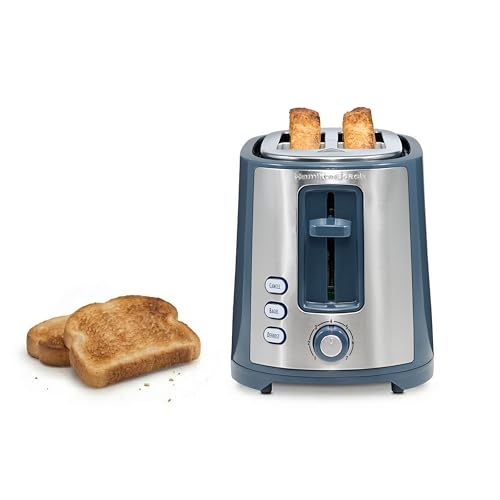
Hamilton Beach 22634 Extra-Wide Slot 2 Slice Toaster
Badge: Best for Small Slices
Strengths
- Toast Boost lifts small items high — the defining need of small households that toast muffins and mini bagels.
- Auto shutoff adds safety in small, busy kitchens where distractions are constant.
- Slide-out crumb tray and seven shades complete a full specification in two-slice form.
Trade-offs
- The Kitchen Makeover Blue finish is conspicuous in a small, visible kitchen.
- No cord storage is stated for put-away use.
- No reheat function is named.
Mini spec box
- Format: 2 slice, extra-wide slot
- Shades: 7 browning settings
- Details: auto shutoff, Toast Boost, slide-out crumb tray
- Functions: Bagel, Defrost
- Colour: Kitchen Makeover Blue
There is a pleasing symmetry in this pick: the best small toaster for small food. Small households disproportionately toast small things — a single muffin half, a mini bagel, the end of a loaf cut thick — and ordinary carriages strand those items low in the slot. Toast Boost exists for exactly that moment, lifting finished toast higher so it leaves by hand. Add auto shutoff for the distracted small-kitchen morning and a slide-out tray that empties into a small bin without a shake-cloud of crumbs, and the 22634 becomes the most small-aware specification in this guide.
Seven shades and bagel and defrost buttons mean none of that awareness costs capability. The two-slice footprint keeps it in this guide’s mini class, and the extra-wide slots take the thick slices a small household buys from a bakery on weekends. Readers comparing detail-rich small machines with the wider field should also see our guide to Best Old Toasters, where simple, durable small designs are judged by a classic lens.
The honest limitation is presentational and practical: the blue finish will dominate a tiny kitchen’s palette, and no cord wrap is stated for households that store the toaster away. If it lives out on the counter, neither matters much; if it lives in a cupboard, weigh the Amazon Basics’ storage story against this pick’s retrieval story and choose your daily annoyance.
Best for: Small households that toast small items daily / Not suited for: Put-away users who need stated cord storage
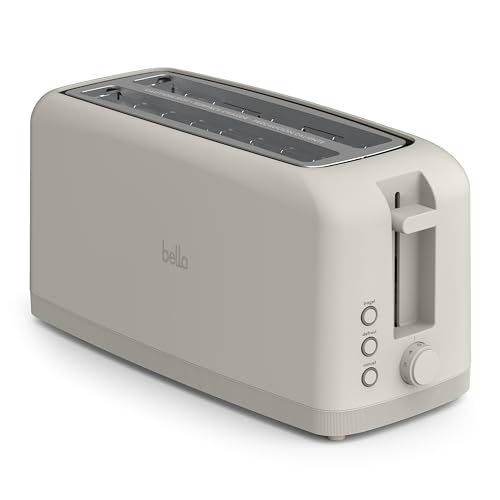
bella Fits-Anywhere Slim Toaster, 4 Slice
Badge: Best Slim Alternative (Not Mini)
Strengths
- Slim Fits-Anywhere body uses narrow counter runs that defeat conventional four-slice machines.
- Extra long and wide slot accepts long artisan slices whole.
- Oatmilk finish suits small, always-visible kitchens aesthetically.
Trade-offs
- It is a four-slice machine: slim is not mini, so it is reviewed prose-only in this guide, without a link or image.
- The listing states no shade count and names no bagel or defrost functions.
- No crumb tray design is described in the listing.
Mini spec box
- Format: 4 slice, slim body, extra long and wide slot
- Design line: Fits-Anywhere
- Colour: Oatmilk
- Controls and functions: not stated in the listing title
- Status in this guide: prose-only — no Amazon link, no image
This review exists to draw a line honestly. The bella is a genuinely clever small-space design: it turns capacity sideways, running four slices along a slim body so a narrow counter gains a family-size toaster. For a long, thin galley kitchen, that may be a better answer than any pick above. But a guide to mini toasters that linked a four-slice machine as a mini pick would be playing word games with its readers, so the bella appears here the way it should: fully reviewed, clearly badged as the slim alternative, and left prose-only, to be judged on its own considerable merits in the four-slice field rather than borrowed ones in this one.
Its stated facts are format facts — the slim body, the extra long and wide slot, the Oatmilk finish — and they are real virtues in small kitchens, where the toaster is furniture as much as appliance. Its unstated facts are the control facts: no shade range, no named functions, no tray description appears in its listing title, so any buyer comparing it with the linked picks here should confirm those details on its listing page before treating it as equivalent.
The honest verdict is therefore double. As a mini toaster, it is not one, and this guide will not call it one. As a narrow-counter four-slice design, it may be exactly the machine a particular small kitchen needs — in which case buy it for the right reason, with its control details verified, rather than because a guide stretched a definition.
Best for: Narrow galley counters with genuine four-slice demand / Not suited for: Anyone shopping for a true mini, two-slice footprint
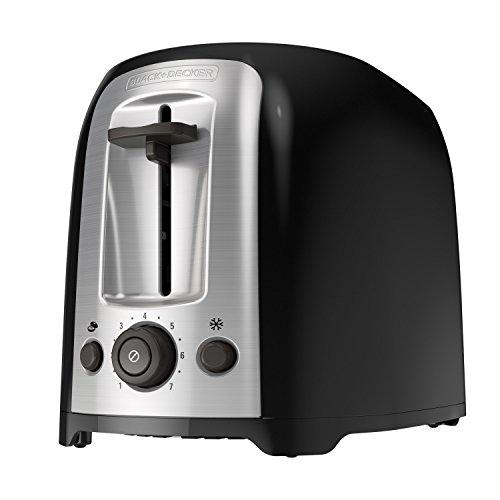
BLACK+DECKER 2-Slice Toaster with Extra-Wide Slots
Badge: Best Classic Compact
Strengths
- Extra lift lever — small-item retrieval solved mechanically in a compact body.
- Removable crumb tray keeps a small machine easy to keep clean.
- Seven shade settings and a bagel mode in standard two-slice form.
Trade-offs
- No defrost function is stated in the listing.
- No cord storage or auto shutoff is described.
- No display feedback for users who like visible timing.
Mini spec box
- Format: 2 slice, extra-wide slots
- Shade settings: 7
- Details: extra lift lever, removable crumb tray
- Mode stated: bagel mode
The classic compact argument is that a small toaster should be a simple toaster: fewer parts, legible controls, nothing to configure. The BLACK+DECKER makes that argument in two-slice form — a lever, a dial with seven settings, a bagel mode, an extra lift for short slices and a tray that comes out to be emptied. In a small household where the toaster may be operated by guests, grandparents or a rotating cast of flatmates, that legibility is a genuine small-space virtue, because the machine never needs explaining.
It also respects the small kitchen’s second constraint, cleaning in a small sink with a small bin. A removable tray empties in seconds and rinses under any tap; the alternative — inverting and shaking a toaster — is an act small kitchens dread and therefore postpone. Readers drawn to oven-format alternatives for tight spaces should note honestly that this pool contains no toaster ovens at all; our guide to Best Oven Toasters covers that separate field.
The honest limitation is the unstated defrost cycle, which matters in freezer-reliant small households, plus the absence of stated cord storage. Confirm defrost on the listing if you toast from frozen daily. As the classic compact — simple, lift-equipped, tray-equipped — it closes this guide’s linked shortlist on the traditional note.
Best for: Small households wanting simple, legible, mechanical operation / Not suited for: Buyers needing a stated defrost cycle or cord wrap
Comparison Table
| Pick | Format | Shades | Small-space strength | Listing |
|---|---|---|---|---|
| Hommater Smart Toaster | 2 slice, wide slot | 9 | Full control set in compact form | Check on Amazon |
| Amazon Basics | 2 slice, extra-wide | 6 | Cord wrap and removable tray | Check on Amazon |
| Elite Gourmet ECT1027B | 2 slice, 1.25 in slots | 6 | Cool-touch housing | Check on Amazon |
| Hamilton Beach 22634 | 2 slice, extra-wide | 7 | Toast Boost and auto shutoff | Check on Amazon |
| bella Fits-Anywhere Slim | 4 slice, slim long slot | Not stated | Slim body — but not mini (prose-only) | Prose-only |
| BLACK+DECKER | 2 slice, extra-wide | 7 | Extra lift lever and removable tray | Check on Amazon |
How to Choose a Mini Toaster
Measure before you shop, in three places: the counter gap the toaster will occupy, the cupboard or shelf it may be stored in, and the longest slice you regularly buy. No listing in this pool states dimensions in its title, so treat the listing page’s measurements as part of the purchase, checked against your tape measure rather than against hope. Format does the first sort for you — two-slice bodies are this pool’s mini class — but individual models vary, and a centimetre is the difference between fitting and dominating a small counter.
Then rank the small-space features in the order small households feel them. Storage first: cord wrap or a body shape that shelves well decides whether the machine can be put away at all. Housing second: in a compressed kitchen, a cool-touch exterior changes placement options and daily comfort. Retrieval third: lift levers and boost features matter because small households toast small items constantly. Controls last: a small household with one or two users needs a repeatable setting more than a wide range, though the Hommater proves you can have both if you want them.
Finally, resist definition creep. Slim is not mini, long-slot is not mini, and a four-slice machine in a narrow body is a space-saving family toaster — a fine thing, reviewed honestly above — rather than a mini one. Buy the format your measured space and your slice count actually describe, and the word on the box stops mattering.
How to Live With a Small Toaster: Use and Care
- Place the toaster with clearance above and behind it; small kitchens tempt corner-cramming, and heat needs somewhere to go.
- Run two empty medium cycles when new, in a ventilated space, to clear element residue before the first real slice.
- Learn one setting per bread and write it down; small households repeat the same loaves, so calibration pays off fast.
- Use the lift lever or boost for every short item instead of tilting the machine or reaching in.
- Empty the crumb tray weekly — small trays fill at the same crumb rate as large ones, and small kitchens notice smoke sooner.
- Store the cord on its wrap if fitted; if not, coil it loosely beside the machine rather than wrapping a warm body.
- Wipe the exterior with a soft damp cloth and never immerse the toaster; unplug before any cleaning.
Troubleshooting. Problem: toast browns faster than expected in a small toaster → compact bodies run repeat cycles hot; drop one shade setting for the second batch. Problem: small slices sit too low to grab → use the stated lift or boost feature; never insert metal into a plugged-in toaster. Problem: crumbs smoke in a tight kitchen → the tray is overdue; unplug, cool, empty it, and shake the cooled machine gently over a bin.
Where Mini Toasters Live: Dorms, Rentals and Small Homes
Each small setting writes its own brief. Dorm rooms add rules — many residences restrict appliances or require auto shutoff — so a student should check the housing contract first and then look hard at the Hamilton Beach’s stated shutoff or the Amazon Basics’ tidy storage. Rentals add impermanence: a toaster that stores in a cupboard and wipes clean protects both the deposit and the counter. Small family homes add hands: the Elite Gourmet’s cool-touch housing earns its place where children circulate. Offices add operators: the BLACK+DECKER’s legible lever-and-dial panel is the one nobody needs taught. The mini label is shared; the right pick is the one whose stated features answer your setting’s specific rule.
The Counter-Space Audit: A Ten-Minute Exercise Before You Order
Small kitchens punish guesses, so run this audit before choosing any pick in this guide. First, clear the exact run of counter the toaster will occupy and measure its width and depth with a tape, not an eye. Write the numbers down. Second, measure the vertical: the clearance between counter and wall cupboards decides whether toast can rise and be lifted comfortably, and whether heat escapes or bakes the cupboard underside. Third, measure the storage fallback — the cupboard shelf or drawer the toaster will use if it does not live out — including the door opening, which is narrower than the space behind it. Fourth, find the outlet. In small kitchens the outlet’s position quietly dictates placement, and a cord that must cross a sink or a hob is a design failure no feature list can redeem.
Now match the audit to the pool. A two-slice body is the default answer, but the audit refines it: if the toaster will be stored between uses, cord management and weight move up the ranking, favouring the Amazon Basics’ wrap; if it will live out permanently in a compressed family kitchen, housing temperature moves up, favouring the Elite Gourmet; if it will live out beside a wall with a narrow run but the household is large, the audit may honestly conclude that mini is the wrong brief and the slim four-slice bella — prose-only here, bought knowingly as a four-slice machine — is the right exception. The audit’s job is not to sell you the smallest box; it is to match a measured space to a stated format, which is the entire discipline of small-kitchen buying.
One more measurement is routinely forgotten: the bread. Take the longest and thickest slice your household buys and measure it. Wide and extra-wide slots are universal among the linked picks, and the Elite Gourmet states its width outright at 1.25 inches, but slot length is a separate dimension, and long artisan slices are the classic failure of compact bodies. If your loaf is long, your honest shortlist narrows to wide-slot two-slice models used one slice at a time, or to the long-slot format reviewed prose-only above. Measuring bread feels excessive for exactly one morning — the first one — and sensible every morning after.
Small Households, Real Routines
Small households toast differently, and the differences explain this guide’s rankings. They freeze more bread, because a loaf outlasts one or two people, which is why defrost appears in these reviews as a headline function rather than a footnote — and why the two picks that leave it unstated, the Elite Gourmet and the BLACK+DECKER, carry that flag plainly. They toast more partial loads — one slice, one muffin half — which is why lift help and boost features punch above their weight here: a carriage designed around pairs still has to serve singles gracefully. And they reheat more, because a small kitchen’s cook is also its server, cleaner and kettle-watcher, and toast waits; the Hommater’s stated reheat function is a small-household feature disguised as a general one.
They also clean differently. A small sink makes tray-washing easy and machine-shaking miserable, which is why removable and slide-out trays are praised in these reviews out of proportion to their glamour. And they store differently: every appliance in a small home is either out, earning its counter rent daily, or away, earning its cupboard space by being effortless to fetch. The Amazon Basics’ cord wrap and the bella’s slim profile are both, in their opposite ways, answers to that rent question — one by being put away gracefully, the other by fitting a run of counter nothing else could use. Judge every pick in this guide by which rent it pays, and the badges will make sense as a set.
One Slice at a Time: Technique for Partial Loads
Small households rarely fill both slots, and partial loads behave differently enough to deserve a technique of their own. A single slice in a two-slice toaster browns faster than a paired load, because the empty slot’s elements radiate without a second slice absorbing heat. The practical fix is simple: step one shade setting lighter for single slices, and learn your single-slice number separately from your paired number if you toast both ways regularly. Bagel halves behave the same way — one half alone in a wide slot will outpace a pair — and frozen single slices compound the effect, which is why the defrost cycle, where stated, is a better tool than a longer standard cycle: it adjusts the timing pattern rather than merely extending it.
Placement within the slot matters too. Centre a single slice rather than pushing it to one side, so both faces see similar element distance; centre a muffin half cut-side as the bagel mode directs. And use the retrieval help your pick states — the extra lift on the BLACK+DECKER, the Toast Boost on the Hamilton Beach — as part of the technique rather than as an emergency measure, because small items toasted daily deserve a routine, not a rescue. These habits cost nothing, apply to every linked pick in this guide, and close most of the evenness gap that buyers blame on compact bodies.
Power, Wiring and Placement in Small Spaces
Small and older homes add an electrical footnote worth reading. Only one listing in this pool states its draw — the Amazon Basics at 900W — and in a dorm room, a caravan or an older flat where the kitchen circuit is shared with a kettle and a microwave, knowing a toaster’s wattage is part of placing it safely. Where a listing does not state power, check the listing page or the appliance label on arrival, and avoid running a toaster and a kettle on the same loaded extension lead; small kitchens breed extension leads, and toasters are among the heaviest draws that get plugged into them.
Placement completes the safety picture. Give the machine clearance above for rising heat and toast, keep it out of the kettle’s steam path so condensation does not reach the slots, and keep cords off the hob and out of the sink’s splash zone. In a compressed kitchen those three rules eliminate most of the risk that makes people wary of countertop toasting — and they cost nothing but the ten-minute audit described earlier in this guide.
When Mini Is the Wrong Answer
An honest small-toaster guide ends by naming its own boundary. If your household regularly toasts for four or more people at the same sitting, no two-slice machine — however good — will feel mini; it will feel slow, and the right purchase is a four-slice format bought on its own terms. If your bread is predominantly long artisan loaves, slot length outranks footprint, and the long-slot design reviewed prose-only in this guide deserves a full look in the four-slice field. If your kitchen’s constraint is budget rather than space, the same pool re-sorted by value will serve you better than a size ranking. And if your counter is generous and your household small, mini buys you nothing at all: a standard machine with the features you want is the honest choice. Small is a tool for a measured problem. Where the problem is real — the dorm, the studio, the galley, the first flat — the five linked picks above solve it without asking you to accept a toy in place of a toaster.
Common Buying Mistakes
- Trusting the word “mini” without measuring. Formats and dimensions decide fit; adjectives do not.
- Buying slim when you meant small. A four-slice slim machine serves a family on a narrow counter — a different brief from a two-slice mini.
- Forgetting the cord. In small spaces, unstated cord storage becomes a daily cable across your only work surface.
- Skipping lift help. Small households toast small items; retrieval features are core, not garnish.
- Ignoring housing heat. Compressed kitchens put hot walls within everyone’s reach; cool-touch design is a placement feature.
Final Recommendation
Start with the Hommater 2 Slice Smart Toaster for the fullest control set in a two-slice body. Choose the Amazon Basics 2 Slice Toaster when storage and tidiness lead — dorms, offices, first flats — and the Elite Gourmet ECT1027B when a tight family counter needs a cool-touch housing. The Hamilton Beach is the small-slice specialist, the BLACK+DECKER the classic compact, and the bella — prose-only here, honestly — is the slim four-slice answer for narrow counters that need capacity more than they need mini. Measure first, and the smallest right toaster will make a small kitchen feel bigger every morning.
A final word on expectations: a mini toaster is a full toaster in a smaller class, not a lesser appliance. Every linked pick in this guide browns, defrosts or reheats, takes bagels, and manages its crumbs with the same seriousness as its standard-size rivals; the only thing surrendered is simultaneous capacity, and for the households this guide serves, that capacity was never going to be used. What is gained in return — counter room, storage ease, and a machine sized to the meals actually cooked — is the whole point of the class, and it is why the right mini toaster never feels like a compromise once it is in daily use. It simply does the full job, quietly, in the space a small home can spare — and in doing so, it gives the small kitchen back the one thing it can never manufacture more of: room to cook, to prep, and to live. Buy the measured fit, keep the tray empty, and a small toaster will hold its corner of a small kitchen for years of mornings.
Frequently Asked Questions
What size is a mini toaster, really?
In the real market, the mini class is the standard two-slice format: the smallest full-function body that still takes bagels and thick bread. Listings here do not state dimensions in their titles, so check the measurements on the listing page against your counter rather than trusting the label on any box.
Is a slim four-slice toaster a mini toaster?
No — slim describes the body’s shape, mini describes capacity and footprint class. The bella in this guide is a clever narrow-counter design, but it toasts four slices, so it is reviewed prose-only as the slim alternative rather than linked as a mini pick.
Can a mini toaster handle bagels and thick bread?
Yes, in this pool: every linked pick states wide or extra-wide slots, and the Elite Gourmet specifies its slots at 1.25 inches. Wide slots are precisely what separates a true mini toaster from a novelty one-slice toy that only accepts thin sandwich bread.
Which features matter most in a small kitchen?
Storage, housing and retrieval, in that order: cord wrap or a shelf-friendly shape, a cool-touch exterior where space is compressed, and lift help for the small items small households toast daily. Shade range matters least, because small households repeat a few breads and learn their settings quickly.
Do mini toasters brown more unevenly?
Compact bodies do run repeat cycles hot, so second batches brown faster; step one setting lighter for repeats. Beyond that, evenness follows the same rules as any toaster — even slices, full loads where possible, and a clean crumb tray so crumbs do not insulate the elements.
How do I keep a small toaster from dominating a small counter?
Choose placement before purchase, not after: a corner run, the end of the counter nearest the outlet, or a cupboard with an easy fetch. Then favour the features that shrink a machine’s presence — cord wrap for storage, a housing that stays cool enough to sit close to other items, and a footprint class you have measured rather than imagined. A two-slice machine placed deliberately takes less visual and working room than a larger machine placed wherever it landed, and in a small kitchen that deliberateness is most of what “mini” really buys.
What should a student in a dorm check before buying?
The residence rules first: many dorms restrict countertop appliances or favour models with auto shutoff. Then storage — a cord wrap and a removable tray make a shared machine practical — and the stated power draw, which the Amazon Basics lists at 900W, for older wiring.