Disclosure: topratedkitchenware.com is reader-supported. When you buy through links on our site, we may earn an affiliate commission from Amazon and other retailers, at no extra cost to you.
Where to buy
Power is the promise every low-flow toilet makes and the one buyers trust least — so this guide ranks its six picks by the evidence behind their flush, from published test scores to named jet systems. Start with the two models carrying a stated maximum performance score if clearing power is your deciding factor.
- HOROW 17 Inch High Elongated Toilet
- Garvee Two Piece Elongated Toilet
- IDEALHOUSE ADA Compliant 17 Inch Elongated Toilet
- American Standard Cadet PRO Right Height Elongated Toilet
- HOROW T0338W One Piece Toilet
- DeerValley Compact One Piece Toilet
Read the full guide ↓
The fear behind the search for the best low flow toilets with enough power is specific and earned: a toilet that saves water on paper and costs it back in second flushes, plungers and embarrassment. That fear dates from the first generation of mandated low-flow designs, when manufacturers simply restricted the water in bowls and trapways designed for abundance, and the results were exactly as weak as the physics predicted. This guide exists because the physics have since been re-engineered rather than merely restricted. Modern power at low volume comes from delivery speed, trapway shape and jet placement — from organizing 1.28 gallons into a fast, coherent event instead of a slow, voluminous one — and the best modern evidence for it is a standardized test in which toilets must clear measured loads of simulated waste, with the top score representing the heaviest load the program uses.
Two picks in this guide carry that top score in their verified data, and they lead it for that reason. The others earn their places through named mechanisms — a siphonic jet stated in the product’s own description, a flush its data characterizes as powerful — or through the established engineering of a major brand’s trade line. Each review separates what is documented from what is merely claimed, because power is the attribute where vague adjectives do the most damage in this category. A buyer with a long, flat drain run, an older home’s rough pipes, or a household whose loads are simply demanding needs evidence, and this guide’s hierarchy is built to give it: stated test score first, stated mechanism second, reputation third, adjectives last.
One distinction runs through everything that follows and is worth grasping before the reviews. Bowl clearing and drainline carry are two different jobs. The flush must first evacuate the bowl completely — that is what performance testing measures. The water must then carry what it evacuated through your home’s horizontal drain run to the main line or septic inlet, and that second job depends on your pipes’ slope and condition as much as on the toilet. A powerful toilet on a sagging run can still disappoint, and the buying guide below teaches you to judge both halves before blaming or crediting any fixture. With that understood, here is what genuine low-flow power looks like, model by model.
Key Takeaways
- Two picks state the top standardized performance score (MaP 1000g) in their verified data: the HOROW 17 Inch single-flush and the HOROW T0338W dual-flush one-piece.
- Power at low volume comes from delivery speed and trapway design, not from stored water — which is why 1.28-gallon models can out-clear older high-volume toilets.
- The IDEALHOUSE’s siphonic jet is stated in its own data; the DeerValley’s flush is characterized there as powerful and quiet — mechanism evidence ranks below a test score but above adjectives.
- Bowl clearing and drainline carry are different jobs: match a test-proven toilet to sound pipes, and fix sagging runs rather than over-buying volume.
- The American Standard Cadet PRO represents the established-brand route: a full 1.6-gallon flush from a trade line, the most water here and the deepest parts support.
- The drainline deep-dive continues in Best Low Flow Toilets With Enough Power Getwaste Thru Pipes.
In this guide
Quick Picks
| Pick | Badge | Power evidence | Flush | Link |
|---|---|---|---|---|
| HOROW 17 Inch High Elongated Toilet | Best Overall Power | Stated MaP 1000g | 1.28 GPF single | Check on Amazon |
| Garvee Two Piece Elongated Toilet | Best Value | Siphonic-class design, no score stated | 1.28 GPF | Check on Amazon |
| IDEALHOUSE 17 Inch Elongated Toilet | Best Siphonic Jet | Siphonic jet stated in data | 1.28 GPF | Check on Amazon |
| American Standard Cadet PRO | Best Established Brand | Trade-line engineering, full volume | 1.6 GPF | Check on Amazon |
| HOROW T0338W One Piece Toilet | Best One-Piece Power | Stated MaP 1000g | Dual 1.1/1.6 GPF | Check on Amazon |
| DeerValley Compact One Piece Toilet | Best Compact Power | Described as powerful and quiet | Dual 1.1/1.6 GPF | Check on Amazon |
How These Picks Were Chosen
The screening standard for this guide was evidence of clearing power, applied in a strict hierarchy to verified product data. A stated standardized maximum performance score — the figure produced by independent bulk-removal testing — is the strongest evidence and was weighted first. A stated power mechanism, such as a siphonic jet, came second, because a named mechanism is a checkable engineering claim. A manufacturer’s characterization of its flush as powerful, stated in its own verified listing data, came third and is always attributed as a description rather than presented as a measurement. Brand engineering reputation — the Cadet PRO’s route into this list — came last and is labeled as such. No score, mechanism or figure was invented for any model; where the data is silent, the review says what the silence means for a power-focused buyer.
All six picks are low-flow designs by the modern market’s standards — five at the 1.28-gallon efficiency class or in dual-flush pairings that average below their full figure, and the Cadet PRO at the 1.6-gallon federal maximum, included because power-focused buyers will cross-shop it and deserve its honest placement: the most water in the guide, spent by an established trade design. This is a research-led guide with no hands-on testing claimed, and no prices are printed because they move constantly. Buyers whose constraint is a septic system rather than raw power should apply the septic guide’s filters to this list, and those focused on bowl cleanliness should read the rim-wash comparison alongside it — power and wash are partners, as Best Low Flow Water Saving Toilets also explores.
The 6 Best Low Flow Toilets With Enough Power

HOROW 17 Inch High Elongated Toilet
Badge: Best Overall Power
Strengths
- Stated MaP 1000g — the top standardized bulk-removal score — at an efficient 1.28 GPF single flush.
- 17-inch chair height and elongated bowl in an accessible two-piece format.
- Single-flush simplicity: full tested power on every flush, no settings.
Trade-offs
- No light flush, so liquid waste uses the full (efficient) volume.
- Tall bowl will not suit every user.
- Conventional two-piece appearance.
Key specs
- Format: Two-piece
- Bowl: Elongated, 17-inch height, ADA chair height class
- Flush: 1.28 GPF single flush, stated MaP 1000g
For the power buyer, this HOROW states the single most reassuring sentence available in this category: its flush was tested with the heaviest standardized load and cleared it, using 1.28 gallons. That pairing — top score, efficient volume — is the direct refutation of the assumption that low flow means weak, and it is why this model leads a guide whose keyword is power. The engineering behind such a result is a fast, coherent delivery: tank water released decisively, a jet driving the siphon, a trapway shaped to keep the column of water and waste moving as one. None of that requires more water; it requires better-organized water, and the score is the receipt.
The single-flush format sharpens the proposition for this audience. Every flush — no buttons, no choices, no guests to confuse — deploys the tested event at the efficient volume. A household that has been burned by a weak toilet and wants the guarantee in hardware rather than in anyone’s habits will find this the most legible purchase in the guide. The surrounding package serves the same mainstream: chair height for adults, an elongated bowl, two-piece serviceability, an accessible tier.
Its boundary is the drainline caveat that applies to every pick here: the score certifies the bowl’s clearing, and your pipes must still carry the load onward — the section below on drainline carry explains how to judge your run. On sound plumbing, this is the power purchase with the least left to faith.
Best for: Power-first buyers wanting tested evidence at an efficient volume / Not suited for: Buyers chasing dual-flush averages

Garvee Two Piece Elongated Toilet
Badge: Best Value
Strengths
- Efficient 1.28 GPF flush in the guide’s value tier, with an elongated bowl and soft-close seat.
- cUPC certification stated in its verified data.
- 15-inch comfort height suits mixed households.
Trade-offs
- No performance score and no named power mechanism is stated in its data — the weakest evidence file in this guide.
- Side push flush placement is unconventional.
- Not the pick for documented problem drains.
Key specs
- Format: Two-piece ceramic
- Bowl: Elongated, 15-inch comfort height
- Flush: 1.28 GPF water-saving, side push
- Seat: Locking PP soft-close included
- Rough-in: 12 inch
- Certification: cUPC certified (as stated)
The Garvee is in this guide to mark the honest boundary of the power conversation. Its specification covers the fundamentals — efficient volume, elongated ceramic bowl, soft-close seat, stated certification — at the value end of the market, and its siphonic-class flush uses the same basic physics as the scored models. What it does not carry is evidence: no published performance score and no named power mechanism appears in its verified data. For a power-focused buyer, that absence is the review. On sound, modern plumbing, toilets of this class clear reliably in ordinary use, and the Garvee’s buyers are unlikely to be disappointed. In a home whose drains have a history — the exact home this keyword’s searcher usually owns — an undocumented flush is a gamble the scored picks exist to remove.
Place it, then, as the value option for the easy house: sound pipes, ordinary loads, strict budget. Its 15-inch height and two-piece practicality suit rentals and second bathrooms, where its simplicity and parts logic shine. But let the hierarchy in this guide do its work — if power is why you came, the evidence is up the list, and it is not expensive evidence to buy.
Best for: Sound-plumbing homes on a strict budget / Not suited for: Problem drains needing documented clearing power

IDEALHOUSE ADA Compliant 17 Inch Elongated Toilet
Badge: Best Siphonic Jet
Strengths
- Siphonic jet stated in its own data — a named power mechanism, not an adjective.
- Full 17-inch ADA chair height with elongated bowl and soft-close seat.
- Efficient 1.28 GPF, easy-clean porcelain, accessible two-piece tier.
Trade-offs
- No standardized performance score is stated, so its power is mechanism-documented, not test-documented.
- Single flush only.
- Two-piece assembly and its tank joint to maintain.
Key specs
- Format: Two-piece ceramic
- Bowl: Elongated, 17 inch ADA compliant
- Flush: 1.28 GPF water saving, siphonic jet
- Seat: Soft-close included
- Rough-in: 12 inch
- Finish: White porcelain, easy clean
The siphonic jet is the mechanism that made low-flow power possible, and the IDEALHOUSE states it in its own data, which is why it holds the middle of this guide’s evidence hierarchy. The principle deserves the explanation this keyword’s readers came for. In a siphonic toilet, the flush’s energy is concentrated at a jet opening aimed into the trapway’s entrance. When that jet fires, it pushes bowl water into the trapway fast enough to establish a siphon — a continuous column that pulls the bowl’s contents through in one decisive event, rather than relying on rising water to float waste over the trap’s weir. It is the difference between pushing and merely filling, and it is why a well-jetted 1.28 gallons clears loads that defeated the un-jetted first-generation low-flow designs at the same volume.
The IDEALHOUSE wraps that mechanism in the comfort specification: full chair height, elongated bowl, soft-close seat, easy-clean porcelain, in the accessible two-piece tier. What it lacks against the HOROW models is the published score that would convert its mechanism claim into a measured result. A buyer whose drains are moderately demanding — older but sound, longer but sloped — can reasonably accept mechanism evidence at this tier; a buyer with a genuinely difficult run should insist on the score. That is a judgment this guide equips you to make rather than making it for you, and it is the honest shape of the middle of this market.
Best for: Chair-height buyers who want a named power mechanism at a value tier / Not suited for: The most difficult drains, where a test score should decide

American Standard Cadet PRO Right Height Elongated Toilet
Badge: Best Established Brand
Strengths
- A trade-line design from a long-established brand, built for installers who stake their name on the flush working.
- Full 1.6-gallon volume — the most water in this guide, delivered by a conventional proven system.
- Right Height elongated bowl and the deepest parts availability in the list.
Trade-offs
- Its power route is volume, not efficiency — it uses the most water per flush here.
- No performance score is stated in the verified data used for this guide.
- Higher tier than the value brands.
Key specs
- Format: Two-piece
- Bowl: Elongated, Right Height
- Flush: 1.6 GPF
- Finish: White
- Model: Cadet PRO 215AA004.020 (as stated in verified data)
The Cadet PRO represents the fourth kind of power evidence: institutional. The Cadet line is American Standard’s trade workhorse, sold to professionals whose repeat business depends on callbacks not happening, and that market position is a real form of quality signal — a flush that chronically underperformed would not survive in the PRO channel. Its method, though, is the traditional one: a full 1.6-gallon flush, the federal maximum, through a conventional system. In a guide organized around power at low flow, that places it last on efficiency while keeping it entirely respectable on capability, and the distinction matters for the buyer cross-shopping it: you are choosing the established, volume-based route with unmatched parts support, not the engineered low-volume route with published scores.
For some homes that is the right call — a household with severe drain history and inexpensive water, or an owner whose plumber recommends and stocks this exact line. This guide’s insistence is only that the trade be seen clearly: the scored HOROW models clear their tested loads on a fifth less water, every flush, for the life of the installation. Reputation is evidence, but it is the softest kind on this page, and it should be bought for its genuine virtues — serviceability, familiarity, support — rather than mistaken for a measurement.
Best for: Brand- and service-first buyers with demanding drains and cheap water / Not suited for: Efficiency-focused buyers — the scored picks clear on less
HOROW T0338W One Piece Toilet
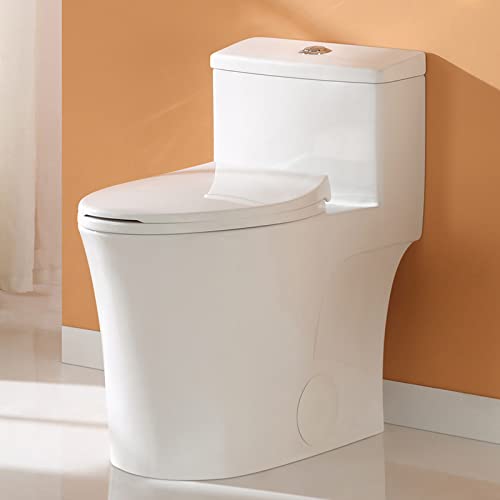
Badge: Best One-Piece Power
Strengths
- Stated MaP 1000g behind the full flush — top-level tested power in a one-piece body.
- Dual flush 1.1/1.6 GPF adds a light setting for liquids without touching the tested full flush.
- Skirted, compact, 17.3-inch chair height — the modern format at full specification.
Trade-offs
- The full flush is 1.6 gallons; the tested power comes at the conventional volume.
- One-piece installation weight.
- Light flush is for liquids — power loads belong on the full setting, always.
Key specs
- Format: One-piece, compact skirted
- Bowl: Elongated, ADA chair height 17.3 inch
- Flush: Dual flush 1.1/1.6 GPF, stated MaP 1000g
- Rough-in: 12 inch
- Finish: White, easy clean
The T0338W answers the power buyer who also wants the modern format and the dual-flush economy. Its full flush carries the same top stated score as the guide’s leader — the heaviest standardized load, cleared — delivered here at 1.6 gallons through a one-piece skirted body at chair height. Read the pairing correctly: the tested figure belongs to the full flush, and the 1.1-gallon light flush is the economy setting for liquids. A household that respects that division gets both virtues — proven power when power is needed, thrift the rest of the time — and a household that tries to make the light flush do the full flush’s work will manufacture the very disappointment this keyword fears. The mechanism is honest; the usage must be too.
Against its single-flush sibling at the top of the guide, the trade is format and flexibility against simplicity and a lower full-flush volume. The T0338W’s skirted body is the easiest here to keep clean, its one-piece casting removes the tank joint, and its chair height matches the tallest two-piece picks. Its costs are the one-piece lift at installation and a full-flush figure at the federal maximum rather than the efficiency threshold. For the renovator building a bathroom around a single considered purchase, it is the most complete power package in the guide; for the pure evidence-per-gallon calculation, the leader still leads.
Best for: Renovators wanting tested power in a modern one-piece dual-flush body / Not suited for: Buyers who want the tested score at a 1.28-gallon full flush

DeerValley Compact One Piece Toilet
Badge: Best Compact Power
Strengths
- Flush characterized in its verified data as powerful and quiet — the two qualities small homes need together.
- Dual flush 1.1/1.6 GPF in a compact skirted body for small bathrooms.
- Standard height suits mixed households and children.
Trade-offs
- “Powerful” here is the manufacturer’s description, not a published test score — the softest evidence tier among the one-piece picks.
- Standard height only.
- Compact bowl proportions.
Key specs
- Format: One-piece, compact, skirted
- Bowl: Standard seat height
- Flush: Dual flush 1.1/1.6 GPF, powerful and quiet (as described)
- Rough-in: 12 inch
- Intended fit: Small bathrooms
The DeerValley closes the list with the evidence hierarchy applied to itself, because its power claim arrives as a description in its own data — powerful and quiet — rather than as a score. This guide attributes it exactly that way, and then adds the context that makes the description plausible rather than empty: it is a purpose-built dual-flush one-piece whose full setting deploys the conventional 1.6-gallon volume through a compact siphonic body, a recipe with no inherent power deficit. In its intended setting — the small bathroom, the en-suite, the apartment — the quiet half of its description may matter as much as the powerful half, because a compact home hears every flush through the wall.
Its buyer is the small-space owner whose drains are ordinary and whose loads are ordinary, and who needs the power question answered adequately rather than maximally. That buyer gets a skirted, easy-clean, dual-flush toilet whose manufacturer stakes its description on the flush. The buyer with a difficult drain run should not mistake the description for the documentation the HOROW models provide — the hierarchy in this guide exists for exactly that discrimination, and the compact pick’s honesty about its tier is a reason to trust the rest of its specification.
Best for: Small bathrooms needing adequate, quiet power with dual flush / Not suited for: Difficult drains where only a published score should decide
Comparison Table
| Model | Power evidence | Flush | Format | Link |
|---|---|---|---|---|
| HOROW 17 Inch (single) | Stated MaP 1000g | 1.28 GPF | Two-piece, 17 inch | Check on Amazon |
| Garvee Two Piece | No score or mechanism stated | 1.28 GPF | Two-piece, 15 inch | Check on Amazon |
| IDEALHOUSE 17 Inch | Siphonic jet stated | 1.28 GPF | Two-piece, 17 inch | Check on Amazon |
| American Standard Cadet PRO | Trade-line reputation, full volume | 1.6 GPF | Two-piece, Right Height | Check on Amazon |
| HOROW T0338W | Stated MaP 1000g | Dual 1.1/1.6 GPF | One-piece skirted, 17.3 inch | Check on Amazon |
| DeerValley Compact | Described as powerful and quiet | Dual 1.1/1.6 GPF | One-piece compact | Check on Amazon |
How to Choose a Low Flow Toilet With Enough Power
Buy the evidence in order. First, look for a published standardized performance score and treat the top figures as the category’s gold standard — they are produced by a defined test with defined loads, which makes them the only power claims in this market that two competing brands cannot both exaggerate. Second, if no score is published, look for the mechanism by name: a siphonic jet, a directed rim system, a glazed trapway — engineering you can reason about. Third, discount bare adjectives to their proper value, which is near zero, and treat brand reputation as the tiebreaker it is rather than the argument it pretends to be. This hierarchy, applied ruthlessly, will sort any shelf or product page in minutes, and it is the entire method behind this guide’s ranking.
Then audit your own plumbing with equal honesty, because power is a system property. How long is the horizontal run from this bathroom to the main stack or septic line, and does it hold its slope? Homes built or re-piped in recent decades generally transport waste easily at modern volumes. Older homes may have runs that sag between hangers, rough cast-iron interiors that grip waste, or repairs that introduced flat spots — and in those homes the water itself is part of the transport machinery, which argues for the strongest documented flush and, often, for correcting the run as part of the renovation. A camera inspection is the definitive answer and is worth its cost when a bathroom is already open; short of that, a history of slow clearing in the old toilet — especially one that worsened gradually — is the drain telling you its condition. Match the strongest evidence to the weakest plumbing, and the combination will serve. The extended treatment of exactly this matching problem is Best Low Flush Toilets, which approaches power from the general low-flush angle.
Finally, size the household’s reality into the choice: heavy family use argues for the scored single flush’s indifference to habits; a dual-flush power model demands the full-button discipline for solids that this guide has repeated deliberately. Power bought and then misused through the light setting is the most common way this category disappoints, and it is a usage failure wearing a product failure’s clothes.
How Power Is Delivered — and How to Keep It
A gravity flush is a race run in about two seconds. The flush valve opens wide and drops the tank’s water fast; speed, not volume, is what the trapway feels. Part of the flow sheets through the rim to wash the walls; part fires through the jet to start the siphon; the siphon then does the heavy work as a continuous pull, emptying the bowl as one event before the refill restores the water spot. Every element of that sequence has a maintenance shadow. A fill valve that leaves the tank level low shortens the race. Rim and jet outlets narrowed by mineral scale slow the delivery the design counted on. A worn flush seal that leaks between uses drops the starting level invisibly. The powerful toilet of year one becomes the mediocre toilet of year five through these small decays, and every one of them is reversible with the routine below.
Set the toilet up for power at installation: confirm the tank water level sits exactly at the manufacturer’s marked line, run the flush repeatedly, and confirm the bowl empties decisively and refills to a full spot each time. Thereafter, the annual ritual is short — lift the lid, check the level, watch one flush with the lid off to see the delivery’s vigor, feel for a fill valve that cycles when nobody has flushed, and descale the outlets gently in hard-water homes before the swirl visibly weakens. Keep chemical drop-in tablets out of the tank; they trade seal life for a blue tint, and a leaking seal is a power leak. That is the whole covenant: the manufacturer engineered the event, and the owner preserves the conditions it was engineered for.
Problem: The flush was strong when installed and has faded over a year or two. → what to do: This is the classic maintenance pattern, not a failing toilet. Check the tank level, then clear mineral scale from the rim and jet outlets, then confirm no slow seal leak is lowering the starting level between flushes. Performance returns with delivery speed.
Problem: The bowl clears but waste seems to stall further down the line. → what to do: That is drainline carry, not bowl power. Confirm nothing else on the run has changed, have the line checked for sag or obstruction if the pattern repeats, and read the drainline-focused companion guide linked from this article — the toilet has done its documented half of the job.
Problem: Solids remain when the light flush is used on a dual model. → what to do: That is correct behavior being misapplied — the light flush is engineered for liquids. Use the full, tested flush for solids every time; the saving survives easily, because liquid flushes dominate the count.
Pressure-Assist, Vacuum and Other Power Routes — Why This Guide Stays With Gravity
Thorough power shoppers will meet two alternative technologies and deserve a straight account of why neither displaces the gravity picks here. Pressure-assist toilets store supply-line pressure in a sealed vessel and release it as a blast that clears with undeniable force at low volumes. Their costs are a flush that announces itself through the whole house, more specialized internals, and a ownership profile better suited to commercial washrooms than to an en-suite at night. Vacuum-assist designs pull from the trapway side and are quieter, but they occupy a thin slice of the residential market with correspondingly thin parts support. Gravity siphonic design, by contrast, now posts top standardized scores at efficient volumes — as two picks in this guide document — while remaining the quietest, simplest and most serviceable mechanism in the category. When the mainstream technology demonstrably meets the requirement, the specialist technologies become answers to narrower questions: extreme commercial loads, unusual drain geometry, a plumber’s specific recommendation for a specific house. For the residential power buyer this keyword describes, the scored gravity toilet is not the compromise choice; it is the mature one. Canadian readers, whose market applies its own efficiency labeling, will find the cross-border notes in Best Low Flush Toilets Canada relevant to the same decision.
Three Households, Three Right Answers
Abstract hierarchies become concrete when they meet real plumbing, so consider the three households this keyword most often describes. The first is the older home with original drains: a long run to the street, cast-iron interiors roughened by decades, and a history of the old toilet clearing slowly on bad days. This household’s risk is transport, not volume, and its correct purchase is the strongest documented bowl event — a top-scored model — paired with a camera inspection of the run while the renovation budget is open. If the inspection finds a sag, the honest project is toilet plus pipe correction, and the household that does both will wonder why it tolerated the old arrangement for years. The second household is the new-build or recently re-piped home, where the drains are smooth, sloped and short. Its risk is nearly zero, and its correct purchase is freedom: any pick in this guide will clear, so the choice should be made on height, format and the dual-flush economy. Spending this household’s money on maximum documented power buys insurance against a risk it does not carry.
The third household is the large family in an ordinary home, whose challenge is neither pipe nor pitch but throughput — many flushes, heavy loads, children whose paper habits are a work in progress. Its correct purchase is the scored single flush, because its guarantee is indifferent to who flushes and how, and its maintenance conversation is with the adults: keep the level at the mark, keep a closet auger in the closet, and teach the full-flush habit where a dual model is installed instead. Notice what the three cases share: in none of them is the answer “the most water available,” and in none of them is it “the least water regardless of evidence.” Power, properly understood, is the match between a documented flush and a described drain — and the households that make that match stop thinking about their toilet entirely, which is the only verdict that matters.
What a Plunger and an Auger Can Tell You
Before any purchase, the humble tools already in most homes offer a free diagnostic that this guide recommends running honestly. If a plunger reliably restores a slow toilet in one or two attempts and the pattern recurs only with the heaviest loads, the story is usually marginal clearing at the fixture — exactly the weakness a documented, test-scored replacement addresses. If the plunger merely pushes the problem around, or a closet auger through the trapway finds nothing while the slowness persists, the resistance lives beyond the fixture, in the run, and the money belongs in inspection rather than in porcelain. Note, too, what the auger brings back: paper and ordinary waste suggest load and clearing; fragments of scale suggest the pipe’s interior; anything fibrous and intact suggests the wipes conversation needs to happen in the household regardless of what anyone believes they flush. Diagnosis is not a delay to the purchase — it is what makes the purchase the last one. The households that end up owning the right powerful toilet are usually the ones that spent twenty minutes learning which problem they actually had, and this guide’s hierarchy is designed to be applied after that twenty minutes, not instead of it.
Power for Guests, Children and Real Life
One audience tests flush power more honestly than any laboratory: the people in your home who did not read the manual. Guests press whatever presents itself, children use paper with a generosity no engineer budgets for, and the half-asleep make no mechanical allowances at all. This is the practical argument for the scored single-flush leader in this guide — its tested event is the only event it has, delivered identically to the careful and the careless alike. Dual-flush power models ask one thing of this audience, that solids take the full button, and the households that thrive with them are the ones that make that single rule socially automatic: mentioned once, modeled always, and designed for by choosing the clearest actuator available. Judge your own household’s reality on this point before purchase, because the most powerful toilet in the guide is the one whose power survives contact with everyone who will ever use it — and that survival is a property of the household as much as of the porcelain.
Common Buying Mistakes
The first mistake is buying volume as a proxy for power
— choosing the 1.6-gallon model on the theory that more water must clear better, when the test data in this guide shows a 1.28-gallon model clearing the heaviest standardized load. Volume is consumption; delivery is power; the score measures the second, not the first. The second mistake is the inverse: buying the lowest volume with no evidence behind it for a house whose drains needed the documented flush. Third, blaming the toilet for the drainline — replacing fixture after fixture while a sagging run defeats each in turn. Diagnose the system before iterating the product.
Fourth, misusing a dual-flush power model through its light setting and concluding the category is weak. Fifth, letting maintenance quietly repeal the purchase: a low tank level and scaled jets will humble any toilet on this page within a few years, and the five-minute annual check is the entire premium on the insurance. Sixth, over-tightening or under-seating the installation and chasing the resulting rock and seep as if they were flush problems — set the toilet level, sealed and at its marked water line, and judge its power only from that honest baseline.
Final Recommendation
Buy the evidence: the HOROW 17 Inch High Elongated Toilet pairs the top published performance score with the efficient 1.28-gallon volume and full power on every flush, and it is this guide’s answer for the power-first household. If you want the same tested score in a modern skirted one-piece with a dual-flush economy for liquids, the HOROW T0338W One Piece Toilet is the complete alternative. Chair-height buyers on a value tier should take the IDEALHOUSE ADA Compliant 17 Inch Elongated Toilet and its named siphonic jet, brand-loyal buyers the Cadet PRO with eyes open about its volume, small bathrooms the DeerValley, and easy houses on strict budgets the Garvee. Whichever you choose, set the water line, keep the outlets clear, and match the toilet to your drains — power, treated as a system, will not let you down.
Frequently Asked Questions
What is a MaP score and why does 1000g matter?
MaP is a standardized bulk-removal test: toilets must clear measured loads of simulated solid waste, and the score states the heaviest load — in grams — the toilet cleared completely in testing. A score of 1000 grams is the top of the scale used in this guide’s data, which makes it the strongest public evidence that a low-volume flush genuinely has enough power. It measures the bowl’s clearing; your drain run’s condition governs what happens next.
Can a 1.28 GPF toilet really be powerful enough?
Yes — the scored models in this guide prove it at the heaviest test load. Power comes from delivery speed, jet placement and trapway shape. A fast, coherent 1.28 gallons establishes a siphon that pulls the bowl empty decisively, while a slow, disorganized larger volume can merely swirl. Judge by the published score and mechanism, not by the gallon figure, which measures consumption rather than capability.
Why does my low flow toilet clog when my old one did not?
Work through the system before blaming the volume: tank level below its mark, rim or jet outlets narrowed by scale, a worn seal leaking the starting level down, or a drain run whose sag the old toilet’s extra water was masking. The first three are maintenance, fixable in minutes. The fourth is plumbing, and the honest fix is the run itself — after which the modern toilet will perform as its test data promises.
Is pressure-assist more powerful than these gravity toilets?
Pressure-assist delivers a forceful blast and clears extremely well, at the cost of considerable noise and more specialized parts. The gravity models here post top standardized scores at the same efficient volumes while staying quiet and conventionally serviceable, which is why this guide recommends them for homes. Pressure-assist remains a legitimate specialist option for unusual drains or commercial settings, ideally on a plumber’s advice for your specific house.
How far will a low flow flush carry waste through my drains?
Carry distance depends on the run’s slope, diameter, interior condition and the flush’s volume and coherence — which is why this guide treats bowl clearing and drainline carry as separate questions and devotes a companion analysis, Best Low Height Toilets, to the household-fit side of the same system. In a sound, properly sloped run, a test-scored low-flow flush transports waste without drama. In a sagging or rough run, correct the pipe; no toilet specification fully compensates for geometry.
Does a bigger tank mean a stronger flush?
No. Tank size in a modern toilet is about storing the rated volume, and flush strength comes from how fast and how well-aimed the release is. Efficiency-era tanks are smaller because the volumes are smaller, while their flush valves open wider and their jets are better placed. The result, documented by the scores in this guide, is that the smaller-tanked modern toilet routinely out-clears the large-tanked designs it replaces.
What maintenance keeps a low flow toilet powerful?
Four habits: keep the tank water level at its marked line; keep rim and jet outlets free of mineral scale, especially in hard-water homes; replace a worn flush seal at the first sign of the fill valve cycling unprompted; and keep chemical drop-in tablets out of the tank. Together they preserve the delivery speed the power was engineered around — which is to say, they preserve the power itself.