Disclosure: topratedkitchenware.com is reader-supported. When you buy through links on our site, we may earn an affiliate commission from Amazon and other retailers, at no extra cost to you.
Where to buy
The best made stainless steel kitchen sinks are the ones whose steel you can specify to the gauge, whose corners and floors are finished for cleaning and drainage, and whose sound treatment was fitted in the factory rather than promised in an advertisement. Four of the six sinks below meet that standard in stainless steel and are linked for purchase. Two further sinks — fireclay farmhouse models that appear in many shoppers’ comparisons — are reviewed in full but deliberately left unlinked, because this guide’s promise is stainless steel and we will not sell you ceramic under a steel headline. Check the latest price on Amazon for the linked picks, and read the full guide ↓ for the reasoning.
- Oxwiser Kitchen Sink 30×18 Inch Undermount, 16 Gauge Single Bowl Bundle — Check on Amazon
- Delironexu 30 Inch Undermount Kitchen Sink, 18 Gauge Handmade, Drain Kit Included
- Oxwiser Kitchen Sinks 32×18 Inch Undermount, 16 Gauge Single Bowl Bundle
- KRAUS KHU640-33 Stainless Steel 33 in 18 Gauge Undermount Kitchen Sink
- Miuara Farmhouse Sink 30 x 18 Inch White Fireclay — reviewed below, prose-only (fireclay, not stainless steel)
- Miuara Farmhouse Sink 33 x 18 Inch White Fireclay — reviewed below, prose-only (fireclay, not stainless steel)
Stainless steel won the kitchen sink category so completely that “best made” and “stainless” are nearly synonyms in most buyers’ minds — and there are good reasons for the dominance. Steel is strong at low weight, immune to rust when the grade is right, tolerant of thermal shock that would crack ceramic, repairable in appearance through its brushed grain, and formable into everything from pressed bowls to fabricated workstation systems. But dominance has a downside: because every maker works in the same material, the differences between a superb steel sink and a mediocre one are invisible in photographs. They live in the gauge, the grade, the corner radius, the floor’s fall and the underside’s treatment — the specification, not the silhouette.
This guide therefore reads like an inspection report. Four stainless sinks are ranked on the evidence of their making. Then, because so many shoppers cross-compare steel against the white farmhouse alternative, we review the two fireclay sinks that dominate that comparison — in full, with their genuine strengths stated plainly — while keeping them unlinked and clearly labelled, so this page never pretends they are something they are not. If you finish the guide and decide fireclay is actually your material, you will know exactly why, and our companion on Best Material For Kitchen Sinks will help you pursue it honestly.
A word about what this guide counts as evidence, since the whole ranking stands on it. Every claim in the reviews below traces to verified product data: a gauge printed in a listing, a feature named by its maker, a component listed in a box. Where that data ends, the review stops — you will find no invented depths, no borrowed specifications from a sibling model, no acoustic claims for sinks whose listings do not make them. That restraint is deliberate, and it is also the buyer’s best tool: a shortlist built only on checkable claims can itself be checked, line by line, before a single dollar moves. We would rather hand you four verified steel sinks and two honestly labelled alternatives than six links and a fog of adjectives, because the first kind of guide is the only kind that survives contact with your own tape measure, your own knuckles and your own kitchen.
Key Takeaways
- Four stainless picks are linked; the two fireclay farmhouse sinks are reviewed prose-only because they fail this keyword’s core material requirement.
- 16-gauge steel (both Oxwiser bundles) is the making standard here; 18-gauge picks trade some mass for width or handmade lines.
- Bundled grids and drains are part of a steel sink’s real-world quality — the Oxwiser sets include them, made to fit, which removes the most common way a good bowl gets undermined by mismatched parts bought separately in a hurry.
- Kraus’s finishing trio — rounded corners, channel grooves, NoiseDefend pads — is the benchmark for pressed-steel refinement at 33 inches.
- Handmade fabrication (Delironexu) delivers crisp lines and a deep 9-inch bowl at the accessible tier of the steel market overall today, without apology whatsoever.
- Fireclay’s glaze out-resists steel on stains — which is precisely why it is reviewed honestly here instead of being silently excluded, and why readers who conclude for fireclay can do so with the same quality of evidence as readers who conclude for steel.
In this guide
Quick Picks
| Pick | Badge | Why it is here | Link |
|---|---|---|---|
| Oxwiser 30×18 Bundle | Best Overall | 16-gauge steel with grid, drain assembly, cap and towel included | Check on Amazon |
| Delironexu 30 Inch Handmade | Best Handmade | Handmade lines, deep 9-inch bowl, drain kit included | Check on Amazon |
| Oxwiser 32×18 Bundle | Best Large Bundle | The complete fitted system at 32 inches | Check on Amazon |
| KRAUS KHU640-33 33 in | Best Wide Stainless | Rounded corners, grooves and NoiseDefend at maximum width | Check on Amazon |
| Miuara Farmhouse 30 x 18 | Best Fireclay Alternative (Prose-Only) | Stain-proof glaze for shoppers reconsidering material | See review below |
| Miuara Farmhouse 33 x 18 | Best Large Fireclay Alternative (Prose-Only) | The wide farmhouse version of the same glaze | See review below |
Read the table’s last column as carefully as its first: four links and two honest “prose-only” labels are this guide’s thesis in miniature. A shortlist you can trust is not one that links everything it mentions, but one that links exactly what fits its promise — stainless steel, well made, verified — and tells you plainly when a good product belongs to a different promise. The reviews below apply that standard pick by pick, steel first, alternatives after, with the evidence for every badge shown rather than asserted.
How These Picks Were Chosen
The method mirrors the keyword: first, material discipline. Only stainless steel sinks qualify for links in a guide to the best made stainless steel kitchen sinks, which is why the two fireclay models — however well made on their own terms — are prose-only. Second, making evidence: stated gauge, declared features, included components and construction method, all taken from verified product data, with silences noted rather than filled. Third, the ownership lens: corners, drainage and sound treatment were weighted because they decide how a steel sink behaves across a decade, not a photoshoot.
We make no hands-on testing claims; these are specification judgements, and the reasoning is shown in each review so you can disagree with our weights and still use our evidence. For the undermount-only cut of this same category, see Best Made Stainless Steel Undermount Kitchen Sinks; for the grade-and-gauge science underneath everything here, see Best Material For Stainless Steel Kitchen Sinks.
The 6 Best Made Stainless Steel Kitchen Sinks (and Two Honest Alternatives)

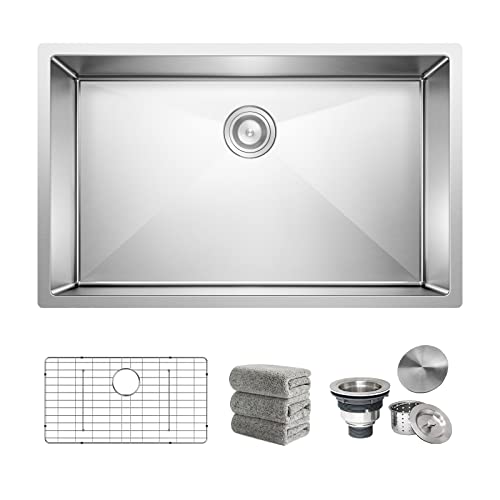
Oxwiser Kitchen Sink 30×18 Inch Undermount Bundle
Badge: Best Overall
Strengths
- 16-gauge stainless steel in the category’s standard footprint — the thickness that defines well-made in this class.
- Five-item bundle (sink, bottom grid, drain assembly, drain cap, towel): the accessories that protect steel, made to fit it.
- Single-bowl undermount format keeps installation and daily cleaning simple.
Trade-offs
- No sound-pad specification appears in the verified data, so we claim nothing for its acoustics.
- The bundle suits one-decision buyers more than component collectors.
- Standard 30-inch width; wide-pan cooks should look at its 32-inch sibling.
Mini spec box: Size: 30 x 18 inch · Mount: undermount · Material: stainless steel · Gauge: 16 · Bowl: single · Bundle: sink, bottom grid, drain assembly, drain cap, towel.
A stainless sink’s making is only half the product; the other half is everything that touches the steel for the next decade. The Oxwiser bundle is this guide’s top pick because it is the only entry that specifies both halves in one box. The bowl meets the central standard — 16-gauge steel, single bowl, undermount — and then the maker closes the loop: a bottom grid sized to the floor so pans never scar it, a drain assembly and cap made for the outlet so nothing sits slightly wrong and corrodes at the seam, even a towel for the drying habit that keeps brushed steel bright. Most “well-made” sinks are well-made components; this one is a well-made system.
It is also the lowest-risk purchase in the guide for a first-time renovator, because it removes the compatibility lottery entirely. If your definition of quality includes never having to think about the sink again after install weekend, this is the specification that delivers it.
Best for: renovators who want the complete, fitted, 16-gauge system in one purchase / Not suited for: buyers who already own accessories or need maximum width

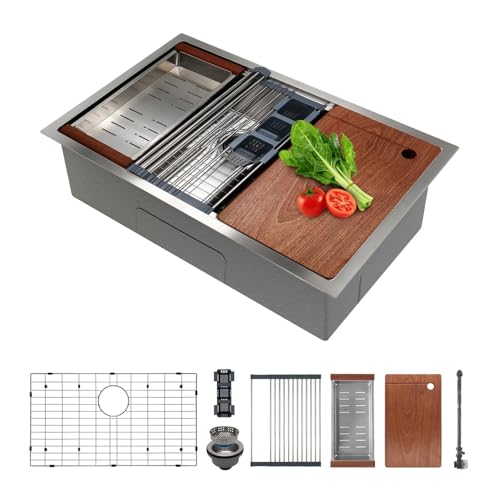
Delironexu 30 Inch Undermount Kitchen Sink, Handmade
Badge: Best Handmade
Strengths
- Handmade fabrication: folded and welded sheet gives the crisp planes pressed bowls cannot copy.
- Deep, generous proportions — 30 x 18 x 9 inches — in the standard width.
- Drain kit included, and the listing honestly states that no additional accessories are bundled.
Trade-offs
- 18-gauge steel concedes mass to the 16-gauge bundles.
- Tighter handmade corners need a slightly more deliberate wipe.
- No grid included; floor protection is an extra step.
Mini spec box: Size: 30 x 18 x 9 inch · Mount: undermount · Material: stainless steel · Gauge: 18 · Bowl: single · Included: drain kit (no additional accessories) · Style: handmade, brushed finish.
Where the Oxwiser argues for the system, the Delironexu argues for the object. Handmade stainless is a genuinely different product from pressed stainless: the fabricator’s folds create the sharp-shouldered, architectural bowl that defines the contemporary steel sink, and the 9-inch depth gives that geometry real working volume. The brushed finish is the correct choice for the format, letting fine daily wear blend into the grain instead of announcing itself. Even the listing’s plain-spoken note — drain kit included, no additional accessories — reads as a maker’s honesty about what is and is not in the box.
Accept the 18-gauge trade knowingly and this is the character pick of the guide: the sink for a buyer who can see the difference between a drawn bowl and a fabricated one, and wants the fabricated one on the accessible tier of the market.
Best for: design-led buyers who value handmade steel and a deep bowl / Not suited for: maximum-thickness purists

Oxwiser Kitchen Sinks 32×18 Inch Undermount Bundle
Badge: Best Large Bundle
Strengths
- The same 16-gauge, five-item fitted system as the top pick, at a 32-inch width.
- The fitted grid matters most exactly here — a wide steel floor is the largest scratch canvas in the category.
- Single purchase, standard undermount format, no compatibility gambles.
Trade-offs
- Requires a cabinet run that accepts 32 inches.
- No verified sound-pad claim, as with its sibling.
- Bundle completeness is wasted on buyers with accessories already in hand.
Mini spec box: Size: 32 x 18 inch · Mount: undermount · Material: stainless steel · Gauge: 16 · Bowl: single · Bundle: sink, bottom grid, drain assembly, drain cap, towel.
Scale changes the making problem. A 32-inch steel floor flexes more, shows more and scratches across a wider canvas than a 30-inch one, so the wide version of a sink is where complete systems earn their keep. Oxwiser’s answer is to keep everything that made the smaller bundle this guide’s leader — the 16-gauge shell, the fitted grid standing guard over that broad floor, the matched drain hardware — and simply build it bigger. The consistency is itself the quality signal: the same specification discipline, applied at the harder size.
If your cabinets allow the width and your cookware demands it, this is the large steel sink we would buy with the fewest second thoughts. Readers comparing wide options across the modern category will also find it discussed among Best Modern Kitchen Sinks.
Best for: wide kitchens wanting the fitted 16-gauge system at full size / Not suited for: standard 30-inch cabinets

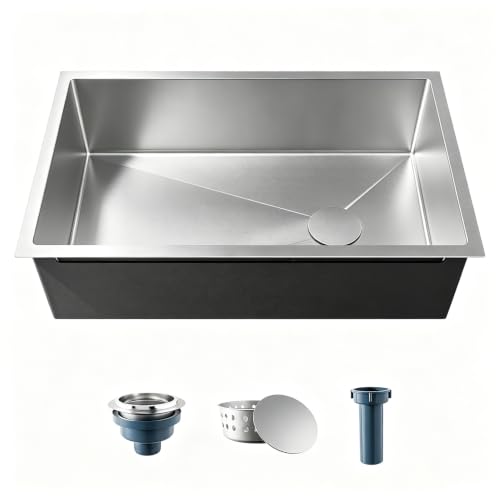
KRAUS KHU640-33 Stainless Steel 33 in Undermount Kitchen Sink
Badge: Best Wide Stainless
Strengths
- Rounded corners that resist buildup and channel grooves that keep a broad floor draining — finishing, not just forming.
- NoiseDefend pads tame the acoustics of the widest steel surface in the guide.
- A fully declared specification from an established maker.
Trade-offs
- 18-gauge steel: at 33 inches, plan on a grid and treat heavy cast iron with respect.
- No accessories are listed in the verified data.
- The width is a hard cabinet constraint.
Mini spec box: Size: 33 inch · Mount: undermount · Material: stainless steel · Gauge: 18 · Bowl: single · Features: rounded corners, channel grooves, NoiseDefend pads.
The KHU640-33 is the finishing school of this guide. Its steel is not the thickest here, and the review will not pretend otherwise — but making is more than one number, and no pick in this list finishes a bowl better. The rounded corners eliminate the grime seam across the widest span in the category; the channel grooves give that broad floor a drainage agenda; the NoiseDefend treatment keeps 33 inches of steel from behaving like a sail in a gale of tap water. Kraus has essentially spent its budget on the last five percent of every surface, which is where ownership is actually lived.
Pair it with a well-fitted grid and it becomes the wide-kitchen connoisseur’s pick: maximum working width, minimum daily friction, and a specification you can verify line by line. The metal question it raises — how much gauge is enough at this span — is explored further in Best Metal For Kitchen Sinks.
Best for: wide kitchens prioritising finish, drainage and quiet / Not suited for: buyers who rank raw thickness above all else
Miuara Farmhouse Sink 30 x 18 Inch White Fireclay (Prose-Only)
Badge: Best Fireclay Alternative (Prose-Only)
Strengths
- Fireclay’s fired glaze resists stain, crack, heat and scratch in ways no steel finish can match.
- Reversible apron-front design with a classic farmhouse presence.
- Food pigments rinse off the glaze instead of shadowing it.
Trade-offs
- It is not stainless steel — the disqualifying fact for this guide’s links, stated plainly.
- Heavy ceramic; apron-front installation is a cabinet project.
- White shows splashes until wiped.
Mini spec box: Size: 30 x 18 inch · Mount: apron front (also drop-in/undermount per listing) · Material: fireclay · Bowl: single, reversible · Surface: glazed white. · Status: prose-only — no link, no image, because the material does not match this guide’s stainless steel brief.
Why review a sink we refuse to link? Because thousands of shoppers arrive at a stainless shortlist carrying a photograph of a white farmhouse kitchen, and they deserve an honest account of what that photograph offers. The Miuara’s glaze is a genuinely superior surface against staining — the curry, berry and tomato tests that shadow steel simply rinse away — and its ceramic mass has a solidity steel cannot imitate. If those virtues outrank everything else for you, this is a well-made sink of its kind.
But kind is the operative word. This guide promised the best made stainless steel kitchen sinks, and a link is an endorsement of fit between product and promise. Fireclay belongs to a different shortlist — one organised by material rather than by steel-making — so we describe it fully, praise it accurately, and leave the purchasing link off. That discipline is what makes the four links above worth trusting.
Best for: shoppers who discover, reading this, that material mattered more to them than steel / Not suited for: anyone committed to a stainless brief — choose from the four linked picks instead
Miuara Farmhouse Sink 33 x 18 Inch White Fireclay (Prose-Only)
Badge: Best Large Fireclay Alternative (Prose-Only)
Strengths
- The same stain-, crack-, heat- and scratch-resistant glaze across a wider apron front.
- Wide single bowl takes large cookware flat; shorter reach across the apron.
- Reversible front keeps the styling decision open until install.
Trade-offs
- Fireclay, not stainless steel — prose-only here for the same material reason.
- The heaviest installation proposition in this guide.
- Needs a farmhouse cabinet setup at 33 inches.
Mini spec box: Size: 33 x 18 inch · Mount: apron front (also drop-in/undermount per listing) · Material: fireclay · Bowl: single, reversible · Surface: glazed white. · Status: prose-only — no link, no image (material mismatch with this guide’s stainless steel brief).
The 33-inch Miuara scales the fireclay argument to the kitchens where farmhouse sinks look most at home. Everything in the smaller model’s review holds — the glaze’s stain immunity, the ceramic presence, the installation commitment — with the practical addition that sheet pans and roasters lie flat and the apron front shortens the working reach. As a piece of making in its own material, it is accomplished: a large ceramic bowl is a demanding object to fire, glaze and ship, and the reversible design shows a maker thinking about installers as well as owners.
None of which changes the one fact this guide is organised around: it is not stainless steel. It stands here, fully reviewed, as the strongest version of the alternative — so that if you leave this page for fireclay, you leave informed rather than tempted, and if you stay for steel, you stay having seen the best case against it.
Best for: large farmhouse renovations weighing fireclay against steel / Not suited for: stainless briefs, quick swaps, or unmodified cabinets
Comparison Table
| Pick | Material | Size | Gauge / Surface | Making signature | Link |
|---|---|---|---|---|---|
| Oxwiser 30×18 Bundle | Stainless steel | 30 x 18 in | 16 gauge | Complete fitted bundle | Check on Amazon |
| Delironexu Handmade | Stainless steel | 30 x 18 x 9 in | 18 gauge | Handmade fabrication | Check on Amazon |
| Oxwiser 32×18 Bundle | Stainless steel | 32 x 18 in | 16 gauge | Fitted system at width | Check on Amazon |
| KRAUS KHU640-33 | Stainless steel | 33 in | 18 gauge | Corners, grooves, NoiseDefend | Check on Amazon |
| Miuara 30 x 18 | Fireclay | 30 x 18 in | Glazed | Stain-proof glaze | Prose-only |
| Miuara 33 x 18 | Fireclay | 33 x 18 in | Glazed | Wide farmhouse glaze | Prose-only |
How to Choose a Well-Made Stainless Steel Sink
Begin with the two numbers that define a steel sink’s making: gauge and, where stated, grade or trade specification. Gauge runs backwards — lower is thicker — and in this guide’s landscape 16 gauge is the premium standard, 18 gauge the lighter tier that buys width or handmade lines, and anything unstated is a question to ask rather than a risk to take. Then inspect the finishing evidence: rounded corners for cleaning, a floor that falls and ideally grooves toward the drain, and sound treatment fitted underneath. Finally, count what is in the box. A grid and drain made for the bowl convert a good component into a good product, and their absence is a cost — in money and in fit — that belongs in your comparison even though it never appears in a headline.
Material discipline comes last, and it is the lesson of this guide’s two prose-only guests: know which material your brief actually requires. Stainless steel offers the best combination of strength, weight, repairability of appearance and format variety currently made; fireclay offers a superior stain-proof surface at the price of weight and installation commitment. Either can be the right answer — but they are different answers, and a well-made purchase starts with not confusing them.
One further check belongs in every steel comparison and rarely appears in one: the replacement horizon. Standard sizes and standard mounts — the profile of every linked pick here — mean that grids, drains and eventually the sink itself can be replaced decades from now without touching counters or cabinets. An exotic format, however beautifully made, mortgages that future. Well-made is partly a property of the object and partly a property of the standards it obeys, and the boring virtue of standard dimensions has saved more kitchens more money than any finish ever invented.
How to Verify a Steel Sink’s Making on Arrival
- Weigh it against its claim. Within a size class, the heavier bowl is usually the thicker one; a sink that feels suspiciously light for its stated gauge deserves scrutiny before install.
- Read the corners with a fingertip. Consistent radius, all the way around, on every corner — consistency is the fingerprint of controlled making.
- Test the floor with water. A splash should travel to the drain unaided. Ponding in a new sink is a level problem or a floor problem, and both are easier to address before mounting.
- Look underneath. Sound pads should be broad, even and firmly bonded. Peeling corners on day one predict a loud year three.
- Fit every bundled part dry. Grid flat, drain seated, cap true. The bundle’s promise is fit; verify it while verification is free.
Troubleshooting. Problem: the bowl drums under the tap despite sound pads → what to do: check clip tension on all sides; uneven mounting defeats factory dampening. Problem: fine lines appear across the grain after cleaning → what to do: someone is wiping across the brushing; switch to grain-direction cleaning with a soft cloth and the marks will stop accumulating. Problem: the grid leaves faint marks where its feet rest → what to do: ensure the feet’s protective caps are intact and lift the grid during weekly cleaning so trapped grit is not ground into the floor.
Why Two Fireclay Sinks Are Reviewed in a Stainless Guide
Because that is where shoppers actually meet them. The search journey for a steel sink crosses the farmhouse display in every showroom and the white apron front in every photograph, and a guide that ignored the alternative would leave its readers to evaluate that alternative from advertisements. So we evaluated it here, under the same lights: fireclay’s glaze is a real and durable advantage against staining; its weight and installation demands are real costs; and its absence from this guide’s links is a matter of category honesty, not quality judgement. If your project concludes for fireclay, the material comparison at Best Materialfor Kitchen Sinks continues the discussion in the open, and you will go there knowing the two best current examples by name.
The Anatomy of a Well-Made Steel Bowl, Part by Part
Take the bowl apart in your mind and judge each part on its own evidence, the way this guide judged the six picks. The flange first: it is the sink’s handshake with the countertop, and a well-made one is flat, clean-edged and consistent in width, because every millimetre of waviness becomes a sealant negotiation on install day. The walls second: they should meet the floor and the rim in transitions that feel intentional — the pressed Kraus bowls round them for cleaning, the handmade Delironexu folds them for architecture — but in neither case should a fingertip find a random ripple or a soft, uneven patch. The floor third: it must fall. A well-made floor is a quiet piece of engineering, sloped and often grooved so that water’s path to the drain is the path of least resistance; stand a new bowl on a level surface, pour in a cup of water, and a good floor empties itself while a bad one keeps a souvenir.
The drain opening fourth: it is the most standardised point on the sink and therefore the least forgivable to get wrong — a true, cleanly finished opening accepts the drain assembly with a seat you can feel, while a sloppy one leaves the assembly sitting on hope and plumber’s putty. The underside fifth: pads broad and bonded, any coating even, clips and rails of honest stock. And the finish last, because it is the part photography judges and ownership barely does: a consistent brushed grain, running one direction, free of the bright cross-scratches that betray careless handling before the sink ever met a customer. A bowl that passes all six inspections is what this guide means by well made — and it is notable that none of the six requires equipment beyond hands, eyes, a cup of water and thirty seconds of attention.
Steel Sink Care That Protects the Making
A well-made steel sink asks little, but it asks specifically. Rinse after use, and dry when you can: the brushed surface’s only real enemy is evaporated hard water, and the twenty-second dry-wipe defeats it completely. Clean along the grain, always, with soft cloths and ordinary detergent; the grain is a one-way street, and every cross-grain scrub writes a permanent bright line into the finish. Keep the grid in place and lift it weekly — the grid protects the floor only while the grit beneath it is rinsed away, and a neglected grid becomes the very abrasive it was hired to prevent. Treat the drain area kindly: it is the hardest-worked square inch of the sink, the place where assemblies seat and water turns, and a monthly wipe there prevents the dark ring that makes even a fine sink look tired.
What not to do is equally specific. Do not leave wet cast iron or steel wool sitting in the bowl; both can leave rust-coloured marks on stainless that are surface deposits rather than damage, but they frighten owners and stain cloths for weeks. Do not use the bowl as a chemical mixing vessel for drain cleaners and bleach soaks; stainless tolerates a great deal, but finishes and drain seals have limits that have nothing to do with the steel’s quality. And do not judge the sink by its first month’s patina: brushed steel settles, its fine lines evening into the grain until the surface looks less new and more owned — the visual signature, owners of the picks in this guide discover, of a sink that is being used exactly as its maker intended.
What “Stainless” Actually Promises — and What It Does Not
The word stainless is a promise with fine print, and well-made purchases start with reading it. Stainless steel resists rust because its chromium content forms a self-repairing oxide skin; that is why the named grades and trade specifications in this guide matter — they are claims about the alloy that carries the promise. What the promise does not cover is equally important. Stainless can show surface marks from iron-bearing objects left wet against it, tea and coffee staining that sits on the surface rather than in it, and the fine scratching that brushed grain is specifically designed to absorb visually. None of these is the steel failing; all of them are the steel being a real material in a real kitchen, and all of them yield to the rinse-and-dry routine.
The practical consequence for buyers is a kind of calm. You do not need a sink that never marks — no such object exists in any material at any tier — you need a sink whose marks stay superficial, blend into its finish, and never become structural. That is exactly the profile of the four linked picks here: gauges thick enough that damage stays cosmetic, grains that forgive, floors protected by grids, and geometry that never gives grime a permanent address. Judge competing sinks by the same standard and the category becomes refreshingly legible: the question is never “will it mark?” but “what will a decade of marks look like?” — and on that question, well-made stainless has the best answer currently manufactured.
The Decade Test: How These Four Steel Picks Age
Project the linked picks forward ten years, under the care routine this guide describes, and a pattern emerges that no showroom can display. The Oxwiser bundles age slowest where it shows most: their floors, guarded by fitted grids since day one, keep the original brushed depth while the grids themselves — replaceable, remember — carry the decade’s scratches. The Kraus wide bowl ages by never changing its daily behaviour: corners that never held grime still do not, grooves still shepherd water, pads still hush the panels, because none of those virtues is a coating that can wear off. The handmade Delironexu ages into its architecture, its folded planes and brushed grain settling into the soft patina that makes fabricated steel look increasingly like furniture and decreasingly like equipment.
Set against that the counterfactual every experienced renovator knows: the thin, square, flat-floored sink at year ten, its corners permanently shadowed, its floor a map of every pan, its voice louder as its pads peel. The distance between those two futures is not luck, climate or household virtue — it is the specification chosen on one day, years earlier. That is the entire argument of this guide, and it is why the picks were ranked on making rather than on the photographs that will be forgotten by the second month of ownership.
Choosing Between the Four Linked Picks: A Short Decision Walk
With the evidence laid out, the final choice among the four stainless picks reduces to three honest questions, asked in order. First: what does your cabinet allow? Measure the interior of the sink base before anything else, because the answer eliminates by size alone — a 30-inch cabinet story ends at the two 30-inch picks, while a run that accepts 32 or 33 inches opens the wide pair. No specification, however beautiful, survives contact with a cabinet it does not fit, and more sink projects have been ruined by optimism at this step than by every other mistake combined.
Second: what does your cooking do to a sink? Households whose pans are heavy, whose wash-ups are large and whose sink works three shifts a day should weight thickness and floor protection first — which points to the Oxwiser bundles and their fitted grids, in whichever width the cabinet allowed. Households whose cooking is lighter but whose standards for finish and quiet are higher should weight the Kraus wide bowl’s corners, grooves and sound treatment. Households for whom the sink is also a visual object — the tailored centre of a designed kitchen — should let the handmade Delironexu’s fabricated lines argue their case.
Third: how much of the system do you already own? A buyer with a beloved grid, a matched drain and strong opinions about accessories buys a bowl, and the Kraus or Delironexu answers cleanly. A buyer starting from an empty cabinet buys a system, and the bundles’ one-box completeness is worth more than any single specification line in this guide. Ask the three questions in that order — cabinet, cooking, cupboard — and the four linked picks resolve into one obvious name for almost every reader. That is not an accident of this shortlist; it is what a shortlist is for.
Common Buying Mistakes
- Assuming every sink in a “stainless” list is stainless — read materials line by line; this guide labels its exceptions, others may not.
- Comparing gauges without comparing boxes — a bare 16-gauge bowl plus aftermarket parts can cost more and fit worse than a bundled one.
- Letting width outrun the cabinet — 32- and 33-inch picks need the run measured first.
- Scrubbing across the grain, manufacturing scratches no maker can prevent for you.
- Skipping the arrival checks — floor fall, pad bonding and accessory fit are only free to verify before mounting.
Final Recommendation
Buy the Oxwiser 30×18 bundle if you want the most completely made stainless proposition in a standard size — 16-gauge steel with its protective system included and fitted. Step up to the 32-inch Oxwiser bundle when the kitchen allows the width. Choose the Delironexu for handmade character and depth, the KHU640-33 for wide finishing and quiet, and take the two Miuara reviews as an honest signpost: if fireclay’s glaze is what your heart actually wants, follow the material guides linked above rather than forcing a steel purchase you will spend a decade second-guessing.
Whichever name you land on, hold the line on the method that produced this list: stated gauge over adjectives, finishing evidence over photography, the whole box over the bare bowl, and material honesty over category convenience. A sink bought that way stops being a gamble and becomes what the four linked picks already are — a specification you verified, installed once, and then a decade of mornings in which the hardest-working surface in your kitchen simply behaves as its maker promised.
Frequently Asked Questions
Why are two sinks in this guide not linked?
Because they are fireclay, not stainless steel. This guide’s promise is the best made stainless steel kitchen sinks, so the two Miuara farmhouse models are reviewed in full — their glaze is genuinely excellent — but left prose-only, without purchase links or images, rather than being sold under a steel headline. The four linked picks are all verified stainless models. Think of the arrangement as a labelling standard rather than a demotion: the fireclay pair may well be the right sinks for a different kitchen and a different brief, and a reader who wants them can find them by the exact names given in their reviews — what they will not get from this page is a steel guide’s endorsement of a ceramic product.
What gauge is best for a stainless kitchen sink?
For most buyers, 16 gauge is the sweet spot: thick enough for dent resistance, quiet and a solid feel, without the handling weight of extreme gauges. 18-gauge sinks can still be well made — the wide Kraus and the handmade Delironexu in this guide are examples — especially when paired with a bottom grid and sensible treatment of heavy pans. The gauge to be wary of is the unstated one: a maker proud of its steel prints the number, and the absence of a number in a specification is information in itself. When two otherwise equal sinks differ only in that one states 16 and the other says “premium thickness,” believe the number.
Does a bottom grid really protect the steel?
Yes. The grid is a sacrificial, replaceable surface: cookware rests and slides on it instead of the bowl floor, water drains beneath it, and the steel keeps its finish. It is the single most effective accessory for a steel sink, which is why the bundled Oxwiser sets — grid included and fitted — lead this guide.
Is fireclay better made than stainless steel?
It is differently made, with a different virtue profile: a fired glaze that resists stains outright, set against greater weight and a more demanding installation. “Better” depends on whether staining or steel’s combination of strength, lightness and format variety matters more to your kitchen — the reviews above lay out both cases. What can be said without hedging is that the comparison itself is legitimate and common, which is why this guide conducts it in the open: fireclay’s best current examples are reviewed above by name, so a reader who switches materials does so for stated reasons, and a reader who stays with steel has seen the strongest case for leaving.
How can I tell if a steel sink is well made before buying?
Look for a stated gauge, a named steel or trade specification, declared finishing features (corner design, drainage, sound pads) and a clear included-components list. Makers who state numbers are inviting verification; makers who rely on adjectives are asking for faith. The arrival checks in this guide then confirm the paperwork in five minutes. One more tell, easy to overlook: internal consistency. A listing whose title, specification table and box contents all tell the same story — same size, same gauge, same included parts — comes from a maker whose paperwork discipline matches its factory discipline, and in this category the two disciplines are rarely found apart.
Are handmade stainless sinks worth choosing over pressed?
If you value crisp architectural lines and a fabricated feel, yes — handmade construction produces geometry pressing cannot. Pressed heavy-gauge bowls counter with refined drainage and production maturity. This guide includes both because “best made” has two legitimate dialects in steel.