Disclosure: topratedkitchenware.com is reader-supported. When you buy through links on our site, we may earn an affiliate commission from Amazon and other retailers, at no extra cost to you.
Where to buy
The six models below are the verified picks for this guide to the best manufacturer of air fryers. Each name links to its Amazon listing, where you can check the latest price on Amazon and confirm the specifications of the exact variant. The picks are organised as a tour of the major makers, with two manufacturers represented twice so you can see how each brand’s range is built.
- Cuisinart French-Door Air Fryer Toaster Oven TOA-FD70
- Cuisinart Air Fryer Toaster Oven TOA-55
- Gourmia French Door Toaster Oven Air Fryer
- Ninja Prestige Smart XL Countertop Oven DT501
- Chefman 6 Quart Dual Basket Air Fryer
- Ninja Foodi 10 Qt DualZone XL Air Fryer DZ401
Read the full guide ↓ for a brand-by-brand reading of the air fryer market, what each manufacturer’s range tells you about its machines, and how to choose a maker, not just a model.
Asking for the best manufacturer of air fryers is a different and, in some ways, wiser question than asking for the best model. Models come and go with the seasons, but a manufacturer’s habits, how it sizes its machines, how honestly it writes its listings, how coherently its range is built, persist across every product it sells. This guide answers the brand question from evidence: the verified listings of six current machines from four makers, Cuisinart, Gourmia, Ninja, and Chefman, read closely for what each brand chooses to emphasise, what it chooses to omit, and which kind of cook each range is really built for. It deliberately invents nothing about factories, headquarters, or corporate history; a manufacturer’s quality is judged here the way a buyer can actually judge it, by its products’ specifications and the pattern across its range. Readers who already know they want one brand’s machines can go deeper with Best Ninja Air Fryers.
The landscape those listings reveal is a market that has sorted itself into strategies. Cuisinart builds oven combos and builds them like a heritage appliance brand, with model numbers, metal finishes, and design lines from mainstream to artisan. Ninja builds systems: the DualZone basket architecture on one side, premium smart ovens on the other, each with named technologies that recur across the range. Gourmia competes on accessible oven combos with branded air technology and family capacities. Chefman competes on features per tier, windows, sync systems, touchscreens, in machines aimed squarely at value-conscious families. None of these strategies is the correct one; each produces a different kind of best, and the reviews below assign each maker the crown it has actually earned.
Two makers appear twice in the picks, and that duplication is the method, not an accident. A single model can flatter a brand; two models at different tiers reveal whether the brand’s virtues survive translation up and down its own range. Cuisinart’s pair, the mainstream TOA-55 and the artisan TOA-FD70, and Ninja’s pair, the DZ401 basket system and the DT501 premium oven, let this guide test each maker’s coherence directly. Gourmia and Chefman appear once each, as their ranges’ clearest representatives in this pool. Every specification is quoted from verified listing information, and no hands-on testing is claimed.
Key Takeaways
- Judge a manufacturer by the pattern across its range: sizing honesty, naming clarity, feature coherence, and whether its virtues survive across tiers.
- Cuisinart is the oven-combo specialist: the TOA-55 is its mainstream standard and the TOA-FD70 its design flagship.
- Ninja is the systems innovator: DualZone baskets (DZ401) and premium smart ovens (DT501) built around named, recurring technologies.
- Gourmia is the accessible oven-combo brand, competing on family capacity and branded air circulation; Chefman is the feature-value challenger, packing windows and sync tech into family machines.
- All six picks are linked; the right manufacturer for you depends on format first and cooking style second.
In this guide
Quick Picks
| Pick | Badge | What it proves about its maker | Check |
|---|---|---|---|
| Cuisinart French-Door Air Fryer Toaster Oven TOA-FD70 | Cuisinart Design Flagship | The brand will spend on design when the tier allows | Check on Amazon |
| Cuisinart Air Fryer Toaster Oven TOA-55 | Cuisinart Mainstream Standard | A complete, honestly specified central model | Check on Amazon |
| Gourmia French Door Toaster Oven Air Fryer | Accessible Oven-Combo Maker | Family capacity and branded air tech at an everyday position | Check on Amazon |
| Ninja Prestige Smart XL Countertop Oven DT501 | Ninja Premium Oven | The DualZone maker also builds flagship ovens | Check on Amazon |
| Chefman 6 Quart Dual Basket Air Fryer | Feature-Value Challenger | Windows and sync systems in a family value machine | Check on Amazon |
| Ninja Foodi 10 Qt DualZone XL Air Fryer DZ401 | Dual-Zone Leader | An architecture, not just a model: two 5 Qt zones, Match Cook, IQ Boost | Check on Amazon |
The middle column is this guide’s real content. A manufacturer is a promise repeated across products, and each pick here is evidence for or against its maker’s promise. Cuisinart promises appliance-grade oven combos and keeps the promise at both tiers shown. Ninja promises engineered systems and keeps it in two different formats. Gourmia promises family oven capacity without flagship ceremony, and Chefman promises features families can see and use at a value position. When you choose among these six machines, you are also choosing which promise you believe, which is why brand-first shopping, done with evidence, is rational rather than lazy.
How These Picks Were Chosen
Picks come from the verified air fryer pool, with brand, model, and listing title confirmed against Amazon catalogue data, and all six are air fryers, so all six are linked under this keyword’s rule. Selection favoured representation: the pool’s makers were mapped, their clearest current machines chosen, and two makers given two slots each so range coherence could be assessed rather than assumed. Each review then reads its machine twice, once as a product to buy and once as evidence about its manufacturer.
The brand analysis is deliberately confined to what listings and product design can support: range structure, specification style, feature strategy, and format specialisation. This guide makes no claims about any company’s factories, ownership, founding, or service network, because the verified material in front of it does not establish those things, and a brand guide that invents corporate colour is worth less than one that reads products carefully. Prices and ratings are not printed, as everywhere in this series, because both change constantly.
The 6 Best Manufacturer of Air Fryers Picks, Reviewed

Cuisinart French-Door Air Fryer Toaster Oven TOA-FD70
Badge: Cuisinart Design Flagship
Strengths
- Artisan French-door design shows Cuisinart investing in presentation at the top of its combo range
- 7 functions including pizza and warm, a thoughtfully domestic set
- Fits a 12-inch pizza per the listing, the family benchmark
- Stainless build consistent with the brand’s appliance identity
Trade-offs
- Premium tier within the brand’s own range
- Single cavity, one temperature at a time
- Design premium buys looks as much as cooking
Mini spec box
- Format: air fryer toaster oven, artisan French-door design, model TOA-FD70
- Functions: 7, including air fry, toast, bake, broil, roast, pizza, warm
- Capacity note: fits a 12-inch pizza, per listing
- Finish: stainless steel
As a product, the FD70 is Cuisinart’s handsome flagship combo: French doors, a seven-function set tuned to real family meals, and room for a 12-inch pizza. As evidence about its manufacturer, it is even more interesting. Cuisinart’s range is built like a traditional appliance line, with clear tiers and a design-led model at the top, which tells you the brand thinks in decades and kitchen remodels rather than in seasons. A maker that maintains an artisan tier is a maker investing in owners who keep machines, and the FD70’s specification, complete, specific, and unembellished, shows the same house style as its mainstream sibling below.
Who it suits: design-led households choosing Cuisinart deliberately, who want the brand’s best-presented combo. The honest limitation is the familiar one: the premium buys presentation as much as performance, and the TOA-55 cooks the same repertoire a tier down. Choosing between them is choosing what Cuisinart means to you, flagship or standard, and the brand is unusual in making both choices respectable.
Best for: buyers who want Cuisinart’s design flagship / Not suited for: value-led briefs

Cuisinart Air Fryer Toaster Oven TOA-55
Badge: Cuisinart Mainstream Standard
Strengths
- Complete mainstream specification: 7-in-1, 1800W, 450°F ceiling, 0.6 cu. ft. cavity
- Removable crumb tray, evidence of a brand that sweats ownership details
- Fits a 12-inch pizza per the listing
- Model-number clarity makes parts, comparisons, and successors easy to track
Trade-offs
- Deliberately central: no exotic functions to excite feature hunters
- Single cavity, standard for the format
- A tier above the value brands in this guide
Mini spec box
- Format: air fryer toaster oven combo, model TOA-55
- Functions: 7-in-1, convection capable
- Power: 1800W; maximum temperature 450°F
- Capacity: 0.6 cu. ft., fits a 12-inch pizza
- Cleanup: removable crumb tray
The TOA-55 is the machine by which to judge Cuisinart, because mainstream models are where manufacturers show their character. Its listing is a model of the brand’s virtues: every number a buyer needs is stated, wattage, temperature ceiling, cavity volume, pizza size, and the ownership details, above all that removable crumb tray, are present rather than cut. This is what a heritage appliance brand sells beyond hardware: the confidence that the central product in the line has been thought through by people who expect it to be used for years and compared against successors with the same naming logic.
Who it suits: brand-led buyers who want the category’s safe centre from a maker with a coherent range. The honest limitation is excitement: Ninja’s systems and Chefman’s features offer more novelty per machine. Cuisinart’s counter-offer is that in five years the TOA-55 will still make sense, its parts will still be findable by model number, and its replacement, if ever needed, will be obvious. For many households that is the manufacturer’s crown that matters.
Best for: the long-term mainstream choice / Not suited for: novelty seekers
Gourmia French Door Toaster Oven Air Fryer
Badge: Accessible Oven-Combo Maker
Strengths
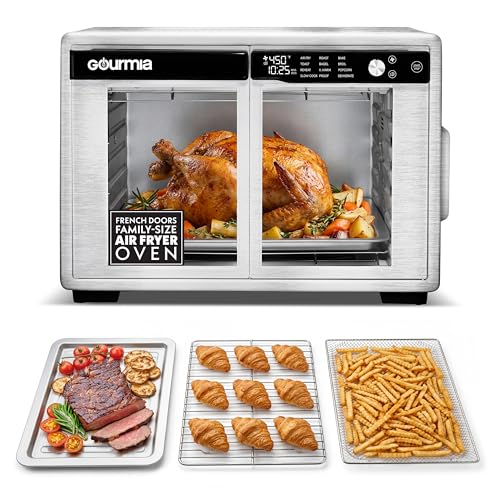
- 9-slice family capacity in a French door oven combo at an everyday position
- FryForce 360° branding shows a maker investing in its own air technology identity
- 12 cooking presets with adjustable time and temperature
- Dishwasher-safe trays, an ownership-first specification
Trade-offs
- Less heritage depth than Cuisinart or Ninja in buyers’ minds
- Single cavity, one temperature at a time
- Oven format crisps small loads gently compared with baskets
Mini spec box
- Format: countertop toaster oven air fryer combo, French doors
- Capacity: 9-slice, per listing
- Presets: 12 cooking presets, adjustable time and temperature
- Air system: FryForce 360°
- Cleanup: dishwasher-safe trays
Gourmia’s representative machine tells a clear brand story: take the format families want, a French door oven combo with genuine 9-slice capacity, give the air system a name and an identity of its own, FryForce 360°, equip it generously, twelve presets, dishwasher-safe trays, and position it where ordinary households actually shop. This is the accessible-specialist strategy, and its virtue is focus. Gourmia is not trying to be a whole kitchen’s worth of brands; it is trying to be the obvious answer when a family wants an oven-style air fryer without entering flagship territory.
Who it suits: families who want oven-combo capacity and easy ownership without a premium tier. The honest limitation is range depth: buyers who want a whole ecosystem, matching baskets, ovens, and systems under one badge, will find Ninja’s world wider. Buyers who want one good machine, honestly specified and easy to live with, are exactly Gourmia’s constituency, and this model shows why the brand has earned it.
Best for: accessible family oven-combo cooking / Not suited for: ecosystem buyers

Ninja Prestige Smart XL Countertop Oven DT501
Badge: Ninja Premium Oven
Strengths
- XL cavity fitting a 12 lb turkey and baking 20 cookies, per the listing
- 10-in-1 system breadth under the Prestige banner
- 1800W in a stainless, permanent-counter build
- Shows Ninja competing at the flagship oven tier, not only in baskets
Trade-offs
- Premium tier and large footprint
- Single cavity, unlike the brand’s own dual-zone baskets
- Oversized for small households
Mini spec box
- Format: countertop oven, model DT501
- Capacity: fits a 12 lb turkey; bakes 20 cookies, per listing
- Functions: 10-in-1, including air fry, bake, toast, pizza, reheat
- Power: 1800W
- Finish: stainless steel
The DT501 exists to correct a lazy assumption: that Ninja is only the dual-basket brand. Under its Prestige banner, Ninja builds a flagship countertop oven with the same house traits as its baskets, a system name, a deep function set, demonstration-grade capacity claims stated in food rather than abstractions, a turkey, a cookie count. That last habit is a manufacturer’s signature worth noticing: Ninja’s listings consistently translate engineering into meals, which makes its machines unusually easy to shop honestly. A brand that tells you what fits is a brand confident you will like the answer.
Who it suits: Ninja loyalists who want the brand’s engineering in an oven, and families who need a genuine second oven. The honest limitation is that the DT501 competes with distinguished oven specialists, Cuisinart in this guide and others beyond it, on their home ground. That it belongs in that company at all is the brand story: Ninja has become a full-range air fryer manufacturer, and this machine is the proof at the top of the range. Its whole-meal versatility is ranked again in Best Multi Tasking Air Fryers.
Best for: flagship oven cooking from the systems brand / Not suited for: small households or value briefs

Chefman 6 Quart Dual Basket Air Fryer
Badge: Feature-Value Challenger
Strengths
- Easy View windows, a feature families feel daily, in a value-position machine
- Sync Finish and Hi-Fry show system thinking at a challenger tier
- Two independent baskets with auto shutoff
- Nonstick dishwasher-safe baskets keep ownership simple
Trade-offs
- Each basket is 3 quarts; family-plus households will outgrow the zones
- Brand carries less heritage weight than Cuisinart or Ninja
- Digital value positioning means plainer materials than flagship machines
Mini spec box
- Format: dual basket air fryer, digital, black
- Capacity: 6 quarts total, two independent 3 Qt baskets
- Features: Easy View windows, Sync Finish, Hi-Fry, auto shutoff
- Cleanup: nonstick dishwasher-safe baskets
Chefman’s machine is the challenger brand’s manifesto: identify the features owners of expensive machines actually praise, viewing windows, synchronised finishing, a high-heat crisping blast, and build them into a family machine at a challenger position. The strategy is visible in the listing’s priorities, which lead with lived-experience features rather than with materials or heritage. That is a legitimate manufacturer’s identity, and for many households it is the most relevant one: Chefman is the brand for buyers who comparison-shop features rather than badges.
Who it suits: value-led families of two to four who want dual-basket convenience with the monitoring and sync features usually sold above this tier. The honest limitation is scale and gravitas: the zones are modest, and the brand does not offer Cuisinart’s appliance-line depth or Ninja’s system breadth. Within its chosen ground, though, Chefman’s proposition is coherent and, on the evidence of this machine, well executed.
Best for: feature-rich dual-basket cooking at a challenger tier / Not suited for: large families or heritage-first buyers

Ninja Foodi 10 Qt DualZone XL Air Fryer DZ401
Badge: Dual-Zone Leader
Strengths
- DualZone architecture: two independent 5 Qt baskets in a 10 Qt system
- Named, transferable technologies, Match Cook and IQ Boost, that recur across the range
- 6-in-1 functions under the Foodi banner
- The clearest example in this guide of a manufacturer owning a format
Trade-offs
- Wide body demands serious counter width
- Single items are capped by one 5 Qt zone
- System richness exceeds what simple cooks need
Mini spec box
- Format: dual basket air fryer, model DZ401, grey
- Capacity: 10 Qt total, two independent 5 Qt baskets
- Functions: 6-in-1 air fry, roast, broil, bake, reheat, dehydrate
- Features: Match Cook, IQ Boost
If one machine in this guide justifies the word “manufacturer” in the keyword, it is this one, because the DZ401 is not merely a product but an architecture. DualZone, two independently controlled baskets with synchronisation logic, is a platform idea: it scales across sizes, carries named technologies from model to model, and gives owners skills that transfer when they upgrade within the brand. That is what strong manufacturers do in every industry, turn a good product into a system, and Ninja’s execution here, 5 Qt zones that are genuinely family-sized, power management between zones, a 6-in-1 repertoire under the Foodi name, is the category’s benchmark.
Who it suits: families who cook main-plus-side dinners and buyers who value a brand with a clear, evolving system. The honest limitation is format lock-in of a mild kind: DualZone skills and expectations tie you to baskets, and whole-item cooking still belongs to ovens like Ninja’s own DT501. A manufacturer strong enough to sell you both halves of that sentence is, on the evidence, the most complete air fryer maker in this guide.
Best for: dual-zone family cooking and system buyers / Not suited for: whole-item cooking or narrow counters
Comparison Table
| Pick | Manufacturer | Brand strategy in one line | Format | Check |
|---|---|---|---|---|
| Cuisinart TOA-FD70 | Cuisinart | Heritage appliance line, design flagship | Oven combo | Check on Amazon |
| Cuisinart TOA-55 | Cuisinart | Heritage appliance line, mainstream standard | Oven combo | Check on Amazon |
| Gourmia Oven Combo | Gourmia | Accessible oven-combo specialist | Oven combo | Check on Amazon |
| Ninja DT501 | Ninja | Systems innovator, premium oven arm | Oven | Check on Amazon |
| Chefman Dual Basket | Chefman | Feature-value challenger | Dual basket | Check on Amazon |
| Ninja DZ401 | Ninja | Systems innovator, DualZone platform | Dual basket | Check on Amazon |
How to Choose a Manufacturer, Not Just a Model
Use four tests, all visible from listings like the ones in this guide. First, specification honesty: does the maker state the numbers that matter, capacity per zone, wattage, temperature range, what fits, in its own titles? Cuisinart and Ninja both pass conspicuously here; treat vagueness in any brand’s listings as a brand trait, not a copywriting accident. Second, range coherence: do the maker’s models form a ladder a buyer can climb, with consistent naming and technologies that recur? Ninja’s DualZone family and Cuisinart’s TOA line both qualify. Third, format truth: does the brand specialise where it is strong, Gourmia in oven combos, Chefman in family features, rather than spraying badges across every shape? Fourth, ownership thinking: crumb trays, dishwasher-safe parts, included accessories, the unglamorous evidence that a maker has imagined year three of your life with its machine.
Keep a one-line record of your own reasoning when you choose: the maker, the model code, and the two specification facts that decided it. That line sounds trivial and becomes valuable constantly, when a friend asks what to buy, when a part needs ordering, when the successor model appears and you must judge whether the range kept its promises. Brand loyalty built on a written record is not sentiment; it is a household’s own longitudinal study, and it is how casual buyers become the people whose kitchen advice everyone else trusts.
Then match the maker to your format decision, which should come first. Oven-combo households are choosing between Cuisinart’s appliance lineage, Gourmia’s accessibility, and Ninja’s premium system oven. Basket households are choosing between Ninja’s platform depth and Chefman’s feature value. Households that expect to own two machines over time often do best staying inside one maker’s world, because controls, vocabulary, and accessories carry over, a mild but real convenience that brand-loyal buyers are not foolish to value. The newest entrants complicate this picture yearly, and Best New Air Fryers tracks which fresh makers are building ranges rather than one-off models.
How to Read a Brand’s Range Before You Buy Into It
- Start at the mainstream model. A maker’s central machine, like the TOA-55, shows its honest priorities better than its flagship or its cheapest line.
- Compare the flagship’s premium. Ask what the top model adds, design, breadth, capacity, and whether the brand prices the addition in features or in aura.
- Check naming discipline. Clear model numbers and recurring technology names signal a range built to be maintained and compared over years.
- Read two listings from different tiers. If the specification style, honesty, and completeness survive the tier change, the brand’s promise is real.
- Look for the ownership details. Crumb trays, washable parts, included accessories: brands that list them are brands thinking past the sale.
- Decide what you are loyal to. A format, a control logic, a service expectation, and then choose the maker whose range serves that loyalty best.
Brand problems have their own troubleshooting pattern. Problem: a maker’s models seem identical under different names → the range is marketing-led; buy the specification, not the badge. Problem: a listing hides capacity or power → the brand is selling around a weakness; find the figure elsewhere on the listing or choose a maker that states it. Problem: last year’s model vanished without successor → parts and accessories may strand; favour makers whose lines persist. Each test uses only public listing evidence, which is precisely why it works for any buyer, anywhere.
The Four Strategies, and What Each Costs You
Every strategy in this guide extracts a characteristic price. Cuisinart’s appliance lineage costs a tier premium over challenger brands and repays it in coherence and longevity of the line. Ninja’s systems cost complexity, controls and concepts to learn, and repay it in capability that compounds across models. Gourmia’s accessibility costs ecosystem breadth and repays it in an easy, focused purchase. Chefman’s feature challenge costs heritage and zone size and repays it in daily-use features at a family tier. There is no strategy without a price, which is why “best manufacturer” has no single answer, only a best fit between a maker’s bargain and a household’s priorities. The reviews above are written to make each bargain explicit, so the fit can be chosen rather than stumbled into.
Why Brand Matters More in Air Fryers Than in Most Appliances
There is a generational point here too. The first wave of air fryers was sold by whoever could ship a basket; the current wave, represented by every maker in this guide, is sold by companies building lines, systems, and successor models. That maturation is the category growing up, and it shifts the buyer’s advantage: in a market of labels, the skill was spotting a good unit; in a market of manufacturers, the skill is choosing a good system and letting its coherence work for you over years.
Air fryers sit at an unusual intersection: they are used daily, they run hot, they involve coated surfaces and fans, and the category is young enough that standards are still settling. In such a category, the maker’s habits, specification honesty, range maintenance, parts thinking, are not branding garnish; they are the main predictors of how the machine will age and how supportable it will be. A toaster can be an anonymous purchase. A machine that will cook a thousand dinners, whose baskets and plates you will want to replace someday, whose successor you may buy on the strength of this one, deserves a manufacturer decision made as carefully as the model decision. That is the serious core inside this keyword’s simple phrasing, and it is why this guide reads six machines as evidence about four companies rather than as six isolated scores. Versatility across a range is part of that evidence too, as Best Multi Function Air Fryers shows when it ranks these same makers by functional breadth.
Brand Promises in the Listings: A Close Reading
Listings are the one place a manufacturer must speak precisely, and the six in this guide repay close reading. Cuisinart’s titles are engineering documents: model code, wattage, cavity volume, temperature ceiling, the pizza benchmark, the crumb tray. Nothing is promised that cannot be checked, and the omissions are as telling as the inclusions, there is no lifestyle language at all. Ninja’s titles are demonstration documents: the turkey, the cookies, the named systems, Match Cook, IQ Boost, DualZone, each a claim about a meal or a mechanism. Gourmia’s title leads with capacity and its branded air system, a specialist’s priorities. Chefman’s leads with the experience, windows, sync, the high-heat finish, a challenger’s priorities. None of these styles is dishonest, but they are not interchangeable, and a buyer who learns to hear them can predict, from a title alone, how the ownership literature, the accessories, and the successor models will feel. That predictive power is the practical reason brand literacy matters.
It also explains this guide’s confidence in judging manufacturers without touching a factory. A company’s listings are written by the company, approved through its own processes, and repeated across its range; they are the most authorised self-description a buyer will ever get. Where a listing is complete, the maker is telling you it expects to be checked. Where it is vague, the maker is telling you something else. Reading six of them side by side, as this guide does, turns that subtext into evidence.
Switching Brands: What Carries Over and What Does Not
Households change makers more often than makers admit, and the experience is smoother than feared, because the core skills of air frying, single layers, dry surfaces, shaking and rotating, temperature judgement, are universal. What does not carry over is the dialect: preset names, sync logic, the feel of a brand’s controls, and the accessory ecosystem of trays and baskets shaped for one maker’s machines. Switching from a Cuisinart oven to a Ninja basket, for example, is a format change wearing a brand change’s clothes, and most of the adjustment is format. Switching within a format, from the TOA-55 to a rival oven, is mostly dialect. The practical advice follows: when you change machines, change one variable at a time where you can, and give any new brand a fortnight of ordinary cooking before judging it, because dialect fluency, not cooking quality, is what the first week measures.
Where the Category’s Makers Are Heading
Read as a group, these six listings sketch the category’s direction without any need for prophecy. Formats are converging into systems: baskets that synchronise, ovens that absorb neighbouring appliances, named technologies that persist across generations so owners can upgrade without relearning. Capacity has stabilised around family reality rather than spectacle, with the boldest claims in this pool expressed as meals, turkeys and pizzas, rather than raw volume. And the specification style is improving under competitive pressure: wattages, ceilings, and cavity volumes that a decade of gadget marketing would have hidden are now stated in titles, because rival makers state them. For buyers, the implication is reassuring. The manufacturers in this guide are competing on evidence more than they used to, and a buyer equipped with the tests in this article is well matched to the market as it now is. Mid-size specialists within each range are compared in Best Medium Size Air Fryers, for readers whose brand decision is really a size decision in disguise.
A Short Method for Interviewing Any Brand
Before any air fryer purchase, give the manufacturer a ten-minute interview using only its own materials. Open the listing of the model you want and the listing of its nearest sibling, above or below it in the range. Ask five questions. Does each listing state capacity in a unit you can verify, per zone where relevant? Does each state power and temperature range, or their equivalents for the format? Do the two models share a naming and technology vocabulary, or does each read like a different company wrote it? Are ownership details, washable parts, crumb management, included accessories, specified rather than implied? And does the flagship’s extra money buy named, checkable things? Score the brand, not the model, on the answers. Cuisinart and Ninja pass this interview in this guide almost line by line, which is the concrete content of their reputations. Gourmia passes on completeness within a narrower range. Chefman passes on experience features while asking you to accept smaller zones. A brand that fails the interview may still sell a decent machine, but it has told you how it will communicate when something goes wrong, and that forecast is worth the ten minutes.
Second Machines and the Two-Brand Kitchen
A pattern this guide’s evidence quietly supports is the two-brand kitchen: an oven from the oven specialist and a basket system from the basket specialist, rather than a forced marriage inside one range. The household that cooks pan meals in a Cuisinart or Gourmia oven and weeknight dual-zone dinners in a Ninja is not being disloyal; it is buying each format from its strongest maker, which is what a landscape guide like this one exists to reveal. The costs are real but modest: two control dialects to learn, two accessory sets that do not interchange. The benefits are the best version of each format and a kitchen that degrades gracefully when one machine is busy, broken, or buried under a holiday. If your cooking genuinely spans both formats weekly, consider the two-brand answer seriously before defaulting to a single badge, and let each manufacturer in this guide compete for the half of your cooking it is actually best at.
What “Manufacturer” Should Not Mean in Your Decision
Three meanings of brand deserve to be retired. The first is country romance: assumptions that a badge’s heritage guarantees a particular factory story. This guide makes no such claims for any maker, because the verified material does not support them, and buyers should be wary of any guide that decorates recommendations with unverifiable origin tales. The second is badge-as-insurance: the belief that a famous name makes a wrong-format purchase right. A Cuisinart oven will not cook like a Ninja basket no matter how good the badge is, and format fit outranks brand every time. The third is badge-as-verdict on rivals: the presence of a strong maker in a category does not make the challengers’ machines bad, as Chefman’s and Gourmia’s complete, coherent specifications in this guide demonstrate. Strip those three meanings away and what remains is the useful one: a manufacturer is a set of repeated, checkable habits, and you are choosing the habits you want to live with for a thousand dinners.
Gifting a Brand: A Small Practical Note
Air fryers are frequent gifts, and the manufacturer lens improves gifting decisions. Give the mainstream model of a coherent range, the TOA-55 pattern, rather than the flagship, because the recipient gets the brand’s real character without the flagship’s learning curve, and give within the format the recipient’s kitchen already leans toward, oven for pan cooks, basket for crispers. Include the exact model code in a note; it is the single most useful thing a recipient can own besides the machine, unlocking parts, accessories, and instructions for years. A gift chosen this way says something accurate about both the brand and the giver: that both were paying attention.
Common Buying Mistakes
- Judging a brand by its flagship alone. The mainstream model is the honest evidence; flagships are showpieces.
- Believing corporate colour over specifications. Judge makers by what their listings state and omit, not by story.
- Buying a badge outside its specialism. Every maker here is best at something specific; buy the specialism, not the logo.
- Ignoring range coherence. A model in a maintained, clearly named line is easier to support, accessorise, and replace.
- Assuming loyalty is irrational. Shared controls and vocabulary across machines are real conveniences; value them knowingly.
Final Recommendation
If the question demands one name, Ninja is the most complete air fryer manufacturer in this guide: it alone fields both a category-defining basket platform, the DZ401, and a flagship oven, the DT501. The strongest heritage alternative is Cuisinart, whose range runs from the Cuisinart French-Door Air Fryer Toaster Oven TOA-FD70 at the design end to the Cuisinart Air Fryer Toaster Oven TOA-55 at the mainstream centre, while the Gourmia French Door Toaster Oven Air Fryer shows the accessible specialist at its best and Chefman remains the feature-value challenger. Choose the maker whose strategy matches your kitchen, then choose its model; in that order, both decisions get easier.
Frequently Asked Questions
Which manufacturer makes the most reliable air fryers?
This guide does not print reliability statistics, because it works from verified listings rather than long-term test data. What it can identify are the brand habits that predict a good ownership experience: complete specifications, coherent model lines, ownership details like crumb trays and washable parts, and ranges that persist across seasons. On that evidence, Cuisinart and Ninja present the strongest cases here, with Gourmia and Chefman coherent within their chosen tiers.
Is Ninja or Cuisinart the better manufacturer?
They lead in different formats. Ninja is the systems innovator, defining the dual-basket category with DualZone and fielding a flagship oven besides. Cuisinart is the oven-combo specialist, with a heritage appliance line from mainstream to artisan. Basket households should start with Ninja; oven-combo households should compare Cuisinart’s line against Ninja’s DT501 and Gourmia’s accessible alternative.
Does the manufacturer matter for replacement parts?
Yes, in a practical sense: makers with clear model numbers and persistent lines, like the TOA and DualZone families here, make it far easier to identify and order the right basket, tray, or plate years later. When you buy, note the exact model code and keep it with your records; it is the key to every future part.
Are challenger brands like Chefman and Gourmia worth considering?
On the evidence of these machines, yes. Gourmia’s oven combo is completely and honestly specified with family capacity and easy-clean trays; Chefman packs genuinely useful features, viewing windows and sync finishing, into a value-tier dual basket. Their trade-offs are range depth and heritage, not basic competence, and for many households those trade-offs are the right ones.
Should I buy all my appliances from one manufacturer?
There are mild real benefits, shared control logic, consistent vocabulary, sometimes shared accessories, and no strong technical reason to force it. Buy each category from its strongest maker, and let loyalty accumulate where a brand earns it repeatedly, as Ninja and Cuisinart both attempt to do across the picks in this guide.
Do manufacturers’ own listings tell the truth about their machines?
They are marketing documents, but they are also the most checkable documents in the process: capacities, wattages, temperature ranges, and included parts can all be verified at delivery and are the figures a maker can least afford to falsify. Read them for what they state, notice what they omit, and compare the style across a brand’s range; that reading is the method of this entire guide.
Is it worth paying more for a big-name manufacturer?
It is worth paying for what the big names in this guide demonstrably add: coherent ranges, complete specifications, persistent model lines that keep parts findable, and systems like DualZone that compound in value. It is not worth paying for a badge applied to a format the maker does not specialise in. The reviews above separate those two cases model by model.
How can I tell if a new manufacturer is serious?
Apply the guide’s tests to its listings: complete specifications with real numbers, a small coherent range rather than a scatter of badges, named technologies or design ideas that recur between models, and ownership details in the specification. A maker that passes those tests on its first machines is behaving like a manufacturer, not a label, and deserves to be judged alongside the established names.
Should I register my appliance or keep the model details?
Keep the exact model code, DZ401, TOA-55, TOA-FD70, DT501 and their peers, somewhere durable, whether or not you register the product. That code is how parts, accessories, manuals, and any future support conversation identify your machine, and it takes ten seconds to record at unboxing.
What is the difference between a manufacturer and a brand label?
In the sense this guide uses the words, a manufacturer stands behind a range: consistent specifications, persistent model lines, parts and accessories that can be identified years later, and technologies that evolve between generations. A label is a badge applied to shifting, unrelated models. The listings in front of you will usually tell you which one you are dealing with, if you read two models from the same range side by side.