Disclosure: topratedkitchenware.com is reader-supported. When you buy through links on our site, we may earn an affiliate commission from Amazon and other retailers, at no extra cost to you.
Where to buy
This guide to the best marine 12 volt battery options links four true 12-volt lithium deep-cycle batteries sized for the jobs a boat’s 12V system actually does — trolling propulsion, house loads, and electronics — and reviews two 24-volt batteries in full as prose-only entries, because a 24V unit cannot take a 12V battery’s place in a 12V boat. One honesty note belongs at the top: every battery in this verified pool is a deep-cycle design, so this guide is about propulsion, house, and electronics power. None of these titles claims engine-cranking duty, and none is presented here as a starting battery.
- SUPER EMPOWER 12.8V 100Ah LiFePO4 Battery, Group 31
- Nermak 2 Pack 12V 10Ah LiFePO4 Deep Cycle Battery
- yeagulch 12.8V 100Ah LiFePO4 Lithium Battery, Group 31
- ABKPOWER 12V 20Ah LiFePO4 Battery
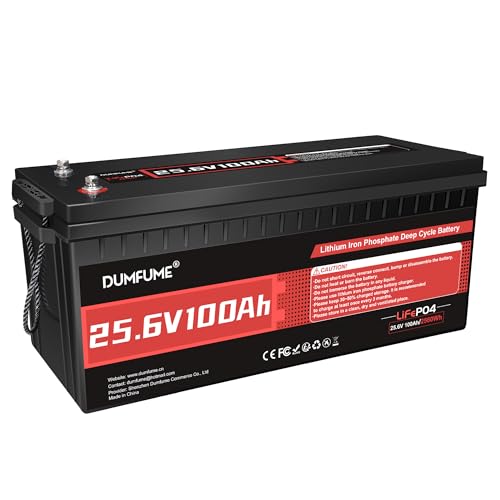
- dumfume 24V 100Ah LiFePO4 Lithium Battery — prose-only, a 24-volt unit, not a 12-volt marine battery
- Qwenoer 22.2V-24V 10Ah Lithium Battery — prose-only, a small 24-volt project pack, not a 12-volt marine battery
Read the full guide ↓ for the detailed reviews, the bank architecture most boats actually need, and the corrosion and charging discipline that decides whether a marine battery lasts two seasons or ten.
A boat is the hardest home a battery can have. It vibrates, it heels, it breathes salt air, it sits in a damp box for weeks and is then asked for a full day’s work without complaint. The best marine 12 volt battery is therefore not simply a good 12V battery that happens to be on a boat — it is a battery whose chemistry, protection, and format respect the marine environment. The modern answer, increasingly, is lithium iron phosphate: light enough to matter in a hull where weight is performance, deep-cycle by nature, sealed against the spills and fumes that make lead-acid unwelcome in enclosed spaces, and steady in its voltage so electronics and motors alike are fed properly all day.
It helps to divide a boat’s electrical life into three jobs, because the picks below divide along the same lines. Propulsion — the trolling motor — wants capacity and current: the 100Ah class. House loads — lights, pumps, refrigeration, the stereo — want capacity and patience: the same 100Ah class, or paralleled multiples of it. Electronics — fish finders, chartplotters, radios — want clean, modest, reliable power: the small-format picks earn their place here, and pretending they belong on a trolling motor would be as wrong as pretending a 100Ah block belongs in a kayak’s finder hatch. A good marine guide matches battery to job; a bad one sorts by a single number.
The two prose-only reviews make the same point from the voltage side. Both are 24V products — one a serious 100Ah deep-cycle unit, one a small project pack — and a 12V boat cannot use either as a 12V battery. They are reviewed honestly because shoppers meet them constantly in this category, and because the larger one’s proper home, a true 24V system, is a real architecture some boats choose deliberately. But the linked shortlist for a 12V boat is four batteries long, and it starts with a Group 31 block whose title leads with trolling motors. Everything after this introduction — the reviews, the architecture, the maintenance discipline — exists to help you place those four batteries correctly aboard your own boat, and to keep them performing long after the purchase is forgotten.
Key Takeaways
- Every linked pick is a 12V-class LiFePO4 deep-cycle battery; the guide covers trolling, house, and electronics duty — no pick is presented as an engine-cranking battery, because no title claims that duty.
- Match the battery to the job: 100Ah class for trolling motors and house banks, 10–20Ah class for fish finders and electronics.
- Two 24V products are prose-only: voltage class is the first gate in a 12V boat, ahead of capacity and brand.
- Both 100Ah picks state 1280Wh and low-temperature protection; the SUPER EMPOWER also states 4P4S expansion for building bigger banks.
- Marine longevity is mostly discipline: tight, corrosion-free connections, correct lithium charging, and sane storage between trips.
- Weight is a marine specification, not a convenience — lithium’s lightness changes how a small boat trims and rides.
In this guide
Quick Picks
| Pick | Badge | Why it is here | Link |
|---|---|---|---|
| SUPER EMPOWER 12.8V 100Ah LiFePO4, Group 31 | Best Overall | Trolling motors named in the title, stated 4P4S expansion, low-temperature cutoff. | Check on Amazon |
| Nermak 12V 10Ah LiFePO4 (2 Pack) | Best for Electronics | Featherweight fish-finder and lighting power, sold as a matched pair. | Check on Amazon |
| yeagulch 12.8V 100Ah LiFePO4, Group 31 | Best Long-Cycle All-Rounder | Stated cycle count in the fifteen-thousand-plus range with low-temperature protection. | Check on Amazon |
| ABKPOWER 12V 20Ah LiFePO4 | Best Compact Step-Up | Double the small-class capacity with a 20A BMS for electronics and light house loads. | Check on Amazon |
| dumfume 24V 100Ah LiFePO4 | Best for True 24V Systems | A serious 24V deep-cycle unit with a stated waterproof rating — for 24V boats, not 12V ones. | Prose-only — 24 volts, not 12 |
| Qwenoer 22.2V-24V 10Ah Lithium Battery | Best for 24V Projects | A compact 24V project pack with charger — a DIY battery, not a marine 12V battery. | Prose-only — 24 volts, not 12 |
How These Picks Were Chosen
This is a research-led guide. Each candidate was checked against its verified manufacturer title, and the linking rule applied two gates drawn from the keyword itself. Gate one is voltage: a marine 12 volt battery must be a 12V-class battery — 12V or 12.8V nominal, the same LiFePO4 class under two labels — so both 24V products are prose-only regardless of their other merits. Gate two is duty honesty: the pool is a deep-cycle pool, so picks are linked for the deep-cycle jobs — trolling propulsion, house loads, electronics — and no pick is credited with a duty its title does not support. In particular, no title here states engine-cranking performance, so this guide never recommends any of these batteries as a starting battery; boats that need cranking should keep a dedicated starting battery in the architecture described later.
Within the four linked picks, evaluation weighted the marine specifics: stated capacity against realistic trolling and house loads, BMS current against motor demand, expansion support for owners who will parallel or series batteries into banks, and protection features that matter in boats stored outdoors. The small picks were judged as electronics batteries — the duty their own titles name — and the guide holds that line in both directions: they are never oversold as propulsion, and the big blocks are never recommended where a 10Ah battery is the correct, lighter answer. Readers comparing the wider deep-cycle field will find the same discipline in our Best Quality 12 Volt Deep Cycle Batteries guide. No prices or fixed ratings are printed; cycle figures are manufacturer statements, reported as such.
The 6 Best Marine 12 Volt Battery Options, Reviewed
SUPER EMPOWER 12.8V 100Ah LiFePO4 Battery, Group 31
Badge: Best Overall
Strengths
- Trolling motors lead its title’s purpose list — propulsion is its stated home ground.
- States 4P4S expansion up to 20.48kWh, so house banks and 24V pairs are documented architectures.
- 100A BMS with low-temperature cutoff covers propulsion current and winter storage in one package.
Trade-offs
- Group 31 is a full-size case; the smallest boats may prefer to split capacity across smaller units.
- One battery is one bank: serious house loads will still parallel a second unit.
- Like every lithium here, it wants a lithium-profile charger rather than an old lead-acid unit.
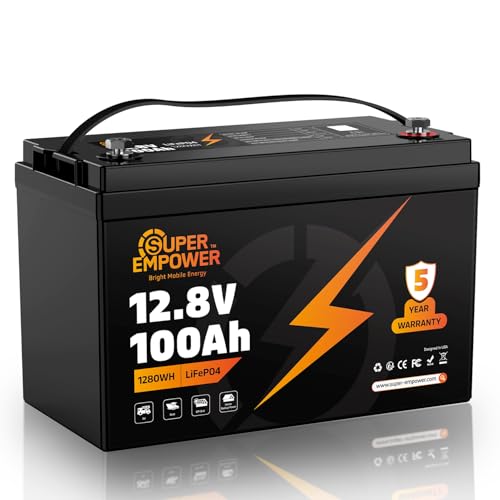
Key specs (from manufacturer title): Voltage: 12.8V nominal (12V class); Capacity: 100Ah; Stated energy: 1280Wh; Group size: 31; BMS: 100A with low-temperature cutoff; Expansion: 4P4S, up to 20.48kWh stated.
For the centre of marine life — a 12V trolling motor and a working set of house loads — this is the battery this guide would install first. Its credentials are the complete set: capacity in the class’s sweet spot, a BMS rated for propulsion current, low-temperature protection for the boat that winters on a trailer, and expansion support stated in the title, which quietly answers the two questions every growing boat eventually asks: can I parallel a second one for the house bank, and can I series a pair when the next trolling motor is a 24V model? Documented yes, on both counts, is a rare and valuable answer.
On the water, the lithium virtues compound. The flat discharge curve means the trolling motor pulls the evening as strongly as the morning, and the weight saving against a lead-acid predecessor is felt in a small boat’s trim, draft, and ease of trailering. The honest limits are format and arithmetic: Group 31 needs its space, and 100Ah is a day-scale answer, not a weekend-off-grid one — which is what the stated parallel path exists for. As a single purchase for a typical fishing boat’s 12V system, though, nothing else in this guide covers as much water. Boats whose owners also camp will recognise the same block doing house duty in our Best No Maintenance Rv 12 Volt Battery guide.
Best for: Trolling propulsion and combined trolling-plus-house duty on typical fishing boats. / Not suited for: Engine cranking, or the smallest compartments where a split small-battery layout fits better.
Nermak 2 Pack 12V 10Ah LiFePO4 Deep Cycle Battery
Badge: Best for Electronics
Strengths
- Fish finders are named in its title — this is purpose-built electronics power, not a shrunk house battery.
- Two matched batteries in the pack suit a finder-plus-lighting layout or a spare aboard.
- LiFePO4 lightness transforms kayak and small-boat electronics, where every pound is carried by hand.
Trade-offs
- 10Ah and a 10A BMS define its ceiling: electronics and light loads only, never propulsion.
- Runtime for hungry modern sonar is a real calculation, not an assumption — do the amps-times-hours sum.
- Small batteries are easy to leave uncharged in a garage all winter; storage discipline still applies.
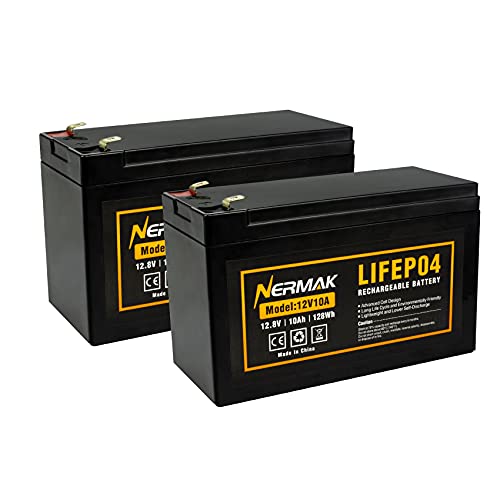
Key specs (from manufacturer title): Voltage: 12V; Capacity: 10Ah per battery; Pack quantity: 2; BMS: built-in 10A; Stated cycles: 2000+; Named uses include fish finder, lighting, scooters, solar/wind.
The modern fish finder is a computer with a transducer, and it wants clean, steady, lightweight power that the old small lead-acid bricks never happily provided. This Nermak pair is the lithium answer at exactly that scale: ten amp-hours of LiFePO4 that a kayak angler can carry in one hand, a built-in BMS sized to electronics loads, and a second battery in the box for the lighting circuit, the second boat, or the spare that turns a flat morning into a minor delay. Its stated cycle design — in the thousands — suits the charge-after-every-trip rhythm of electronics batteries.
The review’s responsibility is the boundary, and it is a bright one. A 10A BMS will not run a trolling motor, and 10Ah will not run a house bank; asking either is a sizing error that ends with a protection shutdown at the worst possible moment. Inside its boundary, though, this is the most likeable pick in the guide: honest capacity, honest current, honest purpose. Anglers upgrading from the small sealed batteries that also power lawn equipment — the world of our Best Prices On 12 Volt Mower Batteries guide — will find the same swap logic here, with the same happy ending in weight.
Best for: Fish finders, chartplotters, lighting, and kayak or small-boat electronics. / Not suited for: Trolling motors, house banks, or any load beyond its 10A ceiling.
yeagulch 12.8V 100Ah LiFePO4 Lithium Battery, Group 31
Badge: Best Long-Cycle All-Rounder
Strengths
- Stated deep-cycle count in the fifteen-thousand-plus range — the longevity headline of the linked field.
- Low-temperature protection stated, suiting trailer boats stored through cold seasons.
- RV and marine positioning in the title matches the dual-life boats-and-campers reality of many owners.
Trade-offs
- The title states no expansion configuration, so bank builders should confirm series and parallel use with the manufacturer.
- Shares the Group 31 footprint considerations of its class: measure the box before ordering.
- Its cycle headline is a manufacturer statement under favourable conditions, as all such figures are.
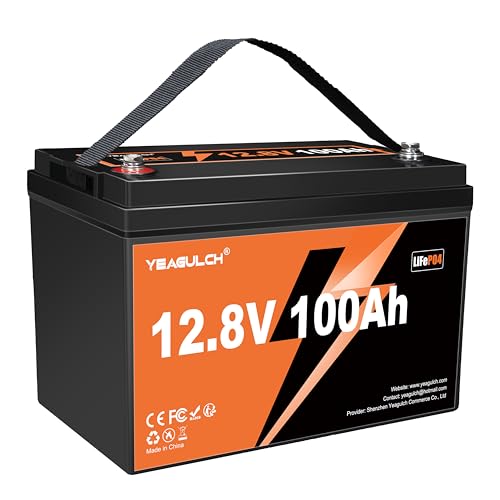
Key specs (from manufacturer title): Voltage: 12.8V nominal (12V class); Capacity: 100Ah; Stated energy: 1280Wh; Group size: 31; BMS: 100A; Stated deep cycles: 15000+; Protection: low temperature.
Where the SUPER EMPOWER wins on documentation, this yeagulch block wins on declared endurance. A stated deep-cycle ambition in the fifteen-thousand-plus range is a design manifesto: this battery expects to be used hard, for years, in exactly the rhythm a boat imposes — charged at the dock, discharged all day, rested, repeated. For owners who keep boats a long time and measure value in seasons, that manifesto is the most persuasive sentence in any title in this guide, and the supporting specification — 100Ah, 1280Wh, 100A BMS, low-temperature protection — is the complete class formula with nothing missing.
Its homework is the familiar pair. Expansion is not stated in the title, so the owner planning a parallel house bank or a future 24V pair should obtain the manufacturer’s guidance first; and the Group 31 case demands the tape-measure courtesy every full-size battery deserves. Neither item diminishes the battery; both are the ordinary diligence of buying a bank component rather than an accessory. For the single-battery trolling or house role, it needs no caveats at all, and for owners whose spelling of the RV twin of this search runs to Best No Maintenenace 12 Volt Rv Battery, the same endurance argument waits on the road side of the category.
Best for: Long-ownership boats wanting maximum declared cycle endurance in a single 100Ah block. / Not suited for: Buyers who need expansion configurations stated in the title before committing to a bank.

ABKPOWER 12V 20Ah LiFePO4 Battery
Badge: Best Compact Step-Up
Strengths
- Marine use and fish finders are both named in its title — its small-class credentials are explicit.
- 20Ah doubles the Nermak’s capacity while staying in the carry-it-in-one-hand class.
- A 20A BMS and a stated 6000+ cycle design give it headroom the 10Ah class cannot offer.
Trade-offs
- Still an electronics and light-load battery: a trolling motor remains far beyond its ceiling.
- Owners whose loads grow will outgrow it into the 100Ah class, so buy for the boat you have.
- 256Wh is a day of electronics, not a weekend of house loads — arithmetic, not criticism.
Key specs (from manufacturer title): Voltage: 12V; Capacity: 20Ah; Stated energy: 256Wh; BMS: 20A; Stated cycles: 6000+; Named uses include fish finder, marine, RV, solar, lighting, home backup.
Between the finder battery and the house bank there is a real and underserved middle: the boat whose electronics have grown — a larger sonar, a chartplotter, lights, a livewell pump on light duty — beyond what 10Ah flatters, but whose owner has no wish to install a full-size block. This ABKPOWER is that middle, specified with unusual honesty: double the small-class capacity, double its BMS ceiling, a stated cycle design in the thousands, and a title that names marine and fish-finder duty outright rather than leaving them to inference.
Its discipline requirement is the mirror of the Nermak’s. The step up is real but it is a step within the small class, not a bridge to propulsion; a trolling motor will still trip its protection and exhaust its capacity in short order. Buy it for the electronics suite you actually run — sum the draws, multiply by your hours, and let the 256Wh figure confirm the fit — and it will feel like the battery the boat always wanted: light, willing, and sized to its job. Owners who think about value across a whole season of trips will find its per-trip arithmetic as friendly as the shoppers in our Best Pricesgolf Cart 12 Volt Battery Prices guide find theirs, once the same usable-energy honesty is applied.
Best for: Grown-up electronics suites, lighting, and light auxiliary loads on small to midsize boats. / Not suited for: Trolling propulsion or full house-bank duty.
dumfume 24V 100Ah LiFePO4 Lithium Battery
Badge: Best for True 24V Systems
Strengths
- A genuine single-unit 24V deep-cycle battery: 2560Wh with a built-in 100A BMS.
- Its title states an IP65 waterproof rating — the only ingress rating claimed anywhere in this line-up.
- Stated certifications and a deep-cycle count in the fifteen-thousand range suit serious 24V marine work.
Trade-offs
- It is 24 volts. A 12V boat cannot use it as its 12V battery, full stop.
- Adopting it means adopting a 24V architecture — charger, and any voltage-sensitive loads, included.
- Its virtues are real but they belong to a different guide’s shortlist.
Key specs (from manufacturer title): Voltage: 24V; Capacity: 100Ah; Stated energy: 2560Wh; BMS: built-in 100A; Stated deep cycles: 15000; Rating stated: IP65 waterproof; Certifications stated: UN38.3, UL1973.
Some boats do choose 24V deliberately — a big trolling motor is the usual reason — and for those boats a single-unit 24V battery like this dumfume is an elegant answer: one box, one BMS, no series pair to balance, with a stated waterproof rating that acknowledges where boats keep their batteries. Reviewed as a 24V product, it is the most completely specified unit in this entire article, and nothing in this review should be read as a quality judgement against it.
But this is a 12-volt guide, and the gate is the gate. Wired into a 12V system, a 24V battery is not a upgrade or a compromise; it is a mismatch that ranges from non-functional to damaging depending on what it touches. It is therefore presented in full, praised accurately, and linked nowhere — so that the shopper who meets it in the wild, attracted by the capacity and the rating, understands both its genuine quality and its categorical exclusion from a 12V shortlist. If your boat’s future is a 24V trolling system, start that research as its own project, with this battery on the list. If your boat is 12V, your shortlist is the four linked picks above.
Best for: Boats deliberately built around a 24V trolling or house system. / Not suited for: Any 12V system, however attractive the capacity figure looks.
Qwenoer 22.2V-24V 10Ah Lithium Battery
Badge: Best for 24V Projects
Strengths
- A complete little 24V package with its own charger and bare-leads flexibility for project wiring.
- Named uses — ride-on cars, DIY projects, solar panels, LED strips, CCTV — are honestly matched to its scale.
- Compact and light, in the way only a 10Ah-class pack can be.
Trade-offs
- Wrong voltage and wrong duty for a 12V marine system: it fails both of this guide’s gates at once.
- Bare-leads project construction is the opposite of a marine battery’s sealed, terminalled format.
- 10Ah at 24V is project energy, not boat energy, by an order of magnitude.
Key specs (from manufacturer title): Voltage: 22.2V-24V; Capacity: 10Ah; Charger: 25.2V 2A included; Format: bare leads wire with cable connector; Chemistry: Li-ion.
Every guide benefits from one review that defines the category by standing entirely outside it, and this cheerful little project pack is ours. It is a 24V lithium-ion battery with bare leads and a wall charger, made for ride-on toys, LED strips, cameras, and the hundred small projects that run on a hobby bench. Judged on that bench, it is a tidy product. Judged as a marine 12V battery, it fails on voltage, on chemistry class, on construction, and on scale simultaneously — a clean sweep that makes it the perfect illustration of why this guide reads titles before it reads prices.
It is included here, unlinked and without an image, because shoppers genuinely encounter packs like this while searching marine batteries, drawn by a familiar voltage neighbourhood and an appealing size. Let its review save you the experiment: a boat’s battery is a sealed, terminalled, deep-cycle unit in the system voltage, protected for propulsion or house current — the four linked picks above are what that description looks like in products. The project pack goes back to the bench, where it belongs, and where by all accounts it serves happily.
Best for: 24V DIY projects, ride-on cars, LED and CCTV tinkering. / Not suited for: Boats — in any capacity, at any voltage setting, under any framing.
Comparison Table
| Pick | Voltage | Capacity | Right job aboard | Standout trait | Link |
|---|---|---|---|---|---|
| SUPER EMPOWER Group 31 | 12.8V | 100Ah | Trolling + house | Stated 4P4S expansion | Check on Amazon |
| Nermak 2 Pack | 12V | 10Ah × 2 | Electronics | Fish finder named in title | Check on Amazon |
| yeagulch Group 31 | 12.8V | 100Ah | Trolling + house | Stated 15000+ deep cycles | Check on Amazon |
| ABKPOWER | 12V | 20Ah | Electronics + light loads | Marine named in title, 20A BMS | Check on Amazon |
| dumfume | 24V | 100Ah | None on a 12V boat | Prose-only — 24V system battery | Prose-only |
| Qwenoer pack | 24V | 10Ah | None on a boat | Prose-only — DIY project pack | Prose-only |
How to Choose a 12V Battery for Your Boat
Inventory the jobs before the batteries. List everything the 12V system feeds — trolling motor, starting (which this guide’s pool does not cover, and which deserves its own dedicated battery), house loads, electronics — with each load’s typical draw and hours. The sums sort themselves into the guide’s three classes almost automatically: propulsion and house work land in the 100Ah class, electronics land in the 10–20Ah class, and anything that lands between them — a heavy electronics suite, a modest motor on a small boat — deserves the honest middle look the ABKPOWER review models.
Then design the architecture, not just the purchase. Most serious fishing boats end up with a dedicated trolling bank and a separate house or electronics supply, so one flat system never strands the other; the stated expansion support on the Best Overall pick exists precisely to let that architecture grow. Check the physical story next: battery box dimensions, ventilation, mounting security against pounding water, and cable runs. Finally, apply the climate and charging tests — lithium-profile charging at the dock or from the tow vehicle, low-temperature protection for trailer storage — and the choice usually narrows itself to one linked pick per job. Anglers cross-shopping by amp-hour labels alone may benefit from the audit habit in our Best 75 Amp 12 Volt Battery guide, where capacity claims are checked against their own arithmetic. And one last test belongs in every marine shortlist, because boats are kept longer than batteries: ask how the purchase behaves at replacement time. A standard group size, a mainstream format, and a maker who answers questions are the difference between a five-minute swap in five years and an archaeological expedition. Buy the battery your future self can replace without a tape measure, a translator, or a prayer.
How to Install, Charge, and Maintain a Marine Battery
Mount the battery secured against movement, in a box or tray that keeps terminals protected from accidental contact and spray. Use marine-grade cable of the correct gauge, keep runs short, and protect every connection against the corrosion that salt air begins within weeks: clean metal, proper crimps, tight hardware, and a protective coating on finished terminals. Charge with a lithium-profile charger, and let the first charge complete fully so the BMS can balance before you judge anything.
- After every trip, recharge promptly; lithium prefers to rest partially charged rather than empty or brim-full for long storage.
- Inspect terminals monthly in season for the white and green beginnings of corrosion, and clean at the first sign.
- Check mounting security after rough-water days; vibration loosens what calm water forgives.
- Before winter, charge to the maker’s storage guidance, disconnect parasitic loads, and store cool and dry where possible.
- Keep electronics on their own supply where the architecture allows, so a flat house bank never silences the finder or the radio.
Troubleshooting follows the environment. Problem: electronics reset when the trolling motor starts → the circuits are sharing a sagging supply; separate the electronics battery or enlarge the bank. Problem: capacity seems to fade across a season → inspect connections first; corrosion resistance steals more marine capacity than chemistry ever does. Problem: the battery will not charge after winter storage → check for a protection state after deep rest and warm the battery if temperatures are near freezing before charging.
Starting, Trolling, House: Why Boats Split Their Banks
New boaters often ask why one big battery cannot simply do everything, and the answer is a story about failure modes. A starting battery’s job is a violent few seconds; a trolling battery’s job is hours of steady draw; a house battery’s job is patience. Combine the jobs and you combine the failures: the deep discharge that trolling requires is exactly what a starting battery hates, and the flat bank that ends a long day’s fishing becomes the bank that cannot start the engine for the run home. Splitting the banks — dedicated starting, dedicated deep-cycle — is not extravagance; it is the architecture that keeps each failure in its own compartment. This guide’s pool serves the deep-cycle side of that architecture, and serves it well; the starting side deserves its own dedicated battery, chosen for cranking duty, and the wisdom to keep the two systems’ charging properly managed. Boats that respect the split rarely meet a tow rope.
Salt, Vibration, and the Ten-Minute Inspection
Marine batteries rarely die of old age; they die of environment, one neglected detail at a time. Salt air creeps into every connection and builds resistance that masquerades as a tired battery. Vibration from pounding water works hardware loose with a patience no garage ever tests. Damp finds the one unprotected terminal. The countermeasure is embarrassingly cheap: a ten-minute inspection, monthly in season, covering terminal tightness and cleanliness, mounting security, cable condition, and a glance at state of charge. Owners who keep that appointment routinely discover that their batteries were never the problem — their connections were — and that the fix costs minutes instead of a replacement. Build the inspection into the post-trip rinse routine and a marine battery’s promised years stop being a claim and start being a schedule.
Trolling Runtime, Worked Through Honestly
Every angler asks how long a battery will run the motor, and every honest answer begins with the same refusal: it depends on the draw, and the draw depends on you. A trolling motor loafing along a calm bank pulls a fraction of what it pulls at full thrust into wind and current. The usable method is a division and a diary. The division: take the battery’s usable watt-hours — most of the stated 1280Wh for the 100Ah lithium picks — and divide by the watts your motor typically draws at your typical setting, which the motor’s documentation states by thrust level. The diary: after your first few trips, note the setting, the hours, and the state of charge remaining, and your own boat will replace every estimate in this paragraph with a fact.
Two habits stretch whatever runtime the maths gives you. The first is thrust discipline: the top settings cost disproportionately, because current draw rises faster than speed, so the angler who reserves full thrust for repositioning fishes hours longer than the one who cruises there. The second is bank hygiene: a battery that starts the day genuinely full — charged completely, with connections clean and tight — delivers its whole specification, while the same battery half-charged through a corroded connection delivers a mystery. Runtime, in other words, is partly purchased and partly practised, and the practised half is free.
Charging at the Dock, From the Engine, and From the Sun
A marine battery’s charging life has three possible sources, and each deserves a sentence of engineering respect. Shore charging at the dock or in the garage is the foundation: a lithium-profile charger sized to the bank, allowed to finish, is what every pick in this guide assumes. Engine charging is the tempting second source, and the one requiring the most care: an outboard’s charging output was designed around lead-acid behaviour, and lithium’s appetite and voltage profile are different enough that a proper DC-to-DC charging arrangement is the responsible bridge between them — improvised direct connections are how expensive lessons are scheduled. Solar is the third source, increasingly practical on larger boats: a modest panel and a lithium-compatible controller will not refill a trolling bank overnight, but it will hold a stored bank at its preferred partial charge and offset a day’s electronics with something approaching elegance.
Whichever sources you combine, the rules of combination are the lithium rules from the rest of this guide: correct profiles, no charging of unprotected cells in freezing conditions, and a state-of-charge monitor that counts energy rather than guessing from voltage. Boats reward owners who treat charging as a system rather than a cable, and the reward is measured in seasons — the difference between a bank that is a fixture of the boat and one that is a recurring purchase.
Group Sizes, Battery Boxes, and the Tyranny of the Compartment
Marine batteries are bought in group sizes — standardised footprints that battery boxes, trays, and hold-downs are built around — and the compartment is the least forgiving editor in this entire purchase. The two 100Ah linked picks are Group 31, the large standard marine footprint; the small picks live outside the group system in electronics-scale cases that mount wherever a finder or a light needs feeding. Before ordering, measure the box in three dimensions, note where the cables enter and how the lid closes, and remember that a battery which fits the footprint but defeats the lid does not fit. Height is the dimension that surprises: lithium internals sometimes package differently from the lead-acid predecessors the box was bought for, and a hold-down that cannot close is a safety item, not an inconvenience, in a boat that pounds through chop.
The small-battery world has its own version of the same discipline. A kayak’s hatch, a jon boat’s bench compartment, a sailboat’s electronics locker — each has a shape, and the Nermak and ABKPOWER formats earn their keep by fitting the shapes that full-size blocks cannot approach. Measure those spaces too, plan the cable run to the device, and protect the little battery from the bilge water and spray its bigger cousins shrug off. In both classes the rule is identical and unglamorous: the compartment decides, the tape measure reports, and the wise buyer listens before the order rather than after the delivery.
Common Buying Mistakes
- Buying one battery for every job. Starting, trolling, house, and electronics are different duties; split the banks.
- Asking an electronics battery to troll. A 10A BMS ceiling is a design boundary, not a challenge.
- Ignoring voltage class in search results. 24V products sit beside 12V ones in every listing; read the voltage line first.
- Skipping corrosion discipline. More marine capacity is lost to green terminals than to chemistry.
- Charging lithium with the old profile. A lithium-profile charger is part of the conversion, on boats as everywhere.
- Leaving the bank flat between trips. Prompt recharging after use is the cheapest longevity there is.
Final Recommendation
Start with the SUPER EMPOWER 12.8V 100Ah LiFePO4 Battery, Group 31 for trolling and house duty — its stated expansion support lets the bank grow with the boat. Give electronics their own lightweight supply from the Nermak 2 Pack 12V 10Ah LiFePO4 Battery, step up to the ABKPOWER 20Ah when the electronics suite outgrows it, and consider the yeagulch 12.8V 100Ah LiFePO4 Battery, Group 31 when declared cycle endurance is the priority. Keep the two 24V products for the 24V systems they serve. Split the banks, mind the connections, charge with the right profile — and the water will provide the only surprises worth having. A marine battery is one of those purchases where the disciplined choice disappears into the background of good days: the motor pulls at dusk as it did at dawn, the finder draws its clean little map of the bottom, and the bank waits in its box, season after season, asking only for a charged rest and a clean terminal in return.
Frequently Asked Questions
Can one of these batteries start my outboard?
This guide does not recommend any of them for engine cranking, because no title in the verified pool claims cranking duty — they are deep-cycle batteries for trolling, house, and electronics loads. The sound architecture keeps a dedicated starting battery for the engine and lets these picks do the deep-cycle work they are designed and documented for.
How big a battery does a 12V trolling motor need?
Work from the motor’s draw and your hours. A 100Ah LiFePO4 battery, most of whose capacity is usable, is the class standard for a full day at moderate settings on a typical fishing boat; heavy wind, current, and high thrust settings spend it faster. If your honest maths exceeds one battery, the answer is a parallel second unit — which is why stated expansion support matters — not a smaller battery and hope.
Why are two picks not linked in a 12V guide?
Because they are 24V products. The dumfume is a serious 24V deep-cycle battery and the Qwenoer is a 24V project pack; neither can serve as a 12V battery in a 12V boat. They are reviewed in full so shoppers who encounter them understand their real purposes — and the boundary of this category — rather than learning it at the battery box.
Is lithium safe on a boat?
LiFePO4 is the lithium chemistry chosen across the marine world precisely for its stability, and it brings practical safety bonuses over lead-acid: sealed construction, no acid to spill in a seaway, no charging fumes to ventilate from an enclosed box. Safety still includes the ordinary disciplines — secure mounting, protected terminals, correct charging, and connections kept free of corrosion — which this guide’s maintenance section covers.
How do I keep a marine battery alive over winter?
Charge it to the manufacturer’s storage guidance rather than leaving it flat or brim-full, disconnect parasitic loads, and store it cool and dry if the boat’s situation allows. If it must stay aboard and be charged in the cold, low-temperature protection — stated on both 100Ah linked picks — is the feature that stands between an ordinary winter charge and permanent damage. A spring check of terminals and mounting completes the routine.
What does 12.8V mean — is that really a 12V battery?
Yes. A LiFePO4 battery is four 3.2V cells in series, which adds to a 12.8V nominal pack built to serve 12V systems. Some makers label the class 12V after the system it replaces; others label it 12.8V after the cell arithmetic. Both linked 100Ah picks in this guide carry the 12.8V label, and both are correct, standard 12V-class marine batteries for trolling motors, house loads, and electronics specified for 12V lithium. The label to treat as a genuinely different class is 24V — a different system voltage entirely, which is why the 24V products in this guide are prose-only.
Can I run my fish finder from the trolling battery?
You can, and many boats do — but a dedicated small electronics battery, like the Nermak or ABKPOWER picks, buys you clean power isolated from motor draw, no interference headaches, and a finder that stays alive even if the propulsion bank runs flat. On small boats especially, the split is cheap insurance and better engineering. Sum your electronics’ draws first; the right size follows from the arithmetic. On a boat that fishes long days with modern sonar, that arithmetic surprises many owners the first time they do it honestly — which is exactly why the 20Ah step-up pick exists in this guide.