Disclosure: As an Amazon Associate, topratedkitchenware.com earns from qualifying purchases. Prices and availability change; check Amazon for the latest.
Where to buy
Check the latest price, availability and delivery on Amazon. Orders are placed on Amazon. We may earn a commission from qualifying purchases.
- Best overall for side sleepers: Novilla 10 Inch Hybrid Mattress, Queen — Check on Amazon
- FDW 8 Inch Gel Memory Foam Mattress, Queen — Check on Amazon
- Novilla 8 Inch Hybrid Mattress, Queen — Check on Amazon
- Best Price Mattress 6 Inch Green Tea Memory Foam Mattress, Queen — Check on Amazon
See 2 more Amazon options
- Zinus 6 Inch Green Tea Memory Foam Mattress, Queen — Check on Amazon
- FP FLEXPEDIC 10 Inch Firm Hybrid Mattress, Queen — Check on Amazon
Read the full guide ↓
Disclosure: As an Amazon Associate, topratedkitchenware.com earns from qualifying purchases. Links to Amazon on this page are affiliate links; they cost you nothing extra. Listing details such as price and availability change often, so check the current Amazon listing before you buy.
Side sleepers are the hardest customers in the budget mattress aisle, and this guide will not pretend otherwise. Sleeping on your side concentrates your weight onto two narrow points — the shoulder and the hip — and those points need a mattress that gives: enough soft material to sink into, and enough total thickness that the sink does not end at a hard base layer an inch later. Under $200, in a queen, thickness is exactly what the budget taxes. Nearly every verified queen at this level is 6 to 8 inches deep, and a 6- to 8-inch mattress is thin for an adult side sleeper — most will feel firmer than their labels promise, and heavier side sleepers will bottom out through the comfort layer onto the support foam or coils beneath. That limit is stated here, in the open, because it shapes every ranking below.
What $200 can still do for a side sleeper is narrower but real. The one 10-inch hybrid that genuinely sells at this level — medium in feel, with gel memory foam over pocket coils — is the closest thing here to a proper side-sleeper bed, and it leads this guide. Below it, an 8-inch all-foam queen with a genuine 2-inch memory foam comfort layer gives lighter and average-weight side sleepers the most sink in this budget class. The rest of the list is ranked honestly downward: a firmer 8-inch hybrid that suits combination sleepers better than strict side sleepers, two thin 6-inch foam queens that only make sense for light bodies and occasional use, and — last, deliberately — a firm 10-inch hybrid whose 365-night trial is the best in this guide and whose firmness is still wrong for most people who sleep strictly on their side. Every pick below is the queen size — check price on Amazon for the current price before you buy.
One boundary before the picks. A mattress is furniture, not a medical treatment. Nothing in this guide treats shoulder pain, hip pain or any other condition, and no mattress at any price should be bought as a cure. A better-matched firmness can be more comfortable — that is the whole claim, and it is enough. If you have persistent pain, numbness or tingling in an arm or leg, or weakness, talk to a clinician about your sleep surface rather than shopping for a fix.
In this guide
Quick Picks
Short on time, or comparing several options at once? Each row below names a side-sleeper type and the mattress that suits it, with a link to the listing. Every pick is the queen size — check price on Amazon.
| Buyer type | Pick | Why it stands out | Link |
|---|---|---|---|
| Best overall for side sleepers | Novilla 10 Inch Hybrid Mattress, Queen | The only 10-inch, medium-feel queen in this budget class — the most room to sink | Check on Amazon |
| Best value for side sleepers | FDW 8 Inch Gel Memory Foam Mattress, Queen | A real 2-inch memory foam comfort layer, positioned in the lower part of this budget class | Check on Amazon |
| Best for combination sleepers | Novilla 8 Inch Hybrid Mattress, Queen | Firmer pocket coils for sleepers who split the night between side and back | Check on Amazon |
| Best for light side sleepers and teens | Best Price Mattress 6 Inch Green Tea Memory Foam Mattress, Queen | Simple, soft-topped foam that works under lighter bodies that do not bottom it out | Check on Amazon |
| Best thin option | Zinus 6 Inch Green Tea Memory Foam Mattress, Queen | Thin and light for bunks, daybeds and guest beds used by occasional side sleepers | Check on Amazon |
| Best trial, wrong firmness for most side sleepers | FP FLEXPEDIC 10 Inch Firm Hybrid Mattress, Queen | A 365-night trial and genuine firmness — strict side sleepers, read the review first | Check on Amazon |
How These Picks Were Chosen
The first filter was the budget, applied to the queen size and applied honestly. Every mattress below is a real Amazon listing whose queen is positioned in this budget class — check price on Amazon for the current price, because listings change often. Two picks sit close to the top of this budget class, and both are flagged in their reviews rather than smuggled in. Well-known mattresses whose queens sit above this budget, including the Linenspa 8-inch hybrid and the thicker Zinus Green Tea queens, are named in this guide’s notes as over-budget, not linked as picks.
The second filter was the side-sleeper test, and it changed the order. For this guide we re-judged the same six verified mattresses by the two things a side sleeper actually feels: how much soft comfort material sits between the shoulder and the support layer, and how much total thickness absorbs the sink before the body reaches something hard. That is why the two 10-inch mattresses bookend this list in opposite directions — the medium one first, because thickness plus a giving surface is the whole side-sleeper brief, and the firm one last, because thickness cannot rescue a surface that does not give. It is also why the firmer 8-inch hybrid, a fine mattress for back sleepers, sits below an 8-inch foam bed here: for a shoulder, two inches of memory foam over foam is a kinder landing than a thinner comfort layer over coils that push back.
We did not sleep on these mattresses ourselves. We read the maker listings and specification pages, compared construction, thickness, coil type, foam certifications and stated firmness, and cross-checked listing details. A mattress had to be CertiPUR-US certified (or carry an equivalent certification we could verify) to be linked. Firmness words in this guide are the makers’ own descriptions, reported as such — firmness is subjective, no two brands calibrate “medium” the same way, and a thin mattress almost always feels firmer than the same foam in a thicker build, because you reach the hard base layer sooner. Side sleepers feel that sooner than anyone.
Two checks from the general guide matter just as much here. The first is the fire barrier. Some budget mattresses — including older models from famous names — use a fiberglass sock under the cover as their flame barrier, and fiberglass that escapes a damaged or unzipped cover is a genuine household contamination problem; we looked for fiberglass-free statements and flag every pick whose listing does not make one, and there is a full section on this below. The second is the trial. The long sleep trials in mattress advertising usually belong to the brand’s own website, not to Amazon: an Amazon purchase normally carries Amazon’s return window, not the brand’s 100 nights. Where a pick’s trial genuinely applies, we say so; where it does not, we say that too.
The 6 Best Mattresses for Side Sleepers Under $200
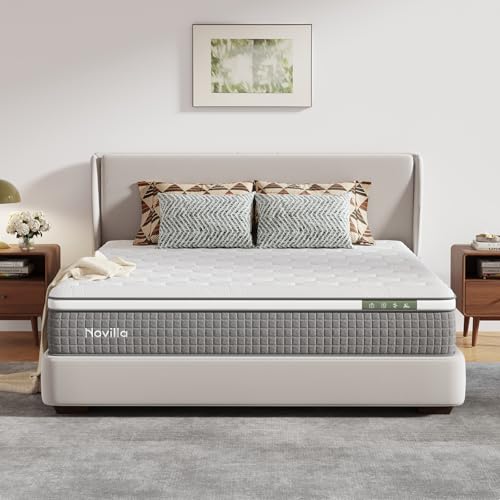
Novilla 10 Inch Hybrid Mattress, Queen (Gel Memory Foam and Pocket Coils)
Who it suits: Side sleepers who want the most mattress this budget can honestly buy — the only pick here with both real thickness and a medium, giving surface.
This is the ceiling of the under-$200 class, and for a side sleeper it earns the top spot on the two numbers that matter: ten inches of total depth, and a comfort stack of gel-infused memory foam and soft comfort foam over hundreds of individually pocketed coils. The pocket coils are the detail that does the work — each coil compresses independently, so the coil under your shoulder can give more than the coil under your ribs, while the unit as a whole still pushes back enough to keep your spine from hammocking. Add targeted support zones and a reinforced perimeter, and this is the one mattress in the guide that can plausibly serve as a side-sleeping couple’s everyday bed. Check price on Amazon for the current price — it sits at the top of this budget class, so confirm the queen listing still fits your budget before you buy.
The feel is maker-described as medium, and the build supports that description better than most: the gel foam top cushions the shoulder and hip while the coils underneath stop the sink before it becomes a sag. Motion isolation is the hybrid’s other honest strength for couples — pocketed coils absorb movement locally instead of broadcasting it across the bed the way a connected innerspring does. Novilla sells the mattress with a 10-year warranty; note that the brand’s 100-night trial is an offer of its own website, so Amazon buyers should judge the bed inside Amazon’s return window instead. Give your shoulder the full expansion window — 24 to 72 hours — before deciding, because a half-expanded hybrid feels firmer than the mattress you actually bought.
- A genuine 10-inch pocket-coil hybrid queen at the top of this budget class — check price on Amazon.
- Gel memory foam and comfort foam over zoned pocket coils — the deepest, most giving comfort stack in this guide.
- Cool-touch knit cover, reinforced edge and a 10-year brand warranty.
Honest limitation: Listings in this class can move, so if the live listing sits above your budget when you check, take the FDW below instead. Even at ten inches, very heavy side sleepers will use most of the comfort layer; this is the best of this budget, not a match for a premium side-sleeper bed.
Choose it if you sleep on your side every night and want one mattress that can serve as a real everyday queen bed. Skip it if you need a bed today at a guaranteed sub-$200 price, or you strongly prefer a firm, lifted feel.
FDW 8 Inch Gel Memory Foam Mattress, Queen
Who it suits: Light and average-weight side sleepers on a strict budget — guest rooms, first apartments and everyday beds for lighter bodies.
FDW is not a famous name, and that is precisely why it is cheap. What the listing offers is the right shape for a side sleeper in this budget class: 8 inches total, built as 2 inches of ventilated gel memory foam over a 6-inch high-density base foam, wrapped in a removable, machine-washable cover — a feature several bigger brands in this guide do not match. Two inches of memory foam is the honest unit of side-sleeper comfort at this level: it is enough to let a lighter or average-weight shoulder sink and spread its load instead of perching on a point, and it is the deepest genuine comfort layer any pick in this budget class here offers. Check price on Amazon for the current price — it is positioned in the lower part of this budget class.
The maker describes the feel as medium firm, and a side sleeper should translate that honestly: the two-layer build reads as supportive rather than plush, and the comfort layer is a fixed depth. Set expectations by the arithmetic and you will not be disappointed — two inches of foam is enough for a lighter side sleeper; it is not enough to keep a heavier side sleeper’s shoulder and hip from reaching the firm base, and no 8-inch foam mattress at any price changes that. If you are over roughly 200 lb and sleep strictly on your side, this mattress plus a topper later is a plan; this mattress alone is a compromise. The washable cover is the practical win — a cover you can unzip and launder beats a spot-clean sermon. One caution that applies here and everywhere in this guide: a removable cover is for washing the cover, and the mattress itself should never be slept on with its cover off; if you ever see glassy fibers, stop and contact the maker rather than vacuuming them deeper into the room.
- Positioned in the lower part of this budget class — check price on Amazon.
- 2 inches of gel memory foam over a 6-inch high-density base — the most sink in this budget class here; CertiPUR-US certified foam.
- Removable, machine-washable cover — rare in this budget class.
Honest limitation: FDW’s warranty and support operation is thinner than the big brands’, and the 2-inch comfort layer runs out under heavier side sleepers, who will feel the firm base through it at the shoulder.
Choose it if you are a light or average-weight side sleeper and the budget is the whole point. Skip it if you are a heavier strict side sleeper buying an everyday bed — the Novilla hybrid’s extra two inches matter more than keeping to the tighter end of the budget.
Novilla 8 Inch Hybrid Mattress, Queen
Who it suits: Combination sleepers who split the night between side and back, and side sleepers who know they prefer a firmer, more lifted surface.
Judged purely as a mattress, this is the most substantial coil build in this budget class: an individually wrapped pocket-coil unit under gel-infused memory foam and comfort foam, in an OEKO-TEX certified knitted cover — check price on Amazon for the current price. Judged as a side sleeper, though, it asks a question the other Novilla does not: the comfort layer over the coils is thinner, the feel is firmer, and the coils push back against the shoulder instead of only receiving it. For a combination sleeper that is a fair trade — the side hours get adequate cushion, the back hours get real support, and the edges hold up when you sit to put shoes on. For a strict side sleeper, especially a lighter one who does not compress the coils much, it can feel unyielding in a way the foam picks do not.
Air moving through the coil unit makes for a less stuffy night than an all-foam build of the same thickness. Like its sibling, it carries Novilla’s 10-year warranty, and the brand’s 100-night trial remains a brand-website offer rather than an Amazon one. The honest summary for this guide’s reader: if your night is half side, half back, this is arguably the pick; if your night is all side, the two mattresses above it here will treat your shoulder better.
- Pocket coils and gel foam in this budget class — check price on Amazon.
- Firmer, more responsive feel — the combination sleeper’s pick in this guide.
- OEKO-TEX certified cover fabric; 10-year brand warranty.
Honest limitation: The comfort layer is thin, so strict side sleepers — especially lighter ones — may find it unyieldingly firm at the shoulder; there is no plush version of this mattress at this price.
Choose it if you split the night between your side and your back, or you like a lifted feel with some give. Skip it if you sleep on your side all night and know you need a soft, deep comfort layer.
Best Price Mattress 6 Inch Green Tea Memory Foam Mattress, Queen
Who it suits: Light side sleepers — children, teenagers and smaller adults — and occasional guest use, from a brand that only makes budget mattresses.
Best Price Mattress is exactly what the name says: a specialist in inexpensive foam beds, and its 6-inch green tea queen is the straightforward version of the idea — check price on Amazon for the current price. Memory foam with a green tea infusion over support and high-density base foams, CertiPUR-US certified, in a cream cover, with the brand’s 10-year warranty behind it. There is no coil unit, no cooling technology story and no zoned anything. What decides this pick’s place in a side-sleeper guide is body weight. Six inches of foam under a light sleeper behaves like a thicker mattress under a heavy one: a child or a small adult does not compress the comfort layer to the base, so the shoulder gets its sink and the bed feels soft-topped and kind. Under an average or heavy adult, the same six inches is a countdown — the shoulder arrives at the base foam quickly, and the bed reads firm no matter what the label says.
For a child’s first big bed, a teenager’s room, or a spare bed that hosts grandchildren twice a month, that is a perfectly rational specification — kids are light and do not bottom out 6-inch foam. The green tea infusion is a freshness treatment, not a comfort feature; expect the usual new-foam smell on opening anyway, and give it a day or two of airing before the first night, as with every pick in this guide. Adults buying for themselves should read the thickness honestly: at 6 inches, this is a light-sleeper and guest mattress, and an average adult side sleeper sleeping on it nightly will feel the base foam doing most of the work within the first year.
- A simple CertiPUR-US foam queen from a specialist budget brand — check price on Amazon.
- Green tea infusion and a 10-year brand warranty.
- Low profile suits kids’ rooms, daybeds and occasional guest use — and light bodies genuinely suit the build.
Honest limitation: The thinnest and simplest build in this guide — right-sized for light sleepers and occasional use, underspecified for an average or heavy adult’s every-night side sleeping.
Choose it if the side sleeper is a child, teenager or light adult, or the bed is for guests. Skip it if you are an average-weight adult buying your own primary mattress — the FDW gives you two more inches.
Zinus 6 Inch Green Tea Memory Foam Mattress, Queen
Who it suits: Buyers who need a thin, light queen — for a bunk, a trundle, an RV, a daybed or a guest room — and want the biggest budget brand’s warranty behind an occasional side sleeper’s bed.
Zinus sells more budget mattresses than anyone, and its Green Tea line is the product most people picture in this budget class. Be precise about which Green Tea queen fits this budget, though, because most of them do not: the 8-, 10- and 12-inch queens sit above this budget. The one that fits this budget class is the 6-inch — check price on Amazon for the current price. Six inches of green-tea- and charcoal-infused memory foam over a sturdy base foam, CertiPUR-US certified, maker-described as medium firm — and in a bed this thin, “medium firm” is honest, because there is barely any soft layer to sink through before the base foam takes over. For a side sleeper that means this mattress has a specific, narrow job: an occasional bed, a light sleeper, a trundle or daybed where a thicker mattress will not fit under the guard rail or the trundle frame. As an everyday bed for an adult side sleeper, it is the wrong tool, and this guide would rather say so than rank it higher on the strength of the brand name.
Zinus is also the brand that forces the fiberglass conversation, so let us have it in the open. Older Zinus mattresses became the best-known fiberglass story in this industry — the flame barrier in earlier models contained fiberglass, and owners who unzipped covers they were never meant to remove released fibers into their homes; the episode produced lawsuits and a permanent change in how the brand builds and describes its beds. Current Zinus listings describe mattresses made without fiberglass. Our advice is the same for every mattress in this guide, and it costs nothing: treat the outer cover as permanent, never unzip or remove it to wash or inspect, and check the live listing’s materials answers before you buy — if a listing cannot tell you what its fire barrier is made of, that silence is itself an answer.
- The only Zinus Green Tea queen that fits this budget class — check price on Amazon.
- Green tea and charcoal infused foam, CertiPUR-US certified, 10-year limited warranty.
- Thin and light — the practical pick for bunks, trundles, RVs and daybeds.
Honest limitation: Six inches is a guest-bed thickness. Adult side sleepers — even average-weight ones — will bottom out onto the base foam at the shoulder and hip, and nobody should buy this as a long-term primary bed for a full-grown side sleeper.
Choose it if you need a thin queen from a major brand with a real warranty, for a light or occasional side sleeper. Skip it if it will be your own every-night bed — step up to the Novilla 10-inch hybrid instead.
FP FLEXPEDIC 10 Inch Firm Hybrid Mattress, Queen
Who it suits: Heavier side sleepers who need real support and will soften the surface with a topper, back-dominant combination sleepers — and almost no one who sleeps strictly on their side. Read this review before the trial seduces you.
This pick comes with a condition a side-sleeper guide has to print plainly: firmness. This is a genuinely firm mattress, built firm on purpose — cooling gel memory foam over a 7-zone individually pocketed spring unit, aimed at sleepers who find “medium” beds mushy. Check price on Amazon for the current price and confirm the queen listing fits this budget before you buy. Firm is a preference, not a virtue, and for a strict side sleeper it is usually the wrong preference: a firm surface holds the shoulder up instead of letting it sink, which is precisely the pressure a side sleeper is trying to escape. The listing’s own firmness language should be believed over any reviewer’s, including ours.
Why is it in this guide at all? Because of the one thing no other pick here offers: a 365-night trial stated in the listing itself, alongside a 10-year warranty, CertiPUR-US certified foam and an explicitly fiberglass-free build. A year-long trial changes the risk maths of buying a mattress you cannot lie on first, and it is almost unheard of at this level. There is a legitimate side-sleeper case for it, and it is this: a heavier side sleeper, whose shoulder sinks through every soft comfort layer in this guide to the hard base beneath, may genuinely sleep better on a firm, supportive 10-inch hybrid with a soft topper added — support from the mattress, sink from the topper, and a year to find out. If that is not your plan, the honest move is to leave this pick alone: a strict side sleeper who wants softness out of the box should take the Novilla 10-inch hybrid at the top of this guide.
- The only pick with a true long trial: 365 nights, stated in the listing, plus a 10-year warranty.
- Explicitly fiberglass-free, CertiPUR-US certified, 7-zone pocket springs — real support for heavier bodies.
- Ten full inches: the support half of a mattress-plus-topper plan for a heavy side sleeper.
Honest limitation: Check the current price on Amazon and confirm it fits your budget before you buy — and its firmness will be wrong for most side sleepers regardless, trial or no trial.
Choose it if you are a heavier sleeper who needs support first and plans to add a topper, or you sleep mostly on your back and land here from a side-sleeper search by mistake. Skip it if the offer is not live, or you sleep strictly on your side and want the softness built in.
Comparison Table
| Product | Type | Thickness | Firmness (maker) | Price | Link |
|---|---|---|---|---|---|
| Novilla 10 Inch Hybrid, Queen | Pocket-coil hybrid | 10 in | Medium | Check price on Amazon | Check on Amazon |
| FDW 8 Inch Gel Memory Foam, Queen | All-foam | 8 in | Medium firm | Check price on Amazon | Check on Amazon |
| Novilla 8 Inch Hybrid, Queen | Pocket-coil hybrid | 8 in | Medium firm | Check price on Amazon | Check on Amazon |
| Best Price Mattress 6 Inch Green Tea, Queen | All-foam | 6 in | Medium firm | Check price on Amazon | Check on Amazon |
| Zinus 6 Inch Green Tea, Queen | All-foam | 6 in | Medium firm | Check price on Amazon | Check on Amazon |
| FP FLEXPEDIC 10 Inch Firm Hybrid, Queen | Pocket-coil hybrid | 10 in | Firm | Check price on Amazon | Check on Amazon |
How to Choose a Mattress for Side Sleepers Under $200
- Fix the size before you compare. Every pick in this guide is a queen. Twin and full versions of the same mattresses are positioned lower, and king versions higher — a low advertised headline is usually the twin, so confirm the size selector on the listing before comparing anything, and check price on Amazon for the queen.
- Count comfort inches, not just total inches. A side sleeper lives in the top two or three inches of the mattress. Ask what the comfort layer is made of and how deep it runs before you ask about the total: 8 inches with a real 2-inch memory foam top will treat a shoulder better than 10 inches that is mostly firm base.
- Match thickness to your weight, honestly. Light side sleepers (under roughly 150 lb) can sleep on 6 to 8 inches without bottoming out. Average side sleepers should start at 8 inches and prefer 10. Heavier side sleepers (over roughly 200 lb) will use up the comfort layer of everything in this guide — buy the 10-inch hybrid, or buy support here and sink from a topper.
- Distrust the firmness adjective; use the construction. There is no industry standard behind “medium.” A thin mattress feels firmer than its label because you reach the base sooner, and a coil unit pushes back in a way foam does not. The build tells you more than the word.
- Decide whether you are strict or combination. If you spend the whole night on one side, softness and depth outrank everything — take the top two picks. If you rotate between side and back, a firmer hybrid serves both positions and the 8-inch Novilla becomes a sensible choice rather than a compromise.
- Budget the pillow with the mattress. Pillow height and mattress softness are one system for a side sleeper: the softer the mattress, the deeper your shoulder sinks, and the less pillow loft you need to keep your head level. Plan to re-check your pillow after the mattress arrives — the section below explains the maths.
- Never remove the outer cover. Whatever brand you buy, treat the cover as a permanent part of the mattress. Some budget fire barriers have historically contained fiberglass, and the fibers only become a problem when a cover is unzipped, torn or removed. If washability matters, buy a mattress protector that goes over the whole bed instead — the one washable-cover pick in this guide is the exception, and even there the mattress is never slept on uncovered.
- Check what the trial actually covers. Brand-website trials usually do not apply to Amazon purchases. On Amazon, your protection is Amazon’s return policy for mattresses plus the maker’s warranty — read both on the listing, and photograph the law label on delivery day in case you ever need the warranty.
- Give the foundation its share of blame. A thin budget mattress on wide-spaced slats will sag between them and feel broken within months — and a side sleeper feels a sag as a shoulder problem first. Slats should be no more than about 3 inches apart for foam and hybrid beds in a box; a sheet of plywood or a bunkie board is a cheaper fix than a new mattress.
- Allow the full expansion time before you judge. These mattresses arrive compressed and need 24 to 72 hours to reach full height, longer in a cold room. A hybrid judged in its first hour feels firmer than the bed you bought. Judge the shoulder test after that window, not before it.
Thickness Is the Tax — and Side Sleepers Pay It First
Every mattress guide at this budget has to explain where the money goes, but side sleepers should read the explanation differently, because the line item this budget starves is the one they sleep on. In a $200 queen, almost none of the money is in the comfort layer. Two inches of gel memory foam is the standard top at this level, and the rest divides between a thick slab of high-density base foam or a pocket-coil unit, a knit cover, compression, boxing and freight. A back sleeper distributes weight across a broad surface and can sleep happily on a thin comfort layer over firm support; the support is doing the work. A side sleeper concentrates the same weight onto a shoulder and a hip, and only the comfort layer stands between those points and the support beneath. Starve the comfort layer and the back sleeper barely notices. The side sleeper notices in the first hour.
That is the honest frame for the thickness ladder in this guide. At 6 inches you are buying a guest-and-kids mattress, whatever the listing calls it — fine for light bodies, wrong for an adult who will sleep on their side nightly. At 8 inches you reach the first plausible everyday bed for a lighter side sleeper, because the comfort layer finally has a support layer thick enough to stand behind it. At 10 inches — reached here only by the two hybrids — a queen starts to serve an average side sleeper properly, with enough total depth that the sink has somewhere to go. What $200 does not buy at any thickness is a deep, plush comfort stack of the kind premium side-sleeper mattresses advertise, or a 15-year service life: plan on roughly five to eight years from the hybrids and less from the thin foam beds under nightly adult use, and the trade-offs look fair rather than disappointing.
Listings in this class can change, and it is worth understanding that before it bites you. The same queen mattress can be presented differently from week to week, and old listings accumulate third-party sellers asking well above the usual range. The only listing that counts is the featured offer on the live listing for the exact size you are buying — check price on Amazon there rather than relying on a marketplace seller. If a pick sits above your budget when you check, the guide tells you which pick to take instead.
Fiberglass: The Warning This Price Class Has Earned
No honest guide to mattresses under $200 can skip this section, because the cheapest way to pass the federal flammability standard is a sock of fiberglass yarn knitted around the foam, and for years that is what many budget mattresses — including models from the biggest names in this guide’s category — quietly used. Fiberglass inside an intact mattress is not a hazard in normal use. The problem arrives when the outer cover is unzipped or torn: the fibers escape, spread through bedding, carpets and washing machines, irritate skin and lungs, and are notoriously difficult and expensive to clean up. Owners learned this the hard way, most publicly with older Zinus mattresses, where covers that looked removable released fibers into homes and the dispute ended in litigation and settlements.
The industry has moved. Current listings from the major budget brands increasingly state “fiberglass free” in so many words — one pick in this guide carries it in its very title — and barriers made from rayon and silica blends have replaced glass in most current models. But “most” is not “all,” and marketplace listings are a mix of current and legacy stock. Three habits protect you completely. First, before buying, search the listing’s questions and answers for “fiberglass” and read what the seller says; a clear answer is a good sign, and an evasive one is a reason to choose another pick from this guide. Second, never unzip or remove the outer cover of any mattress in this class, for any reason — wash a removable protector over it instead, and treat a torn cover as a warranty claim, not a sewing project. Third, be most careful with second-hand and returned-stock mattresses, where you cannot know what a previous owner did to the cover. Follow those rules and the fiberglass question goes back to being what it should be: a reason to buy carefully, not a reason to sleep badly on a mattress you already own.
Pillow Height: The Other Half of the Side-Sleeper Equation
Side sleepers shopping for a mattress often fix the wrong half of the system. When you lie on your side, your head has to be held level across the width of your shoulder — and how much pillow that takes depends directly on how deep your shoulder sinks into the mattress. On a firm or thin mattress, the shoulder stays high, the gap between your head and the bed is wide, and you need a loftier pillow to fill it. On a softer, deeper mattress — the hero pick here, or any pick with a topper added — the shoulder sinks, the gap narrows, and the same pillow that felt right on the old bed now holds your head too high and bends your neck the other way.
The practical rule is to treat the pillow as the second half of this purchase, not a separate one. When the mattress arrives, let it expand fully, then lie on your side with your current pillow and check whether your head feels level or tipped. If you have moved from a firm, thin bed to a softer, thicker one, expect to need less loft. If you have bought one of the firmer or thinner picks here and kept a low pillow from a soft old bed, expect the opposite. Getting this right costs little or nothing, and can matter as much as the choice between the picks themselves. What it cannot do is rescue a mattress whose comfort layer your shoulder has already bottomed out — a pillow adjusts your head, not your hip — which is why this guide ranks thickness and comfort depth first and treats the pillow as the fine-tuning it is.
Too Firm? The Topper Is the Realistic Fix
Here is the upgrade path this guide recommends without embarrassment: if the mattress you can afford under $200 is firmer or thinner than your shoulder wants — and for many side sleepers it will be — the fix is a topper, not a more expensive mattress you cannot buy. A 2- to 3-inch memory foam topper laid over a supportive budget mattress adds exactly the layer this budget starves: depth for the shoulder and hip to sink into, sitting on support that stops the sink from becoming a sag. A too-firm mattress can always be softened; a too-soft one cannot be firmed up, which is why this guide leans toward support when a side sleeper is undecided.
The pairing logic follows from the reviews. The firm FLEXPEDIC plus a soft topper is the heaviest side sleeper’s plan in this guide — support below, sink above, and a 365-night trial to test the combination. The 8-inch Novilla hybrid plus a topper is the combination sleeper’s version of the same idea. And the thin 6-inch picks, which this guide assigns to light sleepers and guests, are the ones a topper helps least as a primary-bed strategy: a topper on a 6-inch mattress makes an 8- or 9-inch bed whose base is still a guest-grade base, fine for a spare room and a false economy for your own back. Read the mattress topper guides alongside this one — including the side-sleeper topper picks — before you spend, and remember the order of operations: mattress for support, topper for sink, pillow for the last inch of alignment.
Common Buying Mistakes
- Comparing a twin price from an advertisement with a queen price on the listing, and feeling cheated by arithmetic that was never hidden.
- Buying a 6-inch mattress as an everyday bed for an adult side sleeper, then blaming the brand when the shoulder finds the base foam — thickness is a specification, not a defect.
- Trusting the firmness adjective over the construction: a “medium” 6-inch foam bed and a “medium” 10-inch hybrid are different mattresses that happen to share a word.
- Choosing the firm pick for its long trial and discovering that a trial does not soften a mattress — firmness is the one thing a return window cannot change about the nights before you use it.
- Keeping a high-loft pillow from a firm old bed on a new softer mattress, then reviewing the mattress for a bent neck the pillow caused.
- Unzipping the outer cover to wash it or “check the foam,” the single action that turns the fiberglass question from theory into a cleanup bill.
- Assuming the brand’s 100-night trial applies to an Amazon purchase, and discovering on day 40 that Amazon’s return window was the real trial.
- Judging a bed-in-a-box in its first hour, before it has expanded — a half-expanded hybrid feels firmer than the mattress you bought, and side sleepers judge firmness first.
- Putting a new mattress on wide-spaced slats or a worn box spring, then blaming the mattress for a sag that starts at the shoulder.
- Paying a marketplace seller’s inflated price on an old listing — always check you are buying the featured offer on the current listing, not a third party’s inflated listing.
Final Recommendation
- Most side sleepers: Novilla 10 Inch Hybrid Mattress, Queen.
- Light and average side sleepers on a budget: FDW 8 Inch Gel Memory Foam Mattress, Queen.
- Combination sleepers: Novilla 8 Inch Hybrid Mattress, Queen.
- Kids, teens and light sleepers: Best Price Mattress 6 Inch Green Tea Memory Foam Mattress, Queen.
- Bunks, trundles and guest beds: Zinus 6 Inch Green Tea Memory Foam Mattress, Queen.
- Heavier sleepers planning a topper: FP FLEXPEDIC 10 Inch Firm Hybrid Mattress, Queen.
Our top two are the Novilla 10-inch hybrid for any side sleeper furnishing a real everyday queen bed — it is the only pick here that combines 10 inches, pocket coils and a giving medium surface in this budget class — and the FDW 8-inch for lighter side sleepers and tighter budgets, because it delivers the deepest honest comfort layer in the class inside a certified, washable-covered foam queen, positioned in the lower part of this budget class — check price on Amazon. Between them they cover the two realistic side-sleeper jobs at this budget: a bed with enough depth to sink into, and a bed with enough foam to get by. If neither fits — because you are a heavier strict side sleeper — the honest answer in this guide is the FLEXPEDIC-plus-topper plan or a larger budget, and we would rather print that than pretend a 6-inch foam queen will treat your shoulder kindly. Whichever you choose, confirm the queen is the size selected, check the featured offer rather than a marketplace price, keep the cover zipped forever, re-check your pillow height once the bed has expanded, and judge the mattress after a week of nights — a $200 mattress bought with open eyes is a bargain; the same mattress bought on a headline is how this category earns its bad reviews.
Frequently Asked Questions
Can a side sleeper really use a mattress under $200?
Yes, within the limits this guide states. A light or average-weight side sleeper can sleep well on the 10-inch hybrid or the 8-inch foam pick here, and a combination sleeper has real choices. What this budget cannot give a side sleeper is a deep, plush comfort stack, and heavier strict side sleepers will bottom out the comfort layers of everything listed — for them, the honest options are the firm hybrid plus a topper, or a bigger budget. Judge the picks against the right body and the right job.
How thick should a side sleeper’s mattress be?
Thicker than other sleepers need, because your shoulder and hip sink further than a back sleeper’s weight spread across the bed. As a working rule from this guide’s picks: 6 inches is for light sleepers, kids and guests; 8 inches is the minimum for an average adult side sleeper’s nightly bed; 10 inches is where this budget starts to feel genuinely comfortable for side sleeping. And count the comfort layer, not just the total — the top two or three inches are where a side sleeper lives.
Is a firm mattress bad for side sleepers?
For most strict side sleepers, yes — a firm surface holds the shoulder up instead of letting it sink, so the body’s weight stays concentrated on the shoulder and hip points rather than spreading. That is why the firmest pick in this guide is ranked last for side sleepers despite having its best trial. The exceptions are heavier side sleepers, who may sink through a soft comfort layer to the hard base anyway and do better with firm support plus a topper, and combination sleepers who spend half the night on their back.
Will a mattress under $200 help with shoulder or hip pain?
A mattress is furniture, not a medical treatment, and no bed in this guide treats shoulder pain, hip pain or any other condition. What a mattress can do is stop making things worse: a surface with enough give that your shoulder is not perched on a pressure point is more comfortable for most side sleepers than a worn-out or rock-hard bed. If pain is persistent, worsening, or comes with numbness, tingling or weakness, see a clinician rather than shopping for a cure — and take their advice about your sleep surface over any guide’s, including this one.
Foam or hybrid for a side sleeper under $200?
It depends on your weight and how strict your side sleeping is. All-foam isolates motion best and gives the most uniform sink, which lighter side sleepers tend to love; its weakness is that a thin foam bed’s comfort layer is all there is. A hybrid’s pocket coils compress independently, so the shoulder coil can give more than its neighbors, and coils add total support for heavier bodies — but at this price the comfort layer over the coils is thinner, which is why the firmer hybrid here suits combination sleepers better than strict ones. Our working rule: strict and lighter, take the foam or the 10-inch hybrid; combination or heavier, take a hybrid and consider a topper.
Does the sleep trial apply if I buy on Amazon?
Usually not. The long trials in mattress marketing — 100 nights and similar — are typically offers of the brand’s own website. An Amazon purchase is covered by Amazon’s return policy plus the maker’s warranty, which is why this guide flags the one pick, the FLEXPEDIC, whose listing itself states a 365-night trial. Read the listing’s own terms before you buy, and keep the packaging until the return window closes.
What if the mattress feels too firm for my shoulder?
First, give it the full expansion window and a week of nights — a bed judged in hour two is not the bed you bought, and your body needs time to adjust to any new surface. Second, check your pillow: too much loft on a new mattress bends the neck and can masquerade as a shoulder problem. If it still feels too firm after that, a 2- to 3-inch memory foam topper is the realistic fix — it adds the sink this budget could not include — and it is a cheaper correction than replacing the mattress. A too-soft mattress has no equivalent fix, which is why this guide leans toward support for undecided buyers.
Do these mattresses contain fiberglass?
It depends on the model and the year it was made, which is why this guide treats the question listing by listing. Current models from the major budget brands are increasingly sold as fiberglass-free — one pick states it in its title — but legacy stock exists, so search the listing’s Q&A for the word before buying. Whatever you buy, never remove the outer cover: fibers only become a household problem when a barrier is exposed.