Disclosure: topratedkitchenware.com is reader-supported. When you buy through links on our site, we may earn an affiliate commission from Amazon and other retailers, at no extra cost to you.
Where to buy
The six grinders below are the strongest candidates in our research pool for anyone comparing the best meat and bone grinders for dog raw diet prep at home. One fact must lead, because honest raw feeding starts with honest equipment claims: none of these six Amazon listings states a bone-grinding capacity, and only one — the AAOBOSI touch model — explicitly names raw pet food as a designed role. This guide therefore judges the picks on what their listings do state (power class, head format, construction, kit, cleanup and storage features) and on how well each fits the real weekly workflow of raw feeding, while telling you exactly what to confirm with a manufacturer before any bone is ground at home.
- RVGMBO 5.0 Upgrade Electric Meat Grinder — Check on Amazon
- FOHERE Electric Meat Grinder, #12 Head, 1 HP
- Aiheal Electric Meat Grinder (Black)
- AAOBOSI Electric Meat Grinder with 3-Speed Touch Screen
- AAOBOSI Multifunctional Digital Meat Grinder
- VEVOR #12 Electric Meat Grinder, 750W / 1 HP
Read the full guide ↓ for the pick-by-pick analysis, a plain-spoken bone briefing, a complete raw-prep workflow, and hygiene and storage guidance for feeding raw safely at home.
Households searching for the best meat and bone grinders for dog raw diet are usually trying to solve a practical problem, not collect a gadget. Commercial raw food is convenient but costly and opaque; whole-bone feeding suits some dogs and some owners and worries others; and the middle path — grinding at home, where you control the proteins, the organs, the bone fraction and the hygiene — needs a machine that can keep up with a weekly routine for years. That routine is the real subject of this guide. A raw-diet grinder is not used twice a year for a celebration sausage; it is used every week, in batches sized to your dog and your freezer, with raw poultry and organ meats in the mix, and it is washed to a standard a burger grinder never meets.
Judged against that routine, the questions change. Throughput matters because a month of food for a large dog is a serious pile of meat. Plate and blade supply matters because organ meats and connective tissue are unkind to dull edges. Cleanup design matters because a machine that takes twenty minutes to wash properly will, in real life, eventually be washed in five — and raw feeding does not forgive that shortcut. And the bone question matters most of all, which is why this guide refuses to blur it: bone content can reach a raw diet by several routes, only one of which involves grinding bone yourself, and our companion research at Best Meat Bone Grinders works through the machine-strength side of that decision in depth.
Key Takeaways
- No listing here states a bone-grinding capacity. If your recipe grinds whole bone, confirm the exact model’s bone specification with its manufacturer, in writing, before buying — or build the bone fraction from pre-ground bone instead.
- The AAOBOSI touch model is the only pick whose listing explicitly names raw pet food, and its built-in storage and stated easy cleanup suit the weekly raw routine.
- For bulk prep, the FOHERE (#12 head, 1 HP, stated 8.8 lbs/min) and the VEVOR #12 (stated 552 lbs/H) are the volume formats in this list.
- The RVGMBO ships with 3 sets of 304 stainless steel blades and plates — the deepest cutting-set supply here, valuable when edges are a recurring cost.
- Raw prep hygiene is a system: cold meat, small batches, immediate washing, complete drying, and portioned freezing. The grinder is only one part of it.
- Work with your veterinarian or a qualified canine nutrition professional on recipe balance; a grinder controls texture and freshness, not nutritional completeness.
In this guide
Quick Picks
| Pick | Badge | What its listing states | Link |
|---|---|---|---|
| RVGMBO 5.0 Upgrade | Best Cutting-Set Supply | 3500W motor class, 3 sets of 304 stainless steel blade and plate, kubbe and sausage kit | Check on Amazon |
| FOHERE #12 | Best Home Throughput | 1 HP, #12 head, 600W all-copper motor (3600W peak), stated 8.8 lbs/min, stainless plates | Check on Amazon |
| Aiheal Electric | Best Overall | 3200W Max, stainless steel, 2 blades, 3 plates, 3 sausage tubes | Check on Amazon |
| AAOBOSI Touch Screen | Best for Raw Pet Food | 3000W Max, stated 4 lbs/min, built-in storage, raw pet food role, LFGB approval stated, easy cleanup stated | Check on Amazon |
| AAOBOSI Digital | Best for Beginners | 3000W Max, 9 presets, auto-reverse, built-in storage | Check on Amazon |
| VEVOR #12 | Best for Multi-Dog Bulk Prep | 750W / 1 HP, stated 552 lbs/H, two plates, three stuffing tubes, kibbe kit, ETL listing stated | Check on Amazon |
How These Picks Were Chosen
The pool for this guide was read through a raw feeder’s eyes. Priority went to stated throughput and format (the two #12 machines and the RVGMBO’s motor class), to cutting-set depth (the RVGMBO’s three blade-and-plate sets; three-plate kits elsewhere), to routine features that decide whether weekly prep stays sustainable (built-in storage and stated easy cleanup on the AAOBOSI models, auto-reverse for stall-prone connective tissue on the digital model), and to any explicit pet-food relevance in a listing — which exactly one pick, the AAOBOSI touch model, provides. Certifications were noted where stated: an ETL listing on the VEVOR and LFGB approval on the AAOBOSI touch model.
The exclusions matter as much as the inclusions. No pick was credited with bone-grinding ability, bone-in throughput or a bone-rated plate, because no listing claims those things, and in raw feeding the cost of a wrong assumption is a destroyed grinder at best. No nutritional claims are made for any machine, because grinders do not balance diets — people do, ideally with professional guidance. What this guide can honestly do is match machines to workloads: a single small dog eating a few pounds a week is a different brief from three large dogs eating a freezer shelf a month, and the reviews below are organised around that difference. Readers comparing the wider category should also see Best Meat Grinders, and anyone whose plan centres on bones specifically should read Best Meat Grinders For Bones before spending anything.
The 6 Best Meat and Bone Grinders for Dog Raw Diet Prep

RVGMBO 5.0 Upgrade Electric Meat Grinder
Badge: Best Cutting-Set Supply
Strengths
- Three full sets of 304 stainless steel blades and plates — an unusually deep supply of the parts raw prep wears fastest.
- A 3500W-class motor brief aimed at fast home grinding.
- Kubbe and sausage kit included, useful for training treats and portioned extras.
Trade-offs
- No throughput figure, head size or certification is stated in the listing title.
- The listing’s speed language is a marketing claim; your real pace will be set by chilling and feeding, as with any grinder.
- No bone capacity is stated — as with every pick here, that question goes to the manufacturer.
Mini spec box (from the listing): Type: electric, home use · Motor class: 3500W · Blades and plates: 3 sets, 304 stainless steel · Kit: kubbe and sausage kit.
Raw feeding consumes cutting edges. Organ meats are soft but slippery, connective tissue is abrasive in its own way, and a weekly routine multiplies small wear into dull plates faster than occasional burger duty ever does. That is why the RVGMBO’s listing leads this guide: three complete sets of blades and plates in 304 stainless steel means you can rotate sets — one working, one washed and dried, one rested — and always have a sharp pair ready, instead of discovering mid-batch that your only plate has gone dull. In a routine built on consistency, that supply is a genuine quality-of-life feature.
The motor brief is aimed at speed, and for boneless raw prep — muscle meat, heart, organs, the occasional batch of green tripe for the brave — a fast, confident grind shortens the time raw meat spends out of refrigeration, which is a hygiene benefit as much as a convenience. Who it suits: the committed home raw feeder grinding boneless or pre-ground-bone recipes weekly, who wants the cutting-set problem solved in the box. The honest limitation is documentation: the listing does not state a head size, a rate or a certification, and it does not mention bones. Buy it for the workflow it demonstrably fits, and direct any whole-bone ambitions to the manufacturer first.
Best for: weekly boneless raw prep with rotating sharp cutting sets / Not suited for: buyers who want stated head size, rate or bone capacity

FOHERE Electric Meat Grinder, #12 Head, 1 HP
Badge: Best Home Throughput
Strengths
- #12 head with a stated 8.8 lbs/min rate — the fastest stated home figure in this list.
- Motor described two ways in the listing: 600W all-copper, 1 HP, with a 3600W peak figure.
- Stainless plates, sausage nozzle and kubbe kit included for home use.
Trade-offs
- Peak and continuous figures in one listing need careful reading — the 600W all-copper figure is the meaningful one for sustained work.
- No certification or blade/plate count is stated in the listing title.
- No bone capacity is stated.
Mini spec box (from the listing): Type: electric, home use · Head: #12 · Motor: 600W all-copper, 1 HP (3600W peak stated) · Stated rate: 8.8 lbs/min · Plates: stainless · Kit: sausage nozzle, kubbe kit.
Volume is the FOHERE’s whole argument, and for raw feeding it is a strong one. A large dog can eat its way through a startling amount of food in a month, and multi-dog households multiply that again; a grinder that moves boneless meat at a stated 8.8 lbs/min through a #12 head turns a month’s prep into a single manageable session, with the meat spending less time warming on the counter. The #12 format brings the standardisation benefit too — plates in this size class are a well-populated market, which matters when you want a second plate texture for different proteins or a replacement on short notice.
The listing’s motor language deserves the careful reading this guide keeps recommending: it states a 3600W peak alongside a 600W all-copper motor and 1 HP. Read the copper figure as the worker and the peak as the headline, and the machine still makes its case — an all-copper winding is the right material for sustained torque. Who it suits: large-dog and multi-dog households prepping in bulk, especially those portioning and freezing weeks ahead. The honest limitation is the familiar one: no bone statement, and kit counts that must be confirmed on the product page. Within boneless and pre-ground-bone workflows, though, this is the home throughput pick.
Best for: bulk boneless raw prep for large or multiple dogs / Not suited for: small households or assumed bone duty

Aiheal Electric Meat Grinder, Stainless Steel (Black)
Badge: Best Overall
Strengths
- 3200W Max class with stainless steel construction — a strong, simple specification.
- Three plates and two blades support texture variety across proteins and a dedicated pair for organ-heavy batches.
- Three sausage tubes extend the machine into treats and portioned extras.
Trade-offs
- Gear material and certification are not stated in the listing title.
- No storage system; the cutting set lives in your drawer.
- No pet-food role is stated — its case is general strength and kit.
Mini spec box (from the listing): Type: electric, home kitchen use · Rating: 3200W Max · Blades: 2 · Plates: 3 · Sausage tubes: 3 · Body: stainless steel, black finish.
The Aiheal is the balanced answer for the raw feeder who wants one strong machine without a specialisation. Three plates matter in this kitchen more than in most: a coarse grind for chunky texture some dogs prefer, a medium for the everyday mix, and a finer pass for puppies, seniors or cats in a mixed household — and with two blades, the pair that handles your organ-heavy batches can stay dedicated to them. The 3200W Max class is the largest home size in this guide’s pool, and the stainless construction suits a machine that will be washed constantly.
Who it suits: the single- or two-dog household grinding weekly, mixing proteins, and valuing a complete kit over connected features. The honest limitation is that nothing in the listing speaks the language of pet food at all — no stated role, no stated bone capacity, no stated gear material. It earns its place here the way it earns its place in our Best Meat Grinders Canada research too: as a strong, complete, mainstream grinder whose abilities are exactly what its listing says they are. For raw feeding within those stated abilities, that is a perfectly sound foundation.
Best for: balanced weekly raw prep for one or two dogs / Not suited for: buyers wanting a stated pet-food role or bone capacity

AAOBOSI Electric Meat Grinder with 3-Speed Touch Screen Control
Badge: Best for Raw Pet Food
Strengths
- The only listing in this pool that explicitly names raw pet food as a designed role.
- Built-in storage and stated easy cleanup — the two features a weekly raw routine depends on most.
- LFGB approval stated; 3-speed control includes a gentle speed for controlled feeding.
Trade-offs
- Stated 4 lbs/min is a home-scale rate; bulk months for several large dogs will take patience.
- “Raw pet food” is not a bone claim — the listing does not state bone capacity.
- Touch controls need dry-ish fingers; set the speed before handling meat.
Mini spec box (from the listing): Type: electric · Rating: 3000W Max · Controls: 3-speed touch screen · Stated rate: 4 lbs/min · Storage: built-in · Approval stated: LFGB · Roles: sausage, burger, raw pet food.
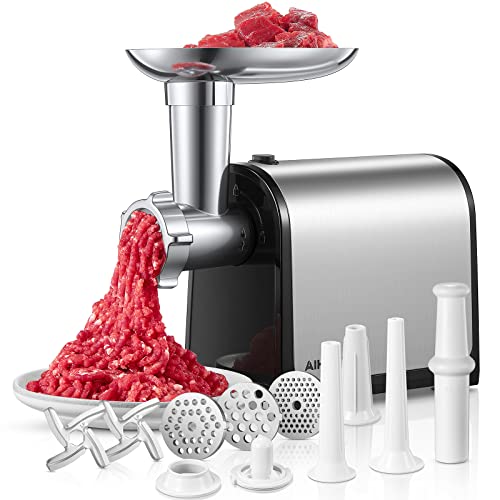
There is a particular value in a manufacturer saying the quiet part out loud. Every other listing in this guide must be interpreted into raw feeding; this one’s maker states raw pet food as one of the machine’s three designed roles, alongside sausage and burgers. That statement, combined with the two features that decide whether a weekly raw routine survives — easy cleanup, explicitly claimed, and built-in storage that keeps the cutting set washed, dried and together — makes this the most routine-honest pick in the list for the average raw-feeding household.
The 3-speed control fits the work: a slow speed for controlled feeding of dense or slippery material, faster speeds for straightforward muscle meat, and a stated 4 lbs/min rate that honestly frames it as a household machine rather than a production line. Who it suits: raw feeders with one or two dogs, boneless or pre-ground-bone recipes, and a premium on a sustainable weekly habit. The honest limitation is scale, plus the standing bone caveat — this listing’s pet-food role makes the manufacturer the most natural first recipient of your bone question, and their answer, not this guide, settles it. Shoppers who verify claims carefully will appreciate the approach in Best Meat Grinders Consumer Reports as a companion read.
Best for: sustainable weekly raw prep for one or two dogs / Not suited for: multi-dog bulk volume or assumed bone grinding
AAOBOSI Multifunctional Digital Meat Grinder
Badge: Best for Beginners
Strengths
- Auto-reverse rescues the stalls that organ meats and connective tissue reliably cause — the beginner’s most common frustration.
- 9 presets make a recipe repeatable: same program, same texture, batch after batch.
- Built-in storage keeps the whole kit in one washable, findable place.
Trade-offs
- No rate, head size or certification is stated in the listing title.
- Presets cannot judge meat temperature or freshness — the cold discipline is still yours.
- No bone capacity is stated.
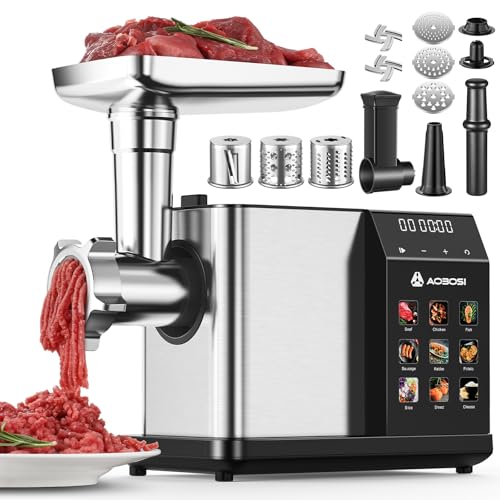
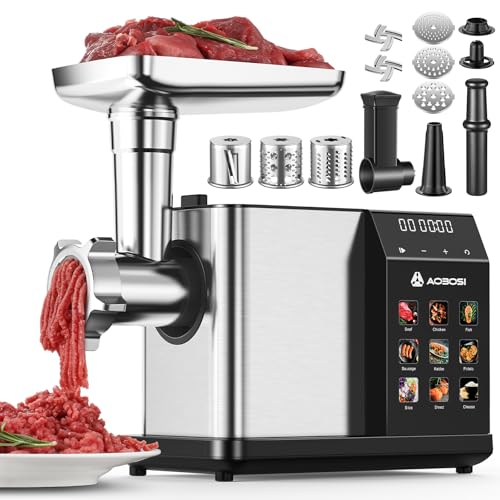
Mini spec box (from the listing): Type: electric, digital · Rating: 3000W Max · Controls: touch screen, 9 presets · Feature: auto-reverse · Storage: built-in · Roles: grinding, sausage, kibbe, cheese grating.
Beginning raw feeders quit for predictable reasons: a batch that stalls the machine and turns into an hour of dismantling, a texture that comes out different every time, a cleanup that eats the evening. This AAOBOSI answers all three failure points directly. Auto-reverse turns the stall into a pause. Presets turn texture into a setting you can write in your recipe notes — program, plate, protein — and reproduce exactly next month. Built-in storage turns cleanup into a closed loop: wash, dry, store inside the machine, done.
That forgiveness is worth real money to a household building a new habit, and the 3000W Max class underneath it is the mainstream home size, adequate for the boneless and pre-ground-bone recipes that sensible beginners start with. Who it suits: first-time raw feeders, and anyone whose previous grinder died by stall-and-force. The honest limitation is that guidance features do not substitute for the two disciplines raw feeding cannot outsource — keeping everything cold, and building a nutritionally complete recipe with professional input. The machine will happily grind an unbalanced diet with perfect texture; the balance is your department, and your vet’s.
Best for: new raw feeders who need a forgiving, repeatable routine / Not suited for: buyers wanting stated throughput or bone capacity

VEVOR Meat Grinder, #12 Electric Meat Mincer, 750W / 1 HP
Badge: Best for Multi-Dog Bulk Prep
Strengths
- Stated 552 lbs/H from a 750W / 1 HP motor through a #12 head — the production format of this list.
- ETL listing stated, with two plates, three stuffing tubes and a kibbe kit.
- Positioned by its maker for kitchens or restaurants — duty language that matches bulk prep.
Trade-offs
- Two plates only; a bulk raw routine will want the plate ecosystem checked before committing.
- Size and weight make it a permanent installation, not a cupboard appliance.
- No bone capacity is stated, even at this format — the manufacturer question still applies.
Mini spec box (from the listing): Type: electric · Head: #12 · Motor: 750W / 1 HP · Stated rate: 552 lbs/H · Plates: 2 · Stuffing tubes: 3 · Kit: kibbe kit · Certification stated: ETL listing · Use: kitchens or restaurants.
At the top end of home raw feeding, the arithmetic changes character. Several large dogs can require food by the tens of pounds per batch, and at that scale the grinder stops being a kitchen gadget and becomes the bottleneck of a small production process: meat waiting, meat warming, people tiring. The VEVOR exists for that arithmetic. A #12 head, a motor stated in continuous terms, and a throughput figure aimed at kitchens and restaurants mean the grinding stage stops being the long pole of prep day, and the session compresses back into the window where cold-chain discipline is easy to keep.
Who it suits: multi-dog households, breeders, and raw feeders who buy whole animals or bulk cases and prep monthly. It is also the format to consider if your household’s dogs are large and your freezer is a chest. The honest limitations are footprint and the standing caveat: it is a lot of machine for a small kitchen, its included plate count is the slimmest here, and its listing — for all its production language — does not state bone capacity. Treat it as the bulk boneless and pre-ground-bone champion, verify anything beyond that with VEVOR, and it will not disappoint. Review-reading shoppers should also see Best Meat Grinders Fakespot for how to weigh owner reports on machines in this class.
Best for: bulk monthly prep for several or large dogs / Not suited for: small kitchens, small batches, or assumed bone duty
Comparison Table
| Pick | Stated format / rate | Raw-diet-relevant stated feature | Bone stated? | Link |
|---|---|---|---|---|
| RVGMBO | 3500W class | 3 sets of 304 stainless blades and plates | No — confirm with maker | Check on Amazon |
| FOHERE | #12 head, stated 8.8 lbs/min | 600W all-copper motor, 1 HP | No — confirm with maker | Check on Amazon |
| Aiheal | 3200W Max | 3 plates, 2 blades, stainless body | No — confirm with maker | Check on Amazon |
| AAOBOSI Touch | 3000W Max, stated 4 lbs/min | Raw pet food role stated; storage; easy cleanup stated | No — confirm with maker | Check on Amazon |
| AAOBOSI Digital | 3000W Max | Auto-reverse; 9 presets; storage | No — confirm with maker | Check on Amazon |
| VEVOR #12 | 750W / 1 HP, stated 552 lbs/H | Production format; ETL listing stated | No — confirm with maker | Check on Amazon |
The Bone Question, Answered Plainly for Dog Owners
Raw diets for dogs traditionally include bone because bone carries minerals that muscle meat alone does not, and because chewing and digesting bone is part of the ancestral model raw feeding follows. But there are three honest ways that bone fraction reaches the bowl, and only one of them loads your grinder. You can buy the bone portion pre-ground from a raw-food supplier and grind only the meat and organs yourself — full control of everything else, zero bone risk to the machine. You can feed appropriate raw meaty bones whole, separately from the ground portion, under your own supervision philosophy. Or you can grind whole bone-in portions at home — which is legitimate only with a machine whose manufacturer specifies it for the bone types you intend, in writing, because bone is the highest shock load a grinder ever sees and dense weight-bearing bones will destroy any machine in this guide.
If the third route is your plan, narrow it before you shop: small, soft bones from small animals are the only candidates ever discussed for home equipment, poultry frames and necks sit in the contested middle, and beef or pork leg bones are never candidates at all. Then ask the manufacturer the precise questions — which bones, what size, which plate, what warranty position — and let the written answers choose your machine. Every pick in this guide is an excellent grinder for the other two routes today, with no assumptions required.
How to Choose a Grinder for a Raw-Feeding Household
Start with the weekly number. Estimate your dog’s weekly food weight honestly — a small dog may eat two or three pounds a week; a large, active dog can eat that in days — and multiply by the batch interval your freezer supports. That number sorts this list by itself: single-dog weekly batches suit the AAOBOSI models and the Aiheal; large or multi-dog monthly batches argue for the FOHERE or the VEVOR. Next, decide your bone route from the section above, because it determines whether you are shopping for stated strength alone or for a manufacturer-confirmed bone specification. Third, weight the routine features: raw prep is forever, so built-in storage, stated easy cleanup, auto-reverse and a deep cutting-set supply (the RVGMBO’s three sets) are not luxuries — they are the difference between a habit and a phase. Finally, plan the recipe before the machine arrives: proteins, organ proportions, bone fraction and supplements are a nutritional design task, and your veterinarian or a qualified canine nutrition professional should review it. The grinder’s job is texture, freshness and consistency; the diet’s completeness is designed, not ground.
One more filter deserves its own paragraph, because raw feeders feel it weekly: texture range. A raw recipe is not one grind but several — coarse for the meat base many dogs prefer, finer for organs to disperse evenly, sometimes a double-ground portion for puppies or seniors. That makes the plate set a working tool rather than a specification line. Three-plate kits, fitted to most picks here, cover the realistic range; the RVGMBO’s three complete blade-and-plate sets go further by making each texture’s pair a dedicated, rested set. When you compare machines, picture your actual recipe moving through them, plate change by plate change, and the right choice usually becomes obvious — it is the machine whose kit matches your recipe’s choreography without improvisation.
Raw Prep Day: The Complete Workflow
- Plan the batch on paper. Proteins, organs, bone fraction (pre-ground or manufacturer-confirmed whole), and any additions — written down, so every batch is repeatable and adjustable.
- Freeze the hardware, chill the meat. Grinder head parts in the freezer; meat very cold and portioned into feed-size pieces; organs kept coldest of all, as they soften fastest.
- Set up a clean station. Sanitised surfaces, a scale for portioning, containers ready, and a clear path from grinder to freezer. Raw prep rewards mise en place more than any other kitchen work.
- Grind protein by protein. Muscle meat first, organs through with a portion of the meat to carry them, re-chilling anything that waits. Change or rest plates for large batches.
- Mix thoroughly, portion immediately. Combine to your recipe, then portion into daily or per-meal containers while everything is still cold. Label with date and recipe version.
- Freeze flat and fast. Thin portions freeze quicker and thaw more evenly. Keep a simple rotation so the oldest food is used first.
- Wash everything, immediately and completely. Dismantle the grinder, wash hot and soapy, sanitise as your household protocol dictates, and dry parts completely before storage — raw poultry residue is not something a machine should sit in.
- Log the batch. Date, proteins, proportions, your dog’s response over the following days. Raw feeding improves by iteration, and iteration needs records.
Troubleshooting. Problem: organs smear and the mix turns soupy → they warmed up; organs soften fastest of all, so grind them semi-frozen, in small additions carried by cold muscle meat. Problem: the machine stalls on connective cuts → sinew wrap; stop, clear it (or reverse, on the digital AAOBOSI), trim harder next batch. Problem: your dog picks around the texture → adjust one variable at a time — a finer plate, a different protein ratio — and use your batch log to know what actually changed.
Hygiene and Storage: The Unglamorous Half of Raw Feeding
Raw feeding’s risks live less in the dog — whose digestion is built for this food — than in the kitchen around the dog, and the grinder sits at the centre of that kitchen. Treat raw prep like the food-safety exercise it is: dedicated boards and containers where you can, hands and surfaces washed as a rhythm rather than an afterthought, raw food stored below and away from ready-to-eat food in the fridge, and thawing done in the refrigerator or cold water, never on the counter through a warm afternoon. Portions should be sized so thawed food is used promptly rather than lingering. The grinder itself gets the strictest version of the routine: fully dismantled, every part washed, nothing left assembled “for tomorrow,” plates and blades dried completely — for hygiene as much as for rust — and stored clean. Households with very young, elderly or immunocompromised members should discuss raw feeding hygiene with their doctor as well as their vet; that conversation is part of doing this properly, and it costs nothing.
Sizing the Batch: Turning Your Dog’s Week into a Machine Choice
The most useful calculation in this category needs no prices and no brand loyalty — just your dog’s weight on the food scale. Most raw-feeding frameworks portion daily food as a small percentage of the dog’s body weight, adjusted for age, activity and condition, which means a medium dog’s week is a modest pile of meat and a giant breed’s week is a project. Multiply the week by your batch interval. Weekly prep for one medium dog is squarely mainstream-grinder work, and the routine features of the AAOBOSI models or the balanced kit of the Aiheal will serve for years. Monthly prep for that same dog quadruples the session, and the calculation starts to argue for the FOHERE’s stated rate. Two large dogs on monthly prep is VEVOR arithmetic — the session must compress, or the meat warms, the people tire and the hygiene discipline frays at exactly the wrong moment.
Run the same honesty over your freezer. A month of food for a large dog is a serious volume of containers, and a grinder that out-paces your freezer space simply relocates the bottleneck. The right purchase is the one where grinder, freezer and household schedule agree — which is why this guide keeps returning to routine rather than records. Nobody’s dog was ever fed better by a faster grinder that its owner dreaded setting up.
Transitioning and Monitoring: The First Month of Home-Ground Raw
If your dog is moving from a commercial food to home-ground raw, treat the first month as an experiment with one subject and excellent notes. Introduce the new food gradually alongside the old, watch stool quality, appetite, coat and energy, and adjust a single variable at a time — protein source before proportions, proportions before texture. Your batch log is the instrument panel: date, recipe version, and a line of observations beats any memory. Some dogs transition in days; others need weeks, and dogs with sensitive digestion or health conditions should make the change under veterinary supervision from the start, not after a problem. Puppies are a special case throughout raw feeding — their mineral balance tolerances are narrower than adults’ — and a home-ground puppy diet is a project to design with a professional, full stop.
Monitoring continues after the transition, in quieter ways. Weigh your dog monthly while the routine is young; condition drifts slowly and is easy to miss by eye. Rotate proteins across batches where your dog tolerates it, both for nutritional breadth and because single-protein monotony is how intolerances announce themselves late. And keep the relationship with your veterinarian honest and current — bring the recipe, bring the log, and let the professional see the whole system. A grinder makes the food; the system around it makes the diet.
Common Buying Mistakes
- Assuming “pet food” on a listing means bone capacity. It does not — only one pick here even states a pet-food role, and neither it nor any other states bone grinding.
- Buying for the dog you have today, in the batch size you imagine. Puppies grow, households add dogs, freezers fill. Size for the realistic year-ahead workload.
- Designing the recipe after buying the machine. The diet plan — proteins, organs, bone route — should drive the purchase, not follow it.
- Underestimating cleanup. In a weekly raw routine, a grinder that is miserable to wash will eventually be washed badly. Weight cleanup and storage features accordingly.
- Letting meat warm during long sessions. Grind in sub-batches, keep the queue refrigerated, and re-chill the head on big days.
- Skipping professional input. An unbalanced raw diet ground perfectly is still unbalanced. Get the recipe reviewed.
Final Recommendation
Match the machine to your household’s arithmetic. For most raw-feeding homes, the AAOBOSI touch model is the most honest fit — the only listing that names raw pet food, with the storage and cleanup design a weekly routine needs — Check on Amazon. Beginners who dread stalls should take the digital AAOBOSI’s auto-reverse and presets; committed weekly grinders should look at the RVGMBO’s three cutting sets; large-dog and multi-dog households should step up to the FOHERE or the VEVOR #12 for stated throughput — Check on Amazon. Keep the first month simple, keep the log honestly, and let the routine — not the marketing — convince you. And every buyer, whatever they choose, should settle the bone route before the first batch: pre-ground bone and boneless recipes work with all six picks today, while whole-bone grinding waits on a manufacturer’s written word. That is not a limitation of these machines — it is what doing raw feeding properly looks like.
A closing thought on expectations. Home grinding will not make raw feeding effortless — nothing honest will. It makes raw feeding yours: your proteins, your proportions, your hygiene standard, your dog’s name effectively written on every container in the freezer. The owners who thrive at it are not the ones with the most powerful machines; they are the ones whose machine, recipe and routine fit together well enough to repeat calmly, every week, without drama. Choose from this list with that fit in mind, and the equipment question — the only question this guide can truly answer — is settled for years.
Frequently Asked Questions
Do I need to grind bones to feed my dog a raw diet?
No. Bone is a component of most raw diet frameworks, but it can arrive pre-ground from a supplier, as part of a prepared raw product, or as whole raw meaty bones fed separately — none of which asks your grinder to process bone. Grinding whole bone at home is one option among several, and it is the only one that requires a manufacturer-confirmed bone specification for your machine.
Which of these grinders is actually specified for raw pet food?
Only one listing says so: the AAOBOSI touch-screen model names raw pet food among its designed roles, alongside sausage and burgers. The other five are specified as meat grinders generally — entirely suitable for the meat and organ portion of raw prep — but their listings make no pet-food statement, and none of the six states bone capacity.
How much grinder do I need for one large dog?
Work from your dog’s weekly food weight and your preferred batch interval. Weekly batches for a single large dog sit comfortably in the mainstream class — the Aiheal or either AAOBOSI. If you prefer monthly prep, or your dog is one of several, the stated throughput of the FOHERE (8.8 lbs/min, #12 head) or the VEVOR #12 (552 lbs/H) compresses prep day and protects the cold chain.
What texture should ground raw food be?
It varies by dog. Many do well on a medium grind; puppies, seniors and small dogs often manage a finer texture more easily, and some dogs prefer coarse, chunky food. Multi-plate kits — three plates on most picks here — let you adjust, and your batch log will tell you which texture your dog actually thrives on. Change one variable at a time.
How do I keep raw prep hygienic in a family kitchen?
Keep everything cold, work in sub-batches, portion and freeze promptly, wash and dry the grinder completely after every session, sanitise surfaces and containers, store raw food separately in the fridge, and thaw in the refrigerator. The workflow and hygiene sections above lay out the full routine; households with vulnerable members should also discuss raw feeding with their doctor.
Can I grind raw food for cats on the same machines?
The grinding itself is the same work — meat and organs, kept cold, through an appropriate plate — and a finer texture is commonly preferred. The recipe, however, is a different nutritional design, and cats have strict requirements that dogs do not. Treat feline recipes as their own project with professional guidance, not as a smaller portion of the dog’s batch.
What proteins should a beginner start with?
Start with one familiar, widely tolerated protein your dog already knows — many households begin with a single poultry or beef base — and keep the first recipes simple: muscle meat, the appropriate organ proportion, and your chosen bone route. Novel proteins, rich organs and complex mixtures are variables to add one at a time in later batches, guided by your log of how each change lands. Simple first batches also teach you the grinder’s behaviour on known material before you ask it to handle anything trickier.
Is a finer grind safer for dogs new to raw food?
A finer texture is often easier for a dog transitioning from processed food, and it mixes uniformly, which helps portion consistency while you are learning. It is a texture choice, not a safety guarantee — safety comes from ingredient quality, cold handling and hygiene. Use your multi-plate kit to adjust, watch how your individual dog handles each texture, and remember that many experienced raw feeders deliberately move toward coarser grinds or chunks over time for dental and digestive engagement, under their own informed judgement.
How long can I store home-ground raw food in the freezer?
General food-safety practice is to portion into per-day amounts, freeze promptly, rotate stock so the oldest is used first, and keep frozen storage to a sensible household horizon of a few months for best quality. Label every container with its date and recipe version — in raw feeding, the label is what turns a freezer into a system.