Disclosure: topratedkitchenware.com is reader-supported. When you buy through links on our site, we may earn an affiliate commission from Amazon and other retailers, at no extra cost to you.
Where to Buy
Every pick below was shortlisted for best meat grinders raw feeders, and each product name links to its Amazon listing so you can check the latest price on Amazon and confirm the current box contents before you order. If you are in a hurry, start with the first pick and work down; the full guide explains exactly why each machine earned its place for a raw pet food preparation workflow.
- CHEFFANO Electric Meat Grinder (2800W Max) — Best Overall. Check on Amazon for the current listing details.
- Sinyder Electric Meat Grinder (3000W Max, Stainless Steel) — Best for Weekly Batches. Check on Amazon for the current listing details.
- CHEFFANO Life Electric Meat Grinder (2000W Max) — Best Accessory Bundle. Check on Amazon for the current listing details.
- LEM Products BigBite #8 Meat Grinder (0.5 HP) — Best Specialist Brand. Check on Amazon for the current listing details.
- RVGMBO 5.0 Upgrade Electric Meat Grinder (3500W Super Motor) — Best High-Speed Claim. Check on Amazon for the current listing details.
- FOHERE Electric Meat Grinder (#12 Head, 1 HP) — Best #12 Head Pick. Check on Amazon for the current listing details.
Read the full guide ↓
Finding the best meat grinders raw feeders for your kitchen means looking past the biggest number on the box. This guide compares six machines on the evidence their listings actually provide, then walks through the buying decisions, the working technique and the mistakes that separate a good purchase from a frustrating one. Whether your workload is a raw pet food preparation workflow or something close to it, the goal is the same: a machine whose strengths line up with your real routine, not with a marketing headline.
Raw feeders ask something specific of a grinder: repeatable batches of ground meat, organs and fat for dogs and cats, made hygienically, portioned sensibly and frozen safely. The workload is rhythmic rather than heroic, a steady session every week or two, and the priorities shift accordingly. Easy cleaning matters enormously because pet food sessions still handle raw meat. Texture control matters because different animals and life stages eat differently. One caution belongs at the front of this guide: none of the listings above claims bone-grinding capability in its title, so this guide treats these machines as meat grinders for boneless raw feeding recipes, and anyone whose recipe depends on ground bone should verify capability directly with the manufacturer before buying.
Readers comparing neighbouring questions often start with our guide to Best Meat Grinders That Grind Bones, which tackles the closest variation of this search head-on.
Key Takeaways
- For best meat grinders raw feeders, the first-listed pick, the CHEFFANO Electric Meat Grinder (2800W Max), is the safest starting point for most buyers.
- Judge machines on stated features, included accessories and format, not on a single headline figure.
- Technique matters as much as hardware: preparation, temperature and cleaning decide most real-world results.
- Every pick here is linked to its Amazon listing; use “Check on Amazon” to confirm current contents and pricing before ordering.
- If your workload is unusual, the detailed reviews flag exactly which pick suits it and which to skip.
In this guide
Quick Picks
| Product | Badge | Listing |
|---|---|---|
| CHEFFANO Electric Meat Grinder (2800W Max) | Best Overall | Check on Amazon |
| Sinyder Electric Meat Grinder (3000W Max, Stainless Steel) | Best for Weekly Batches | Check on Amazon |
| CHEFFANO Life Electric Meat Grinder (2000W Max) | Best Accessory Bundle | Check on Amazon |
| LEM Products BigBite #8 Meat Grinder (0.5 HP) | Best Specialist Brand | Check on Amazon |
| RVGMBO 5.0 Upgrade Electric Meat Grinder (3500W Super Motor) | Best High-Speed Claim | Check on Amazon |
| FOHERE Electric Meat Grinder (#12 Head, 1 HP) | Best #12 Head Pick | Check on Amazon |
The badges above are used consistently through this guide, so when a detailed review repeats a badge you can be sure it refers to the same judgement. Badges reflect fit for a raw pet food preparation workflow: a machine can be excellent in absolute terms and still carry a narrow badge here because its talents point at a particular kind of user.
How These Picks Were Chosen
We compared the machines on the details their manufacturers actually publish: motor figures as stated in each title, head size where given, the plates and blades included, sausage and kubbe accessories, special features such as reverse, presets and built-in storage, and any approvals named in the listing. Headline wattage was deliberately down-weighted, because peak figures are not measured on a common standard and tell you little about how a grinder behaves with cold, sinewy meat.
We also weighed the ownership details that decide whether a grinder gets used for years: how completely the accessory set covers grinding and stuffing, how the parts will wash, whether the body materials suit scrubbing, and how much storage the machine and its kit demand. This is a research-led guide. We do not claim hands-on testing we did not do; instead we show our criteria openly so you can re-rank the picks against your own workload.
Detailed Reviews: the best meat grinders raw feeders lineup, pick by pick
CHEFFANO Electric Meat Grinder (2800W Max)
Badge: Best Overall
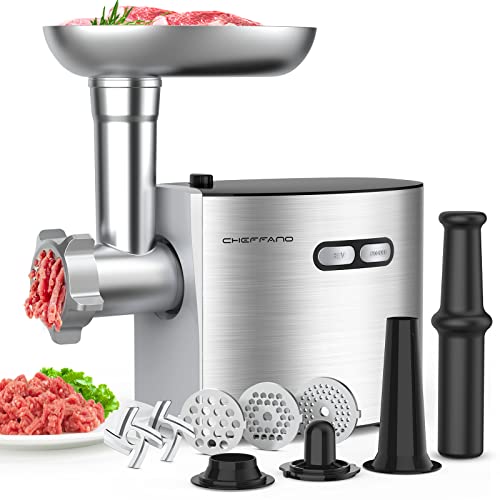
The CHEFFANO Electric Meat Grinder (2800W Max) earns its place in a guide to best meat grinders raw feeders on the strength of what its listing states plainly. ETL approval is stated in the title, a useful trust signal in this class. That single fact shapes who should buy it: a user whose routine in a raw pet food preparation workflow will actually use that strength week after week, rather than admiring it once and working around its absence of other features.
In practical terms, expect this machine to reward good preparation. The specification in its title, including 2800w max, describes the ceiling of what it can do; your habits decide how close to that ceiling a normal session gets. Work steadily, keep the process cold and clean as the how-to section below describes, and the gap between this pick and far more expensive machines narrows quickly. Rush the preparation and the same machine will feel ordinary, because the limiting factor was never the motor.
Strengths
- ETL approval is stated in the title, a useful trust signal in this class
- Two blades and three plates give a sensible spread of grind textures
- Sausage stuffer tubes and a kubbe kit are included rather than sold separately
Trade-offs
- Peak wattage is a maximum figure, so real pace depends on meat temperature and trimming
- No built-in accessory storage is named, so parts need a drawer or box
- Home kitchen positioning means very large batches should be run in stages
Key specifications (from the listing title)
- Type: Electric meat grinder, heavy duty positioning
- Peak power named in title: 2800W Max
- Certification named: ETL approved
- Included: 2 blades, 3 plates, sausage stuffer tubes, kubbe kit
The honest limitation is worth stating plainly: peak wattage is a maximum figure, so real pace depends on meat temperature and trimming. That is not a reason to cross this pick off your list unless that specific weakness collides with your main use. Every machine in this class trades something away; the art of choosing is matching the trade-off to the work you do least, so the strength you use most is the one you paid for. For readers whose routine centres on a raw pet food preparation workflow, this pick makes the most sense when its badge description sounds like your household.
Best for: readers whose priorities match its badge, best overall, in the context of best meat grinders raw feeders / Not suited for: buyers whose main workload is exactly the trade-off described above.

Sinyder Electric Meat Grinder (3000W Max, Stainless Steel)
Badge: Best for Weekly Batches
The Sinyder Electric Meat Grinder (3000W Max, Stainless Steel) earns its place in a guide to best meat grinders raw feeders on the strength of what its listing states plainly. Pure copper motor and metal gears are named in the title, a durability-focused spec sheet. That single fact shapes who should buy it: a user whose routine in a raw pet food preparation workflow will actually use that strength week after week, rather than admiring it once and working around its absence of other features.
In practical terms, expect this machine to reward good preparation. The specification in its title, including 3000w max, describes the ceiling of what it can do; your habits decide how close to that ceiling a normal session gets. Work steadily, keep the process cold and clean as the how-to section below describes, and the gap between this pick and far more expensive machines narrows quickly. Rush the preparation and the same machine will feel ordinary, because the limiting factor was never the motor.
Strengths
- Pure copper motor and metal gears are named in the title, a durability-focused spec sheet
- Stainless steel body with two blades and three grinding plates
- Sausage stuffer tubes and a kubbe kit round out a complete starter set
Trade-offs
- Metal-gear designs still need chilled meat and sensible pacing on long runs
- No storage compartment is named for the accessory set
- Peak wattage is a maximum figure rather than a continuous rating
Key specifications (from the listing title)
- Type: Electric meat grinder / stainless steel mincer
- Peak power named in title: 3000W Max
- Motor and gears: pure copper motor, metal gears
- Included: 2 blades, 3 grinding plates, sausage stuffer tubes, kubbe kit
The honest limitation is worth stating plainly: metal-gear designs still need chilled meat and sensible pacing on long runs. That is not a reason to cross this pick off your list unless that specific weakness collides with your main use. Every machine in this class trades something away; the art of choosing is matching the trade-off to the work you do least, so the strength you use most is the one you paid for. For readers whose routine centres on a raw pet food preparation workflow, this pick makes the most sense when its badge description sounds like your household.
Best for: readers whose priorities match its badge, best for weekly batches, in the context of best meat grinders raw feeders / Not suited for: buyers whose main workload is exactly the trade-off described above.

CHEFFANO Life Electric Meat Grinder (2000W Max)
Badge: Best Accessory Bundle
The CHEFFANO Life Electric Meat Grinder (2000W Max) earns its place in a guide to best meat grinders raw feeders on the strength of what its listing states plainly. Stainless steel body with a sausage stuffer maker role built in. That single fact shapes who should buy it: a user whose routine in a raw pet food preparation workflow will actually use that strength week after week, rather than admiring it once and working around its absence of other features.
In practical terms, expect this machine to reward good preparation. The specification in its title, including 2000w max, describes the ceiling of what it can do; your habits decide how close to that ceiling a normal session gets. Work steadily, keep the process cold and clean as the how-to section below describes, and the gap between this pick and far more expensive machines narrows quickly. Rush the preparation and the same machine will feel ordinary, because the limiting factor was never the motor.
Strengths
- Stainless steel body with a sausage stuffer maker role built in
- Two blades and three plates cover the standard texture range
- A lower peak figure than some rivals can mean a calmer, more manageable home machine
Trade-offs
- At 2000W Max it sits below the headline figures of several rivals, so trim and chill carefully
- No reverse or storage feature is named in the title
- Sausage tube is listed in the singular, so check the listing for the full tube set
Key specifications (from the listing title)
- Type: Electric meat grinder with sausage stuffer maker
- Peak power named in title: 2000W Max
- Body: stainless steel
- Included: 2 blades, 3 plates, sausage tube, kubbe kit
The honest limitation is worth stating plainly: at 2000W Max it sits below the headline figures of several rivals, so trim and chill carefully. That is not a reason to cross this pick off your list unless that specific weakness collides with your main use. Every machine in this class trades something away; the art of choosing is matching the trade-off to the work you do least, so the strength you use most is the one you paid for. For readers whose routine centres on a raw pet food preparation workflow, this pick makes the most sense when its badge description sounds like your household.
Best for: readers whose priorities match its badge, best accessory bundle, in the context of best meat grinders raw feeders / Not suited for: buyers whose main workload is exactly the trade-off described above.

LEM Products BigBite #8 Meat Grinder (0.5 HP)
Badge: Best Specialist Brand
The LEM Products BigBite #8 Meat Grinder (0.5 HP) earns its place in a guide to best meat grinders raw feeders on the strength of what its listing states plainly. The BigBite name signals an auger design aimed at pulling meat through steadily. That single fact shapes who should buy it: a user whose routine in a raw pet food preparation workflow will actually use that strength week after week, rather than admiring it once and working around its absence of other features.
In practical terms, expect this machine to reward good preparation. The specification in its title, including 0.5 hp, describes the ceiling of what it can do; your habits decide how close to that ceiling a normal session gets. Work steadily, keep the process cold and clean as the how-to section below describes, and the gap between this pick and far more expensive machines narrows quickly. Rush the preparation and the same machine will feel ordinary, because the limiting factor was never the motor.
Strengths
- The BigBite name signals an auger design aimed at pulling meat through steadily
- A 0.5 HP rating is a continuous-style figure rather than a peak marketing number
- Stainless steel construction from a brand long associated with game processing
Trade-offs
- The #8 head is smaller than #12 rivals, so very large batches take longer
- Its title names grinding and sausage stuffing only, with no extra function claims
- A specialist brand machine can cost more over its life in branded accessories
Key specifications (from the listing title)
- Type: Electric meat grinder, BigBite #8
- Motor: 0.5 HP
- Body: stainless steel
- Roles named: grinding and sausage stuffing, home use
The honest limitation is worth stating plainly: the #8 head is smaller than #12 rivals, so very large batches take longer. That is not a reason to cross this pick off your list unless that specific weakness collides with your main use. Every machine in this class trades something away; the art of choosing is matching the trade-off to the work you do least, so the strength you use most is the one you paid for. For readers whose routine centres on a raw pet food preparation workflow, this pick makes the most sense when its badge description sounds like your household.
Best for: readers whose priorities match its badge, best specialist brand, in the context of best meat grinders raw feeders / Not suited for: buyers whose main workload is exactly the trade-off described above.

RVGMBO 5.0 Upgrade Electric Meat Grinder (3500W Super Motor)
Badge: Best High-Speed Claim
The RVGMBO 5.0 Upgrade Electric Meat Grinder (3500W Super Motor) earns its place in a guide to best meat grinders raw feeders on the strength of what its listing states plainly. Three sets of 304 stainless steel blades and plates are named in the title. That single fact shapes who should buy it: a user whose routine in a raw pet food preparation workflow will actually use that strength week after week, rather than admiring it once and working around its absence of other features.
In practical terms, expect this machine to reward good preparation. The specification in its title, including 3500w super motor, describes the ceiling of what it can do; your habits decide how close to that ceiling a normal session gets. Work steadily, keep the process cold and clean as the how-to section below describes, and the gap between this pick and far more expensive machines narrows quickly. Rush the preparation and the same machine will feel ordinary, because the limiting factor was never the motor.
Strengths
- Three sets of 304 stainless steel blades and plates are named in the title
- A fast-grind positioning suits households that process in bigger sessions
- Kubbe and sausage kit included for stuffed dishes and links
Trade-offs
- The super motor figure is a headline number; trimming and chilling still decide real pace
- Three blade and plate sets mean the most parts of any pick here to organise
- No named brand heritage in game processing, unlike the LEM pick
Key specifications (from the listing title)
- Type: Electric meat grinder, 5.0 Upgrade
- Motor described in title: 3500W Super Motor
- Blades and plates: 3 sets, 304 stainless steel
- Included: kubbe and sausage kit
The honest limitation is worth stating plainly: the super motor figure is a headline number; trimming and chilling still decide real pace. That is not a reason to cross this pick off your list unless that specific weakness collides with your main use. Every machine in this class trades something away; the art of choosing is matching the trade-off to the work you do least, so the strength you use most is the one you paid for. For readers whose routine centres on a raw pet food preparation workflow, this pick makes the most sense when its badge description sounds like your household.
Best for: readers whose priorities match its badge, best high-speed claim, in the context of best meat grinders raw feeders / Not suited for: buyers whose main workload is exactly the trade-off described above.

FOHERE Electric Meat Grinder (#12 Head, 1 HP)
Badge: Best #12 Head Pick
The FOHERE Electric Meat Grinder (#12 Head, 1 HP) earns its place in a guide to best meat grinders raw feeders on the strength of what its listing states plainly. The #12 head and a stated 8.8 LBS/Min rate target serious batch sizes. That single fact shapes who should buy it: a user whose routine in a raw pet food preparation workflow will actually use that strength week after week, rather than admiring it once and working around its absence of other features.
In practical terms, expect this machine to reward good preparation. The specification in its title, including 600w all-copper; 3600w peak; 1hp, describes the ceiling of what it can do; your habits decide how close to that ceiling a normal session gets. Work steadily, keep the process cold and clean as the how-to section below describes, and the gap between this pick and far more expensive machines narrows quickly. Rush the preparation and the same machine will feel ordinary, because the limiting factor was never the motor.
Strengths
- The #12 head and a stated 8.8 LBS/Min rate target serious batch sizes
- An all-copper 600W motor figure is stated separately from the peak number
- Stainless plates, a sausage nozzle and a kubbe kit are included
Trade-offs
- Peak and rated figures are both in the title, so read carefully to compare fairly
- A #12 head machine is a bigger storage commitment than compact models
- High stated throughput assumes trimmed, chilled meat fed steadily
Key specifications (from the listing title)
- Type: Electric meat grinder with sausage stuffer, #12 head
- Motor: 600W all-copper; 3600W peak; 1HP
- Stated rate: 8.8 LBS/Min
- Included: stainless plates, sausage nozzle, kubbe kit
The honest limitation is worth stating plainly: peak and rated figures are both in the title, so read carefully to compare fairly. That is not a reason to cross this pick off your list unless that specific weakness collides with your main use. Every machine in this class trades something away; the art of choosing is matching the trade-off to the work you do least, so the strength you use most is the one you paid for. For readers whose routine centres on a raw pet food preparation workflow, this pick makes the most sense when its badge description sounds like your household.
Best for: readers whose priorities match its badge, best #12 head pick, in the context of best meat grinders raw feeders / Not suited for: buyers whose main workload is exactly the trade-off described above.
Comparison Table
| Product | Badge | Format | Listing |
|---|---|---|---|
| CHEFFANO Electric Meat Grinder (2800W Max) | Best Overall | Type: Electric meat grinder, heavy duty positioning | Check on Amazon |
| Sinyder Electric Meat Grinder (3000W Max, Stainless Steel) | Best for Weekly Batches | Type: Electric meat grinder / stainless steel mincer | Check on Amazon |
| CHEFFANO Life Electric Meat Grinder (2000W Max) | Best Accessory Bundle | Type: Electric meat grinder with sausage stuffer maker | Check on Amazon |
| LEM Products BigBite #8 Meat Grinder (0.5 HP) | Best Specialist Brand | Type: Electric meat grinder, BigBite #8 | Check on Amazon |
| RVGMBO 5.0 Upgrade Electric Meat Grinder (3500W Super Motor) | Best High-Speed Claim | Type: Electric meat grinder, 5.0 Upgrade | Check on Amazon |
| FOHERE Electric Meat Grinder (#12 Head, 1 HP) | Best #12 Head Pick | Type: Electric meat grinder with sausage stuffer, #12 head | Check on Amazon |
Read the table as a map, not a verdict. The format column alone explains many buying decisions, and the badge column tells you which strength each machine was picked for. If two picks still look equal after the table, the deciding factor is usually in the detailed reviews: an included accessory, a storage arrangement, or a control style that fits your hands and your counter.
How to Choose: a buying guide for best meat grinders raw feeders
Motor figures, read honestly
Every title here leads with a power number, but the numbers are not all the same kind. Figures labelled Max or Peak describe a short ceiling, while rated figures such as the VEVOR 750W or the LEM 0.5 HP describe sustained output. Compare max with max and rated with rated, and remember that knife sharpness, plate condition and meat temperature move real performance more than a few hundred headline watts.
Head size and throat
Head size, given as #8 or #12 on several picks, describes the plate diameter class and the throat that feeds it. A #12 head accepts larger strips and moves volume faster, which suits batch processors. A #8 head is lighter and stores smaller, which suits weekly family grinding. Match head size to your typical session, not your biggest imaginable one.
Plates and blades
Plates decide texture. A coarse plate makes chilli grind and jerky strips; a medium plate is the burger standard; a fine plate serves sausage and smooth blends. Every pick here includes multiple plates, and several include two blades, which matters because a dull knife smears instead of cutting. Keep the knife and plate paired together in storage so their worn surfaces stay matched.
Reverse, presets and storage
Reverse helps clear the occasional sinew wrap without opening the head. Presets and touch controls, prominent on the AAOBOSI picks, help beginners keep a steady pace and help anyone switch tasks quickly. Built-in storage sounds minor until you have hunted a stuffing tube through three drawers with raw meat on the counter; it is a genuine workflow feature.
Materials and cleaning
Stainless bodies and plates tolerate scrubbing and show residue, which supports honest cleaning. Whatever the material, the routine is the same: wash in hot soapy water, brush plate holes clear, dry fully before storage, and never put parts away damp. A light food-safe oil on carbon-steel parts, where a manual recommends it, prevents rust spots between sessions.
A neighbouring angle worth five minutes is covered in our guide to Best Meat Grinders Uk, especially if your workload sits between the two searches.
How to Grind Meat at Home: Setup, Grinding and Cleanup
- Trim first. Remove silver skin, heavy sinew and any gristle that would wrap the knife, and cut the meat into strips the throat accepts without forcing.
- Chill everything. Meat should be very cold, close to freezing at the edges, and the head, plate and knife benefit from time in the freezer too. Cold meat cuts; warm meat smears.
- Assemble and check. Fit the knife with its cutting edges facing the plate, seat the plate flat, and tighten the retaining ring firmly by hand.
- Grind coarse first on large batches. A first pass on a coarse plate evens the mix of lean and fat before any finer pass.
- Feed steadily with the pusher only. Never use fingers or utensils to push meat, and let the auger set the pace rather than forcing the tray.
- Season and mix between passes if the recipe calls for it, working cold and quickly so fat stays in distinct particles.
- Grind the second pass if you want a finer texture, then portion, pack and refrigerate or freeze promptly.
- Wash immediately. Disassemble, wash in hot soapy water with a brush for the plate holes, dry completely, and store parts together.
For raw feeding sessions, dedicate a colour-coded tray and utensils to pet food prep, portion the finished grind into meal-sized containers before freezing, and thaw portions in the fridge rather than on the counter.
If your questions run more basic than this guide assumes, our explainer on Best Meat Grinders Under $100 starts from first principles.
Troubleshooting
Problem: the grinder slows and the meat comes out mushy → the meat is too warm or the knife and plate are dull or mismatched. Stop, chill everything, and check the knife is fitted facing the plate.
Problem: sinew wraps around the knife and output stalls → switch off, unplug, open the head and clear the wrap, then trim the remaining meat more carefully; a reverse function, where fitted, can save opening the head for minor wraps.
Problem: the motor strains and the tray backs up → you are feeding too fast or the strips are too large. Ease off, cut smaller strips, and let the auger pull at its own pace.
Grinding for Raw Diets: Hygiene, Texture and Honest Limits
Hygiene is the first specification for raw feeding, even though it never appears on a box. Grinding raw meat for pets follows the same rules as grinding for people: cold ingredients, clean surfaces, prompt refrigeration and a full wash of every part that touched meat. Choose a machine whose head, plates and accessories come apart without tools you have to hunt for, and plan your session so ground food goes into portion containers and the freezer quickly. Several picks above include storage for their own accessories, which quietly helps: parts that live together get washed together and are ready together.
Texture is a real feeding variable. Some dogs bolt coarse grind happily, many cats prefer a finer, more even texture, and older animals or those with dental issues may need the finest grind you can produce. Multiple plates, included with every pick here, are therefore not a luxury for raw feeders; they are how one machine serves a changing household. Grind a small test amount, look at the particle definition, and adjust plate or pass count before committing the whole batch. Clear, distinct particles that hold together lightly are the goal; a warm, smeared paste signals meat that got too warm or a plate that is too fine for a first pass.
The bone question deserves a straight answer. Ground bone features in some raw feeding recipes, and it is also the fastest way to damage a grinder that was not built for it. Because no title in this pool states bone capability, this guide does not recommend any of these machines for bone. If your chosen recipe framework requires ground bone, shop for a model whose manufacturer explicitly rates it for the specific soft bones involved, or buy pre-ground bone-in product from a pet food supplier and use your grinder for the boneless portion of the diet. Talk to your veterinarian about the overall recipe, too: grinding is the easy part of raw feeding, while nutritional completeness is the part that needs professional input.
For a closely related shortlist, see Best Made Meat Grinders and note how the ranking shifts when the priority changes.
Common Buying Mistakes
- Buying on peak wattage alone and ignoring head size, plates and the included kit.
- Skipping the trimming step and expecting the grinder to defeat silver skin it was never designed to cut.
- Grinding warm meat, then blaming the machine for smeared fat and grey texture.
- Forcing the feed with hands or tools instead of the pusher, which is both unsafe and hard on the gears.
- Putting parts away damp, which invites rust and off smells at the next session.
- Running one fine plate for every job instead of matching plate size to the dish.
Most of these mistakes share one root: choosing for an imagined workload instead of the real one. Be honest about how often, how much and what exactly you will process, and the right pick usually identifies itself. Readers who recognise their situation in Best Manual Meat Grinders may find that shortlist an even closer fit.
Final Recommendation
Start with the CHEFFANO Electric Meat Grinder (2800W Max). It is the first pick in this guide because its stated strengths cover the widest range of readers searching for best meat grinders raw feeders, and its trade-offs are the kind most households can live with. If its badge does not sound like you, move deliberately: the Sinyder Electric Meat Grinder (3000W Max, Stainless Steel) suits the next most common routine, and the CHEFFANO Life Electric Meat Grinder (2000W Max) is the pick for readers whose priority matches its badge most closely.
Shortlist again here for convenience: CHEFFANO Electric Meat Grinder (2800W Max), Sinyder Electric Meat Grinder (3000W Max, Stainless Steel), CHEFFANO Life Electric Meat Grinder (2000W Max). Whichever you choose, confirm the current box contents on the listing before ordering, because accessory sets are the detail most likely to change between production runs, and they are the detail your first session will care about.
Frequently Asked Questions
What size grinder do I need for home use?
For weekly family grinding, any pick here is physically capable; the choice is about session size. A #8-class machine suits a few kilograms at a time, while a #12 head earns its keep when you regularly process large batches. If in doubt, prioritise the completeness of the plate and accessory set over raw size.
Why does my ground meat come out mushy?
Almost always temperature or cutting condition. Meat that is not thoroughly chilled smears instead of cutting, and a dull or wrongly fitted knife makes it worse. Chill the meat and the grinder head, confirm the knife faces the plate, and use a coarser first pass on large batches.
How do I clean a meat grinder properly?
Disassemble fully, wash every part in hot soapy water, use a small brush or skewer to clear plate holes, rinse, and dry completely before reassembly or storage. Do not leave parts soaking for long periods, and check the manufacturer guidance before putting any part in a dishwasher.
Can I grind frozen meat?
Grind meat that is very cold and firm, even frosty at the edges, but not rock-solid frozen blocks, which strain the motor and can damage the knife and plate. Partially thaw solid-frozen meat until it can be cut into strips, then grind while it is still icy cold.
What is the difference between a coarse and fine grind?
Plate hole size decides texture. Coarse grinds suit chilli, jerky and rustic sausage; medium grinds are the burger and meatball standard; fine grinds suit smooth sausage and delicate blends. Many recipes grind coarse first, then pass the meat again through a finer plate.
Can these grinders grind bones for raw pet food?
Their listing titles do not claim bone-grinding capability, so treat them as boneless-meat machines. Forcing bone through a grinder that is not rated for it can damage the knife, plate and gears. If your recipe needs ground bone, choose a model whose manufacturer explicitly states that capability for the type of bone you use, or buy pre-ground bone-in ingredients.
One more angle is covered in depth at Best Manual Meat Grinders For Home Use, which rounds out this cluster of guides.
Going Deeper: Session Craft, Part 1
A word about noise and kitchen reality: electric grinders are not quiet appliances, and the more powerful the motor, the more the session announces itself. Plan grinding for a time that suits your household, set the machine on a stable, dry surface with room for trays on both sides, and keep the cord clear of the work zone. A tidy layout, meat in on the left, grind out on the right, cold storage behind you, turns a noisy chore into a calm routine and reduces the cross-contamination risks that come from wandering around a kitchen with raw meat on your hands.
Going Deeper: Session Craft, Part 2
Blade and plate care repays attention out of proportion to its effort. The knife and plate wear in together as a pair, and mixing a worn knife with a fresh plate, or the reverse, leaves a gap that smears meat. Store each knife with the plate it has been used with, keep them dry, and consider professional sharpening or a matched replacement pair when output starts to smear despite cold meat and careful trimming. Many disappointing grinder experiences trace back to this one inexpensive pairing rather than to the motor.
Going Deeper: Session Craft, Part 3
Think about your recipe pipeline before you judge a session. Burgers want a medium grind and gentle handling afterwards; overworking ground meat while seasoning makes dense, springy patties. Sausage wants an even fat distribution and a cold mix so the emulsion holds. Meatballs and meatloaf benefit from a slightly finer grind that binds without becoming paste. The grinder is the first step of each recipe, not a separate event, and choosing plates with the finished dish in mind is the habit that separates good home grinding from merely adequate grinding.
Going Deeper: Session Craft, Part 4
Storage of the finished product deserves the same discipline as the grind itself. Portion ground meat into the sizes you actually cook, flatten freezer bags so they thaw quickly and stack efficiently, press out excess air, and label with contents, weight and date. Ground meat has more surface area than whole cuts, so it is more perishable: refrigerate what you will use within a day or two and freeze the rest promptly. A grinder session that ends with a tidy, labelled freezer is the real productivity win these machines offer.
Going Deeper: Session Craft, Part 5
Finally, respect the learning curve. Your first session will be slower than your fifth, your trimming will improve, and your sense of how cold is cold enough will sharpen. Keep brief notes, cut, fat added, plate used, result at the table, and let those notes steer the next session. The picks in this guide differ in controls, head size and accessories, but all of them reward the same fundamentals: cold meat, honest trimming, steady feeding and thorough cleaning. Master those, and the machine you choose will feel like the right one.
Worth Knowing: How Session Size Changes Everything
A grinder behaves differently across a long session than across a short one, and planning for that difference is a mark of an experienced home processor. Motors warm, meat warms, and attention wanders. Break big jobs into trays, swap trays in and out of the fridge, and schedule the finest grinding for when the meat is coldest. If you process with a partner, divide the labour: one person trims and cuts, the other feeds and packs, and both wash as they go. The session feels shorter, the product stays colder, and the cleanup at the end is a fraction of what it would be if every part waited in the sink.
Worth Knowing: Reading a Listing Like a Processor
Experienced buyers read a grinder listing in a particular order. They look first for head size and the plate set, because those decide texture and pace. They look next at the blade count and the accessory list, because grinding without stuffing tubes, or with one tired blade, limits the recipes that follow. Only then do they look at the power figure, and they translate it mentally: a peak number is a ceiling, a rated number is a work rate. Finally they check the unglamorous lines, approvals, materials and storage, because those are the lines that describe year three of ownership rather than day one. Read the six listings in this guide in that order and the ranking often rearranges itself in your hands.
Worth Knowing: Fat Is an Ingredient, Not an Accident
Home grinders sometimes treat fat as whatever happens to be attached to the meat, and then wonder why one batch of burgers is juicy and the next is dry. Fat is an ingredient with a job: it carries flavour, keeps lean meat moist and helps grind bind. Decide the fat plan before the session, which cuts supply it, whether you are adding pork fat or tallow, and roughly what share of the total it should be. Weigh or at least eyeball consistently, write the ratio in your session notes, and adjust next time based on eating, not guessing. That single habit does more for the quality of home-ground meat than any difference between the machines in this guide.
Worth Knowing: When to Upgrade, and When Not To
Owners often blame a grinder for problems that belong to technique, and upgrade a machine that was never the bottleneck. Before spending more, audit your last session honestly: was the meat truly cold, was the trimming thorough, were the knife and plate a matched, sharp pair, and did you feed at the auger pace? If the answers are yes and the machine still struggled with your typical volume, an upgrade to a larger head makes sense. If any answer is no, fix the free thing first. The picks here span enough head sizes and feature sets that most households can find their long-term machine in this list rather than beyond it.