Disclosure: topratedkitchenware.com is reader-supported. When you buy through links on our site, we may earn an affiliate commission from Amazon and other retailers, at no extra cost to you.
Where to buy
Search for the best metal chopsticks reddit-style and you are really searching for something buying guides rarely give you: the unfiltered experience of people who bought a pair, lived with it, and came back to argue about it. This guide works the way a good community thread does — it distills the recurring themes of those discussions (the grip complaints, the weight debate, the dishwasher devotion, the square-versus-round schism) and tests them against a verified pool of six stainless steel sets. No scores are quoted and no posts are fabricated; what you get is the community’s collective wisdom, organized, checked against the listings, and turned into picks.
- Lazycorner 304 Stainless Steel Chopsticks, 10 Pairs — food grade 304 in a ten-pair fleet; the workhorse format threads keep recommending.
- IQCWOOD 304 Stainless Steel Chopsticks, 5 Pairs — the classic 304 pair, 9.25 inches, traditional proportions.
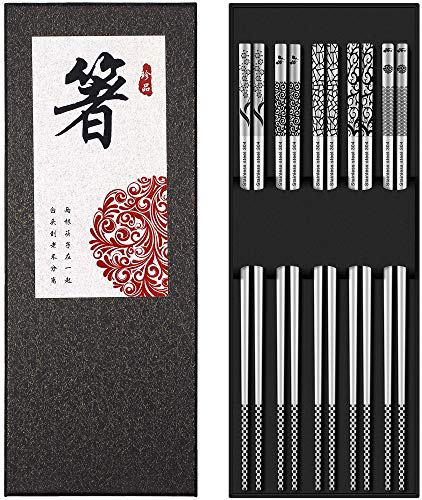
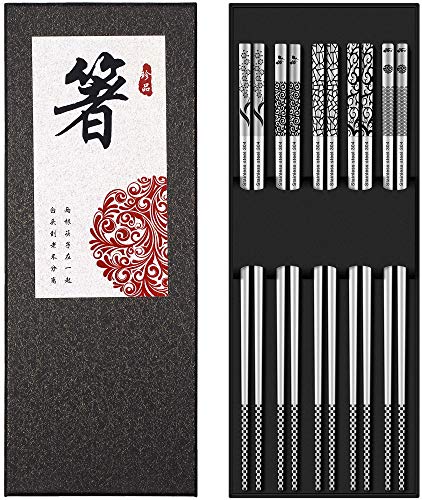
- Greatamzor 18/8 Stainless Steel Chopsticks, 5 Pairs — engraved grip, the feature community advice names first.
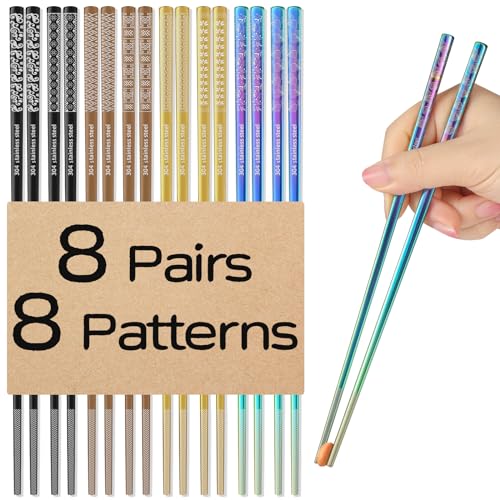
- NEWDRIP 18/8 Stainless Steel Chopsticks, 8 Pairs — the eight-pair rotation households describe settling on.
- Zliutob Stainless Steel Chopsticks, 5 Pairs — textured tips and a square grip: the community checklist in one product.
- LIXTONGR Dragon & Phoenix Black Stainless Steel Chopsticks, 2 Pairs — the 18/10 keeper pair for the one-perfect-pair school.
Read the full guide ↓ for what community experience consistently gets right about metal chopsticks, where forum advice misleads, and which of the six sets matches each school of thought.
There is a reason people add “reddit” to a product search. Star displays and marketing copy all lean one way; a forum thread leans every way at once, and the truth usually survives somewhere in the crossfire. Metal chopsticks generate unusually good threads, because the product is simple, the opinions are strong, and the failure modes are vivid: the pair that skated on every noodle, the pair that felt like rebar, the pair that converted a lifelong wood user in a week, the pair still going after years of dishwasher abuse. Patterns emerge when you read enough of them, and the patterns are remarkably consistent.
Here is the community consensus in one paragraph, before we spend six thousand words earning it. Metal wins on hygiene and permanence, loses on first-week feel, and the whole argument is decided by the tips: textured or engraved ends the slipperiness debate, weight is a preference with two honorable sides, square profiles have devoted partisans for a reason, and the dishwasher is not a risk but the entire point. Every one of those claims gets its hearing below — where it came from, where it overreaches, and which of our six verified sets embodies it.
A methodological promise, because this guide’s genre demands it: we will not quote invented posts, usernames, vote counts or thread statistics, and we will not present any single anecdote as data. What follows describes themes — the arguments and experiences that recur across community discussions of metal chopsticks — and then does the thing threads cannot do for themselves: checks each theme against actual product listings, and tells you which sets the wisdom points to.
Key Takeaways
- The community’s first law of metal chopsticks: judge the tips, not the metal. Textured, engraved or non-slip tips are the difference between the conversion stories and the complaint threads — every pick here has them.
- The weight debate has two honorable sides — solid-feel partisans and lightweight converts — and this pool serves both, from classic builds to the lightweight sets also favored under Best Multi Use Chopsticks.
- Square profiles are the forum’s insider tip: they index in the fingers and refuse to roll, a small geometry with an outsized following, embodied by the Zliutob pick.
- Dishwasher devotion is the community’s practical core: metal’s permanence is a washing story, and the fleets (eight, ten pairs) are what long threads eventually recommend.
- Community advice misleads where it universalizes one kitchen’s habits — read for themes, verify against listings, and beware any post selling certainty, a discipline we apply to the flashier claims under Best Metallic Chopsticks too.
- The keeper-pair school and the fleet school are both right, for different lives — the 18/10 two-pair set and the ten-pair 304 set are their respective champions here.
In this guide
Quick Picks
| Pick | Badge | Community verdict it matches | Link |
|---|---|---|---|
| Lazycorner 304 Stainless Steel Chopsticks, 10 Pairs | Best Workhorse Fleet | “Buy the big 304 set and stop thinking about it” | Check on Amazon |
| IQCWOOD 304 Stainless Steel Chopsticks, 5 Pairs | Best Classic Pair | The traditional metal form the purists describe | Check on Amazon |
| Greatamzor 18/8 Stainless Steel Chopsticks, 5 Pairs | Best Engraved Grip | “Engraving is the grip that never wears off” | Check on Amazon |
| NEWDRIP 18/8 Stainless Steel Chopsticks, 8 Pairs | Best Family Rotation | The eight-pair equilibrium households report | Check on Amazon |
| Zliutob Stainless Steel Chopsticks, 5 Pairs | Best Grip Design | Textured tips plus square profile — the checklist pair | Check on Amazon |
| LIXTONGR Dragon & Phoenix Chopsticks, 2 Pairs | Best Keeper Pair | The one-perfect-pair school’s premium alloy | Check on Amazon |
How These Picks Were Chosen
We built the shortlist from verified listings first — alloy, tips, construction and care, read as specifications — and then mapped each set against the themes that recur in community discussions of metal chopsticks. A set earned its place by embodying a piece of that collective wisdom: the engraved grip the threads praise, the square profile the insiders swear by, the named alloys the specification-minded demand, the fleet sizes the long-term owners converge on. The Quick Picks table states each mapping in the community’s own shorthand, in quotation marks as paraphrase of a recurring sentiment, not as a quote from any individual.
We also applied the skepticism that good threads apply to themselves. Community enthusiasm is evidence about experience, not about specifications; where a theme makes a checkable claim — a grade, a length, a care instruction — we checked it against the listing and reported only what the listing supports. Where listings are silent, the reviews say so, exactly as a well-moderated thread would demand.
No ratings, review counts or forum statistics appear anywhere in this guide, by design. The community lens is qualitative: patterns of praise and complaint, the shape of the consensus, and the honest location of the disagreements. That is what the word in the keyword actually promises, and it is what we have delivered.
The 6 Best Metal Chopsticks, Community-Tested Themes Edition

Lazycorner 304 Stainless Steel Chopsticks, 10 Pairs
Badge: Best Workhorse Fleet
- Material: 304 stainless steel, food grade
- Pairs: 10
- Design: Non-slip, lightweight; heat resistant per listing wording
- Finish: Silver
- Care: Dishwasher safe; reusable for daily meals and gifts
Strengths
- The fleet format is the community’s endgame: enough pairs that washing, guests and loss stop mattering.
- Named 304 alloy — the specification the detail-minded threads insist on.
- Plain silver: the finish with no aging story to tell, ever.
Trade-offs
- No length is stated in the listing — the kind of gap forum skeptics rightly flag.
- No color system; pairs are communal.
- Utilitarian presentation will not satisfy the keeper-pair romantics.
Read enough long-term owner threads and a pattern asserts itself: people stop reviewing individual pairs and start reviewing systems. The system that recurs is a deep fleet of plain, named-alloy steel — bought once, washed forever, immune to the attrition of guests and lunch bags. This Lazycorner set is that system in a box: ten pairs of food grade 304, non-slip, lightweight, dishwasher safe, with no finish that can fade and no specification that needs defending.
The community logic is arithmetic wearing a trench coat. A pair’s enemies are loss and loneliness; a fleet of ten makes both irrelevant, and the per-pair washing load drops so far that cosmetic aging slows to a geological pace. Owners of such fleets tend to become the calm voices in threads — the ones answering “which chopsticks?” with “the big 304 set, years ago, nothing to report since.” In a category fueled by strong opinions, “nothing to report” is the highest available praise.
The skeptics’ points stand and are recorded in the trade-offs: the listing omits a length, and there is no romance here. If your metal journey is about finding the pair, read on to the end of this guide. If it is about ending the search, the fleet is the answer the community converged on, and this is its fullest expression in the pool.
Best for: households that want the search over, permanently, at scale / Not suited for: romantics seeking a single special pair

IQCWOOD 304 Stainless Steel Chopsticks, 5 Pairs
Badge: Best Classic Pair
- Material: 304 stainless steel
- Pairs: 5
- Length: 9.25 inches (as stated in the listing)
- Design: Lightweight, non-slip tips; Korean Japanese style
- Care: Dishwasher safe; reusable
Strengths
- The reference form the purist threads describe: named alloy, traditional length, no gimmicks.
- Non-slip tips quietly fix the classic’s one historical flaw.
- Lightweight build answers the heft complaint inside a traditional silhouette.
Trade-offs
- Plain to a fault for buyers who want character.
- Five pairs, not a party fleet.
- The wood-evoking brand name confuses first-time readers of the listing.
Every category has a product the community treats as the control group — the one recommended to newcomers as “just get the normal good one.” For metal chopsticks, that role belongs to sets exactly like this: 304 steel, silver, 9.25 inches, Korean Japanese proportions, non-slip tips. It is the pair against which the exotic options must argue, and in thread after thread, the exotic options are the ones that end up arguing.
What the classic gets right, on the community’s own evidence, is the absence of failure modes. There is no finish to baby, no color to fade, no construction novelty to wonder about at year three. The specification is complete in the listing — grade, length, tips, care — which is itself a community value: the detail threads reward makers who state their numbers and punish, with exquisite politeness, those who do not.
Its limitation is charisma. Nothing about the set starts a conversation, and buyers who want their permanence with personality should take the engraved or plated paths below. But if the forum wisdom you trust most is the boring kind — the kind that has eaten a thousand meals without incident — the classic is your pair, and its five-count makes it a household standard rather than a solo indulgence.
Best for: newcomers who want the community’s reference pair without drama / Not suited for: buyers who want pattern, color or a story
Greatamzor 18/8 Stainless Steel Chopsticks, 5 Pairs
Badge: Best Engraved Grip
- Material: 18/8 stainless steel
- Pairs: 5
- Length: 9 1/4 inches (as stated in the listing)
- Design: Laser engraved, non-slip; Japanese Korean style
- Care: Dishwasher safe
- Stated uses: Cooking and eating; gift set format
Strengths
- Laser engraving is the grip solution the community rates most durable — texture that is the metal, not on it.
- 18/8 alloy carries the flatware pedigree the specification threads respect.
- Cooking-and-eating coverage matches how owners actually use one pair all meal long.
Trade-offs
- Plain steel color only.
- Engraved grooves want tips-down loading in the dishwasher.
- Mid-scale count for large families.
If the community has a single favorite sentence about metal chopsticks, it is some version of: the grip problem was solved years ago, you just have to buy the solution. The solution, in its most praised form, is engraving — a pattern cut into the steel that no amount of washing, oil or time can remove, because there is nothing to remove. This Greatamzor set is the pool’s purest carrier of that idea, on an 18/8 alloy with a flatware pedigree, in a five-pair gift set format.
The conversion stories in the threads tend to follow a script: smooth metal disappointed, engraved or textured metal converted. The mechanism is exactly as simple as the stories claim. Engraved tips hold noodles and dumplings at ordinary finger pressure, so the squeeze-and-launch cycle that makes beginners hate metal never starts. Add the cooking-and-eating listing — the pair can work at the stove, serve and eat — and the set matches the way owners actually live with one pair across a whole meal.
The caveats are small and practical: plain color, mid-scale count, and grooves that reward being loaded tips-down so the wash reaches them. For the buyer whose research keeps returning to the word “grip” — which is to say, most buyers who arrive via community advice — this is the set the evidence points to first, the same engraved logic that makes steel the garnish tool of choice under Best Metal Chopsticks Stirring Cocktails.
Best for: grip-first buyers and wood converts burned by smooth metal / Not suited for: buyers who want color coding or maximum fleet size

NEWDRIP 18/8 Stainless Steel Chopsticks, 8 Pairs
Badge: Best Family Rotation
- Material: 18/8 stainless steel
- Pairs: 8
- Length: 9.25 inches (as stated in the listing)
- Design: Laser engraved, non-slip; Japanese Korean Chinese styles
- Care: Dishwasher safe
- Stated uses: Cooking and eating; gift set format
Strengths
- Eight pairs is the rotation size family threads converge on — enough for table, stove and wash simultaneously.
- Plain engraved steel: the finish-free format whose appearance never becomes a thread of its own.
- Named 18/8 alloy across the whole fleet.
Trade-offs
- No color coding for assigning pairs.
- Utilitarian presentation.
- Needs a holder sized for eight.
Family threads have their own arc: they begin with a couple’s two pairs, discover guests, children and the dishwasher’s cycle time, and end — with the inevitability of a river — at a fleet. Eight is the number that recurs as the equilibrium, and this NEWDRIP set is that equilibrium specified properly: 18/8 steel, engraved grips, plain unfading finish, listed for cooking and eating and for the dishwasher. It is less a product than the community’s accumulated household experience, manufactured.
The plain finish deserves its moment in a community guide, because forums are where finish aging gets reported most honestly. Colored sets generate the “mine faded” threads; plated sets generate the “still beautiful, but” threads; plain engraved steel generates almost no finish threads at all, which the experienced reader learns to interpret correctly — silence, in a complaints medium, is data. This set is engineered for that silence.
Give up colors and ceremony to get it: pairs here are communal, and the presentation is equipment-grade. Households that need assignment have the multicolor sets in the wider pool; households that want the fleet the long threads describe — named alloy, permanent grip, eight deep — have found it, and can go back to arguing about recipes instead.
Best for: families who want the rotation the long-term owners recommend / Not suited for: households that assign pairs by color

Zliutob Stainless Steel Chopsticks, 5 Pairs
Badge: Best Grip Design
- Material: Stainless steel (grade not stated in the listing)
- Pairs: 5
- Tips: Textured, for grip
- Profile: Square grip section
- Care: Dishwasher safe; reusable
- Stated uses: Sushi, ramen and daily meals
Strengths
- Textured tips plus a square profile is the exact combination insider threads describe as the end of the slipperiness debate.
- Square sections index in the fingers and never roll off the table — two community pet peeves solved by one geometry.
- Sushi-and-ramen brief: designed for the slipperiest ordinary foods.
Trade-offs
- The listing names no alloy grade and no length — the specification gaps the detail threads would flag first.
- Square feel takes a few meals to become home.
- Texture can feel assertive to users who prefer a silky stick.
Every community has its checklist — the handful of features that experienced members recite to newcomers — and for metal chopsticks the checklist reads: treated tips, and if you can find it, a square or faceted body. The reasoning is pure use. Texture gives the food end its grip; the square section gives the fingers flat registration faces so the pair cannot rotate subtly mid-bite, and it parks on plates and tables without rolling into the soup of the person next to you. The Zliutob set is the only pick in this pool that ticks both boxes at once, which makes it the checklist’s physical form.
Its stated brief — sushi, ramen, daily meals — is the checklist’s natural habitat: the slipperiest foods in ordinary dining, eaten with the most precise movements. A pair that holds a salmon slice and a noodle pull with the same calm is a pair whose geometry has been thought through, and community members who cook and eat in the Japanese idiom tend to be the geometry’s loudest defenders.
The forum-standard caveats apply with forum-standard bluntness: the listing does not name a grade or a length, and the specification-minded will mark it down for both, fairly. What can be said is that the design intelligence is verifiable on arrival — texture and shape are facts your fingers can audit in ten seconds — while the unnamed alloy asks for the ordinary steel care this guide teaches. Buy it for the checklist; it is the checklist.
Best for: buyers guided by the community’s grip checklist, and sushi and ramen devotees / Not suited for: buyers who require a fully specified alloy and length

LIXTONGR Dragon & Phoenix Black Stainless Steel Chopsticks, 2 Pairs
Badge: Best Keeper Pair
- Material: 18/10 stainless steel
- Pairs: 2
- Length: 9 inches (as stated in the listing)
- Grip: Non-slip
- Care: Dishwasher safe
- Presentation: Gift box; dragon and phoenix design in black
Strengths
- 18/10 is the alloy the premium threads name when the fleet talk turns to the one pair worth keeping.
- The boxed, black, dragon-and-phoenix presentation is the keeper format: stored, regarded, used for years.
- At 9 inches, the precision length the plating-and-sushi wing prefers.
Trade-offs
- Two pairs: the opposite of a fleet, by design.
- The black finish asks for non-abrasive care to stay deep.
- Its virtues are wasted on buyers who want anonymous utility.
Opposite the fleet school stands the keeper school, and its threads have a different music: one pair, chosen carefully, kept in its box, carried to restaurants, used for years until it is less a utensil than a possession. The keeper school’s material demand is the summit alloy — and 18/10, the nickel-rich recipe with the brightest, most resistant finish, is the name that recurs when those threads turn specific. This LIXTONGR set is the pool’s only 18/10 offering, and it arrives in the keeper format exactly: two pairs, black, dragon and phoenix, gift boxed.
The design supports the philosophy in the ways that matter. A boxed pair accumulates none of the drawer damage that ages working fleets; the non-slip grip keeps the precious object honest as a tool; the 9-inch length is the precision format for the composed, deliberate eating the keeper school celebrates. Even the motif participates — dragon and phoenix, the classic pairing emblem — because a keeper pair is often a couple’s pair, and the symbolism is the point as much as the steel.
The fleet school will call it impractical, and by fleet arithmetic they are right; the keeper school will answer that arithmetic was never the metric. Both are correct, which is why this guide ends its picks with the disagreement intact — and why the personal-pair idea, explored under Best Personal Chopsticks, keeps resurfacing wherever metal chopsticks are discussed seriously.
Best for: the one-perfect-pair buyer, couples, and gift givers / Not suited for: households equipping a table or a rotation
Comparison Table
| Pick | Material (as listed) | Pairs | Length (as listed) | School of thought | Link |
|---|---|---|---|---|---|
| Lazycorner | 304 stainless steel | 10 | Not stated | Fleet workhorse | Check on Amazon |
| IQCWOOD | 304 stainless steel | 5 | 9.25 inches | Classic reference | Check on Amazon |
| Greatamzor 18/8 | 18/8 stainless steel | 5 | 9 1/4 inches | Engraved grip | Check on Amazon |
| NEWDRIP 18/8 | 18/8 stainless steel | 8 | 9.25 inches | Family rotation | Check on Amazon |
| Zliutob | Stainless steel | 5 | Not stated | Grip checklist | Check on Amazon |
| LIXTONGR | 18/10 stainless steel | 2 | 9 inches | Keeper pair | Check on Amazon |
How to Choose, Using Community Wisdom Without Being Used by It
Forum advice is a powerful solvent: it dissolves marketing, and then, if you are careless, it dissolves your own judgment and replaces it with the loudest poster’s. The method that works — in threads and in this guide — is to extract criteria, not conclusions. When a hundred owners independently praise textured tips, that is a criterion: treated tips matter. When one owner declares a specific set the only acceptable one, that is a conclusion: interesting, unverifiable, and possibly a honeymoon talking.
Apply the criteria in the community’s own order. Tips before alloy, because grip decides daily happiness and alloy decides decade-scale aging — both matter, in that sequence. Construction before finish, because a hollow or solid build shapes every meal while a finish shapes every glance. Count before brand, because the fleet-versus-keeper decision changes your life more than any maker’s name. And always, the listing before the legend: the specification you can read beats the reputation you have heard, which is why this guide’s spec boxes quote listings and its reviews flag the gaps.
Finally, notice whose kitchen a poster is cooking in. Advice from a daily ramen household transfers imperfectly to a sushi household; a single diner’s keeper logic says little to a family of six. The picks above are labeled by school of thought precisely so you can match the advice to your own table before you match it to your wallet.
How to Read Community Advice: A Short Field Guide
Since the keyword sent you to the forums, here is the fieldcraft for using them well — the same discipline this guide applied.
- Weight the boring posts. “Two years, no complaints, would buy again” is stronger evidence than any lyrical first-week review, in either direction.
- Look for the mechanism. Praise or blame that names a cause — the tip texture, the square section, the alloy — teaches you something transferable. Vibes do not.
- Count themes, not posts. One eloquent thread is an anecdote; the same observation surfacing across many discussions, over time, is a pattern.
- Discount the extremes symmetrically. The worst pair ever sold and the life-changing pair are both usually a mismatch story: wrong tips, wrong weight, wrong kitchen.
- Verify against the listing. If a claim can be checked — grade, length, care — check it where the maker states it, and let silences in the listing count as information.
- Bring your own data point home. Buy the pair that matches the criteria, live with it, and you become the community’s next useful post.
Troubleshooting the advice itself. Problem: threads contradict each other on weight → both sides are reporting real preferences; decide by your hand size and meal length, not by vote. Problem: an old thread praises a discontinued or changed product → trust the current listing over the archive. Problem: a discussion turns into a metal-versus-wood war → extract the criteria each side names (grip, hygiene, warmth, sound) and score your own priorities; the war itself contains no further information.
The Recurring Debates, Adjudicated
Metal versus wood is the eternal thread, and its honest verdict is a partition, not a victory: metal takes hygiene, permanence and washing; wood takes warmth, quiet and natural grip; the chooser’s kitchen decides. Smooth versus treated tips is not a debate at all — treated wins wherever food is slippery, and the smooth pair’s defenders are usually defending a beautiful object rather than a working one. Solid versus light is a genuine tie, broken by hand and habit. Square versus round tilts square for control and parking, round for traditional feel. Dishwasher versus hand wash ends, for metal, in a rout: the machine is the material’s home, and hand washing survives as a finish-preserving preference for plated and colored sets, not as a necessity for any steel in this guide.
Fleet versus keeper is the debate this guide refuses to settle, because it is not about chopsticks. It is about whether your utensils are infrastructure or possessions — and most drawers, like most lives, end up containing both: the fleet that feeds the household and the pair that means something. The six picks above give each philosophy its best current form; the community’s real consensus is that either, chosen knowingly, beats the disposable default by a distance no thread has ever bothered to measure.
The Conversion Story, Anatomized
The most repeated narrative in community discussions of metal chopsticks is the conversion, and it follows a plot so regular it deserves dissection. Act one: a wood or bamboo user, often nudged by a Korean restaurant’s house pairs or a friend’s kitchen, buys metal out of curiosity or hygiene fatigue. Act two: the first meals disappoint — the pair is smoother, heavier, louder than expected, and the dumplings stage their escapes. Act three, the hinge: either the pair goes to the back of the drawer (the complaint thread is born) or the user adjusts — lighter grip, treated tips if the pair has them, a week of practice — and the same properties that annoyed begin to read as precision.
What the dissection reveals is that act two is almost never about metal. It is about specification: the disappointing first pairs in these stories are disproportionately the smooth, heavy, untreated kind — the version of the product this guide excluded from its picks entirely. And act three’s adjustment is almost never about talent; it is the ordinary motor learning any utensil demands, compressed by a treated tip that forgives while you learn. The community’s conversion archive, read whole, is therefore less a debate about a material than a long, crowdsourced product specification: metal, yes — with texture, with sane weight, with a shape your fingers can index. The six picks in this guide are that specification, itemized.
There is a quieter second narrative worth naming: the non-conversion that ends in respect. Some wood users try good metal, understand it, and go home to wood for the warmth and the quiet — and their posts are often the most useful in the archive, because they map the boundary honestly. This guide has tried to keep their testimony in the room, in the sections on sound and table feel, because a recommendation that knows its own borders is worth more than a sweep.
What Owners Report After a Year
Anniversary posts — the “one year with these” updates — are the archive’s gold, and their themes are strikingly unglamorous. Nobody reports a transformation. They report a non-event: the set is still complete, still bright, still grippy; the dishwasher has done its thousand-piece orchestra nightly and the chopsticks have no opinion about it; a color has softened here, a keeper pair has acquired the small shine of use there. The drama of metal ownership turns out to be the absence of drama, reported with mild surprise by people who expected to have replaced something by now.
The exceptions cluster predictably, and they are the exceptions this guide’s reviews flag in advance. Colored finishes generate the year-one appearance reports — affectionate, usually, but noting the mellow. Plated pairs generate the care reports: worth it, say the owners, with the gentle cycle as the accepted tax. Fleets generate the logistics reports — a pair lost to an office, a pair claimed by a child — which read less like product failures than like weather. And the untreated smooth pair, bought against the archive’s advice, generates the same first-month complaint in every era, like a folk song.
Read enough anniversaries and a buyer’s checklist condenses out of them, which this guide has used as its selection spine: named alloy, treated tips, a shape that indexes, a count that survives real life, and a finish whose aging you have pre-forgiven. It is not a glamorous list. Neither is a year of uneventful dinners — which is, of course, the point.
Questions the Community Asks Before Buying, Answered in One Place
Newcomer threads ask the same handful of questions in rotation, and the archive’s settled answers deserve a single home. Will they be too slippery? Not with treated tips — the one specification that matters most. Will they be too heavy? Only if you buy the heaviest expression of the category; lightweight and hollow-core builds exist precisely for your hand. Are they safe for my pans and bowls? For dining, yes with ordinary courtesy; for nonstick cooking, use them gently or not at all. Do they really survive the dishwasher? It is their native habitat. How long until I am used to them? Days for most, a week of regular meals at the outside — less time than a new pair of shoes demands.
And the meta-question underneath them all — is metal actually better, or just different? — gets the archive’s most honest answer: better at the things washing and years test, different at the things taste and table feel test, and decisively worth trying in its properly specified form before the question is judged. That is, in the end, all this guide has argued, with six listings attached.
Where Most Conversions Begin: The Korean Restaurant Table
Ask the archive where metal first clicked and a setting recurs: a Korean restaurant, where the house pair is metal because the cuisine demands it — grilled meat to turn at the tabletop grill, boiling stews to fish from, kimchi and banchan in sauces that would stain a wooden pair in a single service. The restaurant pair survives a commercial dishwasher nightly and a thousand strangers’ hands, and it performs, meal after meal, without ceremony. Many a home conversion began as a diner noticing that the supposedly difficult material was, in professional hands, simply the water the whole cuisine swims in.
That professional context explains the community’s specification instincts better than any review can. Restaurants chose metal for hygiene that survives inspection, for tips that survive the grill, for a cost-per-year that no organic material can approach — and home buyers, reading the threads, are really reading the downstream of those industrial decisions. When this guide’s picks emphasize named alloys, treated tips and dishwasher indifference, it is translating a professional standard into a shopping list.
It also explains the one mismatch newcomers report: restaurant pairs are often the flat, purely functional Korean style, and a home buyer expecting that exact feel should weight the classic picks in this guide — the 304 sets in traditional proportions — over the gift and plated formats. Know which table you are furnishing: the grill house, the sushi counter, the family kitchen or the keeper’s box. The community’s wisdom is real, but it is addressed to specific tables, and the last skill it teaches is hearing which one is yours.
Common Buying Mistakes
- Buying the conclusion of a thread instead of its criteria. A poster’s perfect pair fits a poster’s kitchen; the criteria — tips, alloy, count — are what transfer.
- Trusting a single ecstatic or furious post. Extremes are usually mismatch stories; themes across many owners are the signal.
- Skipping the listing because the forum “already checked.” Products change and memories blur; the maker’s stated specification is the ground truth.
- Choosing smooth metal because it photographs well. The complaint threads are full of beautiful, slippery pairs.
- Letting the weight debate choose for you. It is a preference with two right answers; your hand is the only poll that counts.
- Buying keeper when you live fleet, or fleet when you live keeper. Match the format to the life, not to the argument you enjoyed reading.
Final Recommendation
If you read the community the way this guide does — for its criteria and its convergent experience — the recommendations sort themselves. The Lazycorner ten-pair 304 fleet is the long threads’ quiet endpoint for households; the IQCWOOD classic is the reference pair for newcomers; and the engraved Greatamzor 18/8 is the grip-first answer for anyone whose research began with a slipperiness complaint. Take the NEWDRIP eight for the family rotation, the Zliutob for the checklist, and the LIXTONGR if your heart belongs to the keeper school. Then do the community the honor it did you: use the pair for a year, and let your own experience become part of the evidence.
That reciprocity is the healthiest thing about the forum habit this keyword names. Listings tell you what a product claims; reviews tell you what it did lately; a community, read patiently and skeptically, tells you what a product becomes in a life. For a tool you will hold at three meals a day for years, that last kind of knowledge is the one worth searching for — and, once you own the pair, worth contributing back.
Frequently Asked Questions
Why do people search Reddit for metal chopstick advice?
Because community discussions contain what listings cannot: long-term, unfiltered ownership experience — how a pair feels in month six, how a finish ages, which complaints survive the honeymoon. Used for themes and criteria rather than scores, that experience is genuinely valuable, and this guide is built to distill it without inventing quotes or statistics.
What is the most common complaint about metal chopsticks in community discussions?
Slipperiness — almost always traced to smooth, untreated tips. It is also the complaint with the clearest solution, which is why the community’s advice converges on textured, engraved or non-slip tips, and why every pick in this guide has a treated surface. The second recurring theme is weight, where opinion splits honestly between solid-feel and lightweight camps.
Do experienced users prefer square or round metal chopsticks?
A vocal and experienced minority swears by square or faceted profiles, for two practical reasons: the flats index in the fingers so the pair does not rotate, and the pair stays where it is set down instead of rolling. Round remains the traditional feel and has its own loyalists. The Zliutob pick is this guide’s square-profile representative.
What alloy do specification-minded buyers look for?
Named food grades — 304 and 18/8 as the proven standard, 18/10 as the premium recipe — because a stated grade is a checkable promise about corrosion resistance and finish over years of washing. Four of the six picks here name their alloy; the reviews flag the ones whose listings do not, so you can weigh that silence yourself.
Is the dishwasher really safe for metal chopsticks, as owners claim?
Yes — for the steel itself, unconditionally in these listings, every one of which states dishwasher safe. The nuance owners add is cosmetic: colored and plated finishes keep their looks longest on gentler cycles, while plain and engraved steel has nothing to lose in any cycle. Function is never the question; appearance is a preference.
How many pairs do long-term owners end up with?
The discussions describe two equilibria rather than a number: a keeper pair or two, owned personally and kept for years, or a household fleet — commonly the five-to-ten pair range of the sets in this guide — that makes washing and guests effortless. Which equilibrium suits you depends on whether your chopsticks are possessions or infrastructure, and many households keep one of each.
Can forum advice replace reading the product listing?
No, and the best community members would be the first to say so. Threads supply experience and criteria; the listing supplies the verifiable specification — alloy, length, care — for the exact product sold today. This guide’s method is the combination: community themes to know what matters, listing facts to know what is true.
What do owners of metal chopsticks say after the first month?
The recurring report is that the learning curve was shorter than the warnings suggested — and that the warnings themselves usually described smooth, heavy pairs rather than the treated, tuned ones. By the one-month mark, the themes shift from grip anxiety to logistics: how many pairs the household actually needs, and whether a second set for guests or the office makes sense. In other words, the material question closes and the fleet question opens, which is exactly the journey this guide’s picks are arranged to serve.