Disclosure: topratedkitchenware.com is reader-supported. When you buy through links on our site, we may earn an affiliate commission from Amazon and other retailers, at no extra cost to you.
Where to buy
If you are looking for the best microwaves by quality rather than by price, size or feature count, start with the six verified picks below. Each name links to its Amazon listing so you can check the latest price on Amazon, examine the current listing photographs of the door, latch and control panel in detail, and confirm the specification before you decide. Quality in a microwave is mostly invisible in a headline — it lives in the door hinges, the cavity coating, the honesty of the power delivery and the way the control panel is built — so this guide is organised around those details, model by model.
- BLACK+DECKER Countertop Microwave Oven, 0.9 Cu.Ft, 900W, Stainless Steel — Best Compact Quality. Check on Amazon for the current listing details.
- TOSHIBA Microwave Oven, 0.9 Cu.Ft, 900W, Black Stainless Steel — Best Small-Household Quality. Check on Amazon for the current listing details.
- TOSHIBA Countertop Microwave Oven, 1.2 Cu.Ft, 1000W, Black — Best Overall Quality. Check on Amazon for the current listing details.
- COMFEE’ Countertop Microwave Oven, 0.7 Cu.Ft, 700W, Black — Best Small-Space Quality. Check on Amazon for the current listing details.
- Farberware Countertop Microwave Oven 1.1 cu.ft, 1000 Watts, Stainless Steel — Best Control Quality. Check on Amazon for the current listing details.
- Chefman Countertop Microwave Oven 0.9 Cu. Ft., 900 Watts, Black — Best Feature Balance. Check on Amazon for the current listing details.
Read the full guide ↓ for what quality actually consists of in a microwave, how each of these six designs embodies it or trades it away, and how to inspect a machine in its first week so a weak one goes back while returning is easy.
Asking for the best microwaves by quality sounds simple and is not, because “quality” in this category bundles three different things that do not always travel together. There is build quality: the door that closes with a solid, aligned thunk in year three as well as week one, the cavity coating that does not bubble or rust at the seams, the control panel whose buttons still respond after thousands of presses. There is cooking quality: power delivered honestly and evenly, defrosting that does not cook the edges, reheating that does not need constant supervision. And there is ownership quality: a manufacturer who publishes real specifications, honours warranties, and can supply a replacement turntable plate in five years’ time. This guide weighs all three, across six verified countertop designs from compact to family size, and it is deliberately suspicious of shortcuts — a long feature list is not quality, a famous badge is not quality, and a low price is neither proof nor disproof of it.
One methodological promise before the picks. We do not print star ratings or review counts in this guide, here or anywhere, because those numbers shift constantly and age badly. Instead, quality is argued from things that can be verified and reasoned about: the verified specifications of each model, the engineering choices visible in its design — sensor versus timed cooking, push-button versus handle door, LED interior lighting, safety interlocks — and the recurring patterns in owner experience with each design, the praises and complaints that repeat because they are structural rather than anecdotal. If you want to see how expert test programmes approach the same question, the discussion in Best Microwaves Cnet explains what lab testing can and cannot tell you about a machine you will own for years.
Key Takeaways
- Microwave quality is three things — build, cooking consistency and ownership support — and a model can be strong in one and weak in another; buy for the combination your household needs.
- The TOSHIBA 1.2 Cu.Ft 1000W is our Best Overall Quality pick because its humidity sensor delivers consistent reheating — the commonest quality failure — while its feature set stays serviceable and mainstream.
- Door and latch design is the best single predictor of long life: it is the highest-cycle moving part on the machine, and push-button and well-aligned handle doors age best.
- Small machines are not automatically low quality — the COMFEE’ and the two 0.9 cubic foot picks here are well-made examples of their classes — but they are built to a price, so inspect them hard in the first week.
- Control quality matters: the Farberware’s weight-or-time defrost and multi-stage cooking give the cook precise tools, and precise tools produce consistent results.
- Judge quality in the first week with simple tests — even heating of a water load, door alignment, turntable smoothness, panel responsiveness — while returns are painless.
In this guide
Quick Picks
| Pick | Badge | Capacity | Power | Quality standout |
|---|---|---|---|---|
| BLACK+DECKER 0.9 Cu.Ft Countertop Microwave | Best Compact Quality | 0.9 cu ft | 900W | Stainless build, push-button door, 10 power levels |
| TOSHIBA 0.9 Cu.Ft Microwave Oven | Best Small-Household Quality | 0.9 cu ft | 900W | LED interior lighting, mute, tidy 10.6 inch turntable |
| TOSHIBA 1.2 Cu.Ft Countertop Microwave | Best Overall Quality | 1.2 cu ft | 1000W | Humidity sensor consistency, easy-clean interior |
| COMFEE’ 0.7 Cu.Ft Countertop Microwave | Best Small-Space Quality | 0.7 cu ft | 700W | Honest compact build, sound control, safety lock |
| Farberware 1.1 cu.ft Countertop Microwave | Best Control Quality | 1.1 cu ft | 1000W | Defrost by weight or time, multi-stage cooking |
| Chefman 0.9 Cu. Ft. Countertop Microwave | Best Feature Balance | 0.9 cu ft | 900W | Full quality-of-life set: mute, ECO, lock, express |
The badges here rank quality within roles, not across them. A compact cannot beat a family model on capacity, but it can absolutely beat it on door feel, panel build and fitness for its purpose — and several of the smaller machines in this line-up are, bolt for bolt, the more carefully judged designs. Placement quality matters too: a well-built machine suffocating in an unventilated cubby will age like a badly built one, so pair this guide with the clearance discipline in Best Microwaves Cabinet before you install anything.
How These Picks Were Chosen
This is a research-led guide, not a teardown lab, and its method suits its question. We verified every model against its manufacturer’s specification and its Amazon listing through the Creators API data available to us, then assessed each design against a quality framework built for this category. Build: door mechanism and latch type, finish, interior design, turntable size and drive, control layout. Cooking: wattage honesty (does the class of machine deliver what the number promises), power-level granularity, defrost system design, and whether a sensor removes the commonest source of inconsistent results. Ownership: brand traceability, specification transparency, safety features such as child locks and interlocks, and the availability of the consumables — plates, roller rings, lamps — that a long-lived machine eventually needs.
Two deliberate exclusions shaped the list. We left out inverter flagships: not because they are poor quality — their cooking quality is excellent — but because this keyword’s pool is a mainstream one, and the honest quality contest among mainstream conventional machines is the useful one for most buyers; readers who want the premium tier assessed should compare against the inverter discussion in our wider guides. And we left out unverifiable imports entirely: a machine whose manufacturer cannot be identified cannot be assessed for ownership quality at all, which disqualifies it from a quality guide by definition. What remains are six designs from traceable brands, spanning 0.7 to 1.2 cubic feet, each of which makes a defensible quality case for a different household. The same scepticism about headline numbers that shapes this guide is applied to published test scores in Best Microwaves Cnet Ratings and to the long-running test programmes discussed in Best Microwaves Consumer Reports — in every case, the method matters more than the medal.
The 6 Best Microwaves by Quality, Reviewed in Detail
The reviews below follow the Quick Picks order. Each one argues the model’s quality case — build, cooking consistency and ownership — names where that case weakens, lists the verified specifications that matter, and ends with a verdict.
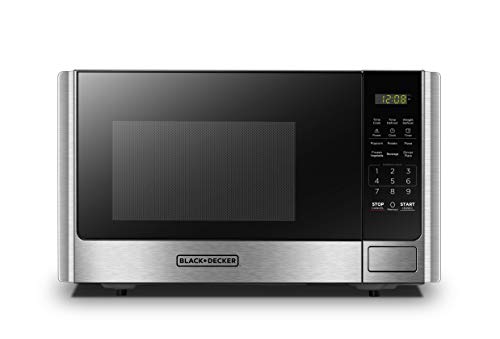
BLACK+DECKER Countertop Microwave Oven, 0.9 Cu.Ft, 900W, Stainless Steel
Badge: Best Compact Quality
Strengths
- Push-button door: the simplest, most alignment-tolerant door mechanism, and the one least likely to sag or mislatch with age.
- Stainless steel finish over a mainstream platform from a brand with a long small-appliance service history.
- Ten power levels at 900W give compact-class cooking an unusual degree of control.
Trade-offs
- No sensor, so reheating consistency depends on the cook’s judgement rather than the machine’s.
- 0.9 cubic feet is a size ceiling: quality of build cannot add litres.
- Feature set is deliberately plain — no mute or ECO headline items.
Key specs: Capacity 0.9 cu ft; Power 900W; 10 power levels; Push-button door; Child safety lock; 6 auto cook presets; Finish: stainless steel.
Start a quality survey with the door, because the door is where microwaves go to die. It opens and closes several times a day, every day, for years; its latches carry the safety interlocks that decide whether the machine may run at all; and a door that drops a millimetre out of alignment announces itself in rattles, steam leaks and eventually a machine that will not start. This BLACK+DECKER uses the push-button release, the most forgiving mechanism in the category: no long handle to lever against its hinges, no swing arc to catch on adjacent cabinetry, and a latch engagement that tolerates years of enthusiastic closing. In a compact machine — the class most often bought cheaply and built carelessly — that choice is a quality statement.
The rest of the design supports it. Stainless steel is not just a finish here; it is the more durable skin for a machine that will be wiped, knocked and steamed daily. The 900W output is honestly matched to the cavity: small machines with inflated wattage claims cook fiercely at the edges and raw in the middle, while this one’s power-to-volume ratio produces the even, predictable behaviour that is cooking quality in practice. Ten power levels — the full mainstream set, not a trimmed compact list — let you use that power properly, from a rolling boil down to a gentle soften. The child safety lock is present and correct.
Its quality limits are the class limits. There is no sensor, so the consistency of your reheating is your own skill, and the cavity’s size is fixed by physics. But judged as what it is — a compact countertop machine for one or two people — this is a well-built example from a traceable brand, and in a quality ranking that is exactly the comparison that matters. It will not do a family’s work; it will do its own work, properly, for a long time.
Best for: singles and couples who want a compact built to last rather than built to a price / Not suited for: families or sensor-dependent reheating.

TOSHIBA Microwave Oven, 0.9 Cu.Ft, 900W, Black Stainless Steel
Badge: Best Small-Household Quality
Strengths
- LED interior lighting: brighter, longer-lived and cooler than the incandescent lamps still found in budget cavities.
- Mute function and child lock show attention to ownership quality, not just cooking specification.
- Black stainless finish and a right-sized 10.6 inch turntable keep the design coherent for apartment kitchens.
Trade-offs
- No humidity sensor at this size in Toshiba’s line, so reheating is timed, not sensed.
- Six auto menus is a working list rather than a generous one.
- 900W trails the 1000W class slightly on dense frozen meals.
Key specs: Capacity 0.9 cu ft; Power 900W; 6 auto menus; Mute function; Child lock; LED lighting; Turntable 10.6 inch removable; Finish: black stainless steel; Positioned by the maker for apartments.
Quality hides in details most buyers never check, and this Toshiba is a small anthology of them. The LED interior light is the emblem: it costs a manufacturer slightly more than a filament lamp, lasts far longer, runs cool, and lights the cavity brightly enough to actually watch food through the door — which is a cooking-quality feature as much as a convenience, because food you can see is food you stop in time. The mute function is the same philosophy applied to sound: a machine that can be silenced respects the household it lives in. The child lock completes a trio of ownership details that signal a design team thinking about years of use, not the showroom minute.
The cooking platform is the sensible compact one: 900W across a 0.9 cubic foot cavity, a 10.6 inch turntable matched to apartment-size plates, six auto menus covering the realistic repertoire. Results are consistent in the way well-matched power and volume always are — no fierce hot rim, no sullen cold centre on ordinary portions — provided you use the power levels for dense food rather than defaulting to full blast. The black stainless finish suits contemporary small kitchens and, being a mid-tone, forgives the fingerprints that pure black advertises and the water spots that bright stainless collects.
Where the quality case thins is automation. Unlike its larger sibling below, this model has no humidity sensor, so reheating precision is the cook’s responsibility, and its menu list is functional rather than generous. Neither is a build flaw; both are the honest price of the size class. As a small-household machine that sweats the details competitors skip, it earns its badge — this is what “good quality” looks like at 0.9 cubic feet.
Best for: apartment households that value thoughtful details and quiet operation / Not suited for: buyers who want sensor automation or family capacity.

TOSHIBA Countertop Microwave Oven, 1.2 Cu.Ft, 1000W, Black
Badge: Best Overall Quality
Strengths
- Humidity sensor removes the biggest source of inconsistent results — human time-guessing — from reheating and steaming.
- Easy-clean interior acknowledges the cavity’s real enemy, baked-on splatter, and makes weekly maintenance a wipe.
- 12 auto menus, mute and ECO mode on a mainstream, widely supported platform.
Trade-offs
- Conventional power delivery: low settings cycle rather than holding steady like an inverter.
- Black finish needs more frequent wiping to look its best.
- Sensor performance depends on covering food correctly so steam reaches the sensor.
Key specs: Capacity 1.2 cu ft; Power 1000W; Turntable 12.4 inch removable; Smart humidity sensor; 12 auto menus; Mute function; ECO mode; Easy-clean interior; Finish: black.
The most common quality complaint about microwaves is not breakdown; it is inconsistency — the machine that reheats beautifully on Tuesday and ruins the same dish on Thursday. Inconsistency is usually a control problem, not a power problem: a timer cannot know that tonight’s portion is smaller, denser or colder than last night’s. This TOSHIBA’s humidity sensor is the mainstream answer, and it is why the model tops a quality ranking despite being a conventional, non-inverter machine. By measuring the steam the food releases, the sensor judges the food rather than the clock, and reheating and vegetable cooking become repeatable in the way quality actually means: same input, same result, day after day.
The build and ownership details back the cooking case. The easy-clean interior treats the cavity’s known failure mode — splatter baked onto walls and seams until it stains, smells and eventually attacks the coating — by making the weekly wipe genuinely quick, which is the maintenance owners actually perform. The 12.4 inch turntable is the right diameter for family plates, seated on a standard removable design that can be washed and, if the worst happens, replaced. Twelve auto menus give the sensor sensible programmes to run. Mute and ECO mode handle the household manners. Underneath it all sits a mainstream Toshiba platform: specifications published, support traceable, consumables obtainable — the ownership layer of quality that only becomes visible years in, when it is the only layer that matters.
Its ceiling is technological. At low power it cycles like every conventional machine, so the gentlest defrosting and melting work is competent rather than exquisite; the inverter tier still owns that territory. The black finish asks for a wipe more often than stainless. And the sensor does its best work with food covered and vented, so uncovered dry items remain a manual job. None of these dents the verdict for a mainstream quality pick: judged on consistency, build sense and support, this is the most complete quality package in the group.
Best for: families who want consistent, repeatable results and a machine built for years of daily use / Not suited for: cooks who need inverter-gentle low power above all.

COMFEE’ Countertop Microwave Oven, 0.7 Cu.Ft, 700W, Black
Badge: Best Small-Space Quality
Strengths
- Honest engineering for its class: power matched to volume, so small portions heat evenly instead of fiercely.
- Sound on/off and one-touch controls reduce the control panel to what its users actually press — fewer modes, fewer failures.
- Child safety lock and ECO mode are included where many compacts strip them out.
Trade-offs
- Built to the compact class’s price expectations; finish and fittings are functional rather than premium.
- 700W and 0.7 cubic feet cap its cooking quality for anything beyond single portions.
- No sensor, no multi-stage programming — consistency is the cook’s job.
Key specs: Capacity 0.7 cu ft; Power 700W; ECO mode; Sound on/off; One-touch buttons; Child safety lock; Finish: black; Positioned by the maker for dorm, apartment and office use.
A quality guide that only honoured expensive machines would be a price guide in disguise, so the COMFEE’ is here to make the opposite case: quality as fitness for purpose, honestly executed. A 0.7 cubic foot dorm-and-office microwave does not need a sensor or twelve menus. It needs to heat single portions evenly, survive being operated by tired students and distracted colleagues, stay silent when asked, and not fall apart when it is moved between rooms and leases. On those criteria this little machine is well judged. Its 700W is correctly matched to its small cavity — the commonest compact flaw is an overpowered cavity that scorches small portions, and this design avoids it — and its one-touch controls present a short, legible list of the things its users genuinely do.
The inclusions argue the same care. Sound on/off in a dorm machine is not a garnish; it is the difference between a microwave and a neighbourhood dispute. The child lock matters in the family-adjacent spaces these machines drift into. ECO mode suits an appliance that sits plugged in far longer than it cooks. COMFEE’ is also a traceable manufacturer with published specifications — the ownership floor that a quality guide must insist on, and that anonymous compacts cannot offer.
Be clear about the ceiling, though. The finish and fittings are functional, the cavity excludes family food entirely, and at 700W its cooking quality for dense or frozen items is limited by physics rather than by any flaw of manufacture. Judge it as a compact and it is a good one; judge it as a family microwave and no compact survives. That distinction — quality within a role — is the whole argument of this guide, and this machine is its clearest illustration. If your kitchen is being planned around a fitted space, the model also appears in the small-space discussion within Best Microwaves Cabinet Trim Kit research — but note that a countertop compact in an open cubby is a placement choice, not an installation.
Best for: dorms, offices and single-person homes wanting an honest, well-judged compact / Not suited for: families or any cooking beyond single portions.

Farberware Countertop Microwave Oven 1.1 cu.ft, 1000 Watts, Stainless Steel
Badge: Best Control Quality
Strengths
- Defrost by weight or by time: two precise instruments for the job where control quality shows most.
- Multi-stage cooking lets one programmed sequence defrost, rest and cook — consistency by design.
- Bright LED display and express cooking keep the interface legible and direct.
Trade-offs
- No sensor, so its precision is manual: it gives you the tools, you supply the judgement.
- Six presets is a shorter list than the TOSHIBA’s twelve.
- Conventional power cycling at low levels, like all non-inverter models here.
Key specs: Capacity 1.1 cu ft; Power 1000W; 10 power levels; Multi-stage cooking; 6 preset options; Defrost by weight or time; LED display; Express cooking; Finish: stainless steel.
There is a second route to consistent cooking besides automation: give the cook precise instruments and let skill do the work. The Farberware is the quality pick for that philosophy. Its defrost system is the clearest example. Defrosting is the most technically demanding everyday microwave job — too much power cooks the edges, too little leaves a frozen core, and the right answer depends on the food’s weight and shape. Defrost by weight automates the duty cycle for the amount you enter; defrost by time hands the same control to an experienced user with a preferred routine. Offering both, rather than a single vague auto button, is control quality in its purest form, and it shows in results: mince that thaws evenly, chicken pieces that stay raw until the pan, bread that revives instead of toughening.
Multi-stage cooking extends the same idea across a whole meal: programme defrost, then a standing rest, then the cook, and the machine executes the sequence with a consistency human attention rarely matches on a busy evening. Ten power levels provide the granularity those programmes need, and the LED display keeps the state of play readable at a glance across a bright kitchen. The stainless build and 1000W family platform are the mainstream virtues — durable skin, honest power, a cavity sized for real plates.
The trade-off is philosophical and should be chosen knowingly: this machine’s consistency is earned by the cook, not donated by a sensor. A household that wants to press one button and walk away will rate the TOSHIBA above it; a household that cooks deliberately will find the Farberware’s instruments more satisfying and, on defrosting specifically, more capable. Quality rankings that ignore that distinction are measuring the wrong thing. For cooks who value control, this is the best-made argument in the group.
Best for: deliberate cooks, batch cookers and anyone whose microwave defrosts several times a week / Not suited for: one-button households who want sensor automation.

Chefman Countertop Microwave Oven 0.9 Cu. Ft., 900 Watts, Black
Badge: Best Feature Balance
Strengths
- The complete quality-of-life set at this size: mute, ECO mode, child lock and express cook all present.
- 900W across 0.9 cubic feet is a well-matched power-to-volume ratio for even everyday results.
- Ten power levels preserve manual control alongside the six presets.
Trade-offs
- No sensor and no inverter; consistency is good, not automated.
- Black finish shows fingerprints and dust readily.
- Cavity suits one or two people’s portions, not family dishes.
Key specs: Capacity 0.9 cu ft; Power 900W; 10 power levels; 6 cooking presets; One-touch express cook; Eco mode; Child safety lock; Mute button; Finish: black.
Balance is an underrated form of quality. A machine that does one thing brilliantly and everything else adequately can be the wrong purchase for a household whose needs are broad, and the Chefman earns its badge by having no weak flank at its size. Cooking fundamentals: 900W honestly matched to a 0.9 cubic foot cavity, ten power levels, six presets, express cook. Household manners: a mute button for thin walls and late nights, ECO mode for the plugged-in week, a child lock for the relevant years. Nothing on that list is exotic; the quality lies in all of it being present, working together, in a class of machine where rivals routinely omit two items to save cost.
In use, that balance shows up as an absence of annoyance, which is what most owners actually mean by a quality appliance. Portions reheat evenly because the power suits the volume. The controls never strand you in a menu when you wanted thirty seconds. The machine does not beep the flat awake, does not sip standby power all week, and does not present a toddler with an inviting, operable door. Each is a small thing; together they are the texture of ownership over years, and they are chosen at design time — which is to say, they are quality, designed in rather than inspected in.
Its limits are the familiar compact ones, plus one aesthetic note: the black finish will show every fingerprint in a sunny kitchen, so fastidious owners should budget a weekly wipe or choose the stainless BLACK+DECKER above. There is no sensor to forgive careless reheating and no inverter to soften low power. Within those honest bounds, this is the most evenly complete small microwave in the group, and for a one- or two-person household that wants one machine to simply be good at everything it does, balance beats brilliance.
Best for: small households wanting the most complete, balanced feature set at this size / Not suited for: families or cooks who prioritise sensor automation.
Comparison Table
| Model | Capacity | Power | Door | Sensor | Quality signature | Link |
|---|---|---|---|---|---|---|
| BLACK+DECKER 0.9 Cu.Ft, Stainless | 0.9 cu ft | 900W | Push-button | No | Door mechanism and stainless build | Check on Amazon |
| TOSHIBA 0.9 Cu.Ft, Black Stainless | 0.9 cu ft | 900W | Conventional | No | LED lighting, mute, detail finish | Check on Amazon |
| TOSHIBA 1.2 Cu.Ft, Black | 1.2 cu ft | 1000W | Conventional | Yes, humidity | Reheating consistency, easy-clean cavity | Check on Amazon |
| COMFEE’ 0.7 Cu.Ft, Black | 0.7 cu ft | 700W | Conventional | No | Honest compact engineering | Check on Amazon |
| Farberware 1.1 cu.ft, Stainless | 1.1 cu ft | 1000W | Conventional | No | Defrost and multi-stage control | Check on Amazon |
| Chefman 0.9 Cu. Ft., Black | 0.9 cu ft | 900W | Conventional | No | Complete quality-of-life feature set | Check on Amazon |
Read across the “quality signature” column and the guide’s argument is visible in one view: there is no single quality, there are qualities — door engineering, detail finish, sensor consistency, honest compact design, control precision and feature balance — and the right pick is the one whose signature matches your household’s daily friction. The table also shows what this pool does not contain: no inverter models, which is why low-power gentleness is the one quality dimension scored “competent” across the board rather than excellent anywhere.
What Quality Actually Means in a Microwave: A Buyer’s Framework
The door and latch. The highest-cycle component on the machine and the carrier of its safety interlocks. Favour mechanisms that close positively without slamming, align without play, and — in push-button designs — release without levering on the hinges. A door you have to lift or jiggle on day one is a machine telling you its future.
The cavity. Look for smooth, well-finished interiors without sharp seams that trap grease, and treat easy-clean coatings as longevity features, not cosmetics: baked-on splatter absorbs energy, overheats locally and attacks the surface beneath it. The waveguide cover — the small mica panel on the cavity wall — should be intact and replaceable; a damaged one is a service item, not a cosmetic flaw.
Power honesty and control. Wattage is an input claim; cooking quality is what arrives in the food. Matched power-to-volume, a full set of power levels, a real defrost system and, ideally, a sensor are the verifiable signs. A machine with fewer, honest controls will out-cook a machine with twenty theatrical presets it cannot execute well.
The turntable drive. The plate should rotate smoothly, seat positively on its hub and survive removal for washing without drama. Roller rings and plates are consumables on a long-lived machine; designs from traceable brands let you replace them instead of replacing the microwave.
Ownership. Published specifications, a real warranty, obtainable parts and a manufacturer who will still exist in five years. This layer is invisible in the showroom and decisive in year four, and it is why this guide’s pool contains only traceable brands — a position the market-by-market guides share, as the sourcing discussion in Best Microwaves Canada shows from the buyer’s side of the border.
How to Inspect a New Microwave in Its First Week
Day one checks, step by step. One: open and close the door twenty times. It should latch positively every time, sit flush, and never need a lift or a slam. Two: run the turntable empty of food but with a mug of water inside — never run a microwave truly empty — and watch a full rotation for wobble, grinding or hesitation. Three: press every control button; each should register first time, with a consistent feel. Four: check the interior light covers the cavity and the display reads clearly in your kitchen’s light. Five: confirm the child lock engages and releases exactly as the manual describes.
Simple cooking-quality tests. Heat a full mug of water and note the time to a rolling boil; you now have your machine’s personal baseline for life. Reheat a plate of mixed leftovers and check the centre temperature against the edges — you are mapping your machine’s hot spots, which every microwave has. Defrost a small pack of mince on the weight setting and inspect for cooked edges. Steam a covered bowl of vegetables. None of this needs instruments; it needs attention, once, while the return window is open and the box is still in the hall.
Care that preserves quality. Wipe splatter the day it happens; steam-clean weekly with a bowl of water and lemon if you cook often. Wash and fully dry the turntable and roller ring before refitting. Keep the door seal and latch area grease-free. Never use scouring pads or oven cleaner inside. Leave the ventilation clearances the manual specifies — a quality machine suffocated in a tight cubby ages like a poor one.
Troubleshooting. Problem: the machine will not start with the door shut → check the latch engagement and that nothing obstructs the door; interlocks are doing their job, and a door that needs force is a return-or-service issue, not a quirk to live with. Problem: reheating is inconsistent → cover food and vent it, stir halfway, and if your model has a sensor, use it for that job instead of timed cycles. Problem: the plate rocks or stalls → clean the ring and hub, reseat the plate, and check for crumbs in the drive. Problem: unusual buzzing, arcing smells or a hot exterior panel → stop, unplug, and seek service; internal high-voltage components are never a home repair.
Quality Across Tiers: What Paying More Does and Does Not Buy
It is worth being precise about the relationship between price tier and quality, because both naive positions — “you get what you pay for” and “they are all the same inside” — are wrong in instructive ways. Paying more, intelligently, buys three real things. It buys cooking technology: inverter power delivery and better sensors genuinely change results, particularly at low power and on reheating. It buys capacity and cavity innovation, such as flatbed floors. And it often buys refinement: quieter fans, heavier doors, better displays, finishes that age gracefully. A buyer who cooks daily and delicately will feel those purchases weekly, and for that buyer the premium tier is a quality purchase, not an indulgence.
What paying more does not automatically buy is the basics done right. A door latch does not know what the machine cost. A cavity coating bubbles at the same seams in a careless design at any tier, and a control panel’s most-pressed button wears at the same rate. This is why the six machines in this guide — all mainstream, none flagship — can sustain a serious quality ranking among themselves: their differences in door design, defrost control, sensor consistency and detail finish are real quality differences, purchasable without leaving the mainstream tier. The correct shopping method follows from that. Set the tier by your cooking (conventional for reheating households, inverter for delicate daily cooking), then, within the tier, choose on quality signatures — door, cavity, controls, support — rather than assuming the tier has chosen for you. Money buys the category of quality available; judgement buys the quality itself.
Common Buying Mistakes
- Confusing features with quality. Twenty presets executed badly are worse than six executed well. Judge the mechanisms — door, cavity, controls, drive — before the menu list.
- Trusting a headline wattage. Power-to-volume match and control granularity decide real results. An honest 900W in a compact out-cooks an inflated claim in a badly matched cavity.
- Ignoring the door in the showroom. Open it, close it, check the alignment and the latch feel. It is the part you will operate thousands of times and the part whose failure ends the machine’s life.
- Skipping the first-week tests. Weak doors, rocking turntables and dead buttons announce themselves immediately. Find them while the box is still in the hall and returns are painless.
- Buying an untraceable brand. No identifiable manufacturer means no warranty worth claiming, no parts, no manual, no recourse — the definition of low ownership quality, whatever the specification sheet promises.
- Suffocating a good machine. Blocked vents and closed cupboards age any microwave prematurely. Installation discipline is part of quality, and it is the part the buyer controls.
Final Recommendation
On quality across all three senses — build, cooking consistency and ownership — the pick is the TOSHIBA 1.2 Cu.Ft 1000W. Its humidity sensor delivers the repeatable reheating that most households experience as “a good microwave”, its easy-clean cavity and mainstream platform are built for years of daily use, and its support trail is the kind you want behind an appliance you will still own in five years.
Choose by signature when your priorities differ. Deliberate cooks and heavy defrosters should take the Farberware 1.1 cu.ft for its instruments. Small households should take the Chefman 0.9 Cu. Ft. for its completeness, or the Toshiba 0.9 for its details, or the BLACK+DECKER 0.9 for its door — three different quality arguments at one size, all defensible. And the COMFEE’ remains the proof that a small, inexpensive machine can still be a quality purchase when it is honestly made for its job.
Frequently Asked Questions
How can I judge a microwave’s quality without relying on ratings?
Use the framework in this guide: door and latch feel, cavity finish, power-to-volume match, defrost system design, control granularity, and the manufacturer’s traceability. Then verify with first-week tests — water heating, a mixed leftover plate, a defrost — while returns are easy. Those checks reveal more about the machine you will live with than any aggregated score.
Which part of a microwave wears out first?
Usually the high-cycle mechanical parts: the door latch and interlock switches, the turntable motor and roller ring, and the control panel’s most-used buttons. That is why door design and panel build feature so heavily in a quality assessment, and why replaceable plates and rings matter on a machine you intend to keep.
Does a sensor actually improve quality, or is it a gimmick?
It improves the specific quality most users notice most: reheating consistency. By judging the food’s steam rather than a timer, a sensor removes portion-size guesswork from reheating and steaming. It does not replace good defrost controls or honest power, which is why this guide rates the sensor model and the control-focused model as different kinds of quality rather than better and worse.
Are smaller microwaves lower quality than larger ones?
Not inherently. Quality is fitness for purpose, honestly executed: a compact with matched power, a sound door and a traceable maker is a quality machine, while an oversized model with a sloppy latch is not. Size limits what a machine can cook; it does not determine how well it is made.
Is stainless steel actually more durable than a black finish?
The substrate and build matter more than the colour, but stainless fronts generally hide daily marks better and age gracefully in mainstream kitchens, while black finishes show fingerprints and dust sooner. The practical quality factor is how the surface tolerates years of wiping — both do, provided you avoid abrasive cleaners.
How long should a quality countertop microwave last?
A well-built mainstream model, kept clean, properly vented and never run empty, should give years of daily service. Longevity is helped by exactly the habits in this guide: prompt splatter cleaning, a clean door seal, correct clearances, and replacing consumables like the turntable plate rather than tolerating a damaged one.
What should I do if a new microwave fails a first-week check?
Return or exchange it promptly rather than adapting to it. A door that will not latch cleanly, a stalling turntable or unresponsive controls in week one are manufacturing faults, not character, and they do not improve with time. This is why the checks come first, while the box and the return window are still open.


