Disclosure: topratedkitchenware.com is reader-supported. When you buy through links on our site, we may earn an affiliate commission from Amazon and other retailers, at no extra cost to you.
Where to buy
The best midrange ice cream makers occupy the most contested ground in the category: above the flimsy novelty machines, below the countertop flagships, in the tier where a household appliance has to justify itself every single week. The six verified picks below map that tier honestly — from a simple one-switch classic at its sensible floor to a genuine compressor design at its ambitious ceiling — and each carries an Amazon link so you can check the latest price on Amazon and read the confirmed specification. This guide prints no prices anywhere, because midrange is a position, not a number: it means paying for the parts that decide texture and longevity, and declining to pay for theatre.
- Cuisinart 1.5-Quart Ice Cream Maker, Frozen Yogurt Sorbet Maker, ICE-21P1 — Best Midrange Classic. The one-switch freezer-bowl machine that defines the tier’s floor done properly.
- Ninja Creami Scoop and Swirl Ice Cream Maker, NC701 — Best Midrange Showpiece. Scooped or swirled soft serve from frozen bases, in a bone and champagne finish.
- Whynter Upright Ice Cream Maker 2.1 Qt, ICM-201SB — Best Step-Up Within the Tier. A built-in compressor and the largest capacity here, for households ready to stretch.
- Nostalgia Electric Ice Cream Maker, 4 Qt, Old Fashioned Vintage Wooden Style — Best Midrange Gathering Machine. Four quarts of frozen yogurt or gelato in a heritage bucket.
- Ninja CREAMi 7-in-1 Ice Cream Maker, NC301 — Best Midrange Versatility. Seven functions that turn frozen bases into ice cream, gelato, sorbet and milkshakes.
- Dash My Mug Ice Cream Maker 2 Pack Bundle, Half-Pint Freezer Mugs — Best Entry Point to the Tier. Single-serve freezer mugs for households testing the habit.
Read the full guide ↓ for badges, trade-offs, a comparison table and a plain account of what midrange money actually buys in this category — motor headroom, bowl quality, capacity honesty and routines that survive contact with a real week.
Midrange is where ice cream makers stop being gifts and start being appliances. The cheapest machines in the category are bought on impulse and forgiven their weaknesses; the most expensive are bought as statements and forgiven their size. The best midrange ice cream makers get no forgiveness at all — they are bought deliberately, by people who compared, and they are expected to churn well in year three, wash without drama, and fit the kitchen they were measured for. That is the standard this guide applies. Every pick below had to answer three questions: does its specification spend money where texture is decided, does its routine fit an ordinary household, and would a careful buyer still feel well served after fifty batches?
The six answers span the tier’s real range. Two are classic freezer-bowl and bucket churners, two are frozen-base processors from the Ninja CREAMi family, one is a single-serve mug system that lets a household test the habit at the tier’s floor, and one — the Whynter — is the stretch: a compressor machine included because its upright format and capacity make it the honest ceiling of what a midrange-minded buyer might reasonably reach for, and because a tier guide that hides its own ceiling helps nobody. Readers comparing design generations across the whole category will find the same machines re-examined from a different angle in our survey of Best Modern Ice Cream Makers.
Key Takeaways
- Midrange value is specification discipline: a heavy-feeling motor, an honest capacity and a bowl or canister built for years, rather than a longer list of novelty functions.
- The tier spans routines, not just sizes — freezer bowls that ask a day of planning, frozen bases that ask freezer shelf space, and one compressor that asks only for counter room.
- Capacity runs from half-pint mugs to a four-quart bucket; the midrange sweet spot for most households is the 1.5 to 2.1 quart band covered by the Cuisinart and the Whynter.
- The Ninja CREAMi pair earn their place on versatility: seven functions and two serving styles from the same frozen-base idea.
- The Nostalgia proves midrange is not a style — a vintage wooden bucket can be a thoroughly sensible tier purchase for households that host.
- Shoppers who outgrow the tier’s ceiling can see where the wider market’s affections lie in our analysis of Best Selling Ice Cream Makers.
In this guide
Quick Picks
| Pick | Badge | Freezing approach | Capacity from title | Link |
|---|---|---|---|---|
| Cuisinart ICE-21P1 | Best Midrange Classic | Double-insulated bowl, pre-freeze | 1.5 quarts | Check on Amazon |
| Ninja Scoop and Swirl NC701 | Best Midrange Showpiece | Frozen-base processor | Pint system, soft serve | Check on Amazon |
| Whynter ICM-201SB | Best Step-Up Within the Tier | Built-in compressor, upright | 2.1 quarts | Check on Amazon |
| Nostalgia Electric 4 Qt | Best Midrange Gathering Machine | Electric bucket churner | 4 quarts | Check on Amazon |
| Ninja CREAMi NC301 | Best Midrange Versatility | Frozen-base processor | 7-in-1 pint system | Check on Amazon |
| Dash My Mug 2 Pack | Best Entry Point to the Tier | Freezer mugs, single serve | Half-pint mugs, 2 pack | Check on Amazon |
The badges are tier judgements, not overall judgements. Best Midrange Classic means the design a careful buyer with a freezer and a planning habit should reach for first; Best Step-Up means the machine to stretch for when the classic’s one-batch-per-freeze limit starts to chafe. Read the detailed reviews with your own routine in mind and the badges will sort themselves.
How These Picks Were Chosen
Every pick comes from a verified pool checked on 2026-11-20: titles, brands and listings confirmed first, and only confirmed models linked and pictured. Spec boxes quote those titles and nothing else — capacities, stated functions, named features such as an LCD display and timer or an aluminium canister. No prices appear anywhere in this guide, by design: tier position is argued qualitatively, from construction and specification, and any figure printed here would be stale before it was useful. Check the latest price on Amazon for the pick that fits you, on the day you are ready to buy.
Selection within the tier followed the midrange buyer’s actual logic. First, the floor had to be honest: the Dash mugs and the Cuisinart classic are the two sensible ways to enter homemade ice cream without buying a novelty or a monument. Second, the middle had to show the category’s live fork — churn a mixture, or freeze a base and process it — because that fork, more than any feature list, decides a household’s routine; the two Ninja designs represent the processing path at its most versatile and its most theatrical. Third, the ceiling had to be visible: the Whynter’s compressor and the Nostalgia’s four-quart bucket show what stretching within the tier buys — spontaneity in one case, scale in the other — so a buyer can decide whether the stretch answers a real need or a passing wish.
The judgements are research-led, drawn from confirmed specifications and the known behaviour of each freezing family, with no invented testing claims and no borrowed enthusiasm. Where a pick’s virtue is narrow, the review says so; where a cheaper design in the set outperforms a dearer one for a particular household, the review says that too. That is what a tier guide owes its reader: not a ladder to climb, but a map of where the value actually sits.
The 6 Best Midrange Ice Cream Makers, in Detail

Cuisinart 1.5-Quart Ice Cream Maker, Frozen Yogurt Sorbet Maker, ICE-21P1
Badge: Best Midrange Classic
Strengths
- The complete classic specification at the tier’s sensible floor: a double-insulated bowl, one-switch operation and an easy mix-in spout.
- Three stated desserts — ice cream, frozen yogurt and sorbet — cover what most households actually churn.
- At 1.5 quarts it makes a family-pleasing batch without the storage burden of the two-quart class.
Trade-offs
- The bowl requires pre-freezing, so the routine is plan-today, churn-tomorrow.
- One switch means no timer; the cook supplies the attention the electronics omit.
- One batch per bowl freezing — a second flavour waits a day.
Mini spec box: Type: freezer-bowl ice cream, frozen yogurt and sorbet maker · Stated capacity: 1.5 quarts · Bowl: double-insulated, requires pre-freezing · Controls: one switch · Feeding: easy mix-in spout · Finish: white · Model: ICE-21P1.
The ICE-21 is what midrange means when the word is used as praise: nothing wasted, nothing missing. Its specification spends exactly where a churner’s quality lives — the insulated bowl that holds the cold, a motor sized for the batch, a spout that admits mix-ins without stopping the churn — and declines every expense that does not change the ice cream. Households upgrading from a novelty machine feel the difference in the first batch: a steadier churn, a firmer finish, a bowl that still performs in its third summer. Households buying their first machine get the category’s clearest teacher, because one switch leaves nowhere for confusion to hide.
Its limits are the family’s honest limits, and they define the upgrade questions this guide exists to frame. When the day-ahead bowl starts to feel like a tax, the answer is the compressor step-up below. When one batch per freeze starts to feel small, the answer is capacity, in the Whynter or the Nostalgia. Until those feelings arrive — and for many households they never do — the ICE-21 is the midrange purchase that needs no apology and no sequel. Yogurt-centred households should note its stated frozen yogurt role, explored fully in our dedicated guide to Best Ice Cream Yogurt Makers.
Best for: deliberate first-time buyers and classic-routine households wanting the tier’s best-judged simplicity / Not suited for: spontaneous makers or anyone who wants timed, unattended churning
Check on Amazon — check the latest price on Amazon for the Cuisinart ICE-21P1.

Ninja Creami Scoop and Swirl Ice Cream Maker, NC701
Badge: Best Midrange Showpiece
Strengths
- Two serving styles from one frozen base — scooped or swirled soft serve — a format no churner at any tier in this guide attempts.
- Midrange money spent on a real capability: the swirl mechanism, not on decorative electronics.
- The bone and champagne finish makes it a countertop presence households are happy to leave out and therefore use.
Trade-offs
- The frozen-base routine moves the work upstream: pints must be frozen before processing, so dessert is always tomorrow’s base or yesterday’s foresight.
- Soft serve is an immediate pleasure; it does not tub up for the week the way a churned batch does.
- Its stated Amazon Exclusive channel designation means benchmark shoppers should track it by its NC701 model number.
Mini spec box: Type: frozen-base ice cream and soft serve maker · Stated serving styles: scooped or swirled · Finish: bone and champagne · Channel note: Amazon Exclusive, as stated in title · Model: NC701.
Midrange buyers are often told to avoid showpieces, and usually the advice is sound — but the Scoop and Swirl’s showpiece quality is its substance. The swirl is not a light show; it changes the dessert, turning a plain base into the parlour format children campaign for and giving a household two textures from one freezing session. In tier terms, that is exactly what the extra money over a basic processor should buy: a capability you will use weekly, in a finish you will not hide, from a system — frozen pints, processed on demand — whose routine suits planners and experimenters alike.
Judge it against its sibling below, the NC301, because the pair frame the midrange processor choice cleanly. The NC301 is broader — seven functions, the wider playground. The Scoop and Swirl is deeper in one beloved direction — the cone. Households that host, celebrate and serve dessert as an event will get more joy per batch from the swirl; households that tinker across gelato, sorbet and milkshakes will get more from the seven-function machine. Neither answer is the tier’s wrong answer, which is what a healthy midrange looks like.
Best for: families and hosts who want parlour-style soft serve as a weekly ritual / Not suited for: make-ahead tub makers or ice-cream minimalists
Check on Amazon — check the latest price on Amazon for the Ninja Creami Scoop and Swirl.
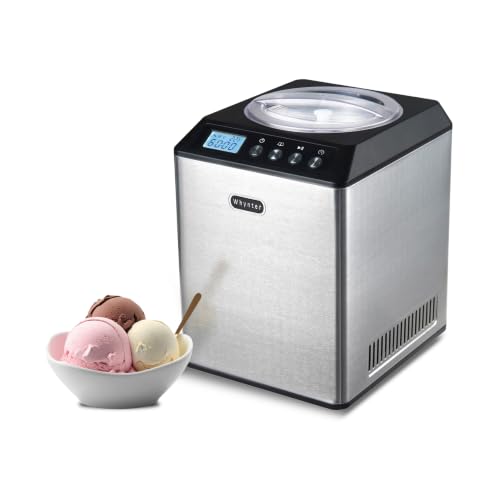
Whynter Upright Ice Cream Maker 2.1 Qt, ICM-201SB
Badge: Best Step-Up Within the Tier
Strengths
- A built-in compressor at the tier’s ceiling: no pre-freezing, no bowl, dessert decided the same hour it is eaten.
- The largest churned capacity in the set at 2.1 quarts, in an upright design that spends height rather than counter width.
- An LCD display and timer — the controls that turn churning from attendance into process.
Trade-offs
- It is the stretch purchase of this guide, positioned qualitatively at the top of the tier; households should feel the step and take it deliberately.
- Compressor machines want a permanent, ventilated home — this is furniture-grade commitment for a small appliance.
- Its capacity is wasted on a two-person household that churns small.
Mini spec box: Type: upright ice cream maker with built-in compressor · Stated capacity: 2.1 quarts · Pre-freezing required: none · Controls: LCD display and timer · Model: ICM-201SB.
Every tier guide owes its reader one honest stretch, and the Whynter ICM-201SB is this one’s. The case for stretching is routine, not luxury: a compressor deletes the category’s two planning taxes — the frozen bowl and the frozen base — and replaces them with a machine that is simply ready. For a household that has already proved its ice cream habit on a classic churner and now chafes at the planning, that readiness is not indulgence; it is the difference between a hobby that fits the week and one that keeps missing it. The 2.1-quart capacity and timed control complete the step-up logic: bigger batches, run deliberately, back to back when a gathering demands.
The case against stretching is equally honest. If your household churns monthly, the compressor’s virtues sit idle while its footprint does not, and the classic below will serve you better for years. The midrange discipline is to stretch for a routine you have already demonstrated, never for one you merely intend. Buyers weighing that exact decision against the heritage alternatives will find useful context in the benchmark discussion at Best Old Fashioned Ice Cream Makers Consumer Reports.
Best for: proven weekly makers ready to delete pre-freezing from their routine / Not suited for: occasional makers, tiny counters or two-person small-batch households
Check on Amazon — check the latest price on Amazon for the Whynter ICM-201SB.

Nostalgia Electric Ice Cream Maker, 4 Qt, Old Fashioned Vintage Wooden Style
Badge: Best Midrange Gathering Machine
Strengths
- Four quarts is the largest capacity in this guide by a wide margin — one churn serves a gathering, with frozen yogurt or gelato stated in its title.
- The vintage wooden style and aluminium canister turn dessert-making into the entertainment itself.
- Electric drive delivers the heritage format without heritage labour.
Trade-offs
- Scale is its virtue and its tax: storage, and a batch size small households will seldom justify filling.
- Bucket-format making is an occasion routine, not a weeknight one.
- The light wood aesthetic commits to a look; minimal kitchens should be sure they love it.
Mini spec box: Type: electric old-fashioned ice cream maker · Stated capacity: 4 quarts · Stated desserts: frozen yogurt or gelato · Canister: aluminium · Style: vintage wooden, light wood finish · Brand: Nostalgia.
The Nostalgia is the midrange pick that breaks the tier’s usual aesthetic — proof that sensible money and wooden buckets are not opposites. For a hosting household, its economics of joy are straightforward: one machine, one churn, dessert for everyone, with the making itself part of the afternoon’s entertainment in a way no silent countertop box can imitate. The stated frozen yogurt capability matters more than it might seem, because gathering desserts increasingly include a lighter option, and a bucket that churns gelato and frozen yogurt alongside ice cream covers the whole table from one canister.
Its midrange honesty is that it spends on capacity and experience rather than electronics, and asks its price in storage rather than in tier. Households that host monthly will find it the hardest-working machine in this guide per gathering. Households that host twice a year should admire it, borrow the idea for a future season, and buy the classic instead. Tier wisdom is mostly that kind of calendar honesty, applied before the purchase rather than after.
Best for: hosts and large families who make dessert an event / Not suited for: small households, small storage or weeknight minimalists
Check on Amazon — check the latest price on Amazon for the Nostalgia Electric 4 Qt.

Ninja CREAMi 7-in-1 Ice Cream Maker, NC301
Badge: Best Midrange Versatility
Strengths
- Seven functions from frozen bases — the verified title names ice cream and gelato, and describes sorbet and milkshakes among the transformations.
- The title’s own range, from healthy to indulgent, is real: light fruit bases and rich custards process in the same system.
- Pint-scale production turns experimentation into a cheap habit — a failed flavour costs a pint, not a tub.
Trade-offs
- Bases freeze before processing, so the routine is a freezer shelf of futures rather than a same-hour churn.
- Volume households work in multiples; there is no single family tub in this system.
- Results depend heavily on base construction, so the learning curve belongs to the cook.
Mini spec box: Type: frozen-base ice cream processor · Stated functions: 7-in-1, including ice cream and gelato · Method: transforms frozen bases into ice cream, sorbet and milkshakes at a button touch · Model: NC301.
The NC301 is the midrange versatility champion because it converts one purchase into a standing dessert laboratory. Its seven functions are not the padded list the tier usually warns against; they are variations on a single, coherent mechanism — a frozen base, processed to order — so each function costs the household nothing in extra parts or counter space. For the cook who thinks in flavours, that coherence is the value: a shelf of pints is a menu in waiting, and the machine’s job is simply to finish whichever one tonight demands.
In tier terms it sits exactly where a midrange flagship should: clearly above the entry designs in capability, clearly below the statement appliances in commitment. Its honest tax is the freezer-first routine and the pint ceiling, both of which its buyers tend to experience as features — portion discipline and make-ahead freedom — rather than limits. If your household’s dessert problem is variety rather than volume, this is the pick the tier was invented for. Its place in the current design generation is traced in our roundup of Best New Ice Cream Makers.
Best for: experimenters and variety-driven households who plan a freezer shelf of bases / Not suited for: single-tub traditionalists or no-planning households
Check on Amazon — check the latest price on Amazon for the Ninja CREAMi NC301.

Dash My Mug Ice Cream Maker 2 Pack Bundle, Half-Pint Freezer Mugs
Badge: Best Entry Point to the Tier
Strengths
- The lowest-commitment route into the tier: two half-pint freezer mugs, an ingredient chute and single-serve portions by design.
- Portion scale is a feature for small households — dessert for one or two, made in the mug it is eaten from.
- Countertop frozen treat making with almost no storage footprint; the mugs live where mugs live.
Trade-offs
- Half-pint servings are the ceiling as well as the concept; a family dessert this is not.
- The freezer-mug routine still asks for pre-frozen mugs, so spontaneity is limited to the mugs you froze.
- Households that catch the habit will outgrow it — which is precisely its role as the tier’s entry point.
Mini spec box: Type: electric soft serve ice cream machine set with freezer mugs · Stated serving: half-pint freezer mugs, 2 pack bundle · Feeding: ingredient chute · Format: single-serve freezer bowls, countertop · Colour: aqua · Brand: Dash.
Every tier needs an honest doorway, and the Dash My Mug set is this one’s. It lets a household discover its true ice cream frequency — the single most valuable fact in this entire category — at the smallest possible commitment of money, space and routine. A couple that churns twice a week in the mugs has learned they should buy the classic or the processor next; a couple that churns twice a season has learned something equally valuable, at mug prices of effort. The design itself is cheerfully fit for purpose: freeze the mugs, churn a single serving, eat from the same vessel, wash almost nothing.
Its limits are written on its title in plain sight — half-pint, single serve — and a buyer who respects them will never be disappointed by it. Treat it as the tier’s tasting spoon: small, honest, and the beginning of many households’ longer story with the machines above it in this guide.
Best for: singles, couples and the ice-cream-curious testing the habit at minimum commitment / Not suited for: families, hosts or anyone needing a shareable batch
Check on Amazon — check the latest price on Amazon for the Dash My Mug 2 Pack.
Comparison Table
| Pick | Tier position | Capacity | What the money buys | Link |
|---|---|---|---|---|
| Cuisinart ICE-21P1 | Tier floor, done properly | 1.5 quarts | Bowl quality and classic simplicity | Check on Amazon |
| Ninja Scoop and Swirl NC701 | Tier showpiece | Pint system | The swirl: two serving styles | Check on Amazon |
| Whynter ICM-201SB | Tier ceiling / step-up | 2.1 quarts | A compressor: no pre-freezing, timed control | Check on Amazon |
| Nostalgia Electric 4 Qt | Tier scale pick | 4 quarts | Capacity and the gathering experience | Check on Amazon |
| Ninja CREAMi NC301 | Tier versatility pick | 7-in-1 pint system | Seven functions, one mechanism | Check on Amazon |
| Dash My Mug 2 Pack | Tier entry point | Half-pint mugs | The habit test at minimum commitment | Check on Amazon |
How to Choose the Best Midrange Ice Cream Makers Without Overbuying
The midrange method is to buy your demonstrated routine, one step up. Start by naming the routine you actually have. If dessert is planned and your freezer has a bowl-sized corner, the classic churners are your family and the only question is size: 1.5 quarts for most, four for hosts. If your household thinks ahead in pints and loves variety, the processors are your family and the question is breadth versus theatre — NC301 or Scoop and Swirl. If you have already lived a churner’s routine for a season and the planning is the only thing you resent, the compressor step-up has earned its place on your counter. Notice what this method never does: it never starts from a feature list, and it never buys a routine you have not yet lived for a machine you have not yet needed.
Then audit the specification the way the tier’s best makers do. Money should be visible in the parts that touch texture and time: the bowl’s insulation, the motor’s steadiness under a firming batch, the canister’s material, the compressor’s presence. Money spent on control theatre — screens that duplicate a switch, functions that rename each other — is the tier’s classic waste. Capacity honesty matters equally: a stated quart and a half that a household fills weekly is worth more than a heroic capacity filled twice a year, because midrange value is measured per batch actually made, and unused capacity is the most expensive kind there is.
Finally, hold the tier line on both sides. Below it sit novelty machines whose savings evaporate in weak churns and early replacements; above it sit statement appliances whose virtues are real but whose routines — permanent counter residence, enthusiast maintenance — belong to a different household budget of space and attention. The midrange buyer’s triumph is not a bargain; it is a machine still earning its place, unremarked and indispensable, in year three.
How to Get Midrange Value From Every Batch: Use, Care and Upgrades
Value in this tier compounds through use, so the how-to is economic as much as culinary. Establish one house base — a vanilla custard for churners, a master pint for processors — and make it until it is reflexive, because a perfected base is the platform every flavour experiment stands on. Chill everything the design allows to be chilled: bases overnight, bowls for their full preparation, pints level and solid. Add mix-ins late, serve the first portion soft from the churn, and freeze the rest in shallow containers that firm evenly and scoop kindly. Keep a batch log — date, base, adjustment, verdict — because midrange machines reward the cook who iterates, and iteration without notes is just repetition.
Care protects the investment the tier represents. Wash dairy parts promptly, dry them completely, and store bowls and canisters aired rather than sealed damp. Keep compressor vents clear and their machines stationary; a compressor that lives in one ventilated spot outlasts one dragged through cupboards. Treat paddles and lids as the wear items they are, note your model number with your paperwork, and replacements become a search rather than an archaeology dig.
Troubleshooting, midrange style, starts with the base before the machine. Problem: a churned batch stays soft past its usual time → the base was warm or the bowl under-frozen; chill longer and freeze fully rather than blaming the motor. Problem: a processed pint is crumbly → the base froze too lean or too cold; let it stand briefly and reprocess, then enrich the next pint. Problem: texture varies batch to batch → your variables are drifting; return to the house base, change one thing, and let the log arbitrate.
When to Stay, When to Step Up: A Tier Ladder in Plain Terms
Stay at the floor while the habit is young. The Dash mugs and the ICE-21 teach a household its frequency, its favourite bases and its real capacity needs, and that knowledge is worth more than any specification. Step into the middle when the questions change from whether you make ice cream to how you want it served and varied — that is the processors’ moment, and the choice between them is taste, not rank. Step to the ceiling when the complaint is purely about planning: when bowls and pints are faithfully prepared and the household still wishes dessert could be decided at dinner. That complaint, and only that complaint, is what a compressor answers.
Notice, too, when not to climb. A bigger batch is not an upgrade if your household is small; a longer function list is not an upgrade if your menu is vanilla and strawberry; a heritage bucket is not an upgrade if your calendar holds two gatherings a year. The midrange mindset — the one this whole guide argues for — treats every step as a purchase of routine, and routines cannot be aspirational. They can only be lived, noticed, and then, at exactly the right moment, better equipped.
The Midrange Freezer and Counter Audit
Before any tier purchase, spend ten minutes measuring the two territories every design in this guide quietly taxes. The freezer first: a double-insulated bowl needs a level, permanent-ish home with air around it to freeze evenly; a pint system needs a shelf where several squat containers can stand flat and be found again; even the bucket and compressor households need tub territory for finished batches. Walk to your freezer with the stated capacities in mind — a 1.5-quart bowl is a substantial object, four quarts of finished ice cream is a shelf — and confirm the room exists in the freezer you have, not the one you vaguely intend to defrost someday. Households that skip this audit do not lack a machine; they lack the machine’s habitat, and the churn suffers for it in ways that get blamed on motors.
The counter second. The churners and processors in this guide are cupboard citizens — out for the batch, away by bedtime — while the Whynter is a resident, and residents must be measured like furniture: footprint, height under cabinets, vent clearance, and the social question of whether a machine in permanent view will be a pleasure or an reproach. The Nostalgia asks a third kind of space, storage for an object with presence, ideally somewhere its wooden style is an asset rather than an obstacle. None of these audits require equipment beyond a tape measure and honesty, and together they predict ownership satisfaction more reliably than any feature comparison in this guide — which is precisely why the midrange buyer, the deliberate buyer, does them first.
What Fifty Batches Teach You: The Long View From the Tier
Talk to households fifty batches into a midrange machine and their reports converge in ways no specification sheet predicts. They talk about the base they perfected, not the machine’s functions. They talk about the bowl’s permanent freezer address, the pint shelf’s quiet order, the grandchildren’s standing orders. They mention, almost in passing, that the machine has become unremarkable — and mean it as the highest praise in the appliance vocabulary, because unremarkable is what weekly tools aspire to. The machines that fail the fifty-batch test rarely fail mechanically; they fail socially, by asking a routine the household would not keep, and they are recognisable in hindsight by the gap between the routine sold and the routine lived.
That long view reframes the tier’s economics one final time. A midrange machine’s cost is best divided not by years but by batches actually churned, and on that measure the honest classic used weekly for three years is one of the cheapest appliances in the kitchen, while the ambitious stretch used monthly is among the dearest. The arithmetic is available to every buyer in advance, because the only variable in it is your own frequency — which is why this guide has insisted, from its first paragraph to this one, that the midrange purchase is a purchase of routine, and that the buyer who knows their routine cannot really buy wrong within these six.
Common Buying Mistakes
The tier’s signature mistake is buying the ceiling for a floor-level habit — a compressor idling on the counter of a monthly maker, quietly converting money into guilt. The mirror mistake is buying the floor for a proven habit, then replacing it within the year at double total cost. The third mistake is chasing function counts: seven honest functions in the NC301 are value, but seven renamed variations anywhere are not, and only the routine test can tell them apart. The fourth is ignoring the freezer audit that both churners and processors quietly demand. The fifth is skipping the log and the house base, then concluding that midrange machines are inconsistent when the inconsistency was in the method. Each mistake is a failure of self-knowledge, not of shopping — which is why this guide has talked about routines at least as much as machines.
Final Recommendation
For most households, the midrange answer is the Cuisinart ICE-21P1: the classic specification, honestly built, at the tier’s sensible floor. Choose the Ninja Scoop and Swirl when serving style is your household’s joy, and stretch to the Whynter ICM-201SB only when a proven weekly habit has made pre-freezing your last remaining complaint. Enter through the Dash mugs if you are still learning your frequency, gather with the Nostalgia if your calendar says so, and experiment with the NC301 if variety is your love language — then check the latest price on Amazon for the one your routine has chosen.
There is one more midrange virtue worth naming before the questions: repairability of routine. When a batch fails in a simple machine, the cause is findable — a warm base, a short freeze, an overfilled bowl — and the next batch fixes it. Complexity hides causes; simplicity teaches. That teaching quality is part of what the tier’s money buys, and part of why its best designs stay in kitchens for years.
One habit separates the households that praise this tier from the ones that drift out of it: a standing, low-effort invitation for the machine to be used. A bowl that lives in the freezer is an invitation. A shelf of pints with a marker pen beside them is an invitation. A bucket stored where it can be seen on a Friday is an invitation. Design your kitchen so the next batch is always the path of least resistance, and the midrange machine you chose so carefully will repay the thought in the only currency that matters in this category — batches, eaten happily, for years.
Frequently Asked Questions
What does midrange actually mean for an ice cream maker?
It means the tier where money is spent on the parts that decide texture and lifespan — bowl insulation, motor steadiness, canister material, or a compressor — rather than on novelty or display. This guide argues the position qualitatively and prints no prices, because the tier is defined by specification discipline: above the flimsy entry machines, below the statement appliances, and expected to perform weekly for years.
Is the compressor Whynter really a midrange machine?
It is this guide’s deliberate step-up: the ceiling a midrange-minded buyer might stretch to, included so the stretch can be judged honestly. Its compressor deletes pre-freezing entirely, which is a premium capability, but its upright format and 2.1-quart family capacity keep it in conversation with the tier below it. Buy it for a demonstrated weekly habit, not as a first machine.
Churner or frozen-base processor — which is better value in this tier?
Neither, in the abstract; they sell different routines. A churner such as the ICE-21 makes a traditional batch from a fresh mixture and asks for a pre-frozen bowl. A processor such as the NC301 asks for frozen pints and returns variety and portion control. Value follows whichever routine your household will actually keep — the machine used weekly is the bargain at any point in the tier.
How long should a midrange ice cream maker last?
Years of weekly use is the fair expectation for the tier, provided the care basics are kept: prompt washing, complete drying, clear vents on the compressor design, and bowls stored aired. The parts that decide longevity are the ones this guide’s spec boxes emphasise, which is why midrange shoppers should read titles for construction — double-insulated bowls, aluminium canisters, heavy-feeling motors — before reading them for functions.
Should a beginner start at the bottom of the tier?
Usually, yes. The Dash mugs or the ICE-21 will teach you your household’s true frequency, favourite bases and capacity needs within a season, and that knowledge protects every later purchase. The exception is the household that already knows — from a borrowed machine or a previous one — that it churns weekly and resents planning; that household may step directly to the design its routine demands.
What is the single best first upgrade for a midrange owner?
Not a machine — a system. A set of shallow, well-sealing storage tubs, a marker for labelling bases and batches, and a reserved freezer address for the bowl or the pints will improve your results more than any accessory, because they remove the small frictions — nowhere to put the batch, no record of the recipe, a bowl that is never quite frozen — that quietly decide whether next week’s batch happens at all. Upgrade the routine first; the machine, if it still needs upgrading, will tell you exactly why.
Can one midrange machine serve a household for both weeknights and parties?
It can, if the household’s two lives are honest about their sizes. A 1.5 to 2.1 quart machine covers weeknights completely and stretches to a modest gathering with a make-ahead tub or two already in the freezer; that two-batch strategy satisfies most real parties. The households that genuinely need a second answer are the frequent big hosts, and for them the Nostalgia’s four-quart bucket is less a second machine than a different instrument for a different evening — which is why both appear in the same tier guide without contradiction.
Why are there no prices in this guide?
Because a printed figure would be stale quickly and would invite the laziest comparison in the category — between numbers rather than routines. The midrange decision is a specification and routine decision first. Once your routine has chosen the machine, check the latest price on Amazon on the day you buy, and let that live figure, for that exact model, settle the transaction.