Disclosure: topratedkitchenware.com is reader-supported. When you buy through links on our site, we may earn an affiliate commission from Amazon and other retailers, at no extra cost to you.
Where to buy
The best modern ice cream makers are defined less by chrome than by a shift in how the freezing gets done: the planning and the ice have been engineered out, and what remains is a decision, a base and a machine that handles the cold itself. The six verified picks below trace that shift honestly — self-contained soft serve, self-churning speed, frozen-base processing, a true compressor, and one deliberate retro counterpoint included so the modern story can be judged against what it replaced. Each carries an Amazon link so you can check the latest price on Amazon and read the confirmed specification for yourself.
- Whynter Upright Ice Cream Maker 2.1 Qt, ICM-201SB — Best Modern Compressor. Built-in refrigeration, an LCD display and a timer in an upright footprint.
- Nostalgia Electric Ice Cream Maker, 4 Qt, Old Fashioned Vintage Wooden Style — Best Retro Counterpoint. The heritage bucket, kept in the guide deliberately as the benchmark modern design reacts against.
- Ninja CREAMi 7-in-1 Ice Cream Maker, NC301 — Best Modern Versatility. Frozen bases transformed into ice cream, gelato, sorbet and milkshakes at a button touch.
- Dash My Mug Ice Cream Maker 2 Pack Bundle, Half-Pint Freezer Mugs — Best Modern Single-Serve. Portion-scale frozen treats in the mug you eat from.
- DOWILIN 2 IN 1 Soft Serve Ice Cream Maker and Slushie Machine — Best Modern Entertainer. Soft serve and frozen drinks from one self-cleaning station with five presets.
- Elite Gourmet EIM1750 Self-Churning Electric 1Qt Ice Cream Maker — Best Modern Simplicity. Ice cream, gelato, sorbet and frozen yogurt in under 20 minutes, with no ice or salt.
Read the full guide ↓ for badges, trade-offs, a comparison table and a clear account of which modern conveniences — no pre-freezing, self-cleaning, preset control, base processing — genuinely change the dessert, and which are merely new names for old churns.
To understand the best modern ice cream makers, start with what the word modern has actually meant in this category’s workshop. For a century, home ice cream meant a canister, a crank and a freezing mixture of ice and salt packed around the outside — effective, social and laborious. The modern era is the long project of removing that labour in stages: first the electric motor replaced the crank, then the pre-frozen bowl replaced the ice bed, and in the current generation three further ideas have taken over — the built-in compressor that carries its own cold, the self-churning designs that need neither ice nor salt, and the frozen-base processors that split making into a freezing day and a processing minute. Every pick in this guide embodies one of those stages, and the guide judges them as modern only where the title evidence supports it: a stated no-pre-freeze design, a stated self-cleaning cycle, stated presets, a stated transformation of frozen bases.
One pick is here precisely because it fails that test beautifully. The Nostalgia bucket is a vintage-styled machine in a modern guide, retained as the counterpoint: it shows what the modern designs are reacting against, and it reminds the reader that capacity and ceremony were the old format’s genuine virtues, which the new formats had to earn their way past. Modern shoppers who want the newest expressions of these ideas compared head-to-head will find them gathered in our roundup of Best New Ice Cream Makers, while readers who prefer the heritage end can weigh the counterpoint’s case in the discussion at Best Old Fashioned Ice Cream Makers Consumer Reports.
Key Takeaways
- Modern, in this category, means the cold is handled for you: compressors, self-churning designs and no-ice-needed systems have replaced the ice-and-salt bed and, increasingly, the pre-frozen bowl.
- The frozen-base processors — the Ninja CREAMi NC301 here — are the generation’s signature idea: freeze first, transform at a button touch, in portions.
- Presets and self-cleaning are the modern conveniences with real weekly value, showcased by the DOWILIN’s five presets and self-cleaning function.
- Speed is a modern spec in its own right: the Elite Gourmet states under 20 minutes for four kinds of frozen dessert, with no ice or salt at all.
- The Whynter’s compressor, LCD display and timer represent the modern control ideal — deliberate, repeatable, back-to-back batches.
- Modern is a direction, not a date: this guide invents no launch years, and judges each design by the features its verified title actually states.
In this guide
Quick Picks
| Pick | Badge | Modern idea it embodies | Capacity from title | Link |
|---|---|---|---|---|
| Whynter ICM-201SB | Best Modern Compressor | Self-contained refrigeration, timed control | 2.1 quarts | Check on Amazon |
| Nostalgia Electric 4 Qt | Best Retro Counterpoint | Heritage format, electric drive | 4 quarts | Check on Amazon |
| Ninja CREAMi NC301 | Best Modern Versatility | Frozen-base processing, 7-in-1 | Pint system | Check on Amazon |
| Dash My Mug 2 Pack | Best Modern Single-Serve | Portion-scale freezer mugs | Half-pint mugs | Check on Amazon |
| DOWILIN 2 IN 1 | Best Modern Entertainer | Presets and self-cleaning, no ice needed | 68 oz | Check on Amazon |
| Elite Gourmet EIM1750 | Best Modern Simplicity | Self-churning, no ice or salt | 1 quart | Check on Amazon |
Read the badges as a timeline you can buy from. The counterpoint shows where the category came from; the compressor and the processors show where it is; the entertainer and the single-serve designs show how thoroughly the modern ideas have colonised every scale of the market, from a two-litre drinks station down to a mug.
How These Picks Were Chosen
The pool behind this guide was verified on 2026-11-20 — titles, brands and listings confirmed before writing, with only confirmed models linked and pictured, and spec boxes quoting only what those titles state. The modern lens was applied strictly: a design counts as modern here for stated reasons — a built-in compressor, a no-ice-needed or self-churning mechanism, frozen-base processing, presets, a self-cleaning function, a display with a timer — and never for an invented launch date or an assumed generation. Where a design’s modernity is its styling rather than its mechanism, the guide says so; where a design is deliberately unmodern, the guide says that too, in the counterpoint’s badge itself.
The set was assembled to make the modern argument checkable. The Whynter anchors the compressor idea at family capacity. The NC301 anchors the processing idea at its most versatile. The DOWILIN and the Elite Gourmet show the no-ice, preset-driven direction at entertaining scale and at personal scale. The Dash mugs show portion culture — the very contemporary idea that dessert should be sized to the eater — in its simplest hardware. And the Nostalgia stands at the head of the list’s order of discussion as the reminder that every one of these conveniences was invented to solve a problem the bucket made you feel in your arms and your afternoon.
The result is research-led guidance with no fabricated testing and no prices printed — check the latest price on Amazon for any pick, on the day. Judgements rest on the confirmed specifications and on the documented behaviour of each freezing approach, and the trade-offs include the modern ones nobody advertises: that convenience moves work rather than deleting it, and that a machine with more systems asks more understanding of its owner.
The 6 Best Modern Ice Cream Makers — and One Honest Counterpoint — in Detail
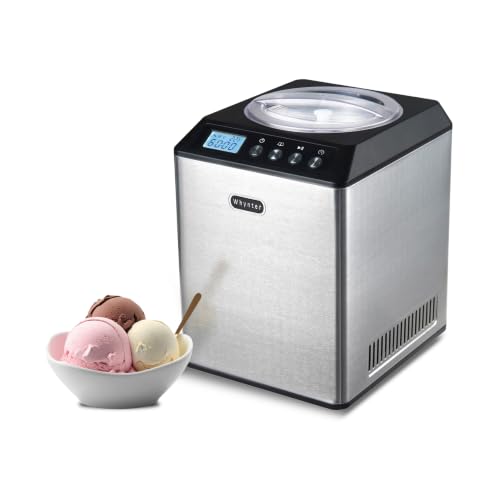
Whynter Upright Ice Cream Maker 2.1 Qt, ICM-201SB
Badge: Best Modern Compressor
Strengths
- The defining modern mechanism: a built-in compressor that makes its own cold, so no pre-freezing of bowls or bases is needed at all.
- Modern control to match — an LCD display and timer that make each churn deliberate and repeatable.
- An upright 2.1-quart format that gives family capacity a contemporary, space-aware silhouette.
Trade-offs
- A compressor is the most complex system in this guide, and complexity is housed permanently: it wants a ventilated counter home.
- Its virtues compound with frequency; a monthly maker pays the footprint for readiness they rarely use.
- It is the step-up purchase of this set in qualitative tier terms.
Mini spec box: Type: upright ice cream maker with built-in compressor · Stated capacity: 2.1 quarts · Pre-freezing required: none · Controls: LCD display and timer · Model: ICM-201SB.
If one machine in this guide deserves the word modern without qualification, it is the Whynter. The compressor is the idea the whole category spent a century approaching: cold as a utility the machine provides itself, like the heat in an oven. Everything else about the design follows from that liberation — batches decided at dinner, second batches without negotiation, a timer and display that treat ice cream as a process to be run rather than a vigil to be kept. Its upright stance is the contemporary answer to the compressor’s traditional bulk, spending the kitchen’s height instead of its worktop.
Its modernity has a modern price, paid in permanence and in tier rather than in labour. This is a machine that joins the kitchen’s fixed equipment, and households should install it mentally the way they would a microwave: measured, ventilated, expected to earn its place weekly. For the frequent maker, it is the guide’s clearest glimpse of the category’s settled future. For the occasional maker, the simpler modern designs below deliver most of the convenience at a fraction of the commitment — a trade this guide is happy to state plainly, because modern was never supposed to mean maximal.
Best for: frequent makers who want self-contained freezing with timed, repeatable control / Not suited for: occasional makers or kitchens without a permanent counter home to offer
Check on Amazon — check the latest price on Amazon for the Whynter ICM-201SB.

Nostalgia Electric Ice Cream Maker, 4 Qt, Old Fashioned Vintage Wooden Style
Badge: Best Retro Counterpoint
Strengths
- The largest capacity in the guide at four quarts — the scale modern personal machines deliberately traded away, offered here in one churn.
- Frozen yogurt or gelato stated in its title, so the heritage format covers more than nostalgia.
- An electric drive is its one modern concession, and it is the right one: the ceremony without the crank labour.
Trade-offs
- By design, it is not a modern machine: no presets, no self-contained cold, no processing tricks — the bucket routine is the point.
- Four quarts is a gathering’s batch, with a gathering-sized storage footprint to match.
- Its vintage wooden style is a commitment to an aesthetic the rest of this guide has moved beyond.
Mini spec box: Type: electric old-fashioned ice cream maker · Stated capacity: 4 quarts · Stated desserts: frozen yogurt or gelato · Canister: aluminium · Style: vintage wooden, light wood finish · Brand: Nostalgia.
Every guide to the modern needs its control sample, and the Nostalgia is a magnificent one. Judge the new designs against it and their trade becomes visible: they surrendered the bucket’s scale and theatre, and in exchange they deleted its labour, its ice and its afternoon. For many households that exchange is the whole story of progress, and they will read this profile as a fond farewell. But the counterpoint earns its link on more than sentiment. There remains a real use — the big, social, everyone-gathers dessert — at which this unmodern machine beats every modern rival in the guide, because none of them churns four quarts of frozen yogurt as an event.
Its presence also disciplines the modern claim itself. A design trend that cannot state what it improved upon is fashion; the compressor, the processor and the self-churning machines can each name the bucket-born burden they removed. If your household’s dessert life is that social one, buy the counterpoint with this guide’s blessing and let the modern machines wait. If it is not, let the Nostalgia stand in your mind as the measure of how far the convenience below has actually come. Its enduring popularity is examined from the sales side in our analysis of Best Selling Ice Cream Makers.
Best for: hosts who want gathering-scale batches and the ceremony of the bucket / Not suited for: anyone shopping for contemporary convenience, presets or compactness
Check on Amazon — check the latest price on Amazon for the Nostalgia Electric 4 Qt.

Ninja CREAMi 7-in-1 Ice Cream Maker, NC301
Badge: Best Modern Versatility
Strengths
- The generation’s signature rethink: instead of churning a liquid, it transforms a frozen base at a button touch — the title’s own description.
- Seven functions spanning ice cream and gelato, with sorbet and milkshakes named among the transformations.
- The stated range, from healthy to indulgent, reflects a genuinely modern idea: one system for protein pints and custards alike.
Trade-offs
- The work is moved, not removed: bases must be frozen ahead, so the freezer shelf becomes part of the machine.
- Pint scale replaces the family tub; volume is achieved in multiples, not in one batch.
- Outcomes ride on base recipes more than with a churner, rewarding cooks who iterate.
Mini spec box: Type: frozen-base ice cream processor · Stated functions: 7-in-1, including ice cream and gelato · Method: transforms frozen bases into ice cream, sorbet and milkshakes · Model: NC301.
The NC301 is the design that made the current era impossible to mistake for the previous one. A churner asks how to freeze a moving liquid; the CREAMi asks why the freezing and the finishing must share an hour at all. Separating them — freeze a pint when you have ten minutes, transform it when you want dessert — turns ice cream into a stored possibility rather than a scheduled production, and the seven functions turn one freezer shelf into a small parlour menu. That is a modern idea in the strongest sense: not a new finish or a new screen, but a new division of labour between the cook, the freezer and the machine.
Its honest costs are the idea’s own shadow. The freezer becomes an ingredient, and households with no shelf to spare will feel the tax weekly. The pint ceiling is real. And because processing can only finish what the base began, the cook’s recipe discipline matters more here than with any churner in the guide. Households that accept those terms tend to become evangelists; households that want one big traditional batch should take the Whynter’s compressor or the counterpoint’s bucket as their answer instead.
Best for: planners and experimenters who want a freezer shelf of ready-to-transform desserts / Not suited for: single-batch traditionalists or freezer-space-poor households
Check on Amazon — check the latest price on Amazon for the Ninja CREAMi NC301.

Dash My Mug Ice Cream Maker 2 Pack Bundle, Half-Pint Freezer Mugs
Badge: Best Modern Single-Serve
Strengths
- Portion culture in hardware form: half-pint freezer mugs that make a single serving in the vessel it is eaten from.
- An ingredient chute keeps the small-batch ritual playful — mix-ins added by the eater, to taste.
- Almost no storage or washing burden; the mugs live with the mugs, which suits small modern kitchens and shared houses.
Trade-offs
- Half a pint is the whole proposition; this is not a family or entertaining machine by any stretch.
- The mugs must be pre-frozen, so the system’s spontaneity extends only as far as your frozen mug supply.
- Enthusiasts will outgrow it — by design, as the entry to the modern category rather than its destination.
Mini spec box: Type: electric soft serve ice cream machine set with freezer mugs · Stated serving: half-pint freezer mugs, 2 pack bundle · Feeding: ingredient chute · Format: single-serve freezer bowls, countertop · Colour: aqua · Brand: Dash.
The Dash mugs are modern in the way that matters most to contemporary eating: they are sized to the person. The older formats assumed a family batch and a shared tub; the mug system assumes an individual, a flavour of their own, and a portion that ends when the mug does. That assumption — visible across modern food culture far beyond ice cream — is executed here with admirable economy: freeze the mugs, churn a serving, eat from the same vessel, wash a mug. For single households, couples with divergent tastes, and anyone managing portions deliberately, it is the most honest design in the guide.
Its limits are its concept, stated on its title in plain words, and a buyer who reads them will be delighted rather than disappointed. Treat it as the modern category’s tasting spoon and its small-kitchen ambassador: the design most likely to be used on a Tuesday, which is the day modern convenience is actually for.
Best for: singles, couples and portion-conscious households wanting dessert at mug scale / Not suited for: families or hosts needing a shareable batch
Check on Amazon — check the latest price on Amazon for the Dash My Mug 2 Pack.

DOWILIN 2 IN 1 Soft Serve Ice Cream Maker and Slushie Machine
Badge: Best Modern Entertainer
Strengths
- Five presets spanning soft ice cream, slushie, margarita, frappé and milkshake — modern preset control applied to a whole frozen-drinks station.
- A self-cleaning function, the modern convenience whose value compounds after every single use.
- No ice needed and a 68-ounce capacity: the largest frozen-drinks format in the guide, built for gatherings.
Trade-offs
- Its centre of gravity is soft serve and drinks; firm, dense, tub-style ice cream is other machines’ art.
- A two-litre station claims real counter territory and earns it only in households that entertain.
- Preset breadth rewards households that rotate formats; a vanilla-only household pays for range it skips.
Mini spec box: Type: 2-in-1 soft serve and slushie machine · Stated capacity: 68 oz · Presets: 5 (soft ice cream, slushie, margarita, frappé, milkshake) · Ice required: none · Cleaning: self-cleaning function stated.
The DOWILIN represents the modern idea at its most sociable: the appliance as a drinks-and-dessert station, run by presets, cleaned by itself. Its five stated programs cover the frozen repertoire of an entire party — soft serve for the children, slushies and frappés for the afternoon, milkshakes for the evening — and its no-ice-needed design removes the errand that used to precede every frozen gathering. The self-cleaning cycle deserves its emphasis: in a machine handling dairy and sugar syrups for a crowd, the difference between a rinse cycle and a full manual scrub is the difference between a machine used monthly and one used once.
Be clear-eyed about its genre. This is the modern parlour-and-bar format, not the modern churner, and a household dreaming of dense, scoop-shop tubs should spend its money on the Whynter or the NC301. A household dreaming of being the house where summer afternoons happen will find the DOWILIN the most contemporary object in this guide — the one that most completely assumes dessert is an event with an audience. Mid-tier shoppers weighing it against simpler modern designs can place it on the value ladder with help from Best Midrange Ice Cream Makers.
Best for: entertainers wanting soft serve and frozen drinks from one self-cleaning station / Not suited for: purists seeking firm, dense, tub-style churned ice cream
Check on Amazon — check the latest price on Amazon for the DOWILIN 2 IN 1.

Elite Gourmet EIM1750 Self-Churning Electric 1Qt Ice Cream Maker
Badge: Best Modern Simplicity
Strengths
- Self-churning with no ice or salt needed — the modern deletion of the category’s oldest chore, stated in its title.
- Speed as a specification: ice cream, gelato, sorbet and frozen yogurt in under 20 minutes, as titled.
- More than 25 included recipes, a beginner-friendly bridge into the modern routine.
Trade-offs
- One quart is a small batch, sized for a few people rather than a table.
- Fast small churns reward a thoroughly chilled base; a warm mixture will not meet the stated time happily.
- No presets, display or compressor — its modernity is mechanical simplicity, not electronic control.
Mini spec box: Type: self-churning electric ice cream maker · Stated capacity: 1 quart · Stated time: under 20 minutes · Ice or salt required: none · Extras: 25+ recipes included · Colour: mint.
The Elite Gourmet is the modern idea with everything inessential stripped away, and there is a case that it is the most modern machine here per unit of fuss. Its title tells the whole contemporary story in one breath: self-churning, four desserts, under twenty minutes, no ice, no salt. Against the bucket at the top of this guide — its labour, its ice bed, its afternoon — the EIM1750 reads like a telegram from the present. For a small household, that compression of the entire ritual into a quick, clean, quart-sized event is precisely what modern was supposed to deliver.
Its limits are scale and ceremony, both honestly on its title. It will not feed a party, time a procession of batches, or anchor a counter with displays. It will make a couple’s dessert tonight, cleanly and quickly, and do the same next week without having asked anything of the freezer in between. Households that recognise their actual dessert life in that sentence have found their modern machine; households feeding six should take the Whynter’s capacity or the DOWILIN’s volume as their version of the same progress.
Best for: small households wanting the modern no-ice, no-salt routine at its simplest and fastest / Not suited for: large families, entertainers or control-focused enthusiasts
Check on Amazon — check the latest price on Amazon for the Elite Gourmet EIM1750.
Comparison Table
| Pick | Era it represents | Capacity | Defining stated feature | Link |
|---|---|---|---|---|
| Whynter ICM-201SB | Modern compressor | 2.1 quarts | No pre-freezing, LCD display and timer | Check on Amazon |
| Nostalgia Electric 4 Qt | Heritage counterpoint | 4 quarts | Vintage wooden bucket, aluminium canister | Check on Amazon |
| Ninja CREAMi NC301 | Modern processor | 7-in-1 pint system | Transforms frozen bases at a button touch | Check on Amazon |
| Dash My Mug 2 Pack | Modern single-serve | Half-pint mugs | Single-serve freezer mugs, ingredient chute | Check on Amazon |
| DOWILIN 2 IN 1 | Modern entertainer | 68 oz | 5 presets, self-cleaning, no ice needed | Check on Amazon |
| Elite Gourmet EIM1750 | Modern simplicity | 1 quart | Self-churning, under 20 minutes, no ice or salt | Check on Amazon |
How to Choose the Best Modern Ice Cream Makers by the Convenience You Actually Need
Choose by the burden you most want deleted, because each modern design deletes a different one. If the burden is planning — the bowl that is never frozen, the dessert decided too late — the compressor deletes it entirely, and the Whynter is your design. If the burden is the churn itself, the long attended freezing of a liquid, the processors delete it by moving the freezing into an unattended overnight and leaving a minute of transformation; the NC301 is your design. If the burden is the ice and salt of the old method, the self-churning and no-ice designs delete it at the smallest scale and the largest: the Elite Gourmet for a household, the DOWILIN for a crowd. If the burden is portion chaos — the tub that becomes three extra servings — the Dash mugs delete it by design. Modern choice is therefore not a ladder but a diagnosis: name the chore you resent, and the category’s present has a machine aimed at it.
Then discount the conveniences you will not feel. A timer matters to a cook who iterates recipes; to a set-and-serve household it is decoration. Self-cleaning matters enormously in a dairy-and-syrup drinks station and modestly in a rinse-and-done churner. Presets matter when formats rotate and are invisible when they do not. The modern market’s characteristic sin is selling every convenience to every buyer, and the defence is the routine audit this guide keeps returning to: describe your last ten desserts honestly, and buy the machine that would have made those ten easier — not the machine that makes forty hypothetical others possible.
Finally, let the counterpoint vote. If reading the Nostalgia’s profile produced a pang — if the gathering, the bucket and the afternoon are your actual dessert life — then modernity is the wrong master for this purchase, and the heritage machine is the right one. A guide that cannot say that is selling a trend; this one would rather sell you the machine your summers will thank.
How to Work the Modern Way: Bases, Timing and Care
Modern machines share a modern method, and it begins before any of them is switched on. Bases are made ahead and chilled thoroughly — overnight for churners, frozen solid and level for processors — because every contemporary design trades the old ice bed’s brute cold for precision, and precision rewards preparation. During the make, respect each system’s stated sequence: compressors like a brief pre-cool in a hot kitchen, self-churning designs like the mixture poured to their stated fill, processors like a pint that has rested just long enough to process smoothly. Serve soft at the machine’s finish for the brightest flavour, then give tubbed portions their freezer time to firm for scooping.
Care has modernised too, mostly in your favour. The DOWILIN’s self-cleaning cycle should be run while residues are fresh, not admired as a feature and skipped. Processor pints and churner bowls alike want prompt washing and complete drying, because dairy films are the enemy of next week’s flavour. Compressor vents want their clearance kept, and the machines want to stay where they were installed; the modern counter is a small ecosystem, and the machines that live on it longest are the ones whose owners treat placement as part of the appliance.
Troubleshooting follows the era’s logic — check the preparation before the machine. Problem: a churned batch runs long and stays soft → the base was warm or the room is hot; chill deeper and pre-cool where the design allows. Problem: a processed pint is powdery → the base froze too lean or too hard; rest it briefly, process again, and enrich the next pint. Problem: a preset cycle disappoints → the fill exceeded the stated capacity or the mixture’s consistency differs from the program’s assumption; reduce the fill and let the preset work on the load it was tuned for.
What Modern Still Owes the Old: Texture, Ritual and Repair
Honesty about the modern requires naming what it has not improved. Texture purists still argue — with some justice — that a slow churn in a near-frozen canister builds a density the fast modern cycles approximate rather than equal, and that the bucket’s theatre was never merely labour: it was the dessert’s social architecture, the reason the gathering gathered. The modern answer is not to deny either point but to price them. Most households, most weeks, will trade a measure of ceremony and a whisper of texture for dessert that actually happens on a Tuesday — and the few who will not are exactly the households the counterpoint exists for.
There is also the question of repair and longevity, where modernity’s ledger is genuinely mixed. A wooden bucket and a simple churner can be understood, maintained and kept for decades by their owners; a compressor or a processor is a small system whose failures belong to technicians. The modern buyer’s hedge is the discipline this guide has practised throughout: buy the stated specification from a maker who states it clearly, keep the model number and paperwork, and choose the simplest modern design that deletes your burden — because every system you do not buy is a system that cannot fail in your kitchen.
Modern Formats for Modern Households: Singles, Sharers and Small Families
The modern category makes most sense when it is mapped onto how households actually live now. The single-person flat, once served only by the shop tub, is the natural home of the mug system and the small self-churning machine: dessert at portion scale, no leftovers ageing in a shared freezer, washing measured in moments. The shared house — several adults, divergent tastes, one kitchen — is the natural home of the pint processor, because a freezer shelf of labelled bases is a peace treaty: everyone’s flavour exists, nobody’s batch is compromised, and the machine’s minute of work is the only negotiation required. The small family, the statistical centre of the market, is where the compressor and the entertainer divide the honours: the compressor for the weekly rhythm of a household that plans its treats, the DOWILIN for the household whose weekends fill with other people’s children.
Notice what this mapping quietly proves: the modern revolution in this category was not really about freezing technology, impressive as the compressor is. It was about portion and permission — dessert sized to the eater, made on the eater’s schedule, without a family-sized production as the price of admission. The bucket assumed a crowd and an occasion; the modern machines assume a person and a Tuesday. Households choosing among the six should therefore ask the demographic question before the technical one — who eats, how many, how often, together or separately — because the modern range contains a genuinely right answer for each pattern, and a genuinely wrong one wearing the same era’s styling.
The Next Test of Modern: What to Watch in Any New Listing
Because this guide defines modern by stated features rather than by dates, it hands you a durable test for any machine you meet after reading it, in any listing, in any season. Ask four questions of the title alone. Where does the cold come from — a compressor, a pre-frozen element, or a base you froze yourself? What has been deleted — the ice, the salt, the planning, the attendance, the washing? What is the honest unit of production — a quart, a pint, a mug, a two-litre tank — and does it match your table? And what does the machine ask in return — counter permanence, freezer territory, recipe discipline? A design that answers all four in its own title is a modern machine you can buy with confidence; a design that answers them with photography and adjectives is asking you to fund its ambiguity.
Apply the same test retrospectively to this guide’s six and the badges explain themselves. The Whynter answers with a compressor and a timer. The NC301 answers with a transformation and a pint. The DOWILIN answers with presets, a tank and a cleaning cycle. The Elite answers with a clock time and two deletions — no ice, no salt. The Dash answers with a mug. And the counterpoint, magnificently, answers with a bucket and a canister, reminding every future listing that the questions are older than the answers — and that knowing exactly what a machine is remains the most modern skill a buyer can own.
Common Buying Mistakes
The modern shopper’s first mistake is buying the era instead of the machine — choosing whatever looks newest while its routine fits somebody else’s kitchen. The second is believing convenience deletes work rather than moving it: processors move it to the freezer shelf, compressors move it to placement and care, and households surprised by the move feel cheated by machines that were only ever honest. The third is stacking conveniences — presets, displays, self-cleaning, seven functions — without asking which single burden they most resent. The fourth is dismissing the heritage format unread, or buying it unread; both errors skip the counterpoint’s lesson. The fifth is neglecting the new era’s paperwork: model numbers and stated specifications are the modern owner’s toolkit, and they belong in a folder, not in a memory.
Final Recommendation
For the household that wants the modern ideal whole — no pre-freezing, timed control, family capacity — the Whynter ICM-201SB is this guide’s first recommendation. For the household whose modernity is variety, the Nostalgia Electric 4 Qt stands as the honoured alternative only when gatherings are truly your format; otherwise the versatility crown belongs to the Ninja CREAMi NC301, the simplicity crown to the Elite Gourmet EIM1750, and the entertainer’s crown to the DOWILIN. Choose by the burden you resent most, check the latest price on Amazon for that machine, and let the counterpoint keep you honest.
One more modern consideration belongs in every buyer’s notebook: sound and patience. Compressors hum at refrigerator level, processors work in short, purposeful bursts, and churners murmur — none of it loud, all of it present in a small flat at midnight. Modern convenience includes the right to make dessert quietly in an open-plan kitchen while a film plays, and the designs in this guide respect that right in different measures. If your kitchen is also your living room, weigh the noise of the make as honestly as its speed.
Keep the modern habit modern, finally, by keeping its paperwork: the model number filed, the stated specifications noted, the first successful base recipe written down where the household can find it. The era’s machines reward documented owners — settings remembered, bases iterated, parts searchable by number — and gently punish everyone else with repeated first attempts. A single page of notes, started the day the machine arrives, is the cheapest modern accessory in this entire guide, and the one most likely to still be adding value when every preset in the category has been renamed twice over.
Frequently Asked Questions
What makes an ice cream maker “modern” in this guide?
Stated, mechanical modernity — not a launch date, which this guide never invents. A design counts as modern here for reasons its verified title supports: a built-in compressor, a self-churning or no-ice-needed mechanism, frozen-base processing, presets, a self-cleaning function, or display-and-timer control. The Nostalgia bucket is included explicitly as the retro counterpoint, so the modern claims around it can be judged against what they replaced.
Is a compressor machine always the most modern choice?
It is the most self-contained choice, which is one kind of modern. The frozen-base processors are arguably the more radical idea, since they reorganise the whole process around the freezer shelf, and the self-churning designs are the most modern per unit of simplicity. The right superlative depends on the burden you want deleted: planning, churning, or the ice-and-salt chore itself.
Do modern machines make better ice cream than the old bucket style?
They make ice cream more often, with less labour, and with more repeatable results — which for most households is the improvement that matters. Texture purists can fairly note that a slow bucket churn has a density and a ceremony the fast cycles approximate. This guide’s position is that the best machine is the one whose output your household actually eats weekly, and for most modern kitchens that is a modern machine.
Why is a vintage-style machine in a modern guide at all?
Because a trend that cannot face its predecessor is marketing. The Nostalgia’s four-quart bucket shows exactly what modern designs traded away — scale and ceremony — and what they bought with the trade. It also remains the right purchase for gathering-led households. Keeping it linked and honestly badged as the retro counterpoint makes every modern claim in the guide more trustworthy, not less.
Are presets and self-cleaning worth prioritising?
Presets earn their keep when a household rotates formats — soft serve, slushies, frappés — as the DOWILIN’s five stated programs assume. Self-cleaning earns its keep in any machine that handles dairy and syrups for a crowd, because it converts the worst part of entertaining into a rinse cycle. In a simple churner used for one flavour, both matter less than a steady motor and an honest capacity.
Do modern machines need special ingredients or mixes?
No. Every design in this guide works from ordinary bases — cream, milk, sugar, flavourings, or yogurt where the title states it — and the modern differences are in freezing and processing, not in proprietary ingredients. Processors reward a base built for their pint format, and preset machines reward mixtures of the consistency their programs assume, but the shopping list stays a normal one. If a listing implies a machine only works with special mixes, treat that as a routine cost and weigh it like any other.
What is the easiest modern machine for a beginner?
The Elite Gourmet EIM1750: self-churning, no ice or salt, a stated sub-20-minute cycle and more than 25 included recipes to learn from. The Dash mugs run it close for single-serve households. Begin with a thoroughly chilled simple base, let one clean success teach the routine, and only then explore the wider modern repertoire of the processors and the compressor.