Disclosure: topratedkitchenware.com is reader-supported. When you buy through links on our site, we may earn an affiliate commission from Amazon and other retailers, at no extra cost to you.
Where to buy
The best midsized microwaves are the ones whose cavities match your dishes, and this guide proves the match with the only numbers that settle it: capacity, stated turntable diameters and wattage from the verified listings. Five of the six models below sit inside the midsized band and are linked; the one compact below the band is reviewed prose-only as the lower measuring stick.
- BLACK+DECKER 0.9 Cu. Ft. Microwave — 0.9 cu. ft., 900W. Best All-Round Starting Point
- TOSHIBA 0.9 Cu. Ft. Microwave — 0.9 cu. ft., 900W. Best Verified Fit at 0.9 Cu. Ft.
- TOSHIBA 1.2 Cu. Ft. Microwave, Black — 1.2 cu. ft., 1000W. Best Overall
- COMFEE’ 0.7 Cu. Ft. Microwave — 0.7 cu. ft., 700W. Best Compact Reference (Below the Band) (reviewed in full below as a prose-only pick in this guide: at 0.7 cu. ft. it is a compact oven below the roughly 0.9 to 1.4 cu. ft. midsized band this guide is built on.)
- Farberware 1.1 Cu. Ft. Microwave — 1.1 cu. ft., 1000W. Best for Cooking From Frozen
- Chefman 0.9 Cu. Ft. Microwave — 0.9 cu. ft., 900W. Most Features at 0.9 Cu. Ft.
Read the full guide ↓
The best midsized microwaves share a promise that is easy to say and harder to verify: a cavity big enough for real family dishes, in a body small enough for a real kitchen. This guide verifies it the slow way, number by number, using only the figures the verified listings actually state. Midsized here means roughly 0.9 to 1.4 cu. ft., and within that band the differences that matter are not the tenths of a cubic foot in the headline. They are the turntable diameter that decides whether your largest plate rotates, the wattage that decides how long a family portion takes, and the cooking system, sensor, inverter or plain timed power, that decides how evenly the result arrives.
Five of the six verified models sit inside the band, from two distinct 0.9 cu. ft. designs through a 1.1 with a staging trick no rival here matches, to a pair of 1.2 cu. ft. sensor models. The sixth, a 0.7 cu. ft. compact, is kept as a prose-only lower bound, because a guide to a size class should show its floor as clearly as its ceiling. Along the way this treatment stays general on purpose: it is the reference view of the class, against which the counter-fit view at Best Multifunctional Microwaves and the household view in the sibling midsized guides can be compared. If you only read one midsized guide, read this one; if you read two, make the second the one written for your constraint.
Key Takeaways
- Five linked models span the true midsized band, 0.9 to 1.2 cu. ft. in this pool; the 0.7 cu. ft. COMFEE is prose-only because a compact cannot anchor a midsized shortlist.
- Two makers state turntable diameters, 10.6 inches at 0.9 cu. ft. and 12.4 inches at 1.2 cu. ft., and those two numbers are the most useful in the entire guide.
- The Farberware is the only model here with multi-stage cooking, chaining a defrost into a cook in one programme.
- The Chefman 0.9 cu. ft. carries the fullest small-format feature set in the pool: express cook, Eco mode, child lock and a mute button.
- Sensor cooking appears only at 1.2 cu. ft. in this guide, in the black TOSHIBA; buyers who want sensing at this size should start there.
In this guide
Quick Picks
This table is the class at a glance: verified capacity, power and the one standout figure or feature that separates each model from its neighbours. The compact is labelled prose-only in its row, as it is throughout the guide.
| Pick | Badge | Capacity | Power | Standout verified feature | Check |
|---|---|---|---|---|---|
| BLACK+DECKER 0.9 Cu. Ft. Microwave | Best All-Round Starting Point | 0.9 cu. ft. | 900W | Push-button door, child lock, 6 presets | Check on Amazon |
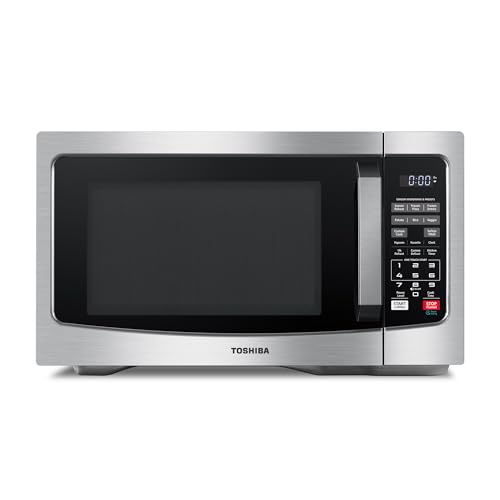
| TOSHIBA 0.9 Cu. Ft. Microwave | Best Verified Fit at 0.9 Cu. Ft. | 0.9 cu. ft. | 900W | Stated 10.6-inch turntable, mute, LED lighting | Check on Amazon |
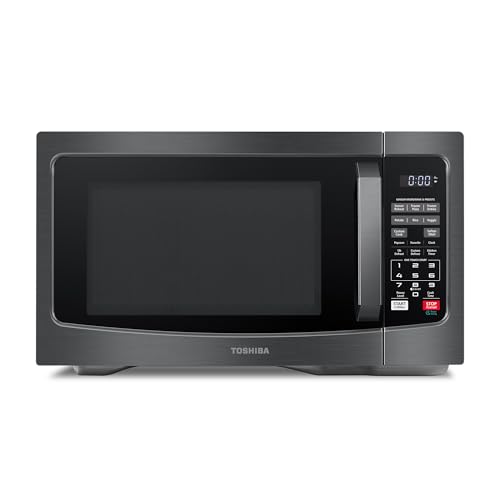
| TOSHIBA 1.2 Cu. Ft. Microwave, Black | Best Overall | 1.2 cu. ft. | 1000W | Stated 12.4-inch turntable, sensor, 12 menus | Check on Amazon |
| COMFEE’ 0.7 Cu. Ft. Microwave | Best Compact Reference (Below the Band) | 0.7 cu. ft. | 700W | Sound on/off, ECO mode (below the midsized band) | Prose-only in this guide |
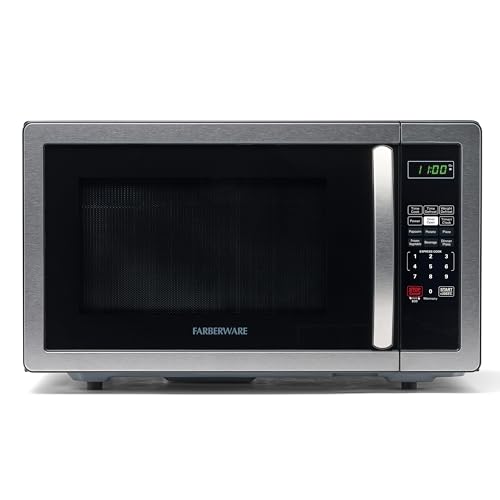
| Farberware 1.1 Cu. Ft. Microwave | Best for Cooking From Frozen | 1.1 cu. ft. | 1000W | Multi-stage cooking, defrost by weight or time | Check on Amazon |
| Chefman 0.9 Cu. Ft. Microwave | Most Features at 0.9 Cu. Ft. | 0.9 cu. ft. | 900W | Express cook, Eco mode, mute at 0.9 cu. ft. | Check on Amazon |
How These Picks Were Chosen
The six models were drawn from a pool verified on 2026-11-20, and this guide restricts itself to verified facts: capacity, wattage, turntable diameters where printed, and the features each listing names. That restriction is why two reviews in this guide can quote an exact turntable size and the others cannot: the figure is used only where a maker states it. No prices, scores, exterior dimensions or lifespan claims appear, because none are in the verified data, and a class guide built on invented numbers would fail at exactly the job it exists to do.
Band discipline follows the same rule. The midsized band, roughly 0.9 to 1.4 cu. ft., links five models. The COMFEE at 0.7 cu. ft. and 700W is a compact by any honest reading, so it is reviewed in full without a purchase link or an image, as the floor of the comparison. Its inclusion is not a consolation prize: buyers cross-shopping the boundary need the compact case stated well, in the same guide, by the same standard, before they decide which side of the line their dishes live on.
No hands-on testing is claimed. The analysis compares verified specifications against the stable facts of the format: how plate diameter interacts with turntable diameter, how wattage scales reheating time, how sensor and staged cooking change results, and where timed cooking needs technique to match them. Recommendations name a best household and a poor fit for every model, and readers who want the newest designs rather than the class reference should continue to Best New Microwaves, where recency, not representativeness, is the organising idea.
The 6 Best Midsized Microwaves, Verified Number by Number
Each review leads with the verified figures, then translates them into dishes, minutes and households. Where a number is not stated in a listing, the review says so; in a size guide, an admitted gap is worth more than a confident guess.
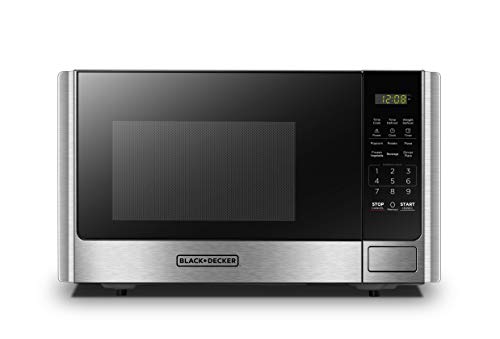
BLACK+DECKER Countertop Microwave Oven, 0.9 Cu.Ft, 900W, Stainless Steel
Badge: Best All-Round Starting Point
Strengths
- 0.9 cu. ft. and 900W is the classic apartment balance of footprint, plate size and cooking speed
- Push-button door and child safety lock make it an easy shared-household and family choice
- Six presets and ten power levels cover everyday cooking without menu overload
Trade-offs
- No sensor or inverter technology is claimed, so cooking is timed and power-cycled
- No mute function is listed for late-night use
- Large serving dishes and tall containers can still exceed a 0.9 cu. ft. cavity
Key specs from the verified listing:
- Capacity: 0.9 cu. ft.
- Power: 900W
- 10 power levels
- 6 auto cook presets
- Push-button door
- Child safety lock
BLACK+DECKER aims this 0.9 cu. ft. model at the largest real audience in the category: renters and small households who need a proper plate to fit, reasonable speed at 900W, and controls nobody has to learn. Six auto cook presets handle the staples, ten power levels handle everything else, and the push-button door plus child safety lock make it practical in shared and family kitchens. Stainless steel keeps it presentable on an open counter. The spec sheet is equally clear about what is absent. No humidity sensor judges your reheating, no inverter smooths low-power delivery, and no mute mode is listed. Those absences are the price of the format and the tier, and for the reheating, defrosting and simple cooking this size class is bought for, most owners will never miss them. It is the safe, central recommendation whenever 0.9 cu. ft. is the right answer to the space question.
Start the class here, because this is the format the word midsized was invented for: 0.9 cu. ft., 900W, a plate that fits, portions that reheat at packaged-food pace, and controls a household can share without a manual. It will not win any single category in this guide, not the biggest turntable, not the deepest menus, not the cleverest staging, and that is precisely its role. It is the reference point against which every upgrade in the reviews below has to justify itself in dishes and minutes, not adjectives.
Best for: first-time buyers who want the class reference format / Not suited for: households needing sensor guidance or a mute mode

TOSHIBA Microwave Oven, 0.9 Cu.Ft, 900W, Black Stainless Steel
Badge: Best Verified Fit at 0.9 Cu. Ft.
Strengths
- The only 0.9 cu. ft. model here with a stated turntable size, 10.6 inches, so plate fit can be judged before buying
- Mute function and LED lighting make it the best-mannered apartment oven in this pool
- Positioned by the maker for apartments, and the spec matches that brief honestly
Trade-offs
- Six auto menus is a modest menu count next to the twelve-menu TOSHIBA models
- No sensor or inverter technology is claimed in the verified title
- Black stainless steel is a distinctive finish that will not match silver stainless appliances
Key specs from the verified listing:
- Capacity: 0.9 cu. ft.
- Power: 900W
- 6 auto menus
- Mute function and child lock
- LED lighting
- 10.6-inch removable turntable
TOSHIBA positions this 0.9 cu. ft., 900W model for apartments, and unusually, the verified details back the positioning up. The 10.6-inch removable turntable is stated outright, so you can measure your favourite plate against a real number instead of guessing from capacity. Six auto menus cover the staples, a mute function respects thin walls and sleeping flatmates, LED lighting makes the cavity easy to check mid-cook, and a child lock is included for young families in small spaces. The black stainless steel finish gives a compact oven a more deliberate look than basic black or white. What is not claimed is sensor cooking or inverter delivery, so this remains a timed oven, and six menus is a shorter list than the twelve offered by its larger TOSHIBA siblings. For a renter choosing on fit, manners and verifiable plate size, it is the most specifically suitable compact-mid option in this pool.
This TOSHIBA is the review that justifies the guide method, because it replaces the capacity guess with a measurement: a 10.6-inch turntable, stated. If your largest plate is at or under that diameter, fit is proven before purchase, a claim no other 0.9 in this pool can make from its verified listing. The rest of its specification, mute, lighting, menus and lock, reads like a checklist for the small homes its capacity targets. Buyers should still note what is absent, sensor and inverter, and decide whether proof of fit outweighs cooking guidance; for plate-driven shoppers, it does.
Best for: plate-driven buyers who want fit proven by a stated figure / Not suited for: daily defrosters seeking inverter delivery

TOSHIBA Countertop Microwave Oven, 1.2 Cu.Ft, 1000W, Black
Badge: Best Overall
Strengths
- A stated 12.4-inch turntable in a 1.2 cu. ft. body takes large plates that defeat most mid-size ovens
- Smart Humidity Sensor cooking with twelve auto menus is the deepest guided set in the pool
- Mute, ECO mode and an easy clean interior make it the considerate family workhorse
Trade-offs
- Plain black finish rather than stainless, which some buyers read as a step down visually
- No inverter delivery is claimed, so low power pulses instead of running continuously
- 1000W is mid-pack, slower on very large portions than the 1200W and 1250W models
Key specs from the verified listing:
- Capacity: 1.2 cu. ft.
- Power: 1000W
- 12.4-inch removable turntable
- Smart Humidity Sensor
- 12 auto menus
- Mute function, ECO mode, easy clean interior
Start with the number TOSHIBA actually prints for this model: a 12.4-inch removable turntable inside a 1.2 cu. ft., 1000W cavity. In a category where plate fit is usually a guess, a stated diameter lets you check your largest plate before ordering, and 12.4 inches covers most family dinnerware. Around that practical core sits the full TOSHIBA convenience set, Smart Humidity Sensor cooking, twelve auto menus, a mute function for quiet hours, ECO mode for standby and an easy clean interior, all verified in the title. The plain black finish is the visible compromise, and there is no inverter claim, so delicate low-power jobs pulse rather than flow. Neither point undermines the brief this oven sets itself, which is guided, family-scale reheating and cooking with the best plate fit in its size class, and on that brief it is arguably the most complete conventional microwave in this entire pool.
The black TOSHIBA takes the overall badge because it wins the two contests that decide midsized ownership: the plate contest, with the stated 12.4-inch turntable that leads this guide, and the consistency contest, with sensor cooking and twelve menus that make different cooks produce the same result. At 1.2 cu. ft. and 1000W it also sits at the capacity point where family portions stop being a squeeze. Its compromises, a plain black finish and no inverter claim, are visible and priced into the verdict; neither touches the two contests that matter most at this size.
Best for: families with large dinnerware and several cooks / Not suited for: buyers set on a stainless finish or inverter power

COMFEE’ Countertop Microwave Oven, 0.7 Cu.Ft, 700W, Black, ECO Mode
Badge: Best Compact Reference (Below the Band)
Strengths
- Explicitly positioned for dorm, apartment and office use, and the compact spec matches those spaces
- Sound on/off control makes it welcome in shared rooms, libraries of student housing and open offices
- ECO mode trims standby draw in spaces where the oven sits idle most of the day
Trade-offs
- 0.7 cu. ft. and 700W is the slowest, smallest combination in this pool
- No preset count or sensor cooking is stated in the verified title
- Family portions and large plates are simply outside this format
Key specs from the verified listing:
- Capacity: 0.7 cu. ft.
- Power: 700W
- ECO mode
- Sound on/off
- One-touch buttons
- Child safety lock
COMFEE’ names its audience in the verified title itself, dorm, apartment and office, and builds a 0.7 cu. ft., 700W oven to match. The features that matter in those shared spaces are present and stated: sound on/off so the beeps can be silenced in a room where someone is sleeping or working, one-touch buttons so a queue of colleagues or flatmates is not held up by a menu, an ECO mode for the long idle hours between uses, and a child safety lock for family apartments. Cooking capacity is the honest limit of the format. At 0.7 cu. ft. this is a mug, soup bowl and single-plate oven, and at 700W it needs longer than the bigger models here for the same job, with package times adjusted accordingly. No preset count or sensor is claimed, and none is credited. For a single person in a small room, it is a well-mannered, space-honest choice.
Read this COMFEE’ review as the floor of the class, stated fairly. Within compact limits it is a considerate machine, quiet when asked, frugal at standby, simple for a queue of office users. But its numbers, 0.7 cu. ft. and 700W, define a different promise: single servings at gentle pace. A midsized guide that linked it would be telling family buyers a story its own figures contradict, so it stands here prose-only, useful to exactly the readers whose dishes fit it and honest to everyone else. Its small-room virtues are discussed further in Best New Microwaves For Emf, where placement in tight spaces gets a full treatment.
Why this pick is prose-only in this guide: at 0.7 cu. ft. it is a compact oven below the roughly 0.9 to 1.4 cu. ft. midsized band this guide is built on. It is reviewed in full so you can judge it, but it carries no purchase link and no product image here.
Best for: single rooms, dorms and offices / Not suited for: family reheating in any form

Farberware Countertop Microwave Oven 1.1 cu.ft, 1000 Watts, Stainless Steel
Badge: Best for Cooking From Frozen
Strengths
- Multi-stage cooking is unique in this pool: defrost then cook in one programmed sequence
- Defrost by weight or by time gives two honest routes depending on whether you know the weight
- Express cooking and an LED display keep daily operation fast and legible
Trade-offs
- No sensor cooking is claimed, so reheating judgement stays with the cook
- No mute function or child lock is stated in the verified title
- No inverter delivery, so the stages still use conventional pulsed power
Key specs from the verified listing:
- Capacity: 1.1 cu. ft.
- Power: 1000W
- 10 power levels with multi-stage cooking
- 6 preset options
- Defrost by weight or time
- LED display and express cooking
This 1.1 cu. ft., 1000W Farberware is the planner of the group. Its headline, multi-stage cooking across ten power levels, lets you chain a defrost into a cook as a single programme, and its defrost can run by weight or by time, which covers both the labelled freezer bag and the mystery container. Six presets, express cooking and an LED display round out a spec aimed at people who cook from frozen several nights a week. Honesty about the gaps matters as much as the headline. The verified title lists no humidity or food sensor, no mute mode and no child lock, and there is no inverter claim, so low power still pulses. None of that cancels the staging advantage, which is real and unique here; it simply defines the buyer. If your microwave mostly reheats, the sensor TOSHIBA and Panasonic models serve you better; if it mostly thaws and then cooks, this is your oven.
The Farberware earns its distinct place with the only structural idea in this guide that nobody else offers: staging. A defrost that flows into a cook without a return visit changes the weeknight pattern for households that freeze their proteins, and its dual defrost basis, weight or time, covers both the labelled bag and the anonymous tub. At 1.1 cu. ft. it also occupies the least crowded point in the band, a genuine middle between the 0.9 pair and the 1.2 sensor model. Buyers who rarely freeze should discount its headline accordingly; buyers who freeze weekly should not look past it.
Best for: households that cook from frozen several nights a week / Not suited for: buyers who need a sensor or a child lock stated

Chefman Countertop Microwave Oven 0.9 Cu. Ft., 900 Watts, Black
Badge: Most Features at 0.9 Cu. Ft.
Strengths
- The fullest feature set at 0.9 cu. ft. in this pool: presets, express cook, Eco mode, child lock and mute
- 900W is a full step faster than the 700W compacts for the same single-plate jobs
- One-touch express cook suits the grab-and-go rhythm of small households
Trade-offs
- Black finish only in this listing, with no stainless option in the verified pool
- No sensor or inverter technology is claimed, so cooking remains timed and pulsed
- A 0.9 cu. ft. cavity still limits serving dishes and tall containers
Key specs from the verified listing:
- Capacity: 0.9 cu. ft.
- Power: 900W
- 10 power levels
- 6 cooking presets with one-touch express cook
- Eco mode
- Child safety lock and mute button
Chefman packs more stated features into 0.9 cu. ft. than anyone else in this pool: ten power levels, six cooking presets with one-touch express cook, an Eco mode, a child safety lock and a mute button, at 900W in a black body. That combination answers the two complaints small-oven owners actually make, that compact models feel stripped down, and that they beep in small homes where sound carries. Speed is respectable too, because 900W handles a plate or a bowl in the time band most package directions assume. The boundaries are the usual ones for the size. No sensor and no inverter are claimed, so cooking is timed and pulsed, and a 0.9 cu. ft. cavity still says no to large serving dishes. For a single person, a couple or a small family kitchen that wants compact dimensions without compact manners, this is the most complete option at its size in the group.
The Chefman closes the linked list by collapsing the usual size-versus-features trade: at 0.9 cu. ft. it carries express cooking, Eco mode, a child lock and a mute button together, a set that elsewhere in this pool requires stepping up in size or giving something back. For a small household that wants one oven to be small and complete at once, it is the natural finalist against the TOSHIBA 0.9, and the choice between them is philosophical: stated turntable proof and lighting on one side, the fuller convenience set on the other. Either is a defensible end to a midsized search at this capacity.
Best for: small households wanting a complete feature set at 0.9 cu. ft. / Not suited for: cooks with serving dishes larger than the format
Comparison Table
The table below is deliberately plain: verified capacity, power, the cooking system each listing actually claims, and the living-with details. Anything not in a verified listing is marked as not stated rather than smoothed over.
| Model | Capacity | Power | Sensor / inverter | Quiet and family notes | Check |
|---|---|---|---|---|---|
| BLACK+DECKER 0.9 Cu. Ft. Microwave | 0.9 cu. ft. | 900W | No sensor or inverter stated | Push-button door; child lock; no mute listed | Check on Amazon |
| TOSHIBA 0.9 Cu. Ft. Microwave | 0.9 cu. ft. | 900W | No sensor or inverter stated | Mute function; child lock; LED lighting | Check on Amazon |
| TOSHIBA 1.2 Cu. Ft. Microwave, Black | 1.2 cu. ft. | 1000W | Smart Humidity Sensor; no inverter stated | Mute function; ECO mode; easy clean | Check on Amazon |
| COMFEE’ 0.7 Cu. Ft. Microwave | 0.7 cu. ft. | 700W | No sensor or inverter stated | Sound on/off; ECO mode; child lock | Prose-only |
| Farberware 1.1 Cu. Ft. Microwave | 1.1 cu. ft. | 1000W | Multi-stage cooking; no sensor stated | No mute or lock stated in the verified title | Check on Amazon |
| Chefman 0.9 Cu. Ft. Microwave | 0.9 cu. ft. | 900W | No sensor or inverter stated | Mute button; child lock; Eco mode | Check on Amazon |
How to Choose a Midsized Microwave With Numbers, Not Adjectives
Use the two-diameter test. Write down your largest plate diameter and the diameter of your most-used bowl, then compare them with every figure a maker states. In this pool the stated turntable diameters are 10.6 inches in a 0.9 cu. ft. oven and 12.4 inches in a 1.2 cu. ft. oven, and the gap between those numbers is the gap between standard dinnerware and oversized dinnerware. Where no diameter is stated, you are buying an estimate; the rational response is either to accept the estimate with standard plates or to size up. No other single habit prevents more returns in this category.
Translate wattage into your own timings. Most packaged directions assume a band around 900W to 1100W. A 900W midsized oven follows them almost literally. A 1000W oven follows them with a small shortening on long cooks. Anything slower, like the 700W compact reviewed here, needs systematic extension and a stir, and anything faster needs the opposite discipline. When you change ovens, recalibrate your five staple dishes in the first week and write the new times down; an oven is only ever as good as the timings its owner actually knows.
Decide what kind of help you are buying. Sensor help judges the food and suits reheating-heavy households. Staging help sequences the programme and suits frozen-heavy households. Menu help encodes defaults and suits multi-cook households. Mute, Eco and lock help manage the home around the oven. The models in this guide each lead with a different kind of help, which is why a single winner is less useful than a matched one: name your dominant microwave job, reheating, defrosting-then-cooking, or feeding several cooks, and the shortlist sorts itself by help type before it sorts by size.
Respect the band edges. Below roughly 0.9 cu. ft., dish diameter and pace both contract at once, and the oven becomes a single-serving tool. Above roughly 1.4 cu. ft., the cavity stops being the constraint and the counter becomes one. The midsized band is popular because it is the range where neither the dish nor the kitchen is the binding constraint for most homes. Buyers near an edge should read the edge reviews in this guide twice, once for the model and once for the warning, and cross-check placement questions in Best New Microwaves For Emf Emissions, where door and counter clearances are treated carefully.
Finally, discount any claim you cannot trace. This guide uses only verified-listing facts, and your own shortlist should too. If a capacity, a turntable size, a sensor or a lock matters to your decision, find it stated by the maker for the exact model, as the reviews here do, or treat it as absent. That discipline sounds austere; in practice it is what separates the buyers who keep their oven for years from the buyers who re-shop within a season. The class rewards measurement, and it punishes vibes, reliably and in that order.
How to Get Midsized Results: Technique That Matches the Hardware
Arrange food the way microwaves reward: an even layer, thicker items toward the outside of the dish, a vented cover to hold steam without sealing pressure in. On a turntable model, centre the dish on the plate so rotation is smooth; on any model, pause once midway for anything deeper than a couple of centimetres and stir or turn it. Finish with a standing minute under the cover. These four habits, none of which cost anything, close most of the quality gap between a basic timed oven and a sensor model, and they are the difference between midsized capacity and midsized results.
Defrost like the staging models do, even on a plain oven. Work in short bursts at defrost setting or low power, separate and turn pieces as they loosen, and rest the portion between bursts so surface heat migrates inward instead of cooking the edges. The Farberware in this guide automates the sequence by chaining defrost into cooking; on the other models, your timer and a fridge note with your standard portions and burst counts will reproduce most of the benefit. Either way, plan defrosting as a process with rests, not a single blast with hope.
Keep the cavity in the condition the systems expect. Sensors read steam, so a grease-filmed cavity feeds them noise; wipe splashes the day they happen and wash the turntable and ring regularly. Check that the door closes cleanly and the latch engages without force, and never run the oven empty, which stresses components designed to pour energy into food. A midsized oven in family service works hard; five minutes of weekly care is the cheapest performance upgrade in this entire guide.
Problem: the centre of a deep dish stays cold while the edges bubble. The dish is too deep for a single run: stir halfway, spread the next portion shallower, and always allow the standing minute. Problem: rice and grains dry at the surface. Add a spoon of water before reheating, cover vented, and use a medium power level for longer rather than full power for less. Problem: defrosted meat cooks at the corners. Shorten the bursts, lengthen the rests, and separate pieces earlier; corners are thin, and thin parts need the rest most.
The Turntable Diameter Manifesto: The Most Honest Number in the Category
Capacity is a volume; dinner is a diameter. That mismatch explains most disappointment in this class, and it is why the two stated turntable figures in this pool deserve their prominence. A 12.4-inch turntable welcomes the wide-rimmed plates that define modern dinnerware, while a 10.6-inch turntable honestly bounds a compact-mid cavity to standard plates. Makers who print the figure let buyers decide with a ruler; makers who omit it leave the same buyers to decide with a return label. When you compare any two midsized ovens, ask for the diameter first and the marketing second.
A word, too, about the tenths between the stated sizes, because buyers agonise over 0.9 versus 1.1 versus 1.2 as if they were different species. In dish terms the steps are modest: the same standard plate fits all three, the same family bowl works in all three, and the differences appear at the margins, a taller covered container here, a wider casserole there. Choose the step by the marginal dish you actually own, the one that almost fits your current oven, rather than by an abstract preference for the bigger number. The band rewards that kind of specific thinking, and punishes round-number thinking, with unusual consistency.
There is a second, quieter benefit to a stated diameter: it disciplines the whole purchase. A buyer who has measured a plate has usually also measured a counter, checked a door swing and thought about portions, which is to say they have done the whole job. The guides in this programme return to the figure so often because it is a proxy for that discipline. Readers planning an installation-style alternative will find the contrast drawn out in Best O Er Range Microwaves coverage, where diameter gives way to venting and mounting as the deciding numbers.
Staging, Sensing and Timing: Three Philosophies of Microwave Help
Every model in this guide embodies one of three philosophies. Timed ovens, the BLACK+DECKER, the apartment TOSHIBA and the Chefman, trust the cook and reward technique. The sensor TOSHIBA distrusts the clock and reads the food instead, which suits reheating, the most judgement-heavy everyday job. The Farberware trusts the plan, chaining stages so a frozen ingredient becomes a cooked dish on a schedule set once. None of the three is the future and the others the past; they are answers to different kitchens, and the mature purchase is the one that matches your dominant failure mode, guessing times, forgetting the second stage, or never being home to intervene.
Households can also blend philosophies across time. A staging oven still reheats by hand perfectly well; a sensor oven still accepts a manual programme; a timed oven still produces excellent results in disciplined hands. What you cannot blend is size. Philosophy is software, but the cavity is hardware, which is the final reason this guide ranks fit evidence, stated diameters and honest bands, above every cleverness the category has invented. Choose the hardware by measurement and the philosophy by habit, in that order, and a midsized oven will feel designed for your kitchen because, in effect, it was.
Common Buying Mistakes
Mistake one: comparing capacities and ignoring diameters. Two ovens can share a cubic-foot figure and differ completely in the plates they accept. The stated turntable diameter, where it exists, is the comparison that predicts your daily experience.
Mistake two: assuming midsized means medium in every dimension. A midsized cavity can sit in a deep body, and a compact cavity in a wide one. Measure the counter for the body and the dishes for the cavity as two separate decisions.
Mistake three: running every job at full power. Full power is for water and speed, not for defrosting, melting or reheating delicate food. The power levels exist because the physics demands them; households that use them eat noticeably better from the same oven.
Mistake four: sealing containers tight. Steam needs a vent. A sealed lid in a microwave is a small pressure vessel with a messy failure mode, and it also starves a sensor of the steam it reads. Cover, vent, and let the standing minute finish the job.
Mistake five: treating the prose-only compact as a bargain midsized oven. It is a different tool with a different promise. Buying it for family work does not save money; it spends it on the wrong specification and bills you in queues.
Final Recommendation
The reference recommendation of this guide is the TOSHIBA 1.2 cu. ft. in black: the stated 12.4-inch turntable settles the fit question for the widest dinnerware, and its sensor cooking with twelve menus settles the consistency question for the busiest households. It is the most completely evidenced midsized pick in the pool.
Choose by your dominant job from there: the Farberware 1.1 cu. ft. if your week runs on frozen ingredients and staged cooking, or the TOSHIBA 0.9 cu. ft. apartment model if your surface is small and you want its fit proven by a printed figure. Keep the BLACK+DECKER as the simple reference format and the Chefman as the feature-complete small alternative, measure your largest plate tonight, and the class will do the rest.
Frequently Asked Questions
What size is a midsized microwave in cubic feet?
In the verified pool behind this guide, midsized runs from about 0.9 to 1.4 cu. ft. The linked models here occupy 0.9 to 1.2 cu. ft. of that band. In dish terms, that range covers standard to oversized dinner plates, family bowls and medium casseroles. Below it, at 0.7 cu. ft., an oven is a compact for single servings; above it, from about 1.6 cu. ft., it is a full-size oven for serving dishes, with a full-size footprint to match.
Why does turntable diameter matter more than capacity?
Because your food experiences the oven as a rotating disc, not as a volume. A plate larger than the turntable cannot rotate freely, so it cooks unevenly and may stall against the cavity wall, whatever the cubic-foot figure promises. That is why this guide highlights the two stated diameters in the pool, 10.6 inches and 12.4 inches, and advises buyers with oversized dinnerware to compare plates against those numbers directly before ordering.
What does multi-stage cooking actually do?
It chains two programmed phases into one run, most usefully a defrost followed by a cook at a set power, without you returning to the oven between them. The Farberware in this guide is the only model here whose verified listing states it, paired with defrost by weight or by time. Households that cook from frozen several nights a week feel it as a genuine routine upgrade; households that mostly reheat will rarely use it and should weight sensors or menus instead.
Is 900W enough for family reheating?
For plates and bowls, yes, with the right expectations. A 900W midsized oven follows most packaged timings closely and reheats a family plate in a few minutes; a queue of three or four plates takes proportionally longer than it would at 1200W or 1250W, which is a patience question rather than a quality one. Technique, even layers, a halfway stir and a standing minute, matters more to the result than the wattage gap at this level.
Which is better at 0.9 cu. ft., the TOSHIBA, the BLACK+DECKER or the Chefman?
Each leads a different contest. The TOSHIBA proves fit with a stated 10.6-inch turntable and adds mute and LED lighting for apartment life. The BLACK+DECKER is the simplest to use and to share, with a push-button door and a lock. The Chefman carries the fullest convenience set at the size, express cook, Eco mode, lock and mute together. All three are honestly specified; choose by whether proof, simplicity or features decides your household arguments.
Why is one model in this guide prose-only?
The COMFEE model is a 0.7 cu. ft., 700W compact, which places it below the midsized band this guide exists to rank. It is reviewed in full and its real virtues for dorms, desks and offices are stated plainly, because buyers cross-shopping the boundary deserve the compact case made well. It carries no purchase link or image here because presenting a compact as a midsized pick would mislead the family buyers this guide serves.