Disclosure: topratedkitchenware.com is reader-supported. When you buy through links on our site, we may earn an affiliate commission from Amazon and other retailers, at no extra cost to you.
Where to buy
Shopping for the best mixers electronic controls have produced means looking past the plug: the six electric mixers below were chosen for how well their motors and speed controls actually behave in a bowl. Each pick is linked here; the full reviews explain the control, power, and cleanup trade-offs behind the ranking.
- Cuisinart Power Advantage Plus 9-Speed Hand Mixer (HM-90S, White) — Best Overall Electronic · Check on Amazon
- WEPSEN 5-Speed Hand Mixer with 4-Bowl Nesting Set — Best Electronic Starter Kit
- KitchenAid 5-Speed Ultra Power Hand Mixer (Black Matte) — Best for Everyday Baking
- Hamilton Beach 6-Speed Hand Mixer with Easy Clean Beaters (62636J) — Best Power for the Tier
- Cuisinart 9-Speed Hand Mixer with Storage Case (HM-90BCS, Brushed Chrome) — Best Premium Electronic
- Proctor Silex Easy Mix 5-Speed Hand Mixer (62511) — Best Lightweight Electronic
Read the full guide ↓ for strengths, trade-offs, and who each option actually suits.
Every mixer in a modern kitchen is electric, so the best mixers electronic shoppers should care about are the ones where the electronics genuinely improve the mixing: controlled starts that do not throw flour, speeds that hold steady when a batter thickens, and motors with enough reserve to finish the job they started. A mixer with nine speeds that surges unpredictably is worse than a mixer with five speeds that behaves. This guide ranks control first, power second, and spec-sheet decoration last.
The word electronic also hides a real divide in this category. At one end are simple, honest machines — a dial, a motor, beaters — that do a few jobs well and ask almost nothing of you. At the other end are managed-power designs that ramp up gently, spread speeds across a wider useful range, and bundle the attachments that let the electronics show what they can do. Both ends have a right buyer. The six picks below cover that spectrum deliberately, from a complete premium kit to a featherweight five-speed that disappears into a drawer.
We compare each pick on speed control, motor substance, attachments, storage, and cleanup, and we call out the near-duplicates honestly — two of these picks share a platform, and pretending otherwise would waste your money. If you are deliberately avoiding one famous brand, the companion guide to Best Mixers Excluding Kitchen Aid shops the same category from that angle.
Key Takeaways
- In electronic mixers, speed control beats speed count: a gentle, honest first gear prevents most splashing and overmixing.
- Soft-start ramping (Cuisinart SmoothStart) is the single most useful electronic feature for dry ingredients.
- Motor reserve matters when batter thickens mid-mix; the 275 watt Hamilton Beach has the most headroom here.
- Two picks share the Cuisinart nine-speed platform — choose between them on finish and bundle, not performance.
- Attachments decide what the electronics can actually do; whisk and hooks in the box beat a longer speed list.
- The lightest pick (Proctor Silex) wins on effort for small daily jobs, and loses honestly on thick doughs.
In this guide
Quick Picks
Six electric mixers ranked for control first. Badges here match the detailed reviews, so you can follow any pick from this table straight to its full assessment.
| Pick | Badge | Why it made the list | Check |
|---|---|---|---|
| Cuisinart Power Advantage Plus 9-Speed Hand Mixer (HM-90S, White) | Best Overall Electronic | Nine electronically managed speeds with SmoothStart ramping — the most controlled electric hand mixer here | Check on Amazon |
| WEPSEN 5-Speed Hand Mixer with 4-Bowl Nesting Set | Best Electronic Starter Kit | A five-speed electric mixer bundled with bowls and measures, the fastest way to a working electric setup | Check on Amazon |
| KitchenAid 5-Speed Ultra Power Hand Mixer (Black Matte) | Best for Everyday Baking | Five steady speeds and post-free Turbo Beaters make daily electric mixing calm and tidy | Check on Amazon |
| Hamilton Beach 6-Speed Hand Mixer with Easy Clean Beaters (62636J) | Best Power for the Tier | A 275 watt motor and full attachment set give electric mixing real muscle for thick doughs | Check on Amazon |
| Cuisinart 9-Speed Hand Mixer with Storage Case (HM-90BCS, Brushed Chrome) | Best Premium Electronic | The nine-speed Cuisinart formula in brushed chrome with the full six-piece accessory set | Check on Amazon |
| Proctor Silex Easy Mix 5-Speed Hand Mixer (62511) | Best Lightweight Electronic | The lightest, simplest electric option — five speeds, a bowl rest, and almost no footprint | Check on Amazon |
How These Picks Were Chosen
We built this list by comparing electric hand mixers on the behavior of their motors and controls, using manufacturer specifications — speed counts, stated wattage where brands publish it, included attachments, storage systems — and the recurring ownership themes for each model family: startup splatter, speed stability under load, beater cleanup, cord management, and drawer footprint. Models earned their places by being genuinely different from each other in at least one way a buyer would feel.
Two honesty notes. First, this is research-led guidance; we did not run a laboratory motor bench, and we do not claim hands-on testing we did not do. Second, where two listings are the same platform in different finishes or bundles, we present them as exactly that. A buying guide that invents differences between color variants is not a guide at all. Popularity figures and prices move too fast to print responsibly, so both are left out on purpose.
The result is a short list with a clear logic: control at the top, a starter kit for new kitchens, a steady everyday benchmark, a power value, a premium bundle, and a lightweight specialist. Readers who want the same category filtered differently can cross-check Best Mixers Excluding Kitchenaid before deciding.
The 6 Best Mixers Electronic Controls Make Worth Buying

Cuisinart Power Advantage Plus 9-Speed Hand Mixer (HM-90S, White)
Badge: Best Overall Electronic
Strengths
- Nine speeds with SmoothStart, which ramps up gently so dry ingredients stay in the bowl
- Snap-on storage case keeps the mixer and its attachments together in one tidy unit
- A long-running, widely owned model, so replacement attachments are easy to find
Trade-offs
- The storage case adds bulk, which matters in shallow drawers
- Nine speeds is more than most recipes need, and the top settings are rarely used
- White finish shows batter splashes and turmeric-style stains more than darker colors
| Speeds | 9 speeds with SmoothStart |
|---|---|
| Storage | Snap-on storage case |
| Color | White |
The HM-90S is the hand mixer for people who hate the flour explosion. SmoothStart is its signature: instead of lurching to full power, the motor eases in, so the first seconds of mixing flour, cocoa, or powdered sugar happen at a civilized pace. Across nine speeds you get a genuinely low gear for folding and a top gear that whips quickly, with an LED-free, simple control layout that never needs a manual after the first use.
The snap-on case is the other half of its appeal. Beaters, whisk, and hooks clip into a case that snaps onto the mixer body, so the whole kit stores as one object instead of a drawer treasure hunt. In the bowl it is a confident all-rounder: cake batters, cookie dough, buttercream, whipped cream, and light doughs all come together evenly. It is heavier in the hand than the lightest models here, which you notice on long whipping jobs, but the trade is stability and speed range. If your baking is varied and your drawers are chaotic, this is the mixer that fixes both problems at once.
The electronic story here is the speed management. Nine settings would be a gimmick if the motor simply spun faster at each click, but the SmoothStart ramp means the electronics meter out power at startup, so speed one is a genuine working gear rather than a launchpad. For electronic-mixer shoppers, that is the feature that separates a controlled appliance from a noisy one: the machine holds the speed you chose instead of surging past it.
In practice, that control shows up everywhere — folding dry ingredients without a flour cloud, creaming at a steady middle speed, whipping without babysitting the dial. If the word electronic in your search meant precision rather than just plugged-in, this is the pick that takes the idea most seriously.
Best for: Bakers who want the finest electronic speed control in a hand mixer / Not suited for: shallow drawers, because the storage case adds bulk

WEPSEN 5-Speed Hand Mixer with 4-Bowl Nesting Set
Badge: Best Electronic Starter Kit
Strengths
- Bundle includes four stainless nesting bowls plus measuring cups and spoons, a real starter kit
- Whisks and beaters included, so whipped and beaten jobs are both covered out of the box
- Nesting bowls store compactly, which suits small kitchens and first apartments
Trade-offs
- The mixer itself is a simple five-speed unit, less refined than the legacy brands here
- A bundle is only good value if you actually need bowls and measures
- Newer brand, so long-term support and spare parts are less certain
| Speeds | 5 speeds |
|---|---|
| Included | 4 stainless nesting bowls, measuring cups and spoons |
| Attachments | Whisks and beaters |
The WEPSEN listing is really two purchases in one box: a five-speed electric hand mixer and a stainless baking starter kit of four nesting bowls, measuring cups, and measuring spoons. For a first kitchen, a dorm-adjacent setup, or a vacation home, that bundling is the entire argument — you unbox it and you can bake that afternoon without a separate bowl run.
The mixer itself is unpretentious: five speeds, beaters for batters, whisks for cream and eggs. It handles the standard repertoire — cakes, muffins, frostings, whipped toppings — without fuss, and the stainless bowls are genuinely useful beyond this kit, with sizes that nest down to a single stack. Do not expect the damped, premium feel of the KitchenAid or the speed range of the nine-speed Cuisinarts, and do not ask it to knead stiff dough. Judge it as what it is: the fastest route from no equipment to baking, at a bundle tier that undercuts buying the pieces separately. For outfitting a kitchen from zero, nothing else in this guide competes with it.
As an electronic purchase, the WEPSEN is about the whole circuit, not just the motor: a five-speed electric mixer plus the bowls and measures that electric baking assumes you already own. Many first-time buyers discover the hidden cost of going electric — the accessories around the machine. This bundle closes that gap in one box.
The electronics themselves are simple — five speeds, no soft-start theatrics — and that simplicity has a virtue: there is very little to fail, confuse, or outgrow slowly. For a first electric mixer in a first kitchen, simple controls you understand beat a panel you never fully learn. Upgrade later if baking becomes a serious hobby; start here if the goal is to be mixing this weekend.
Best for: First kitchens buying their first electric mixer and bowls together / Not suited for: bakers who already own bowls and want maximum motor refinement

KitchenAid 5-Speed Ultra Power Hand Mixer (Black Matte)
Badge: Best for Everyday Baking
Strengths
- Same proven KHM512 platform as the silver version, in a Black Matte finish that hides wear
- Turbo Beaters rinse clean quickly because there is no center post to trap batter
- Lockable swivel cord and one-touch beater eject keep the work area tidy
Trade-offs
- Mechanically identical to the other KHM512 colors, so choose on finish and availability, not performance
- Beaters only in the box; no whisk or dough hooks included
- Higher tier than entry-level mixers, which light users may not fully use
| Speeds | 5 speeds |
|---|---|
| Beaters | Turbo Beaters, dishwasher safe |
| Cord | Lockable swivel cord |
| Color | Black Matte |
Choose the Black Matte KHM512 if you like the KitchenAid formula but want the finish that ages most gracefully on an open shelf. Matte black shrugs off the scuffs and fingerprints that glossy finishes advertise, and mechanically this is the same machine as the Contour Silver version: five speeds, Turbo Beaters, lockable swivel cord, and the thumb-press eject button. Nothing about the mixing changes with the color, and any guide that pretends otherwise is inventing differences.
That honesty is actually the point of including two colors in one guide. Hand mixers live in drawers and get knocked around; a finish you still like in three years matters more than a novelty shade. Performance is the familiar KitchenAid story: gentle starts for flour, enough top-end speed for whipped cream and meringue, and beaters that clean up in seconds because batter has nowhere to hide. It is a mid-tier purchase that behaves like a long-term one, provided your baking stays in hand-mixer territory — batters, frostings, soft doughs, and whipped work rather than stiff bread dough. If it does, this is a buy-once sort of tool.
KitchenAid’s electronic approach is conservative in the best sense: five speeds, each one honest, delivered without surging. The KHM512 does not chase a spec-sheet speed count, because for electric mixing the spacing between speeds matters more than the number of them. You can feel the steps — stir, mix, beat, whip — and each holds steady under the load of a real batter.
The supporting details are electronic-era thinking too: an eject button that releases beaters without force, a cord that locks to either side so the machine adapts to your kitchen rather than the reverse. If your search for an electronic mixer really meant a mature, sorted electric tool, the Black Matte KHM512 is the least dramatic and most dependable answer in this guide.
Best for: Everyday bakers who value steady speeds and easy cleanup / Not suited for: shoppers who need a whisk and dough hooks included
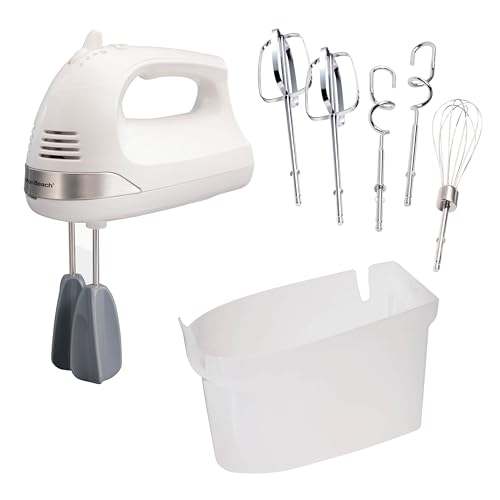
Hamilton Beach 6-Speed Hand Mixer with Easy Clean Beaters (62636J)
Badge: Best Power for the Tier
Strengths
- 275 watt motor is the strongest headline figure among the hand mixers in this guide
- Full attachment set: traditional beaters, dough hooks, and a whisk, in a snap-on case
- Easy Clean beaters are designed to release batter and rinse without scrubbing
Trade-offs
- White finish and a utilitarian design will not win any style points
- At higher speeds it is louder than the premium-feel rivals
- The case stores attachments but adds drawer bulk
| Speeds | 6 speeds |
|---|---|
| Motor | 275 watts |
| Attachments | Traditional beaters, dough hooks, whisk |
| Storage | Snap-on storage case |
| Color | White |
Hamilton Beach built the 62636J around a simple promise: more motor, more attachments, less money drama. The 275 watt motor gives it real confidence with thicker cookie doughs and heavier batters that make lighter mixers complain, and the box includes the full trio — traditional beaters, dough hooks, and a whisk — so you are not accessory-shopping a week later. Everything snaps into the storage case, which keeps the kit together.
The Easy Clean beaters earn their name with smooth surfaces that batter slides off in the sink. Six speeds cover the useful range, and there is a slower first gear that behaves itself around flour better than most budget mixers. It is not the quietest or prettiest tool here, and the white plastic shows its working life, but judged on capability per tier it is the value anchor of this guide. Bakers who mix often, mix thick, and would rather spend on ingredients than appliances have picked Hamilton Beach for decades for exactly this reason. This model shows why.
Hamilton Beach competes on electrical substance: a 275 watt motor is real headroom, and headroom is what keeps an electric mixer honest when a dough thickens mid-recipe and lesser motors start to slow and strain. Six speeds cover the working range, and the full attachment set means the electronics are never waiting on accessories you do not own.
There is no soft-start subtlety here, so the electronic discipline is yours to supply: start low, especially in flour, and step up as the mixture comes together. Do that and this is the hardest-working electric mixer in the guide for thick, frequent mixing — the one a weekly cookie baker will appreciate most by the third month.
Best for: Frequent, thick mixing on a sensible budget of effort / Not suited for: bakers who want the quietest, softest-starting machine

Cuisinart 9-Speed Hand Mixer with Storage Case (HM-90BCS, Brushed Chrome)
Badge: Best Premium Electronic
Strengths
- 220 W motor with nine speeds and SmoothStart for controlled, splatter-free starts
- Six-piece set with snap-on case, so beaters, whisk, hooks, and spatula store together
- Brushed chrome finish resists fingerprints better than glossy alternatives
Trade-offs
- Closely related to the HM-90S, so owners of that model gain little by switching
- The cased unit is bulky for small drawers
- Sits in the upper tier for a hand mixer, which casual bakers may not need
| Speeds | 9 speeds with SmoothStart |
|---|---|
| Motor | 220 W |
| Set | 6-piece set with snap-on storage case |
| Color | Brushed Chrome |
Think of the HM-90BCS as the HM-90 formula in its dress clothes: a 220 W motor, nine speeds, SmoothStart anti-splatter ramping, and a six-piece accessory set, all wrapped in brushed chrome with a snap-on storage case. The chrome is not just cosmetic. It wipes clean without showing every fingerprint, which matters for a tool that lives through buttercream sessions.
The six-piece set is the practical difference from the white HM-90S listing: you get the full attachment family plus the case, so whipping, beating, and light dough work are all covered from day one. Mixing behavior is classic Cuisinart — a true low speed that folds without flinging, a strong midrange for creaming, and enough top-end pace for meringue. The case keeps everything in one footprint in the cupboard. If you are choosing between the two Cuisinart nine-speed models in this guide, decide on finish and the exact bundle in front of you; the mixing experience itself is essentially the same, and both are among the most complete hand-mixer kits you can buy.
The HM-90BCS takes the same electronic package as the white HM-90S — 220 W motor, nine speeds, SmoothStart — and presents it as the premium tier of the idea: brushed chrome body, six-piece accessory set, snap-on case. Shoppers comparing the two Cuisinarts should understand they are comparing bundles and finishes, not electronic performance, which is shared.
Where the premium framing is earned is in completeness. The whisk, beaters, hooks, and spatula are all in the case from day one, so the electronic control you paid for is usable across every mixing job immediately. If you are buying one electric hand mixer to serve for years and want the full kit in a finish that hides fingerprints, this is the version to buy once.
Best for: Buy-once shoppers who want the complete premium kit / Not suited for: owners of the HM-90S, who would gain almost nothing

Proctor Silex Easy Mix 5-Speed Hand Mixer (62511)
Badge: Best Lightweight Electronic
Strengths
- Compact and lightweight, so it is easy on the arm during longer whipping jobs
- Bowl rest feature keeps drips in the bowl instead of on the counter
- Simple five-speed control that anyone can use without a learning curve
Trade-offs
- 215 watts of peak power is the modest end of this group, so thick doughs are off the menu
- Basic beater set only, with no whisk or dough hooks in the box
- Black plastic design is purely functional
| Speeds | 5 speeds |
|---|---|
| Power | 215 watts peak power |
| Feature | Bowl rest |
| Color | Black |
The Proctor Silex Easy Mix is the minimalist entry in this guide: five speeds, a compact black body, 215 watts of peak power, and a bowl rest. It makes no attempt to be a status object, and that is its charm. It is light — genuinely light — which matters more than spec sheets admit when you are holding a mixer over a bowl of cream for several minutes, and its small footprint disappears into a drawer that the cased kits would dominate.
Within its lane it is a capable mixer: pancake and cake batters, boxed mixes, frostings, whipped cream, scrambled-egg prep, and mashed potatoes all come out fine. The lane has edges, though. Stiff cookie dough makes it work hard, and bread dough is simply not its job. The beater set is basic, with no whisk or hooks, so plan on it as a batter-and-cream tool. For small households, occasional bakers, RV and cabin kitchens, and anyone who values light and simple over powerful and featured, it is the honest, easy choice in this lineup.
The Proctor Silex is the reminder that electronic does not have to mean complicated. Five speeds, 215 watts of peak power, a bowl rest — the entire electronic proposition fits in one light body that a child could learn and a grandparent could lift without thinking about it. For small, frequent jobs — a quick batter, a small whip, mashed potatoes for two — reaching for this is faster than setting up anything bigger.
Its limits are electrical honesty: peak power is modest, so thick doughs slow it down, and there are no hooks or whisk in the box. Treat it as the light electric specialist it is, and it may become the most-used mixer in a small kitchen precisely because it asks for nothing.
Best for: Small kitchens and light, frequent jobs / Not suited for: stiff doughs and large batches
Comparison Table
| Pick | Badge | Standout trait | Watch out for | Check |
|---|---|---|---|---|
| Cuisinart Power Advantage Plus 9-Speed Hand Mixer (HM-90S, White) | Best Overall Electronic | Nine speeds with SmoothStart, which ramps up gently so dry ingredients stay in the bowl | The storage case adds bulk, which matters in shallow drawers | Check on Amazon |
| WEPSEN 5-Speed Hand Mixer with 4-Bowl Nesting Set | Best Electronic Starter Kit | Bundle includes four stainless nesting bowls plus measuring cups and spoons, a real starter kit | The mixer itself is a simple five-speed unit, less refined than the legacy brands here | Check on Amazon |
| KitchenAid 5-Speed Ultra Power Hand Mixer (Black Matte) | Best for Everyday Baking | Same proven KHM512 platform as the silver version, in a Black Matte finish that hides wear | Mechanically identical to the other KHM512 colors, so choose on finish and availability, not performance | Check on Amazon |
| Hamilton Beach 6-Speed Hand Mixer with Easy Clean Beaters (62636J) | Best Power for the Tier | 275 watt motor is the strongest headline figure among the hand mixers in this guide | White finish and a utilitarian design will not win any style points | Check on Amazon |
| Cuisinart 9-Speed Hand Mixer with Storage Case (HM-90BCS, Brushed Chrome) | Best Premium Electronic | 220 W motor with nine speeds and SmoothStart for controlled, splatter-free starts | Closely related to the HM-90S, so owners of that model gain little by switching | Check on Amazon |
| Proctor Silex Easy Mix 5-Speed Hand Mixer (62511) | Best Lightweight Electronic | Compact and lightweight, so it is easy on the arm during longer whipping jobs | 215 watts of peak power is the modest end of this group, so thick doughs are off the menu | Check on Amazon |
How to Choose an Electronic Mixer That Actually Behaves
Judge the first speed before anything else. The most-used gear on any mixer is the slowest one — it is where dry ingredients get incorporated, where folding happens, where control lives. In listings and demonstrations, look for soft-start or anti-splatter language and treat it as a headline feature, not a footnote. A mixer that cannot start gently will cost you cleanup and overmixed batters for its entire life.
Then think about speed spacing, not speed count. Five well-spaced speeds — stir, blend, mix, beat, whip — cover real baking. Nine speeds add finer steps in the middle, which frequent bakers do use, especially for buttercream and meringue. What nobody needs is a tall speed count where the first three settings are all effectively the same surge. Choose the range that matches your recipes, not the biggest number on the box.
Motor figures need honest reading. Brands state wattage differently, and peak power is not working power, so treat the numbers as rough tiers rather than precise rankings. The practical question is reserve: will the motor hold its speed when the cookie dough thickens? Stronger motors in this guide — the 275 watt Hamilton Beach, the 220 W Cuisinart — answer that question more comfortably than the lightest models, which are built for batters and creams instead.
Attachments are the other half of the machine. Beaters alone limit you to beating. A whisk transforms whipping and folding; dough hooks extend a hand mixer into light dough work. Storage decides whether those attachments survive: snap-on cases keep kits together, while loose attachments migrate to the back of drawers and vanish. Finally, weigh the thing in your mind — you hold a hand mixer for every second it works, so a lighter body is a real feature for long jobs and smaller hands.
If your kitchen is starting from zero, bundle logic matters more than any single specification, and the starter-kit pick here reflects that. If you are upgrading, buy the control you lacked — usually the gentle start or the whisk — rather than a shinier version of the same frustrations. The shoppers comparing notes in Best Mixers Fir Run and other niche roundups are chasing the same thing: a machine whose electronics make mixing calmer, not louder.
How to Use an Electric Hand Mixer Well: Technique and Troubleshooting
Technique starts before the switch. Bring butter and eggs to the temperature the recipe assumes, use a bowl deeper than feels necessary, and stir dry ingredients into wet by hand for the first few strokes. That one habit removes most of the splashing people blame on their mixers, because the motor never meets a loose pile of flour at full exposure.
Work in speed stages. Start at the lowest setting until the mixture is cohesive, step up to the middle for the main mixing, and reserve the top speeds for whipping. Move the mixer slowly through the bowl in overlapping passes, tilting the bowl toward the beaters rather than chasing mixture around, and scrape the bowl down once mid-mix — no beater geometry reaches the bottom curve perfectly, and pretending otherwise leaves unmixed pockets in finished cakes.
Stop on time. Most home overmixing happens in the last thirty seconds: cake batters turn tough, whipped cream goes grainy, buttercream gets airy and warm. Mix to the visual cue the recipe describes — just combined, soft peaks, ribbon stage — and then stop, even if the timer in your head says the job should take longer. The mixer works fast; your eyes should decide when it is done.
Match the attachment to the job every time. Beaters are the generalists — batters, frostings, mashed work. The whisk is the specialist for anything whose goal is air: cream, egg whites, light sponges. Dough hooks exist for soft, small doughs and should be used at low speeds with the bowl steadied. Using beaters where a whisk belongs costs you minutes and volume; using a whisk in thick batter bends wires and strains the motor. Thirty seconds spent swapping attachments is the highest-value habit in electric mixing.
Care is simple and worth doing. Eject attachments straight into warm soapy water or the dishwasher where the maker allows it, wipe the body with a damp cloth without ever immersing it, and store the cord loosely coiled rather than yanked tight around the body, which fatigues the cable over years.
Troubleshooting. Problem: flour or powdered sugar erupts at startup → the first speed is too aggressive for loose dry ingredients; stir by hand first, start at the lowest setting, and hold a clean towel loosely over the bowl rim for the first seconds. Problem: the motor slows and strains in thick dough → the batch is beyond the machine; divide it, finish by hand, or step up to a stronger model for that recipe rather than cooking the motor. Problem: whipped cream turns grainy → it was over-whipped; stop at soft peaks next time, and rescue this batch by folding in a splash of unwhipped cream by hand.
Hand Mixer vs. Stand Mixer: The Electronic Decision Most Kitchens Face
The electronic question behind this whole guide is whether your mixing should live in your hand or on the counter. Hand mixers win on storage, price of entry, cleanup, and control at the bowl — you feel resistance change as a dough thickens, which is information no stand mixer gives you. They lose on capacity, on stiff doughs, and on any job where you want both hands free for five straight minutes.
Stand mixers win exactly there: bread doughs, double batches, long kneads, and hands-free whipping. They lose on footprint and on small jobs, where hauling out a stand mixer to whip a cup of cream is its own deterrent. Many serious home bakers end up owning both, using the stand mixer weekly and the hand mixer daily. If you can only start with one, start with the hand mixer — it covers the widest range of everyday work for the least commitment, and every pick in this guide proves the point.
What the Speed Numbers on the Box Really Mean
Speed counts are the most marketed and least standardized numbers in this category. One brand’s speed three can spin like another brand’s speed five, because there is no shared scale — only each maker’s internal steps. Wattage is similarly slippery: some figures describe peak draw, others working power, and none of them directly measures how the beaters move through dough.
So shop the behaviors instead: Does it start gently? Does it hold speed in thick batter? Are the low speeds genuinely low? Those three questions, answered honestly, predict your experience far better than the biggest number on the carton. It is the same skepticism worth bringing to fee-and-tier roundups like Best Mixers Fees — the headline figure is rarely the whole story, in mixers or in money.
Corded Reliability, and Why Every Pick Here Plugs In
Cordless hand mixers exist, and for a single small job they are charming. But electric mixing is sustained work, and sustained work is where batteries sag: speeds droop as charge falls, and the last minute of a whip is exactly when you want full power. Every pick in this guide is corded, deliberately. A cord delivers the same speed in minute one and minute ten, never needs charging before a baking day, and will still work in a decade.
The cord’s only real cost is management, and the better designs solve it: swivel cords that lock to the side you prefer, enough length to reach a sensible outlet, and bodies shaped to stand or rest on a bowl rim between stages. If your counter has exactly one accessible outlet, measure the run before you buy and choose accordingly. For everyone else, corded is not the old-fashioned option — it is the reliable one, and reliability is the entire point of an appliance you reach for weekly.
One more electrical habit is worth forming: plug the mixer in only when you are ready to mix, and unplug it before ejecting attachments or wiping the body. It takes two seconds, it protects the machine and your fingers, and it is the kind of boring discipline that keeps a good appliance good for a very long time.
Common Buying Mistakes
Mistake one: buying the highest speed count and never using half of it. Most bakers live on three speeds. Pay for control quality — a gentle start, steady middles — before paying for quantity of settings you will click past.
Mistake two: starting dry ingredients at working speed. Even the best electronics cannot fully save a bowl of loose flour from an impatient start. Thirty seconds of hand stirring first is the cheapest anti-splatter technology ever made.
Mistake three: ignoring the attachment list until after purchase. A mixer without a whisk whips slowly; a mixer without hooks should not meet bread dough. The box contents are part of the machine, and replacing missing pieces later costs more than choosing the complete kit now.
Mistake four: storing the mixer and its attachments in different places. By the third bake, something is missing. Cased kits and single-drawer discipline both work; chaos does not. The same organizational thinking applies when comparing guides such as Best Mixers Fkr Gin for other corners of the kitchen — the right tool is the one you can actually find and use.
Final Recommendation
The Cuisinart HM-90S is the final recommendation for most shoppers: its nine electronically managed speeds and SmoothStart ramping deliver the calmest, most controlled mixing in this guide, and the snap-on case keeps the whole kit together. It is the electronic mixer concept executed most completely at hand-mixer scale.
Take the WEPSEN bundle if your kitchen needs bowls and measures as much as a motor, the KitchenAid KHM512 if steady everyday behavior and easy cleanup top your list, the Hamilton Beach 62636J if thick and frequent mixing demands the most motor, the brushed-chrome HM-90BCS if you want the premium complete kit, and the Proctor Silex if light, small, and simple is the whole brief. Every one of them is a genuinely capable electric mixer — the choice is about which behavior you will feel every time you bake.
Start with the Cuisinart Power Advantage Plus 9-Speed Hand Mixer (HM-90S, White) if you want the safest all-round choice, or the WEPSEN 5-Speed Hand Mixer with 4-Bowl Nesting Set if its badge matches your kitchen better.
Frequently Asked Questions
What does electronic actually mean for a mixer?
In practice it means the motor and speed control are managed electrically rather than by a simple mechanical switch alone — better models use that control to ramp up gently, hold a chosen speed under load, and space speeds usefully. All modern hand mixers are electric; the good electronic ones are the ones whose control you can feel behaving well in the bowl.
Is a 9-speed mixer better than a 5-speed mixer?
Not automatically. Nine speeds give finer steps for delicate work like meringue and buttercream, and frequent bakers do use them. Five well-spaced speeds cover the standard repertoire completely. Judge the gentleness of the first speed and the steadiness of the middles before counting settings.
How much power does a hand mixer need?
For batters, frostings, and whipped work, every pick in this guide has enough. For thicker cookie doughs and frequent heavy mixing, the stronger motors — the 275 watt Hamilton Beach and the 220 W Cuisinarts — hold speed more comfortably. Stiff bread dough belongs to a stand mixer regardless of hand-mixer wattage.
Can an electric hand mixer knead bread dough?
Light, soft doughs in small quantities, yes, with dough hooks and patience. Stiff or large doughs, no — the motor and your arm will both object, and a stand mixer is the right tool. Several picks here include hooks for the lighter end of that work.
Why does my mixer splatter at startup?
Loose dry ingredients plus an abrupt start. Stir dry into wet briefly by hand, begin at the lowest speed, use a deep bowl, and consider a soft-start model if splattering is your main frustration — it is exactly the problem SmoothStart-style ramping was designed to solve.
Are cordless electric mixers worth it?
For very light, occasional jobs they can be convenient, but for sustained mixing a corded model holds its speed from the first minute to the last, never needs charging, and typically offers more motor for the tier. That is why every pick in this guide is corded: for a tool you rely on weekly, consistent power beats untethered convenience. If your kitchen truly has no reachable outlet near the counter, a cordless model is a reasonable compromise — just expect shorter, gentler mixing sessions.
How long should an electric hand mixer last?
Years of regular use is a reasonable expectation from the established brands here, provided attachments are washed promptly, the body is never immersed, and the motor is not routinely stalled in dough beyond its class. Simpler models have less to fail; premium kits justify themselves through attachments and control rather than lifespan alone.


