Disclosure: topratedkitchenware.com is reader-supported. When you buy through links on our site, we may earn an affiliate commission from Amazon and other retailers, at no extra cost to you.
Where to buy
If you are shopping for the best mixers for cooks — not for one recipe, but for the whole life of a kitchen — the six hand mixers below are the shortlist this guide is built around. A cook’s mixer is a generalist: it creams and whips on baking days, mashes and blends on savoury days, and must be fast to deploy and faster to clean, because a tool that takes effort to start gets skipped. Prices and availability change often on Amazon, so use the links to check the current listing before you buy.
- Best Overall: Cuisinart Power Advantage Plus 9-Speed Hand Mixer, White (HM-90S) — Check on Amazon
- Best All-Rounder on a Budget of Space: Hamilton Beach 6-Speed Electric Hand Mixer, White (62682G) — Check on Amazon
- Best Accessory Range: LILPARTNER Hand Mixer Electric, 7-Speed, Light Pink — Check on Amazon
- Best Compact Pick: KitchenAid 5 Ultra Power Speed Hand Mixer, Empire Red (KHM512) — Check on Amazon
- Best for Small Kitchens: KitchenAid 5 Ultra Power Speed Hand Mixer, Contour Silver (KHM512) — Check on Amazon
- Best Starter Set: WEPSEN 5-Speed Electric Hand Mixer with Mixing Bowls Set — Check on Amazon
Read the full guide below for the detailed reviews, the comparison table and the sections on what a cook actually asks of a mixer — deployment, cleanup, savoury range, batch days and the drawer it lives in ↓
The best mixers for cooks are chosen by a different standard from the best mixers for bakers, and the distinction matters. A baker asks a mixer to perform a few demanding jobs superbly. A cook asks it to perform a hundred ordinary jobs willingly: whipping cream for a sauce and for a dessert in the same meal, mashing potatoes without glue, beating eggs for a frittata, emulsifying a dressing, creaming butter for the cake that follows the roast, mixing a meatloaf gently, folding a batter, rescuing a lumpy gravy at the last minute. None of these jobs is heroic. All of them share one requirement that specialist guides underrate: the mixer must be effortless to start. A cook mid-service, with pans on the stove and timing in their head, reaches for the tool that comes out of the drawer in one motion and goes back clean in thirty seconds — and quietly stops using the one that does not.
That is why this shortlist is all hand mixers, and why its criteria are a cook’s criteria: speed range for the variety, attachments for the range of textures, a cord that behaves around a stove-side bowl, storage that keeps the machine findable, and cleanup that never becomes a reason to use a fork instead. The nine-speed Cuisinart leads on control; the Hamilton Beach follows on stated power and a burst button that turns out to be a savoury cook’s friend; the LILPARTNER brings the broadest accessory set; the two KitchenAid finishes bring compact tidiness; and the WEPSEN bundles the bowls a new kitchen lacks. Every review grades the pick across both sweet and savoury work, because that is the job description the keyword actually writes.
Key Takeaways
- A cook’s mixer is a generalist: judge it on deployment speed, cleanup and range, not on one heroic job.
- The Cuisinart HM-90S leads on control — nine speeds and SmoothStart cover everything from dressings to batters without splashing.
- The Hamilton Beach’s stated 250 watts and QuickBurst suit savoury rescue work: lumps, mashes and last-minute emulsions.
- Storage is a cooking feature: cased mixers (Cuisinart, Hamilton Beach) get used; loose mixers in utensil drawers get excavated.
- The KitchenAid pair’s dishwasher-safe beaters and one-button release set the cleanup standard for daily cooking.
- Starting a kitchen from zero? The WEPSEN set’s bowls and measures make it the most enabling first purchase.
- Judge a cook’s mixer by its full loop — drawer to bowl to sink to drawer — because a machine that is slow to start or slow to clean quietly stops being used, whatever its specifications promise.
In this guide
Quick Picks
| Pick | Badge | Speeds | Attachments named in listing | Cook’s role |
|---|---|---|---|---|
| Cuisinart Power Advantage Plus 9-Speed (HM-90S) | Best Overall | 9 | Beater (as listed) | Finest control across sweet and savoury work |
| Hamilton Beach 6-Speed Hand Mixer (62682G) | Best All-Rounder | 6 | Traditional beaters | Stated power and burst for mashes and rescues |
| LILPARTNER Hand Mixer Electric, Light Pink | Best Accessory Range | 7 | 5 stainless steel accessories | Dough, cream and cake named; broadest toolkit |
| KitchenAid KHM512, Empire Red | Best Compact Pick | 5 | Turbo Beaters | Tidy daily tool with the easiest cleanup |
| KitchenAid KHM512, Contour Silver | Best for Small Kitchens | 5 | Turbo Beaters | Same platform, neutral finish |
| WEPSEN 5-Speed Hand Mixer Set | Best Starter Set | 5 | Whisks, beater | Bowls and measures bundled for new kitchens |
How These Picks Were Chosen
This guide is research-led and built from verified listings. Every specification used — speed counts, stated wattage, named attachments, storage and cord features — comes from the listing itself, and where a listing is silent, the review says so. The weighting, though, is this keyword’s own: because “for cooks” asks about a whole kitchen life, we weighted deployment and cleanup alongside mixing ability, and we assessed each pick against a savoury repertoire — mashed potatoes, eggs, dressings, batters, meat mixtures — as carefully as against cakes and creams.
We also kept the format honest. All six picks are hand mixers, which suits the cook’s brief of speed and versatility; the buying guide discusses where a stand mixer enters a cook’s kitchen and what it adds, because many cooks own both and use them for different departments of the same meal. Colour variants of the KitchenAid platform are identified as the same machine wherever they appear. We claim no hands-on testing; the assessments rest on verified specifications and on the ordinary, well-understood demands of home cooking.
The 6 Best Mixers for Cooks, Reviewed

Cuisinart Power Advantage Plus 9-Speed Hand Mixer, White (HM-90S)
Badge: Best Overall
Strengths
- Nine speeds — the widest range here — means a gear for every texture a cook meets, from a dressing’s stir to a meringue’s whip.
- SmoothStart anti-splatter ramps in gently, protecting soups’ edges, flour and the cook’s shirt alike.
- The snap-on case keeps the machine and attachments together, so deployment is one grab.
Trade-offs
- The listing names a beater rather than a whisk; whipped work is beater-paced.
- Control this fine rewards cooks who enjoy it; a two-speed temperament may find seven gears surplus.
- The white finish shows turmeric, tomato and cocoa until wiped.
Mini spec box
- Format: electric hand mixer
- Speeds: 9
- Features: SmoothStart anti-splatter, snap-on storage case
- Listing positioning: cake mixer, hand held mixer
- Colour: White
A cook’s week is a tour of viscosities, and the HM-90S is the pick that travels it best. Monday’s mashed potatoes want a low, patient gear and a machine that will not turn them to glue with enthusiasm. Wednesday’s vinaigrette wants thirty seconds at a stir. Friday’s cake wants creaming at the middle and flour at the bottom of the dial, with no flour on the walls — SmoothStart’s entire reason to exist. Sunday’s whipped cream wants the top gears and a clean stop at soft peaks. Nine speeds sounds like a specification; in a cook’s kitchen it is actually a vocabulary, and this machine speaks more of it than any other pick here — fluently, from the first whispered stir of a dressing to the full voice of a whipped dessert.
The case deserves its sentence: a cook reaches for this mixer more often because it lives as one object, findable in the dark of a cupboard, complete with its attachments. Its limitations are a named beater where whisk-lovers would want a whisk, and a white finish in a savoury kitchen that will test it with every curry and ragù. Neither dents the verdict: for the cook who wants one hand mixer that answers the whole week, from Monday’s mash to Sunday’s cream, this is the most capable and controlled answer in the pool.
Best for: cooks who mix daily across sweet and savoury work and value control / Not suited for: cooks who want a confirmed whisk above all, or who mix only occasionally

Hamilton Beach 6-Speed Electric Hand Mixer, White (62682G)
Badge: Best All-Rounder
Strengths
- A stated 250 watt motor — honest power that shows in mashes, thick batters and meat mixtures.
- QuickBurst is a rescue feature: a short push for lumpy gravies, stiff mashes and last dry pockets.
- The bowl rest parks the mixer mid-service, on the bowl, where a busy cook actually needs it.
Trade-offs
- Six speeds is a coarser vocabulary than the Cuisinart’s nine, especially at the gentle end.
- Traditional beaters only, per the listing — no whisk for the whipped end of the repertoire.
- No soft-start is named; flour and liquid starts need a cook’s technique.
Mini spec box
- Format: electric hand mixer
- Speeds: 6, plus QuickBurst
- Motor: 250 watts
- Attachments named in listing: traditional beaters
- Features: bowl rest, snap-on storage case
- Colour: White
If the Cuisinart is the linguist of this group, the Hamilton Beach is its strong, practical friend. The stated wattage is the headline a cook should care about: savoury mixing is load work — potatoes do not whip, they yield — and a machine that publishes its power is a machine whose maker expects it to be worked. QuickBurst, marketed for baking, reveals a second career at the stove: the gravy that lumped, the mash that needs one more push, the batter with a flour pocket hiding at the bottom all surrender to a one-second burst aimed by hand, without the overmixing a sustained speed would cause.
The bowl rest completes the service picture — a cook’s mixing is interrupted by definition, by the stove, the door, the timer, the taster — and a mixer that parks on the bowl rim, dripping inward, keeps a working counter workable. Its trade-offs are range and refinement: six speeds, beaters only, no named soft start. For the cook whose mixing skews savoury and hearty, those trades are barely trades at all, and this is the pick we would put in their drawer — where, if our experience of such kitchens is any guide, it will be reached for more days in the year than any other powered tool they own.
Best for: savoury-leaning cooks who mash, rescue and mix hearty mixtures daily / Not suited for: whipped-work specialists or cooks who prize the finest low speeds

LILPARTNER Hand Mixer Electric, 7-Speed, Light Pink
Badge: Best Accessory Range
Strengths
- Five stainless steel accessories — the broadest toolkit here, spanning the listing’s named jobs of dough, cream and cake.
- Seven speeds give a cook’s range: gentle incorporation to a working whip.
- Dishwasher-safe attachments suit a daily cook’s cleanup economics.
Trade-offs
- No wattage is stated, so its power cannot be ranked against the Hamilton Beach’s published figure.
- Light pink is the only finish offered in this listing.
- More accessories means more pieces to store and to wash on a busy night.
Mini spec box
- Format: electric hand mixer
- Speeds: 7
- Accessories: 5 stainless steel accessories
- Listing-named jobs: whipping dough, cream, cake
- Attachments: dishwasher safe
- Colour: Light Pink
Versatility in a cook’s mixer is mostly attachments, and the LILPARTNER arrives with the most of them. The listing’s own job list — dough, cream, cake — reads like a cook’s weekend: a small dough for flatbreads to go with the stew, cream whipped for the dessert, a cake because it is Saturday. Five stainless accessories give those jobs their proper tools rather than one compromise shape, and seven speeds cover the range a generalist actually uses, from folding a batter to whipping a cream.
The cautions are informational and practical: with no wattage published, heavy savoury loads should be approached with the same small-batch respect any unstated motor deserves, and a five-piece set asks for a storage habit — one box, one drawer corner, one home — or it becomes five pieces in five places. For the cook who bakes as much as they sauté — the true generalist this keyword describes — it is the most naturally matched pick in the group after the leader, and the one whose accessory drawer will see the widest variety of work across a year.
Best for: generalist cooks whose mixing runs from small doughs to creams and cakes / Not suited for: cooks who want a published wattage figure, or who dislike multi-piece sets
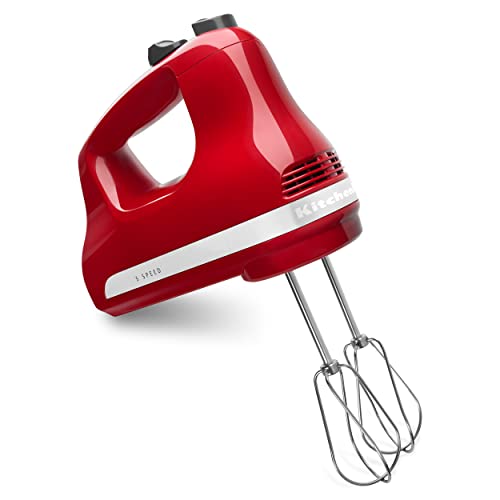
KitchenAid 5 Ultra Power Speed Hand Mixer, Empire Red (KHM512)
Badge: Best Compact Pick
Strengths
- Turbo Beaters keep thick mixtures — mashes, batters, frostings — moving without clogging.
- The lockable swivel cord stays out of the food and locks to the side the cook works from.
- One-button release and dishwasher-safe beaters make it the fastest-cleaning pick here.
Trade-offs
- Five speeds is the joint-narrowest vocabulary in the group.
- Compact format means everyday jobs, not production loads.
- Empire Red is a bold finish for an everyday tool.
Mini spec box
- Format: electric hand mixer
- Speeds: 5
- Attachments named in listing: Turbo Beaters
- Features: lockable swivel cord, easy-release button, dishwasher-safe beaters
- Colour: Empire Red
The KHM512 is the cook’s daily driver: the machine for the ninety percent of mixing that is small, quick and in the middle of something else. Its virtues are all about friction — or its absence. The cord locks out of the bowl. The beaters eject with a button a floury hand can manage. The whole cleanup is a dishwasher rack. A cook who mixes twice a day will feel those mercies compound into something that looks, from the outside, like the machine simply being used more — which is the truest measure of a cook’s tool there is, truer than any specification printed on any box in this guide.
Its ceiling is honest: five speeds and a compact format are sized for everyday work, and the cook who regularly creams for a crowd or kneads anything should look up this guide to the Cuisinart’s range or out of the category to a stand mixer. Within the everyday, it is close to flawless, and its red finish makes it the easiest machine in the group to spot in a crowded drawer — a small, real virtue at 6 p.m. on a weeknight, when dinner is already late and the last thing anyone needs is a scavenger hunt for the mixer.
Best for: daily cooks in compact kitchens who mix often and clean fast / Not suited for: large batches or cooks needing a wide speed range

KitchenAid 5 Ultra Power Speed Hand Mixer, Contour Silver (KHM512)
Badge: Best for Small Kitchens
Strengths
- The identical KHM512 platform — Turbo Beaters, swivel cord, one-button release — in a neutral finish.
- Contour Silver suits shared kitchens and landlords’ colour schemes alike.
- The same cleanup standard: dishwasher-safe beaters, minimal fuss.
Trade-offs
- It is the same machine as the red model; no cooking difference exists.
- The same five-speed, compact-format ceiling applies.
- Silver’s discretion is a drawback if you liked the red one’s findability.
Mini spec box
- Format: electric hand mixer
- Speeds: 5
- Attachments named in listing: Turbo Beaters
- Features: lockable swivel cord, easy-release button, dishwasher-safe beaters
- Colour: Contour Silver
The silver KHM512 is the red one in a quieter coat, and this guide treats it with the same honesty as every colour variant in the programme: same speeds, same beaters, same cord, same ceiling, same daily virtues. It is reviewed separately because the pool includes it and because finish is a legitimate basis for choosing a tool you will see every day — silver reads as a neutral appliance, sits happily in shared and rented kitchens, and shows a baking day’s evidence less theatrically than either black or white. Choose between the two KHM512s with your eyes and your kitchen’s own palette; your cooking, in either case, will not know the difference at all, ever, honestly.
Best for: cooks who want the compact platform in a finish that blends anywhere / Not suited for: anyone expecting a different machine from the red version

WEPSEN 5-Speed Electric Hand Mixer with Mixing Bowls Set
Badge: Best Starter Set
Strengths
- Four large stainless nesting bowls included — a cook’s prep runs on bowls, and these nest into one footprint.
- Whisks are named in the listing, covering eggs, dressings and creams properly.
- Measuring cups and spoons complete the starter kit a new kitchen actually lacks.
Trade-offs
- The lightest-duty mixer here: five speeds, bundle-first design, everyday loads only.
- Established kitchens will duplicate bowls and measures they already own.
- No storage case or soft-start feature is named.
Mini spec box
- Format: electric hand mixer with bowl set
- Speeds: 5
- Included: 4 large stainless steel nesting bowls, measuring cups and spoons
- Attachments named in listing: whisks, beater
Every cook remembers the first kitchen: one bowl, no whisk, measuring by mug. The WEPSEN set is aimed with unusual precision at that kitchen. The mixer itself is a competent five-speed everyday tool with whisks and a beater — enough for eggs, batters, dressings, mashes in modest quantities and the whole beginner repertoire. But the purchase is the ecosystem: four large stainless bowls for the mise en place that good cooking runs on, and the measuring tools that turn guessing into repeatability. A new cook equipped with this set can cook almost anything in a first cookbook without an equipment excuse.
Its ceiling is the lightest in the guide, and a cook who falls in love with the craft will outgrow the mixer while keeping the bowls for a decade — which is, when you think about it, exactly the right way round for a starter set to age.
Best for: new cooks and first kitchens needing the whole mixing ecosystem in one box / Not suited for: equipped kitchens or heavy daily loads
Comparison Table
| Pick | Speeds | Motor (as listed) | Storage | Cook’s strength | Link |
|---|---|---|---|---|---|
| Cuisinart HM-90S | 9 | Not stated | Snap-on case | Control across all textures | Check on Amazon |
| Hamilton Beach 62682G | 6 + QuickBurst | 250 watts | Snap-on case | Savoury power and rescues | Check on Amazon |
| LILPARTNER 7-Speed | 7 | Not stated | Not stated | Accessory range | Check on Amazon |
| KitchenAid KHM512, Empire Red | 5 | Not stated | Drawer | Daily ease and cleanup | Check on Amazon |
| KitchenAid KHM512, Contour Silver | 5 | Not stated | Drawer | Daily ease and cleanup | Check on Amazon |
| WEPSEN 5-Speed Set | 5 | Not stated | Bundled bowls | Starter ecosystem | Check on Amazon |
How to Choose the Best Mixers for Cooks: The Generalist’s Criteria
Choose by friction first. A cook’s mixer earns its place in the first five seconds and the last thirty: how fast it deploys, how fast it cleans. Cases, one-button releases and dishwasher-safe beaters are therefore primary features for this keyword, not garnish — which is why the cased Cuisinart and Hamilton Beach and the quick-release KitchenAids dominate this guide’s podium. Choose by vocabulary second: count the textures in your week — eggs, dressings, mashes, batters, creams, doughs — and buy the speed range and attachment set that covers them, erring toward the Cuisinart’s nine speeds or the LILPARTNER’s five accessories if your week is wide.
Choose by honesty about scale third. Everyday family cooking is hand-mixer territory entire. The stand mixer enters a cook’s kitchen for specific departments — bread in quantity, big-batch baking, a household that entertains at scale — and the cook who buys one for those departments while keeping a hand mixer for the daily ninety percent has the arrangement most experienced cooks eventually describe. Our specialist guides go deeper on the baking departments, from the Best Mixers For Dry Goods for the flour-and-pantry side of prep to the cake coverage elsewhere in this programme; this guide’s job is the centre, where most cooking lives.
How a Cook Actually Uses a Hand Mixer, Meal by Meal
- Breakfast: eggs beaten in the pan’s neighbour bowl in twenty seconds — low speed, no drama — or a pancake batter mixed to just-combined and rested.
- Prep: dressings emulsified at a stir, marinades blended, a meatloaf mixture combined gently and briefly so it stays tender.
- The main event: potatoes mashed at low speed with restraint (overworked potatoes turn gluey — the mixer’s power is exactly why the cook’s judgement matters), gravies rescued with a burst, pan sauces finished with a quick whip of cream.
- Dessert: cream whipped to soft peaks, a quick cake or crumble topping mixed while the main course rests.
- Cleanup as part of the recipe: beaters rinsed or racked immediately, every time, so the machine is always in its ready state.
Troubleshooting. Problem: mashed potatoes turned gluey → the mixer ran too long or too fast; potatoes need the lowest gear, warm liquid, and an early stop — mash to just-smooth and finish with a fork. Problem: the dressing keeps splitting → mix at the lowest speed with the oil added in a thin stream; emulsion is a pace, not a power. Problem: batter splashes at every start → begin with the beaters submerged and the speed at its floor, and consider a soft-start machine at your next purchase.
Sweet and Savoury: One Machine, Two Departments
Cooks, unlike bakers, must cross the sweet-savoury border with the same tool, sometimes within one meal — and that crossing imposes two disciplines worth naming. The first is flavour hygiene: a beater that whipped garlic butter in the afternoon must be properly washed before it whips cream in the evening, which is another practical argument for the dishwasher-safe attachments in this pool. The second is texture translation: the judgement that stops a batter at just-combined is the same judgement that stops a mash at just-smooth and a meat mixture at just-mixed, because in a cook’s hands a mixer is mostly a device for almost overdoing things, and its speeds are best understood as degrees of restraint.
There is a third discipline, quieter than both: temperature awareness. Cold ingredients resist, warm ingredients yield, and the same machine at the same speed produces different results in January’s cold butter and July’s soft one. Experienced cooks read the mixture, not the dial — the sound of the load, the way the mass moves, the moment it changes character — and they choose mixers that reward that reading with fine, predictable steps between speeds. It is one more reason the control-led picks sit at the top of this guide: in a cook’s kitchen, feel is a specification too. The picks that serve cooks best are the ones that make restraint easy — fine low gears, a gentle start, a burst instead of a blast — and it is no accident that those phrases describe this guide’s podium.
A Note on the Word “Mixer”
The word wanders. In the drinks world it means what goes with spirits — guides like the Best Mixers For Craft Cocktails, the Best Mixers For Crown and the Best Mixers For Crown Royal Black cover that shelf — and in the audio world it means a board that blends microphones. This guide is about the kitchen machine, the one that lives in the drawer and comes out at every meal, from the first eggs of the morning to the last whipped cream of the night.
The Cook’s Drawer: Organisation as a Mixing Feature
It sounds like housekeeping and behaves like engineering: where the mixer lives decides how much cooking it does. The ideal is boring — the machine and every attachment in one place, reachable with one hand, at the height of the counter it serves. Cased mixers achieve this by design, which is why two of this guide’s top three picks snap into cases; a caseless mixer achieves it with a dedicated drawer corner or a small bin that keeps body and beaters married. The failure mode is the utensil drawer diaspora: body in one drawer, beaters in another, the whisk — on the rare machines that include one — in a third place entirely, and a cook who consequently beats eggs with a fork for a year while owning a perfectly good mixer in pieces.
The same logic applies at the sink end. A mixer whose attachments go in the dishwasher returns to its home clean and complete; a mixer that needs hand-washing competes with the pans for the cook’s remaining evening energy and sometimes loses, spending the night in the sink and the morning unavailable. When you compare the picks in this guide, run the full loop in your imagination — drawer, bowl, sink, drawer — and choose the machine whose loop you would happily run twice a day, in the middle of a meal, with something already on the stove. That loop, not the top speed, is the cook’s specification.
Batch Days and Crowds: Where the Hand Mixer Hands Over
Every cook has a few days a year that break the everyday pattern: the holiday marathon, the freezer-filling Sunday, the party for twenty. It is worth knowing, calmly and in advance, what those days ask. Batters double and triple. Mashes become pot-sized. Cream is whipped by the litre. A hand mixer can serve these days in shifts — batch after batch, with rests for the motor and the cook — and for many households that is genuinely enough, because the alternative is storing a stand mixer for fifty weeks to shine for two. But the cook who hosts monthly, or batch-cooks weekly, crosses a line where the stand mixer’s bowl and hands-free running stop being luxuries and become the difference between a pleasure and a shift.
The graceful pattern, again, is departmental: the hand mixer stays the daily tool even after the stand mixer arrives, because most jobs on a batch day are still small — a dressing, a dip, a quick whip, a sauce that needs thirty seconds of attention — and deploying the big machine for them is its own friction. Buy the second machine for the days that demand it, keep the first for the days that do not, and the kitchen ends up, as experienced cooks keep reporting, with both machines earning their space — a division of labour so natural that cooks who reach it rarely remember deciding it.
What a Mixer Cannot Do: A Cook’s Reality Check
A buying guide owes its reader a short list of the jobs this category will not perform, so that nobody buys a hand mixer as a universal solvent. It will not chop, slice or grate — that is knife and processor work. It will not blend a soup smooth in the pot; that is the immersion blender’s department, and confusing the two tools at a stove is a splash risk with hot liquid. It will not knead a serious bread dough beyond the small, soft territory our bread guides describe. And it will not rescue technique: it will overwork potatoes, toughen batters and split dressings exactly as efficiently as it performs them correctly, because a mixer amplifies the cook’s decisions rather than replacing them.
None of this diminishes the category — it defines it. The hand mixer is the kitchen’s great middle tool, covering the wide territory between the fork and the food processor, and the cook who buys it for that territory, with eyes open about its borders, gets a decade of daily service from it. Most kitchen tools are bought for a job; this one is bought for a territory, and territories are where cooks actually live. The picks above are graded for exactly that territory, and their reviews’ ceilings are drawn from this same map.
Teaching Someone Else to Cook with Your Mixer
A cook’s mixer eventually gets borrowed by the household — a partner finishing dinner, a teenager making a first cake, a parent helping at a holiday. Machines differ in how teachable they are, and the difference is worth a paragraph in a guide for cooks, because the household’s least experienced user sets the machine’s real safety and success floor. The forgiving traits are predictable: a gentle start that does not punish a beginner’s switch-on, speeds that change one click at a time rather than in lunges, attachments that eject without a puzzle, and a body light enough for smaller hands. By those measures the KitchenAid pair and the soft-starting Cuisinart are the household-friendly picks, while the more powerful machines ask for a sentence of instruction — beaters in the bowl before you switch on, start low, always — that every cook should be able to give in one breath.
There is a quieter benefit on the other side: a mixer that a beginner can use successfully is a mixer that gets a second cook trained in your kitchen, and households with two confident cooks eat better than households with one. Choose the machine you would hand to a learner without hovering, and you have usually chosen well for yourself too — because the traits that forgive a beginner, a gentle start and honest steps between speeds, are the same traits that forgive an expert’s tired Friday-night cooking.
Common Buying Mistakes
Mistake one: buying a specialist when your cooking is general — the cook’s brief rewards range and readiness over any single heroic capability. Mistake two: ignoring cleanup until the third time you choose a fork over a mixer that is dirty in the sink; the machine you clean fastest is the machine you own, in every sense. Mistake three: storing attachments separately from the machine, guaranteeing a scavenger hunt at the moment of need — a case or a dedicated drawer corner is a feature. Mistake four: overworking the mixtures that punish power — potatoes, meat mixtures, batters — because the machine made it easy; a cook’s mixer skill is mostly stopping, and the cooks who internalise that produce better food on a five-speed machine than careless cooks produce on a nine-speed one. Mistake five: buying both finishes of the KitchenAid platform as if they cooked differently. Mistake six: underestimating the starter-set logic — a new kitchen needs bowls and measures more than it needs a ninth speed. Mistake seven: using the mixer where it does not belong — over a hot burner, in a soup pot, against a mixture that should have been split — and blaming the tool for a boundary the cook crossed. Mistake eight: letting the machine live wherever it lands after washing, instead of in its one home; a cook’s mixer is a system of machine plus place, and half the system is the place.
Final Recommendation
For most cooks, the Cuisinart HM-90S is the first choice: nine speeds, a splash-free start and a case that keeps it ready make it the most complete everyday mixer here. Savoury-leaning cooks should take the Hamilton Beach 62682G and its burst button; daily minimalists take a KitchenAid KHM512 in whichever finish suits the kitchen; new cooks take the WEPSEN set and start cooking the same day. Any of them, kept clean and within reach, will be used more in a month than a grander machine used in a year — and use, for a cook, is the whole point.
A closing thought for the cook still weighing the finalists: imagine the most ordinary Tuesday in your kitchen, not the most ambitious Saturday. The right mixer is the one that improves the Tuesday — the eggs, the mash, the quick batter, the two-minute cleanup — because Tuesdays are where cooking actually lives, and a machine chosen for them will handle the Saturdays with more grace than a machine chosen for the Saturdays ever handles a Tuesday.
Frequently Asked Questions
What do cooks actually use a hand mixer for, beyond baking?
Mashed potatoes and root vegetables, beaten eggs and frittata bases, salad dressings and marinades, pancake and fritter batters, meatloaf and meatball mixtures, whipped toppings and sauces, and last-minute rescues of lumpy gravies and pan sauces. The savoury list is longer than the sweet one in most kitchens, which is why this guide grades savoury work as carefully as baking.
Is a hand mixer or a stand mixer better for a home cook?
For the daily ninety percent — small, quick, varied jobs — a hand mixer wins on deployment and cleanup, and it is the machine most cooks reach for most. A stand mixer adds real value for bread, big baking and batch cooking. Many cooks own both and use them by department; if you are buying one first, the hand mixer is the cook’s first machine.
Can a hand mixer mash potatoes well?
Yes, with technique: lowest speed, warm liquid added gradually, and a stop at just-smooth. The risk is overworking, which turns potatoes gluey — a mixer makes the mash faster, so the cook’s restraint has to arrive sooner. The Hamilton Beach’s burst button is useful for the final texture adjustment in one-second touches.
What is the most common way cooks damage a hand mixer?
By treating it like a food processor — forcing it through loads that should have been split, run in long continuous stretches, or both. The classic scene is a doubled, stiff mixture and a cook who keeps the motor running while it audibly strains. Split the batch, work in bursts, let rests cool the motor, and the same machine will serve for years; the damage pattern is almost never a single accident but a habit.
How many speeds does a cook need?
Enough to cover a gentle stir and a real whip with steps between — five is workable, seven is comfortable, nine is luxurious. What matters more than the count is the character of the lowest gear: a first speed that stirs without splashing is the one a cook uses most, and soft-start designs like the Cuisinart’s build that gentleness in.
Are the two KitchenAid mixers in this guide the same?
Yes — both are the KHM512 platform with the same speeds, Turbo Beaters, swivel cord and release button, in Empire Red and Contour Silver finishes. Choose by colour and availability; the cooking is identical, as their listings confirm — and if a household cannot agree on the colour, that is the household’s first recipe negotiation, best settled before the machine arrives.
Can I use a hand mixer in a hot pan or pot?
No. A hand mixer is a bowl tool, not a stove tool: its body and cord do not belong over heat, and hot liquids splash dangerously when beaten. Mash potatoes in the drained pot off the heat if the pot is sturdy and off the burner, or transfer to a warm bowl — and for blending hot soups, use an immersion blender, which is designed for exactly that job.
How long will a hand mixer last a daily cook?
Years of daily service is a reasonable expectation for the established names in this guide, provided the motor is treated with the respect this article keeps recommending: bursts rather than marathons on heavy loads, no forcing through straining sounds, rests worked into long jobs the way rests are worked into dough, and attachments cleaned before residue hardens into the kind of crust that stresses an eject mechanism every time it is used. The machines that die young in cooks’ kitchens almost always die of one repeated abuse — usually being asked to power through mixtures that should have been split into two batches.
What should a brand-new cook buy first?
A set that removes excuses: the WEPSEN bundle pairs a workable five-speed mixer and whisks with the bowls and measuring tools a first kitchen lacks. A new cook with that box can attempt nearly anything in a beginner cookbook on day one, and upgrade the mixer itself years later while keeping the bowls — which will by then have mixed a thousand meals and earned the patina that makes a kitchen look cooked-in rather than merely equipped.


