Disclosure: topratedkitchenware.com is reader-supported. When you buy through links on our site, we may earn an affiliate commission from Amazon and other retailers, at no extra cost to you.
Where to buy
The six products below are the verified picks for this guide to the best mixers for pressing powders — the hand mixers that blend dry powders evenly, gently, and without turning your workspace into a dust storm, before the mixture ever meets a press. Each name links to its Amazon listing, where you can check the latest price on Amazon, confirm the current attachment set, and read the newest owner feedback before you decide.
- Cuisinart Power Advantage Plus 9-Speed Hand Mixer, HM-90S — Check on Amazon
- WEPSEN 5-Speed Electric Hand Mixer with 4 Mixing Bowls Set
- KitchenAid 5 Ultra Power Speed Hand Mixer, KHM512, Black Matte
- Hamilton Beach 6-Speed Electric Hand Mixer with Easy Clean Beaters
- Cuisinart 9-Speed Hand Mixer with Storage Case, HM-90BCS
- Proctor Silex Easy Mix 5-Speed Hand Mixer
Read the full guide ↓ for why low-speed control is the whole game with powders, how to add binder without ruining a batch, and the hygiene rules that separate a craft setup from a contaminated one.
Choosing the best mixers for pressing powders is a different problem from choosing a mixer for baking, even though the machines look the same. Pressing work — cosmetic powders bound for pans, bath and body powders, dry blends destined for pucks and tablets — lives or dies on one thing: uniformity. A pressed powder is only as good as its blend. Streaks of unmixed pigment become streaks in the pan; pockets of concentrated binder become hard spots that crack; an unevenly distributed ingredient is a defect you can see the moment the press opens. The mixer’s job is to make a dry, dusty, escape-prone material perfectly homogeneous without launching it into the air, and that job rewards exactly the opposite virtues from cake batter: the gentlest possible start, fine low-speed control, and attachments that fold powder rather than whip it.
All six picks here are electric hand mixers, and that is a deliberate fit rather than a limitation. Powder work is small-batch work — a few hundred grams at a time, in a deep bowl, with the operator watching the blend and adjusting constantly. A hand mixer puts the beaters under your direct control, lets you sweep the bowl’s corners where dry pockets hide, and stops the instant you lift your thumb. The reviews below grade each machine on the powder-specific criteria: how slowly and smoothly it can start, how its attachments treat dry material, how it stores and cleans in a craft workspace, and how honestly it suits the batch sizes pressing actually involves.
Key Takeaways
- Uniformity is the product: a pressed powder shows every mixing flaw, so even blending at low speed matters more than power or speed range at the top end.
- Smooth, gentle starts are the headline feature — the Cuisinart picks’ SmoothStart anti-splatter technology exists to stop exactly the explosive first second that ruins powder work.
- Hand mixers fit pressing because pressing is small-batch, hands-on work; you are the stand, the sensor, and the quality control.
- Dedicate your tools: a mixer used for cosmetic or craft powders must never return to food use, and food tools should not migrate the other way either.
- Binder goes in gradually — a little at a time, mixed fully between additions — or the batch develops wet clumps that no pressing can fix.
- Work safely with fine powders: a dust mask, decent ventilation, and slow speeds are the difference between a craft session and a cleanup disaster.
In this guide
Quick Picks
| Pick | Badge | Speeds | Why it is here |
|---|---|---|---|
| Cuisinart Power Advantage Plus HM-90S | Best Overall | 9 | SmoothStart anti-splatter starts, snap-on storage case, the finest low-end control here |
| WEPSEN 5-Speed Hand Mixer Bowls Set | Best for Batch Workflow | 5 | Comes with 4 stainless nesting bowls plus measuring cups and spoons — a powder station in a box |
| KitchenAid KHM512, Black Matte | Best Compact | 5 | Lockable swivel cord, Turbo Beaters, easy-release button; small footprint for tight craft benches |
| Hamilton Beach 6-Speed Easy Clean | Best for Longer Sessions | 6 | 275 watt motor, Easy Clean beaters, dough hooks and whisk, snap-on storage case |
| Cuisinart HM-90BCS | Best for Fine Control | 9 | 220 W motor with SmoothStart, 6-piece set, storage case, brushed chrome |
| Proctor Silex Easy Mix | Best Budget Pick | 5 | 215 watts of peak power, bowl rest, compact and lightweight; the dedicated second mixer |
How These Picks Were Chosen
This is a research-led guide. Each pick was verified against its Amazon listing data through the Creators API — the exact model, speed count, the attachments and features the listing names, and any power figure the maker publishes. Only listing-confirmed facts appear in the spec boxes; where a listing gives no wattage, the box leaves wattage out rather than borrowing a number from a sibling model. That discipline matters in this category more than most, because powder work is decided by small specification details — a slow-start feature, an eject button that works one-handed, a storage case that keeps craft attachments separate — that sloppy guides routinely invent or omit.
The ranking criteria are pressing-specific. First, start behaviour: does the machine offer a genuinely gentle first speed or an anti-splatter slow start, because the first two seconds decide whether your pigment is in the bowl or on your shirt. Second, low-end granularity: more speeds across the range means finer control in the low band where powder work lives — which is why the 9-speed Cuisinarts bracket this list. Third, workflow fit: included bowls, storage cases that quarantine craft attachments, beaters designed for easy cleaning, and bowl rests that keep a dusty mixer off the bench. Fourth, honest scale: every pick is assessed for the small batches pressing involves, and the guide says plainly where a machine’s limits sit. The same powder-handling logic — gentle starts, gradual additions, uniformity over speed — recurs in this site’s coverage of other powder tasks, including the drink-side blending in Best Mixers For Protein Shakes, where clumps are the enemy for the mirror-image reason.
A scope note, stated plainly: this guide covers hand mixers for small-batch, craft-scale powder blending — the scale of indie cosmetic makers, bath-product crafters, and hobbyist pressers. Industrial powder production uses dedicated ribbon and tumble blenders that share nothing with this category, and no pick here pretends otherwise. Within the craft scale, though, the right hand mixer is not a compromise; it is the tool the work actually wants.
The 6 Best Mixers for Pressing Powders

Cuisinart Power Advantage Plus 9-Speed Hand Mixer, HM-90S
Badge: Best Overall
Strengths
- SmoothStart anti-splatter technology delivers the gentle first seconds powder work depends on.
- 9 speeds give the finest low-end granularity in this guide — real control in the band where powders are blended.
- Snap-on storage case keeps the craft-dedicated attachments together and quarantined from kitchen tools.
Trade-offs
- Its listing does not publish a wattage figure, so power comparisons rest on its speed range and start behaviour.
- A 9-speed control rewards a deliberate operator; beginners must resist jumping straight to mid-range speeds.
- White finish shows pigment dust readily — expect a wipe-down ritual after coloured batches.
Mini spec box
- Type: Electric hand mixer
- Speeds: 9
- Features: SmoothStart anti-splatter, snap-on storage case
- Finish: White
- Model: HM-90S
The HM-90S takes the top badge because its defining feature reads like it was designed for this keyword: SmoothStart. The technology ramps the beaters up gently instead of jolting to full selected speed, and in powder work that ramp is the difference between a blend and a blast. Start a bowl of fine pigment-bearing powder on a conventional mixer and the first second aerosolises the top layer; start it on the HM-90S and the powder folds in calmly, staying where you put it. Across a pressing session — where you may start the mixer a dozen times as you add ingredients in stages — that behaviour compounds into less waste, less cleanup, and less powder in the air you are breathing.
The 9 speeds do the rest of the work. Powder blending lives between speeds one and three, and a 9-speed machine slices that low band finely, letting you find the exact pace where the blend turns over without lifting dust. The snap-on case is the final, unglamorous virtue: in a craft setup, attachments that live in a closed case stay clean, stay together, and stay visibly separate from food tools — a hygiene system disguised as storage. If you buy one mixer for pressing work, this is the one the guide would hand you.
Best for: Cosmetic and craft pressers who blend staged, multi-ingredient powders regularly / Not suited for: Anyone who wants the absolute lowest-cost entry or works with unpigmented powders only

WEPSEN 5-Speed Electric Hand Mixer with 4 Mixing Bowls Set
Badge: Best for Batch Workflow
Strengths
- The only pick that arrives as a workstation: 4 large stainless steel nesting bowls, measuring cups and spoons included.
- Multiple bowls mean parallel batches and staged ingredients without washing between steps.
- Whisks and beaters included cover both folding powders and incorporating binder.
Trade-offs
- 5 speeds give less low-end finesse than the 9-speed Cuisinarts; starts need a careful thumb.
- The set’s footprint — bowls, cups, spoons — is the largest storage commitment here.
- As a bundle brand, long-term attachment availability is less certain than the big names.
Mini spec box
- Type: Electric hand mixer set
- Speeds: 5
- Included: 4 large stainless steel nesting mixing bowls, measuring cups and spoons, whisks and beaters
- Use framing (per listing): Baking and kitchen mixing supplies
Pressing sessions are won and lost on workflow, and the WEPSEN set is the only pick that sells the workflow itself. Four nesting stainless bowls transform how a batch runs: base powder in one, pigment premix in another, binder-ready blend in a third, finished batch resting in the fourth — no mid-session washing, no cross-contamination between stages, no hunting for a clean vessel with dusty hands. The included measuring cups and spoons extend the same logic to the ingredient staging that precise powder formulas demand. For a maker producing several small batches in a sitting — different shades, different scents, different formulas — this set removes the friction that makes batch days exhausting.
The mixer itself is a competent 5-speed hand mixer, and the honest trade-off is finesse: with five speeds, the gap between “barely turning” and “turning properly” is wider than on the 9-speed picks, so your starting technique — beaters buried, thumb gentle, bowl deep — carries more of the load. The set also asks for storage room the others do not. But judged as what it is — a complete powder station at a bundle tier — it earns its badge by solving the session, not just the mixing.
Best for: Batch producers running several formulas or shades per session / Not suited for: Minimalist workspaces, or operators who prioritise the finest speed control

KitchenAid 5 Ultra Power Speed Hand Mixer, KHM512, Black Matte
Badge: Best Compact
Strengths
- Lockable swivel cord keeps the cable where you put it — a small mercy when circling a bowl of fine powder.
- Turbo Beaters and an easy-release button make attachment changes quick and one-handed.
- Dishwasher-safe beaters simplify the post-session cleanup that powder work always generates.
Trade-offs
- 5 speeds, like the WEPSEN, mean coarser low-end steps than the 9-speed picks.
- No storage case in the listing — craft quarantine is a system you must improvise.
- Black matte shows light-coloured powder dust clearly between cleans.
Mini spec box
- Type: Electric hand mixer
- Speeds: 5
- Features: Lockable swivel cord, Turbo Beaters, easy-release button, dishwasher-safe beaters
- Finish: Black Matte
- Model: KHM512
The KHM512 is the pick for the presser whose workspace is a corner, not a studio. Its virtues are ergonomic and quietly perfect for powder sessions: the swivel cord locks to the side you prefer, so the cable stops dragging through the bowl’s rim or across finished pans; the easy-release button pops dusty beaters off with one hand while the other steadies the bowl; and the beaters go in the dishwasher when the session ends. KitchenAid’s hand mixer line is a mature, well-documented product family, which matters when a craft tool must be replaced or matched years later.
For pressing specifically, it is a mid-finesse tool: five speeds cover the working range, but the gentlest starts demand the buried-beater technique described in the how-to section, since there is no dedicated slow-start feature in the listing. Pair it with a deep bowl and a careful thumb and it blends small powder batches cleanly and stores in a drawer afterwards — the compact craft option from the biggest name in the guide.
Best for: Small workspaces and makers who value ergonomics and easy cleanup / Not suited for: High-volume batch days, or anyone wanting a factory storage case
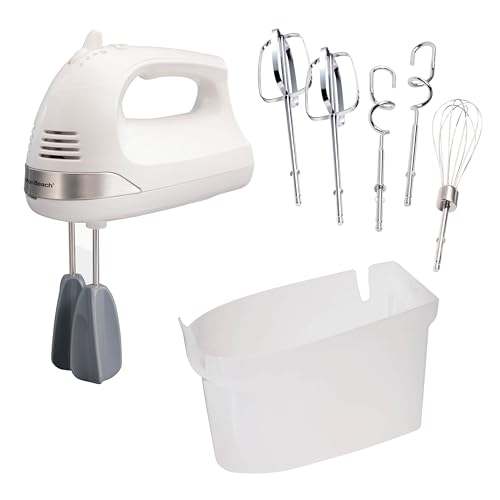
Hamilton Beach 6-Speed Electric Hand Mixer with Easy Clean Beaters
Badge: Best for Longer Sessions
Strengths
- 275 watt motor — the strongest published power figure in this guide — for sustained blending without strain.
- Easy Clean beaters are designed to release residue fast, which powder cling makes genuinely valuable.
- Snap-on storage case plus a full attachment set: traditional beaters, dough hooks, and whisk.
Trade-offs
- More motor invites more enthusiasm; powder discipline (low speeds) must come from the operator.
- 6 speeds sit between the 5-speed and 9-speed picks for low-end granularity.
- The white finish will show coloured pigment dust between wipe-downs.
Mini spec box
- Type: Electric hand mixer
- Speeds: 6
- Motor: 275 watt
- Included: Traditional beaters, dough hooks, whisk, snap-on storage case
- Feature: Easy Clean beaters
- Model: 62636J
Long pressing sessions change what a mixer needs to be. Batch after batch, the work is not hard in any single moment, but it is continuous — and the Hamilton Beach is built like the session tool: the strongest published motor in this guide at 275 watts, a snap-on case keeping the full attachment set together, and beaters explicitly designed for easy cleaning, which anyone who has scrubbed dried binder-powder paste out of standard beaters will recognise as a headline feature rather than a footnote. The whisk earns its keep in the final blending stage, folding the last additions through a nearly finished batch without compacting it.
Its discipline requirement is the mirror of its strength: a powerful motor at careless speeds will happily redecorate your workspace with your most expensive pigment. Work at the bottom of its 6-speed range, bury the beaters before starting, and the power becomes pure headroom — the motor never strains, never heats, never fades across a long day. For the maker whose pressing is a weekly production rhythm rather than an occasional experiment, this is the workhorse pick.
Best for: Regular producers running long, multi-batch sessions / Not suited for: Beginners whose speed discipline is still forming

Cuisinart 9-Speed Hand Mixer with Storage Case, HM-90BCS
Badge: Best for Fine Control
Strengths
- 220 W motor with SmoothStart anti-splatter technology — power and a gentle start in one machine.
- 9 speeds slice the low working band finer than any other pick here.
- 6-piece set in a snap-on storage case, in brushed chrome that shrugs off workshop life.
Trade-offs
- Sits in a higher tier than the budget picks — the control is what you are paying for.
- Brushed chrome shows fingerprints and smears, if cosmetics of the tool itself matter to you.
- Like its HM-90S sibling, it rewards a methodical operator over a hurried one.
Mini spec box
- Type: Electric hand mixer
- Speeds: 9
- Motor: 220 W with SmoothStart anti-splatter technology
- Set: 6-piece, snap-on storage case
- Finish: Brushed chrome
- Model: HM-90BCS
The HM-90BCS is the connoisseur’s version of the Best Overall pick: the same 9-speed, SmoothStart philosophy, with a published 220 W motor behind it and a brushed chrome body that suits a workshop aesthetic. For pressing, its case is precision work — formulas where a shade is built from several pigments added in sequence, where binder is introduced in small increments, where the difference between speed one and speed two is the difference between folding and lifting. The 6-piece set covers the attachment range those staged processes need, and the case keeps the whole system quarantined and clean between sessions.
Choosing between the two Cuisinarts is the pleasant problem of this guide: the HM-90S leads on its all-round balance, the HM-90BCS answers with a stated motor figure and the chrome finish. Neither is a wrong answer for powder work, and the guide’s ordering reflects overall value rather than capability — on pure control, this machine is the equal of the top pick and the superior of everything else here. If your formulas are exacting and your sessions are staged, this is your mixer.
Best for: Precision formulators running staged, multi-pigment blends / Not suited for: Budget-first buyers, for whom the HM-90S covers the same technique

Proctor Silex Easy Mix 5-Speed Hand Mixer
Badge: Best Budget Pick
Strengths
- Compact and lightweight — easy to manoeuvre around a bowl for long, gentle blending.
- Bowl rest lets you park the mixer on the bowl’s edge mid-session without dusting the bench.
- 215 watts of peak power is ample for dry powder blending, which never needs real force.
Trade-offs
- No slow-start feature and 5 speeds — starting technique is entirely on you.
- No storage case; a dedicated craft drawer or box is up to you.
- The lightest-duty build here; treat it as a dedicated powder tool, not a household workhorse.
Mini spec box
- Type: Electric hand mixer
- Speeds: 5
- Power: 215 watts of peak power
- Features: Bowl rest, compact and lightweight
- Finish: Black
- Model: 62511
The Proctor Silex earns its badge through a piece of pressing logic the other picks cannot match: dedication economics. The hygiene rule of this craft — a powder mixer never returns to food — means many makers need a second mixer bought solely for the craft bench, and at that point the budget pick stops being a compromise and becomes the strategy. The Easy Mix is light in the hand across a long blending session, its bowl rest keeps a powder-dusted machine perched on the bowl rather than the bench, and its 215 watts of peak power are honestly sufficient because dry powder blending is a finesse task, not a force task. As a product class it sits in the lower-cost tier of hand mixers, which is precisely what a dedicated tool should do.
Its limits are the expected ones: no slow-start assistance, coarser speed steps, no case. All three are manageable with the buried-beater start and a storage box of your own. What it cannot survive is being asked to be two tools — craft mixer on Saturday, cake mixer on Sunday — because the hygiene rule forbids the double life. Bought as a dedicated powder mixer and used with technique, it is the smartest money in this guide.
Best for: Makers who need a dedicated, craft-only mixer at the lowest commitment / Not suited for: Anyone planning to share one mixer between craft and kitchen
Comparison Table
| Pick | Speeds | Slow-start / control feature | Workflow extra | Link |
|---|---|---|---|---|
| Cuisinart HM-90S | 9 | SmoothStart anti-splatter | Snap-on storage case | Check on Amazon |
| WEPSEN Bowls Set | 5 | Standard start | 4 nesting bowls + measuring set | Check on Amazon |
| KitchenAid KHM512 | 5 | Standard start | Lockable swivel cord; dishwasher-safe beaters | Check on Amazon |
| Hamilton Beach 62636J | 6 | Standard start | Easy Clean beaters; case; whisk + hooks | Check on Amazon |
| Cuisinart HM-90BCS | 9 | SmoothStart anti-splatter | 6-piece set in case; brushed chrome | Check on Amazon |
| Proctor Silex Easy Mix | 5 | Standard start | Bowl rest; lightest body | Check on Amazon |
How to Choose a Mixer for Pressing Powders
Prioritise the start, not the top speed. Powder work is decided in the first two seconds and conducted in the lowest third of the dial. A slow-start feature like SmoothStart, or failing that a genuinely slow first speed, is worth more than any specification at the top of the range. When comparing any two mixers for this work, compare their behaviour at speed one — that is the only speed comparison that predicts your experience.
Count speeds in the low band. A 9-speed machine divides the gentle range finely; a 5-speed machine steps through it coarsely. If your formulas are simple one-powder blends, coarse steps are fine. If you stage pigments and binder in increments, the fine steps of the 9-speed picks repay their tier difference in control you will use every session.
Plan the quarantine system before the mixer arrives. Craft powder tools and food tools must live separate lives. A snap-on storage case (Cuisinart, Hamilton Beach) is a quarantine system in a box; without one, dedicate a labelled container. Decide where the craft mixer lives, which bowls are craft bowls — the WEPSEN set makes this effortless — and never let the systems blur mid-session.
Match the machine to your session shape. Occasional single batches: any pick here, with the budget Proctor Silex as the rational dedicated tool. Regular multi-batch days: the Hamilton Beach’s motor and easy-clean beaters, or the WEPSEN’s bowl fleet. Precision formulation work: the 9-speed Cuisinarts. The wrong match is rarely a bad mixer — it is a good mixer bought for a different session shape, the same category of error this site’s guides exist to prevent in every field from Best Mixers For Pro Tools audio rigs to pressing benches.
Respect the scale boundary. Hand mixers are the right tool at craft scale — batches you can watch, sweep, and judge by eye. When a formula’s batch outgrows a large mixing bowl, the honest answer is dedicated powder-blending equipment, not a bigger hand mixer run longer. Recognising that boundary protects both your product and your tools.
How to Blend Powders for Pressing, Step by Step
Step 1 — Set up for dust discipline. Dust mask on, ventilation on, deep bowl chosen, ingredients weighed and staged in order. Lay out only what this batch needs; powder work punishes clutter because everything within reach becomes a surface to clean.
Step 2 — Combine the dry base at the lowest speed. Bury the beaters in the powder before switching on — this single habit prevents most dust events. Run at speed one, sweeping slowly around the bowl’s walls and base where unmixed pockets hide, until the base is one uniform colour and texture.
Step 3 — Add pigments and actives in stages. Add each colour or functional ingredient in two or three portions rather than one, mixing fully at low speed between portions. Staging is how a strong pigment disperses evenly instead of surviving as concentrated specks that streak the pressed pan.
Step 4 — Sift or rest if the blend fights you. If the mixture clumps or resists uniformity, stop the mixer and pass the blend through a fine sieve, then give it a final gentle mix. The sieve is not a failure; it is a standard stage in powder making, and the mixer’s job resumes after it.
Step 5 — Introduce binder gradually. Add liquid binder in the smallest increments your formula allows, mixing at the lowest speed after each addition until the powder reaches an even, just-cohesive consistency — uniformly damp-looking, never wet in patches. Evenness at this stage is the pressed product’s strength and finish.
Step 6 — Rest, then press. Let the finished blend rest briefly so binder distributes by capillary action, give it one last gentle stir, and press. Clean the mixer and beaters immediately — dried binder-powder residue hardens into the hardest cleaning job in the craft.
Troubleshooting
Problem: A cloud of powder erupts at startup → The beaters were not buried, or the start was too fast. Always start with beaters submerged in the powder at the lowest speed; a slow-start model like the Cuisinarts forgives, but technique is the real fix.
Problem: The pressed product shows streaks or specks of colour → A pigment was added in one portion or under-mixed. Re-blend the batch with staged additions and a sieve pass; prevention is adding strong pigments in two or three portions, fully dispersed between each.
Problem: The blend has wet clumps after binder → Binder went in too fast. Break the clumps through a sieve, re-blend gently, and next time halve the increment size. Clumps pressed into a pan become hard spots that crack — they cannot be pressed away.
Hygiene and Safety Rules That Are Not Optional
Powder pressing sits closer to manufacturing than to baking, and its rules deserve manufacturing respect. First, the separation rule, stated once more because it is the rule: tools that touch cosmetic or craft powders — mixer, beaters, bowls, spoons — never touch food again, and kitchen tools never migrate to the craft bench. Pigments and functional ingredients are not food, and food tools carry residues a cosmetic product must not inherit. Second, respiratory sense: fine powders are airborne by nature, so a dust mask and ventilation are standard equipment, not caution theatre — the same respect for airborne material that any workshop discipline, from the studio setups in Best Mixers For Radio Stations to a pressing bench, applies to its own hazards. Third, ingredient discipline: work from written formulas with weighed ingredients, label every batch with its formula and date, and keep craft materials stored as craft materials, clearly marked, away from the pantry. Fourth, skin and surface sense: gloves for strong pigments, a bench covering you can discard or wash, and immediate cleanup — powder migrates, and the time to contain it is the session, not the weekend. None of this is bureaucracy; it is what separates a maker’s practice from a hobbyist’s lucky streak, and it is the foundation a small product line is built on.
How Different Powders Behave Under the Beaters
Not all powders ask the same thing of a mixer, and a presser who works across types learns to read the material before choosing the pace. Fine, soft cosmetic bases — the talc- and mica-style blends of pressed face and eye products — are the most escape-prone: they aerosolise at the slightest provocation, reward the slowest starts, and punish a lifted beater with a visible plume. Pigment-heavy blends behave oppositely in one respect: the colourants are dense and prone to surviving as specks, so they need the staged additions and full dispersion time described earlier, at the same low speeds. Bath and body powders, often built on starches and clays with fragrance distributed through them, sit between the two — less flighty than cosmetic bases, but the fragrance component must be distributed as evenly as any pigment or the finished product varies from scoop to scoop. Dry blends for pressing into pucks and tablets — herbal, mineral, or household formulas — tend to be the most forgiving: coarser particles, less flight, and a blend you can judge confidently by eye. The mixer’s settings follow the material, not the clock: the flightier the powder, the lower the working speed and the deeper the bowl; the denser the pigment load, the longer the staged blending. This material-first thinking is the same discipline other precision fields apply to their own medium — the gain decisions in Best Mixers For Pro Tools 11 setups, for instance, are likewise dictated by the signal, not the schedule — and it is what separates a formulator from a person merely stirring.
From Blend to Press: Making the Hand-Off Clean
The best blend in the world can be ruined in the thirty seconds between bowl and press, so the hand-off deserves the same deliberation as the mixing. Work over a tray or sheet that catches stray powder — what falls is often recoverable if the surface is clean and dedicated. Transfer with a scoop or spoon rather than tipping the bowl, because tipping avalanches the blend and can segregate particles by size as they slide — the fine fraction runs ahead, the coarse fraction lags, and the uniformity you just built quietly unbuilds itself at the last moment. Fill the press mould or pan evenly, in the manner your pressing method requires, and check the first pressed unit critically before committing the batch: colour evenness, surface integrity, and edge behaviour in that first unit are a report on the blend itself. If the first unit streaks, the answer is back in the bowl, not in more pressure. Keep notes as you go — formula, increments, speeds, pressing observations — because the batch you cannot reproduce is a prototype, not a product. Makers who treat the hand-off as part of the process produce consistent pans; makers who treat it as an afterthought chase inconsistencies that were born in the transfer, not the mixing. It is the same lesson this site’s guides teach in every category the word “mixer” touches, from the bar shelf surveyed in Best Mixers For Prosecco entertaining to the studio desk: the transitions are part of the craft.
Storing Powders, Tools, and Work in Progress
A pressing practice accumulates materials, and storage is where good hygiene either survives between sessions or quietly collapses. Raw powders belong in sealed, labelled containers — ingredient, supplier or source, and date — stored dry and away from both the pantry and the bathroom cabinet, the two places craft materials most often wander into trouble. Blends in progress should be labelled with the same rigour as finished products: formula name, stage reached, and date, because an unlabelled bowl of beige powder is a mystery no one can solve a week later, and mysteries get thrown away or, worse, guessed at. Tools store with their system: the mixer’s case or dedicated box, beaters clean and dry inside it, bowls nested with the craft set rather than the kitchen stack. Finished pressed products cure and store best in the same dry, sealed discipline, away from humidity that powders absorb eagerly. Finally, keep a simple session log — paper is fine — recording what was made, from which formula revision, with which observations. Storage sounds like housekeeping, but in powder work it is actually inventory control, contamination control, and reproducibility control wearing one apron. The maker who can reach, mid-session, for a labelled container and a clean, dedicated beater without thinking is the maker whose process has matured — and whose next purchasing decision, when it comes, will be about capacity and ambition rather than replacing what chaos consumed.
Common Buying Mistakes
- Shopping by top speed or wattage. Powder blending needs neither. The start and the low band are the whole specification.
- Planning to share the mixer with the kitchen. The hygiene rule forbids it. Buy a dedicated craft mixer — the budget pick exists for exactly this.
- Adding binder all at once. The most common batch-killer in pressing. Increments, always.
- Using a shallow bowl. Depth is dust control. A deep bowl and buried beaters prevent the cloud that coats the room.
- Skipping the mask because the batch is small. Fine powder does not scale its behaviour to your batch size. Mask and ventilation, every session.
- Judging the blend by the top layer. Unmixed pockets hide at the walls and base. Sweep the whole bowl before you call it blended.
Final Recommendation
For most pressers, the Cuisinart HM-90S is the right first purchase: its SmoothStart behaviour and 9-speed low-end control are the exact virtues powder work rewards, and its case keeps the craft system quarantined. Batch producers should look at the WEPSEN bowls set for workflow or the Hamilton Beach for session endurance, precision formulators at the Cuisinart HM-90BCS, and anyone equipping a dedicated craft bench on a budget at the Proctor Silex. Whichever you choose, bury the beaters, start slow, add binder in increments, and keep the craft tools craft-only — technique and hygiene will do more for your pressed powders than any single specification. Set up the bench the same way every session, weigh rather than guess, label everything you make, and let the blend — uniform, calm, and fully dispersed — be the thing your press is remembered for.
Frequently Asked Questions
Why use a hand mixer for pressing powders instead of a stand mixer?
Because pressing batches are small and demand constant supervision. A hand mixer lets you sweep the bowl’s corners, feel resistance changes through your hand, and stop instantly — control that matters when the material is dry, light, and prone to escaping. A stand mixer suits larger, wetter doughs and batters; for a few hundred grams of powder, it is oversized, harder to monitor, and its fixed beater path leaves the bowl’s edges — where unmixed pockets hide — unvisited.
What speed should I use for blending powders?
The lowest speeds, almost exclusively. Powder blending happens at the bottom of the dial: fast enough to turn the material over, slow enough to keep it in the bowl and out of the air. This is why speed count in the low band matters — a 9-speed machine offers finer gradations where you work than a 5-speed one. If powder is lifting into a visible cloud, the speed is too high, whatever the number says.
Can I use my kitchen hand mixer for cosmetic powders?
No — not if it will ever touch food again. The separation rule is absolute in this craft: cosmetic pigments and ingredients are not food-safe, and a mixer that has blended them cannot be reliably returned to food service. The practical solution is a dedicated craft mixer, which is why this guide includes a budget pick bought solely for the bench. The same rule protects the other direction: food residues have no place in a cosmetic batch.
How do I stop powder from going everywhere?
Four habits, in order of impact: bury the beaters in the powder before switching on; start at the lowest speed (a slow-start feature like SmoothStart helps further); use a deep bowl so the working material sits well below the rim; and add ingredients in portions rather than dumping them, since each addition is a fresh dust risk. Together these turn a notoriously messy process into a tidy one — and a tidy process is not a cosmetic preference, because powder that stays in the bowl is powder that ends up in the product, at the ratios the formula intended.
Why does my pressed powder crack or have hard spots?
Almost always a blending problem upstream: binder added too quickly creates wet clumps that press into hard, brittle inclusions, while under-mixed regions lack cohesion and crumble. The fix is process, not pressure — binder in small increments, mixed fully at low speed between additions, with a sieve pass if clumps appear. A uniform blend presses into a uniform pan; no press can repair an uneven mixture.
Do I need a mask for small batches?
Yes. Fine powders become airborne in proportion to their fineness, not your batch size, and a pressing session involves repeated starts, additions, and sieve passes — each one a small dust event. A basic dust mask and ordinary ventilation are cheap, standard practice in every powder craft, and they also keep your finished product cleaner by keeping the workspace air clearer.
When should I move beyond a hand mixer for powder work?
When your batches consistently outgrow a large mixing bowl, or when production volume turns blending into the bottleneck of your day. At that point the category changes to dedicated powder-blending equipment designed for dry material at scale. Until then, a hand mixer with good low-speed control is not a starter compromise — it is the appropriate tool, which is why this guide grades these six on craft criteria rather than apologising for their size. Many established small makers still run hand mixers for development batches even after adding larger equipment for production, because the hands-on control that suits a new formula never stops being useful — the tool scales down gracefully in a way industrial equipment never scales up.


