Disclosure: topratedkitchenware.com is reader-supported. When you buy through links on our site, we may earn an affiliate commission from Amazon and other retailers, at no extra cost to you.
Where to buy
Yes, we know — but the best mmeat smokers search still deserves a straight answer, and the six machines below are it: two electric cabinets and four pellet grills, each verified against its listing. Every pick links to Amazon so you can check the latest price on Amazon before you buy.
- EAST OAK 30-Inch Electric Smoker with Mobility Stand (Polar Night) — Check on Amazon
- Royal Gourmet SE2805 28-Inch Electric Smoker
- Traeger Pro 22 Wood Pellet Grill and Smoker
- Pit Boss 700 Carbon Series Pellet Grill and Smoker
- Pit Boss 500 Carbon Series Pellet Grill and Smoker
- Pit Boss 850 Navigator Series Pellet Grill and Smoker
Read the full guide ↓
The best mmeat smokers is a typo — an extra ‘m’ that search engines forgive and this guide answers without teasing: you are looking for the best meat smokers, and the six machines below are a straight, verified shortlist. Two are vertical electric cabinets (an EAST OAK with probe and stand, and a compact Royal Gourmet) and four are pellet grills from Traeger and Pit Boss spanning 543 to 932 square inches. If your typing is usually more precise, the budget-framed variant at Best Mudget Smokers covers neighboring ground.
Meat smoking rewards two things above all: steady low heat and time. Every pick here automates the first so you can supply the second. The cabinets hold low temperatures on an element and a handful of chips, stacking ribs, shoulders, and chickens on racks. The pellet grills feed their own fire from a hopper, cook on one wide level, and double as grills and ovens when the smoking is done. Between them is every realistic home brief, from a balcony brisket to a holiday spread.
Each review below covers what the machine is, who it suits, and where it honestly falls short, with specifications taken only from verified listing data. The buying guide then turns the cabinet-versus-pellet question into a decision, and the how-to section covers running a long session on either format — because the best smoker is the one whose routine you will actually keep.
Key Takeaways
- ‘Mmeat’ is a typo for meat — the shortlist is six verified meat smokers: two electric cabinets, four pellet grills.
- Cabinets (454–725 sq in stacked) are the economical, dedicated smoking tools.
- Pellet grills (543–932 sq in single-level) add grilling, roasting, and baking to smoking.
- Every pick manages its own temperature; most include a meat probe.
- The Pit Boss 850 (932 sq in, 30 lb hopper) is the big-batch ceiling of the list.
In this guide
Quick Picks
| Pick | Badge | Cooking space | Link |
|---|---|---|---|
| EAST OAK 30-Inch Electric Smoker with Mobility Stand (Polar Night) | Best Cabinet | 725 sq in cooking area | Check on Amazon |
| Royal Gourmet SE2805 28-Inch Electric Smoker | Best Compact | 454 sq in cooking area | Check on Amazon |
| Traeger Pro 22 Wood Pellet Grill and Smoker | Most Versatile | 572 sq in cooking space | Check on Amazon |
| Pit Boss 700 Carbon Series Pellet Grill and Smoker | Best Mid-Size Pellet | 718 sq in cooking space | Check on Amazon |
| Pit Boss 500 Carbon Series Pellet Grill and Smoker | Best Compact Pellet | 543 sq in cooking space | Check on Amazon |
| Pit Boss 850 Navigator Series Pellet Grill and Smoker | Best for Big Batches | 932 sq in cooking space | Check on Amazon |
How These Picks Were Chosen
Every pick in this guide was cross-checked against the manufacturer’s listing data before it was written up: the model name, fuel type, cooking area, and control style in this article come from that verified listing information, not from memory or from third-party roundups. Where a listing states a figure — a cooking area, a wattage, a hopper size — that is the figure used in the spec boxes, and where a listing does not state something, this guide leaves it out rather than guessing.
The shortlist was built by comparing the attributes that actually change a smoking session: how fuel and smoke are delivered, how temperature is controlled, how much food fits in a realistic load, and how the cook is monitored. Models that duplicated another pick’s exact formula without adding anything were cut. This is a research-led guide: the judgments come from verified specifications, design analysis, and the accumulated pattern of owner experience with each format, not from a single weekend of hands-on testing, and the trade-offs sections say plainly where each machine is weak.
Best Mmeat Smokers: The 6 Picks in Detail
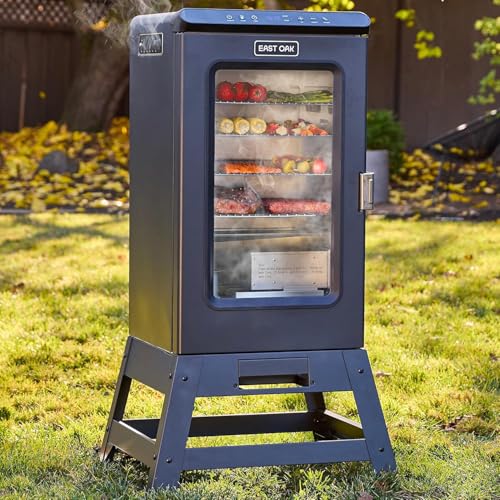
EAST OAK 30″ Outdoor Electric Smoker with Meat Probe and Mobility Stand
Badge: Best Cabinet
Strengths
- Mobility stand raises the cabinet to a comfortable working height
- Built-in meat probe covers doneness without extra equipment
- Side loader keeps the door shut during long sessions
Trade-offs
- Stand adds footprint compared with a countertop-height setup
- Vertical cabinet still limits the widest cuts
- Probe is a single point of measurement on multi-cut loads
Key specs (from the verified listing):
- 30-inch vertical electric cabinet
- 725 sq in cooking area
- Built-in meat probe
- Mobility stand included
- Side wood chip loader (up to 6x longer uninterrupted smoke, per maker)
- Color: Polar Night
This Polar Night EAST OAK variant adds one ergonomic idea to the familiar formula: a mobility stand. A 30-inch vertical smoker sits low, and loading the bottom racks of a ground-level cabinet means crouching with a hot tray. Raising the cabinet on its stand puts the door, racks, and controls at a friendlier height, and it makes rolling the unit between its cooking spot and its storage spot simpler. For older cooks, or anyone with a bad back, that is not a cosmetic extra.
Underneath the stand, the cooking package is the strong EAST OAK combination: 725 square inches of rack space, a side chip loader that keeps smoke sessions running up to six times longer per load without door openings, and a built-in meat probe so internal temperature — the only doneness signal that matters — is always on the display. The cabinet format still shapes what you cook: stacked racks love ribs, wings, sausage, and chicken pieces, while the widest cuts need trimming or creative placement. A single probe also means one cut gets monitored continuously and the rest get spot-checked, which is normal for the class but worth planning around on mixed loads.
For meat in its classic cabinet forms — ribs, shoulder, chicken — its probe, stand, and side loader make it the most comfortable cabinet here.
Best for: cooks who value working height, mobility, and probe feedback in one cabinet / Not suited for: tight patios where the stand’s extra footprint is a problem

Royal Gourmet SE2805 28-Inch Electric Smoker
Badge: Best Compact
Strengths
- Compact 28-inch size fits smaller patios and balconies
- 1350W element is strong for the cabinet size
- Three grates still allow stacked, multi-item cooks
Trade-offs
- 454 sq in is the smallest cooking area in this guide
- Analog control means manual temperature management
- Fewer racks limit very large batch cooking
Key specs (from the verified listing):
- 28-inch vertical electric smoker
- 454 sq in cooking area
- 1350W heating element
- Analog temperature control
- 3 cooking grates
- Adjustable heat
- Color: Black
The Royal Gourmet SE2805 is the compact option in this lineup: a 28-inch vertical electric smoker with 454 square inches across three cooking grates and a 1350W element. That wattage matters in a small cabinet — a strong element in a modest volume recovers temperature quickly after the door opens, which is exactly when small smokers usually struggle. For apartment patios, small decks, and households cooking for two to four people, the size is the point rather than a compromise.
Controls are analog with adjustable heat, so running it is a dial-and-patience exercise: set, let it settle, and check with your own thermometer at the moments that matter. Three grates still allow genuinely stacked cooking — a small shoulder up top, ribs in the middle, vegetables below — you simply plan portions around the cabinet instead of filling it by instinct. The limitation is obvious and honest: this is not the smoker for a twenty-person barbecue or a pile of full packer briskets. It is a right-sized tool for regular small-batch smoking, and in that role the quick recovery and small footprint are real advantages rather than consolations.
Small-batch meat smoking is its brief: a shoulder or a few racks of ribs in a 28-inch footprint that fits where bigger machines cannot.
Best for: small patios and small households that smoke modest batches often / Not suited for: hosts who regularly cook for large groups

Traeger Pro 22 Wood Pellet Grill & Smoker
Badge: Most Versatile
Strengths
- One machine grills, smokes, bakes, and roasts — replaces two appliances
- 18 lb hopper supports long cooks between refills
- 450°F top end handles roasting and grilling, not just low-and-slow
Trade-offs
- Pellet fuel costs more to run than electric chips
- Horizontal format takes more patio width than a vertical cabinet
- Smoke flavor is milder than a dedicated chip-burning cabinet for some tastes
Key specs (from the verified listing):
- Wood pellet grill and smoker
- 572 sq in cooking space
- 6-in-1 versatility: grill, smoke, bake, roast, braise, BBQ
- Built-in meat probe
- 450°F maximum temperature
- 18 lb pellet hopper
The Traeger Pro 22 comes at smoking from the opposite direction of the vertical cabinets: it is a wood pellet grill first, with 572 square inches of single-level cooking space, a 450°F maximum temperature, and 6-in-1 versatility spanning grilling, smoking, baking, roasting, braising, and barbecue. That breadth changes the buying math. A cabinet smoker only smokes; this machine can smoke a brisket on Saturday and grill burgers on Tuesday, which is why pellet grills have become the default one-machine answer for many patios.
For smoking specifically, the pellet system feeds fuel automatically from an 18 lb hopper, so long cooks need hopper checks rather than chip reloads, and the built-in meat probe covers doneness. The single-level grate is the format advantage: wide cuts lie flat with room around them, and there is no rack-stacking Tetris. The trade-offs are running cost and character. Pellets cost more per cook than a handful of wood chips in an electric cabinet, the machine’s footprint is wider, and pellet smoke is a cleaner, milder smoke than a chip cabinet produces — some traditionalists find it less assertive on brisket. If you want one appliance that does everything well, it earns its place; if you want a dedicated smoke box, the cabinets are purer tools.
Meat beyond smoking is its argument — the same machine that smokes a brisket grills the burgers while it rests.
Best for: one-machine patios that grill as often as they smoke / Not suited for: purists who want a dedicated, chip-burning smoke cabinet

Pit Boss 700 Carbon Series Wood Pellet Grill & Smoker
Badge: Best Mid-Size Pellet
Strengths
- 718 sq in of single-level space fits wide cuts easily
- Wide 180–500°F range covers smoking through searing-range heat
- LCD controller and probe give clear session information
Trade-offs
- 13.5 lb hopper is smaller than some rivals, so very long cooks need a refill
- Pellet running costs exceed electric chip costs
- Horizontal footprint is larger than a vertical cabinet
Key specs (from the verified listing):
- Wood pellet grill and smoker
- 718 sq in cooking space
- LCD digital controller
- 180°F to 500°F temperature range
- Built-in meat probe
- 13.5 lb pellet hopper
- Color: Black
The Pit Boss 700 Carbon Series offers 718 square inches of single-level pellet cooking with an LCD digital controller, a 180°F to 500°F temperature range, and a built-in meat probe. The temperature range is the spec to notice: the low end sits in classic smoking territory, while the high end reaches heat that many pellet units cannot, which widens the machine from low-and-slow specialist toward genuine all-purpose cooker. The 718 square inches lie on one level, so briskets, spatchcocked birds, and multiple racks of ribs spread out flat with airflow around them.
Day to day, the LCD controller keeps the session legible — set temperature, actual temperature, probe temperature — and the pellet auger does the fuel work that chip cabinets ask you to do by hand. The hopper holds 13.5 lb, which covers most cooks but means an overnight session deserves a top-up check before bed. Running costs follow the pellet pattern: more per cook than electric chips, in exchange for automation and versatility. Compared with the cabinets in this guide, it is wider, heavier, and more versatile; compared with other pellet grills, its cooking area and temperature ceiling are its calling cards.
Its 718 sq in of flat space is brisket geometry: full packers lie flat with room for a water pan beside them.
Best for: pellet shoppers who want generous single-level space and a wide temperature range / Not suited for: small patios or buyers minimizing per-cook fuel cost

Pit Boss 500 Carbon Series Wood Pellet Grill & Smoker
Badge: Best Compact Pellet
Strengths
- Full pellet automation in a more compact footprint
- 180–500°F range covers smoking to high-heat cooking
- Probe and LCD controller included, not reserved for bigger models
Trade-offs
- 543 sq in is the smallest pellet cooking area here
- 13.5 lb hopper still needs checking on the longest cooks
- Single-level space fills up fast with mixed loads
Key specs (from the verified listing):
- Wood pellet grill and smoker
- 543 sq in cooking space
- LCD digital controller
- 180°F to 500°F temperature range
- Built-in meat probe
- 13.5 lb pellet hopper
- Color: Black
The Pit Boss 500 Carbon Series is the compact pellet option: 543 square inches of cooking space with the same LCD digital controller, 180°F to 500°F temperature range, built-in meat probe, and 13.5 lb hopper as its 700-series sibling. That shared control package is the point — stepping down in size does not mean stepping down in automation. The auger still feeds pellets, the controller still holds the set temperature, and the probe still reports doneness; you are simply cooking on a smaller single-level grate.
Who does 543 square inches fit? Households that smoke one brisket, a couple of chickens, or a few racks of ribs at a time — which is most households, most of the time. The wide temperature range keeps weeknight grilling in play, so the machine earns its patio space between smoking weekends. The limits show up at parties: a mixed load of brisket, ribs, and sides will not fit at once, and the hopper deserves a check before an overnight cook. As an entry into pellet cooking that does not ask for a big patio or a big footprint, it is a sensibly complete package.
Compact pellet meat smoking — one brisket, a couple of chickens, weeknight grilling — in the smallest pellet footprint here.
Best for: smaller households wanting full pellet automation in a compact machine / Not suited for: hosts who cook several large cuts at the same time

Pit Boss 850 Navigator Series WiFi Pellet Grill & Smoker
Badge: Best for Big Batches
Strengths
- 932 sq in is the largest cooking space in this guide
- 30 lb hopper is built for the longest unattended cooks
- WiFi/Bluetooth plus Flame Broiler add monitoring and searing range
Trade-offs
- Largest footprint and heaviest presence on the patio
- Most features to learn and maintain
- Premium-tier positioning in the pellet category
Key specs (from the verified listing):
- Wood pellet grill and smoker
- 932 sq in cooking space
- WiFi and Bluetooth connectivity
- Flame Broiler for direct-flame searing
- LCD digital controller
- 180°F to 500°F temperature range
- Built-in meat probe
- 30 lb pellet hopper
The Pit Boss 850 Navigator is the maximalist of this guide: 932 square inches of cooking space, a 30 lb pellet hopper, WiFi and Bluetooth connectivity, an LCD controller, a 180°F to 500°F range, and a Flame Broiler that opens a direct-flame searing zone most pellet grills lack. Every one of those specs answers a known pellet-grill complaint — not enough space, not enough hopper, no remote monitoring, no real sear — which makes it the machine for cooks who have hit the limits of a smaller grill and know exactly which limits they were.
For smoking, the combination of space and hopper is the story: multiple briskets or a party-sized spread of ribs lie flat on one level, and 30 lb of pellets removes refueling from the overnight equation. Connectivity lets you follow the cook from indoors. The costs are size and commitment. This is a large, heavy appliance that dominates a small patio, its feature set takes an evening to learn properly, and it sits at a premium tier of the category. Buyers who cook big and often will use everything it offers; buyers who smoke a chicken twice a month will not.
When the meat order is plural — multiple briskets, a party of ribs — its 932 sq in and 30 lb hopper are the answer in this list.
Best for: big-batch cooks who want maximum space, hopper capacity, and connectivity / Not suited for: small patios or occasional smokers
Comparison Table
| Pick | Format | Cooking area | Standout feature | Link |
|---|---|---|---|---|
| EAST OAK 30-Inch Electric Smoker with Mobility Stand (Polar Night) | Electric vertical cabinet | 725 sq in cooking area | Built-in meat probe | Check on Amazon |
| Royal Gourmet SE2805 28-Inch Electric Smoker | Electric vertical cabinet | 454 sq in cooking area | 1350W heating element | Check on Amazon |
| Traeger Pro 22 Wood Pellet Grill and Smoker | Wood pellet grill & smoker | 572 sq in cooking space | 6-in-1 versatility: grill, smoke, bake, roast, braise, BBQ | Check on Amazon |
| Pit Boss 700 Carbon Series Pellet Grill and Smoker | Wood pellet grill & smoker | 718 sq in cooking space | LCD digital controller | Check on Amazon |
| Pit Boss 500 Carbon Series Pellet Grill and Smoker | Wood pellet grill & smoker | 543 sq in cooking space | LCD digital controller | Check on Amazon |
| Pit Boss 850 Navigator Series Pellet Grill and Smoker | Wood pellet grill & smoker | 932 sq in cooking space | WiFi and Bluetooth connectivity | Check on Amazon |
How to Choose Between Cabinet Smokers and Pellet Grills
The first decision is format, because format decides what cooking feels like. A vertical electric cabinet is a dedicated smoke box: food stacks on racks, wood chips smolder over an element, and the machine does one job with minimal fuss and low running cost. A pellet grill is a horizontal, automated wood-fired oven: it smokes, grills, roasts, and bakes on a single-level grate, feeds its own fuel, and asks more patio space and more money per cook in pellets.
Capacity reads differently across the formats. Cabinet figures — 454 to 725 square inches in this guide — are totals across stacked racks, which suit many medium items. Pellet figures — 543 to 932 square inches — are single-level, which suit wide cuts like full briskets and spatchcocked birds. Compare your biggest realistic load, not the headline number: a turkey or a full packer brisket cares about the largest single surface and the height above it, not the summed total.
Temperature control is the second filter. Electric cabinets specialize in the low-and-slow band and hold it cheaply and steadily. Pellet grills span a wider range — the models here run from 180°F up to 450 or 500°F — which is why they can grill on weeknights and smoke on weekends. If you will genuinely grill as often as you smoke, that range matters; if you will not, a cabinet’s focus is a virtue.
Last, count the ongoing costs in effort. Cabinets need chips, water-pan refills, and rack washing. Pellet grills need pellet storage, ash vacuuming, and auger care. Neither is onerous, but the right choice is the routine you will actually keep up, because a smoker that is annoying to maintain becomes patio furniture by August.
How to Run a Long Smoke Session, Whatever You Cook On
- Start with the fuel system. On an electric cabinet, load dry chips and fill the water pan. On a pellet grill, check the hopper level and make sure the fire pot is clean enough for reliable ignition.
- Preheat and stabilize. Bring the cooker to your target temperature and let it sit there for 20 to 30 minutes. Metal mass is a temperature battery; a stabilized cooker shrugs off the cold mass of the food far better.
- Season and load. Pat meat dry, season evenly, and load with space between pieces. Crowded food steams instead of smoking, and bark suffers.
- Place the probe correctly. Center of the thickest muscle, away from bone and fat pockets. On mixed loads, probe the cut that will finish last and spot-check the rest.
- Manage by exception. Good smoking is mostly leaving the cooker closed. Refill chips through the loader or check the hopper at planned intervals instead of peeking hourly.
- Finish, wrap, and rest deliberately. Many cooks wrap brisket or shoulder once the bark is set, then rest the meat at least 30 minutes before slicing against the grain.
After the cook, the routine is short but non-negotiable: empty ash and chip residue, scrape grates or wash racks, empty drip trays before they become a science project, and store fuel dry — pellets that absorb moisture swell and jam augers, and damp chips smoke poorly. A covered, dry storage spot extends the life of electronics, elements, and finishes alike.
Troubleshooting
Problem: temperature swings widely → check for wind exposure, a nearly empty hopper or chip tray, and a door or lid that is being opened too often; stabilize fuel and shelter the cooker first.
Problem: bark stays pale and soft → the surface was wet or the load was crowded; pat meat dry, space pieces apart, and give the bark time at temperature before wrapping.
Problem: pellet auger stops feeding → moisture-swollen pellets are the usual cause; empty the hopper, clear the jam, and refill with dry pellets stored indoors.
A Quick Note on the Name, Then Straight to the Meat
Search typos are more honest than most queries: ‘mmeat’ tells us exactly what the searcher wants — meat, smoked, at home — with one finger’s slip on the keyboard. Guides that punish the typo with a thin or mocking page waste the visit. So this guide simply does the job properly: verified picks, real specifications, honest trade-offs, and the full buying and how-to apparatus you would get under the correctly spelled keyword. If anything, the typo is a reminder that the fundamentals matter more than the phrasing — a point that holds for odder searches like Best Offest Smokers too.
Those fundamentals, briefly: choose format by the food you cook most, capacity by your largest regular load, and control by how much attention you can give a ten-hour cook. Everything else — windows, wheels, WiFi, stands — is refinement. The six picks here were filtered by those fundamentals first, which is why a compact 28-inch cabinet and a 932 sq in flagship can share one shortlist honestly: each is the best answer to a different, common version of the same question.
The Meats That Decide Your Smoker
Work backwards from your menu. If it is brisket and pork shoulder — the low-and-slow monuments — then long unattended running is your first spec: side chip loaders in cabinets, generous hoppers in pellet grills, and probes everywhere. If it is ribs and chicken, rack count and moisture management matter more, and cabinets shine. If it is a mixed grill-party menu, single-level pellet space and high-temperature range take over, because the smoker must also be a grill by 6 p.m.
Sausage, jerky, and fish deserve a mention because they quietly favor cabinets: tall interiors, gentle heat, and — on the RYHOFOUD-style designs found elsewhere in our guides — hanging hooks. None of the six picks here is a bad meat smoker; they are differently aimed. Match the aim to the menu and the choice usually makes itself. Readers exploring fuel alternatives after this guide will find the same menu-first method in Best Natural Gas Smokers and Best Non Electric Smokers.
Cleaning and Maintenance: The Fifteen-Minute Habit
A smoker’s lifespan is decided less by its purchase price than by a fifteen-minute routine repeated after every cook. While the machine is still warm, empty the chip tray or ash, scrape the grates or brush the racks, and empty the drip tray before its contents become archaeology. Wipe the door seal and the area around it, because a grease-crusted seal leaks heat and smoke on every future cook. Then, before you close the door, make sure the interior is dry — a clean, dry cabinet seasons itself better with each session, while a dirty, damp one corrodes.
Monthly, go one level deeper. Wash racks and pans properly, vacuum pellet ash from the fire pot area on pellet grills, check that chip loaders slide freely, and inspect the cord, plug, and any probe cables for damage. Look at the interior walls: a even, dark patina is seasoning and should be left alone; flaking rust or bubbling finish should be addressed while it is still a small job. Check hinges, latches, and stand or leg bolts, and snug anything the heat cycles have loosened.
Seasonally, treat the machine like the outdoor appliance it is. Deep-clean before the heavy cooking season, verify temperature accuracy against a probe at cooking level, and store it under a cover in the driest spot you have. These habits are unglamorous, and they are the entire difference between a smoker that cooks like new in year five and one that gets replaced in year two. Every machine in this guide rewards the routine; none of them survives neglect gracefully.
A Practical Guide to Smoke Wood
Wood is the ingredient that makes a smoker a smoker, and it divides into families with distinct personalities. Fruitwoods — apple, cherry, peach — burn mild and slightly sweet, and they are the safe hands for poultry, fish, pork, and anything delicate. Hickory is the traditional barbecue backbone: assertive, savory, and right at home on shoulder, ribs, and brisket, though a heavy hand can push chicken toward bitterness. Oak is the steady middle — more presence than fruitwood, less push than hickory — and it blends beautifully with both, which is why so many competition cooks treat it as a base.
Mesquite sits at the strong end: wonderful in small doses on beef, harsh when it dominates a long cook. Maple and alder are the gentle specialists, maple for pork and vegetables, alder for fish. For cabinets, these woods come as chips; for pellet grills, as pellets, often in blends. The practical approach is a small pantry: one fruitwood, hickory, and oak will cover nearly everything you cook while you learn your own preferences, and small bags keep the experiment cheap.
Technique matters as much as species. Dry wood, a settled fire or element, and a thin stream of pale smoke produce clean flavor; thick white clouds produce the acrid taste beginners blame on the wood itself. Meat takes smoke most readily while it is cool and moist, early in the cook, which is why the first hours deserve your best smoke discipline. Later, the cooker is mostly an oven finishing the job — a truth that should relax you about late-session refills.
Common Buying Mistakes
- Buying by headline capacity alone. A summed rack total and a single-level grate area describe different kinds of space. Match the format to your largest realistic load.
- Judging doneness by time or color. The stall makes liars of clocks. Internal temperature, checked with a probe, is the only reliable signal.
- Opening the door to look. Every look costs heat and time. Use windows, probes, and patience instead.
- Overloading the chip tray. More chips make harsher smoke, not better smoke. A thin, steady stream beats a thick cloud.
- Skipping the rest. Slicing immediately spills the juices you spent hours keeping. Rest large cuts at least 30 minutes.
- Ignoring storage. A smoker left wet and dirty between cooks ages years in a season. Ten minutes of cleanup per cook is the cheapest longevity there is.
Final Recommendation
Start with the EAST OAK with mobility stand if a dedicated cabinet fits your cooking: probe, side loader, and comfortable working height in one complete package. Start with the Pit Boss 850 Navigator if your brief is scale and versatility — it is the largest and most capable machine here — and compare their two listings to feel the format decision concretely.
Choose the Royal Gourmet for small spaces, the Traeger Pro 22 for the most versatile single machine, and the two mid-size Pit Boss models to split the difference on area. However your search was spelled, the shortlist logic travels: format, capacity, control — and if it takes you onward to Best Off Set Smokers or Best Offset Bbq Smokers, the same three questions will sort those formats too.
Quick links: Check the EAST OAK 30-Inch Electric Smoker with Mobility Stand (Polar Night) on Amazon | Check the Pit Boss 850 Navigator Series Pellet Grill and Smoker on Amazon
More Notes for Best Mmeat Smokers Shoppers
Smoke wood pairing is the fastest skill to build after your first cooks. Pork loves hickory and apple; brisket stands up to oak and hickory; chicken and fish prefer fruitwoods in a lighter hand. Keep two or three woods in the pantry, note what you used in a simple cook log, and your preferences will become obvious within a season. Every machine in this guide makes that learning easy, because consistent temperature removes the noise from the experiment.
Resting and slicing are part of smoking, not afterthoughts. A brisket rested properly and sliced against the grain at the right thickness tastes like a different, better cook than the same brisket sliced hot and carelessly. Budget the rest into your schedule — large cuts hold beautifully wrapped for an hour or more — and let the meal, not the clock, set the pace. The machines do the long work; these final ten minutes are yours.
Finally, a word about secondhand smoke — the good kind. A smoker that runs regularly perfumes its corner of the patio, seasons its own interior, and gets better understood by its cook with every session. The difference between owners who love their smokers and owners who sell them is rarely the machine; it is the rhythm of use. Pick the format that fits your life, cook on it twice a month, and any pick in this guide will earn its space.
Electrical safety is the unglamorous foundation of every cabinet in this guide. Plug the smoker into a proper outdoor-rated outlet, keep the cord off wet ground, and avoid extension cords where you can — if one is unavoidable, it should be a heavy-duty outdoor cord rated for the load, laid out so nobody trips it mid-cook. Never run an electric smoker in standing water or heavy rain, and give the plug and socket a glance each season for corrosion or damage. These are thirty-second habits that protect both the machine and the cook, and they cost nothing but attention.
The smoke ring deserves a short myth-busting paragraph, because it causes more beginner anxiety than any other topic. The pink ring under the bark is a chemical reaction between smoke gases and the meat’s surface pigments; it is pretty, it is traditional, and it is not a doneness signal, a smoke-penetration meter, or a quality grade. Electric cabinets, which burn chips rather than logs, often produce a fainter ring than offset pits while delivering excellent smoked flavor. Judge your cooks by tenderness, moisture, and taste — the ring will take care of itself, or not, without changing what is on the plate.
A few accessories genuinely earn their place next to any smoker in this guide. Heat-resistant gloves turn rack handling from a juggling act into a non-event. A sturdy sheet pan is the universal transport between kitchen and smoker. A spray bottle of water or apple juice helps bark set on long cooks. Butcher paper or foil for wrapping gives you control over the stall and the bark’s final texture. None of these is expensive, all of them get used weekly, and together they matter more to your results than any single feature upgrade on a spec sheet.
Leftovers are the dividend of smoking, and they reward a little planning. Large cuts almost always cook better in full size than in small portions, so cook the whole shoulder or brisket and treat the surplus as an ingredient: pulled pork for sandwiches and tacos, brisket for chili and hash, smoked chicken for soups and salads. Cool leftovers promptly, refrigerate them in shallow containers, and reheat gently with a splash of moisture to keep the texture you worked hours to create. Many cooks quietly admit the second-day dishes are why they really smoke.
A last word on patience, because it is the ingredient no listing can sell you. Smoking compresses badly: rushing a preheat, crowding a cabinet, opening a door every half hour, and slicing without a rest each tax the final plate in ways no machine can refund. The smokers in this guide were chosen to remove every obstacle except the clock — temperature, fuel, and monitoring are handled. What remains is the discipline to let a shoulder take the hours it takes. Cooks who make peace with that discover the hobby’s real pleasure: the food is almost a by-product of a well-run, unhurried day.
Fuel storage deserves more respect than it usually gets. Wood chips should live in a sealed container indoors, where they stay dry and keep their aroma; a bag left open in a damp garage absorbs moisture and odor alike, and both show up in the food. Pellets are even less forgiving — they are compressed sawdust, and humidity swells them into a crumbly mass that feeds erratically and can jam an auger outright. Buy pellets in quantities you will use within a season, store them off the floor in a lidded bin, and never pour the dusty bottom of a bag into the hopper. Good fuel is invisible in the finished food; bad fuel is all you can taste.
Frequently Asked Questions
What wood chips or pellets suit most meats?
Fruitwoods like apple and cherry are mild and forgiving, and suit poultry, pork, and fish. Hickory is the classic all-purpose barbecue wood with a stronger profile that stands up to brisket and shoulder. Oak is a middle path — present but not aggressive. Mesquite is the strongest common option and is best used sparingly or blended. When in doubt, start milder: you can add smoke time, but you cannot take harsh smoke back out of finished meat.
How long does a typical smoke session take?
It depends on the cut far more than the machine. Ribs commonly take several hours, a pork shoulder the better part of a day, and a brisket longer still, while fish and sausage are comparatively quick. Every smoker in this guide is built around holding a low, steady temperature for those durations; the real planning skill is starting early enough that the meat, not the guests, decides when dinner is.
Do I need to soak wood chips before smoking?
No. Soaking mostly delays smoke production while the water steams off, and it does not meaningfully extend useful smoke. Dry chips in the tray or loader, a settled thin stream of smoke, and a closed door produce cleaner flavor. The exception some cooks swear by is a small handful of soaked chips mixed into dry for a slower start — a preference, not a requirement.
Can I use an electric smoker in cold or windy weather?
Yes, with expectations adjusted. Cold and wind increase heat loss, so preheat longer, shelter the cabinet from wind where you safely can, and keep the door shut. Digital models compensate automatically to a point; analog models may need a slightly higher dial setting. Avoid using any outdoor electric appliance in rain, and keep cords and connections dry.
What is the easiest meat to smoke first?
Pork shoulder. It is forgiving of temperature wander, hard to ruin, cheap to practice on, and it teaches the essential lessons — smoke dosing, the stall, probing for tenderness, resting — in a single cook. Ribs are the classic second lesson. Save brisket, the least forgiving of the classic cuts, for your third or fourth session, when you know your machine’s habits.
How much meat can these smokers handle at once?
In practical terms: the cabinets stack several racks of ribs, multiple chickens, or a shoulder plus sides; the pellet grills spread one to several briskets or a large bird across a single level, with the 932 sq in Pit Boss 850 at the top of the range. Judge by your largest regular load rather than the theoretical maximum — food needs air space around it to smoke properly, so a comfortable load is always smaller than a crammed one.


