Disclosure: topratedkitchenware.com is reader-supported. When you buy through links on our site, we may earn an affiliate commission from Amazon and other retailers, at no extra cost to you.
Where to buy
If you are shopping for best multi cup coffee makers, the short answer is below: the picks that genuinely match the brief carry links to their Amazon listings, where you can check the latest price on Amazon and confirm the current specification. Prose-only picks, where a guide has them, are reviewed in full further down without links, and the reason is stated plainly beside them.
- BLACK+DECKER 12-Cup Thermal Programmable Coffee Maker, CM2046S — Check on Amazon
- Cuisinart PerfecTemp 12-Cup Thermal Drip Coffee Maker, DCC-3400NAS — Check on Amazon
- BLACK+DECKER CaféCraft 12-Cup Thermal Coffee Maker — Check on Amazon
- Cuisinart 12-Cup PerfecTemp Thermal Carafe Coffee Maker, White
- BUNN Speed Brew Platinum Thermal Coffee Maker, CSB3T
- Hamilton Beach FlexBrew Advanced 5-in-1 Coffee Maker
Read the full guide ↓
Finding the best multi cup coffee makers that actually fit your kitchen is less about chasing the longest feature list and more about matching a machine to the way you really live. This guide compares six verified options side by side, explains what separates them in daily use, and is honest about which picks carry buying links and which are described in prose only. Every product below comes from a verified listing pool checked on 2026-11-20, with specifications taken from those listings rather than invented, and no prices or ratings printed, because both change too often to print responsibly.
Read on for the quick picks, the detailed reviews, a comparison table, and the buying and how-to guidance that will still be useful after the box is open. Readers comparing formats will also find our related guides useful, including 6 Best Basic Coffee Makers Simple Drip Brewers and How To Clean A Coffee Maker Daily Weekly And Monthly.
Key Takeaways
- The best choice in this guide depends on your dominant routine, not on a single headline specification.
- Every pick brews into a thermal carafe, so no coffee sits cooking on a hot plate.
- Specifications in every review come from the verified listing for that exact product, checked on 2026-11-20.
- No static prices are printed anywhere in this guide; use the links to check the latest price on Amazon.
- Technique and routine, loading, ratios, cleaning and descaling, decide long-term satisfaction as much as the machine does.
- Badges are used consistently between the Quick Picks table and the detailed reviews, so a pick can be followed through the guide without confusion.
In this guide
Quick Picks
| Pick | Badge | Headline specification | Listing |
|---|---|---|---|
| BLACK+DECKER 12-Cup Thermal Programmable Coffee Maker, CM2046S | Best Overall | Capacity: 12 cups | Check on Amazon |
| Cuisinart PerfecTemp 12-Cup Thermal Drip Coffee Maker, DCC-3400NAS | Best for Daily Use | Capacity: 12 cups | Check on Amazon |
| BLACK+DECKER CaféCraft 12-Cup Thermal Coffee Maker | Best Compact Pick | Capacity: 12 cups | Check on Amazon |
| Cuisinart 12-Cup PerfecTemp Thermal Carafe Coffee Maker, White | Best for Versatility | Capacity: 12 cups | Check on Amazon |
| BUNN Speed Brew Platinum Thermal Coffee Maker, CSB3T | Best for Small Households | Capacity: 10 cups | Check on Amazon |
| Hamilton Beach FlexBrew Advanced 5-in-1 Coffee Maker | Best Premium Pick | Formats: drip and single serve, pods and grounds (per listing) | Check on Amazon |
The table is a map, not the territory. Each pick below gets a full review with strengths, trade-offs, the specifications the listing actually states, and a plain verdict about who should buy it and who should not. If you are torn between two rows, read those two reviews and the comparison table, and the decision usually makes itself. For a different format altogether, see Automatic Drip Coffee Maker Features That Matter Most.
How These Picks Were Chosen
This guide is research-led. We compared the verified listings available for this category, checked each product’s stated specification against the brief of best multi cup coffee makers, and ordered the picks so that genuine matches come first. Where a listing was sparse, the review says so and sticks to what the listing states rather than filling gaps with plausible inventions. We make no hands-on testing claims; what we offer is careful comparison, honest trade-offs, and the accumulated logic of how these machines behave in real kitchens.
Links follow a strict rule: a pick is linked, with its verified product image, only when it genuinely matches the keyword’s core product and attributes. Picks that sit beside the brief are reviewed prose-only, without a link or image, with the difference explained. Prices are never printed, because they move; ratings and review counts are never printed, because a fixed number in an article is stale the week it is published. What remains is the part of a review that stays true: design, specification, fit and trade-offs.
The 6 Best Multi cup coffee makers
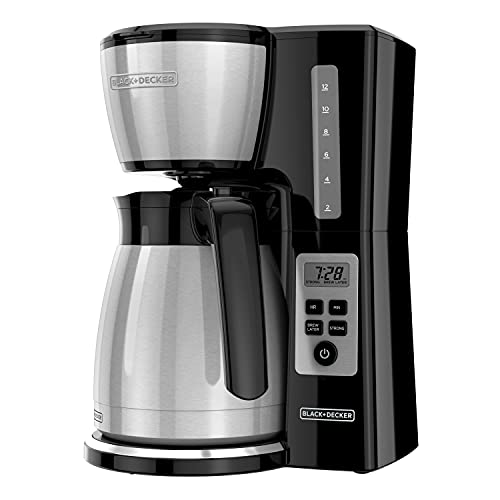
BLACK+DECKER 12-Cup Thermal Programmable Coffee Maker, CM2046S
Badge: Best Overall
Strengths
- Thermal carafe keeps coffee hot without a scorching hot plate
- Programmability means coffee can be ready when the alarm goes off
- VORTEX showerhead is designed to saturate grounds evenly for fuller extraction
Trade-offs
- Thermal carafes pour more slowly and heavily than glass
- No single-serve side; every brew is a carafe brew, large or small
- Black and steel finish shows fingerprints more than matte finishes
Key specifications (from the verified listing):
- Capacity: 12 cups
- Carafe: thermal
- Controls: programmable, with brew strength control
- Showerhead: VORTEX Technology (per listing)
- Finish: black and steel
The BLACK+DECKER 12-Cup Thermal Programmable Coffee Maker, CM2046S approaches best multi cup coffee makers from a clear position, and its verified specification shows it: capacity: 12 cups, carafe: thermal. In a field of machines that all promise a good morning pot, position is what you are actually choosing. The strengths above are the reasons this model exists; the trade-offs are the reasons a different household should choose a different pick. Neither list is decoration. Together they describe a machine with a point of view about how coffee should fit a kitchen.
In daily brewing, what separates these machines is behaviour across the whole pot, not the first sip. Extraction evenness decides whether the cup tastes clean or muddy, brew temperature decides whether it tastes sweet or sour, and the thermal carafe decides what is left of the coffee at the second and third hour. Thermal carafe keeps coffee hot without a scorching hot plate Brew with fresh grounds at a consistent ratio for a week before judging any machine in this guide; drip coffee rewards a settled routine and punishes daily improvisation, whatever the badge on the front.
Ownership is a long, quiet relationship: a carafe rinsed daily, a lid washed where oils collect, a descaling cycle run before the machine asks for it by slowing down. None of the picks here is demanding, but all of them repay the same small discipline. Choose the one whose daily gestures, pouring, programming, cleaning, fit your hands and your mornings, because you will repeat those gestures thousands of times.
Best for: households brewing a full morning carafe that must stay hot through a long, staggered breakfast / Not suited for: solo drinkers who usually want exactly one mug and nothing stored

Cuisinart PerfecTemp 12-Cup Thermal Drip Coffee Maker, DCC-3400NAS
Badge: Best for Daily Use
Strengths
- PerfecTemp hotter brewing targets the temperature range drip coffee needs for proper extraction
- Double-wall steel carafe holds heat for hours without a hot plate
- Brew strength control lets one machine serve both mild and bold drinkers
Trade-offs
- Premium-tier positioning in this line-up
- Thermal carafe is heavier to pour from than glass, especially when full
- Hotter brewing rewards fresh grounds; stale coffee tastes more obviously stale
Key specifications (from the verified listing):
- Capacity: 12 cups
- Carafe: double-wall stainless steel thermal
- Brewing: PerfecTemp hotter brewing (per listing)
- Controls: brew strength control
- Finish: silver
The Cuisinart PerfecTemp 12-Cup Thermal Drip Coffee Maker, DCC-3400NAS approaches best multi cup coffee makers from a clear position, and its verified specification shows it: capacity: 12 cups, carafe: double-wall stainless steel thermal. In a field of machines that all promise a good morning pot, position is what you are actually choosing. The strengths above are the reasons this model exists; the trade-offs are the reasons a different household should choose a different pick. Neither list is decoration. Together they describe a machine with a point of view about how coffee should fit a kitchen.
In daily brewing, what separates these machines is behaviour across the whole pot, not the first sip. Extraction evenness decides whether the cup tastes clean or muddy, brew temperature decides whether it tastes sweet or sour, and the thermal carafe decides what is left of the coffee at the second and third hour. PerfecTemp hotter brewing targets the temperature range drip coffee needs for proper extraction Brew with fresh grounds at a consistent ratio for a week before judging any machine in this guide; drip coffee rewards a settled routine and punishes daily improvisation, whatever the badge on the front.
Ownership is a long, quiet relationship: a carafe rinsed daily, a lid washed where oils collect, a descaling cycle run before the machine asks for it by slowing down. None of the picks here is demanding, but all of them repay the same small discipline. Choose the one whose daily gestures, pouring, programming, cleaning, fit your hands and your mornings, because you will repeat those gestures thousands of times.
Best for: flavour-first households that drink drip coffee across the whole morning and care about brew temperature / Not suited for: shoppers who prefer a glass carafe and a warming plate, or who brew one cup at a time

BLACK+DECKER CaféCraft 12-Cup Thermal Coffee Maker
Badge: Best Compact Pick
Strengths
- Hot and iced modes make it the seasonal all-rounder of this group
- Programmable start covers weekday mornings without thought
- Thermal carafe keeps the hot batch hot and frees counter space from a hot plate
Trade-offs
- Iced mode still needs a freezer stocked with ice to shine
- Jack-of-two-temperatures design is less specialised than a dedicated cold brewer
- Listing detail is brief, so confirm the exact control layout on the product page
Key specifications (from the verified listing):
- Capacity: 12 cups
- Carafe: thermal
- Drinks: hot and iced coffee (per listing)
- Controls: programmable
- Line: CaféCraft
The BLACK+DECKER CaféCraft 12-Cup Thermal Coffee Maker approaches best multi cup coffee makers from a clear position, and its verified specification shows it: capacity: 12 cups, carafe: thermal. In a field of machines that all promise a good morning pot, position is what you are actually choosing. The strengths above are the reasons this model exists; the trade-offs are the reasons a different household should choose a different pick. Neither list is decoration. Together they describe a machine with a point of view about how coffee should fit a kitchen.
In daily brewing, what separates these machines is behaviour across the whole pot, not the first sip. Extraction evenness decides whether the cup tastes clean or muddy, brew temperature decides whether it tastes sweet or sour, and the thermal carafe decides what is left of the coffee at the second and third hour. Hot and iced modes make it the seasonal all-rounder of this group Brew with fresh grounds at a consistent ratio for a week before judging any machine in this guide; drip coffee rewards a settled routine and punishes daily improvisation, whatever the badge on the front.
Ownership is a long, quiet relationship: a carafe rinsed daily, a lid washed where oils collect, a descaling cycle run before the machine asks for it by slowing down. None of the picks here is demanding, but all of them repay the same small discipline. Choose the one whose daily gestures, pouring, programming, cleaning, fit your hands and your mornings, because you will repeat those gestures thousands of times.
Best for: households whose coffee habit flips between hot mornings and iced afternoons across the year / Not suited for: iced-coffee purists who want true cold brew, which is a different, slower method entirely

Cuisinart 12-Cup PerfecTemp Thermal Carafe Coffee Maker, White
Badge: Best for Versatility
Strengths
- The 1 to 4 cup setting answers the small-batch problem that full-size brewers usually handle badly
- Brew Pause lets an impatient first cup pour before the cycle ends
- Same PerfecTemp hotter-brewing family as its silver sibling, in a lighter finish
Trade-offs
- White finish shows coffee splashes and needs more wiping to stay smart
- Thermal carafe weight and pour speed are the class trade-offs
- Full 12-cup footprint for a machine often used at quarter capacity
Key specifications (from the verified listing):
- Capacity: 12 cups
- Carafe: thermal, PerfecTemp line
- Small batches: 1 to 4 cup setting (per listing)
- Controls: brew strength control and Brew Pause (per listing)
- Finish: stainless steel and white
The Cuisinart 12-Cup PerfecTemp Thermal Carafe Coffee Maker, White approaches best multi cup coffee makers from a clear position, and its verified specification shows it: capacity: 12 cups, carafe: thermal, perfectemp line. In a field of machines that all promise a good morning pot, position is what you are actually choosing. The strengths above are the reasons this model exists; the trade-offs are the reasons a different household should choose a different pick. Neither list is decoration. Together they describe a machine with a point of view about how coffee should fit a kitchen.
In daily brewing, what separates these machines is behaviour across the whole pot, not the first sip. Extraction evenness decides whether the cup tastes clean or muddy, brew temperature decides whether it tastes sweet or sour, and the thermal carafe decides what is left of the coffee at the second and third hour. The 1 to 4 cup setting answers the small-batch problem that full-size brewers usually handle badly Brew with fresh grounds at a consistent ratio for a week before judging any machine in this guide; drip coffee rewards a settled routine and punishes daily improvisation, whatever the badge on the front.
Ownership is a long, quiet relationship: a carafe rinsed daily, a lid washed where oils collect, a descaling cycle run before the machine asks for it by slowing down. None of the picks here is demanding, but all of them repay the same small discipline. Choose the one whose daily gestures, pouring, programming, cleaning, fit your hands and your mornings, because you will repeat those gestures thousands of times.
Best for: one-or-two-person households that occasionally host, and want one machine honest at both batch sizes / Not suited for: drinkers who always brew a full carafe and would rather have the simplest control set

BUNN Speed Brew Platinum Thermal Coffee Maker, CSB3T
Badge: Best for Small Households
Strengths
- Speed Brew design is built around fast, cafe-style drip brewing at home
- 10-cup size is the slightly smaller carafe some kitchens honestly need
- BUNN’s commercial heritage shows in a no-nonsense, brew-focused design
Trade-offs
- 10 cups is the smallest carafe here; big households may brew twice
- Brew-focused design means fewer programmable extras than the Cuisinart picks
- Thermal carafe class trade-offs on weight and pour apply
Key specifications (from the verified listing):
- Capacity: 10 cups
- Carafe: thermal
- Design: Speed Brew line, stainless steel
- Finish: black and stainless steel
- Brand line: BUNN Speed Brew Platinum
The BUNN Speed Brew Platinum Thermal Coffee Maker, CSB3T approaches best multi cup coffee makers from a clear position, and its verified specification shows it: capacity: 10 cups, carafe: thermal. In a field of machines that all promise a good morning pot, position is what you are actually choosing. The strengths above are the reasons this model exists; the trade-offs are the reasons a different household should choose a different pick. Neither list is decoration. Together they describe a machine with a point of view about how coffee should fit a kitchen.
In daily brewing, what separates these machines is behaviour across the whole pot, not the first sip. Extraction evenness decides whether the cup tastes clean or muddy, brew temperature decides whether it tastes sweet or sour, and the thermal carafe decides what is left of the coffee at the second and third hour. Speed Brew design is built around fast, cafe-style drip brewing at home Brew with fresh grounds at a consistent ratio for a week before judging any machine in this guide; drip coffee rewards a settled routine and punishes daily improvisation, whatever the badge on the front.
Ownership is a long, quiet relationship: a carafe rinsed daily, a lid washed where oils collect, a descaling cycle run before the machine asks for it by slowing down. None of the picks here is demanding, but all of them repay the same small discipline. Choose the one whose daily gestures, pouring, programming, cleaning, fit your hands and your mornings, because you will repeat those gestures thousands of times.
Best for: impatient households that want a carafe fast, from a brand whose whole identity is brewing speed / Not suited for: feature hunters who want timers, iced modes and single-serve sides in one machine
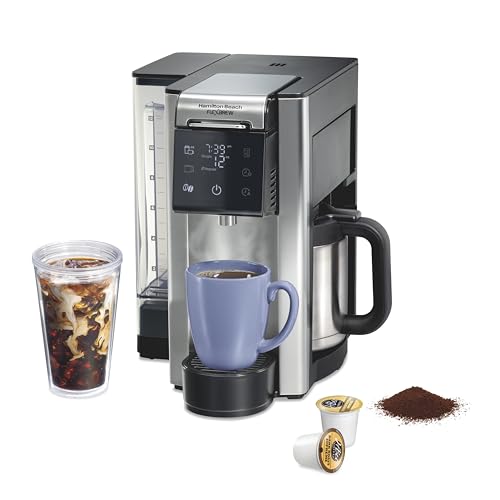
Hamilton Beach FlexBrew Advanced 5-in-1 Coffee Maker
Badge: Best Premium Pick
Strengths
- The genuine multi-format machine here: carafe for the household, single serve for the odd one out
- Pods or grounds on the single-serve side keeps both camps happy
- 60 oz removable reservoir feeds both sides and refills at the sink
Trade-offs
- Two brewing systems mean two cleaning routines to keep up with
- Largest countertop commitment in this group
- Single-serve side is a cup at a time, by definition
Key specifications (from the verified listing):
- Formats: drip and single serve, pods and grounds (per listing)
- Capacity: 12-cup thermal drip side
- Reservoir: removable 60 oz (per listing)
- Drinks: hot and iced (per listing)
- Controls: programmable drip side
The Hamilton Beach FlexBrew Advanced 5-in-1 Coffee Maker approaches best multi cup coffee makers from a clear position, and its verified specification shows it: formats: drip and single serve, pods and grounds (per listing), capacity: 12-cup thermal drip side. In a field of machines that all promise a good morning pot, position is what you are actually choosing. The strengths above are the reasons this model exists; the trade-offs are the reasons a different household should choose a different pick. Neither list is decoration. Together they describe a machine with a point of view about how coffee should fit a kitchen.
In daily brewing, what separates these machines is behaviour across the whole pot, not the first sip. Extraction evenness decides whether the cup tastes clean or muddy, brew temperature decides whether it tastes sweet or sour, and the thermal carafe decides what is left of the coffee at the second and third hour. The genuine multi-format machine here: carafe for the household, single serve for the odd one out Brew with fresh grounds at a consistent ratio for a week before judging any machine in this guide; drip coffee rewards a settled routine and punishes daily improvisation, whatever the badge on the front.
Ownership is a long, quiet relationship: a carafe rinsed daily, a lid washed where oils collect, a descaling cycle run before the machine asks for it by slowing down. None of the picks here is demanding, but all of them repay the same small discipline. Choose the one whose daily gestures, pouring, programming, cleaning, fit your hands and your mornings, because you will repeat those gestures thousands of times.
Best for: mixed households where some drink by the carafe and some by the pod, and one machine must serve both / Not suited for: minimalist counters, or households certain they will only ever brew one way
Comparison Table
| Pick | Badge | Key specification | Also notable | Listing |
|---|---|---|---|---|
| BLACK+DECKER 12-Cup Thermal Programmable Coffee Maker, CM2046S | Best Overall | Capacity: 12 cups | Carafe: thermal | Check on Amazon |
| Cuisinart PerfecTemp 12-Cup Thermal Drip Coffee Maker, DCC-3400NAS | Best for Daily Use | Capacity: 12 cups | Carafe: double-wall stainless steel thermal | Check on Amazon |
| BLACK+DECKER CaféCraft 12-Cup Thermal Coffee Maker | Best Compact Pick | Capacity: 12 cups | Carafe: thermal | Check on Amazon |
| Cuisinart 12-Cup PerfecTemp Thermal Carafe Coffee Maker, White | Best for Versatility | Capacity: 12 cups | Carafe: thermal, PerfecTemp line | Check on Amazon |
| BUNN Speed Brew Platinum Thermal Coffee Maker, CSB3T | Best for Small Households | Capacity: 10 cups | Carafe: thermal | Check on Amazon |
| Hamilton Beach FlexBrew Advanced 5-in-1 Coffee Maker | Best Premium Pick | Formats: drip and single serve, pods and grounds (per listing) | Capacity: 12-cup thermal drip side | Check on Amazon |
Read the table by columns, not rows. The specification column shows the physical commitment each machine asks of your kitchen, and the badge column shows the job each was chosen for. A pick that looks beaten on one column often wins the column your household actually lives in. Shoppers still deciding between formats should compare with How To Choose A Coffee Maker For Your Kitchen Routine before committing.
How to Choose the Right Option for Multi cup coffee makers
Before the individual factors, one discipline helps every shopper in this category: separate the decision into the machine, the routine and the space, and refuse to let a strong showing in one hide a failure in another. A superb machine in the wrong size is wrong. A perfectly sized machine whose cleaning routine you will abandon by March is wrong. The factors below are ordered so that the physical commitments come first, because they are the hardest to change after purchase, and the preference questions come last, because they are the easiest to live with either way. Work through them with your own kitchen in mind, and most readers find the field narrows to two picks, at which point the detailed reviews and the comparison table finish the job.
Carafe style and the second hour
All six picks use thermal carafes, which hold heat by insulation rather than a hot plate. That protects flavour across a long morning. Judge a thermal carafe on pour feel, lid design and how completely it empties; a carafe that traps the last half cup wastes coffee daily. If your household drinks a pot within the hour, carafe differences shrink; across three hours, they dominate.
Capacity in mugs, not maker cups
The cup printed on coffee makers is a small standard measure, not your mug. Translate before you buy: a 12-cup carafe is roughly five or six mugs, a 10-cup roughly four or five. Households should count their busiest regular morning in mugs and buy for that, treating party capacity as a second-brew problem.
Brew temperature and strength control
Drip coffee extracts properly in a narrow hot range, which is what Cuisinart’s PerfecTemp hotter brewing is designed around. Strength controls then adjust the cup’s intensity without changing your scoop habits. If you drink one roast happily all year, these controls are set-and-forget; if your household splits between mild and bold, they are the peace treaty.
Programmability and small-batch honesty
A timer is worth having exactly when your wake time is regular. Small-batch settings matter when a 12-cup machine regularly brews four cups, because flow and temperature tuned for a full pot mishandle a quarter pot. The white Cuisinart’s dedicated setting and the strength controls elsewhere are the honest answers in this pool.
How to Run a Multi-Cup Brewer for a Household
- Agree a house ratio of coffee to water and write it on a note inside the cupboard door; consistency beats improvisation.
- Program the weekday brew the night before, and hand over the simple manual steps for weekends.
- Use the small-batch setting or strength control on half pots rather than accepting a thin brew.
- Decant leftover coffee rather than reheating it in the carafe for hours; flavour falls off a cliff late in the day.
- Rotate descaling duty monthly in busy households; scale builds faster with daily full pots.
Troubleshooting. Problem: weekday half pots taste thin → use the small-batch setting where offered, or increase the coffee ratio slightly for small volumes. Problem: one person always gets the weak first cup → let the full cycle finish before pouring; early pours are disproportionately strong and leave the pot weak. Problem: coffee is cold by the second person’s morning → brew into the thermal carafe, keep the lid closed, and stagger the program time closer to the later riser.
Brewing for More Than One: Where Multi-Cup Machines Earn It
Multi-cup brewing looks simple until a household’s real pattern shows up: two people leave at different times, a third wants a small cup at noon, and Sunday adds guests. The machines here answer that pattern with carafe capacity, programmability and, in the FlexBrew’s case, a single-serve side for the off-schedule drinker. The reviews judge each pick against the pattern, not against a laboratory pot: how does the second cup taste, how does the machine behave on a half batch, how much thought does a weekday demand?
Half-batch honesty separates this group. Most big brewers make their best coffee near full capacity, where temperature and flow were designed to land. The white Cuisinart’s dedicated small-batch setting is the explicit answer, and the strength controls on both Cuisinarts help tune smaller pots. If your household brews four cups on weekdays and twelve on weekends, weight those features heavily; if you always brew full, the BUNN’s speed and the BLACK+DECKER thermal value move up.
Finally, count the true cost of capacity: counter depth, carafe storage, and the discipline of cleaning a bigger system. A multi-cup machine you maintain beats a bigger one you resent.
That angle also explains this guide’s ordering. The picks are arranged so the machines that answer the brief most directly come first, and the ones that answer a neighbouring brief, or a narrower version of it, are labelled for what they are. If your own brief turns out to be the neighbouring one, the ordering still serves you: it shows the border clearly instead of blurring it. Related reading: Coffee Maker For One Person A Simple Way To Choose and 12cup Coffee Maker Buying Guide For Busy Households.
Brew water deserves a sentence of its own. Coffee is almost entirely water, and heavily chlorinated tap water will flavour a pot no machine can rescue. If your tap water tastes strong, filter it for brewing and taste the difference in a single pot; it is the cheapest upgrade in this entire guide. Water also drives descaling frequency, so the same decision protects the machine.
Grind freshness is the second quiet variable. Pre-ground coffee is convenient and consistent, and these machines are designed around it. Freshly ground coffee, dosed consistently, lifts any pick in this guide by more than the gap between the picks themselves. If you upgrade one habit after buying, make it a simple grinder and a consistent scoop, then settle the routine for a month before changing anything else.
Think about the carafe as tableware, not just a component. A thermal carafe goes to the table at brunch, sits on a desk through a work morning, and pours for guests. Its weight when full, its drip behaviour and whether it pours the last cup completely are daily experiences, not specifications. The reviews flag pour and lid behaviour wherever the class has known trade-offs, because you will meet them every single day.
Programmability has a social dimension: the person who wakes first should not have to be the person who brews. A timer set the night before makes the machine the household’s first riser, and a thermal carafe means the last riser still gets hot coffee. Households with staggered mornings consistently rate this combination as the feature they would not give back.
Counter planning matters before the box arrives. Measure depth with the lid open, because carafe brewers need vertical room to fill and to lift the basket. Check the outlet position against the cord, and leave the machine a permanent home; a brewer that lives out gets used, cleaned and descaled, while one that is fetched and stored slowly becomes an occasional appliance.
A Week of Real Use, and What It Teaches
Picture the machine across a full week and the differences in this pool sharpen. Weekday mornings reward the timer and the thermal carafe: coffee brewed before anyone is fully awake, still hot when the last person leaves. Midweek, a half pot exposes whether a brewer handles small volumes honestly, which is why the small-batch setting and the strength controls keep appearing in these reviews. The weekend adds guests, a second pot, and perhaps an iced jug, and suddenly capacity and the iced mode are the features that matter. A machine that covers your whole week without a workaround is worth more than one that wins a single morning.
There is a short learning curve with any new brewer, and it is mostly about ratio. Owners change machines and keep their old scoop habits, then blame the new pot for tasting different. Give a new machine a settled week: same coffee, same scoop, same water, and one adjustment at a time if the cup is not where you want it. Drip brewing is a system, machine, coffee, grind, water and ratio together, and the machine is only the most visible part. The reviews above judge the machines; this discipline is what lets them show it.
Long ownership is decided by cleaning, not by features. Coffee oils coat baskets and carafe lids invisibly and turn rancid slowly, and scale narrows water paths a fraction at a time. The households that love a brewer in year three are the ones who rinsed the carafe daily, washed the oily parts weekly, and descaled before the machine slowed. None of that is effort comparable to the brewing itself; it is simply the rent a good pot charges, and every pick in this guide charges roughly the same rent.
Gifting changes the calculation in one specific way: the recipient’s routine, not yours, is the specification. A machine matched to your mornings and gifted into different mornings becomes a cupboard resident. If you are buying from this guide as a gift, choose the pick whose trade-offs are kindest to a beginner, simple controls, forgiving technique, easy cleaning, and include the one piece of advice from the how-to section that you found most useful. A sentence of hard-won routine is worth more than any accessory.
Second-hand and hand-me-down versions of these categories circulate widely, and the reviews here double as a used-buying checklist: the strengths describe what should still work, the trade-offs describe what wear looks like, and the specifications let you verify that a listing is the model it claims to be. Inspect seals, baskets, carafes and cups, the parts that age, and run a full cycle before money changes hands. A well-kept example of the right pick beats a neglected example of a better one.
One more consideration belongs in every appliance decision and rarely appears in specification tables: the sound a machine makes in your actual home. Kitchens with hard surfaces amplify noise, open-plan homes carry it into living spaces, and early risers feel it most. You cannot fully predict a machine’s sound from its listing, but you can predict your household’s tolerance, and you can plan around it, choosing when and where the loud work happens. Shoppers who know they are noise-sensitive should weight that knowledge as heavily as any feature, because a machine avoided for its sound delivers none of its performance.
Returns and warranty thinking deserve a calm paragraph before purchase, not a panicked one after. Buy through the listing, keep the packaging until the machine has survived its first week of real routines, and run every core function in that first week rather than discovering a fault at month three. Register the product if the brand offers it, and keep the order record somewhere findable. None of this is pessimism; it is the standard discipline of buying any machine you intend to keep for years, and it costs nothing but a calendar note.
Accessories and consumables shape the true shape of ownership. Filters, pods, spare cups, gaskets and descaler are the recurring cast of these categories, and a machine whose consumables are easy to source in your area is a machine that stays convenient. Before buying, check that the consumables your routine needs are ordinary purchases rather than treasure hunts, and factor their rhythm into the routine you are designing. The machine is bought once; its ecosystem is bought forever.
Gifting changes the calculation in one specific way: the recipient’s routine, not yours, is the specification. A machine matched to your mornings and gifted into different mornings becomes a cupboard resident. If you are buying from this guide as a gift, choose the pick whose trade-offs are kindest to a beginner, simple controls, forgiving technique, easy cleaning, and include the one piece of advice from the how-to section that you found most useful. A sentence of hard-won routine is worth more than any accessory.
Second-hand and hand-me-down versions of these categories circulate widely, and the reviews here double as a used-buying checklist: the strengths describe what should still work, the trade-offs describe what wear looks like, and the specifications let you verify that a listing is the model it claims to be. Inspect seals, baskets, carafes and cups, the parts that age, and run a full cycle before money changes hands. A well-kept example of the right pick beats a neglected example of a better one.
One more consideration belongs in every appliance decision and rarely appears in specification tables: the sound a machine makes in your actual home. Kitchens with hard surfaces amplify noise, open-plan homes carry it into living spaces, and early risers feel it most. You cannot fully predict a machine’s sound from its listing, but you can predict your household’s tolerance, and you can plan around it, choosing when and where the loud work happens. Shoppers who know they are noise-sensitive should weight that knowledge as heavily as any feature, because a machine avoided for its sound delivers none of its performance.
Common Buying Mistakes
- Counting capacity in maker cups and buying a carafe too small for the household’s mugs.
- Leaving coffee on a hot plate habit from an old machine and expecting thermal holding to work the same way; it is better, but different.
- Brewing small pots on full-pot settings and concluding the machine makes weak coffee.
- Never descaling, then blaming the brewer for slow, lukewarm, bitter pots that scale caused.
- Judging a machine by its first cup and ignoring how the carafe pours and holds at hour two.
Every mistake on that list has the same shape: a shopper optimised for the wrong variable, the headline instead of the routine, the first week instead of the first year. The defence is boring and effective. Write down your real pattern, servings, timing, space and cleaning tolerance, and judge every pick in this guide against that page. The machine that matches the page is the recommendation; the machine that matches the advertisement is the risk. For more on adjacent choices, see Choosing A 10cup Coffee Maker What To Look For At Home.
Final Recommendation
Start with the BLACK+DECKER 12-Cup Thermal Programmable Coffee Maker, CM2046S, this guide’s first pick, unless a specific trade-off in its review describes your kitchen, in which case the review itself points to your alternative. The Cuisinart PerfecTemp 12-Cup Thermal Drip Coffee Maker, DCC-3400NAS is the natural second look, chosen for a different balance of the same brief. Beyond those two, choose by the single column of the comparison table your household lives in, space, capacity, format or speed, and let the rest be tie-breakers. A machine matched to your routine will feel like the best drip coffee maker you have owned; a machine matched to someone else’s will feel like a compromise forever, whatever it cost.
Whichever you choose, protect the purchase with the boring habits: keep the routine consistent for the first month, clean and descale on schedule, and revisit the settings once your pattern settles. That is how a good pick becomes a long one. One more comparison worth your time before you decide: Best Drip Coffee Makers That Brew Hotenough.
Frequently Asked Questions
How often should I descale a drip coffee maker?
With daily brewing and average water, roughly monthly is the honest rhythm, sooner with hard water. Slow brewing, spluttering and lukewarm coffee are scale announcing itself.
What grind suits these brewers?
A medium grind is the baseline for drip baskets. Too fine slows flow and over-extracts into bitterness; too coarse rushes through and tastes thin. Change one variable at a time when dialling in.
Can I brew half a pot in a 12-cup machine?
Yes, and the results are best with the pick that offers a dedicated small-batch setting, or by using the strength control and a slightly adjusted ratio. A plain quarter pot on full settings is the weakest cup these machines make.
Why does the last cup from a thermal carafe pour slowly?
Thermal carafes pour through a partially closed lid by design, which protects heat. Pour steadily, use the lid’s pouring position, and accept the slower pour as the price of the second hour’s heat.
Can a multi-cup machine make good coffee for one person?
It can, especially the pick with a small-batch setting and the FlexBrew with its single-serve side. A standard carafe brewer at quarter capacity is the weakest case; choose accordingly if you often brew solo.
How many mugs does a 12-cup carafe really fill?
Roughly five or six household mugs, because the maker’s cup is a smaller measure than a mug. Plan guest numbers on mugs, not on the box number.


