Disclosure: topratedkitchenware.com is reader-supported. When you buy through links on our site, we may earn an affiliate commission from Amazon and other retailers, at no extra cost to you.
Where to buy
This shortlist for the best natural cleaner for toilets keeps only the products whose listings state a natural-school positioning and a toilet bowl job: a biobased gel that names hard water rings, an essential-oil gel in a stock-up pack, an antibacterial gel from a plant-derived brand, and a plastic-free tablet. Two enzyme drain products from the same verified pool are reviewed in prose only, because cleaning a drain line and cleaning a bowl are different jobs, and this guide does not blur them for the sake of a link. The shortlist for the best natural cleaner for toilets is:
- Seventh Generation Toilet Bowl Cleaner, Fresh Mint — Check on Amazon
- Mrs. Meyer’s Clean Day Toilet Bowl Cleaner, Lemon Verbena (Pack of 4)
- method Antibacterial Toilet Bowl Cleaner, Spearmint (6 Pack)
- BLUELAND Toilet Bowl Cleaner Tablets
- Roebic K-97 Main Line Cleaner (covered in prose only — see its review below)
- Green Gobbler Enzyme Drain Cleaner (covered in prose only — see its review below)
Read the full guide ↓ for how each product was judged, where it genuinely helps, where it does not, and the safety and technique notes that matter more than brand names in this category.
The search for the best natural cleaner for toilets usually begins with a smell — the bleach reek of a conventional bowl cleaner hanging in a small bathroom — or with a household change: a baby, a septic tank, a skin sensitivity, a new scepticism about what gets flushed into the water system every week. Whatever brought you here, the honest starting point is that natural bowl cleaning works, provided it is bought and used as what it is: a routine system of gentler formulas, contact time and frequency, rather than a one-for-one swap for the strongest bottle on the old shelf.
The four linked picks divide the natural school into its real choices. Seventh Generation brings a biobased formula whose listing names stubborn grime and hard water rings. Mrs. Meyer’s brings an essential-oil gel whose scent has made it the school’s most loyal following. Method’s six-pack brings stated antibacterial action for households unwilling to give sanitising up. BLUELAND abolishes the bottle altogether with plastic-free tablets aimed at limescale and ring stains. Each is a different answer to the question of what natural should mean in your house, and the reviews are written to help you choose a definition, not just a product.
Two products are deliberately not linked. The Roebic K-97 and the Green Gobbler Enzyme Drain Cleaner are legitimate biological products, but they clean main lines and drains — the pipe beyond the bowl — and a shopper who bought either to scrub a bowl would own the wrong tool. They are reviewed in prose so you can recognise them, understand the boundary, and, if your problem is actually a slowing line, follow that thread deliberately, perhaps alongside Best Natural Cleaners For Toilets for the wider shortlist treatment of the same school.
Key Takeaways
- Natural bowl cleaning is a routine, not a strength contest: weekly use, real contact time, and early treatment of rings.
- Seventh Generation’s biobased gel is the hard-water pick — its listing names hard water rings as a target and states septic safety.
- Mrs. Meyer’s four-pack is the scent-led everyday pick; method’s six-pack is the antibacterial option; BLUELAND’s tablets are the plastic-free option.
- Enzyme drain and main-line products (Roebic, Green Gobbler Enzyme) are prose-only here — they treat pipes, not bowls.
- No linked pick uses chlorine bleach; several state septic-safe positioning in their listings.
- Judge a natural cleaner after a month of routine, not after one rescue attempt on a neglected bowl.
In this guide
Quick Picks
Four linked bowl cleaners representing four definitions of natural, plus two prose-only pipe products explained and bounded. Start from the badge that matches your household’s reason for switching.
| Product | Badge | Why it is here | Listing |
|---|---|---|---|
| Seventh Generation Toilet Bowl Cleaner, Fresh Mint | Best Overall | Biobased, stated tough on hard water rings, septic safe, four-pack | Check on Amazon |
| Mrs. Meyer’s Clean Day Toilet Bowl Cleaner, Lemon Verbena (Pack of 4) | Best for Scent and Routine | Lemon verbena gel in a four-bottle stock-up pack | Check on Amazon |
| method Antibacterial Toilet Bowl Cleaner, Spearmint (6 Pack) | Best Antibacterial Option | Spearmint antibacterial gel, six-bottle pack, one-step positioning | Check on Amazon |
| BLUELAND Toilet Bowl Cleaner Tablets | Best Plastic-Free | Tablets for limescale, rust and ring stains, with no plastic packaging | Check on Amazon |
| Roebic K-97 Main Line Cleaner | Prose-Only: Main-Line Product | A biological main-line treatment — valuable, but it does not clean a bowl | Prose only |
| Green Gobbler Enzyme Drain Cleaner | Prose-Only: Drain Product | An enzyme gallon for drains, grease traps and septic — not a bowl cleaner | Prose only |
How These Picks Were Chosen
Selection began with the Creators API-verified pool and then applied two screens. The first was categorical: is this product a toilet bowl cleaner? Two pool members — a main-line bacteria treatment and an enzyme drain cleaner — failed that screen and were moved to prose-only coverage, with the reasoning recorded in the sources file and the link count reduced accordingly. The second screen was definitional: does the listing itself state a natural-school positioning, such as biobased, essential oils, plant-derived branding or plastic-free format? The four linked picks each state theirs in their own words, and the reviews quote that positioning rather than upgrading it.
The guide is research-led and claims no test-bench results, no germ percentages and no descaling times. Those numbers would depend on your water, your bowl’s glaze and your routine in ways no remote guide can measure, and in the natural category they would also miss the point: the meaningful differences between these picks are philosophy, format, scent and pack logic, all of which are stated facts that can be compared honestly. Performance guidance here is therefore about method — how each format is used, how often, and on what kind of soil it succeeds.
A word about the homemade tradition, because many readers arrive from it: vinegar-and-bicarbonate style mixtures have a real place in this school, and Best Natural Recipie For Cleaning Toilets covers that territory. The commercial picks in this guide earn their place beside the mixtures on consistency and convenience — the same formula every week, in a bottle or tablet that is already under the sink — not on a claim that a kitchen mixture cannot clean a bowl at all.
The Best Natural Cleaner for Toilets: 4 Linked Picks and 2 Prose-Only Pipe Products

Seventh Generation Toilet Bowl Cleaner, Fresh Mint
Badge: Best Overall
Strengths
- Biobased formula is the listing’s headline, stated without hedging
- Names stubborn grime and hard water rings as targets — the two soils that define this category
- No chlorine bleach, stated septic safe, in a four-bottle pack
Trade-offs
- Fresh mint is the sole scent; the fragrance-free must look elsewhere
- Rings yield across treatments, not in one application — the natural pace applies
- A four-pack asks for commitment before the first bottle is finished
| Detail | From the product listing |
|---|---|
| Format | Format: liquid bowl cleaner |
| Pack | Pack: four 24 oz bottles |
| Scent | Scent: fresh mint |
| Biobased formula | Biobased formula |
| Stated action | Stated action: fights stubborn grime and is tough on hard water rings |
| Stated septic safe; no chlorine bleach | Stated septic safe; no chlorine bleach |
Seventh Generation leads this guide because it confronts the natural school’s hardest test by name. Hard water rings are where gentle cleaners go to be doubted, and this listing states that its biobased formula is tough on them, alongside stubborn grime generally, with no chlorine bleach and septic-safe positioning. That combination — philosophy plus a named target — is what a sceptical switcher needs: not a promise that natural is magic, but evidence that the maker formulated for the exact stain on your bowl.
Work it as a treatment on rings and as a routine everywhere else. Lower the water for ring work, coat, wait, brush; keep the weekly pass for the bowl, rim and waterline. The four-pack format is part of the method in hard-water homes, where frequency is higher and a bottle per bathroom is the difference between a routine and an intention. Given a month of that rhythm, most households stop missing the bleach bottle — the bowl is simply never allowed to become the kind of dirty that needed it.
On the facts, the Seventh Generation Toilet Bowl Cleaner, Fresh Mint is a biobased bowl cleaner in a fresh mint scent that is positioned for stubborn grime and hard water rings, made without chlorine bleach and described as septic safe. It leads because it states both a philosophy and a target, which is the strongest hand a natural cleaner can show. The listing details in the spec box above are the whole of what the maker states about size, format and intended use, and this guide deliberately goes no further than those stated details: no performance percentages, no laboratory claims and no invented specifications have been added. Read them as a description of what the product is designed to do, then match that design honestly against the problem in your bathroom before you buy.
Best for: hard-water and septic households wanting the natural school’s most complete all-rounder / Not suited for: fragrance-free homes and one-pass rescue cleaning

Mrs. Meyer’s Clean Day Toilet Bowl Cleaner, Lemon Verbena (Pack of 4)
Badge: Best for Scent and Routine
Strengths
- Lemon verbena scent is the school’s best-loved fragrance, and habit follows scent
- Four bottles station the routine in every bathroom at once
- Same gel identity as the single bottle — a known quantity, bought in working quantity
Trade-offs
- Scent-led buying is personal; untested, four bottles is a gamble
- An everyday maintenance gel, not the pick for heavy existing scale
- Households avoiding fragrance altogether should choose a different badge
| Detail | From the product listing |
|---|---|
| Format | Format: liquid bowl cleaner |
| Pack | Pack: four 24 fl oz bottles |
| Scent | Scent: lemon verbena |
| Stated septic safe positioning from the same formula family | Stated septic safe positioning from the same formula family |
Mrs. Meyer’s sells a routine disguised as a scent. Lemon verbena — bright, herbal, garden-adjacent — makes the weekly bowl clean the least resented chore in the bathroom, and in natural cleaning, resentment is a performance variable: the cleaner that gets used cleans best. The four-pack format is the routine made physical, one bottle per bathroom, so the guest toilet gets the same standard as the family one and no bowl is left to ripen while its bottle sits two rooms away.
Judge this pick on a month, not a day. Its work is the steady prevention of the ring, the streak and the stale smell, done pleasantly enough that nobody negotiates out of their turn. Households furnishing a bathroom from scratch — the same readers browsing Best No Frill Toilets for a straightforward fixture — tend to underestimate how much of a new toilet’s long-term appearance is decided by exactly this kind of unglamorous weekly stock. This pack is that stock, bought once and forgotten, which is the point.
On the facts, the Mrs. Meyer’s Clean Day Toilet Bowl Cleaner, Lemon Verbena (Pack of 4) is the lemon verbena bowl cleaner sold as a four-bottle pack, for households that want the same scented cleaner in every bathroom and a spare under the sink. Its case rests on adherence: the most-used natural cleaner is the most effective one. The listing details in the spec box above are the whole of what the maker states about size, format and intended use, and this guide deliberately goes no further than those stated details: no performance percentages, no laboratory claims and no invented specifications have been added. Read them as a description of what the product is designed to do, then match that design honestly against the problem in your bathroom before you buy.
Best for: scent-motivated households with several bathrooms to keep on one routine / Not suited for: fragrance-free homes and heavy-scale rescue jobs
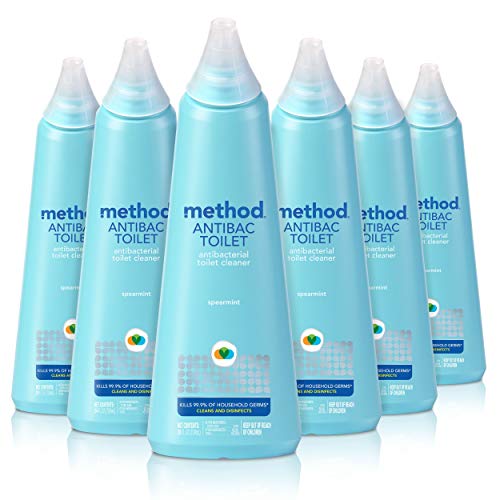
method Antibacterial Toilet Bowl Cleaner, Spearmint (6 Pack)
Badge: Best Antibacterial Option
Strengths
- Listing states it cleans and sanitises in one step — bowl, seat and under the rim
- Tough-on-grime positioning suits busy family bowls
- Six bottles is a full stocking system for multi-bathroom homes
Trade-offs
- Antibacterial is the strict-definition compromise in this guide — read the label and decide with eyes open
- Spearmint only; no alternative scent in this format
- Bulk format punishes a change of mind
| Detail | From the product listing |
|---|---|
| Format | Format: liquid bowl cleaner gel |
| Pack | Pack: six 24 fl oz bottles |
| Scent | Scent: spearmint |
| Antibacterial formula, labelled to kill household germs | Antibacterial formula, labelled to kill household germs |
| Stated use | Stated use: toilet bowls, seats and under the rim |
Method’s six-pack answers the most common reason households give for not switching: they want the cleaning pass to sanitise, stated on the bottle, in the same step. Method’s brand roots are plant-derived cleaning, and this gel is the pragmatic branch of that family — an antibacterial formula, spearmint scented, positioned to clean and sanitise the bowl, seat and under-rim in one pass. This guide links it with the distinction printed rather than buried, because a household that defines natural strictly should choose Seventh Generation or BLUELAND, while a household that defines it as gentler-than-bleach mainstream will find this pick exactly right.
The six-bottle format targets the homes where bowls multiply: large families, rentals, houses with a cleaner on a rota. In those settings the sanitising step is often a contractual or parental requirement, and meeting it inside a natural-leaning brand, in bulk, with one product for every bathroom, is a genuinely tidy solution. Station the bottles, keep the weekly rhythm, and the compromise disappears into routine.
On the facts, the method Antibacterial Toilet Bowl Cleaner, Spearmint (6 Pack) is the same spearmint antibacterial bowl gel, sold as a six-bottle pack for multi-bathroom homes, rentals and anyone who stocks cleaning supplies in bulk. It holds the antibacterial end of the natural spectrum, labelled as such. The listing details in the spec box above are the whole of what the maker states about size, format and intended use, and this guide deliberately goes no further than those stated details: no performance percentages, no laboratory claims and no invented specifications have been added. Read them as a description of what the product is designed to do, then match that design honestly against the problem in your bathroom before you buy.
Best for: households that require stated antibacterial action but want a natural-leaning brand and bulk format / Not suited for: strict plant-only households

BLUELAND Toilet Bowl Cleaner Tablets
Badge: Best Plastic-Free
Strengths
- Plastic-free solid format removes the bottle from the waste stream
- Listing names limescale, rust, hard water and ring stains — the full mineral set
- No chlorine bleach, dyes, ammonia or parabens, stated in the listing; septic-safe positioning
Trade-offs
- Dissolve-and-wait is the slowest method here; planners thrive, improvisers chafe
- A tablet cannot be aimed — under-rim work belongs to the gels
- Light-routine format; a neglected bowl needs gel treatments first
| Detail | From the product listing |
|---|---|
| Format | Format: solid cleaning tablets, plastic-free |
| Pack size | Pack size: 28 tablets |
| Scent | Scent: lemon cedar |
| Stated targets | Stated targets: limescale, rust, hard water and toilet ring stains |
| Stated septic safe | Stated septic safe |
| Made without chlorine bleach, dyes, ammonia or parabens | Made without chlorine bleach, dyes, ammonia or parabens |
BLUELAND is the pick for the household whose natural brief is really about waste and ingredient lists. Twenty-eight lemon cedar tablets, no plastic bottle, no chlorine bleach, dyes, ammonia or parabens — and a stated target list that reads like this category’s charge sheet: limescale, rust, hard water and toilet ring stains. The tablet dissolves in the bowl and works while you do something else, which makes it the lowest-effort entry in the guide and the easiest weekly habit to keep: drop, wait, brush, flush.
Its boundaries are the format’s. A dissolving tablet treats the waterline and bowl below it beautifully and the under-rim barely at all, so households with rim-jet streaking should pair the tablet rhythm with an occasional gel pass from another pick. And like every natural option here, it maintains far better than it rescues. Bring a neglected bowl back with gel treatments first — perhaps while researching Best New Toilets you decide the bowl is worth saving after all — then let the tablets hold the line, week after plastic-free week.
On the facts, the BLUELAND Toilet Bowl Cleaner Tablets is a pack of plastic-free solid tablets scented lemon cedar that are dropped into the bowl to attack limescale, rust, hard water marks and ring stains without chlorine bleach, dyes, ammonia or parabens. It is the format radical of the group, and its stated mineral targets keep it honest. The listing details in the spec box above are the whole of what the maker states about size, format and intended use, and this guide deliberately goes no further than those stated details: no performance percentages, no laboratory claims and no invented specifications have been added. Read them as a description of what the product is designed to do, then match that design honestly against the problem in your bathroom before you buy.
Best for: waste-conscious households wanting the simplest possible weekly habit / Not suited for: under-rim streak problems as the main issue, and rescue cleaning
Roebic K-97 Main Line Cleaner
Badge: Prose-Only: Main-Line Product
Strengths
- A genuine biological product from a specialist maker
- Treats the main line, where the costliest clogs form
- Helps prevent sewer and septic line clogs, per its listing
Trade-offs
- Works in the pipe, invisibly — it will not remove a single visible stain from a bowl
- Slow biological action measured in days
- Not linked here: it fails this keyword’s bowl-cleaner screen
| Detail | From the product listing |
|---|---|
| Format | Format: bacteria and enzyme liquid |
| Bottle size | Bottle size: 32 fl oz |
| Stated purpose | Stated purpose: main line cleaning |
| Stated action | Stated action: breaks down organic build-up |
| Stated benefit | Stated benefit: helps prevent sewer and septic line clogs |
Roebic K-97 is covered so that its bottle is never bought in error for a dirty bowl. It is a bacteria-and-enzyme liquid for the main sewer or septic line: poured into the system, it colonises the pipe and digests organic build-up, helping prevent the deep clogs that back up into toilets. That is real, useful, natural-school work — one floor down from where this keyword lives. Inside a bowl it would do nothing visible at all, because the stains on porcelain are mineral and grime on a surface, not organic build-up inside a pipe.
Keep the boundary and both products make sense: a stain on the bowl calls for a linked gel or tablet from this guide; a house whose toilets slow and gurgle together calls for a main-line conversation, in which this product legitimately stars. Owning both is coherent. Substituting either for the other is the only error, and it is the error this prose review exists to prevent.
On the facts, the Roebic K-97 Main Line Cleaner is a bacteria-and-enzyme liquid made for the main sewer or septic line rather than a single fixture, where it breaks down organic build-up over time. The listing details in the spec box above are the whole of what the maker states about size, format and intended use, and this guide deliberately goes no further than those stated details: no performance percentages, no laboratory claims and no invented specifications have been added. Read them as a description of what the product is designed to do, then match that design honestly against the problem in your bathroom before you buy.
Best for: recognition only — buy it for main-line maintenance, on its own category’s terms / Not suited for: cleaning a toilet bowl in any respect
Prose-only pick: no Amazon link or product image is shown for this product in this guide, for the reason recorded in the article sources file. It is covered so you can recognise it on a shelf and judge it against the linked picks.
Green Gobbler Enzyme Drain Cleaner
Badge: Prose-Only: Drain Product
Strengths
- Enzyme approach positioned as an alternative to caustic chemicals — philosophically this guide’s school
- Targets oils and fats, a real drain problem
- Gallon covers up to eight stated treatments
Trade-offs
- A drain and trap product: it does not scrub, stain-treat or freshen a bowl
- Biological pace — days, not a cleaning session
- Not linked here: it fails this keyword’s bowl-cleaner screen
| Detail | From the product listing |
|---|---|
| Format | Format: enzyme liquid drain cleaner |
| Bottle size | Bottle size: 1 gallon |
| Stated yield | Stated yield: up to 8 treatments |
| Stated targets | Stated targets: oils and fats |
| Stated uses | Stated uses: grease traps and septic tanks |
| Stated safe for pipes; anti-glug bottle design | Stated safe for pipes; anti-glug bottle design |
| Maker positioning | Maker positioning: an alternative to caustic chemicals |
The Green Gobbler gallon tempts natural shoppers because its philosophy matches theirs — enzymes instead of caustics, digestion instead of dissolution — and its listing aims it at drains, grease traps and septic tanks, where oils and fats are the enemy. All of that is true, and none of it makes it a toilet bowl cleaner. A bowl’s problems sit on glazed porcelain in open air; a drain’s problems coat the inside of a pipe. The enzyme that digests the second has no mechanism for the first, and a gallon bought for bowl duty would be a gallon misspent.
File it where it belongs: if your natural-cleaning project extends from the bowl to the whole drainage system — a septic household thinking biologically about everything it pours away — this is a leading citizen of that larger project, dosed on its own schedule. In this guide it stands as the second boundary marker, proof that the natural label alone does not make a product a bowl cleaner, and that category honesty is worth more than a longer link list.
On the facts, the Green Gobbler Enzyme Drain Cleaner is a gallon of enzyme cleaner that digests oils and fats in drains, grease traps and septic systems, positioned by its maker as an alternative to caustic chemicals. The listing details in the spec box above are the whole of what the maker states about size, format and intended use, and this guide deliberately goes no further than those stated details: no performance percentages, no laboratory claims and no invented specifications have been added. Read them as a description of what the product is designed to do, then match that design honestly against the problem in your bathroom before you buy.
Best for: recognition only — buy it for enzyme drain and septic maintenance / Not suited for: any bowl-cleaning purpose
Prose-only pick: no Amazon link or product image is shown for this product in this guide, for the reason recorded in the article sources file. It is covered so you can recognise it on a shelf and judge it against the linked picks.
Comparison Table
The four linked picks are compared as bowl cleaners. The two prose-only rows close the table so the whole verified pool is accounted for — and so no reader mistakes absence of a link for absence of a reason.
| Product | Size / pack | Standout point | Listing |
|---|---|---|---|
| Seventh Generation Toilet Bowl Cleaner, Fresh Mint | 24 oz bottles, pack of 4 | The biobased all-rounder that names the natural school’s hardest job | Check on Amazon |
| Mrs. Meyer’s Clean Day Toilet Bowl Cleaner, Lemon Verbena (Pack of 4) | 24 fl oz bottles, pack of 4 | Essential-oil scent that turns a chore into a habit | Check on Amazon |
| method Antibacterial Toilet Bowl Cleaner, Spearmint (6 Pack) | 24 fl oz bottles, pack of 6 | Stated sanitising action for households that will not give it up | Check on Amazon |
| BLUELAND Toilet Bowl Cleaner Tablets | 28 tablets | The waste-free format, aimed squarely at mineral stains | Check on Amazon |
| Roebic K-97 Main Line Cleaner | 32 fl oz bottle | Bacteria and enzymes for the main line beyond the toilet | Prose only |
| Green Gobbler Enzyme Drain Cleaner | 1 gallon bottle | Enzyme digestion of oils and fats in drains and traps | Prose only |
How to Choose the Best Natural Cleaner for Toilets
Choose your definition first, because every later decision hangs on it. If natural means plant-based or biobased ingredients as the headline, Seventh Generation and Mrs. Meyer’s are your shelf. If it means the absence of specific ingredients — chlorine bleach, dyes, ammonia, parabens — BLUELAND’s listing states its exclusions most completely. If it means a gentler mainstream brand with stated antibacterial action, method is your shelf and you should buy it without guilt. Households argue about these definitions; products cannot. Match the listing language to your household’s actual rule and the category becomes simple.
Choose by your water next. Hard water writes the real brief in this category: rings form faster, mineral is the dominant soil, and the picks that name it — Seventh Generation on hard water rings, BLUELAND on limescale and ring stains — deserve first look. Soft-water households can choose almost entirely on scent, format and philosophy, because their soil is ordinary grime that any pick here handles on a weekly rhythm. Either way, grade your current bowl honestly: a maintained bowl can be kept by any linked pick, while a neglected one should be brought back with repeated gel treatments before a tablet routine is asked to hold it.
Choose format by temperament. Gels are control: aimed under rims, dosed by eye, worked with a brush — the format for people who clean actively. Tablets are delegation: dropped in, left to dissolve, brushed at the end — the format for people who clean by habit-stacking, attaching the bowl to another weekly routine. Pack size is the same decision at larger scale. A single bottle tests a scent; a four or six-pack builds a system. In a category where the routine is the product, the format you will actually use, at the frequency you will actually keep, outperforms the theoretically best formula bought once and resented.
Finally, set the trial correctly. Give a natural cleaner a month of weekly use before judging it, treat rings with the low-water method described in the how-to, and fix the inputs that fight you — a leaking flapper lays down mineral daily, and no cleaner in this guide outruns a leak. Then check the current price on Amazon for your chosen pick, buy the pack that stations a bottle in each bathroom, and write the start date on it. A month later the bottle, not a review, will tell you whether the switch worked.
How to Clean a Toilet Naturally, Step by Step
The natural method replaces chemical force with sequence: soften, wait, agitate, repeat. Follow it in order and the gentlest pick in this guide will outperform a strong one used carelessly.
- Gather the kit: your chosen gel or tablets, a toilet brush with an under-rim angle, a cloth for the exterior, and a few minutes of patience budgeted in advance.
- Flush once so the bowl is wet — natural gels spread and cling better on a wet surface than a dry one.
- For ring work, lower the water level (close the supply valve and flush, or sweep water down with the brush) so the product meets the stain undiluted.
- Apply gel under the rim first, then around the waterline and any streaks; or drop in a tablet and let it dissolve fully.
- Wait for the contact time the label states — and use the wait: wipe the seat, lid, base and exterior with a cloth and a little product or your usual bathroom cleaner.
- Brush the bowl thoroughly, working the under-rim jets and the waterline in slow circles rather than frantic strokes.
- Flush and inspect under the best light the room has. Judge by improvement, and schedule the repeat rather than escalating.
- Repeat the treatment on surviving stains across the week; mineral and old grime yield to accumulated gentle chemistry.
- Leave the seat up or down per house rule, the bottle back in its station, and the brush rinsed — a tidy kit is a kit that gets used again.
- Calendar the next session now. Weekly is the rhythm that keeps natural cleaning in its winning territory.
One habit protects all of this work: deal with inputs. A toilet is cleaned by what goes into it as much as by what is scrubbed off it — hard water, a seeeping flapper, and iron-rich refill water all redeposit daily. A five-minute flapper check each season is worth a shelf of products, and in iron country, a look inside the tank tells you whether the bowl’s streaks are a cleaning problem or a plumbing one.
Troubleshooting
Problem: the ring fades but never fully clears → it is older scale than a maintenance gel dissolves quickly; persist with weekly low-water treatments, and consider the porcelain-safe pumice step described in this site’s mineral deposit guide.
Problem: the bowl smells clean for a day, then stale again → the source is usually under the rim or in a rarely flushed guest bowl; treat the rim-jet area directly and flush idle toilets weekly.
Problem: streaks appear in the same lines after every clean → a rim jet is partly blocked or a tank part is rusting; clear the jet gently with a wooden skewer and inspect the tank hardware.
Septic Tanks and the Natural School Belong Together
A septic system is a bacterial workforce, and every product flushed from the toilet reports for duty in the tank. That is why septic households are the natural school’s most natural constituency: several picks here state septic-safe positioning, none of the linked picks uses chlorine bleach, and the whole philosophy — small regular doses of gentler chemistry — matches the tank’s preference for an undisturbed biology. The prose-only enzyme products in this guide belong to the same story one level down, maintaining the lines and the tank itself; the household that thinks of bowl, line and tank as one system cleans all three better.
Keep records as you would for any living system: what products, how often, and any change in how the house drains. When the tank is serviced, that notebook turns small talk into diagnosis, and it is the same notebook that tells you whether your natural switch changed anything beyond the smell of the bathroom — which, for the record, it will.
Scent Is a Feature, Not a Frivolity
In a large, ventilated space, scent is decoration. In a small bathroom, scent is environment — the difference between a room that smells faintly of lemon verbena, mint or cedar and one that carries a chemical tang for an hour after cleaning. Natural brands understand this, which is why their scent families are built from essential-oil and garden references rather than abstract freshness. Treat scent as a primary buying criterion without embarrassment: a household that likes its cleaner’s smell cleans more often, and in this category frequency is effectiveness.
The corollary is to test before committing. Every multi-pack in this guide has a single-bottle or smaller sibling logic behind it — prove the scent in your smallest bathroom, at your most sensitive hour, before the four or six-pack arrives. Scent regret is the silliest reason a good routine dies, and it is entirely preventable.
Common Buying Mistakes
Mistake one: buying a drain or main-line enzyme product to clean a bowl. The prose-only reviews exist because this mistake is easy, well-intentioned and total — pipe biology does nothing visible on porcelain.
Mistake two: the one-week verdict. Natural cleaners are judged fairly only across a month of routine; a single rescue attempt on a neglected bowl is a test no maintenance product, natural or not, was built to pass.
Mistake three: flushing away the contact time. These formulas work while they sit; a gel given thirty seconds has been poured away, not used.
Mistake four: the giant first purchase. Scent and format are personal; prove them small, then let the multi-packs do their stocking work.
Mistake five: cleaning the bowl and ignoring the tank. A leaking flapper or rusting hardware redeposits daily, and the cleaner gets blamed for a plumbing fault.
Final Recommendation
Start with Seventh Generation Toilet Bowl Cleaner, Fresh Mint (Check on Amazon) — it is the most complete natural answer here, biobased, bleach-free, septic-stated and aimed by name at the hard water rings that define this category’s hard cases. Choose Mrs. Meyer’s Clean Day Toilet Bowl Cleaner, Lemon Verbena (Pack of 4) (Check on Amazon) instead when scent and stock-up simplicity are what will keep your household’s routine alive, and method’s six-pack when stated antibacterial action is a house requirement. Take BLUELAND if plastic waste is your deciding issue. Any of the four, used weekly with patience, will hold a toilet to a standard that makes the switch permanent.
The natural school asks for rhythm and gives back a calmer bathroom: gentler storage, garden scents, and a clean that never smells like a warning label. For most households, that trade settles itself within a month.
Frequently Asked Questions
What is the best natural cleaner for toilets overall?
On stated facts, the Seventh Generation gel in this guide: a biobased formula, no chlorine bleach, septic-safe positioning, and a listing that names stubborn grime and hard water rings as targets — the two soils that decide this category. Households led by scent may fairly prefer Mrs. Meyer’s, and those led by waste may prefer BLUELAND’s tablets; the guide’s badges exist because best in this category depends on which definition of natural your house runs on.
Do natural toilet cleaners disinfect?
Most plant-based and biobased bowl cleaners are sold as cleaners, not disinfectants, and their listings here are quoted accordingly. The method pick is the exception in this line-up, with stated antibacterial, clean-and-sanitise positioning. Households with a medical or childcare need for stated sanitising action should choose on that stated claim — and should also know that ordinary cleaning itself, done thoroughly and often, carries much of the practical hygiene of a bathroom.
Are these cleaners safe for septic tanks?
The linked picks that address it state septic-safe positioning — Seventh Generation, and BLUELAND among them — and the natural school’s bleach-free, small-dose rhythm is generally the tank-friendly pattern. Confirm the statement on the specific product you buy, avoid flooding the system with any cleaner, and keep a note of what the system is treated with for whoever services it.
Why did a natural cleaner not shift my toilet ring?
Either the ring is built scale — older and harder than a maintenance formula dissolves in a few passes — or the contact method was missing: product diluted in a full bowl and flushed within a minute cannot work. Lower the water, coat the ring, wait, brush, and repeat across the week. If a month of that rhythm barely moves it, the deposit needs the mechanical step described in the mineral deposit guide before a natural cleaner maintains the result.
Can I make my own natural toilet cleaner instead?
Yes — the homemade tradition is real, and this site covers it under the recipe angle in the targets linked from this guide. Commercial picks win on consistency, storage and stated septic positioning; mixtures win on cost and cupboard ingredients. Many households run both: mixtures for the weekly pass, a bought gel for ring treatments. What neither school survives is irregular use.
How is a bowl cleaner different from an enzyme drain cleaner?
They work on different stages of the same system. A bowl cleaner treats the porcelain surface — stains, grime, rings — in open air, in minutes. An enzyme drain cleaner works inside pipes over hours and days, digesting organic build-up where no brush reaches. The Roebic and Green Gobbler products reviewed in prose in this guide are good examples of the second kind, which is exactly why they are not linked as answers to a bowl-cleaning question.


