Disclosure: topratedkitchenware.com is reader-supported. When you buy through links on our site, we may earn an affiliate commission from Amazon and other retailers, at no extra cost to you.
Where to buy
These are the verified picks for this guide to best natural gas grills tacoma. Each linked name goes to its Amazon listing, where you can check the latest price on Amazon and confirm the current fuel configuration before you decide — in the natural gas category, that confirmation step matters more than any other on this page. Picks shown without a link are reviewed in full below and appear prose-only for the reason stated in their review.
- Nexgrill 4-Burner Propane Gas Grill with Side Burner
- IdeaMaxx 3-Burner Propane Gas Grill with Cast Iron Grates
- Weber Spirit E-425 Gas Grill
- Nexgrill 4-Burner Propane Gas Grill with Stainless Steel Lid
- AMERLIFE 6-Burner Propane Gas Grill with Side Burner
- Realcook Charcoal Grill with Offset Smoker (reviewed prose-only below — no purchase link, for the reason its review explains)
Start with our top linked pick: Check on Amazon. Read the full guide ↓ for the detailed reviews, the sizing and fuel guidance, and the how-to layer.
Shopping for the best natural gas grills tacoma style means shopping for a climate as much as for a grill. Tacoma and the wider Puget Sound region grill through marine air, long damp winters, moss-season humidity and glorious, mild summers — conditions that reward stainless construction, punish neglected cast iron, and make a plumbed natural gas line especially attractive, because the household that grills year-round in the Northwest is the household most tired of swapping propane tanks in the rain.
The six verified formats below are reviewed with that regional lens on: build materials and weather resilience first, then burners, area and grates. Their verified fuel configurations are stated in every spec box — as listed they are propane configurations (one title does not specify), so the guide’s regional sections also cover the Tacoma-side practicalities of going plumbed: line installation through licensed local fitters, permits under local code, and siting a fixed grill under Northwest weather. Nothing here invents local rules or prices; codes and costs are your fitter’s and your city’s to state, and this guide says so wherever it matters.
If you grill in the South Sound, read the reviews asking one question — how will this format age within sight of the water, under a cover, through a wet winter — and the answers will sort the pool quickly.
A useful companion read at this stage is Best Natural Gas Barbecue Grills, which approaches the same pool from a different priority.
Key Takeaways
- Puget Sound marine air rewards stainless bodies and covered storage; neglected bare cast iron rusts fast here.
- A plumbed line suits year-round Northwest grilling — no tank swaps in February rain.
- All picks state verified fuel in their spec boxes; NG configuration must be confirmed per model before a Tacoma install.
- Local permits and gas codes are your licensed fitter’s domain — this guide deliberately quotes no local rules.
- Site a fixed grill under some shelter with the lid swing and hose radius in mind.
- A quality cover is not an accessory in Tacoma; it is part of the grill.
In this guide
Quick Picks
| Pick | Badge | Headline facts (from verified listing) |
|---|---|---|
| Nexgrill 4-Burner Propane Gas Grill with Side Burner | Best Large Four-Burner | Burners: 4 main burners plus a side burner; Total output stated: 60,000 BTU |
| IdeaMaxx 3-Burner Propane Gas Grill with Cast Iron Grates | Best for Small Spaces | Burners: 3; Output stated: 38,200 BTU |
| Weber Spirit E-425 Gas Grill | Best Premium Pick | Burners: 4; Sear Zone with Boost Burners (from listing title) |
| Nexgrill 4-Burner Propane Gas Grill with Stainless Steel Lid | Best Balanced Family Pick | Burners: 4 plus a side burner; Total output stated: 52,000 BTU |
| AMERLIFE 6-Burner Propane Gas Grill with Side Burner | Best for Crowds | Burners: 6 plus a side burner; Total output stated: 60,000 BTU |
| Realcook Charcoal Grill with Offset Smoker | Best for Smoke Flavour (Prose-Only) | Fuel: charcoal only; Format: barrel grill with offset smoker |
The table is the short version; the reviews below are the honest one. Note in particular the fuel column of each spec box that follows — in a guide to best natural gas grills tacoma, the configuration a listing actually sells is part of the product, and it is printed for every pick rather than left for you to discover at checkout.
How These Picks Were Chosen
A note on method before the picks: this is a research-based guide. It does not claim workshop testing, invented cook-offs or proprietary scoring. What it does is slower and, for this category, more useful — every product was verified into the pool first, and each review is built only from what its verified listing states: burners, output where given, cooking area where given, grate material, construction and fuel configuration.
Ranking within the guide follows the keyword’s priorities. Formats that give the cook real temperature zones outrank formats that merely add size; grate materials that sear and endure outrank novelty features; and brands with deep replacement-parts ecosystems earn credit, because a grill plumbed to a house gas line is infrastructure, and infrastructure is judged on whether it can be repaired in year nine. Fuel configuration is disclosed for every pick in its spec box — most of this market ships as propane, and this guide treats stating that plainly as part of the product information, not as fine print.
Badges were assigned after the reviews were written, not before, so each badge summarises an argument you can read rather than a marketing slot that needed filling. Where a badge and a verdict seem to pull in different directions, trust the verdict — it is written for your household, not for the average one.
Readers comparing this format with the wider cluster often continue to Best Natural Gas Bbq Grills for the neighbouring angle on the same decision.
The 6 Best Picks Reviewed in Full: Best natural gas grills tacoma

Nexgrill 4-Burner Propane Gas Grill with Side Burner
Badge: Best Large Four-Burner
Strengths
- The largest stated cooking space in this pool alongside the six-burner — 626 sq in swallows party loads
- 60,000 BTU across four burners gives genuine two-zone flexibility
- Double-door cabinet and stainless body suit a fixed, plumbed-in patio position
Trade-offs
- Listed and configured for propane — it is not a natural gas grill as sold here
- Stainless panels need regular wiping to keep water spots and fingerprints in check
- At this size it is a two-person assembly and a committed footprint
At a glance: Burners: 4 main burners plus a side burner; Total output stated: 60,000 BTU; Cooking space stated: 626 sq in; Body: stainless steel with double-door cabinet; Ignition: electronic; built-in thermometer. Fuel note: Propane as listed — not a natural gas model as configured; treat it as a format reference and verify any NG version or approved conversion before planning a gas-line install.
This Nexgrill is the big stainless four-burner that anchors a lot of American patios: 626 square inches of stated cooking space, 60,000 BTU of total output, a side burner, and a double-door cabinet underneath. Numbers like those describe a grill that can cook burgers for a crowd on the left while vegetables finish gently on the right, and still leave the side burner free for a skillet of peppers and onions.
For a natural gas shopper, the honest framing is that this exact listing is a propane configuration. Its value in this guide is as a size-and-layout benchmark: if your patio plan calls for a plumbed line, use this grill’s footprint, burner layout and cabinet format as the template, then confirm — on the listing and with the manufacturer — whether a factory natural gas version or an approved conversion kit exists for it. Never assume a propane grill can be re-jetted safely without the manufacturer’s own kit and instructions.
Through a Tacoma lens, judge the Nexgrill 4-Burner Propane Gas Grill with Side Burner on how its body and grates will age in marine air and how happily it will live in one sheltered, plumbed spot all year. Then complete the regional routine: confirm the natural gas configuration for the exact model, and let a licensed local fitter handle the line, the outlet placement and the local code questions.
Best for: hosts who cook for crowds and want the four-burner layout, cabinet storage and output headroom this class offers / Not suited for: anyone who needs a natural gas grill out of the box with no conversion questions to resolve

IdeaMaxx 3-Burner Propane Gas Grill with Cast Iron Grates
Badge: Best for Small Spaces
Strengths
- Cast iron grates hold heat and lay down strong sear marks for a three-burner
- Foldable side shelves shrink the footprint when the grill is parked
- Three burners still allow a hot zone and a cooler zone for most family meals
Trade-offs
- Propane configuration only as listed — no natural gas variant is stated
- Smaller burner count means less true multi-zone cooking than the four- and six-burner picks
- Foldable shelves trade some prep stability for the compact parked size
At a glance: Burners: 3; Output stated: 38,200 BTU; Grates: cast iron; Side shelves: foldable; Intended use in title: portable outdoor, patio and camping. Fuel note: Propane as listed — not a natural gas model as configured.
The IdeaMaxx is the compact counterpoint in this lineup: three burners, 38,200 BTU, cast iron grates and side shelves that fold down when the cooking is done. For a small patio or a balcony-adjacent setup, that folding detail is the whole ballgame — the grill works like a full-size cooker on Saturday and parks like a much smaller one on Sunday.
Cast iron grates are the other reason to look twice. They store heat, so the surface recovers faster after a cold steak lands on it, and they produce the deep, dark sear marks that thin wire grates struggle to match. The trade is maintenance: cast iron wants a light oil wipe after cooking and a little respect in wet weather. As listed, this is a propane grill, so natural gas households should read it as the compact-format option and verify fuel options before committing.
Through a Tacoma lens, judge the IdeaMaxx 3-Burner Propane Gas Grill with Cast Iron Grates on how its body and grates will age in marine air and how happily it will live in one sheltered, plumbed spot all year. Then complete the regional routine: confirm the natural gas configuration for the exact model, and let a licensed local fitter handle the line, the outlet placement and the local code questions.
Best for: small patios and campers who want cast iron searing in a three-burner footprint that folds away / Not suited for: large-crowd hosts, or natural gas buyers unwilling to verify a conversion path first

Weber Spirit E-425 Gas Grill
Badge: Best Premium Pick
Strengths
- A dedicated Sear Zone with Boost Burners is built for steakhouse crusts
- Porcelain-enameled cast iron grates combine cast iron’s heat with easier care
- Weber’s dealer and parts network is the deepest in this pool, which matters for a grill you plan to keep for years
Trade-offs
- Listed here in propane configuration — confirm the natural gas version before planning a line install
- Premium-tier positioning within this pool
- Accessory rails invite extra purchases that are easy to over-buy
At a glance: Burners: 4; Sear Zone with Boost Burners (from listing title); Grates: porcelain-enameled cast iron; Accessory system: Weber Works rails; Fuel as listed: propane. Fuel note: Propane as listed — the Spirit family is the one to check first for a factory natural gas sibling model.
The Weber Spirit E-425 is the refinement pick. Four burners, a Sear Zone with Boost Burners for concentrated steak heat, porcelain-enameled cast-iron grates, and the Weber Works rail system for snap-on prep accessories. Where several grills in this pool compete on raw size, the E-425 competes on control: the sear zone gets properly fierce while the remaining burners hold gentler temperatures for chicken, vegetables and finishing.
Weber is also the brand in this pool where the natural gas question is most worth asking directly, because the Spirit line is a mainstream family with broad retail distribution — check the listing and Weber’s own channels for the natural gas configuration of this format rather than assuming the propane listing converts. Long-term ownership is the quiet argument here: burners, igniters, grates and flavorizer bars for popular Weber families stay available for years, and a plumbed grill is exactly the kind of appliance you want to repair rather than replace.
Through a Tacoma lens, judge the Weber Spirit E-425 Gas Grill on how its body and grates will age in marine air and how happily it will live in one sheltered, plumbed spot all year. Then complete the regional routine: confirm the natural gas configuration for the exact model, and let a licensed local fitter handle the line, the outlet placement and the local code questions.
Best for: quality-first buyers who sear often and plan to keep one grill for a long time / Not suited for: shoppers chasing the largest cooking area per purchase, or anyone who will not verify the fuel version
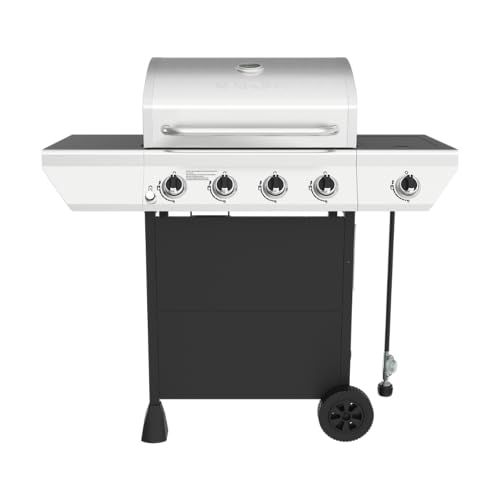
Nexgrill 4-Burner Propane Gas Grill with Stainless Steel Lid
Badge: Best Balanced Family Pick
Strengths
- 526 sq in and four burners hit the family-size sweet spot without the six-burner footprint
- Matte cast iron grates sear well and hide seasoning wear gracefully
- Side burner and built-in thermometer cover the everyday extras without add-ons
Trade-offs
- Propane as listed, so natural gas use needs a verified factory version or approved kit
- Mid-pack output — very large, thick cuts benefit from a longer preheat
- Stainless lid still needs a cover in harsh weather to stay looking new
At a glance: Burners: 4 plus a side burner; Total output stated: 52,000 BTU; Cooking space stated: 526 sq in; Grates: matte-finish cast iron; Ignition: electronic; built-in thermometer; stainless steel lid. Fuel note: Propane as listed — not a natural gas model as configured.
This second Nexgrill trades a little of its sibling’s stainless theatre for a practical matte-black-and-steel look: four burners, 52,000 BTU, 526 square inches of cooking space and matte-finish cast iron grates. That is family arithmetic done right — enough room for a dozen burgers with a vegetable zone to spare, without demanding the patio depth of the biggest carts in this guide.
The matte cast iron grates deserve a word. Cast iron’s heat retention is what makes recovery searing possible after the lid has been open, and the matte finish is forgiving about the mottled seasoning look that glossy grates advertise. As with the other propane listings here, the natural gas shopper’s job is verification: this format — mid-size four-burner with side burner — is precisely what most households should plumb for, but the fuel hardware itself must come from a factory NG model or a manufacturer-approved conversion.
Through a Tacoma lens, judge the Nexgrill 4-Burner Propane Gas Grill with Stainless Steel Lid on how its body and grates will age in marine air and how happily it will live in one sheltered, plumbed spot all year. Then complete the regional routine: confirm the natural gas configuration for the exact model, and let a licensed local fitter handle the line, the outlet placement and the local code questions.
Best for: families who want the balanced four-burner format with cast iron grates and a side burner / Not suited for: buyers who need stated natural gas configuration from the listing itself

AMERLIFE 6-Burner Propane Gas Grill with Side Burner
Badge: Best for Crowds
Strengths
- The largest stated cooking area in this pool at 650 sq in, plus a warming rack
- Six burners allow three distinct temperature zones at once
- Cast iron grates across a very wide box suit batch cooking and big gatherings
Trade-offs
- Propane configuration as listed — the natural gas question must be resolved before purchase
- The widest footprint here; small patios will feel it
- More burners mean more parts to clean, inspect and eventually service
At a glance: Burners: 6 plus a side burner; Total output stated: 60,000 BTU; Cooking area stated: 650 sq in; Grates: cast iron; warming rack fitted; Built-in thermometer and regulating valve (from listing title). Fuel note: Propane as listed — not a natural gas model as configured.
The AMERLIFE is the maximalist entry: six burners, 60,000 BTU, a stated 650 square inches of cooking area, cast iron grates and a warming rack, plus a side burner for the pan work. Six burners change what is possible — a fierce sear zone, a medium zone for chicken and sausages, and a low zone for holding and toasting, all running at once without lid-opening negotiations.
That capacity is aimed at a specific household: the one that hosts. Graduation weekends, double-family cookouts, a whole pack of ribs next to a tray of corn — this is the grill that does not make you cook in shifts. The honest costs are footprint and upkeep. Six burners mean six burners to brush around, inspect and keep clear, and as listed this is a propane grill, so a natural gas installation starts with verifying a factory NG option or an approved conversion — never with improvisation.
Through a Tacoma lens, judge the AMERLIFE 6-Burner Propane Gas Grill with Side Burner on how its body and grates will age in marine air and how happily it will live in one sheltered, plumbed spot all year. Then complete the regional routine: confirm the natural gas configuration for the exact model, and let a licensed local fitter handle the line, the outlet placement and the local code questions.
Best for: frequent hosts who regularly cook for a crowd and want three heat zones at once / Not suited for: small patios, minimalist cooks, or buyers who need a stated natural gas model
Realcook Charcoal Grill with Offset Smoker
Badge: Best for Smoke Flavour (Prose-Only)
Strengths
- Offset smoker box delivers genuine wood-smoke flavour no gas grill fully imitates
- 800 sq in of stated space is the largest cooking area in this pool
- Charcoal heat gives a different, deeper crust character for those who love the ritual
Trade-offs
- It is not a gas grill — no burners, no gas line, no instant start
- Fire management is a skill and a time commitment every single cook
- Ash, charcoal storage and longer cleanup are part of the deal
At a glance: Fuel: charcoal only; Format: barrel grill with offset smoker; Cooking space stated: 800 sq in; Intended use in title: backyard parties and gatherings. Fuel note: Charcoal — not a gas grill of any kind; included prose-only as the smoke-flavour reference point.
The Realcook is here for one honest reason: it is the flavour benchmark. A barrel charcoal grill with an offset smoker and a stated 800 square inches of space, it represents everything gas gives up in exchange for convenience — live fire, real smoke, and the deep bark on ribs and brisket that comes from hours in a smoke bath. For gatherings it is a genuine event grill.
It is reviewed prose-only, with no purchase link in this guide, because it does not belong to the product class this keyword is about: it burns charcoal, full stop. If reading about it makes you realise smoke flavour matters more to you than push-button gas convenience, that is a legitimate conclusion — many households end up owning both, a gas grill for Tuesday and a charcoal smoker for Saturday. Just do not buy it expecting anything a gas line can connect to.
Through a Tacoma lens, judge the Realcook Charcoal Grill with Offset Smoker on how its body and grates will age in marine air and how happily it will live in one sheltered, plumbed spot all year. Then complete the regional routine: confirm the natural gas configuration for the exact model, and let a licensed local fitter handle the line, the outlet placement and the local code questions.
Best for: smoke-flavour devotees who want an offset-smoker event grill alongside (not instead of) gas / Not suited for: natural gas shoppers — this grill cannot use gas at all
Comparison Table
| Pick | Badge | Format | Fuel as listed | Listing |
|---|---|---|---|---|
| Nexgrill 4-Burner Propane Gas Grill with Side Burner | Best Large Four-Burner | Burners: 4 main burners plus a side burner | Propane as listed | Check on Amazon |
| IdeaMaxx 3-Burner Propane Gas Grill with Cast Iron Grates | Best for Small Spaces | Burners: 3 | Propane as listed | Check on Amazon |
| Weber Spirit E-425 Gas Grill | Best Premium Pick | Burners: 4 | Propane as listed | Check on Amazon |
| Nexgrill 4-Burner Propane Gas Grill with Stainless Steel Lid | Best Balanced Family Pick | Burners: 4 plus a side burner | Propane as listed | Check on Amazon |
| AMERLIFE 6-Burner Propane Gas Grill with Side Burner | Best for Crowds | Burners: 6 plus a side burner | Propane as listed | Check on Amazon |
| Realcook Charcoal Grill with Offset Smoker | Best for Smoke Flavour (Prose-Only) | Fuel: charcoal only | Charcoal | Prose-only in this guide |
Read the fuel column as the table’s most important data. It is the column most grill comparisons omit, and in the natural gas category it is the difference between a smooth installation and an expensive surprise. If your shortlist is still forming, the companion guide at Best Natural Gas Cast Iron Grills covers the adjacent version of this search.
How to Choose the Right Grill for natural gas grills tacoma
The natural gas decision comes first and colours everything. Unlike a propane cart, a natural gas grill is installed: line, shutoff, quick-disconnect and hose, all the work of a licensed gas fitter, all semi-permanent. The grill must match that supply — factory natural gas configuration, or a manufacturer-approved conversion of a propane model, with orifices sized for the fuel. Every spec box in this guide states the verified configuration of its pick so you can plan from facts, and the reviews never blur a propane listing into a natural gas claim.
Buy area and burners as a pair. This pool’s stated cooking areas run from a compact 360 square inches to a crowd-sized 650. Translate area into people — roughly 70 to 90 square inches per diner for mixed loads — and then check that the burner count can divide your chosen area into the zones your cooking needs. Searing, roasting and holding at once is a four-burner talent; six burners turn it into crowd logistics; three burners keep weeknight cooking simple and honest.
Let grate material follow your climate and temperament. Bare cast iron is the sear champion and the maintenance champion’s burden. Porcelain-enameled cast iron splits the difference so well that it is this guide’s default for outdoor-permanent grills. Lighter porcelain-coated grates suit compact formats and relaxed routines. The wrong pairing — bare iron under a forgetful owner, in damp air — is how good grills die young.
Finally, buy the company as much as the grill. A plumbed grill should be repairable for a decade or more. Burner tubes, heat diffusers, igniters and grates all eventually renew, and the depth of a brand’s parts channel decides whether renewal is a parcel or a project. That is why established families recur throughout this pool, and why their presence is a feature, not a lack of imagination.
The same format questions are examined from another direction in Best Natural Gas Gas Grills, which many readers pair with this guide.
How to Set Up, Use and Maintain a Natural Gas Grill
Setup sequence for a plumbed grill. Position the grill in its permanent spot first — level, sheltered, with lid clearance — because the fitter will place the outlet for that spot. After installation, connect the hose to the quick-disconnect, open the shutoff, leak-check with soapy water, and light each burner in turn with the lid open. A correct flame is mostly blue and steady; a correct first session is an empty fifteen-minute burn to clear factory residues, followed by grate seasoning if your grates are bare cast iron.
Cooking method. Default to zones: fierce heat for searing, moderate heat for cooking through, and a cool edge for holding and resting. Preheat ten to fifteen minutes with the lid closed, brush, oil lightly, and cook with the lid down, turning food once where possible. The steady, endless supply of natural gas rewards this patience — temperatures recover predictably because the fuel never fades the way a near-empty tank does late in a long cook.
Maintenance calendar. After every cook: hot brush, quick grate wipe. Monthly in season: grease tray, exterior wipe-down, hose and coupling check. Each spring: grates off, diffusers brushed, burner ports cleared, igniter tested, and a soapy-water check of every connection before the first big cook. That calendar, kept, is the difference between a fifteen-year grill and a five-year one.
Troubleshooting.
Problem: igniter clicks but the burner does not light → confirm gas flow by checking the shutoff and coupling, clean the electrode tip and its gap, and light manually with a long lighter to isolate whether the fault is gas or spark.
Problem: sooty, yellow flames → stop cooking, let everything cool, and clean the burner ports and air inlets; persistent yellow flames after cleaning mean the fuel configuration needs professional verification.
Problem: the lid thermometer and the food disagree → lid thermometers read air at the lid, not grate temperature; trust a grate-level or probe thermometer for decisions, and treat the lid dial as a trend indicator.
The First Year With a Plumbed Grill: What Owners Learn
The first thing owners notice is what they stop doing. No tank runs. No shaking a cylinder to guess its contents. No mid-cook flame fade on a long brisket-style session. A natural gas grill’s supply is as boring as a kitchen tap, and boring is the highest praise infrastructure can earn. Within a month, most owners have quietly reorganised their cooking around it — more weeknight grilling, more ‘while we’re out here’ vegetables, more reasons to eat outside.
Permanence cuts both ways, so site like you mean it. The grill will live where the outlet is, in all weathers, for years. Owners who thrive chose level ground, a wind-sheltered aspect, lid clearance, standing room at the shelves and a cover that fits from day one. Owners who struggle chose by tape measure alone. The fitter installs where you point; point like someone who has mentally cooked a hundred dinners in that exact spot — because by year two, you will have.
Care becomes a calendar, not a crisis. The plumbed grill rewards rhythm: hot brush after cooks, grease tray on schedule, connections checked when disturbed, a spring inspection before the season’s first crowd. None of it is skilled work, and all of it compounds — a grill on that calendar in year five looks and cooks like a grill half its age, while its neglected twin is shopping for replacement burners. The reviews above score parts availability heavily precisely because the calendar eventually calls for a part, and the call should be easy to answer.
The quiet economics. Owners rarely tally fuel savings, because utility pricing varies and the honest totals depend on local rates. What they tally instead is dinners: the plumbed grill gets used, and used appliances are the only ones that ever pay for themselves. Every format decision in this guide — size, zones, grates, brand support — is ultimately a bet on how many dinners a grill will cook across its life. Bet on the format your household will light on a Tuesday, and the economics take care of themselves.
Grilling Through a Puget Sound Winter
Northwest winter grilling is a discipline of small habits. Preheat longer than summer muscle memory suggests, because a cold, damp firebox drinks heat. Keep the lid down and trust the thermometer and a probe rather than peeking — every lid lift in 40-degree drizzle costs minutes. Cook slightly fattier, sturdier cuts that forgive temperature swings, and let the grill run a few minutes after cooking to dry the interior before the cover goes on; trapping a wet, steamy box under a cover is how winter rust starts.
Natural gas quietly shines here. The February cookout dies at the propane stage — an empty tank discovered at dusk, in the rain, with salmon waiting. A plumbed grill removes that failure mode entirely, which is why year-round Northwest cooks convert at a rate that surprises sunnier regions. The tether that limits patio rearrangement matters less when the grill lives under the same eave all year anyway.
Wind is the other winter variable. A sheltered siting — not enclosed, never indoors, but out of the direct southerly gusts — keeps burner flames honest and temperatures stable. When you choose the grill’s permanent spot for the line install, stand there on a blustery day first.
Materials vs Marine Air: What Ages Well Near the Water
Tacoma’s air carries salt and constant moisture, and grill materials respond in character. Stainless steel bodies resist the environment best, provided the grade is decent and the surface is wiped down occasionally; tea-staining and surface spots wipe away, while painted steel that chips will bubble at the chip. Cast iron grates are the vulnerable glory — superb to cook on, but in marine air they must live oiled and, ideally, under a cover that breathes rather than seals in damp.
Porcelain-enameled cast iron is the regional compromise this guide keeps recommending: most of cast iron’s searing mass with a glass-hard coat between the metal and the marine air. Whatever you choose, the maintenance rhythm is the same — brush hot, oil lightly, dry burn after wet cooks, and inspect burners and diffuser bars each spring for the corrosion that Northwest winters plant.
Covers deserve a sentence of their own: buy the cover that fits your exact format, vented, and use it. In this climate the cover is not protecting the grill from rain so much as from the thousand damp nights that do the slow damage.
Tacoma buyers should also think about the calendar. The region’s grill-buying season and its gas-fitting season overlap in spring, when every household with a patio project has the same idea at once. Choosing your format in winter — verifying the natural gas configuration, booking the fitter early, and having the outlet live before the first warm weekend — converts a queue into a head start. The region’s mild shoulder seasons are a gift to the prepared: a grill plumbed by March cooks through the long Northwest spring evenings that arrive well before summer, and by the time the whole neighbourhood is shopping, your installation is already seasoned, tested and boring in the best possible way.
For the related cut of this category, see Best Natural Gas Grills 42 Inch before you finalise a model number.
Common Buying Mistakes
Treating fuel as an accessory. Fuel configuration is not an add-on to be resolved at checkout; it is the grill’s identity. Natural gas buyers who start from format and verify configuration — in that order — succeed. Everyone else gambles.
Letting a temporary arrangement become permanent. A delivered grill and an uninstalled line tempt improvisation. Resist it. Gas appliances run in their approved configuration or not at all, and ‘just for this weekend’ is how bad setups fossilise.
Overbuying burners, underbuying cover. The glamorous specification gets the budget while the fitted cover — the thing that decides how the grill looks and cooks in year five — gets skipped. Protect the purchase you actually made.
Trusting the lid thermometer as gospel. It reads the air near the lid, in weather, with optimism. A probe thermometer costs little and ends doneness arguments permanently.
Skipping the leak check. Soapy water on every new or disturbed connection takes ninety seconds. On a plumbed appliance that lives against your house, it is the cheapest insurance in the entire project.
Forgetting that permanent means maintainable. A plumbed grill cannot be wheeled into a workshop. Choose formats whose burners, diffusers and igniters you can reach, clean and replace in place — and whose maker still sells those parts.
Shoppers who started here frequently cross-check against Best Natural Gas Grills At Home Depot when the shortlist narrows to two formats.
Final Recommendation
Start with the Nexgrill 4-Burner Propane Gas Grill with Side Burner. It earns the first look in this pool for the balance its review lays out — the format fits the widest range of households shopping for best natural gas grills tacoma, and its strengths survive the trade-offs that follow them. Confirm its natural gas configuration path exactly as its spec box directs, and you have the safest pair of hands in this guide.
Choose the IdeaMaxx 3-Burner Propane Gas Grill with Cast Iron Grates instead if its badge matches your life more closely — the badges in this guide were written to be shopped, not admired. Hosts with genuine crowd volume should read the AMERLIFE 6-Burner Propane Gas Grill with Side Burner review twice before deciding; its capacity argument is real, and so is its footprint. And whichever format wins, close the purchase the way this guide has insisted from the first section: model number verified, fuel configuration confirmed, licensed fitter booked. A natural gas grill bought that way is not a purchase — it is patio infrastructure, and it will cook like it for a decade.
Frequently Asked Questions
Is a natural gas grill weaker than a propane grill?
A correctly configured natural gas grill cooks with the same authority as its propane counterpart. The fuels differ in energy per cubic foot, which is why natural gas models use larger orifices — the hardware compensates, and the cooking evens out. Weak performance almost always traces to a configuration mismatch or blocked burners, not to the fuel itself.
What does it cost to run a natural gas line to a patio?
Costs vary too much by region, distance and local labour to quote responsibly in a guide, and any figure printed here would mislead as many readers as it helped. The reliable method is two quotes from licensed local gas fitters once you know where the grill will stand — and to budget that figure into the purchase from the start, as this guide’s buying sections advise.
Can a natural gas grill be moved after installation?
Within the radius of its hose, yes — the quick-disconnect exists precisely so the grill can be uncoupled for cleaning, servicing or patio work. Beyond that radius it is a fixed appliance, which is the honest trade for unlimited fuel. Choose the spot as if it were permanent, because functionally it is.
Do I need a special cover or accessories for a natural gas grill?
The grill itself uses standard accessories — cover, brush, tools — sized to its format. The natural-gas-specific items are the hose and quick-disconnect hardware supplied for the installation, plus keeping that coupling clean and capped. A fitted, vented cover matters more than usual because a plumbed grill lives outdoors in one spot all year.
How long should a plumbed gas grill last?
With the maintenance rhythm in this guide — hot brushing, grease discipline, spring inspections and timely burner or igniter replacement — a well-built format from a brand with a deep parts channel is a decade-plus appliance. Longevity is mostly a parts-availability question, which is why brand ecosystems are weighted so heavily in the reviews above.
Can I grill year-round in Tacoma on natural gas?
Yes — and the plumbed supply is arguably more valuable in the Northwest than anywhere, because it removes the empty-tank failure on dark, wet evenings. Pair it with a sheltered siting, a fitted cover and the winter habits in this guide (longer preheats, lid discipline, dry burn before covering) and a gas grill becomes a four-season appliance.
Does marine air change which grate material I should choose?
It tilts the field toward porcelain-enameled cast iron, which keeps most of cast iron’s searing weight while shielding the metal from damp, salty air. Bare cast iron still sears beautifully in Tacoma — it simply demands a stricter oil-and-cover routine to stay ahead of rust.


