Disclosure: topratedkitchenware.com is reader-supported. When you buy through links on our site, we may earn an affiliate commission from Amazon and other retailers, at no extra cost to you.
Where to buy
Looking for the best non toxic measuring spoons for a kitchen that is moving away from plastic? The six sets below are this guide’s recommendations, in review order. Each name links to its Amazon listing, where you can check the latest price on Amazon and confirm the stated materials.
- THLHKD 6-Piece Stainless Steel Measuring Spoons Set — Check on Amazon
- Spring Chef Nesting Stainless Steel Measuring Spoons Set of 7 with Leveler
- Spring Chef Stainless Steel Measuring Cups and Spoons Set of 14 with Leveler
- Hudson Essentials Stainless Steel Measuring Spoons Set of 7
- U-Taste 18/8 Stainless Steel Measuring Spoons Set of 9
- THLHKD 13-Piece Stainless Steel Measuring Cups and Spoons Set with Funnel
Read the full guide ↓ for what the material choice actually involves, what the listings do and do not say, and how to think about finishes, washing, and replacing plastic one tool at a time, at a pace that suits your household and your budget rather than anyone else’s timeline.
Shoppers searching for the best non toxic measuring spoons usually mean something specific and sensible: they want a measuring tool whose material they understand, that does not bring plastic into contact with their food, and that will not degrade, stain, or shed its surface into years of daily use. Stainless steel is the mainstream answer to that brief, and it is the material every set in this guide is made from, as stated in each manufacturer’s own listing. This guide takes a careful approach to the topic. It does not make health claims, because a spoon listing is not medical evidence and this is a kitchen guide, not a clinic. What it does instead is more useful: it compares six stainless steel sets on the material facts their listings actually state, including one set that specifies its steel as 18/8, explains in plain language why cooks choose steel over plastic for food contact, notes honestly where a listing is silent about finishes or coatings, and covers the care habits that keep a steel set in like-new condition. If your goal is a plastic-free measuring drawer built on materials you can verify from the listing itself, this is the shortlist. The guide also maps the wider materials landscape, steel against plastic, silicone, and wood, so the choice is informed rather than reflexive, and it closes with the practicalities of living with steel: washing, drying, storing, and retiring the old plastic set without drama.
Key Takeaways
- Every set in this guide is stainless steel per its manufacturer’s listing, which is the material cooks choose when they want to remove plastic from food-contact measuring.
- One set, the U-Taste, states its steel grade as 18/8, the most specific material information in the guide.
- Steel is non-porous in normal kitchen use: it does not hold stains or flavors the way plastic can, and it does not flex, crack, or wear its markings away.
- Listings here do not state added coatings on the spoon bowls; where a detail is not stated, this guide says so rather than guessing.
- Replacing plastic measuring tools with one steel set is a one-time purchase, because a steel set is a buy-for-years tool rather than a recurring replacement.
- Simple care, prompt washing and full drying, keeps steel in the condition that makes it a low-maintenance, low-concern material.
- A steel set is infrastructure rather than a consumable: nothing to peel, print-fade, or absorb stains, so the verified material you buy is the surface still in your drawer years later.
- Judge listings like a materials shopper: the material named up front, any grade or finish stated in the open, and health adjectives treated as marketing rather than evidence.
In this guide
Quick Picks
| Pick | Badge | Set size | Material fact from the listing | Link |
|---|---|---|---|---|
| THLHKD Spoons Set of 6 | Best Overall | 6 spoons | Stainless steel, clear markings, 1/8 tsp to 1 tbsp | Check on Amazon |
| Spring Chef Nesting Set of 7 | Best for Spice Jars | 7 spoons plus leveler | Stainless steel, rectangular, fits in spice jars | Check on Amazon |
| Spring Chef Set of 14 | Best Complete Set | 14 pieces, cups and spoons | Stainless steel cups and spoons, nesting, leveler included | Check on Amazon |
| Hudson Essentials Set of 7 | Best Simple Set | 7 spoons | Stainless steel, fits in spice jars | Check on Amazon |
| U-Taste Set of 9 | Best Stated Steel Grade | 9 spoons | 18/8 stainless steel stated, sizes down to 1/16 tsp | Check on Amazon |
| THLHKD Set of 13 | Best for New Kitchens | 13 pieces plus funnel | Stainless steel, stackable, dishwasher safe | Check on Amazon |
How These Picks Were Chosen
This guide is research-led, and its selection rule was simple: only sets whose listings state stainless steel construction were eligible, because the entire point of the search is a verifiable material. Within that pool, sets were compared on the specificity of their material information, the completeness of their size ranges, and the design features that matter in daily use, such as jar fit, nesting storage, and included levelers. One set states a specific steel grade, 18/8, and that specificity is credited in its review. The other listings state stainless steel without a grade, and their reviews say exactly that, because a material-conscious shopper deserves to know which claims are detailed and which are general. No set in this guide is described with certifications or safety designations that its listing does not state. Prices change and are not printed; check the latest price on Amazon through the links. Readers comparing the broader market can also see Best Place To Get Measuring Spoons for retail routes and Best Professional Measuring Spoons for heavy-use sets.
The 6 Best Non Toxic Measuring Spoons

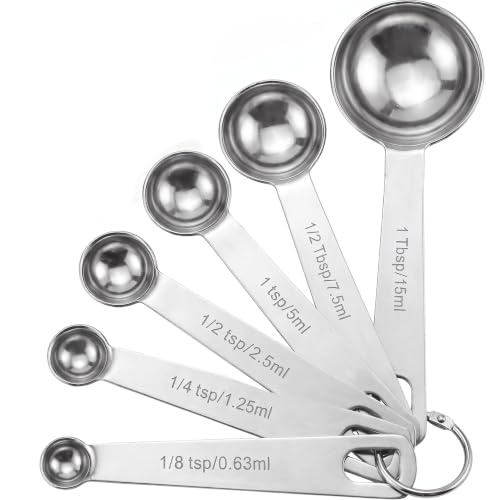
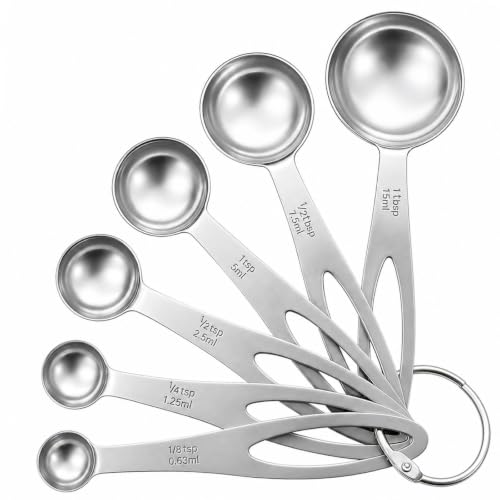
THLHKD 6-Piece Stainless Steel Measuring Spoons Set
Badge: Best Overall
Strengths
- Stainless steel construction stated in the listing, covering the everyday range from 1/8 teaspoon to 1 tablespoon.
- Clear size markings, so the set stays readable and useful for years rather than fading like printed plastic.
- Listed for dry and liquid ingredients plus coffee, spices, and protein powder, a true all-purpose material brief.
Trade-offs
- The listing states stainless steel without specifying a grade, for shoppers who want that detail.
- Spoons only; measuring cups must come from elsewhere or from a combined set.
- No leveler is included.
Mini spec box
- Material: stainless steel
- Pieces: 6
- Size range stated: 1/8 tsp to 1 tbsp
- Markings: clear size markings
- Use: dry and liquid ingredients, coffee, spices, protein powder
For most households making the switch from plastic, this is the natural first set: six stainless steel spoons covering the daily range, with markings the manufacturer describes as clear. The material case is straightforward. A steel bowl does not flex under a packed scoop, does not take on the orange stain of turmeric or the ghost of last week’s garlic the way plastic surfaces can, and does not depend on a printed layer for its size information. The stated range beginning at 1/8 teaspoon covers the small seasoning work where plastic spoons are often at their flimsiest. The honest limitation is specificity: the listing says stainless steel and no more, so the shopper who wants a stated grade should look at the U-Taste set below, which provides one. For everyone else, this set replaces the plastic spoons in the drawer with a material they can verify from the listing, at the core sizes a kitchen actually uses, and it does so without accessories or complication.
Best for: households replacing plastic spoons with a core steel set / Not suited for: shoppers who require a stated steel grade
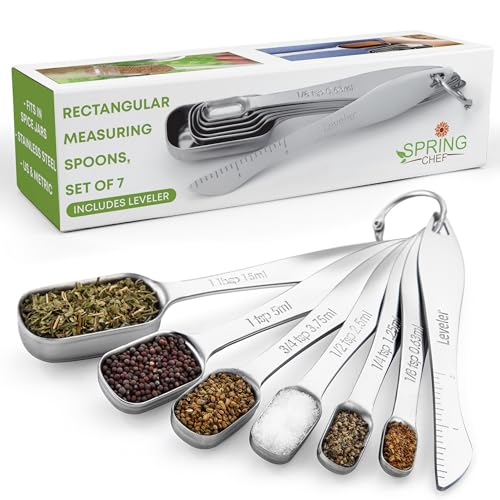
Spring Chef Nesting Stainless Steel Measuring Spoons Set of 7 with Leveler
Badge: Best for Spice Jars
Strengths
- Stainless steel with rectangular heads that fit in spice jars, so spices are measured from the jar rather than shaken.
- An included leveler makes dry measuring repeatable.
- Nesting design and a long handle suit compact, organized storage.
Trade-offs
- Steel grade is not specified in the listing.
- Rectangular bowls need a touch more care with liquids than deep round bowls.
- Spoons only, in a seven-piece set.
Mini spec box
- Material: stainless steel
- Pieces: 7 spoons plus leveler
- Head shape: rectangular
- Storage: nesting
- Handle: long handle
- Use: dry and liquid ingredients; fits in spice jars
Spice work is where a material switch pays off fastest, because spices are the ingredients most likely to stain and scent a plastic spoon permanently. A steel rectangular spoon enters the jar, measures, levels with the included leveler, and rinses clean without carrying yesterday’s smoked paprika into today’s baking soda. The nesting format keeps the seven spoons together, and the long handle reaches deep jars. For a household whose plastic-free project starts at the spice rack, this set is the most functional expression of it in the guide. Its limits are the unspecified steel grade and the rectangular bowl’s slightly less secure feel with liquids, both minor in context. Buyers focused on overall set quality across cups and spoons can compare the discussion in Best Quality Measuring Cups And Spoons before deciding.
Best for: spice-heavy kitchens switching to steel / Not suited for: shoppers who want a stated steel grade above design

Spring Chef Stainless Steel Measuring Cups and Spoons Set of 14 with Leveler
Badge: Best Complete Set
Strengths
- Cups and spoons in one stainless steel system, so the whole measuring drawer changes material in a single purchase.
- Rectangular spoons keep jar access, and the included leveler serves both cups and spoons.
- Nesting storage keeps fourteen pieces compact.
Trade-offs
- Steel grade is not specified in the listing.
- Fourteen pieces is the largest set here, with the storage and washing that implies.
- Households that only need spoons are buying cups they may not use.
Mini spec box
- Material: stainless steel
- Pieces: 14, measuring cups and spoons
- Spoon head shape: rectangular
- Storage: nesting
- Included accessory: leveler
- Use: dry and liquid ingredients
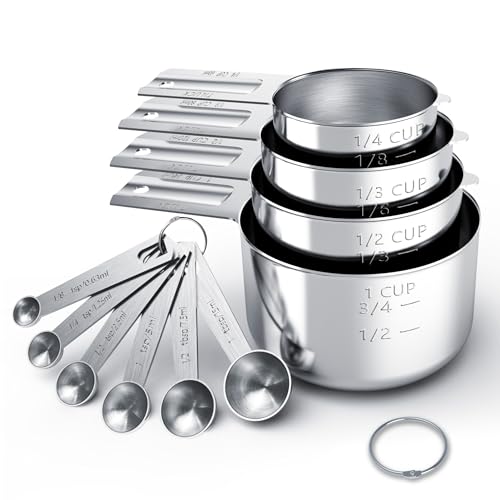
A plastic-free measuring drawer usually fails in the cups, not the spoons, because households replace the spoons and keep the old plastic cups for another few years. This set prevents that half-measure: fourteen stainless steel pieces, cups and spoons together, nesting into one stack, with a leveler for the dry measuring that cups do most consequentially with flour. The rectangular spoon heads preserve spice-jar access, so the complete set does not sacrifice the design detail that makes steel spoons pleasant to use daily. The trade-offs are scale and specificity: the grade is unstated, and fourteen pieces is a commitment for a small drawer. For a household doing the material switch properly, once, this is the most thorough option in the guide, and the one most likely to end the project rather than extend it.
Best for: a complete, one-purchase switch from plastic cups and spoons / Not suited for: minimalists or spoons-only shoppers

Hudson Essentials Stainless Steel Measuring Spoons Set of 7
Badge: Best Simple Set
Strengths
- Stainless steel spoons designed to fit in spice jars, stated plainly in the listing.
- Seven pieces cover the standard home range without accessories or extras.
- Suited to both dry and liquid ingredients.
Trade-offs
- No steel grade is specified in the listing.
- No leveler is included.
- Spoons only; no cups in the set.
Mini spec box
- Material: stainless steel
- Pieces: 7
- Design note: fits in spice jars
- Use: dry or liquid ingredients
Hudson Essentials is the quiet option: seven stainless steel spoons, jar-friendly by design, nothing else promised and nothing else needed. For the material-focused buyer, its appeal is the absence of complication: no coatings are mentioned because the product is simply steel spoons, and the listing’s two facts, stainless steel and spice-jar fit, are exactly the two facts this shopper came for. In a drawer, it behaves the way steel should, rinsing clean of spice color and scent and keeping its shape indefinitely. The limits match its simplicity: no stated grade, no leveler, no cups. If your plastic replacement project is specifically the spoon set and your other tools are already sorted, this is the direct, unadorned way to complete it.
Best for: a simple, direct plastic-to-steel spoon swap / Not suited for: buyers wanting a leveler or a stated grade
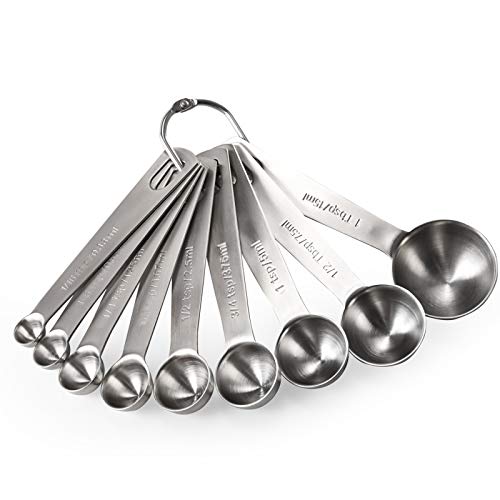
U-Taste 18/8 Stainless Steel Measuring Spoons Set of 9
Badge: Best Stated Steel Grade
Strengths
- The listing states 18/8 stainless steel, the most specific material information in this guide.
- The widest stated size range here, from 1/16 teaspoon to 1 tablespoon with intermediate 1/3 and 3/4 sizes.
- Nine steel spoons replace a plastic set and its usual gaps in a single purchase.
Trade-offs
- No leveler or cups are included.
- Nine similar spoons require reading the handle at each use.
- The very small spoons need deliberate storage so they are not lost.
Mini spec box
- Material: 18/8 stainless steel
- Pieces: 9
- Sizes stated: 1/16 tsp, 1/8 tsp, 1/4 tsp, 1/3 tsp, 1/2 tsp, 3/4 tsp, 1 tsp, 1/2 tbsp, 1 tbsp
- Use: dry and liquid ingredients
Material shoppers read listings the way other shoppers read reviews, and this is the listing that rewards them. The 18/8 designation states the steel’s family plainly, the kind of specificity that lets a buyer verify what they are getting instead of trusting a vague assurance. Around that material core sits the most complete size ladder in the guide, so the set that satisfies the material brief also happens to be the set that handles fine increments, scaling, and tiny seasoning measures without estimation. For a household that wants one purchase to settle both the material question and the capability question, this is the strongest candidate here. Its caveats are practical: no leveler, no cups, and nine spoons that demand a moment’s reading. None of those touches the material case, which is the reason it anchors the recommendations for detail-focused buyers, including those comparing options in Best Results By Ekco Measuring Spoons and other legacy-brand searches.
Best for: detail-focused buyers who want a stated steel grade and full size range / Not suited for: cooks who want cups included

THLHKD 13-Piece Stainless Steel Measuring Cups and Spoons Set with Funnel
Badge: Best for New Kitchens
Strengths
- Stainless steel cups and spoons together, stackable into one stored unit.
- Dishwasher safe construction is stated, supporting the wash-and-dry routine that keeps steel at its best.
- The included funnel makes refilling spice jars and bottles a clean job.
Trade-offs
- Steel grade is not specified in the listing.
- Thirteen pieces plus a funnel is a full kit, more than spoons-only households need.
- No leveler is stated.
Mini spec box
- Material: stainless steel
- Pieces: 13, measuring cups and spoons, plus funnel
- Storage: stackable
- Care: dishwasher safe
- Use: dry and liquid ingredients; baking and cooking
For a kitchen being set up from scratch, or an established kitchen doing the material switch in one decisive order, THLHKD’s stackable steel kit is the practical rival to the Spring Chef 14-piece. The differences are in the details: stacking rather than nesting, a funnel rather than a leveler, and stated dishwasher-safe care that suits households whose steel will be machine-washed daily. The funnel has a quiet material benefit of its own: spices refilled cleanly stay in their jars instead of dusting counters and hands, and a tidy refill routine is part of keeping a low-concern kitchen actually low-effort. The unstated grade is the standing caveat, as with most sets here. Choose between this and the Spring Chef kit by the accessory you will use more, the funnel or the leveler, confident that either completes the plastic-free measuring drawer in steel.
Best for: new kitchens and one-order material switches / Not suited for: shoppers who require a stated steel grade
Comparison Table
| Set | Pieces | Material as stated | Grade stated | Notable feature | Link |
|---|---|---|---|---|---|
| THLHKD 6 | 6 | Stainless steel | No | Clear markings, 1/8 tsp to 1 tbsp | Check on Amazon |
| Spring Chef 7 | 7 plus leveler | Stainless steel | No | Rectangular, fits spice jars | Check on Amazon |
| Spring Chef 14 | 14 | Stainless steel | No | Cups and spoons, nesting, leveler | Check on Amazon |
| Hudson Essentials 7 | 7 | Stainless steel | No | Fits in spice jars | Check on Amazon |
| U-Taste 9 | 9 | 18/8 stainless steel | Yes, 18/8 | Finest size range, to 1/16 tsp | Check on Amazon |
| THLHKD 13 | 13 plus funnel | Stainless steel | No | Stackable, dishwasher safe | Check on Amazon |
How to Choose Non Toxic Measuring Spoons
Begin with the material statement itself. A listing that names its material plainly, as every set here names stainless steel, is the foundation; a listing that hides behind vague eco language without naming a material is not giving you anything to verify. Next, decide how much specificity you need. One set here states a grade, 18/8; the rest state the material family. Many buyers are satisfied with the family name from a reputable listing, while detail-focused buyers will prefer the stated grade, and this guide flags which is which so the choice is yours rather than the marketing’s. Then check for coatings and finishes: the listings in this guide describe plain stainless steel spoons without stated coatings on the bowls, and if a finish matters to you, the product page’s full description is the place to confirm it before ordering. After material, choose on ordinary measuring merits, because a non toxic set still has to measure: size range, jar fit, storage format, and whether cups are included. Finally, think in terms of the whole drawer. The most effective material switch replaces cups and spoons together, which is why two complete kits appear in this guide; a spoons-only switch is a fine start, but the old plastic cups will still be there, waiting to be the next purchase.
How to Use and Care for Stainless Steel Spoons
Daily use needs no special ritual. Measure dry ingredients with the spoon-and-level method, liquids to the brim, and sticky ingredients with a lightly oiled spoon so they release fully. Wash the set after use, especially after salty or acidic ingredients, and dry it rather than leaving it wet in the sink; prompt washing and drying is the whole of steel care for most households, and sets whose listings state dishwasher-safe construction can go straight into the machine. Store the spoons nested, stacked, or on their ring so handles do not bend under heavier utensils, since a bent spoon measures and levels poorly. If a strong spice leaves a trace of scent in a bowl, a wash with hot soapy water, or a paste of baking soda and water for a stubborn case, restores it; steel’s non-porous surface is exactly why this works where stained plastic often keeps the ghost of the spice. Avoid steel wool on the bowls to protect the finish, and read stamped or clearly marked handles at an angle to the light when markings seem faint. That is the complete care program: wash, dry, store flat or nested, and the set will serve for years without its surface or its sizes degrading.
Troubleshooting
Problem: a steel spoon picks up a lingering spice smell → wash in hot soapy water and dry fully; for a stubborn case, apply a baking soda paste, let it sit briefly, then wash and dry again.
Problem: water spots make markings hard to read → the set is air-drying wet; towel-dry after washing and read the handle at an angle to the light, which restores contrast on marked sizes.
Problem: a spoon handle has bent slightly → it was stored under heavy utensils; store the set nested or hung, and replace a badly bent spoon, since a bent rim no longer levels accurately.
Problem: the household keeps reaching for the old plastic set out of habit → the switch was never completed physically; move the plastic set out of the kitchen drawer to a utility spot the same day the steel set arrives, so the drawer itself teaches the new habit.
What Non Toxic Means for a Spoon, in Plain Language
The phrase non toxic does a lot of work in kitchen marketing, so it is worth being precise about what a shopper can and cannot conclude from a listing. What you can conclude is the material: stainless steel is a known, stable alloy used across cookware and food equipment, it is non-porous in ordinary use, and it does not rely on a surface coating to do its job in these sets as listed. Choosing it removes plastic from the food-contact moment of measuring, which is the concrete, verifiable step this search is really about. What a listing cannot tell you is anything medical, and this guide makes no health claims for any set, because that is not what product listings establish and not what a buying guide should pretend. The honest framing is a materials framing: some households prefer to minimize plastic contact with food, especially with hot, fatty, or acidic ingredients, and steel spoons are the durable, mainstream way to do that for measuring. Within that framing, the differences among the sets here are ordinary and checkable: a stated grade on one set, jar-fit designs on others, kits versus spoons-only formats. Buy on those checkable facts, keep the health conversation for sources qualified to have it, and your drawer ends up exactly where you intended: steel, verifiable, and built to last.
Replacing Plastic One Drawer at a Time
A full kitchen material overhaul is expensive and usually unnecessary; measuring tools are the smart place to start because they are inexpensive, used constantly, and in contact with everything from hot liquids to acidic ingredients in small, repeated doses. The practical sequence most households follow is spoons first, since they stain and wear fastest in plastic, then cups, which is why this guide includes two complete kits for anyone who prefers to finish the job in one order. After the measuring drawer, the same logic extends naturally to the tools that touch food most: spatulas, storage, and prep bowls, each replaceable on its own schedule as the plastic versions wear out. There is no need to discard working tools dramatically; the sustainable version of this project, in every sense, is to replace pieces as they fail with steel or other long-life materials, so that within a year or two the drawer’s material profile has changed completely without waste or a single large bill. The sets in this guide are priced and sized for exactly that kind of step, and the one you choose today will still be the set in the drawer when the rest of the transition completes.
Steel vs Plastic vs Silicone vs Wood: A Materials Tour for Measuring Tools
Each measuring material has a real profile, and choosing well means knowing all four rather than demonizing any. Plastic is light and inexpensive, and modern food-grade plastics are regulated products; its practical weaknesses for measuring are flexibility under load, surface staining and scent retention with strong spices, and markings that are usually printed and therefore temporary. Silicone is heat-tolerant and gentle on pans, and it appears in measuring tools mostly as flexible cups and spoon-spatula hybrids; its flexibility, a virtue in a spatula, works against the crisp leveling that precision spoons exist for, which is why dedicated silicone measuring spoons are uncommon. Wood is traditional, beautiful, and kind to surfaces, but it is porous, absorbs moisture and flavors, cannot be fully sanitized the way steel can, and swells and dries with washing, so wooden measures drift out of true and are better kept for dry, rustic uses than for a precision drawer. Stainless steel’s profile is the mirror image: rigid, non-porous in ordinary use, indifferent to spice pigments, washable by any method the listing allows, and stable in shape across decades, at the cost of more weight in the hand and a higher first price than plastic. For a tool whose entire job is to be the same volume every day for years, and whose surface meets every ingredient in the kitchen, that profile is why steel dominates this guide and why the material question, once settled, rarely needs revisiting.
One more material note belongs here because shoppers ask: finishes. A plain steel spoon is a single material from surface to core, which is the simplest possible answer to the what-is-touching-my-food question. Where a set adds a colored finish, as some designs in the wider market do, the finish becomes part of the food-contact surface and deserves the same listing scrutiny as the base material: what is it, and does the manufacturer say so? The six sets in this guide are presented as stainless steel in their listings without stated bowl coatings, and this guide’s advice is to verify the full product description for any set, here or elsewhere, when a finish is visible in photos but unnamed in text.
Reading a Listing Like a Materials Shopper
Materials shopping is a reading skill, and it transfers to every future purchase. Start at the title, where honest listings put the material first, as all six here do. Then scan the description for three things: a grade or composition detail, which only the U-Taste listing provides among these sets with its 18/8 designation; any mention of coatings, linings, or finishes, whose absence in a steel listing generally means the surface is the steel itself; and care instructions, which reveal how the maker expects the surface to be treated, with dishwasher-safe statements signaling a finish the maker is confident about. Be wary of listings that lead with health adjectives and bury the material, or never state it at all; the adjective is marketing, the material is the fact. Apply the same reading to the photos last, because photos show shape and finish but cannot confirm composition. A shopper who reads this way will notice that this guide’s comparison table has a whole column for whether a grade is stated, and that most rows say no. That is not a defect in the sets; it is the normal state of the market, and it is exactly why the one stated grade earns its badge. Over time, this reading habit is worth more than any single purchase, because it converts material preference from a vibe into a verification you can perform on any product in under a minute.
The Rest of the Food-Contact Drawer: Extending the Same Logic
Once the measuring drawer is steel, the same reasoning naturally audits the tools around it, and it is worth mapping the territory so the project stays proportionate. The highest-contact tools after measuring spoons are spatulas and turners, which meet hot pans and food simultaneously; storage containers, which hold food for hours or days rather than seconds; cutting boards, whose surfaces score and harbor residue in the cuts; and water bottles and lunch gear, which are personal and daily. A sensible household works through that list in order of contact time and heat, replacing pieces as they wear, and spends its research energy where contact is longest. Measuring spoons sit at the short-contact end, which is precisely why they are the easy, inexpensive place to begin: the decision is simple, the cost is small, the tools last indefinitely, and the habit of reading materials formed here carries into the bigger purchases where it matters more. Nothing in this guide argues for urgency or alarm about the tools you already own. It argues for a direction: when a food-contact tool needs replacing anyway, choose the verifiable, durable material, and let the kitchen’s profile improve one ordinary purchase at a time. The six sets above are this year’s ordinary purchase for the measuring drawer, chosen well.
For Households with Kids: Why Steel Spoons Suit Family Kitchens
Family kitchens put measuring tools through a particular life: small hands learning to cook, spoons dropped on tile, sets left in sinks after baking projects, and ingredients measured by cooks who are still learning what a level teaspoon means. Stainless steel suits that life on purely practical grounds. It survives drops that crack plastic, it washes completely clean after the sticky, colorful projects kids love, and it does not hold the taste of yesterday’s experiment in today’s lemonade. There is also a teaching benefit: a rigid spoon with clear or stamped markings shows a young cook what a true level measure looks like, because the tool does not bend and confuse the lesson, and the same set a child learns on remains accurate when they are old enough to bake alone. Parents auditing the kitchen for materials usually start with bottles and storage; the measuring drawer is a painless addition to that audit, inexpensive and permanent. The sets here scale to family use naturally: the complete kits equip a whole household’s baking, the jar-fit sets keep spices measured rather than shaken by enthusiastic small cooks, and the fine-ladder U-Taste set supports the small, careful quantities that cooking with children often involves. No special children’s product is needed; ordinary steel, chosen once, covers the family years and beyond.
How Long a Steel Set Lasts, and What Finally Wears Out
Shoppers switching materials often ask what the end of a steel set’s life looks like, and the honest answer is that most steel sets do not wear out in any ordinary sense. There is no coating to peel, because there is no coating; there are no printed sizes to fade into illegibility where markings are stamped or clearly formed; and the bowls do not absorb the stains that make plastic sets look tired within a couple of years. What actually ends steel sets’ service is loss and bending: the teaspoon that vanishes during a move, the handle bent under a heavy pan in a crowded drawer. Both are storage problems, which is why this guide keeps returning to nesting, stacking, and rings: a set stored as a unit stays a set. A realistic expectation is that a steel measuring set bought today is the set still in the drawer a decade from now, measuring the same volumes it measured on its first day, which reframes the purchase entirely. Plastic sets are consumables bought repeatedly; a steel set is infrastructure bought once. For a material-motivated shopper, that permanence is not a side benefit but the core of the proposition: one verified material, bought once, in contact with your food for years, with nothing to degrade, shed, or be replaced. The six sets in this guide differ in design and completeness, but they share that permanence, and it is the deepest reason the material switch, once made, is rarely regretted or reversed.
Common Buying Mistakes
- Trusting vague eco or toxin-free language without a stated material; buy the material you can verify, which here is stainless steel.
- Assuming a grade is stated when it is not: only one set in this guide specifies 18/8, and the reviews flag the rest honestly.
- Replacing the spoons but keeping plastic cups for years, leaving the material switch half done.
- Ignoring ordinary measuring merits: a non toxic set with the wrong sizes or no jar fit will frustrate daily cooking.
- Neglecting basic care: leaving steel wet and stained undermines the clean-surface benefit the material was chosen for.
- Expecting medical conclusions from a product listing; listings establish materials, not health outcomes.
- Leaving both sets in the drawer after the switch, which guarantees the old plastic habits survive the purchase.
Final Recommendation
For the detail-focused material shopper, choose the U-Taste Set of 9: it states its 18/8 stainless steel plainly and adds the finest size range in the guide. For most households, the THLHKD Set of 6 is the straightforward first switch, and anyone completing the whole drawer should take a kit: Spring Chef’s 14-piece for its leveler and nesting, or THLHKD’s 13-piece for stacking, dishwasher-safe care, and the funnel. Spice-focused kitchens will be happiest with the jar-fit Spring Chef or Hudson sets. Every route ends in the same place: a measuring drawer made of a material you chose on purpose and can verify from the listing. When the set arrives, retire the plastic spoons the same day rather than letting both sets coexist, because the drawer your hand searches will keep finding the old tools out of habit. Wash the steel set, dry it, give it the front of the drawer, and let the first week of cooking establish the new normal; material switches succeed on placement and routine far more than on intention.
Frequently Asked Questions
Why do people choose stainless steel measuring spoons over plastic?
For material reasons that are easy to verify: steel is rigid and durable, non-porous in ordinary kitchen use, resistant to the staining and lingering scents that plastic can pick up from spices, and free of printed markings that wear away. Households minimizing plastic contact with food find steel the mainstream, long-lasting alternative for measuring tools.
What does 18/8 stainless steel mean?
It is a grade designation for the alloy family, stated in the U-Taste set’s listing. For a shopper, its practical meaning is specificity: the manufacturer is telling you exactly which common food-equipment steel the spoons are made from, rather than naming the material family alone. Most sets in this guide state stainless steel without a grade, and their reviews note that plainly.
Are these spoons coated?
The listings summarized in this guide describe stainless steel spoons and do not state added coatings on the bowls. If a coating or finish is a deciding factor for you, confirm it in the full product description on the listing page before ordering, since finishes are exactly the kind of detail that should be verified rather than assumed in either direction.
Is stainless steel hard to care for?
No. Wash after use, dry rather than leaving the set wet, and store it nested or on its ring so handles stay straight. One set here, the THLHKD 13-piece, states dishwasher-safe construction; for the others, a quick hand wash or top-rack care is the cautious default. That minimal routine keeps the surface and markings in good condition for years, which is the entire maintenance contract of the material: a few seconds of washing and drying in exchange for a surface that stays the same, measure after measure, without products, treatments, or replacement cycles of any kind.
Should I replace my plastic cups at the same time?
If your goal is a plastic-free measuring drawer, yes, eventually, and the two complete kits in this guide exist for that purpose. If budget or drawer space argues for stages, spoons first is the sensible order, since they wear and stain fastest, with cups following when the old set needs replacing anyway.
What should I do with my old plastic measuring spoons?
Keep one set as a backup for non-food jobs, garage and garden measuring, pet food, or craft projects, where its flexibility does no harm, and let the steel set own the kitchen drawer. If the plastic set is cracked, warped, or badly stained, retire it outright, since those are the conditions under which any tool stops measuring honestly. The transition does not require a ceremony; it requires the steel set to be in the drawer and the plastic set to stop being the one your hand finds first.
Does stainless steel affect the taste of ingredients?
Measuring contact lasts seconds, and stainless steel is used across cookware and cutlery precisely because it is a neutral surface in ordinary use. Cooks switching from plastic more often notice the opposite effect: steel does not carry forward the flavors of previous ingredients the way a scented plastic spoon can, so each measure tastes like itself. Prompt washing after strong spices keeps it that way.
Can steel spoons handle hot or acidic ingredients?
Measuring spoons meet ingredients briefly at the counter, and stainless steel is the standard material across cookware for good reason. The sensible habit is to rinse after measuring something acidic or salty rather than leaving the spoon sitting in it, which keeps any kitchen tool in its best condition over years of use.