Disclosure: topratedkitchenware.com is reader-supported. When you buy through links on our site, we may earn an affiliate commission from Amazon and other retailers, at no extra cost to you.
Where to buy
The six models below are this guide’s answer to best of convection ovens. Four carry direct listing links, because their verified listing titles state convection in so many words — as a named oven type, a named setting, or a named capability. Two are reviewed in full but kept prose-only, because their titles describe their airflow in branded or implied terms and never state convection, and a survey of convection should link only where the maker states the feature it is surveying.
- VEVOR Commercial Convection Oven, 47L (43Qt)
- Ninja French Door Premier Air Fry Oven FO101 — convection not stated in its listing title, reviewed prose-only below
- Breville Smart Oven Air Fryer Pro (BOV900)
- KoolMore 23-Inch Commercial Countertop Convection Oven (KM-CTCO-15)
- Cuisinart Air Fryer Toaster Oven Combo TOA-55
- Oster Extra-Large French Door Air Fryer Countertop Oven — convection not stated in its listing title, reviewed prose-only below
Read the full guide ↓ for what separates the commercial, flagship and balanced schools of convection design, and for the evidence rule that decided which picks are linked.
Best of convection ovens is the broadest question in this category, and it deserves a stricter answer than usual, not a looser one. Convection — hot air moved by a fan so that food cooks in a current rather than in still heat — is a specific, claimable feature. Makers state it, or they describe their airflow in their own vocabulary, or they let the words air fryer carry the implication. This guide links only the first group: picks whose verified listing titles state convection directly. The result is a survey with a spine — two commercial ovens, one premium flagship, one balanced household machine — plus two prose-only reviews of strong ovens whose makers chose other words, included so the reader can see exactly what the rule includes and what it sets aside.
The category itself spans more range than any other in the countertop world. At one end sit commercial cavities built for bakeries, where convection is not a feature but the founding assumption, and the buying questions are about pans, racks and sanitation. At the other end sit domestic flagships where convection is one setting among thirteen, and the questions are about guidance, finish and breadth. Between them sits the balanced household oven that most kitchens actually need. A best-of survey that flattens those schools into a single ranking misleads; this one ranks within a disclosed method and lets the badges carry the distinctions.
One boundary should be drawn at the start. Every pick here is a countertop oven with a single cavity. The convection world also includes built-in wall ovens, double ovens and ranges, which answer different kitchens and different budgets; readers weighing those formats will find the price landscape surveyed in Best Prices Convection Doublewall Ovens and the professional tier in Best Pro Convection Double Wall Ovens. This guide’s territory is the counter, and on the counter, these six are the pool’s strongest claims.
Key Takeaways
- Four of the six picks state convection in their listing titles and are linked; two describe their airflow in other words and are prose-only, with the reason named.
- The survey spans three schools: commercial tiered ovens, a thirteen-function domestic flagship, and a balanced household oven with stated capacity.
- The balanced pick is the only linked oven that states both convection and a household capacity figure (0.6 cu. ft.) in its title.
- Commercial picks bring credentials home ovens lack — one is ETL listed for safety and sanitation — at the cost of guidance and styling.
- Capacity evidence varies by school: litres and quarts from the commercial picks, pan-fit claims from the family machines, silence from the flagship — check the format that matches your pans.
- Convection stated is not convection identical: tier uniformity, temperature range and guidance separate these ovens more than the shared word unites them.
In this guide
Quick Picks
| Pick | Badge | Why it earns its place | Listing |
|---|---|---|---|
| VEVOR Commercial Convection Oven, 47L (43Qt) | Best Commercial Pick | A 47L four-tier commercial convection oven with trays, racks and gloves in the box, for cooks whose output is counted in trays. | Check on Amazon |
| Ninja French Door Premier Air Fry Oven FO101 | Best Finish, Convection Unstated | The most polished domestic design in the pool, with ten functions and a PFAS-free surface stated — but no convection claim in its title. | See review |
| Breville Smart Oven Air Fryer Pro (BOV900) | Best Overall | Thirteen stated functions and a stated convection setting in a premium countertop oven — the most complete domestic package in the pool. | Check on Amazon |
| KoolMore 23-Inch Commercial Countertop Convection Oven (KM-CTCO-15) | Best for Small Businesses | A 23-inch ETL-listed commercial convection oven built for half-size pans and four racks — the professional credential pick. | Check on Amazon |
| Cuisinart Air Fryer Toaster Oven Combo TOA-55 | Best Balanced Pick | Convection capability stated outright, a 0.6 cu. ft. cavity, a removable crumb tray, and a stated 12-inch pizza fit. | Check on Amazon |
| Oster Extra-Large French Door Air Fryer Countertop Oven | Best Family Size, Convection Unstated | An extra-large French door design that fits 15 by 12 inch pans, reviewed in full but not linked, because its title never states convection. | See review |
Badges name each oven’s school and role rather than pretending a single scale fits a bakery oven and a family oven equally. The two prose-only badges name the evidence gap directly, so the table can be skimmed honestly.
How These Picks Were Chosen
This survey is research-led, and its method is an evidence rule applied without exception. The six picks come from a verified pool for the convection oven category. Each listing title was read for one claim above all: does it state convection — as a named convection oven, a named convection setting, or a named convection capability? Picks that state it are linked. Picks that describe circulation in branded language, or rely on the words air fryer to imply it, are reviewed in full and linked nowhere. No specification was imported from brand reputation, sibling models, or earlier versions of the same oven.
Ranking within the linked group weighed the completeness of the stated evidence first — how much of the oven a buyer can verify from the title alone — then capability for the oven’s intended school, then the practicalities of ownership such as cleaning and guidance. Price was excluded from the ordering on principle: it changes constantly, and a best-of survey should rank machines, not moments. Each review therefore positions its oven qualitatively by tier, and leaves the live figure to be checked on Amazon at purchase time. No hands-on testing is claimed anywhere in this guide.
Scope was held deliberately. Built-in and double wall formats were excluded even where their convection credentials are impeccable, because mixing installation classes corrupts every comparison that follows; readers committed to those formats have dedicated surveys, including the Whirlpool-focused pricing picture in Best Prices Whirlpool Convection Double Wall Ovens. Microwave-convection combinations were excluded for the same reason — a different mechanism sharing a name — and are surveyed in Best Prices On Microwave Convection Ovens.
The 6 Best of Convection Ovens, Reviewed in Detail
VEVOR Commercial Convection Oven, 47L (43Qt)
Badge: Best Commercial Pick
Strengths
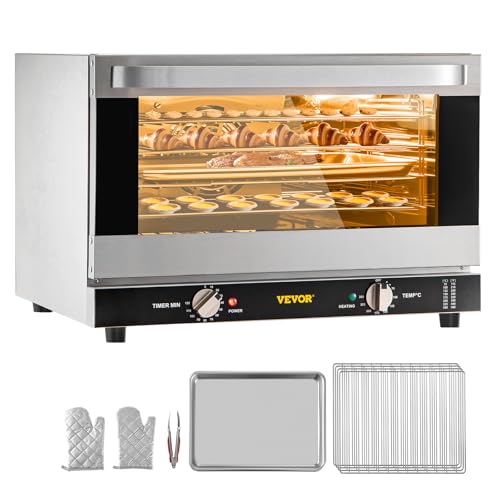
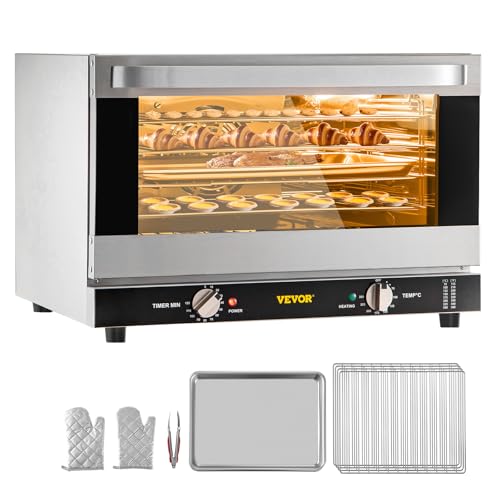
- Convection stated in the product name, with a 47L / 43Qt four-tier cavity stated beside it
- Restaurant and bakery intent stated outright, and the working kit — trays, wire racks, clip gloves — included
- 1600W stated power in a stainless commercial format built for daily, hard use
Trade-offs
- No preset library or domestic guidance; the operator is the program
- Half-size commercial format must be checked against home pans before ordering
- Commercial looks and a front glass door design that prioritise work over kitchen styling
| Capacity (as listed) | 47L / 43Qt |
| Format | Half-size countertop, 4-tier |
| Power (as listed) | 1600W |
| Door | Front glass door |
| Electrical (as listed) | 120V |
| Included (as listed) | Trays, wire racks, clip gloves |
Any honest survey of the best of convection ovens has to include the commercial tradition, because that is where convection proved itself: bakeries and restaurant kitchens adopted fan ovens for uniformity across trays long before the feature became a domestic selling point. The VEVOR 47L represents that tradition without translation. Its listing states commercial convection oven, states the cavity in two unit systems, states four tiers, and includes the gloves you need because hot trays are the daily reality. Nothing about it is styled for a lifestyle photograph, and everything about it is legible to a working cook.
What it offers a home is production logic. Four tiers turn a baking session into a single load; the front glass door lets you read browning across levels without opening the cavity; and the half-size format connects you to the commercial ecosystem of standard pans. A household that bakes for a market stall, a team, a congregation or simply a large and hungry family will find this the most capable convection tool in the guide per tier. The same household must accept the bargain: you are the preset library. Time, temperature and rotation are your decisions, every time.
Its limitation in a best-of survey is range of appeal, not quality. Cooks who want an oven to suggest, guide and forgive will find it blunt. Cooks who already know what done looks like will find it refreshingly free of opinions. In a category increasingly sold on screens and programs, there is a real argument that the most convection oven here is the one that spends its entire budget on the cavity, the fan and the racks.
Best for: batch bakers, small food businesses and confident cooks who work in trays / Not suited for: cooks who want presets, toasting finesse, or a domestic finish
Ninja French Door Premier Air Fry Oven FO101
Badge: Best Finish, Convection Unstated
Strengths
- French door cabinet in stainless with a PFAS-free surface stated in the listing
- Ten functions named as a count, with air fry, sear crisp, bake, broil, toast and dehydrate listed
- A 20.3 Qt cavity sized for real household cooking without a commercial footprint
Trade-offs
- The listing describes its airflow as cyclonic air and never states convection, so it is not linked in a convection guide
- Function-led interface asks the cook to learn Ninja’s program language
- Mid-size capacity will not serve batch or banquet cooking
| Capacity (as listed) | 20.3 Qt |
| Functions (as listed) | 10-in-1, including air fry, sear crisp, bake, broil, toast and dehydrate |
| Temperature (as listed) | 450F cyclonic air |
| Surface (as listed) | PFAS-free |
| Finish (as listed) | Stainless |
| Door | French door |
The Ninja FO101 earns its place in a best-of survey on design and breadth: a French door cabinet, a stainless finish, a stated PFAS-free surface, and ten functions whose names read like a week of household cooking — air fry, sear crisp, bake, broil, toast, dehydrate. It is the oven in this guide that most clearly imagines a person, rather than a production line, in front of it. The French doors suit daily rhythm, the function count suits varied cooking, and the 20.3 Qt cavity suits the portions most households actually make.
It is prose-only for a reason this guide applies without exception: its listing never states convection. The airflow is described as cyclonic air, a branded phrase, and a survey that links picks on stated evidence cannot translate a brand’s vocabulary into a specification on the reader’s behalf. That discipline will occasionally exclude a machine whose engineering almost certainly moves air with a fan — air frying is fan work by nature — but the alternative is a guide that asserts what listings do not say, and such guides eventually assert anything.
Consider it, then, as the design-led candidate bought on its stated merits: finish, functions, surface and size. If a stated convection specification is a requirement — for a recipe workflow, for comparison shopping, or simply for peace of mind — choose from the linked picks. If the specification matters less than the daily experience of the machine, the Ninja’s stated evidence still makes a strong case, made here with its one gap in plain sight.
Best for: design-led households cooking varied meals at household scale / Not suited for: buyers who require a stated convection specification or batch capacity
Breville Smart Oven Air Fryer Pro (BOV900)
Badge: Best Overall
Strengths
- Convection setting stated in the listing, with the maker quantifying its effect on cook time
- Thirteen functions, the broadest stated range here, with roast, bake and dehydrate named
- Brushed stainless steel flagship design from an established countertop oven line
Trade-offs
- Its listing states no capacity, so pan-fit must be verified from interior dimensions before ordering
- Premium-tier positioning, and a control system that rewards a careful read of the manual
- Breadth of functions is wasted on a cook who only ever performs three of them
| Functions (as listed) | 13 functions, including roast, bake and dehydrate |
| Convection (as listed) | Convection setting stated; maker states it reduces cook time by up to 30% |
| Finish (as listed) | Brushed stainless steel |
| Type (as listed) | Countertop oven |
| Capacity (as listed) | Not stated in listing title |
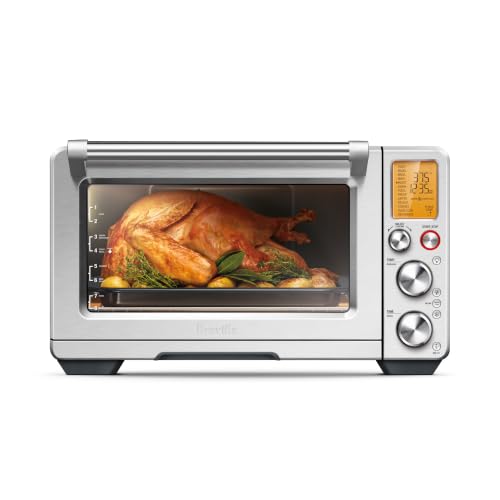
If the best of convection ovens means the most complete expression of what a domestic convection oven can be, the Breville Smart Oven Air Fryer Pro is this guide’s answer. Its listing states a convection setting in so many words and lets the maker quantify what that setting does to cook time. It states thirteen functions — the broadest count in this survey — and names roast, bake and dehydrate among them, which matters because dehydrate is the function that reveals a serious low-temperature, long-duration design rather than a toaster with ambitions. The brushed stainless cabinet is the flagship statement of a line that has defined the premium countertop category for years.
The completeness is practical, not decorative. A household with one oven slot and many cooking styles — the roast on Sunday, the weeknight bake, the air-fried snacks, the dried herbs from a garden glut — needs breadth more than it needs any single extreme. The Breville’s stated evidence covers that breadth while keeping convection, the subject of this guide, explicit rather than implied. It is also the pick most likely to replace, rather than supplement, an existing toaster oven and a separate dehydrator, which is its own kind of value in a crowded kitchen.
Two cautions belong in the record. First, the listing states no capacity, so the pan test falls to you: check interior dimensions against your largest dish before ordering, because a flagship that does not fit the family casserole is a flagship in the wrong harbour. Second, breadth has a learning curve; the control system rewards the cook who reads, and mildly taxes the cook who will not. Neither caution dents the conclusion: on stated evidence, this is the most complete domestic convection oven in the pool.
Best for: one-oven households with varied cooking who want stated convection and maximum function breadth / Not suited for: buyers who need a stated capacity in the guide, or who want the simplest possible controls

KoolMore 23-Inch Commercial Countertop Convection Oven (KM-CTCO-15)
Badge: Best for Small Businesses
Strengths
- ETL listing for safety and sanitation stated, the professional credential none of the domestic picks carry
- Purpose-built for half-size pans with four racks stated, in stainless steel
- Convection, countertop format, width and 1600W power all stated in one legible title
Trade-offs
- Twenty-three inches of commercial width is the largest counter commitment in this survey
- Sanitation-first design means a plain interface and no cooking guidance
- Adopting half-size pans is a system decision that may retire favourite home pans
| Width (as listed) | 23 in. |
| Format | Commercial countertop, for half-size pans |
| Racks (as listed) | 4 racks |
| Power (as listed) | 1600W |
| Material (as listed) | Stainless steel |
| Certification (as listed) | ETL listed for safety and sanitation |
The KoolMore KM-CTCO-15 is the pick a professional would recognise first. Its title reads like a line from a equipment catalogue — width, format, pan size, rack count, wattage, material, certification — and it closes with the credential that separates workplace equipment from home appliances: an ETL listing for safety and sanitation. In a survey of the best of convection ovens, that matters because convection’s home ground is the professional kitchen, and this is the one pick that arrives with its workplace papers in order.
For a small business — a café adding a bake-off program, a food truck, a deli, a bakery outgrowing a domestic oven — the half-size pan system is the deeper benefit. Standard pans move from rack to shelf to storage without negotiation, four racks multiply a small footprint into real throughput, and stainless steel tolerates the cleaning regime a business actually performs. The same virtues translate to a very serious home baking station, provided the counter can surrender twenty-three inches permanently.
The trade-offs are the mirror of the virtues. There is no guidance, no domestic styling, and no interest in your toast. A business buyer will call that focus; a casual home cook will call it austerity, and both will be right. This guide’s verdict is narrower: as a convection oven — fan, cavity, racks, evidence — the KoolMore is exemplary, and for the buyer whose setting is commercial, it outranks every domestic pick here.
Best for: cafés, bakeries, food trucks and other small food businesses / Not suited for: casual home cooks or narrow domestic counters

Cuisinart Air Fryer Toaster Oven Combo TOA-55
Badge: Best Balanced Pick
Strengths
- Convection capability stated in the listing, alongside a stated 0.6 cu. ft. capacity
- Removable crumb tray — the small maintenance feature that decides long-term tidiness
- Fits a 12-inch pizza as stated, the household benchmark most buyers actually picture
Trade-offs
- 0.6 cu. ft. is a household cavity, not a batch cavity; tier cooks should look to the commercial picks
- 1800W draw needs the usual circuit respect in an older kitchen
- Seven functions is a sensible bench, but function collectors will want the Breville’s thirteen
| Capacity (as listed) | 0.6 cu. ft. |
| Functions (as listed) | 7-in-1 |
| Power (as listed) | 1800W |
| Temperature (as listed) | Maximum 450°F |
| Cleaning (as listed) | Removable crumb tray |
| Fit (as listed) | Fits a 12-inch pizza |
| Finish (as listed) | Stainless steel |
The Cuisinart TOA-55 is the balanced centre of this survey, and balance in a convection oven is harder than it looks. Its listing states convection capability in plain words — the exact evidence this guide links on — then states the things a household buyer needs in the order they need them: a 0.6 cu. ft. cavity, a maximum temperature of 450°F, a removable crumb tray, and a fit claim anyone can picture, a 12-inch pizza. Seven functions cover the domestic repertoire without turning the control panel into a syllabus. It is, specification by specification, the oven that makes the fewest demands on its owner.
That temperament suits the majority of kitchens. Most households need convection for even roasting and baking, air frying for the week’s regular pleasures, and a cavity that takes the family pizza and the standard casserole. The crumb tray deserves its sentence: toaster-class ovens live or die on whether crumbs are a ten-second task or a burnt-on archaeology project, and a removable tray is the difference between an oven that stays pleasant and one that slowly becomes a chore. Stainless steel, a sane footprint for its class, and a stated temperature ceiling complete a specification with no weak line.
Its ceiling is scale. Six-tenths of a cubic foot will not batch-bake, will not take the largest roasting ambitions, and will not pretend otherwise. Buyers whose cooking is counted in trays should choose the commercial picks without regret. Buyers whose cooking is counted in family meals will find this the most proportionate convection oven in the guide — the one whose stated evidence and everyday behaviour match most closely.
Best for: most households wanting stated convection, honest capacity and easy upkeep / Not suited for: batch bakers or cooks feeding crowds from one cavity
Oster Extra-Large French Door Air Fryer Countertop Oven
Badge: Best Family Size, Convection Unstated
Strengths
- Extra-large French door format that fits 15 by 12 inch pans, as stated — the family pan claim in the pool
- Six cooking presets and an auto-shutoff timer stated, a sensible guidance bench for a big domestic oven
- French doors keep the counter in front usable and shorten the reach over hot food
Trade-offs
- Its listing never states convection, so a convection survey cannot link it on the evidence allowed
- Extra-large is a permanent counter claim, the joint-largest domestic footprint here
- Air fryer positioning means grease and crumb management are part of weekly life
| Format (as listed) | Extra-large, French doors |
| Pan fit (as listed) | Fits 15 x 12 inch pans |
| Presets (as listed) | 6 cooking presets |
| Timer (as listed) | Auto-shutoff timer |
| Type (as listed) | Air fryer countertop oven |
The Oster is the family-size argument in this survey, and its listing makes that argument concretely: an extra-large French door cabinet that fits 15 by 12 inch pans. That pan figure is the most domestic capacity claim in the pool, because it is expressed in the unit families actually own — the big baking pan, the party tray, the sheet that feeds a table. Six cooking presets and an auto-shutoff timer complete a specification aimed at busy households: enough guidance to be helpful, a safety habit built in, and doors that open sideways so a heavy pan travels a short, controlled distance.
Like the Ninja, it is prose-only on this guide’s single evidence rule: the listing never states convection. It calls itself an air fryer countertop oven, and air frying implies moving air, but implication is not a stated specification, and a survey titled convection owes its readers the word or an honest absence. The point is procedural fairness, not a judgement on the machine, which on its stated evidence — size, pan fit, presets, timer, doors — is a coherent and appealing family appliance.
Buy it, if you buy it, as exactly that: a large, guided, family air fryer oven whose convection specification you are content to leave unstated. Buyers for whom the convection claim itself is the purchase — the readers this guide primarily serves — have four linked picks whose listings say the word. Everyone else can weigh the Oster’s generous pan claim against that single missing word with both facts in front of them, which is all an honest survey can offer.
Best for: families whose largest pan is the real capacity test and who do not need a stated convection claim / Not suited for: buyers who require convection to be stated in the listing
Comparison Table
| Pick | Badge | Capacity / format (as listed) | Standout stated feature | Listing |
|---|---|---|---|---|
| VEVOR Commercial Convection Oven, 47L (43Qt) | Best Commercial Pick | 47L / 43Qt, half-size, 4-tier | Commercial convection stated; trays, racks and gloves included | Check on Amazon |
| Ninja French Door Premier Air Fry Oven FO101 | Best Finish, Convection Unstated | 20.3 Qt, French door | 10-in-1 functions; PFAS-free surface stated; convection not stated | See review |
| Breville Smart Oven Air Fryer Pro (BOV900) | Best Overall | Not stated in listing title | 13 functions; convection setting stated | Check on Amazon |
| KoolMore 23-Inch Commercial Countertop Convection Oven (KM-CTCO-15) | Best for Small Businesses | 23 in. wide, half-size pans, 4 racks | ETL listed stated; stainless steel; 1600W | Check on Amazon |
| Cuisinart Air Fryer Toaster Oven Combo TOA-55 | Best Balanced Pick | 0.6 cu. ft.; fits a 12-inch pizza | Convection capability stated; removable crumb tray | Check on Amazon |
| Oster Extra-Large French Door Air Fryer Countertop Oven | Best Family Size, Convection Unstated | Extra-large; fits 15 x 12 inch pans | 6 presets; auto-shutoff timer; convection not stated | See review |
The capacity column preserves each listing’s own language — litres, quarts, cubic feet, pan dimensions, or an honest not-stated — because converting a maker’s claim into a different unit implies a precision the evidence does not carry. Compare shapes, not just numbers: a four-tier 47L and a single-space family cavity with the same nominal volume cook very different weeks.
Note what the table cannot show: fan behaviour. Convection quality lives in airflow design, and no title in any pool quantifies it. The guide’s defence is to link only stated convection and to describe each oven’s school faithfully, so the reader’s final check — the listing itself, its documentation and its dimensions — starts from honest ground.
How to Choose a Convection Oven
Choosing a convection oven begins with a question most listings will not ask you: which school of oven is your kitchen actually in? The commercial school assumes a skilled operator and rewards throughput. The flagship school assumes varied cooking and rewards breadth. The balanced school assumes a household routine and rewards proportion. Naming your school first makes every later specification fall into place, because the right capacity, the right controls and the right cleaning burden are all school-dependent.
Verify the convection claim itself
Start where this guide starts: with the word. A listing that states convection — as the oven type, a setting, or a capability — gives you a specification you can hold the product to. A listing that circulates air under a branded name may perform beautifully, but it has not made the claim, and your recourse and your comparisons both weaken. The Breville Smart Oven Air Fryer Pro (BOV900) states a convection setting outright; the balanced Cuisinart Air Fryer Toaster Oven Combo TOA-55 states convection capability. Either phrasing is evidence. A trademarked breeze is not.
Capacity in the unit you cook in
Translate every capacity claim into your own kitchen’s units before comparing. Litres and quarts suit cooks who think in volume and batches. Cubic feet suit cooks replacing a known oven. Pan dimensions — a 12-inch pizza, a 15 by 12 inch pan — suit cooks who think in the dishes they own, and are often the most honest household measure of all. Then take the pan test physically: measure your largest pan with its handles, and require the stated format to swallow it with the door closed. A survey can rank evidence; only your tape measure can rank fit.
Temperature range and the low end
Headline temperatures cluster at the top, but convection quality shows at the bottom. Dehydrating, proofing and slow roasting ask for low, stable heat held for hours, and an oven whose stated functions include dehydrate is telling you its low end is engineered, not incidental. Check the stated ceiling against your habits too — pizza and searing reward the highest ceilings — and remember that a fan oven’s effective heat runs ahead of a still oven’s at the same dial setting, which the how-to section below turns into working rules.
Ownership: cleaning, guidance and footprint
Finally, price the ownership, not the purchase. Removable crumb trays, accessible interiors and racks that wash easily decide whether an oven is still pleasant in year two. Presets decide whether weeknight cooking is guided or manual. Footprint decides whether the oven lives on the counter as a citizen or as an obstacle. And format decides mobility: a countertop oven can move house, serve an office, or lend itself to a hall kitchen, which is why the portable end of this category has its own dedicated comparison in Best Portable Convection Ovens. Choose the oven whose ownership profile matches your patience, not just your recipes.
How to Cook With Convection, and Keep the Oven Honest
Convection changes three habits: temperature, timing and arrangement. Cooks who adjust all three get the even browning and reliable batches the feature promises; cooks who adjust none conclude, wrongly, that the fan makes little difference.
The working rules, step by step
First, when converting a conventional recipe, reduce the temperature modestly or shorten the time, and treat the first attempt as calibration — note what worked, because your oven’s fan has its own personality. Second, give air a path: pans centred, gaps between items, racks not touching walls, because convection can only cook what the current can reach. Third, use shallow, low-sided pans for roasting and browning, reserving deep dishes for braises and bakes where the fan’s drying effect is unwanted. Fourth, rotate and swap in multi-rack cooking at the halfway point. Fifth, rest roasted foods as you would from any oven — convection changes the cooking, not the chemistry of resting.
Matching the oven to the dish
Lean into convection where moving air is the point: roasted vegetables with crisped edges, trays of baked goods that must match each other, reheated fried foods that should crisp rather than steam, and dehydrating, where a gentle current over hours is the entire method. Moderate it where stillness serves: delicate cakes, custards and soufflés can prefer a conventional mode where the oven offers one, because a fan’s current can set a crust before a centre has risen. The flagship pick’s breadth is useful exactly here — an oven with many stated functions lets the cook choose the physics per dish rather than accepting one airflow for everything.
Care that protects performance
A convection oven’s performance lives in its air path, so care means keeping that path clean. Wipe splatter before it bakes into insulation-smelling varnish, wash racks and trays on the rhythm the cooking sets, empty crumb trays before they smoulder, and keep the fan’s guard free of grease film. The balanced pick’s removable crumb tray makes the most frequent job the easiest, which is why such details appear in this guide’s reviews at all. A clean fan moves the air the specification promised; a neglected one slowly converts a convection oven into a still oven with noise.
Troubleshooting: three common problems
Problem: baked goods brown on top before the centre sets → the fan is setting the surface early; lower the temperature a step, move the rack down one position, or switch to a non-convection mode for that dish if the oven offers one. Problem: roasts dry at the edges → the dish is too exposed to the current; use a deeper pan, tent loosely partway through, and shorten the cook rather than lowering it further. Problem: two racks cook unevenly → air paths are blocked or rotation was skipped; reduce pan footprints, stagger the racks, and swap positions halfway.
Convection, Air Frying, and the Words Between
The vocabulary of this category deserves one clear paragraph, because the prose-only decisions in this guide turn on it. Convection is the generic engineering term: a fan circulates heated air. Air frying is a cooking style performed with convection at high intensity in a small space — which is why nearly every air fryer oven is, physically, a convection appliance. Makers nevertheless choose their words, and the choices are informative: a maker who states convection is specifying; a maker who names a proprietary airflow is branding. Neither choice proves performance, but only one creates a verifiable claim. Readers who want the office and break-room end of this category, where toaster ovens dominate, will find it surveyed in Best Office Depot Convection Toaster Ovens.
The practical upshot for shoppers is a two-step reading habit. First, find the claim: convection stated, or airflow described in house language? Second, judge the rest of the specification on its own stated merits — capacity, temperature, functions, cleaning — because a branded airflow in a well-specified oven may serve a household better than a stated convection claim in a poorly fitting one. This guide links the first kind and reviews both kinds, which is the most a survey can honestly do.
Where Countertop Convection Ends and Built-In Begins
Every pick here plugs in and sits on a counter, and that format is a genuine school, not a compromise: installation in minutes, service without a tradesperson, a second oven exactly where a kitchen needs one at feast times. Its boundaries are equally real — cabinet volumes stop where built-ins begin, and a countertop oven is a permanent resident of your work surface. Kitchens being renovated around cooking should weigh the built-in path early, using the double-wall pricing survey in Best Prices Convection Doublewall Ovens as a map of that territory, and households adding capacity to a finished kitchen should stay here without a flicker of doubt. The best oven is the one whose format your kitchen can actually adopt.
Common Buying Mistakes
Treating air fryer and convection as opposites. Air frying is convection cooking under a style name. The useful question is not which label an oven wears but whether its listing states the convection specification you are shopping for.
Comparing capacities across unit systems by eye. Litres, quarts, cubic feet and pan dimensions are not interchangeable at a glance. Convert carefully, then verify with the pan test.
Ignoring the low end of the temperature range. Dehydrating, proofing and slow work expose weak low-temperature control that a headline maximum temperature hides. Stated functions like dehydrate are the clue.
Buying a commercial oven for domestic guidance. Tiered commercial picks are superb tools that will never once suggest a setting. Cooks who want guidance should buy it deliberately, in the flagship or balanced school.
Blocking the air path. Oversized pans against the walls convert a convection oven into a still oven with a fan trapped behind a sheet pan. Leave gaps; the current is the cooking medium.
Final Recommendation
The first choice for most readers is the Breville Smart Oven Air Fryer Pro (BOV900): stated convection, thirteen stated functions, and the flagship completeness that suits a one-oven household — provided you verify interior dimensions against your largest pan, since its listing states no capacity.
Choose by school when your school is clear. Production cooks should take the VEVOR 47L for tiered batch work; small businesses should take the KoolMore for its pan system and ETL credential; households wanting proportion over breadth should take the Cuisinart TOA-55, the balanced centre of this survey. And the two prose-only ovens remain legitimate purchases on their stated merits — the Ninja for finish and functions, the Oster for family pan capacity — bought with the single missing word clearly in view.
Frequently Asked Questions
What is the difference between a convection oven and an air fryer oven?
Mechanically, very little: air frying is high-intensity convection in a compact cavity. The difference that matters when shopping is the claim. Some listings state convection as a specification; others describe their airflow in branded terms or rely on the air fryer label. This guide links the first group and reviews both, so the distinction is visible rather than hidden.
Why are two picks prose-only in a best-of guide?
Because their listing titles never state convection — one describes its airflow as cyclonic air, the other simply calls itself an air fryer countertop oven. A survey of convection that linked them would be asserting a specification their makers did not state. They are reviewed in full because they are significant ovens, and their gap is named in their badges so no reader can miss it.
Which pick is best for a small food business?
The KoolMore KM-CTCO-15, on stated evidence: it is built for half-size pans, carries four racks, is made of stainless steel, and states an ETL listing for safety and sanitation — the credential a business setting actually needs. The VEVOR 47L is the alternative where tray volume matters more than the sanitation listing.
Does convection really cook faster?
Moving air transfers heat to food surfaces more efficiently than still air, so convection generally shortens cooks or allows lower temperatures for the same result. One maker in this guide quantifies its convection setting’s effect on cook time in its listing. Treat any such figure as a starting point and calibrate with your own first cooks, noting settings as you go.
What capacity should a household convection oven have?
Work backwards from your largest regular dish. A stated 0.6 cu. ft. cavity that fits a 12-inch pizza covers most family cooking; households that roast for crowds or bake in batches should look to the tiered commercial capacities. The only reliable test is your largest pan, handles included, with the door closed.
Can a countertop convection oven replace a full-size oven?
For many households it can handle the great majority of oven work — roasting, baking, reheating, dehydrating — while heating a smaller volume. What it cannot do is match the largest built-in cavities or free the counter it sits on. Households that cook one very large item regularly should measure that item against stated formats before deciding.
What should I check on the listing before ordering?
That convection is stated if it matters to you; the capacity in a unit you can test against your pans; the temperature range at both ends; what trays and racks are included; how crumbs and splatter are managed; and the electrical requirement. Then check the latest price on Amazon, because this guide prints none by design.