Disclosure: topratedkitchenware.com is reader-supported. When you buy through links on our site, we may earn an affiliate commission from Amazon and other retailers, at no extra cost to you.
Where to buy
Every pick in this guide to the best off grid toilets is sold through Amazon, which makes it easy to compare the current configuration, included accessories, and delivery options for your area before you commit. Start with the name links below to open each listing, read the newest owner feedback on the exact model, and confirm what ships in the box, because kits and refill supplies change over time.
- TRELINO Composting Toilet Evo S White — Check on Amazon
- Nature’s Head Structure Kit with Composting Toilet, Foot Spider Handle
- Nature’s Head Structure Kit with Composting Toilet, Spider Handle
- MODIWELL R1808 Fixed RV Dry Flush Toilet
- MODIWELL LE-310 Compact Dry Flush Toilet
- Laveo Dry Flush Toilet
Read the full guide ↓
Introduction: Living Without a Sewer Line
The best off grid toilets solve a problem that a conventional bathroom never has to think about: there is no sewer connection, no septic tank, and often no pressurized water line waiting behind the wall. Whether the setting is a remote cabin, a tiny home on a rural parcel, a converted van, or a homestead that handles its own waste by design, the toilet has to contain waste safely, control odor without a water trap, and be emptied on a schedule the owner can actually keep. That is a very different job from flushing, and it is why the products that earn a place here fall into two proven families: composting toilets that separate liquids from solids and break solids down with a dry medium, and dry flush toilets that seal each use into a disposable liner with no water at all.
This guide compares six current models across both families, all of them self-contained and waterless. We look at how each one handles the daily realities of off-grid life: how often it needs emptying, what it asks from your power system, how it behaves in cold weather, what consumables it consumes, and how much space it takes from a small floor plan. If your property does have conventional plumbing in the main house and you are comparing standard fixtures for that bathroom instead, guides such as Best One Piece Comfort Height Toilets cover a different category entirely; everything below assumes you have no flush water and no drain to connect to, or that you have deliberately chosen not to use them.
Key Takeaways
- Off-grid toilets divide into composting models, which separate urine and dry out solids, and dry flush models, which seal waste into liners for disposal.
- Composting designs reward owners who keep a simple routine: add medium, turn the handle, and empty the liquids bottle before it fills.
- Dry flush designs are the lowest-effort daily experience, but they create an ongoing need for refill liners and a small amount of battery power.
- Ventilation is the single biggest factor in odor control for a composting toilet installed indoors; plan the vent path before you buy.
- Capacity numbers only make sense against your household size, so match the solids chamber and liquids bottle to the number of daily users.
- The Nature’s Head kits are the strongest all-round composting choice here, while the MODIWELL and Laveo dry flush units suit owners who want sealing instead of compost management.
In this guide
Quick Picks
| Pick | Badge | Why it stands out | Link |
|---|---|---|---|
| TRELINO Composting Toilet Evo S White | Best Portable Pick | A compact urine-diverting composting toilet sized for camping and small spaces, with separate liquid and solid capacities. | Check on Amazon |
| Nature’s Head Structure Kit, Foot Spider Handle | Best Overall | A complete self-contained composting kit built for cabins, tiny homes, and full-time off-grid living. | Check on Amazon |
| Nature’s Head Structure Kit, Spider Handle | Best for Cabins and Tiny Homes | The same proven composting platform in a complete kit, with the standard spider handle configuration. | Check on Amazon |
| MODIWELL R1808 Fixed Dry Flush Toilet | Best Fixed Dry Flush | A rechargeable, waterless sealing toilet with a swivel top, made to stay in one place. | Check on Amazon |
| MODIWELL LE-310 Compact Dry Flush Toilet | Best for Van Life | A foldable, self-contained dry flush unit that stores small and sets up without plumbing. | Check on Amazon |
| Laveo Dry Flush Toilet | Best Sealed, Low-Effort System | A waterless, self-contained toilet that seals waste away with no compost medium to manage. | Check on Amazon |
How These Picks Were Chosen
This is a research-led guide, not a hands-on lab test, and we want to be plain about that. We built the shortlist from current Amazon listings whose product identity could be verified directly against the manufacturer’s model information, then compared the six finalists on the criteria that decide whether an off-grid toilet is pleasant or miserable to live with. Those criteria were: the waste-handling method and how much daily attention it needs; liquids and solids capacity relative to household size; whether the unit needs power, and if so, how much and from what source; the venting arrangement for indoor installations; footprint and seat height against real cabin and van floor plans; and the consumables each system consumes over a year of use, described in qualitative terms rather than invented running-cost figures.
We also read owner feedback with a skeptical eye. Recurring themes in owner reports — a liquids bottle that fills faster than expected, a fan that matters more than the brochure suggests, a liner cartridge that is easy to change — carry more weight with us than any single glowing or furious report. Where two listings describe closely related variants of the same platform, as with the two Nature’s Head kits below, we say so openly and explain the difference the listing itself identifies, rather than pretending they are unrelated products. Finally, we excluded any model that secretly depends on a water supply or a drain, because a toilet that needs plumbing is not an off-grid toilet no matter how it is marketed.
The 6 Best Off Grid Toilets

TRELINO Composting Toilet Evo S White
Badge: Best Portable Pick
Strengths
- Urine-diverting design keeps liquids separate, which is the main defense against odor in a small composting toilet.
- Compact footprint suits tents, camper vans, boats, and tight cabin corners where a full-size unit will not fit.
- No power, no water, and no vent fan required for basic outdoor and camping use.
Trade-offs
- The small chambers fill quickly with more than one or two users, so emptying becomes a frequent chore.
- There is no active ventilation, so indoor use in a closed room demands good ambient airflow.
- Solids are stored rather than actively composted at this size, so plan disposal rather than garden use.
Mini spec box
- Type: urine-diverting composting toilet
- Liquids capacity: 1.2 gal
- Solids capacity: 1.6 gal
- Dimensions: 13 x 15.4 x 11.7 inches
- Power: none required
The TRELINO Evo S is the smallest commitment in this guide, and for many off-grid situations that is exactly the point. It is a urine-diverting dry toilet: liquids run forward into a sealed bottle while solids drop into a separate chamber where they are covered with litter or medium after each use. Because urine and solids never mix, the sharp ammonia smell that gives basic bucket systems a bad name largely never forms. For a camper, a boat owner, or a cabin used on weekends by one or two people, the 1.2-gallon liquids bottle and 1.6-gallon solids chamber are workable sizes, and the whole unit lifts out easily when it is time to empty.
Its limits follow directly from its size. A family living off grid full time would empty this toilet constantly, and the absence of a powered vent means a stuffy indoor bathroom is not its natural home. Treat it as the portable end of the off-grid spectrum: excellent where mobility and simplicity matter most, outgrown where daily residential volume is the reality.
Best for: campers, van travelers, and weekend cabins with one or two users / Not suited for: full-time households or enclosed indoor bathrooms without airflow
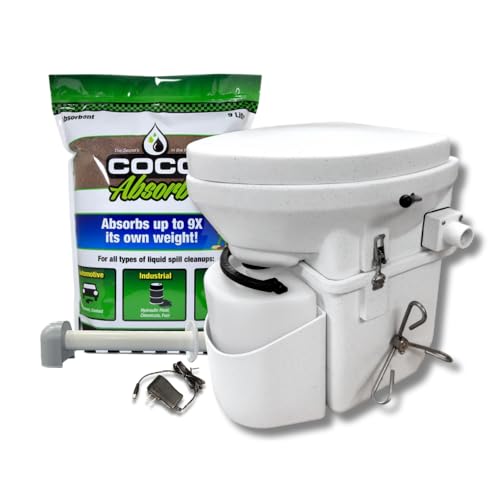
Nature’s Head Structure Kit with Composting Toilet — Foot Spider Handle
Badge: Best Overall
Strengths
- Complete all-inclusive kit intended as a self-contained, waterless system for cabins, tiny homes, and off-grid living.
- Urine diversion plus an agitator handle keeps solids drying instead of sitting wet, which is the core of real composting.
- Fully self-contained design needs no drain and no water line, so it installs where a flush toilet cannot go.
Trade-offs
- Indoor installations still need a vent path planned, and routing it is the fiddliest part of the install.
- The liquids bottle needs regular emptying in a multi-person household; forgetting it is the classic beginner mistake.
- It asks for a routine — medium, turning, emptying — that dry flush owners never have to learn.
Mini spec box
- Type: self-contained composting toilet, complete kit
- System: 100% self-contained, waterless
- Handle: foot spider handle configuration
- Intended settings: cabins, tiny homes, off-grid living
- Plumbing: none required
Nature’s Head has become the reference point for self-contained composting toilets, and this structure kit packages the toilet as a complete system for a permanent off-grid installation. The design separates urine at the seat, routes solids into a chamber filled with a dry medium such as coco coir or peat, and uses a hand- or foot-operated agitator to mix and aerate the contents after use. A small vent fan draws air through the chamber and out of the building, which both dries the solids and carries away odor before it reaches the room. For a household weighing Best Off Grid Toilets For Residential Use, this is the configuration most often meant by that phrase: fixed in place, used every day, and emptied on a predictable cycle.
The foot spider handle variant suits installations where bending to a low side handle is awkward, or where the toilet sits in a structure — a framed enclosure or platform — that changes how you reach the mechanism. Living with it well comes down to three habits: keep spare medium on hand, empty the urine bottle before it is brim-full, and let the fan run. Owners who keep those habits generally report a bathroom that smells like potting soil rather than a latrine; owners who skip them discover that composting is a process, not magic.
Best for: full-time off-grid homes, cabins, and tiny homes wanting a proven composting system / Not suited for: owners who want zero routine, or installs with no possible vent route

Nature’s Head Structure Kit with Composting Toilet — Spider Handle
Badge: Best for Cabins and Tiny Homes
Strengths
- The same complete, self-contained composting kit as its sibling listing, in the widely used spider handle configuration.
- Waterless operation removes the largest single water demand in an off-grid home.
- Composting output, once finished, is far easier to handle responsibly than raw sealed waste.
Trade-offs
- Very close in concept to the foot spider kit above, so compare both listings carefully before ordering either.
- Needs the same venting and emptying routine; there is no version of composting that maintains itself.
- Cold slows composting activity, so unheated winter cabins need adjusted expectations.
Mini spec box
- Type: self-contained composting toilet, complete kit
- System: 100% self-contained, waterless
- Handle: spider handle configuration
- Intended settings: cabins, tiny homes, off-grid living
- Plumbing: none required
We include this second Nature’s Head kit because the listing is distinct and because the handle configuration genuinely matters to some installs: the standard spider handle is operated from the side of the unit, which suits a conventional floor-standing placement against a wall, the layout most cabins and tiny homes actually have. Everything said about the composting process above applies here — urine diversion at the seat, a medium-filled solids chamber, agitation after use, and continuous gentle ventilation doing the quiet work of odor control.
For a tiny home, the appeal is structural as much as sanitary. A composting toilet removes the black-water tank, the macerator, and the dump-station trip from the design entirely, and it frees the builder from placing the bathroom where a drain can reach. If your building already has plumbing and you are simply renovating, a plumbed fixture from a guide like Best One Piece Dual Flush Toilets may serve you better; if your building has no drain at all, this kit is the kind of product the whole plan can rest on.
Best for: tiny homes and cabins with a standard floor-standing layout / Not suited for: anyone expecting a flush-and-forget experience

MODIWELL R1808 Fixed RV Dry Flush Toilet
Badge: Best Fixed Dry Flush
Strengths
- Seals each use into a liner automatically, so there is no compost medium, no agitator, and no smell of stored waste.
- Fixed format with a swivel top suits a permanent spot in an RV, boat, cabin, or off-grid bathroom.
- Rechargeable and waterless, so it asks very little from the building: no plumbing, modest power.
Trade-offs
- Every use consumes liner material, so refills are a permanent running commitment.
- Sealed waste still has to go somewhere — into household trash where local rules allow, not onto the land.
- Depends on its battery and mechanism; a flat battery means no flush until it is recharged.
Mini spec box
- Type: dry flush toilet, waterless sealing system
- Format: fixed installation, swivel top
- Power: rechargeable battery
- Plumbing: none required
- Settings listed: RVs, boats, off-grid, emergency and care use
Dry flush is the other serious answer to off-grid sanitation, and the MODIWELL R1808 shows why it has a loyal following. Instead of composting anything, it wraps and seals each use inside a fresh section of liner film, twisting it closed so odor and contents stay locked away until the cartridge is removed. The user experience is the closest thing in this guide to a normal toilet: sit, use, press, walk away. For care situations, for guests who will never learn a composting routine, and for owners who simply do not want to think about waste biology, that simplicity is worth a great deal.
The honest cost of that simplicity is consumables and disposal. Liners are a per-use resource you must keep in stock, and the sealed bundles join your regular waste stream, which some off-grid households are specifically trying to minimize. The R1808’s fixed, swivel-top format is aimed at a toilet that stays in one place — an RV bathroom, a boat head, a cabin corner — rather than one that travels in a cupboard.
Best for: fixed off-grid bathrooms, RVs, boats, and care use where simplicity beats everything / Not suited for: zero-waste households or owners who dislike buying refills

MODIWELL LE-310 Compact Dry Flush Toilet
Badge: Best for Van Life
Strengths
- Foldable, compact design stores in a fraction of the space of a fixed toilet — decisive in vans and small cabins.
- Self-contained and rechargeable, with the same one-touch sealing idea as larger dry flush models.
- No plumbing setup at all, so it moves between vehicles and buildings as your life changes.
Trade-offs
- Compact dry flush capacity suits one or two travelers, not a busy household.
- Shares the dry flush reliance on refill liners and battery charge.
- A folding unit will never feel as furniture-solid as a fixed toilet.
Mini spec box
- Type: compact dry flush toilet, waterless
- Format: foldable, self-contained
- Power: rechargeable battery
- Color listed: gray
- Settings listed: RVs, road trips, cabins, marine, van life
The LE-310 answers the question every van builder asks: where does the toilet go when there is no spare floor? Its folding design collapses for storage and sets up when needed, and because it seals waste in liner film, it does not demand the venting or the medium management of a composting unit — a real advantage in a small vehicle where drilling a vent hole is a serious decision. For road trips, seasonal cabins, and marine use, it offers dry flush hygiene in the smallest package in this guide.
Keep expectations matched to scale. This is a traveler’s toilet: superb for a couple on the road, a poor answer for a five-person homestead. If your off-grid life is stationary and daily, the fixed R1808 above or a Nature’s Head kit will serve you better; if your off-grid life has wheels, the LE-310 is built for exactly that.
Best for: van life, road trips, small boats, and seasonal cabins / Not suited for: full-time family households

Laveo Dry Flush Toilet
Badge: Best Sealed, Low-Effort System
Strengths
- The original name in dry flush: a waterless, portable, self-contained toilet that seals waste with each flush.
- No compost medium, no urine bottle, no vent fan — the lowest daily attention of any system here.
- Works across tiny homes, vans, boats, camping, RVs, and off-grid sites without modification.
Trade-offs
- Liner cartridges are a continuing purchase, and running out means the toilet is out of service.
- Sealed waste goes to the trash stream, which not every off-grid household accepts.
- Portable format trades the anchored feel of a fixed installation for flexibility.
Mini spec box
- Type: dry flush toilet, waterless
- Format: portable, self-contained
- Material listed: LDPE
- Color listed: white
- Settings listed: tiny homes, vans, boats, camping, RVs, off grid
Laveo built its reputation on a simple promise: a toilet that behaves like a toilet, anywhere, with nothing to plumb and nothing to compost. Each flush seals the bowl’s contents into the liner system below, leaving a clean bowl and no odor, and when the cartridge is finished you remove a sealed bundle rather than confronting anything you would rather not see. Positioned by its maker as easier to use than either an incinerating or a composting toilet, it is aimed squarely at owners who want sanitation handled, not a new hobby.
In a head-to-head of daily effort, nothing in this guide beats it. In a head-to-head of self-sufficiency, the composting models answer back: they consume medium instead of manufactured liners and produce a finished material rather than trash. Which trade suits you depends on your supply runs, your waste options, and your patience — the buying guide below walks through that decision in full.
Best for: owners who want the simplest possible daily routine, plus tiny homes and RVs / Not suited for: households avoiding disposable consumables
Comparison Table
| Pick | Badge | System | Key attributes | Link |
|---|---|---|---|---|
| TRELINO Evo S | Best Portable Pick | Composting, urine-diverting | 1.2 gal liquids, 1.6 gal solids; 13 x 15.4 x 11.7 in; no power | Check on Amazon |
| Nature’s Head Kit, Foot Spider | Best Overall | Composting, self-contained | Complete waterless kit; foot spider handle; cabins and tiny homes | Check on Amazon |
| Nature’s Head Kit, Spider | Best for Cabins and Tiny Homes | Composting, self-contained | Complete waterless kit; spider handle; cabins and tiny homes | Check on Amazon |
| MODIWELL R1808 | Best Fixed Dry Flush | Dry flush, sealing | Fixed format; swivel top; rechargeable; no plumbing | Check on Amazon |
| MODIWELL LE-310 | Best for Van Life | Dry flush, sealing | Foldable and compact; rechargeable; self-contained | Check on Amazon |
| Laveo Dry Flush | Best Sealed, Low-Effort System | Dry flush, sealing | Portable; LDPE body; no medium or venting needed | Check on Amazon |
How to Choose the Right Off Grid Toilet
Start with the waste philosophy, not the product. Every off-grid toilet is a commitment to a way of handling waste. Composting says: separate, dry, and let biology do slow, quiet work, in exchange for a small daily routine and a finished material at the end. Dry flush says: seal it and hand it to the trash stream, in exchange for cartridges and near-zero daily thought. Neither is morally or practically superior in the abstract; the right answer depends on your distance from supplies, your local rules on waste disposal, and your honest tolerance for routine. Owners who choose against their own temperament end up hating a good toilet.
Do the capacity math for your household. For composting models, two capacities matter: the liquids bottle, which fills fastest and sets your most frequent chore, and the solids chamber, which sets the deep-emptying cycle. One person produces a modest daily volume of urine; multiply by your household and by the days between convenient emptying opportunities, and compare honestly with the bottle size. The TRELINO’s 1.2-gallon bottle is a weekend size; a full-time household should be looking at the larger self-contained composting kits and accepting a bottle-emptying rhythm of days, not weeks. For dry flush, capacity is counted in uses per cartridge, so estimate daily uses across the household and translate that into how often you will change cartridges and how many spares you must store.
Plan power and venting before you fall in love. Composting toilets installed indoors want a small vent fan, which means a modest continuous draw on a solar battery bank and a hole through a wall or roof for the vent hose. Dry flush toilets want intermittent power to run the sealing mechanism, supplied by a rechargeable battery you must remember to charge. Off-grid power budgets are real: a tiny continuous fan load is easy to overlook in a solar calculation and annoying to discover in December. If your site has no power at all, a simple urine-diverting unit like the TRELINO, used with good ambient airflow, is the honest choice.
Measure the space and the seat. Off-grid bathrooms are small, and a toilet that fits on paper can still fail against a sloping van wall or a cabin corner. Check footprint, the swing of any lid or swivel top, and the room your knees need. Seat height matters for older users and for care situations; a very low portable unit is a poor match for someone with limited mobility, no matter how clever its waste system is. And if the building does have a plumbed bathroom as well, remember the off-grid unit only has to serve the off-grid part of your life — a guest cabin, a workshop, a boat — which often argues for the simpler end of this list.
How to Set Up and Maintain an Off Grid Toilet
Setup for a composting toilet follows a predictable sequence. First, position the unit and, for indoor installs, route the vent hose to the outside with as few bends as you can manage. Second, prepare the solids chamber with the recommended medium, moistened to the texture of a wrung-out sponge — damp, never wet. Third, fit the liquids bottle and make sure the diverter directs urine forward with the seat down. Fourth, if the unit has a fan, connect it and confirm air is moving before the first use. Dry flush setup is shorter: place the unit, fit a cartridge, charge the battery, and run one sealing cycle empty so you understand the sound and timing before you need it.
Daily and weekly care is where these toilets are won or lost. For composting: turn the agitator after solid uses, add a small handful of medium when contents look wet, and empty the liquids bottle at roughly three-quarters full rather than waiting for the brim. For dry flush: keep count loosely of uses so a cartridge never runs out mid-visit, wipe the bowl with a cloth rather than flooding it with cleaner, and keep the spare cartridge stored with the toilet, not in a distant shed. Monthly, inspect seals, hinges, and the vent path; a blocked vent announces itself as odor long before it announces itself as a mechanical fault.
Troubleshooting. Problem: a composting toilet smells indoors → check the fan is running and the vent is unobstructed first, then check whether urine is reaching the solids chamber, because a wet chamber is the most common odor source. Problem: fruit flies appear around a composting unit → the chamber is too wet or has been left unturned; add dry medium, turn thoroughly, and empty and wash the liquids bottle. Problem: a dry flush unit will not seal → check battery charge first, then confirm the cartridge is seated correctly and the liner path is not jammed with a mis-folded bundle.
Composting vs Dry Flush: The Decision That Matters Most
Strip away brands and this guide is one argument between two philosophies. Composting toilets — the TRELINO and both Nature’s Head kits — treat waste as a process. They need no consumable cartridges, they sip or ignore power, and over time they turn solids into a dry, earthy material that is far less confronting to handle than raw waste. Their price of admission is participation: medium to manage, a handle to turn, a bottle to empty, a vent to keep clear. In return they suit the deep off-grid use case, where supply runs are rare and self-reliance is the whole point of the property.
Dry flush toilets — the two MODIWELL units and the Laveo — treat waste as a package. They ask almost nothing of you day to day and they behave consistently for guests, children, patients, and renters who will never read a manual. Their price of admission is dependence: cartridges to buy and store forever, sealed waste entering the trash stream, and a battery between you and a working flush. For a property an hour from a store, visited monthly, that dependence is trivial. For a homestead at the end of a winter road, it deserves a hard think. Readers comparing the wider off-grid picture often also weigh plumbed conveniences for the main house, where topics like Best One Piece Quiet Toilets and Best One Piece Low Profile Toilets belong to a different, water-connected world.
Cold Weather, Altitude, and Other Off-Grid Realities
Winter is the season that exposes weak off-grid sanitation plans. Composting slows as temperatures fall, because the biology doing the work prefers warmth; in an unheated cabin the chamber behaves more like storage than composting, which is acceptable if you plan spring emptying with that in mind. Liquids bottles and urine lines can freeze in severe cold, so route and insulate with the same care you give your water jugs. Dry flush mechanisms are less temperature-sensitive in concept, but batteries lose capacity in the cold and liner film handles best at moderate temperatures, so store cartridges indoors where you can.
Humidity is the quieter seasonal test. In a wet coastal or forest climate, a composting chamber takes on moisture from the air itself, and owners in those regions learn to be more generous with dry medium and more disciplined about the vent fan, which is doing double duty as a dehumidifier for the chamber. In arid country the opposite problem appears: contents can dry so hard between visits to a seasonal cabin that the agitator meets real resistance, and a small amount of water added to the medium at setup keeps the system workable. Neither condition is a reason to avoid composting, but both are reasons to choose your medium and your routine for your climate rather than copying a stranger’s setup from a different one.
Altitude and transport matter for the mobile end of this guide. A sealed dry flush unit or a lidded composting portable travels without drama, while any container of liquids should be emptied before a long drive, not after it. Finally, think about the end of every waste stream before the first use: where the urine goes (diluted onto ground away from water sources is a common practice where rules allow), where finished compost goes, and where sealed cartridges go. A toilet plan that ends with “somewhere” is not finished yet.
Planning the Space: Placement, Privacy, and Daily Flow
An off-grid toilet lives closer to daily life than a plumbed one, because you interact with its systems — the bottle, the cartridge, the medium bin — as part of normal use. Placement therefore deserves more thought than “the corner it fits in.” Put a composting toilet where its vent run is short and straight, where the liquids bottle can be lifted out without a sideways shuffle, and where a bag of medium can live within arm’s reach; a routine that requires three trips across the cabin is a routine that quietly stops happening. Put a dry flush unit where a finished cartridge can be carried out without crossing the kitchen, and where its charging cable reaches an outlet without crossing a walkway.
Privacy and dignity are practical features, not luxuries. In a one-room cabin or a van, a curtain, a folding screen, or a small enclosed closet transforms the experience for partners and guests, and it also contains the small sounds and smells of any maintenance moment. Think about lighting at the toilet spot — a small warm light makes night use calmer and reduces spills — and about a handwashing answer nearby, since off-grid bathrooms often lack a plumbed sink: a jug with a tap, a basin, and a towel rail complete the room more than any upgrade to the toilet itself. Finally, plan the floor. A washable mat or a tray under the unit catches the inevitable drips from bottle changes and makes the weekly wipe-down a two-minute job instead of a project.
Supplies and Spares: What to Keep on the Shelf
Every system in this guide has a short list of things that must never run out, and an off-grid property punishes an empty shelf more than a city apartment does. Composting owners should store medium in a sealed bin (it absorbs ambient moisture if left open), spare vent fan filters or screens where the model uses them, and a dedicated small brush and spray bottle for the seat and diverter. Dry flush owners should store at least one full spare cartridge beyond the one in the unit, keep the charging cable with the toilet rather than in a general drawer, and hold a small reserve of the bags or liners their disposal routine uses. Both camps benefit from nitrile gloves, a lidded bucket for transport during emptying, and paper products chosen with the system in mind — anything that goes into a composting chamber should be plain and quick to break down.
Spares thinking extends to the toilet itself. A spare liquids bottle for a composting unit turns emptying from a deadline into a swap: full bottle out, clean bottle in, and the full one dealt with at a convenient hour. A second battery, or a small power bank routine, does the same for a dry flush toilet in a remote spot. None of these extras is glamorous, and none appears in a product title, but together they are the difference between an off-grid bathroom that feels settled and one that feels improvised. When you compare listings, it is worth checking what each kit actually includes — the Nature’s Head structure kits, for example, are sold as complete systems, while simpler portable units assume you will assemble the supporting cast yourself.
Guests, Children, and Accessibility: The Human Factors
The owner of an off-grid toilet learns its habits; everyone else in the building has to be taught, and the best systems are the ones that forgive beginners. Guests facing a composting toilet need two instructions and no more: liquids and solids go in different directions by design, so sit properly; and turn the handle afterward. A small framed card in the bathroom explaining this, plus where the medium lives, prevents the two classic guest errors — urine in the solids chamber and a forgotten agitator — better than any verbal briefing. Dry flush toilets ask almost nothing of guests, which is a genuine advantage for rental cabins and multi-generational properties, though someone still owns the cartridge count.
Children change the calculation again. A urine-diverting seat works when a child sits fully and correctly; a small child hovering produces exactly the mixing the design exists to prevent, so households with young children often keep a simple pour-rinse routine and lower their odor expectations for a few years, or choose dry flush until the children are older. For older relatives and anyone with limited mobility, judge the toilet as furniture first: seat height, stability when sitting and rising, and the effort needed to operate handles or pedals. A fixed unit at a comfortable height, with wall support nearby, will serve an aging parent far better than the cleverest folding travel toilet, and in care situations the sealed, no-contact emptying of a dry flush system protects the dignity of everyone involved.
Common Buying Mistakes
- Buying capacity for the brochure household, not the real one. Count every daily user, including guests in your busiest season.
- Ignoring the vent. An indoor composting toilet without a planned vent path is the single most common cause of disappointment.
- Forgetting consumables. Dry flush cartridges and composting medium are part of the product; if you cannot keep them in stock, choose the other family.
- Skipping local rules. Counties and parks differ on composting toilets, urine disposal, and sealed waste in trash. Check before you install, not after a complaint.
- Choosing a travel unit for a residence. Folding and mini toilets are brilliant on the road and exhausting as a full-time household’s only toilet.
- Assuming off-grid means maintenance-free. Every system here trades the plumber for a routine. Pick the routine you will actually keep.
Final Recommendation
For most off-grid homes, start with the Nature’s Head structure kit in the handle configuration that fits your layout — the Check on Amazon listing for the foot spider version is the one to open first if bending is a concern — because a complete, self-contained composting system is the most self-reliant answer over years of daily use. If the idea of managing compost genuinely puts you off, the dry flush route is respectable and far simpler day to day: look next at the Laveo (Check on Amazon) for portable flexibility or the fixed MODIWELL R1808 for a permanent spot. Travelers should take the LE-310, weekend campers the TRELINO, and anyone still deciding should re-read the composting-versus-dry-flush section above, because that choice matters more than any badge in this guide.
Frequently Asked Questions
Do off grid toilets smell?
A correctly installed and maintained one should not smell in the room. Odor almost always traces to a specific cause: a vent fan that is off or blocked, urine mixing into the solids chamber of a composting toilet, or a liquids bottle left past full. Dry flush units avoid most of these by sealing each use, which is why they are popular with guests and care settings.
What happens to the waste from a composting toilet?
Solids break down slowly in the chamber with the help of a dry medium and agitation, losing volume and moisture. When the chamber is emptied, the material is typically buried, bagged for disposal, or finished in an outdoor composting arrangement, depending on local rules. Urine is emptied separately and is commonly diluted and dispersed on ground away from wells and waterways where regulations permit.
Can an off grid toilet work with no power at all?
Yes, within limits. A simple urine-diverting toilet like the TRELINO needs no power, though it also has no fan, so it suits ventilated and outdoor settings best. Composting toilets with fans and all dry flush toilets use small amounts of power; off-grid homes usually supply this from the same battery bank that runs lights, but it must be included in the budget.
How often does a composting toilet need emptying?
The liquids bottle is the frequent chore — plan on days, not weeks, in a multi-person household. The solids chamber is the slow one, typically emptied after extended use because drying and breakdown steadily reduce its volume. Exact intervals depend on user count, medium, and temperature, which is why this guide avoids promising a fixed schedule.
Are dry flush cartridges a big ongoing commitment?
They are a real one. Each cartridge covers a limited number of uses, so a full-time household goes through them steadily and must keep spares in stock. For occasional use — a guest cabin, an RV, an emergency backup — the commitment is minor. Judge it against your distance from resupply.
Is a composting toilet legal for a residence?
Rules vary widely by county, state, and country, and some jurisdictions require specific approvals or a backup conventional system. Many rural areas accept composting toilets readily; some suburbs effectively do not. Check with your local building or health department before building a plan around one. If your home does have sewer access and you are choosing a fixture for it, Best One Piece Bidet Toilets is the more relevant starting point.
Which is better for a van: composting or dry flush?
It depends on your build. A compact dry flush like the LE-310 folds away and needs no vent hole, which many van owners prefer. A small urine-diverting composting unit avoids cartridge costs but needs airflow and more frequent bottle emptying. Space, trip length, and your feelings about drilling the van usually decide it.


