Disclosure: topratedkitchenware.com is reader-supported. When you buy through links on our site, we may earn an affiliate commission from Amazon and other retailers, at no extra cost to you.
Where to buy
The six picks below are the researched shortlist for this guide to the best organic grills. Linked picks take you to their Amazon listing, where you can check the latest price on Amazon and confirm the current configuration before you decide. Picks marked prose-only are covered in full in the reviews, without a sales link, for the reasons explained in the introduction.
- SUNLIFER Charcoal Grill Offset Smoker — Best Overall. Check on Amazon for the current listing.
- Realcook Charcoal Grill with Offset Smoker (Barrel) — Best Smoker Combo. Check on Amazon for the current listing.
- Pukomc Electric Indoor Grill 1700W — Best Indoor Electric. Check on Amazon for the current listing.
- YOHAWJAN Electric Indoor Grill 1500W — Best Tabletop Electric. Check on Amazon for the current listing.
- Char-Broil Classic 3-Burner Propane Gas Grill — Best Compact Gas. Check on Amazon for the current listing.
- Electactic 4-Burner Gas Grill with Side Burner — Best for Entertaining. Check on Amazon for the current listing.
Read the full guide ↓ for the reasoning behind the ranking, the honest limitations of every pick, and the buying guidance that will still matter after the boxes are opened.
Strip the label down and the best organic grills are the grills that let you cook over honest fuel, on honest surfaces, without chemical shortcuts — which is why this guide spans three fuel families instead of pretending only one can qualify. Charcoal grills that burn natural lump cleanly lead the ranking, electric grills that cook without combustion at all sit in the middle, and straightforward propane models close the list for readers whose ‘organic’ is about ingredients rather than fire.
The six verified picks divide neatly. Two barrel charcoal grills with offset smokers cover the traditional end — real fire, real smoke, party-size grates. Two indoor electric grills cover the apartment end, where there is no combustion, no fuel storage, and no smoke beyond what the food itself makes. Two propane cart and compact grills cover the convenience end, with porcelain-coated and stainless surfaces that clean up without harsh chemicals.
No grill carries an organic certification, and this guide will not invent one. What it does is rank real, verified products by how well each supports a cleaner way of cooking — and it is frank about the trade-offs, from charcoal’s ash to electric’s gentler sear to propane’s flavour ceiling.
Key Takeaways
- Best Overall: SUNLIFER Charcoal Grill Offset Smoker — best for backyard cooks who want charcoal flavour and an offset smoker without stepping up to a competition rig.
- Best Smoker Combo: Realcook Charcoal Grill with Offset Smoker (Barrel) — best for picnic-and-patio cooks who like running a grill and a smoker side by side.
- Best Indoor Electric: Pukomc Electric Indoor Grill 1700W — best for indoor cooks who want the highest wattage in this line-up and easy cleanup after weeknight grilling.
- Best Tabletop Electric: YOHAWJAN Electric Indoor Grill 1500W — best for apartment cooks, dorm-adjacent kitchens, and anyone whose building bans open-flame grills but who still wants grill marks and Korean-BBQ-style tabletop cooking.
- Fuel and format decide more than brand: match the grill to your space, your building rules, and your usual headcount before comparing features.
- Every specification in this guide comes from the verified listing itself; where a listing gives no figure, we say so rather than invent one.
In this guide
Quick Picks
| Pick | Badge | Why it earns its place | Listing |
|---|---|---|---|
| SUNLIFER Charcoal Grill Offset Smoker | Best Overall | Grill-plus-smoker combo covers weeknight burgers and weekend ribs | Check on Amazon |
| Realcook Charcoal Grill with Offset Smoker (Barrel) | Best Smoker Combo | Barrel-plus-offset layout separates direct grilling from gentle smoking | Check on Amazon |
| Pukomc Electric Indoor Grill 1700W | Best Indoor Electric | 1700W is strong for an indoor electric unit, so preheat and recovery are comparatively quick | Check on Amazon |
| YOHAWJAN Electric Indoor Grill 1500W | Best Tabletop Electric | True electric cooking — plugs into a standard outlet, no fuel or charcoal to store | Check on Amazon |
| Char-Broil Classic 3-Burner Propane Gas Grill | Best Compact Gas | Three burners give a genuine two-zone setup — sear on one side, hold on the other | Check on Amazon |
| Electactic 4-Burner Gas Grill with Side Burner | Best for Entertaining | Four burners plus a side burner is the most flexible cooking layout in this group | Check on Amazon |
How These Picks Were Chosen
This guide is research-led. We compared the verified product pool for the best organic grills cluster — listing specifications, formats, cooking areas, burner and firebox layouts, and the features each manufacturer actually states — and ranked the products against the use case in the keyword rather than against a generic ideal. We did not hands-on test these units, and we do not claim otherwise; what we offer is a careful, specification-honest comparison that tells you exactly what each listing does and does not promise.
Three filters did most of the work. First, truth of type: a pick had to be the kind of product the keyword asks for, or be demoted to clearly labelled prose-only coverage. Second, specification support: any number in this guide — a cooking area, an output figure, a wattage — appears in the product’s verified listing title; where the listing is silent, the guide is silent too. Third, fit for a real household: capacity against headcount, footprint against patio, and upkeep against the time a normal owner will actually spend. If you are comparing across fuel types, our notes on Best Organic Charcoal Grills and Best Natural Gas Barbecue Grills cover the neighbouring searches in this cluster.
The 6 Best organic grills

SUNLIFER Charcoal Grill Offset Smoker
Badge: Best Overall
Strengths
- Grill-plus-smoker combo covers weeknight burgers and weekend ribs
- Barrel shape holds a wide grate for family-size batches
- Charcoal fuel means real smoke flavour no electric unit can copy
Trade-offs
- Listing gives no exact cooking-area figure — compare in person if size is critical
- Manual fire control; temperature swings are part of charcoal cooking
- Ash and grease cleanup after every few cooks is non-negotiable
Key specs from the verified listing:
- Format: barrel charcoal grill with offset smoker
- Cooking area: described as spacious in listing (no figure given)
- Use cases in listing: outdoor patio, backyard, camping, parties
Charcoal cooking rewards patience in a way push-button fuels do not. The fire you build — a full chimney for a hot sear, a half chimney banked to one side for indirect roasting — is the temperature control, and a grill like this one is really a well-shaped container for that fire. Expect the first few sessions to be calibration: how long the coals take to ash over, how the vents change the temperature in the first fifteen minutes, and where the hot spots sit on the grate.
In the context of best organic grills, this pick earns its place for backyard cooks who want charcoal flavour and an offset smoker without stepping up to a competition rig. The fit is specific, not generic: the format, the fuel, and the stated specifications line up with that job in a way the other picks here do not, which is exactly what a shortlist is for. Shoppers whose cooking looks different should keep reading — the next picks redistribute those strengths toward different priorities, and the comparison table below lines the trade-offs up side by side.
Flavour is the honest reason to choose this fuel. Food cooked over real coals picks up a roasted, lightly smoked character that comes from drippings vaporising on the fire, and no flavour bar or smoke box fully imitates it. The trade is time and attention: you light the fire before you prep, you manage it during the cook, and you deal with ash afterwards. For cooks who enjoy that ritual, this format is the point, not the obstacle.
The honest limitation is worth stating plainly: listing gives no exact cooking-area figure — compare in person if size is critical. That is not a reason to cross this pick off — every grill in this guide has a limitation of the same seriousness, listed just as plainly — but it is the fact to weigh against your own cooking. If that limitation touches exactly what you cook most, choose the pick whose limitation lives somewhere you will never notice.
Best for: backyard cooks who want charcoal flavour and an offset smoker without stepping up to a competition rig / Not suited for: cooks whose priorities collide with the limitation above — see the comparison table for the better-matched alternative.

Realcook Charcoal Grill with Offset Smoker (Barrel)
Badge: Best Smoker Combo
Strengths
- Barrel-plus-offset layout separates direct grilling from gentle smoking
- Spacious grate handles mixed loads — mains in the barrel, sides in the offset warmth
- All-charcoal fuel keeps the flavour profile traditional
Trade-offs
- No numeric cooking area in the listing title — check dimensions before buying for a tight patio
- Two-chamber cooking doubles the surfaces to season and clean
- Charcoal sessions need lead time; there is no push-button start
Key specs from the verified listing:
- Format: spacious barrel charcoal grill with offset smoker
- Use cases in listing: backyard, patio, camping, picnic, party
Flavour is the honest reason to choose this fuel. Food cooked over real coals picks up a roasted, lightly smoked character that comes from drippings vaporising on the fire, and no flavour bar or smoke box fully imitates it. The trade is time and attention: you light the fire before you prep, you manage it during the cook, and you deal with ash afterwards. For cooks who enjoy that ritual, this format is the point, not the obstacle.
In the context of best organic grills, this pick earns its place for picnic-and-patio cooks who like running a grill and a smoker side by side. The fit is specific, not generic: the format, the fuel, and the stated specifications line up with that job in a way the other picks here do not, which is exactly what a shortlist is for. Shoppers whose cooking looks different should keep reading — the next picks redistribute those strengths toward different priorities, and the comparison table below lines the trade-offs up side by side.
Heat management here is manual but learnable. Open vents feed the fire and raise the temperature; closing them down starves it gently. Arrange coals in two zones — a thick bed on one side, a thin scatter or none on the other — and you gain a searing station and a safe zone on the same grate, which is how experienced charcoal cooks handle everything from steaks to whole chickens on one fire.
The honest limitation is worth stating plainly: no numeric cooking area in the listing title — check dimensions before buying for a tight patio. That is not a reason to cross this pick off — every grill in this guide has a limitation of the same seriousness, listed just as plainly — but it is the fact to weigh against your own cooking. If that limitation touches exactly what you cook most, choose the pick whose limitation lives somewhere you will never notice.
Best for: picnic-and-patio cooks who like running a grill and a smoker side by side / Not suited for: cooks whose priorities collide with the limitation above — see the comparison table for the better-matched alternative.
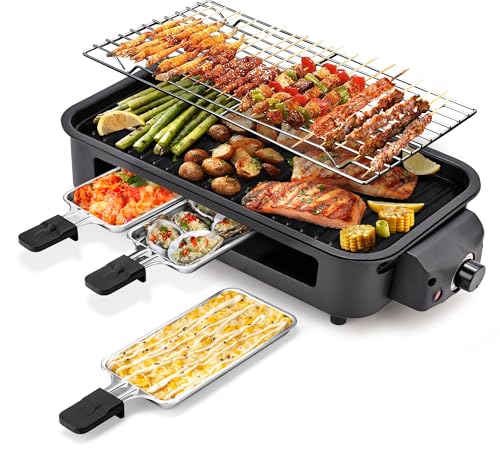
Pukomc Electric Indoor Grill 1700W
Badge: Best Indoor Electric
Strengths
- 1700W is strong for an indoor electric unit, so preheat and recovery are comparatively quick
- Two cooking surfaces — grill net and flat plate — widen what one appliance can do
- Removable dishwasher-safe parts keep the post-dinner cleanup honest and short
Trade-offs
- Still a countertop appliance — no stand, no outdoor presence
- Non-stick surfaces need non-metal utensils to stay intact
- Electric elements cycle on and off, so heat is less steady than a heavy cast-iron grate
Key specs from the verified listing:
- Power: 1700W (from listing title)
- Format: 2-in-1 indoor grill with grill net and non-stick cooking plate
- Plates: removable, dishwasher safe per listing
- Controls: temperature control
Electric grilling trades raw firepower for permission. A plug-in grill works on balconies, in apartments, and in buildings where gas and charcoal are banned outright, and it asks for nothing but an outlet. The element cycles to hold temperature, the plates do the searing, and the whole session can happen indoors when the weather refuses to cooperate.
In the context of best organic grills, this pick earns its place for indoor cooks who want the highest wattage in this line-up and easy cleanup after weeknight grilling. The fit is specific, not generic: the format, the fuel, and the stated specifications line up with that job in a way the other picks here do not, which is exactly what a shortlist is for. Shoppers whose cooking looks different should keep reading — the next picks redistribute those strengths toward different priorities, and the comparison table below lines the trade-offs up side by side.
Set expectations honestly: an electric element under a plate does not produce charcoal smoke, and the sear is gentler than a ripping-hot grate over coals. What it does produce is even, controllable heat that is very hard to burn food with, plus cleanup that usually ends at the sink. For the cooks this format serves — apartment dwellers, small-space households, tabletop-BBQ fans — those are the right priorities.
The honest limitation is worth stating plainly: still a countertop appliance — no stand, no outdoor presence. That is not a reason to cross this pick off — every grill in this guide has a limitation of the same seriousness, listed just as plainly — but it is the fact to weigh against your own cooking. If that limitation touches exactly what you cook most, choose the pick whose limitation lives somewhere you will never notice.
Best for: indoor cooks who want the highest wattage in this line-up and easy cleanup after weeknight grilling / Not suited for: cooks whose priorities collide with the limitation above — see the comparison table for the better-matched alternative.

YOHAWJAN Electric Indoor Grill 1500W
Badge: Best Tabletop Electric
Strengths
- True electric cooking — plugs into a standard outlet, no fuel or charcoal to store
- Interchangeable grill and griddle plates cover searing and flat-top cooking in one unit
- Removable non-stick plates make cleanup far simpler than a fixed outdoor grate
Trade-offs
- Countertop footprint — it is a tabletop unit, not a freestanding stand grill
- 1500W electric heat sears more gently than gas or charcoal at full blast
- Indoor smoke is reduced, not eliminated — fatty foods still need ventilation
Key specs from the verified listing:
- Power: 1500W (from listing title)
- Format: countertop indoor grill, 2-in-1 grill and griddle plates
- Plates: non-stick, removable grill and griddle plate
- Extras in listing: 3 raclette cheese pans
- Controls: temperature control
Electric grilling trades raw firepower for permission. A plug-in grill works on balconies, in apartments, and in buildings where gas and charcoal are banned outright, and it asks for nothing but an outlet. The element cycles to hold temperature, the plates do the searing, and the whole session can happen indoors when the weather refuses to cooperate.
In the context of best organic grills, this pick earns its place for apartment cooks, dorm-adjacent kitchens, and anyone whose building bans open-flame grills but who still wants grill marks and Korean-BBQ-style tabletop cooking. The fit is specific, not generic: the format, the fuel, and the stated specifications line up with that job in a way the other picks here do not, which is exactly what a shortlist is for. Shoppers whose cooking looks different should keep reading — the next picks redistribute those strengths toward different priorities, and the comparison table below lines the trade-offs up side by side.
Set expectations honestly: an electric element under a plate does not produce charcoal smoke, and the sear is gentler than a ripping-hot grate over coals. What it does produce is even, controllable heat that is very hard to burn food with, plus cleanup that usually ends at the sink. For the cooks this format serves — apartment dwellers, small-space households, tabletop-BBQ fans — those are the right priorities.
The honest limitation is worth stating plainly: countertop footprint — it is a tabletop unit, not a freestanding stand grill. That is not a reason to cross this pick off — every grill in this guide has a limitation of the same seriousness, listed just as plainly — but it is the fact to weigh against your own cooking. If that limitation touches exactly what you cook most, choose the pick whose limitation lives somewhere you will never notice.
Best for: apartment cooks, dorm-adjacent kitchens, and anyone whose building bans open-flame grills but who still wants grill marks and Korean-BBQ-style tabletop cooking / Not suited for: cooks whose priorities collide with the limitation above — see the comparison table for the better-matched alternative.

Char-Broil Classic 3-Burner Propane Gas Grill
Badge: Best Compact Gas
Strengths
- Three burners give a genuine two-zone setup — sear on one side, hold on the other
- Porcelain-coated grates resist rust better than bare steel when the grill lives outdoors
- Compact footprint suits smaller patios while still feeding a family dinner
Trade-offs
- 360 sq. in. fills up fast when cooking for a crowd
- Propane only as listed — no natural-gas configuration in this listing
- Entry-tier construction means thinner steel than premium cart grills
Key specs from the verified listing:
- Burners: 3 propane burners
- Output: 30,000 BTU (from listing title)
- Cooking area: 360 sq. in. (from listing title)
- Grates: porcelain-coated
- Extras in listing: side shelves
Gas cooking is about repeatability. Turn the knobs, wait for the preheat, and the grill is at roughly the same place it was last Tuesday, which is why so many weeknight cooks end up on propane. A multi-burner layout matters more than headline output: separate burners let you build a hot zone and a gentle zone side by side, so chicken can finish away from the flare-ups its own fat causes.
In the context of best organic grills, this pick earns its place for smaller households and first-time gas-grill owners who want real burner zoning without a huge cart. The fit is specific, not generic: the format, the fuel, and the stated specifications line up with that job in a way the other picks here do not, which is exactly what a shortlist is for. Shoppers whose cooking looks different should keep reading — the next picks redistribute those strengths toward different priorities, and the comparison table below lines the trade-offs up side by side.
Running costs and logistics are part of gas ownership. Keep a spare tank or a gauge habit, because running dry mid-cook is the classic gas-grill failure. Check burner tubes each season for blockages, brush the grates while they are still warm, and the grill will light reliably for years. None of that is difficult; all of it is easier than most owners expect before they start.
The honest limitation is worth stating plainly: 360 sq. in. fills up fast when cooking for a crowd. That is not a reason to cross this pick off — every grill in this guide has a limitation of the same seriousness, listed just as plainly — but it is the fact to weigh against your own cooking. If that limitation touches exactly what you cook most, choose the pick whose limitation lives somewhere you will never notice.
Best for: smaller households and first-time gas-grill owners who want real burner zoning without a huge cart / Not suited for: cooks whose priorities collide with the limitation above — see the comparison table for the better-matched alternative.

Electactic 4-Burner Gas Grill with Side Burner
Badge: Best for Entertaining
Strengths
- Four burners plus a side burner is the most flexible cooking layout in this group
- Stainless steel body shrugs off patio weather better than painted finishes
- Side burner handles sauces, corn, and side dishes without a trip indoors
Trade-offs
- Largest footprint here — measure your patio before ordering
- Propane configuration as listed; no natural-gas version in this listing
- More burners means more parts to clean and eventually service
Key specs from the verified listing:
- Burners: 4 main burners plus a side burner
- Output: 42,000 BTU (from listing title)
- Body: stainless steel (from listing title)
- Extras in listing: built-in thermometer
The honest limitation of gas is flavour depth. A gas flame is clean, and while drippings vaporising on hot flavour bars add a grilled character, it is milder than charcoal smoke. What you get in exchange is speed, control, and a grill that is ready before the side dishes are. For households that grill three nights a week, that trade usually wins.
In the context of best organic grills, this pick earns its place for regular hosts who cook a main and two sides at once and want everything at the grill. The fit is specific, not generic: the format, the fuel, and the stated specifications line up with that job in a way the other picks here do not, which is exactly what a shortlist is for. Shoppers whose cooking looks different should keep reading — the next picks redistribute those strengths toward different priorities, and the comparison table below lines the trade-offs up side by side.
Gas cooking is about repeatability. Turn the knobs, wait for the preheat, and the grill is at roughly the same place it was last Tuesday, which is why so many weeknight cooks end up on propane. A multi-burner layout matters more than headline output: separate burners let you build a hot zone and a gentle zone side by side, so chicken can finish away from the flare-ups its own fat causes.
The honest limitation is worth stating plainly: largest footprint here — measure your patio before ordering. That is not a reason to cross this pick off — every grill in this guide has a limitation of the same seriousness, listed just as plainly — but it is the fact to weigh against your own cooking. If that limitation touches exactly what you cook most, choose the pick whose limitation lives somewhere you will never notice.
Best for: regular hosts who cook a main and two sides at once and want everything at the grill / Not suited for: cooks whose priorities collide with the limitation above — see the comparison table for the better-matched alternative.
Comparison Table
| Pick | Badge | Fuel / format | Headline listing spec | Listing |
|---|---|---|---|---|
| SUNLIFER Charcoal Grill Offset Smoker | Best Overall | Charcoal | Format: barrel charcoal grill with offset smoker | Check on Amazon |
| Realcook Charcoal Grill with Offset Smoker (Barrel) | Best Smoker Combo | Charcoal | Format: spacious barrel charcoal grill with offset smoker | Check on Amazon |
| Pukomc Electric Indoor Grill 1700W | Best Indoor Electric | Electric | Power: 1700W (from listing title) | Check on Amazon |
| YOHAWJAN Electric Indoor Grill 1500W | Best Tabletop Electric | Electric | Power: 1500W (from listing title) | Check on Amazon |
| Char-Broil Classic 3-Burner Propane Gas Grill | Best Compact Gas | Gas | Burners: 3 propane burners | Check on Amazon |
| Electactic 4-Burner Gas Grill with Side Burner | Best for Entertaining | Gas | Burners: 4 main burners plus a side burner | Check on Amazon |
Reading the table honestly matters more than reading it quickly. The headline spec is a starting point, not a verdict: a bigger cooking area only helps if your gatherings need it, and a higher output figure only helps if the grate and burner layout can use it. The detailed reviews above explain, pick by pick, where each number helps and where it is simply printed. For a deeper dive into the neighbouring options, see Best Natural Gas Bbq Grills and Best Natural Gas Cast Iron Grills.
How to Choose the Right Grill for Organic grills
Start with the constraint you cannot change. If a lease or building rule bans open flame, the decision is already made and the electric options are your shortlist. If your patio is small, measure it — including the space the lid needs to open and the room you need to stand and work — before falling for a large cart. If your household is two people, a gathering-size grill will mostly heat air. Constraints first, features second: that order prevents nearly every bad grill purchase.
One clarification is worth making before you choose, because it shapes the whole purchase: no regulator certifies a grill as organic, and no pick in this guide claims that status. The word describes your method, not the manufacturer’s label. That is liberating rather than disappointing — it means any of these six grills can anchor an organic kitchen, and the decision returns to the honest questions of fuel, surface, and fit. A cook who grills organic vegetables on the electric plates, with no combustion in an apartment kitchen, is practising the same values as the cook smoking a pasture-raised brisket over lump charcoal in a barrel. The guide ranks charcoal first because the search phrase pairs ‘organic’ with fire most often, but the ranking is a starting point for your definition, not a verdict on anyone else’s.
Next, size the cooking area to your usual cook. Count what actually goes on the grate on a normal weekend — burgers, a pack of sausages, corn, a tray of vegetables — and notice how much room that takes. Most families discover their real requirement is smaller than the party in their imagination. A grill sized for the usual cook heats faster, uses less fuel, and cleans quicker, every single time you use it.
Then weigh control against convenience for your fuel. Charcoal gives flavour and ritual at the price of time and ash. Gas gives speed and zoning at the price of a tank and a milder smoke profile. Electric gives permission and simplicity at the price of searing intensity. None of these is a compromise to be embarrassed about; each is the right answer for a different household, and this guide ranks within the keyword’s brief rather than declaring one fuel universally best.
Finally, budget for the whole purchase, not the box. A cover, a brush, a probe thermometer, and — for charcoal — a chimney starter, or — for gas — a spare tank plan, are part of the grill in practice. A mid-tier grill with its full kit outperforms a premium grill missing its basics within a month of ownership. Our cluster notes on Best Natural Gas Gas Grills cover the adjacent choices if your shortlist is still moving.
How to Light, Cook On, and Care for a Charcoal Grill
Start with a chimney starter, not lighter fluid. Fill it according to the cook ahead — a full chimney for searing, half for a gentler fire — light the paper or cube underneath, and wait until the top coals are edged with grey ash before pouring them out. Fluid-soaked coals can leave a chemical taste on food; a chimney never does.
Build the fire for the food. For steaks and burgers, spread the coals in an even layer. For chicken pieces, whole birds, or roasts, bank the coals to one side and cook the food on the other, with the lid down — that is indirect cooking, and it is how charcoal grills roast without burning.
Use the vents as your thermostat. Bottom vents do most of the work: wide open for heat, partly closed to settle a fire down. Make small adjustments and wait several minutes between them; charcoal responds slowly, and chasing the temperature with big vent swings causes overshoot in both directions.
Keep the lid down while cooking. Every peek dumps heat and adds minutes. Look through the vent if your grill allows it, trust your timings, and open the lid when it is time to turn, baste, or check — not to admire.
After cooking, close the vents to starve the fire, let everything cool completely, and empty ash once it is cold. Ash left in the bowl absorbs moisture and rusts steel from the inside, which is the quiet killer of charcoal grills. Brush the grate while it is still warm from the next preheat, and oil it lightly before food goes on.
Troubleshooting
Problem: Food tastes faintly of fuel → what to do: The coals were not fully lit. Wait until the top layer is grey-ashed before spreading them, and switch to a chimney starter if you are using fluid.
Problem: Temperature keeps spiking → what to do: Too much air or too much fuel. Close the bottom vent partway, spread the coals thinner, and give the grill several minutes to settle before adjusting again.
Problem: Chicken burns outside, raw inside → what to do: The fire is too direct. Move the bird to the indirect side, lid down, and finish over the coals only for the last few minutes of skin crisping.
Three Fuels, One Organic Question: Which Fits Your Cooking?
Charcoal is the traditionalist’s answer. Burn natural lump — carbonised wood, nothing added — light it in a chimney, and the entire cook runs on wood and air. The cost is time, ash, and attention. If your organic interest is really about provenance and process, charcoal is where it lives, and the two offset barrels in this guide are its strongest representatives.
Electric is the minimalist’s answer. No combustion means no fuel additives, no starter chemicals, and nothing stored in a tank or a bag; the cook is exactly as clean as the ingredients you put on the plate. Propane sits between: a clean-burning fuel with instant control, chosen by cooks whose organic focus is the food itself. None of the three is the ‘correct’ reading of the keyword — your definition picks your fuel, and this guide’s ranking follows the most common one.
Surfaces, Seasoning, and Keeping the Cook Clean
Whatever the fuel, the cooking surface is where an organic approach succeeds or fails. Cast iron and steel season with use into durable, naturally low-stick surfaces that need nothing but heat, a brush, and a light coat of oil. Porcelain-enamelled grates — like those on the compact gas pick here — clean with hot water and a brush rather than chemical sprays. Non-stick indoor plates, like those on the electric picks, want wooden or silicone tools and gentle washing to stay intact.
Two habits complete the picture. Burn in any new grill hot and empty before its first cook to clear manufacturing residue, and clean as you go — a grate brushed while warm rarely needs anything stronger later. Organic cooking is mostly a set of small, consistent habits; the grill just has to cooperate, and every pick here does.
What Ownership Looks Like After the First Month
Ownership of a charcoal grill settles into a rhythm after the first month. You learn your grill’s chimney count the way you learn a coffee ratio: a full chimney for steak night, half for chicken, a modest pile for vegetables. You keep charcoal dry — a lidded bin beside the grill — because damp lump lights reluctantly and burns sulkily. You develop a vent memory for your particular bowl or barrel, and the anxious thermometer-watching of the first cooks fades into occasional, confident checks.
The running costs are honest and small: charcoal itself, replacement grates every few seasons depending on material, and the occasional handle, wheel, or ash pan. What owners consistently report valuing is not any single feature but the absence of failure modes — there is no igniter to die, no element to burn out, no regulator to reset. A charcoal grill that is kept dry and emptied of ash simply continues, which is why so many of them are inherited rather than replaced.
Common Buying Mistakes
- Buying on cooking area alone. A huge barrel is wonderful for parties and wasteful for Tuesday; match the grate to your usual headcount, not your biggest-ever gathering.
- Skipping the chimney starter and reaching for lighter fluid, then blaming the grill for the taste. The chimney costs little and removes the problem entirely.
- Cooking everything directly over the fire. Without an indirect zone you have no safe place for food that is browning faster than it cooks through.
- Leaving ash in the bowl between cooks. Ash plus moisture is a rust recipe; two minutes with a scoop after the grill cools saves the firebox.
- Trusting the lid thermometer as grate temperature. It reads the air near the lid. A simple probe thermometer at grate level tells the truth.
- Choosing a kettle or barrel with no plan for where it lives. Charcoal grills are hot, smoky, and need clearance from walls, fences, and overhangs.
One more mistake deserves its own line: buying from a headline instead of a listing. Specifications drift between model years and variants, so confirm the exact configuration — burner count, cooking area, included stand or shelves — on the listing itself before ordering. The guides at Best Natural Gas Grills 42 Inch and Best Natural Gas Grills At Home Depot walk through the neighbouring variants in this cluster if you want a second comparison before deciding.
Final Recommendation
Start with the SUNLIFER Charcoal Grill Offset Smoker (Best Overall). It is the pick whose strengths line up most completely with best organic grills: the format fits, the verified specifications support the job, and its main limitation is the one most cooks in this category will notice least. If your household matches its profile — backyard cooks who want charcoal flavour and an offset smoker without stepping up to a competition rig — the decision is genuinely this simple.
Choose differently when your priorities differ: the Realcook Charcoal Grill with Offset Smoker (Barrel) if picnic-and-patio cooks who like running a grill and a smoker side by side; the Pukomc Electric Indoor Grill 1700W if indoor cooks who want the highest wattage in this line-up and easy cleanup after weeknight grilling; the YOHAWJAN Electric Indoor Grill 1500W if apartment cooks, dorm-adjacent kitchens, and anyone whose building bans open-flame grills but who still wants grill marks and Korean-BBQ-style tabletop cooking. Each of those picks trades a little of the leader’s all-round fit for a clear advantage in one direction, and the detailed reviews spell out exactly what that trade costs.
Our top linked picks, for a final check of current listings: SUNLIFER Charcoal Grill Offset Smoker, Realcook Charcoal Grill with Offset Smoker (Barrel), Pukomc Electric Indoor Grill 1700W.
Frequently Asked Questions
What makes a grill ‘organic’?
Nothing official — there is no organic certification for grills. Shoppers use the word for cooking over natural fuel without chemical starters, on inert surfaces like steel, cast iron, or porcelain. This guide ranks grills by how well they support that approach.
Is charcoal or electric better for organic cooking?
They answer different definitions. Lump charcoal lit in a chimney is the traditional wood-fired route; electric involves no combustion or fuel at all. Choose charcoal for flavour and process, electric for apartments and simplicity.
Can a propane grill fit an organic approach?
Yes, if your focus is ingredients and clean surfaces — propane burns cleanly and the grills here use porcelain-coated or stainless cooking surfaces. It will not give you wood-fire provenance, and this guide ranks it accordingly.
How do I grill organically without lighter fluid?
A chimney starter with paper or a natural firelighter, plus lump charcoal, removes fluid from the process entirely. Wait for grey-ashed coals before cooking and there is no chemical taste to avoid.
Which pick is best for an apartment?
The two indoor electric grills. They need only an outlet, produce no combustion by-products, and their removable plates clean at the sink — the practical organic option where open flame is banned.
Do offset smokers help organic cooking?
They help organic barbecue: a separate firebox lets you smoke low and slow over pure wood charcoal heat. If you will smoke meats regularly, the two barrel combos here are the natural picks.
Still comparing? The neighbouring guides in this cluster — Best Natural Gas Grills At Lowes — cover the closest alternative searches, with the same verified-listing standard applied throughout.


