Disclosure: topratedkitchenware.com is reader-supported. When you buy through links on our site, we may earn an affiliate commission from Amazon and other retailers, at no extra cost to you.
Where to buy
The best outdoor cookers for most households are not the ones in the camping catalogue — they are the compact electric cookers that ride to the patio, the RV, the tailgate or the powered campsite and produce real food where a socket or hookup exists. This guide is honest about that definition from the first line: every pick below is an electric countertop cooker, not a propane burner and not weatherproof, and we review them for powered outdoor living — patios, decks, RV kitchens, holiday parks and tailgates with power. Each name links to its Amazon listing so you can check the latest price on Amazon and confirm the size suits your setup.
- BLACK+DECKER 6-Cup Rice Cooker with Steaming Basket — Check on Amazon
- Aroma ARC-363NG Rice Cooker and Soup Maker (1.5 Qt)
- Zojirushi NS-ZCC10 Neuro Fuzzy Rice Cooker and Warmer
- Zojirushi NS-TSC10 Micom Rice Cooker and Warmer (5.5-Cup)
- Dash Mini Rice Cooker (2-Cup, Ceramic Nonstick)
- BLACK+DECKER 16-Cup Rice Cooker (RC516)
Read the full guide ↓
Type best outdoor cookers into a search box and you will be shown two different worlds. One is fire: propane burners, camp stoves and grills. The other — the world this guide honestly covers — is powered outdoor living, where the cooking happens on a patio table, in an RV galley, at a holiday-park hookup or beside a tailgate with a generator or mains lead nearby. For that second world, a compact electric cooker is often the best outdoor cooker of all: no fuel to carry, no open flame for sites that ban it, no wind blowing the heat sideways, and food that cooks itself while you are outside enjoying the day instead of tending a burner.
We will not pretend these six machines are something they are not. None of them burns propane, none is rated for rain, and none belongs on a backcountry trail. What they are is a well-chosen spread of portable electric cookers — from a two-cup personal Dash that fits in a tote bag to a sixteen-cup BLACK+DECKER that feeds a crowd — each verified, each reviewed for how it behaves when the kitchen is a picnic table. Flame-cooking readers are not ignored: the guide explains where electric stops and fire should take over, and our related coverage of Best Pellet Cookers explores the fuel-burning end of outdoor cooking for those who want smoke with their supper.
Read the picks with your own outdoor life in mind. The right answer for a couple touring in a campervan is the wrong answer for a family hosting patio dinners, and both are wrong for a student whose balcony is their entire outdoors. The reviews below are organised around exactly those differences.
Key Takeaways
- Every pick here is electric: these are cookers for patios, RVs, powered campsites and tailgates with a socket or hookup — not propane burners, and not rain-proof.
- Portability is a system, not a spec: cooker size, a lid that stays put in transit, and a pot that removes for washing at a campsite sink all matter.
- The Dash Mini and Aroma 1.5 Qt suit one or two people; the 16-cup BLACK+DECKER is the only pick here that feeds a crowd.
- Fuzzy-logic and Micom Zojirushi models deliver the best grain quality outdoors, where nobody wants to babysit a pot.
- Keep electric cookers under cover and away from wet ground outdoors; a dry, level, shaded surface is part of the setup, not an afterthought.
In this guide
Quick Picks
| Pick | Badge | Why it earns its place |
|---|---|---|
| BLACK+DECKER 6-Cup Rice Cooker | Best for RV and Patio Sides | Six cooked cups with a steaming basket — patio sides and RV dinners for one to three people, in a body that stores anywhere. |
| Aroma ARC-363NG Rice Cooker | Best Personal Size | A personal soup-and-grains cooker for solo travellers and couples who cook small at powered pitches. |
| Zojirushi NS-ZCC10 Neuro Fuzzy | Best Premium Grain Quality | Flagship grain quality with a delay timer, for households whose outdoor table still expects proper rice. |
| Zojirushi NS-TSC10 Micom | Best Mid-Size for Families | Micom precision in a mid-size body that suits family touring and regular patio use. |
| Dash Mini Rice Cooker | Most Portable | The smallest, lightest cooker here — a personal grain station that travels in a tote and cooks for one. |
| BLACK+DECKER 16-Cup Rice Cooker | Best for Feeding a Crowd | Sixteen cooked cups and a steaming basket: the crowd feeder for patio parties, team events and big family gatherings. |
How These Picks Were Chosen
We selected these six from verified listings with outdoor-with-power use as the filter. That meant weighing the things that matter outside a kitchen: physical size and storability in an RV locker or car boot, capacity matched to realistic outdoor groups, simple controls that work in bright sunlight without a manual, removable pots and bowls that can be washed in a shallow campsite sink, and keep-warm or delay functions that let food wait while people swim, hike or watch the game. Every specification quoted in the reviews — capacities, baskets, timers, coatings — comes from the verified listing for that model, and nothing else.
The method is research-led, and its limits are stated plainly: we are not claiming expedition testing. We compared published specifications, feature sets and design intent across the pool, and we excluded nothing silently — the pool simply contains no flame cookers, which is why this guide defines its outdoor honestly as the powered kind. Readers whose outdoor cooking centres on big rice-based gatherings may also want Best Paella Cookers, where large-format grain cooking gets its own treatment.
The 6 Best Outdoor Cookers for Powered Patio, RV and Campsite Cooking

BLACK+DECKER 6-Cup Rice Cooker with Steaming Basket
Badge: Best for RV and Patio Sides
Strengths
- Simple one-touch style operation with very little to learn
- Removable non-stick bowl is quick to wash
- Steaming basket adds a second cooking job at no extra size
Trade-offs
- Six cooked cups is a small batch for families
- Basic feature set — no digital programs in the listing
- White finish shows stains more readily
Key specs (from the verified listing)
- Capacity: 6 cups cooked
- Bowl: removable, non-stick
- Accessory: steaming basket
- Colour: white
BLACK+DECKER built this cooker for people who want dinner without a manual: a removable non-stick bowl, a steaming basket, and simple controls in a clean white housing. Six cups cooked is the right scale for one to three people — a side of rice for a family dinner, or a full small meal of grains and steamed vegetables for a couple. The removable bowl goes straight to the sink, and the steaming basket means fish, dumplings or vegetables can cook in the same cycle as the rice below. There is no digital program library here and the listing does not promise one; what you get is predictability. It will not slow cook a stew or sauté, and it is too small for entertaining. As a compact, honest grain-and-steam appliance, it does exactly what its name says.
Outdoors, the BLACK+DECKER six-cup earns its place through sheer practicality. It is small enough for an RV locker, simple enough to run on a patio table without a thought, and its steaming basket is a genuine outdoor asset: vegetables, corn portions or dumplings steam above the grains, so one small machine on one socket produces a two-part meal. The removable non-stick bowl is the other campsite virtue — it lifts out and washes in a small sink where a fixed pot would be a wrestling match. For one to three people eating outside, this is the sweet spot of the line-up.
Best for: RV travellers, patio cooks and small outdoor meals for one to three / Not suited for: groups, or anyone needing digital programs outdoors

Aroma ARC-363NG Rice Cooker and Soup Maker (1.5 Qt)
Badge: Best Personal Size
Strengths
- Smallest footprint here — ideal for one or two people
- Soup and oatmeal roles suit small-batch cooking beyond rice
- Automatic keep-warm needs no attention after cooking
Trade-offs
- Too small for family batches or entertaining
- Basic controls with no digital programming
- No steamer basket named in the verified listing
Key specs (from the verified listing)
- Capacity: 3 cups uncooked / 6 cups cooked (1.5 Qt)
- Functions: rice, oatmeal, soup maker
- Keep warm: automatic
- Colour: white
The ARC-363NG is Aroma in miniature: one and a half quarts, three cups uncooked or six cups cooked, with automatic keep-warm and a listing that names oatmeal and soup making alongside rice. That soup-maker note matters — a compact cooker that handles a small pot of soup, a morning of oatmeal and a side of rice covers a surprising share of solo and couple cooking. It is the kind of appliance that earns a permanent counter spot in a small apartment precisely because it is small. The boundaries are obvious and worth stating: six cooked cups will not feed a crowd, there are no digital programs to fine-tune, and the verified listing does not name a steamer basket. Buy it for what it is — a personal-size cooker that does small batches well — and it is a satisfying, space-honest choice.
The little Aroma is the solo traveller’s cooker. At one and a half quarts it disappears into a cupboard or a storage box, yet it covers the meals a single camper or a couple actually cook at a powered pitch: a small soup, morning oatmeal, a side of grains. Automatic keep-warm matters more outdoors than in, because outdoor evenings refuse to run on schedule — the food waits politely while the sunset does its thing. It will not feed a group and does not claim to. For personal-scale outdoor cooking with power, it is honest, tiny and useful.
Best for: solo campers and couples at powered pitches / Not suited for: families or any group larger than two
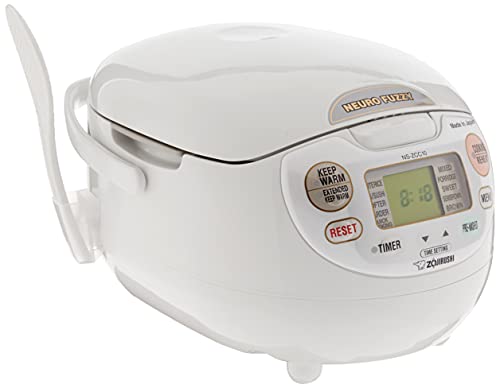
Zojirushi NS-ZCC10 Neuro Fuzzy Rice Cooker and Warmer
Badge: Best Premium Grain Quality
Strengths
- Neuro Fuzzy logic is renowned for consistent grain texture
- Automatic keep-warm and delay timer support set-ahead cooking
- A specialist machine from a brand built on rice cookers
Trade-offs
- A rice specialist — no slow cook or sauté in the listing
- Premium-tier positioning in its class
- White finish needs wiping to stay bright
Key specs (from the verified listing)
- Technology: Neuro Fuzzy logic
- Keep warm: automatic
- Timer: delay timer
- Colour: white
Zojirushi built its reputation on rice, and the NS-ZCC10 shows why: Neuro Fuzzy logic that continually adjusts temperature and time during the cycle, automatic keep-warm, and a delay timer so the rice finishes when dinner does. This is a specialist instrument. The verified listing promises excellence at grains and warmth-holding, and nothing else — no sauté, no slow cook, no steamer theatrics. Judge it as a specialist and it is superb: households that eat rice daily notice the difference in texture consistency that fuzzy-logic control delivers, batch after batch. Judge it as a multicooker and it will disappoint, because it never claimed to be one. The white finish is classic Zojirushi and wipes clean easily. For grain-centred cooking where the base itself is the main event, this is the connoisseur pick of the group.
The Zojirushi NS-ZCC10 is the pick for people whose outdoor table is an extension of a serious kitchen — the holiday home, the long-stay pitch, the patio of a household that entertains around rice-based meals. Neuro Fuzzy control means the grains come out right without supervision, which outdoors translates to freedom: set it, use the delay timer, and go back to your guests. Automatic keep-warm holds the result. It is a premium-tier, specialist machine and the least rough-and-tumble here — transport it in its box or a padded bag, keep it dry, and it will reward you with the best grain texture in this guide.
Best for: grain purists cooking outdoors at home-base settings / Not suited for: rough transport or wet-weather use of any kind

Zojirushi NS-TSC10 Micom Rice Cooker and Warmer (5.5-Cup)
Badge: Best Mid-Size for Families
Strengths
- Micom control gives precise, repeatable grain cooking
- Handy 5.5-cup size for small-to-mid households
- LCD controls and delay timer are easy to live with
Trade-offs
- Mid-size capacity will not cover large gatherings
- Rice-focused feature set, like its sibling
- Fewer functions than similarly sized multicookers
Key specs (from the verified listing)
- Capacity: 5.5 cups (1.0 litre)
- Technology: Micom (microcomputerised) control
- Controls: LCD, with delay timer
The NS-TSC10 is Zojirushi in a slightly smaller, LCD-controlled package: five and a half cups, one litre, Micom computerised control and a delay timer. Where the Neuro Fuzzy model is the flagship statement, the TSC10 is the everyday precision tool — big enough for a family side dish or a couple of days of grains for two, small enough to live on the counter. Micom control keeps cooking repeatable: the same grains, the same water, the same result, which is what regular rice eaters actually want from a machine. The listing keeps the promise narrow — a rice cooker and warmer with good controls — and that narrowness is a virtue for buyers who are tired of appliances that do nine things adequately. It will not braise or sauté. It will make the grains it was built for, very well, for years.
The TSC10 splits the difference for touring families: five and a half cups of Micom-controlled cooking in a body that travels more easily than its flagship sibling. LCD controls read clearly, the delay timer lets a day out end with food ready, and the size matches real family sides without the bulk of a crowd machine. On a patio it is the everyday-driver pick; in a larger RV or a holiday rental it covers breakfast grains through dinner sides. Like all Zojirushi machines it is a grain specialist, so plan other appliances — or a campfire — for anything beyond grains and warming.
Best for: touring families who want precise grains without bulk / Not suited for: crowd catering or off-grid cooking without power

Dash Mini Rice Cooker (2-Cup, Ceramic Nonstick)
Badge: Most Portable
Strengths
- Truly personal size — the smallest cooker in this pool
- Ceramic nonstick pot removes for easy washing
- Handles oatmeal and quinoa as well as rice
Trade-offs
- Two cooked cups is a single serving, not a side for sharing
- No capacity for entertaining or batch cooking
- Basic feature set by design
Key specs (from the verified listing)
- Capacity: 1 cup uncooked / 2 cups cooked
- Pot: removable, ceramic nonstick
- Keep warm function
- Also cooks: oatmeal, quinoa and grains
- Colour: black
The Dash Mini is exactly what it sounds like: a personal rice cooker that takes one cup uncooked and returns two cups cooked, in a removable ceramic nonstick pot with a keep-warm function. The listing also names oatmeal and quinoa, which is the honest frame for this machine — it is a single-serving grain station for a dorm room, a small apartment, an office kitchenette or one person who cooks for one. The ceramic pot lifts out, rinses clean and goes back in seconds. Nothing about the Dash pretends to scale: it cannot feed a family, host a dinner or batch-cook a week of lunches. But portability and portion honesty are features too. For the cook who eats alone most nights and hates washing a full-size pot for a single serving, this little machine solves a real problem neatly.
If portability is the whole point, the Dash Mini wins it outright. One cup uncooked, two cups cooked, a removable ceramic pot and a body small enough for a tote bag, a desk drawer or the corner of a campervan. It is a personal outdoor cooker: grains or oatmeal for one, cooked wherever there is a socket — a powered pitch, a marina berth, a festival crew area with facilities, a balcony. Nobody should buy it to feed friends. Everybody who cooks alone away from home should look at it, because full-size cookers simply do not travel like this.
Best for: one person cooking anywhere a socket exists / Not suited for: sharing — it makes a single serving by design

BLACK+DECKER 16-Cup Rice Cooker (RC516)
Badge: Best for Feeding a Crowd
Strengths
- Big batch capacity with one-touch simplicity
- Steaming basket cooks a second food over large grain batches
- Removable bowl keeps cleanup manageable at this size
Trade-offs
- Too large for one- or two-person everyday cooking
- One-touch means no fine program control
- Needs storage space when not in use
Key specs (from the verified listing)
- Capacity: 16 cups cooked / 8 cups uncooked
- Bowl: removable, non-stick
- Accessory: steaming basket
- Operation: one touch
The RC516 is BLACK+DECKER scaled up: sixteen cups cooked from eight cups uncooked, one-touch operation, a removable non-stick bowl and a steaming basket riding on top. It is built for the meals small cookers cannot touch — extended-family dinners, meal-prep Sundays, community events, big pots of grains with vegetables or proteins steaming above. One-touch operation keeps that scale simple; there is no menu to mis-set when you are cooking for a crowd. The removable bowl matters at this size, because sixteen cups of cooked grains leaves a pot that needs a proper wash, not a wipe. The trade-offs are the mirror of its strengths: it is too much machine for a solo weeknight, one-touch control gives no fine tuning, and it needs a home in a cupboard between big jobs. For households that regularly cook grains at volume, it earns that space.
Every outdoor gathering eventually asks the same question: what feeds everybody? In this line-up, the answer is the sixteen-cup BLACK+DECKER. Eight cups uncooked becomes a mountain of grains, and the steaming basket lets a second dish ride above it — vegetables or proteins for the whole table from one socket on the patio. One-touch operation is a crowd feature too: no settings to get wrong while you are hosting. It needs storage space and a proper wash afterwards, and it is nobody’s travel-mini. As the designated crowd machine for powered outdoor events, nothing else here comes close.
Best for: patio parties, gatherings and big outdoor batches / Not suited for: solo travellers or anyone short on storage
Comparison Table
| Pick | Capacity | Standout trait | Badge | Link |
|---|---|---|---|---|
| BLACK+DECKER 6-Cup Rice Cooker | 6 cups cooked | Steaming basket, removable bowl | Best for RV and Patio Sides | Check on Amazon |
| Aroma ARC-363NG Rice Cooker | 3 cups uncooked / 6 cups cooked (1.5 Qt) | Auto keep-warm, soup making | Best Personal Size | Check on Amazon |
| Zojirushi NS-ZCC10 Neuro Fuzzy | Neuro Fuzzy logic | Neuro Fuzzy logic, delay timer | Best Premium Grain Quality | Check on Amazon |
| Zojirushi NS-TSC10 Micom | 5.5 cups (1.0 litre) | Micom control, LCD display | Best Mid-Size for Families | Check on Amazon |
| Dash Mini Rice Cooker | 1 cup uncooked / 2 cups cooked | Ceramic pot, keep warm | Most Portable | Check on Amazon |
| BLACK+DECKER 16-Cup Rice Cooker | 16 cups cooked / 8 cups uncooked | Steaming basket, one-touch | Best for Feeding a Crowd | Check on Amazon |
How to Choose the Best Outdoor Cookers for Your Kind of Outdoors
Begin by naming your outdoors honestly, because the category splits three ways. Powered outdoor living — patios, decks, RVs, caravans, holiday parks, marinas and tailgates with power — is what electric cookers serve, and it is where most people’s outdoor cooking actually happens. Flame cooking — grills, burners and fire pits — is a different purchase entirely, better for searing and smoking than for grains and gentle dishes. Off-grid cooking, with no socket at all, excludes everything in this guide; be suspicious of any article that implies a mains appliance works in the wild. Once you know you are in the powered camp, the next question is group size. Outdoor groups are consistently larger than indoor ones, so size up one step from your household number: couples who host should look at the sixteen-cup machine, while true solo travellers can revel in the Dash and the little Aroma.
Then think like a traveller, not a homeowner. Storage volume matters — measure the locker, cupboard or boot space the cooker must live in. Lids and loose parts matter: a steaming basket that nests inside the pot travels well, a glass lid travels nervously, and any cooker rides better in a box or bag than loose among gear. Cleaning matters most of all, because outdoor washing-up is done in small sinks with limited hot water; removable non-stick bowls and ceramic pots that rinse clean are worth more outside than any extra program. Finally, plan the power itself. Know where the socket is, keep leads off wet ground and out of walkways, and give the cooker a dry, level, shaded surface — direct sun on a dark appliance and a sudden shower are both enemies of electric outdoor cooking. Households that split their cooking between indoors and out often pair a portable pick from this guide with a stay-at-home machine from Best Portable Cookers research, keeping one in each world.
How to Cook Outdoors with an Electric Cooker: Setup, Use and Care
Electric outdoor cooking succeeds or fails on setup. The cooking itself is the same button-press as indoors; the environment is what changes, and the steps below are about controlling it — power, surface, weather and transport — so the machine can do its simple job well.
Work through this routine the first few times and it becomes habit: site, surface, power, cook, clean, store.
- Site the cooker under cover: a patio roof, gazebo, awning or RV interior. Electric cookers and rain do not mix, and a dry overhead cover is non-negotiable outdoors.
- Use a level, stable, heat-safe surface at comfortable height — a camp table or patio side table, never the ground, a wobbly stool or a surface where leads dangle for children or dogs to catch.
- Route the power lead safely: shortest practical run, off wet ground, away from walkways, and only through outdoor-rated extension equipment if a lead is unavoidable.
- Prep indoors where you can: measure grains and water in the kitchen or RV galley, carry the loaded pot out, and let the cooker work while you stay outside with your people.
- Use keep-warm and delay features as your outdoor timing tools — food that holds safely is food that survives a long swim, a late kickoff or a slow sunset.
- Clean promptly and simply: removable bowls and pots go to the nearest proper sink; wipe the exterior dry before storing, especially after dewy evenings.
- Store the cooker dry, in its box or a bag, with accessories nested inside the pot so nothing is lost between trips.
Problem: the cooker keeps tripping the site power → the circuit is shared or limited, common at campsites and marinas. Run one appliance at a time, unplug kettles and heaters while cooking, and check the site’s supply limit before blaming the machine.
Problem: grains cooked unevenly outdoors → wind and cold steal heat from the exterior, and a cooker on a cold surface starts at a disadvantage. Move it into shelter, out of the wind, and let it sit at ambient temperature before starting rather than cooking straight from a cold locker.
Problem: condensation or a damp exterior after an evening cook → dew forms fast outdoors. Unplug, wipe the machine fully dry, and store it inside overnight rather than leaving it on the patio, however convenient that seems.
Outdoor Cooking Without Flame: Where Electric Genuinely Wins
There are outdoor situations where electric is not the compromise but the correct tool. Many campsites, marinas, festival sites and rental properties restrict or ban open flame; an electric cooker cooks real food inside those rules. Fire bans in dry seasons make the same argument at regional scale. Electric cooking is also the quiet option — no roaring burner under a conversation — and the unattended option, since a cooker with keep-warm does not need a fire-tender. Grain-based outdoor menus suit it perfectly: rice bowls on the patio, oatmeal at a powered pitch, steamed vegetables over grains at the RV. Menus built on grains and gentle cooking are exactly what Best Paleo Vegetarian Recipes For Slow Cookers explores from the slow-cooking side, and the two approaches share most of their shopping list.
Where electric honestly loses is equally clear. It cannot sear a steak with a crust, smoke a brisket, or boil a giant pot of seafood over roaring heat — those jobs belong to grills, burners and machines like the ones in Best Pig Cookers territory, built for whole-animal and crowd-scale flame cooking. The mature outdoor kitchen uses both worlds: fire for drama, electricity for the dependable base dishes that make a meal complete. Buying this guide’s picks as your only outdoor cooking gear makes sense if your outdoor life is patio-and-RV; if you also grill, treat them as the support act that never lets the side dishes fail.
Capacity Planning for Outdoor Groups
Outdoor appetites are bigger than indoor ones — fresh air is a seasoning — and outdoor groups grow without warning. Plan capacity in cooked cups and be generous: a side dish for six patio guests wants at least the mid-size machines here, and a main-dish grain for six wants the sixteen-cup BLACK+DECKER or two batches. The steamer baskets on the BLACK+DECKER models quietly double your output, cooking a vegetable or protein course in the same cycle and on the same socket, which matters when outdoor power points are scarce. For drinks-and-nibbles gatherings where grains are one element among many, the smaller cookers suffice and store better.
Also plan the second socket. Outdoor power is often a single point feeding lights, music, a fridge and your cooker. Sequence the cooking — grains first, held on keep-warm, then other appliances — rather than running everything at once and tripping the supply mid-party. The delay timers on the Zojirushi models help here too: start the grains before guests arrive and let the machine hold them, freeing the socket and your attention. Good outdoor cooking is mostly logistics; the cooker is simply the most reliable part of it.
Menus That Suit Powered Outdoor Cooking
The fastest way to succeed with an electric cooker outdoors is to cook what it cooks best, and that menu is broader than most people expect. Breakfast at a powered pitch is the hidden triumph: oatmeal started in the Aroma or the Dash, ready when the tent unzips or the RV blinds go up, with no flame to light and no pan to wash beyond a removable pot. Lunch belongs to grains and steaming — a BLACK+DECKER batch of rice with vegetables steaming above it becomes grain bowls, wraps and salads on a patio table. Evening is where keep-warm earns its keep: a cooker of grains holding safely while the rest of the meal — grilled, ordered or assembled — happens around it, so the dependable base of the meal is never the thing that goes wrong.
Build outdoor menus in layers around the cooker rather than expecting it to perform every course. The cooker’s layer is the cooked, warm, filling one: grains, steamed vegetables, soups. The fresh layer — salads, breads, cheeses, fruit — needs no appliance at all. The fire layer, where a grill or campfire exists, handles the seared and smoky elements. A patio dinner built that way plays every method to its strength, and the electric cooker’s contribution — reliability — is exactly what outdoor meals lack most often. Hosts discover quickly that guests remember the meal that arrived complete and on time far more fondly than the ambitious one that arrived in anxious stages.
Drinks and timing complete the picture. Outdoor meals drift; that is their pleasure. Cookers with keep-warm and delay timers — the Zojirushi pair are the specialists here — absorb that drift gracefully, while one-touch machines reward a host who starts them when guests arrive rather than before. Plan the cooker’s start the way you plan the ice: early enough to matter, late enough to be fresh. And when the meal is over, the removable bowl goes to the sink while the evening continues — outdoor hosting’s least glamorous and most decisive advantage.
Weather, Seasons and the Honest Limits of Electric Outdoors
Powered outdoor cooking has seasons, and pretending otherwise leads to disappointed purchases. Spring and autumn are its glory days: mild air, long evenings, patios and pitches at their best, and a cooker that takes the chill off a meal without heating a kitchen. Summer works beautifully in shade — remember that a dark appliance in direct sun is working against the weather as well as for your dinner — and keep-warm functions should be used thoughtfully in high heat, with food held for reasonable periods rather than entire afternoons. Winter narrows the territory to covered patios, garages-turned-party-rooms, RV interiors and holiday rentals, which is still a generous territory, but the fantasy of a cooker on an open deck in January rain belongs to nobody’s product listing, including every pick in this guide.
Wind deserves its own sentence, because it is the outdoor variable indoor cooks forget. Wind steals heat from a cooker’s exterior, lengthens cooking times and cools food the moment the lid lifts. A sheltered corner, a windbreak or simply turning the machine’s back to the breeze restores normal behaviour — the same shelter logic that flame cooks apply to their burners, minus the risk of the heat blowing out entirely. Dew is the other quiet factor: it arrives with evening, settles on everything, and is the reason this guide repeats its driest instruction in several places. Bring the cooker in. Every time. The machines reviewed here will serve for years of outdoor meals if that one habit holds, and may not survive a single season of being left out as garden furniture.
Packing and Transport: Moving Your Cooker Without Damage
A cooker that travels badly stops travelling, so transport deserves the same attention as cooking. The original box, if you kept it, is the best transport case ever made for the machine — it was engineered for exactly that journey. If the box is gone, a sturdy tote or a padded bag with the cooker wrapped in a towel achieves most of the same protection. Nest the accessories inside the pot, where they cannot rattle against the exterior or get lost in the vehicle, and keep the lid secured: a steaming basket and bowl that shift in transit are the usual source of the scratches and dents that shorten a travelling cooker’s life. Glass components, where a set includes them, travel wrapped and separated, never loose against metal.
In the vehicle, the cooker rides low, stable and cushioned — in a footwell or wedged among soft luggage — rather than perched on a seat where a braking stop becomes a launch. At the destination, give it five minutes of inspection before its first cook: check the exterior for travel damage, confirm the pot seats properly, and run the first cycle with plain water if the machine has had a rough journey or a long storage. That small ritual catches problems while they are still inconveniences. Households that cook outdoors regularly eventually assign the cooker a permanent travel kit — its bag, its lead, a small cloth, a favourite spatula — packed as one object. Packing the kit once, properly, is the difference between outdoor cooking that happens spontaneously and outdoor cooking that requires an expedition before the expedition.
A final word on value, since outdoor gear budgets compete with the trip itself. The sensible order is to buy the size you will use weekly first — for most households the six-cup BLACK+DECKER class — and let a season of real outdoor meals tell you whether a crowd machine or a premium grain specialist is genuinely missing. Outdoor cooking has a way of revealing its true pattern slowly: some households discover they host constantly, others that their outdoors is two people and a sunset. Both discoveries are cheaper after one right-sized purchase than before it, and every machine in this guide will keep serving in its proper role whichever way your pattern settles.
Common Buying Mistakes
- Taking an electric cooker off-grid. No socket means no cooking, full stop. If your outdoor life has no power hookups, you need flame equipment, not anything in this guide — buy for the trips you actually take.
- Leaving electric appliances out in dew or rain. Outdoor does not mean weatherproof. One wet night can end a cooker. Bring it in, wipe it dry, store it under cover every single time.
- Undersizing for outdoor groups. Patio guests eat more and arrive in greater numbers than dinner-party guests. The personal and small cookers here are for personal and small groups; crowds need the sixteen-cup machine.
- Ignoring the wash-up reality. A fixed pot that needs scrubbing is miserable at a campsite sink. Removable bowls and pots are not minor conveniences outdoors — they decide whether the cooker gets used on the next trip.
- Running long leads across wet grass and walkways. Power routing is part of outdoor cooking safety. Short runs, dry ground, no trip hazards — or choose a cooking spot nearer the socket.
Final Recommendation
For most powered-outdoor cooks, the BLACK+DECKER six-cup is the right first buy: small enough to store and travel, big enough for real sides, with a steaming basket that turns one socket into a two-part meal. It is the patio-and-RV all-rounder of this line-up.
Specialists should choose by their pattern. Solo travellers get the Dash Mini or the little Aroma and the freedom of cooking anywhere a socket exists. Grain purists at a home base get a Zojirushi and the best texture here. Anyone feeding crowds gets the sixteen-cup BLACK+DECKER and stops doing maths at parties. Match the machine to your outdoors — powered, covered and sociable — and these cookers will quietly become the most reliable part of eating outside.
Start with the BLACK+DECKER 6-Cup Rice Cooker if you want the safest first choice for this guide’s purpose. If its main trade-off is the one thing you cannot live with, the Aroma ARC-363NG Rice Cooker is the alternative we would buy instead — check the latest price on Amazon for both before you decide.
Frequently Asked Questions
Can you really use an electric rice cooker outdoors?
Yes, wherever there is a proper power supply and a dry, covered, level surface — patios, RVs, powered campsite pitches, marinas and tailgates with power. What you cannot do is use one off-grid, in rain, or on wet ground. The cooker does not know it is outside; the setup has to respect that it is.
What is the best outdoor cooker in this guide for a crowd?
The BLACK+DECKER 16-Cup (RC516). Sixteen cups cooked, one-touch operation and a steaming basket make it the only pick here designed for gatherings. Everything smaller is a personal or small-group machine, however good it is.
Are any of these cookers suitable for backpacking or off-grid camping?
No — and any guide implying otherwise is misleading you. All six are mains electric appliances. For off-grid cooking you need flame equipment such as a camp stove or grill, which is a different purchase category entirely.
How do I clean a cooker at a campsite?
Choose models with removable bowls or pots — most picks here have them — and wash those in the site sink like any dish. Wipe the cooker body with a damp cloth, dry it fully, and store it under cover. Prompt, simple cleaning is a design feature to shop for, not an afterthought.
Will a small cooker like the Dash Mini work in an RV?
It is one of the best RV picks here: tiny storage footprint, personal portions, a removable ceramic pot and keep-warm. Just run it on the RV’s normal power supply, on a stable surface, and store it padded so it does not rattle in transit.
Electric or propane for outdoor cooking — which is better?
They do different jobs. Electric wins for grains, steaming, gentle dishes, flame-restricted sites and unattended cooking with keep-warm. Propane and flame win for searing, smoking and very large pots. Most well-equipped outdoor cooks eventually own both and use each where it is strong.


