Disclosure: This article contains affiliate links. If you buy through links on this page, we may earn an affiliate commission at no extra cost to you.
A convection oven cleans differently from a standard oven, and it punishes the wrong cleaner in ways a regular range never will. The fan at the back wall is not just a spinning blade behind a cover; it is a motor, a heating element ring, and a set of bearings that sit directly in the path of anything you spray. Add a temperature sensor that pokes into the cavity like a small metal finger, a catalytic or enamel coating that varies wildly between brands, and a door gasket that hates solvents, and you have a cleaning job where the chemistry matters as much as the scrubbing. Pick a cleaner that is too aggressive and you can fog the fan cover finish, soften the gasket, or leave a residue that smokes and smells like a chemical fire the next three times you roast. Pick one that is too weak and you will spend a Saturday chiseling carbon off the floor of the oven while the fan cover stays greasy enough to fling specks onto your food.
This guide is built around how convection ovens actually get dirty and how they actually get clean. The picks below cover the full range of situations: the fume-free spray for an apartment kitchen with no vent hood worth mentioning, the heavy gel for a range that has roasted a decade of holiday birds, the soak system that cleans racks in a bag instead of your bathtub, and a gentle everyday degreaser that keeps a new oven from ever reaching the crisis stage. Every pick is a real product you can find, described in plain terms about what it does well and where it falls short. Prices move around constantly, so instead of printing numbers that will be wrong next month, each pick is positioned as budget, mid-range, or premium for its category, and each one ends with a note to check price on Amazon before you buy.
One warning belongs at the very top, because it is the mistake that ruins ovens: never spray or apply a chemical oven cleaner and then run the self-clean or pyrolytic cycle, and never use a commercial cleaner inside the oven while a high-heat cleaning cycle is running, unless your oven’s manufacturer explicitly says that specific combination is approved. Pyrolytic cycles heat the cavity to temperatures that will carbonize cleaner residue, bake chemical films onto the enamel, and can damage the fan motor and sensor. The self-clean cycle is a cleaning method of its own. A bottled cleaner is a different method. They are alternatives, not teammates, and mixing them is how people end up with a dead control board, a ruined finish, or a kitchen full of acrid smoke. Throughout this guide, every cleaner discussed is meant to be used on a cold or barely warm oven, with the power off, exactly as its label directs.
What to look for in a cleaner for a convection oven
Fan and element safety comes first
In a true convection oven, the rear wall hides a fan and often a circular heating element. In a fan-assisted oven, the fan circulates heat from the top and bottom elements. Either way, cleaner that pools behind the fan cover or soaks into the element ring is a problem. Look for cleaners that cling rather than run, because a gel or foam that stays where you put it is far less likely to migrate through the perforations in the fan cover. Thin, watery sprays are convenient but they drip, and drips travel. If a product’s label warns against spraying electrical components, heating elements, or fans, treat that as a hard boundary: apply it to a cloth or sponge for those areas instead of spraying directly, or keep it for the walls and floor only. The picks below note which ones are clingy enough for controlled application around the back wall.
The temperature sensor is fragile and easy to coat
That slender metal probe near the top of the cavity reads the oven’s temperature, and your thermostat decisions are only as good as its readings. A baked-on film of cleaner residue or carbonized grease on the sensor can insulate it and throw readings off, which shows up later as uneven baking that no recipe adjustment fixes. Whatever cleaner you choose, the sensor should be wiped gently with a damp cloth only, never scrubbed with an abrasive pad and never soaked in gel. When you evaluate cleaners, prefer ones that rinse clean with water rather than leaving a film, because everything left behind in the cavity eventually ends up baked onto that probe.
Fume-free formulas versus lye-based heavy hitters
Oven cleaners divide into two broad families. Lye-based cleaners, built on sodium hydroxide, are the heavy artillery: they dissolve carbonized grease chemically, so the oven does most of the work while you wait. They are also caustic, produce strong fumes, demand gloves and ventilation, and can discolor aluminum, damage some finishes, and irritate lungs badly in a closed kitchen. Fume-free formulas swap the harshest chemistry for milder solvents and surfactants; they are noticeably easier to live with, safer around kids and pets in the home, and gentler on finishes, but they need longer dwell time and more elbow grease on truly baked-on carbon. Neither family is automatically better. The honest question is how bad your oven is and how sensitive your household is. A cleaner used twice a year on a disaster oven can justify the heavy formula. A cleaner used monthly to maintain a decent oven should be the gentle one, because you will actually use it instead of dreading it.
Surface compatibility: enamel, stainless, and catalytic liners
Most oven interiors are porcelain enamel over steel, which tolerates most cleaners well. But convection ovens add complications. Some models have catalytic liner panels on the walls that absorb grease and burn it off gradually at normal cooking temperatures; harsh chemicals can strip the catalytic coating and ruin the panel permanently. Continuous-clean coatings have the same vulnerability. Stainless interiors and trim can be streaked or discolored by lye left on too long. Aluminum parts, including some fan covers and rack components, react badly with caustic cleaners and can pit or darken. Before buying anything, check your oven manual for a cleaning-products warning; manufacturers usually name the chemistry to avoid. The safest universal habit is to test any new cleaner on a small, hidden area of the cavity floor first and wait through one heating cycle before committing to the whole oven.
Format matters: spray, gel, foam, and soak systems
Sprays cover large areas quickly but run and drip. Gels cling to vertical walls and the back panel, which is exactly where convection ovens collect their worst grease, since the fan throws fat droplets outward in a circle. Foams sit in between, expanding into corners before collapsing. Soak systems are a different idea entirely: they take the racks out of the oven and clean them in a bag or tray with a dedicated solution, which matters because racks are usually the filthiest part and the hardest to scrub in place. Many households end up happiest with two products: a clinging cleaner for the cavity and a soak for the racks. That is why this guide includes a rack-specific pick rather than pretending one bottle does everything equally well.
Dwell time and your actual schedule
Every cleaner has a dwell time, the minutes or hours it needs to sit and work. Twenty-minute products suit a quick Saturday tidy. Overnight products suit a deep restoration, because eight hours of chemistry replaces an hour of scrubbing. Be honest about which person you are. An overnight gel you actually leave on overnight will outperform a fast spray you rush. Also consider temperature: most cleaners work on a cold oven, a few work faster on a slightly warm one, and none should be applied to a hot oven. If your only cleaning window is between dinner and bedtime, a fume-free formula you can leave on while the household sleeps, in a kitchen that does not need to be evacuated, is worth more than maximum chemical strength.
Rinsing and residue
The step nobody markets is the rinse. Cleaner residue left in the cavity will smoke, smell, and flavor food the next time the oven heats. Products differ a lot here: some wipe away with a few passes of a wet cloth, others need repeated rinsing until the cloth comes away clean, and lye-based products in particular must be fully neutralized and removed. When you compare picks, weigh the rinse burden alongside the cleaning power. A slightly weaker cleaner that rinses in five minutes can be the better tool for a small convection oven where you cannot easily reach the back corners to wipe them five times.
In this guide
Quick comparison of the six picks
| Product | Best for | Formula type | Dwell style | Tier |
|---|---|---|---|---|
| Easy-Off Professional Fume Free | Regular deep cleans without harsh fumes | Fume-free spray | Hours or overnight | Mid-range |
| Zep Oven & Grill Cleaner | Severe, long-neglected carbon buildup | Heavy-duty clinging cleaner | Short to medium | Budget |
| Carbona Oven Rack & Grill Cleaner | Racks cleaned separately in a soak bag | Soak system | Overnight soak | Mid-range |
| Easy-Off Fume Free Oven Cleaner | Fume-free cleaning for ovens and air fryers | Spray | Medium | Mid-range |
| Goo Gone Oven & Grill Cleaner | Surface-safe cleaning on mixed finishes | Foaming gel spray | Short to medium | Mid-range |
| Method Heavy Duty Kitchen Degreaser | Frequent light maintenance, fresh spills | Plant-based degreaser spray | Minutes | Budget |
Read the table as a map, not a ranking. The strongest cleaner here is not the best cleaner for a new oven, and the gentlest one is not a failure because it cannot strip a decade of carbon. Matching the product to the state of your oven and the surfaces inside it is the whole game with convection models, where one careless spray toward the fan can undo all the good the cleaning was supposed to do.
The six best oven cleaners for convection ovens

Top pick
1. Easy-Off Professional Fume Free Oven Cleaner
For most convection oven owners, this is the sensible default. The fume-free formula trades the lung-searing blast of traditional lye sprays for a slower, milder chemistry that you can use in a closed apartment kitchen without feeling like you need to evacuate the building. You spray it on a cold oven, close the door, and let it sit for a couple of hours or overnight. In the morning, baked-on grease that would have taken a scouring pad and real effort wipes away with a damp sponge in broad, satisfying sheets. On a convection oven specifically, its biggest virtue is control: the spray lays down a layer that mostly stays where it lands, and because it is not aggressively caustic, an accidental mist drifting toward the fan cover is far less likely to scar the finish than a lye hit would be.
It is not magic, and the honest limitation is carbon. Grease that has been baked through hundreds of roast cycles into a hard black glaze will need a second application, and the corners behind the rack supports still ask for a non-scratch pad and patience. The formula also asks for time, which means planning: this is a start-it-after-dinner cleaner, not a guests-arrive-in-an-hour cleaner. But for the normal cycle of a home convection oven cleaned two to four times a year, the balance of effectiveness, tolerable smell, and surface kindness is hard to beat, and it is safe on the enamel interiors found in most ranges. It also behaves well around the door glass, lifting the brown haze that builds up on the inside pane without streaking when wiped with a clean, wet cloth and then buffed dry.
Strengths:
- No harsh fumes, so it suits apartments, small kitchens, and homes with kids or pets nearby
- Gentle enough for enamel interiors and door glass, with low risk to finishes
- Long dwell does the work; minimal scrubbing on ordinary baked-on grease
- Forgiving if a little overspray reaches trim or the fan cover area
Trade-offs:
- Needs hours, ideally overnight, so it cannot rescue a same-day emergency
- Hard, carbonized glaze may need a second application and some pad work
- Not the strongest choice for a truly neglected oven’s first rescue clean
Who it suits: The mainstream convection oven owner who cleans a few times a year, cooks in a kitchen without a powerful vent hood, and wants the job done without gloves-and-goggles drama. If your oven is dirty but not a disaster, start here. You can check price on Amazon.

2. Zep Oven & Grill Cleaner
When an oven has been neglected for years, when the floor is black, the walls are varnished with polymerized fat, and the fan cover looks like it was bronzed, gentle chemistry stops being a virtue. Zep’s oven and grill cleaner is the heavy-duty end of this list: a professional-style formula that clings to vertical surfaces and attacks carbonized grease with the kind of aggression that fume-free sprays simply do not have. It is the cleaner you reach for once, carefully, to bring a wreck back to baseline, and then you maintain the oven afterward with something milder. The cling matters enormously in a convection oven, because the worst fouling is on the back wall around the fan, where the airflow has been painting grease in a ring for years. A runny cleaner slides off that wall in minutes. This one stays put and works.
That strength comes with rules that are not optional. This is a gloves-on, windows-open, kitchen-cleared product. Keep it off aluminum, keep it off painted and decorative surfaces outside the cavity, and do not spray it directly into the fan assembly or onto the heating element; for the back wall, spray it onto your applicator or aim carefully at the cover’s solid areas, then wipe rather than flood. Rinse thoroughly and then rinse again, because heavy-duty residue left behind will smoke impressively on the next preheat. Used with that discipline, it can strip in twenty or thirty minutes what an hour of scrubbing with a mild cleaner cannot touch, and it doubles as a grill grate cleaner outdoors where ventilation is free. It is also genuinely economical per clean, sitting at the budget end of the category despite its professional positioning, because a little goes a long way and one can handles several deep cleans.
Strengths:
- Strongest carbon-cutting power on this list for neglected ovens
- Clings to the back wall and vertical surfaces where convection grease concentrates
- Works in tens of minutes rather than overnight on severe buildup
- Budget-friendly per use and equally at home on grill grates
Trade-offs:
- Harsh fumes demand real ventilation, gloves, and an empty kitchen
- Can damage aluminum, painted surfaces, and some finishes if misapplied
- Must never be sprayed directly into the fan or onto elements; requires careful, controlled application
- Thorough rinsing is mandatory or residue will smoke on the next heat cycle
Who it suits: Someone rescuing a badly neglected convection oven, a landlord or house-flipper facing a range that has not been cleaned in years, or a confident cleaner who respects strong chemistry and will follow the precautions. It is a rescue tool, not a weekly habit. You can check price on Amazon.
3. Carbona Oven Rack & Grill Cleaner
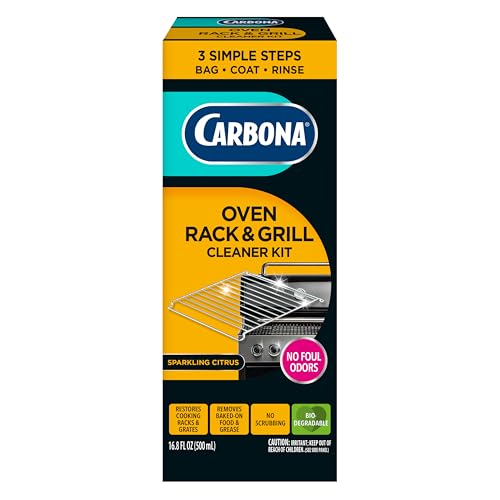
Ask experienced cleaners what the worst part of the job is and most will say the racks. They hold the thickest grease, they are an awkward shape, they do not fit in most sinks, and scrubbing each rung is miserable. Carbona’s system sidesteps the entire fight: you slide the racks into the provided bag, pour in the cleaning solution, seal it, lay it flat, and let the soak work for hours or overnight. The chemistry loosens the carbon while the racks sit undisturbed, and afterward the residue rinses and wipes off with a fraction of the scrubbing. In a convection oven household this matters more than it might seem, because the fan circulates hot, greasy air over the racks constantly, and rack grease is a major source of the smoke and off-flavors people blame on the oven itself.
The system is deliberately narrow, and that is its honesty: it does nothing for the cavity walls, the floor, or the fan cover. It is one half of a two-product strategy, paired with a cavity cleaner from this list. The bag format also means planning around space; you need a flat spot, a garage floor, a patio, or a bathtub you are willing to commit for the soak period, and you should keep the bag somewhere it will not be kicked or punctured. Each treatment is a consumable, so the per-clean cost lands mid-range rather than budget, though most households only deep-clean racks two or three times a year. The payoff is that the racks come out uniformly clean, including the underside rungs and welded joints that sponges never reach, and they come out without the scratched, dulled finish that aggressive pad scrubbing leaves on chrome. For convection cooking, clean racks also simply work better: air flows around food instead of through a layer of old grease.
Strengths:
- Removes the worst chore in oven cleaning almost entirely; the soak does the work
- Reaches rungs, joints, and undersides that in-place scrubbing misses
- No harsh scrubbing, so rack finishes stay bright instead of scratched
- Keeps the mess sealed in a bag rather than spread across your sink or tub
Trade-offs:
- Cleans racks only; you still need a separate product for the cavity
- Needs a flat, undisturbed spot for an hours-long soak
- Consumable format means buying refills for each deep clean
- Very thick carbon may still need a light pass with a non-scratch pad after soaking
Who it suits: Anyone whose racks are the dirtiest part of the oven, anyone who hates the bathtub-scrub ritual, and anyone pairing it with a cavity cleaner for a complete, low-effort deep clean twice a year. You can check price on Amazon.

4. Easy-Off Fume Free Oven Cleaner
The second Easy-Off entry on this list is a different listing from the professional pick at the top, and the distinction matters. This 24-ounce fume-free spray is positioned for ovens and air fryers alike, which makes it the natural choice for households whose cleaning problem is split between a full-size convection cavity and a countertop appliance that gets used far more often. The formula removes grease and burned-on food without the harsh fumes of a traditional lye-based cleaner, so it can be used in a small or poorly ventilated kitchen without clearing the room for the afternoon.
In a convection oven, that gentler chemistry calls for the same discipline described throughout this guide: keep spray off the fan assembly and the elements, apply it to the walls and floor where splatter actually lives, and give it time to work before wiping. On moderately heavy buildup it softens grease and baked-on spills so they lift with a damp cloth and a second pass on stubborn patches, rather than demanding aggressive scrubbing around the fan cover. In an air fryer basket or drawer, the same spray tackles the polymerized film that dish soap alone leaves behind, which is where this pick quietly earns its place in a modern kitchen. The trade-off is rescue power: a truly neglected oven with thick carbon still belongs to the heavy-duty pick at the top of this list, and this spray will need longer dwell and repeat applications to make the same ground.
Strengths:
- Fume-free formula suited to ovens and air fryers in one bottle
- Removes grease and burned-on food without harsh fumes
- Generous 24-ounce size for repeated whole-cavity cleans
- Gentler chemistry for regular maintenance cleans
Trade-offs:
- Less rescue power than the heavy-duty cleaners on thick carbon
- Needs longer dwell and repeat passes on neglected ovens
- Spray format still needs care around the fan and elements
Who it suits: Households that clean both a convection oven and an air fryer, renters and small-kitchen cooks who cannot tolerate harsh fumes, and owners who prefer frequent gentle cleans over rare chemical rescues. You can check price on Amazon.

5. Goo Gone Oven & Grill Cleaner
Goo Gone built its reputation on removing sticky, baked, stubborn messes without destroying the surface underneath, and its oven and grill cleaner carries that same philosophy into the cavity. The foaming gel spray format is a thoughtful hybrid: it sprays on for coverage, then holds as a foam-gel rather than running, which gives you a middle path between the fog-everything spray and the spread-it-by-hand gel. The headline virtue is surface safety. The formula is designed to stay friendly with the mixed materials inside modern convection ovens and on the surfaces around them, which makes it a reassuring choice for newer ranges, stainless interiors, and anyone who has ever watched a harsh cleaner bloom a permanent cloudy patch on a finish they liked.
Performance lands where you would expect from that positioning: fresh and medium baked-on grease comes off readily, the foam gives you visual confirmation of where you have treated, and the smell during use is far more tolerable than the caustic end of the category. Where it asks for compromise is the oldest, hardest carbon, the black glaze on the floor of an oven that has roasted weekly for five years without a clean. There, expect a second application and a non-scratch pad, or step up to a stronger pick for that one zone and use this for everything else. It also works nicely on the oven door exterior, the glass, and grill surfaces, so it tends to become a household staple rather than a single-purpose bottle. For convection owners whose ovens are maintained reasonably and whose priority is not harming a fairly expensive appliance, that balance is exactly right, and its mid-range positioning reflects a specialty formula rather than a commodity spray.
Strengths:
- Surface-safe philosophy suits newer ovens, stainless interiors, and mixed finishes
- Foaming gel sprays on easily but clings instead of running toward the fan and seams
- Pleasant to use compared with caustic cleaners; tolerable odor
- Versatile across door glass, exteriors, and grill surfaces
Trade-offs:
- Oldest, hardest carbon may need repeat applications and pad work
- Not a rescue cleaner for abandoned ovens
- Specialty formula sits at a mid-range tier rather than budget
Who it suits: Owners of newer or premium convection ovens who clean regularly, care about protecting finishes, and want one versatile product for the cavity, the door, and the grill. You can check price on Amazon.

6. Method Heavy Duty Kitchen Degreaser
This final pick is not, and does not pretend to be, a strip-the-oven cleaner. It is a plant-based degreaser spray, and its role in a convection oven household is prevention. Most oven disasters are not sudden; they are the accumulation of fifty small splatters that were each left for next time. A degreaser you can spray on a cool oven floor after a roast, wipe in two minutes, and use again next week without gloves, fumes, or a household evacuation is the product that keeps a convection oven from ever needing the rescue treatment. It handles fresh grease, light baked-on film, the greasy mist that settles on the fan cover between deep cleans, and the stovetop and backsplash splatter that come with the same meals.
Used that way, it is genuinely excellent: quick, pleasant-smelling, safe-feeling around food-prep spaces, and gentle on every finish in and around the oven, including the sensor and the fan cover, where its mildness is a real advantage for in-between wipe-downs. The limit is equally clear. Carbon that has been baked hard over months will laugh at it. If your oven is already in deep trouble, buy one of the cleaners above for the reset and this one for the routine afterward. Its budget positioning makes that two-product strategy painless, and a bottle lasts a long time when it is used in small, frequent doses. Many convection owners find the rhythm that works is this degreaser monthly, a true oven cleaner twice a year, and racks soaked on the same twice-yearly schedule, a routine that keeps the fan, the sensor, and the cavity in the condition the oven was designed for.
Strengths:
- Gentle plant-based formula safe for frequent use on all oven finishes
- Fast wipe-on, wipe-off maintenance that prevents heavy buildup
- No fumes or gloves needed, so it actually gets used
- Budget-friendly and useful across the whole kitchen, not just the oven
Trade-offs:
- Cannot strip hard, long-baked carbon; it is maintenance, not rescue
- Needs to be used regularly to deliver its real value
- Not a substitute for a true oven cleaner at deep-clean time
Who it suits: The tidy cook who would rather spend two minutes weekly than a brutal Saturday twice a year, and any convection owner who wants a safe in-between cleaner for the fan cover and sensor area. You can check price on Amazon.
Cleaning around the convection fan and temperature sensor
The back wall is where convection ovens earn their reputation for being tricky to clean, and it deserves its own method rather than bravado. Start with the oven cold, the power off at the breaker or the plug if you plan to do more than wipe, and the racks out. Most fan covers are held by a few screws or clips and are designed to be removed for cleaning; your manual will say. If the cover comes off easily, take it off, soak it in hot water with dish soap or a degreaser, and scrub it at the sink where you have light, space, and no risk to the motor. That single step does more for airflow and even cooking than any amount of wiping through the perforations. Behind the cover, the fan blade itself usually needs nothing more than a gentle wipe with a cloth dampened with degreaser or soapy water. Never flood that area, never spray cleaner directly into the motor housing, and never spin the blade hard by hand.
If the cover does not come off, or you would rather not remove it, work with a cloth or sponge rather than a spray bottle. Apply your chosen cleaner to the applicator, not the oven, so nothing atomized drifts through the cover slots. Wipe the cover in sections, rinse the cloth often, and finish with two passes of a cloth dampened with plain water. The temperature sensor, that thin probe near the ceiling of the cavity, gets the gentlest treatment of all: a damp cloth, no abrasive, no soaking in gel, no bending. It is sturdier than it looks but it is a measuring instrument, and coating it in cleaner film or bending it against its bracket will show up later as a cake that sinks or a roast that overcooks for no apparent reason. When everything is wiped, leave the door open for an hour so the back wall dries fully before the next preheat, and run the oven empty at moderate heat for fifteen minutes before cooking food again, which burns off any trace moisture and confirms nothing is left to smoke.
The self-clean cycle question, answered plainly
Because this causes more damaged ovens than any cleaner on the shelf, it is worth stating slowly. A pyrolytic self-clean cycle heats the oven to extreme temperatures to burn grease to ash. A chemical cleaner works by dissolving grease at room temperature so you can wipe it away. These are two complete, alternative systems. Do not apply a bottled cleaner and then run self-clean to finish the job. Do not use a bottled cleaner on an oven that is mid-cycle or still hot from one. Do not assume a cleaner labeled for self-cleaning ovens means it is meant to be combined with the cycle; that phrase on labels generally means the product is suitable for use in ovens that have the feature, used separately, on a cold oven. The only exception is a manufacturer instruction for your specific model that explicitly approves a specific combination, which is rare enough that you should treat it as nonexistent unless you are reading it in your own manual right now.
There is a second, quieter reason to keep the systems separate on convection models. Self-clean temperatures are hard on fan motors, bearings, door gaskets, and control electronics, and many technicians will tell you the cycle is the single most stressful thing an oven does in its life. If your chemical cleaning routine is working, you may rarely need the cycle at all, which is a genuine side benefit of the products in this guide. If you do use self-clean, remove the racks first unless the manual says they are rated for it, because the heat can discolor and roughen rack finishes and make them drag. And never leave a chemical cleaner soaking in the oven on a timer that could collide with a delayed self-clean cycle someone else in the household set. Cold oven, power off, cleaner, wipe, rinse, done: that sequence is the whole safety system.
Why the racks deserve their own plan
Racks fail differently from walls. Their grease is thinner per square inch but spread over a huge total surface of thin metal rungs, and every rung is a place carbon builds in a ring that a flat sponge bridges over instead of cleaning. In a convection oven the racks also sit directly in the airflow, so dirty racks actively redistribute old grease smoke onto new food. The soak method described in the Carbona pick is the thorough answer, but it is not the only workable one. A large plastic storage bin or a bathtub lined with an old towel, filled with hot water and a degreaser or a generous dose of dish soap, will loosen a weekend’s worth of rack grease in a few hours, after which a non-scratch pad finishes the job. What matters is the soak itself; dry scrubbing cold carbon off rungs is the worst hour in all of kitchen cleaning, and it damages the chrome finish that keeps racks sliding smoothly.
Two habits keep racks from returning to crisis. First, dry them completely before they go back in, because trapped moisture in the joints is where rust starts on racks that are not stainless. Second, if your racks have become rough and draggy from past aggressive scrubbing or a self-clean cycle they were left in for, a whisper of high-heat cooking oil wiped on and then mostly wiped off the contact rails can restore some glide. Beyond that, treat racks on the same schedule as the cavity, twice a year for most households, and they will never again be the reason you dread opening the oven door.
best kitchen shears for everyday use
Matching the cleaner to your type of convection oven
Not every convection oven is built the same way, and the differences change which cleaner belongs in your hand. A true convection range, with a third element wrapped around the fan, fouls in a distinctive ring pattern on the back wall and rewards the clinging formats, gels and foams, because that ring sits on a vertical surface that sprays abandon within minutes. A fan-assisted oven, where the fan simply moves air heated by the main elements, spreads its grease more evenly and more thinly, and for those ovens a fume-free spray used a little more often is usually the whole answer. Wall ovens deserve a thought of their own: the cavity is at eye level, which makes application easier and more precise, but it also puts your face directly in front of whatever you spray, which is a strong argument for applicator-applied gels and against fogging caustic sprays at head height. Double wall ovens add a scheduling wrinkle, since cleaning both cavities in one session doubles your dwell management; many owners sensibly alternate, deep cleaning one oven while the other stays in service.
Dual-fuel and professional-style ranges raise the stakes in a different way. Their cavities are often larger, their fan covers more substantial, and their finishes and trim more expensive to damage, and some pro-style models use catalytic panels or special coatings that restrict cleaner chemistry sharply. With those ovens, the manual is not a suggestion; it is the specification sheet for what may touch the interior, and the gentle end of this guide, the fume-free spray, the surface-safe foam, and the maintenance degreaser, is where you should live unless the manufacturer says otherwise. At the other end of the market, compact countertop convection ovens and air-fryer ovens should never see a caustic oven cleaner at all unless their manuals explicitly allow it; their interiors are small, often nonstick-coated, and close to their heating elements and fans, and a degreaser on a cloth is the correct tool. Knowing which of these machines you own is worth more than any single product choice, because the wrong tier of chemistry on the wrong interior is how a cleaning day becomes a repair bill.
The door, the gasket, and the glass
The cavity gets the attention, but the door assembly is where convection ovens quietly lose efficiency. The braided gasket that seals the door is what keeps the fan’s carefully circulated hot air inside the box; when it is soaked in cleaner, stiffened by solvents, or crusted with grease, it leaks heat, lengthens preheats, and makes the fan work against a draft of its own making. Clean the gasket with nothing stronger than warm water and a little dish soap on a cloth, wipe it rather than saturate it, and never use a caustic or lye-based cleaner on it. If the gasket is torn, flattened, or brittle, no cleaner will save it, and replacing it will do more for your baking than any product in this guide.
The glass is a two-sided job. The inside pane collects a brown film that most of the picks here will lift during a normal cavity clean; wipe it with the same product you used on the walls, applied with a cloth, and finish with a clean wet wipe and a dry buff to avoid streaks. The harder problem is the haze that forms between the panes, which no surface cleaner can reach. That film comes from grease vapor drawn through the door’s vent slots over years of use, and fixing it means removing the door and separating the panels, a job many manufacturers document in the manual and many owners reasonably hand to a technician. Do not spray cleaner into the door vents hoping to reach it; you will add chemical residue to the trapped film and make the eventual proper cleaning worse. The exterior glass and handle, meanwhile, need only the maintenance degreaser and a microfiber cloth, and they are a good weekly habit because they are the part of the oven you actually look at while dinner cooks.
Ventilation, gloves, and working safely with any cleaner
Even the gentlest product on this list deserves basic respect, and the stronger ones demand it. Work with the kitchen ventilated: a window open, the vent hood running, or a fan moving air out of the room, not because every cleaner is dangerous but because dissolved grease and solvent vapor together are unpleasant to breathe for an hour. Wear household rubber gloves for anything beyond the plant-based degreaser, and wear them for the whole job including the rinse, because repeated wet work alone will wreck your hands. Eye protection sounds excessive until the first time a sponge flicks a droplet; with a caustic product it stops being excessive entirely. Keep children and pets out of the kitchen while cleaner is dwelling in an open oven, and if you are soaking racks in a tub or bin, say so out loud to the household, because a tub of cleaning solution looks exactly like a tub of water to a tired person at midnight.
Storage and disposal are part of the same discipline. Keep oven cleaners capped, upright, and away from food and food-contact items, never decanted into unlabeled bottles, and never mixed with anything else, least of all another cleaner, since combinations can release gases neither product would produce alone. Wipe up drips on floors and counters immediately, both for safety and because several of these formulas will mark surfaces they were never meant to touch. When the job is done, the greasy rinse water and used sponges go out with the household trash rather than being saved for the next job, and the gloves get rinsed before they come off. None of this is complicated, but it is the difference between a cleaning routine you can repeat calmly for years and one bad afternoon that puts you off cleaning the oven at all, which is how ovens end up needing the rescue cleaner in the first place.
A step-by-step deep clean for a convection oven
Begin the night before if your plan involves an overnight product. Remove the racks and set them soaking by whichever method you have chosen. Take out any thermometer probes, pans, or stored items, and confirm the oven is completely cold. Lay an old towel or a sheet of cardboard on the floor in front of the oven, because every cleaner on this list can mark flooring. Put on gloves for anything stronger than the maintenance degreaser, and open a window or run the vent hood if your product has any fume warning at all.
Apply the cavity cleaner with the map of the oven in mind: heaviest on the floor and the ring around the fan cover, lighter on the ceiling and door. Use the applicator method near the back wall. Close the door and let the dwell time run fully; the chemistry is doing work you would otherwise do with your shoulder. When time is up, wipe with a damp sponge or cloth, working from the top down so loosened grime falls onto areas you have not finished yet, and rinse your cloth constantly in a bucket of clean water rather than the sink you use for dishes. Follow with at least two full wipe-downs with plain water, changing the water when it clouds, because the rinse is what stands between you and a smoky, chemical-smelling first roast. Wipe the sensor last, gently, with its own clean damp cloth. Clean the door glass inside and out, dry everything with a soft towel, leave the door ajar for an hour, then run the oven empty at a moderate temperature for fifteen to twenty minutes. Refit the clean, dry racks, and the job is genuinely done rather than merely stopped.
Mistakes that damage convection ovens
The first is spraying cleaner directly at the fan cover until it drips through, soaking the motor and element connections behind it. The second is scrubbing the temperature sensor or coating it in gel. The third is combining chemical cleaners with the self-clean cycle, covered above because it keeps happening. The fourth is using caustic cleaner on catalytic liner panels, which destroys the coating that makes those panels work; if your oven has them, the manual’s cleaning instructions override everything in this guide. The fifth is reaching for a steel wool pad or a razor scraper on enamel and glass, which trades one afternoon’s carbon for permanent scratches that collect grease faster forever after. The sixth is skipping the rinse. And the seventh is cleaning a warm oven because you are in a hurry, which flashes solvents into fumes, bakes cleaner onto surfaces, and can warp your sense of smell for the rest of the day. Every one of these is avoidable with the applicator method, a cold oven, the right product tier for the job, and patience measured in dwell time instead of scrubbing.
Frequently asked questions
Can I use a regular oven cleaner in a convection oven?
Yes, with conditions. Standard oven cleaners are fine on the enamel walls and floor of a convection oven. The convection-specific risks are the fan, its motor and element, and the temperature sensor, so apply cleaner near the back wall with a cloth or sponge instead of spraying directly, keep caustic products off the sensor entirely, and rinse thoroughly. If your oven has catalytic liner panels, check the manual first, because some standard cleaners will damage those coatings regardless of how carefully you apply them.
Is it safe to spray cleaner directly on the convection fan?
No. Spraying directly at the fan cover sends cleaner through the perforations onto the blade, the element ring, and potentially the motor and its bearings. Remove the cover for sink cleaning if your model allows it, or wipe the cover with cleaner applied to a cloth. The fan blade itself needs only a gentle wipe with a damp, degreaser-moistened cloth, and the area should never be flooded or soaked.
Can I run the self-clean cycle after using an oven cleaner to finish the job?
No. Chemical cleaning and the pyrolytic self-clean cycle are alternative methods, not steps in one process. Applying a cleaner and then running self-clean can carbonize residue onto the enamel, generate heavy fumes, and stress the fan motor, gasket, and electronics. Use one method or the other on a cold oven, and only combine anything if your specific oven manual explicitly approves it.
How often should a convection oven be deep cleaned?
For most households, a full deep clean two to four times a year keeps a convection oven in good shape, with a light degreaser wipe-down monthly or after messy roasts in between. Heavy roasters, frequent bakers, and households that cook fatty foods at high heat should lean toward the shorter interval, because grease on the fan cover and sensor quietly degrades cooking performance long before the oven looks truly dirty.
What is the safest cleaner for a brand-new convection oven?
A fume-free formula or a gentle degreaser is the right tier for a new oven, because the goal is maintenance, not stripping. Products like the fume-free pick and the plant-based degreaser in this guide protect finishes, are forgiving around the fan and sensor, and are pleasant enough that you will use them often. Save the heavy-duty chemistry for the day, years from now, if the oven ever gets ahead of you.
The bottom line
A convection oven rewards the owner who matches the cleaner to the job: a fume-free spray for routine deep cleans, a clinging gel for controlled work around the fan wall, a heavy-duty formula kept in reserve for genuine rescues, a soak that takes the racks out of the fight entirely, and a gentle degreaser that makes next month’s mess a two-minute wipe instead of next season’s project. Keep every chemical away from the self-clean cycle, off the sensor, and out of the fan motor, rinse like you mean it, and the same fan that makes these ovens cook so evenly will keep doing it for years. When you are ready to stock the cleaning shelf, check price on Amazon for the pick that matches your oven’s current condition, and start with the gentlest product that can honestly do the job in front of you.