Disclosure: topratedkitchenware.com is reader-supported. When you buy through links on our site, we may earn an affiliate commission from Amazon and other retailers, at no extra cost to you.
Where to buy
If you are shopping for the best pioneer mixers, brand honesty narrows this pool fast: two picks are genuine Pioneer DJ products and are linked below — one standalone mixer and one controller with a mixer section, labelled as such. The other four are consoles from Riworal, FULUODE and Pyle. They are real products, reviewed in full further down, but they are not Pioneer, so they appear in prose only, with no link and no image.
- Pioneer DJ DJM-250MK2 2-Channel DJ Mixer,Black — Best Overall — True Pioneer Mixer. Check on Amazon for the current listing details.
- Pioneer DJ DDJ-FLX4 2-Channel DJ Controller, 16 Pads, Graphite — Best for Digital Beginners — Pioneer Controller With Mixer Section. Check on Amazon for the current listing details.
- 6 Channel Audio Interface Sound Board Mixing Console 16-Bit DSP DJ Mixer Audio Reverb Effect +48V Phantom Bluetooth Studio Audio Mixer For Karaoke Studio Streaming Recording — Prose Only — Not a Pioneer Product. Covered in prose below only: it is made by Riworal, not Pioneer, so it cannot answer a search for Pioneer mixers. It carries no link in this guide.
- FULUODE Audio Mixer 8 Channel, CT-80S Professional Sound System Mixer Board DJ Mixing Console with Reverb MP3 Player Bluetooth 48V Phantom Power Supply USB Recording for Studio Karaoke Live Music — Prose Only — Not a Pioneer Product. Covered in prose below only: it is made by FULUODE, not Pioneer, so it cannot answer a search for Pioneer mixers. It carries no link in this guide.
- PYLE Studio Audio Sound Mixer Board – 6 Channel Bluetooth Compatible Professional Portable Digital DJ Mixing Console w/ USB Mixer Audio Interface – Mixing Boards For Studio Recording – PMXU68BT — Prose Only — Not a Pioneer Product. Covered in prose below only: it is made by Pyle, not Pioneer, so it cannot answer a search for Pioneer mixers. It carries no link in this guide.
- PYLE Studio Audio Sound Mixer Board – 4 Channel Bluetooth Compatible Professional Portable Digital DJ Mixing Console with USB Mixer Audio Interface – Mixing Boards For Studio Recording – PMXU48BT — Prose Only — Not a Pioneer Product. Covered in prose below only: it is made by Pyle, not Pioneer, so it cannot answer a search for Pioneer mixers. It carries no link in this guide.
Read the full guide ↓ for how each pick handles the job, where each one compromises, and which buyers each one actually suits.
The search for the best pioneer mixers is really a search for an ecosystem as much as a product. Pioneer DJ gear dominates club booths for a reason: the layout is a shared language. Channel strips, EQ curves, filter behaviour and cueing logic feel familiar from an entry unit to a flagship, so skills transfer and rental or club gear never feels foreign. Buyers who type this keyword usually want that language at home — for vinyl, for DVS, or for learning digital DJing the way working DJs actually do it.
This guide applies the brand test strictly. Two of the six verified picks are genuine Pioneer DJ products. The DJM-250MK2 is a true standalone two-channel mixer in the club style, with a Sound Color FX filter and a rekordbox DVS unlock. The DDJ-FLX4 is a Pioneer DJ controller — decks and a mixer section in one unit, driven by software — and we link it with that distinction stated openly, because for digital beginners it is a legitimate Pioneer answer, while vinyl purists should note it is not a standalone mixer for turntables. The remaining four picks are live and studio consoles from other brands; they are covered in prose only, because a Pioneer search deserves Pioneer products in its links.
What follows is therefore two deep reviews of the genuine picks, four honest explanations of what the alternatives actually do, and buying guidance built around the real fork in this category: standalone mixer versus controller, vinyl versus digital, and home learning versus booth ambition. If your needs turn out to be microphones and live instruments instead, we say which prose-only family fits — and if you are comparing how brand focus works in other categories on this site, guides such as Best Cake Mixers apply the same discipline in the kitchen.
Key Takeaways
- Two of the six verified picks are genuine Pioneer DJ products, and only those two are linked: the DJM-250MK2 standalone mixer and the DDJ-FLX4 controller.
- The DJM-250MK2 is the pick for vinyl and DVS: club-style layout, per-channel filter and a rekordbox DVS unlock.
- The DDJ-FLX4 is the pick for digital beginners: decks and mixer in one, Smart Fader assistance and streaming-friendly design — but it is a controller, not a turntable mixer.
- The four prose-only picks are live and studio consoles from other brands; useful tools, wrong answer to a Pioneer search.
- Choose by source first: records and players point to the mixer, a laptop library points to the controller, microphones point away from Pioneer DJ entirely.
In this guide
Quick Picks
| Pick | Badge | Why it is here | Listing |
|---|---|---|---|
| Pioneer DJ DJM-250MK2 2-Channel DJ Mixer,Black | Best Overall — True Pioneer Mixer | A genuine standalone Pioneer DJ mixer: 2 channels, Sound Color FX filter and a rekordbox DVS unlock for vinyl-plus-digital setups. | Check on Amazon |
| Pioneer DJ DDJ-FLX4 2-Channel DJ Controller, 16 Pads, Graphite | Best for Digital Beginners — Pioneer Controller With Mixer Section | A genuine Pioneer DJ controller with a built-in 2-deck mixer section, Smart Fader help and streaming-ready design — linked with its controller nature stated plainly. | Check on Amazon |
| 6 Channel Audio Interface Sound Board Mixing Console 16-Bit DSP DJ Mixer Audio Reverb Effect +48V Phantom Bluetooth Studio Audio Mixer For Karaoke Studio Streaming Recording | Prose Only — Not a Pioneer Product | Six-channel Riworal live console with reverb and phantom power; a fine karaoke and streaming tool, but not Pioneer gear. | Prose only — no link |
| FULUODE Audio Mixer 8 Channel, CT-80S Professional Sound System Mixer Board DJ Mixing Console with Reverb MP3 Player Bluetooth 48V Phantom Power Supply USB Recording for Studio Karaoke Live Music | Prose Only — Not a Pioneer Product | Eight-channel FULUODE live board with MP3 playback and recording; built for bands and events, not for the Pioneer DJ ecosystem. | Prose only — no link |
| PYLE Studio Audio Sound Mixer Board – 6 Channel Bluetooth Compatible Professional Portable Digital DJ Mixing Console w/ USB Mixer Audio Interface – Mixing Boards For Studio Recording – PMXU68BT | Prose Only — Not a Pioneer Product | Six-channel Pyle studio board with Bluetooth and USB interface duties; a recording tool from a different brand. | Prose only — no link |
| PYLE Studio Audio Sound Mixer Board – 4 Channel Bluetooth Compatible Professional Portable Digital DJ Mixing Console with USB Mixer Audio Interface – Mixing Boards For Studio Recording – PMXU48BT | Prose Only — Not a Pioneer Product | Four-channel Pyle studio board; compact and simple, but neither Pioneer nor DJ-focused. | Prose only — no link |
How These Picks Were Chosen
We applied the keyword literally: a pick could be linked only if Pioneer DJ made it and it genuinely served DJ mixing. Two products passed — one standalone mixer, one controller whose mixer section is its control centre. Four consoles from Riworal, FULUODE and Pyle failed the brand test, so they remain in the guide as clearly flagged prose-only context, because readers comparing categories benefit from seeing what the neighbouring products do and cost in effort, even when the brand rules them out.
Within the genuine picks, we weighed the factors that decide satisfaction over years, not minutes: layout familiarity with club gear, filter and EQ behaviour, how each unit handles vinyl, DVS and streaming sources, and how much room each leaves a beginner to grow. Every specification in the spec boxes comes from the verified product titles in the pool; nothing is invented, and where a title is silent we say nothing rather than guessing.
This guide is research-led. We compared verified listing data and manufacturer descriptions; we do not claim hands-on bench testing. Prices are never printed because listings move — use the Check on Amazon links on the two linked picks to see current listings, and read the controller-versus-mixer section carefully before deciding, because that choice matters more than any single feature on either unit.
The Best Pioneer Mixers — Two Genuine Pioneer Picks, Four Honest Alternatives

Pioneer DJ DJM-250MK2 2-Channel DJ Mixer,Black
Badge: Best Overall — True Pioneer Mixer
Strengths
- A true standalone Pioneer mixer with the club layout DJs already know
- Sound Color FX filter shapes transitions on any source, including vinyl
- Rekordbox DVS unlock bridges real records and a digital library in one booth
Trade-offs
- Two channels only — no room for a third deck without compromise
- Effects are deliberately focused; performers wanting deep FX chains need a bigger DJM
- It brings no decks of its own — you supply turntables or players
At a glance: Brand: Pioneer DJ; Type: standalone DJ mixer; Channels: 2; Effects: Sound Color FX filter; Software: free rekordbox DVS unlock.
The DJM-250MK2 is the purest answer to this search: a standalone Pioneer mixer, built in the image of the club-standard DJM line. Two channels, generously spaced controls, EQ that behaves the way Pioneer EQ has behaved in booths for years, and a crossfader placed for constant use. Anyone who has mixed on installed club gear will feel at home within one track, and anyone learning will be learning the layout the industry actually uses.
Its Sound Color FX filter is the expressive heart of the unit. A single large knob per channel lets you sweep a filter across the outgoing record during a blend — thinning it, darkening it, adding motion — and because it is analogue in feel and instant in response, it becomes part of your phrasing rather than a menu you visit. On vinyl, where software effects are out of reach, that one knob does more musical work than a page of digital effects.
The rekordbox DVS unlock extends the mixer’s life in both directions. Keep playing your records, and when a track exists only in your digital library, control vinyl on the same decks reaches it without rewiring. The honest limits are focus: two channels, a lean effects section, and no built-in decks. If those limits match your setup — and for most two-deck DJs they do — this is the Pioneer mixer to build around. Check on Amazon for the current listing before you commit.
Best for: vinyl and DVS DJs who want the authentic Pioneer mixer experience at home / Not suited for: laptop-only beginners who need decks included, or four-deck performers
Check on Amazon for the current listing, included accessories and availability.
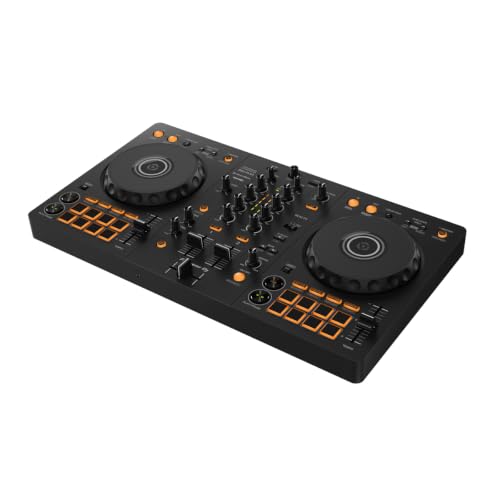
Pioneer DJ DDJ-FLX4 2-Channel DJ Controller, 16 Pads, Graphite
Badge: Best for Digital Beginners — Pioneer Controller With Mixer Section
Strengths
- Genuine Pioneer DJ design with decks and a mixer section in one portable unit
- Smart Fader and a beginner-friendly layout make first mixes satisfying quickly
- Streaming-ready design and a mic input suit livestreamed sets from one device
Trade-offs
- It is a controller, not a standalone mixer — it needs software and a computer or compatible device to work
- Not the tool for a pure turntable setup; vinyl DJs belong with the DJM above
- Performance pads and compact controls reward digital techniques more than traditional ones
At a glance: Brand: Pioneer DJ; Type: DJ controller with mixer section; Decks: 2; Pads: 16; Features: Smart Fader, streaming-ready, mic input for livestreaming; Colour: Graphite.
The DDJ-FLX4 answers the other half of the Pioneer question: what if you own no decks at all? It folds two software decks and a central mixer section into one graphite unit, so the mixer skills you practise — EQ, faders, cueing, filter-style transitions — are the same skills the DJM teaches, learned on Pioneer layout from day one. Sixteen performance pads add the digital vocabulary of hot cues and samples that standalone vinyl setups handle differently.
Smart Fader is its signature teaching aid: it helps align tempo and level as you crossfade, so early mixes sound musical while your ears are still learning to do that work manually. Used honestly — as training wheels you gradually rely on less — it shortens the frustrating first month of DJing considerably. The streaming-ready design and microphone input extend the same idea to broadcasting: one device can carry a set and your voice to an audience, which is how many new DJs now start.
We link it with its nature stated plainly: it is a controller. It does not replace a standalone mixer for turntables, and it depends on software in a way the DJM never will. But for the large group of buyers whose library lives on a laptop and whose Pioneer search means ‘teach me the Pioneer way’, it is a genuine, well-judged answer — and a versatile one in its class. Check the latest price on Amazon and confirm which software the current listing bundles.
Best for: digital beginners and streamers who want genuine Pioneer workflow with decks included / Not suited for: vinyl-only DJs or anyone needing a standalone mixer for external players
Check on Amazon for the current listing, included accessories and availability.
6 Channel Audio Interface Sound Board Mixing Console 16-Bit DSP DJ Mixer Audio Reverb Effect +48V Phantom Bluetooth Studio Audio Mixer For Karaoke Studio Streaming Recording
Badge: Prose Only — Not a Pioneer Product
Why this pick is prose-only: it is made by Riworal, not Pioneer, so it cannot answer a search for Pioneer mixers. It is reviewed in full below so you can judge it fairly, but it gets no Amazon link and no product image in this guide.
Strengths
- Six channels with phantom power serve microphones a DJ mixer cannot
- DSP reverb and Bluetooth cover karaoke, streaming and small live work
- USB interface duties make basic recording straightforward
Trade-offs
- Not a Pioneer product — it fails this search’s defining test
- Live-console layout: no DJ crossfader workflow, no phono stage, no DVS path
- EQ voiced for voices and instruments, not for blending records
At a glance: Brand: Riworal; Channels: 6; Effects: 16-bit DSP reverb; Phantom power: +48V; Connectivity: Bluetooth, USB audio interface.
The Riworal console is a competent six-channel live board: microphone inputs with phantom power, reverb for vocals, Bluetooth for backing tracks and a USB connection for recording or streaming. For a small venue, a worship duo or a creator desk, those features are arranged exactly as their users expect.
It is not, however, a Pioneer mixer, and no feature list changes that. A reader searching Pioneer wants Pioneer’s layout language, EQ behaviour and ecosystem; this board speaks a different dialect for a different craft. Its channels balance live inputs rather than blend decks, and it offers no phono stage or DVS route for turntables.
It therefore stays prose-only in this guide — not as a punishment, but as accurate labelling. If microphones dominate your setup, a console of this type, a versatile mid-tier example of its class, is the right family to research. If decks dominate, the two linked Pioneer picks above are where your money belongs.
Best for: karaoke hosts, streamers and small live acts / Not suited for: Pioneer shoppers and deck-based DJs
FULUODE Audio Mixer 8 Channel, CT-80S Professional Sound System Mixer Board DJ Mixing Console with Reverb MP3 Player Bluetooth 48V Phantom Power Supply USB Recording for Studio Karaoke Live Music
Badge: Prose Only — Not a Pioneer Product
Why this pick is prose-only: it is made by FULUODE, not Pioneer, so it cannot answer a search for Pioneer mixers. It is reviewed in full below so you can judge it fairly, but it gets no Amazon link and no product image in this guide.
Strengths
- Eight channels handle bands and multi-mic events with room to spare
- MP3 playback, reverb and USB recording cover event duties in one box
- Bluetooth and phantom power add flexibility for karaoke and live music
Trade-offs
- A FULUODE live console, not Pioneer DJ equipment in any respect
- Size and strip layout oppose the fast, close handwork of DJ mixing
- No DJ cueing culture, DJ crossfader design or software ecosystem
At a glance: Brand: FULUODE; Model: CT-80S; Channels: 8; Features: reverb, MP3 player, Bluetooth; Power: 48V phantom; Recording: USB.
With eight channels, the FULUODE CT-80S is the pool’s event workhorse: several vocal microphones, instruments, backing tracks from its MP3 player, reverb to help singers and USB recording to keep a copy of the night. Community halls, rehearsal rooms and mobile karaoke rigs are its natural habitat.
Habitat is the point. This is a live-sound console from a different brand, solving the problem of many simultaneous live inputs. A Pioneer DJ mixer solves the opposite problem: two music sources, blended artfully. The FULUODE’s breadth is a liability at a DJ booth, where its strips spread controls your hands need close together, and its feature list spends money on inputs a DJ will never open.
Prose-only is therefore the honest placement. Judge it, if you need it, against other live consoles — where it stands as a capable, generously channelled option — and judge Pioneer DJ gear against the two linked picks, where the brand promise of this search actually lives.
Best for: small bands, karaoke operators and event hosts / Not suited for: anyone building a Pioneer DJ setup
PYLE Studio Audio Sound Mixer Board – 6 Channel Bluetooth Compatible Professional Portable Digital DJ Mixing Console w/ USB Mixer Audio Interface – Mixing Boards For Studio Recording – PMXU68BT
Badge: Prose Only — Not a Pioneer Product
Why this pick is prose-only: it is made by Pyle, not Pioneer, so it cannot answer a search for Pioneer mixers. It is reviewed in full below so you can judge it fairly, but it gets no Amazon link and no product image in this guide.
Strengths
- Six channels plus a USB interface make a simple recording hub
- Bluetooth playback is convenient for references and casual listening
- Straightforward controls suit beginners in home recording
Trade-offs
- Made by Pyle, not Pioneer — a different brand and design brief
- Studio routing logic, not DJ performance logic
- No phono inputs, DJ filter or DVS support for deck setups
At a glance: Brand: Pyle; Model: PMXU68BT; Channels: 6; Connectivity: Bluetooth, USB audio interface; Use case: studio recording.
Pyle’s six-channel board is a general-purpose studio tool: microphones and instruments in, a mix out to a computer over USB, Bluetooth when you need quick playback. Podcasters and home recordists find its simplicity appealing, and as a lower-cost design in the console class it covers the basics without drama.
Set against a Pioneer search, though, it answers a question nobody here asked. It carries no Pioneer layout, no DJ crossfader design, no per-channel filter for transitions and no path for turntables or DVS. A beginner who bought it expecting to learn DJing would learn recording-desk habits instead — useful habits, wrong craft.
That is why it appears without a link. Our job in a brand-led guide is to protect the meaning of the brand: Pioneer picks get links, everything else gets an honest explanation of what it is actually for, which is what this section provides.
Best for: home recordists and podcasters / Not suited for: Pioneer DJ buyers at any level
PYLE Studio Audio Sound Mixer Board – 4 Channel Bluetooth Compatible Professional Portable Digital DJ Mixing Console with USB Mixer Audio Interface – Mixing Boards For Studio Recording – PMXU48BT
Badge: Prose Only — Not a Pioneer Product
Why this pick is prose-only: it is made by Pyle, not Pioneer, so it cannot answer a search for Pioneer mixers. It is reviewed in full below so you can judge it fairly, but it gets no Amazon link and no product image in this guide.
Strengths
- Compact four-channel format fits small desks and simple rigs
- USB interface and Bluetooth cover solo recording and playback
- Very little to misconfigure — friendly for first-time console owners
Trade-offs
- Not Pioneer, and not DJ equipment — a small studio board
- Four live channels do not substitute for two DJ channels
- No DJ cueing, filter or phono features
At a glance: Brand: Pyle; Model: PMXU48BT; Channels: 4; Connectivity: Bluetooth, USB audio interface; Use case: studio recording.
The four-channel Pyle shrinks the studio-board idea to desk size: a microphone or two, an instrument, USB to the computer, Bluetooth for playback. For a solo podcaster it is a tidy, unintimidating hub, and its restraint is its charm.
For this keyword it is the clearest no in the pool. It is not Pioneer, not a DJ mixer, and not expandable into either. Its presence here is useful precisely because it marks the boundary: if a product like this tempts you, your real need is probably a creator desk, and you will be happier researching consoles properly than forcing a DJ guide to bless one.
It closes the prose-only group as a reasonable small console in its own category — and as a reminder that in mixer shopping, the brand and the craft matter more than the channel count on the box.
Best for: solo podcasters and streamers with minimal inputs / Not suited for: DJ booths, vinyl setups and Pioneer ecosystems
Comparison Table
| Pick | Badge | Key attributes | Listing |
|---|---|---|---|
| Pioneer DJ DJM-250MK2 2-Channel DJ Mixer,Black | Best Overall — True Pioneer Mixer | Pioneer DJ; standalone mixer; 2 channels; Sound Color FX filter; rekordbox DVS unlock | Check on Amazon |
| Pioneer DJ DDJ-FLX4 2-Channel DJ Controller, 16 Pads, Graphite | Best for Digital Beginners — Pioneer Controller With Mixer Section | Pioneer DJ; controller with mixer section; 2 decks; 16 pads; Smart Fader; mic input | Check on Amazon |
| 6 Channel Audio Interface Sound Board Mixing Console 16-Bit DSP DJ Mixer Audio Reverb Effect +48V Phantom Bluetooth Studio Audio Mixer For Karaoke Studio Streaming Recording | Prose Only — Not a Pioneer Product | Riworal; 6 channels; 16-bit DSP reverb; +48V phantom; Bluetooth | Prose only |
| FULUODE Audio Mixer 8 Channel, CT-80S Professional Sound System Mixer Board DJ Mixing Console with Reverb MP3 Player Bluetooth 48V Phantom Power Supply USB Recording for Studio Karaoke Live Music | Prose Only — Not a Pioneer Product | FULUODE; 8 channels; reverb; MP3 player; Bluetooth; USB recording | Prose only |
| PYLE Studio Audio Sound Mixer Board – 6 Channel Bluetooth Compatible Professional Portable Digital DJ Mixing Console w/ USB Mixer Audio Interface – Mixing Boards For Studio Recording – PMXU68BT | Prose Only — Not a Pioneer Product | Pyle; 6 channels; Bluetooth; USB audio interface | Prose only |
| PYLE Studio Audio Sound Mixer Board – 4 Channel Bluetooth Compatible Professional Portable Digital DJ Mixing Console with USB Mixer Audio Interface – Mixing Boards For Studio Recording – PMXU48BT | Prose Only — Not a Pioneer Product | Pyle; 4 channels; Bluetooth; USB audio interface | Prose only |
How to Choose a Pioneer Mixer
Decide your format before your model. A standalone mixer like the DJM-250MK2 assumes you own, or will buy, sources: turntables, media players or a DVS laptop. A controller like the DDJ-FLX4 includes the decks and assumes your library is digital. Neither format is superior; they are answers to different shelves of music. Buyers who mix the formats up — a controller for a record collection, a bare mixer for a laptop-only library — spend twice. Our cross-category guides make the same point in other words, whether the topic is DJ gear or Best Commercial Stand Mixers: define the workflow first, then rank hardware.
Next, be honest about your sources over the next two years. Pure vinyl points to phono quality and a good filter. A hybrid shelf points to DVS support. A streaming-first path points to a controller with a microphone input and software that talks to streaming services. The two linked picks map neatly onto those paths: DJM for records and hybrid, FLX4 for digital and streaming.
Then weigh learning curve against ceiling. Assisted features like Smart Fader genuinely shorten the road to musical mixes, and there is no shame in them; the question is whether the unit still rewards you once the assistance matters less. Pioneer layouts pass that test because the same layout scales to club flagships — the strongest argument for the brand at any level. Finally, count the whole setup: a mixer needs sources, a controller needs software and a suitable computer, and both need headphones and speakers you trust. Budget for the chain, not the centrepiece.
How to Set Up a Pioneer DJ Setup and Practise Well
For the standalone route, setup runs: turntables into phono inputs with ground wires attached, players into line inputs, master out to speakers, headphones into the cue socket. Set each channel’s gain with your loudest record so peaks sit strong with headroom, then mix on faders and EQ, using the filter for transitions. For the controller route: install the software first, connect the controller by USB, set the software’s audio to the controller, plug speakers into its outputs and your microphone into its mic input if you stream. In both routes, learn cueing before tricks: cue the incoming track, blend the cue/master knob until you can hear both, and rehearse the transition in headphones before performing it in the room.
A practice structure that works for either format: spend ten minutes on beatmatching or tempo alignment alone, ten on EQ swaps — exchanging bass between tracks at the phrase boundary — and ten on one transition type repeated until it is boring. Boring is the goal; boring means automatic, and automatic frees your attention for track selection, which is where sets are actually won.
Troubleshooting mini-section. Problem: one deck sounds thin and quiet → it is likely in a line input instead of a phono input, or its ground wire is loose. Problem: the controller’s jog wheels feel laggy → check the software buffer settings and close background applications before blaming the hardware. Problem: your microphone overwhelms your streamed set → lower the mic level, keep music ducked slightly under speech moments, and test levels on a private recording before going live. Care is simple in both formats: dust off, cables unstrained, faders moved gently through their travel now and then, and liquids kept far from the booth.
Standalone Mixer vs Controller: The Honest Trade-Offs
A standalone mixer is an instrument with a long life: it does not care which software wins next year, it welcomes any source with the right output, and its skills transfer to every club booth on earth. Its costs are literal — you must own sources — and practical, since recording and streaming need extra steps. A controller is a complete, portable studio: decks, mixer and effects in one bag, software integration a bare mixer cannot match, and a gentler learning curve. Its costs are dependence — on software, on a computer, on a product generation. Most DJs eventually touch both; your first purchase should simply match the library and budget you have today, which is why this guide links one of each and labels them clearly.
Why the Pioneer Layout Became the Default
Pioneer’s dominance is not only marketing. When most club booths share a layout, that layout becomes infrastructure: guest DJs walk in fluent, rental stock stays compatible, and tutorials assume its geography. Learning on Pioneer gear is therefore a network decision as much as a product decision. That network effect is exactly why brand honesty matters in a guide like this — a non-Pioneer console may be a fine product, but it cannot sell you fluency in a language it does not speak. Readers who enjoy ecosystem thinking may find the same logic in our Best Bread Mixers research, where one dominant design language shapes a whole category.
Building a Pioneer Setup in Stages
Most Pioneer owners did not buy their final setup first, and the brand’s real value shows in how gracefully a rig can grow. A sensible first stage is one centre — the DJM-250MK2 if your library is records and files, the DDJ-FLX4 if it is files alone — plus headphones you trust and the best speakers your room honestly supports. That stage already teaches the complete craft: cueing, EQ discipline, phrasing and selection. Nothing about it is a toy version of DJing; it is DJing, at home scale.
The second stage adds reach rather than novelty. For mixer owners, that can mean control vinyl to unlock the digital library through the DVS pathway, or a second source type — a media player beside the turntable — so the booth speaks both languages. For controller owners, it can mean a standalone microphone solution for streamed shows, or simply a larger, better-organised library, which improves sets more than any hardware at this stage. Notice what is absent from stage two: a replacement centre. Pioneer layouts are designed so the centre survives your growth, because the layout you learned is the layout the bigger units use.
Stage three is where the ecosystem argument completes itself. The DJ who learned on Pioneer walks into a club, a rental shop or a friend’s studio already fluent. That fluency is worth money — it is the return on choosing the dominant layout early — and it is precisely what a non-Pioneer console, however capable, cannot pay. When you price the two linked picks, price that fluency in. A guide can only point at it; your future self, playing away from home without a flicker of unfamiliarity, will collect it.
One staging warning applies to both routes: resist buying for the DJ you might become in three years at the cost of the DJ you are this winter. Channels, pads and effects that wait for a hypothetical future mostly gather dust, while a focused unit that matches tonight’s library gets played nightly — and nightly play is what actually manufactures the future DJ. Buy the stage you are on, play it thoroughly, and let your own sets, not a catalogue, tell you when to climb.
Care, Transport and the Long Life of Pioneer Gear
Pioneer units reward simple, consistent care. Keep dust off the faders — covers or a cloth when the booth sleeps — because grit in a fader track is the beginning of crackle. Move every control through its full travel occasionally, especially on a mixer that sits unused between monthly sessions; controls that rest in one position for a year are the ones that misbehave first. Keep cables strain-relieved so no connector carries the weight of its own lead, and keep liquids at the traditional distance: not on the same surface, not on a shelf above, not in a hand passing over the unit.
Transport separates home gear from gig gear in practice. A controller travels in a padded bag with its USB cable coiled separately, never wrapped tight around the unit. A standalone mixer travels upright, faders protected, ideally in a case if it leaves the house regularly. At the destination, let cold gear warm to room temperature before powering it after a winter car journey — condensation is a quiet enemy of electronics. None of this is elaborate, and all of it is the difference between a unit that ages into a trusted classic and one that becomes a cautionary listing. Buy Pioneer for the layout and the ecosystem; keep it with these habits, and the purchase compounds for years.
One last consideration belongs to households rather than DJs: both linked Pioneer picks are unusually shareable. A mixer or controller teaches best when it is simply left set up, and a unit that lives ready in a shared space gets used by partners, teenagers and visiting friends in a way a packed-away unit never does. If your home has more than one aspiring DJ, that accessibility is a genuine feature — argue for the setup a permanent place, keep headphones plugged in, and the best Pioneer mixer becomes the one that is always on. It is a fitting final test for the whole guide: the right product, in the right format, from the right brand, given a permanent home, will be played more in a month than a technically finer unit spends its life in a cupboard. Choose for use, and Pioneer rewards you.
And if you are buying as a gift — a common route into this category — the same brand logic protects you: a genuine Pioneer unit gives the recipient the layout the whole DJ world teaches on, plus a clear upgrade path that never strands the gift. Few presents in music gear age as gracefully.
Common Buying Mistakes
Buying a console for a DJ job. More channels is not more DJ. Live boards balance inputs; DJ mixers perform transitions. The crafts and the controls differ.
Buying a controller for a record collection. Controllers are brilliant with digital libraries and the wrong centre for turntables. Match the format to the shelf.
Ignoring the software question. A controller is only as good as the software it runs and the computer beneath it. Confirm both before the hardware seduces you.
Skipping the cue system in tests. You will cue thousands of times. If selecting and blending cue sources feels awkward in a demo, it will feel worse at midnight in a dark room.
Budgeting only for the centrepiece. Headphones, speakers, cables and — for a mixer — sources, all cost money. A complete modest chain beats a famous box standing alone.
Final Recommendation
Choose by shelf and you cannot go far wrong. Vinyl and hybrid DJs should take the DJM-250MK2 — the genuine standalone Pioneer mixer here, with the filter and DVS pathway that style of mixing lives on: Check on Amazon. Digital beginners and streamers should take the DDJ-FLX4, Pioneer’s controller answer with decks included and assistance that teaches while it helps: Check on Amazon. And if your sources are microphones and instruments, leave the Pioneer DJ family with our blessing and research the live consoles reviewed above in their own category — the right tool, honestly labelled, is the whole point of guides like this one and of our wider mixer research such as Best Countertop Mixers.
Frequently Asked Questions
Which Pioneer pick is best for vinyl?
The DJM-250MK2. It is a standalone mixer with phono support for turntables, a per-channel filter for blending records and a rekordbox DVS unlock if you later add control vinyl. The DDJ-FLX4 is a controller for digital libraries and is not the centre of a turntable setup.
Is the DDJ-FLX4 a mixer or a controller?
It is a controller with a mixer section at its centre. The mixer skills it teaches — EQ, faders, cueing — are genuine Pioneer skills, but the unit needs software and a host device to play music, unlike the standalone DJM-250MK2.
Why are the Pyle, Riworal and FULUODE picks not linked?
Because this is a Pioneer search and they are not Pioneer products. They are live and studio consoles, reviewed in prose so you can see what they do, but linking them as Pioneer mixers would misrepresent them and mislead you.
Can I stream a set with these Pioneer picks?
Yes, by different routes. The FLX4 is designed for it, with streaming-ready features and a microphone input for talking over your set from one device. The DJM-250MK2 routes through your computer setup instead, which suits DJs who already record or broadcast from a laptop.
What is Smart Fader, and should beginners rely on it?
Smart Fader on the FLX4 helps align tempo and level as you crossfade, so early mixes sound musical while your ears develop. Treat it as training assistance: enjoy the help, but practise with intention so the underlying skills — tempo matching and level judgement — grow underneath it.
Will learning on these units help if I later play in clubs?
Yes. Pioneer layout is the club default, so the geography of the channel strips, EQ and cueing you learn at home transfers directly to installed booth gear. That transferability is one of the strongest reasons to choose the brand.


