Disclosure: topratedkitchenware.com is reader-supported. When you buy through links on our site, we may earn an affiliate commission from Amazon and other retailers, at no extra cost to you.
Where to buy
All six of the best pit toilets below — in their modern, self-contained form — are sold through Amazon, so you can open each listing to verify the current configuration, dimensions, and newest owner feedback before committing. A note on what you will find there: every pick in this guide is a modern self-contained toilet — composting or dry flush — because these are the products that have replaced the traditional dug pit for most buyers today. They deliver what a pit toilet promises, sanitation away from plumbing, without an open hole in the ground. Start with the name links and check what each listing includes for installation and first use.
- LOO SEAL R1808 Waterless Self-Contained Dry Flush Toilet — Check on Amazon
- Modiwell LE-310 Smart Dry Flush Toilet
- Nature’s Head Self Contained Composting Toilet, Close Quarters Spider Handle
- OGO Origin Compact Composting Toilet
- Nature’s Head Self Contained Composting Toilet, Foot-Spider Handle
- TROBOLO WandaGO Composting Toilet
Read the full guide ↓
Introduction: The Pit Toilet, and What Has Replaced It
The best pit toilets used to be a hole, a seat, and a small building — and for a surprising number of properties they still are, because the formula asks nothing of the modern world: no water, no power, no sewer, no septic. But a traditional pit carries real costs that its simplicity hides. It can contaminate groundwater if it is dug in the wrong soil or too close to a well. It smells in proportion to the weather. It fills, eventually, and then someone digs another pit. And in a growing number of counties and parks, a new open pit is simply not permitted anymore, whatever grandfathered arrangements the old outhouse enjoys.
That is why the products in this guide are what they are. Buyers searching for a pit toilet today usually want its virtues — off-grid, unplumbed, private, permanent-feeling — without its open hole, and the market’s answer is the self-contained toilet: composting units that separate and dry waste inside a sealed body, and dry flush units that seal each use into a liner. All six picks below install in the same outhouse or shelter a pit toilet would have used, sit at a familiar height, and remove the pit from the equation entirely. We compare them on the criteria that matter for this job: how completely they contain waste, how they are serviced, how they behave across seasons, and how well they suit the rural, cabin, farm, and remote-site settings where pit toilets have always lived.
Key Takeaways
- A traditional pit is simple but open: groundwater risk, odor, finite life, and tightening rules are its real price.
- Modern self-contained toilets keep the pit toilet’s virtues — no water, no sewer, an outhouse shelter — while sealing waste away from soil and air.
- Composting models suit permanent rural sites best, turning the servicing task into an occasional, manageable routine.
- Dry flush models suit sites where digging is impossible or users rotate, because each use is sealed with no learning curve.
- Setbacks from wells and water, and local rules, still apply to how you handle urine and finished compost — the pit is gone, the responsibility is not.
- The TROBOLO WandaGO is the closest in spirit to a classic portable outhouse toilet; the Nature’s Head units are the strongest permanent composting replacements.
In this guide
Quick Picks
| Pick | Badge | Why it stands out | Link |
|---|---|---|---|
| LOO SEAL R1808 Dry Flush Toilet | Best Sealed Replacement in a Permanent Outhouse | A fixed-style, swivel-top dry flush toilet that drops into an outhouse shelter and seals every use. | Check on Amazon |
| Modiwell LE-310 Smart Dry Flush Toilet | Best No-Dig Alternative for Rotating Users | A rechargeable portable dry flush toilet with one-click sealing that anyone can use correctly. | Check on Amazon |
| Nature’s Head Composting Toilet, Close Quarters | Best Composting Outhouse Toilet | A self-contained composting toilet in a close-quarters design made for tight outhouse spaces. | Check on Amazon |
| OGO Origin Compact Composting Toilet | Best for Small Outhouses | A compact composting toilet with a 15-inch footprint for the smallest shelters. | Check on Amazon |
| Nature’s Head Composting Toilet, Foot-Spider | Best Composting for High-Use Sites | A self-contained composting toilet with a foot-spider handle for busy cabins and shared sites. | Check on Amazon |
| TROBOLO WandaGO Composting Toilet | Best True Portable Outhouse-Style Toilet | A portable urine-diverting dry toilet with height adjustment, built for outdoor and camping use. | Check on Amazon |
How These Picks Were Chosen
This guide is research-led and built from current, verifiable listings. Because the keyword describes a function — sanitation with no plumbing, traditionally over a pit — rather than a mechanism, we selected for the function and were transparent about the mechanism: every pick is self-contained, waterless, and installable in an outhouse-type shelter without digging, plumbing, or a drain. We then weighted the criteria that decide success in pit-toilet territory. Containment came first: how completely the system separates waste from soil, groundwater, and the user’s nose. Servicing came second: what emptying actually involves at a rural site, and how far waste travels. Third was permanence — whether the unit furnishes a fixed outhouse for years or serves as a movable answer for camps and seasonal sites. Fourth was user-proofing, because outhouses serve guests, workers, and family members who never asked for a lesson. Fifth was consumables: cartridges for the dry flush picks, medium for the composting picks, judged against the resupply reality of a remote property.
We also held a line on honesty about the traditional option. A well-sited pit on suitable land, where rules allow, still works, and the section below on converting or keeping an outhouse says so. What we would not do is pretend a plumbed indoor toilet belongs in this guide, or that any product here requires a pit — the entire point of these six is that the hole in the ground has become optional.
The 6 Best Pit Toilets (Modern Self-Contained Replacements)

LOO SEAL R1808 Waterless Self-Contained Dry Flush Toilet
Badge: Best Sealed Replacement in a Permanent Outhouse
Strengths
- Fixed-style swivel-top format sits in an outhouse like a permanent fixture, not camping gear.
- Every use is sealed into the liner system, so nothing reaches the soil and no pit is ever dug.
- Rechargeable and waterless — the shelter needs no infrastructure beyond a charging habit.
Trade-offs
- Cartridges are a standing supply commitment for the life of the installation.
- Sealed waste leaves with the trash, which a remote site must plan for.
- Shares the R1808 designation with a MODIWELL model sold elsewhere; verify the exact listing when ordering.
Mini spec box
- Type: dry flush toilet, waterless, self-contained
- Format: swivel top, fixed-style
- Power: rechargeable battery
- Plumbing: none required
- Settings listed: RVs, boats, off-grid, vans, tiny homes, emergency and care use
If the plan is to retire an old pit — fill it in safely, keep the outhouse building, and never dig again — the LOO SEAL R1808 is the most direct replacement in this guide. It occupies the shelter like the fixture the pit seat pretended to be, and it changes the waste story completely: instead of an open column of waste beneath the floor, each use is wrapped and sealed at the surface, and what leaves the building is a closed bundle carried out by hand. Groundwater anxiety, pit-wall collapse, and the eventual second pit all leave the picture at once.
The ongoing bargain is the cartridge. A busy outhouse on a farm or at a shared cabin consumes liners steadily, and the site needs a trash route for them. For properties with regular vehicle access that is a trivial trade; for a walk-in site at the end of a trail, weigh the composting picks below, whose consumable is lighter to carry in and whose output is easier to deal with on the land, under local rules.
Best for: permanent outhouses on farms, cabins, and sites with vehicle access / Not suited for: walk-in sites far from trash service

Modiwell LE-310 Smart Dry Flush Toilet
Badge: Best No-Dig Alternative for Rotating Users
Strengths
- One-click sealing makes the toilet idiot-proof for guests, crews, and seasonal workers.
- Portable and rechargeable, so it serves a site before any shelter or permanent setup exists.
- No pit, no vent, no medium — the fastest route from bare ground to working sanitation.
Trade-offs
- Portable scale and cartridge pace suit moderate traffic, not a festival.
- Battery and cartridge discipline are the whole maintenance plan; neglect either and it stops.
- Less of a permanent fixture feel than the fixed picks in an established outhouse.
Mini spec box
- Type: dry flush toilet, waterless one-click sealing
- Format: portable, rechargeable
- Power: rechargeable battery
- Settings listed: vans, trucks, car travel, tiny homes, camping, backup and off-grid living
- Plumbing: none required
Many pit-toilet searches begin at a site with nothing: a new parcel, a work camp, a hunting lease, a festival field. The LE-310 Smart is the pick for that first season, when digging a pit would be premature — the land use may change, the rules may forbid it, the site may move — but people need a real toilet this weekend. It stands in a privacy shelter or a corner of a barn, seals every use at one click, and asks its rotating cast of users for nothing at all. When the site matures into permanence, it retires gracefully into the backup role it was also designed for.
Its honesty box is short: cartridges in, bundles out, battery charged. Sites that can run that loop get the simplest sanitation in this guide; sites that cannot should look at composting, where the loop is slower and lighter on supplies.
Best for: new sites, camps, seasonal crews, and as a transitional toilet / Not suited for: permanent high-traffic outhouses
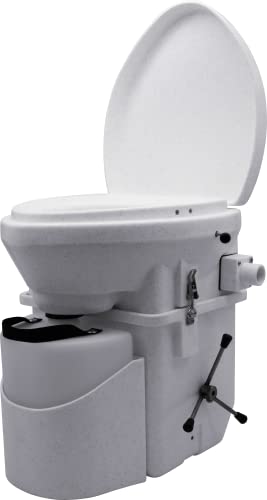
Nature’s Head Self Contained Composting Toilet with Close Quarters Spider Handle
Badge: Best Composting Outhouse Toilet
Strengths
- True composting inside a sealed body: waste is contained, dried, and reduced instead of accumulated in the ground.
- Close-quarters handle design fits the narrow outhouse footprint a pit seat used to occupy.
- Consumables shrink to composting medium — the lightest supply line of any pick here.
Trade-offs
- Needs a vent through the shelter and users who will turn the handle and mind the urine bottle.
- Composting pauses in deep cold, so a winter outhouse treats the chamber partly as storage.
- Guests need the short composting briefing that dry flush users never hear.
Mini spec box
- Type: self-contained composting toilet
- Handle: close quarters spider handle design
- System: waterless, urine-separating composting
- Plumbing: none required
- Settings: cabins, boats, and small off-grid spaces
This is the pick that most faithfully inherits the pit toilet’s job while fixing its flaws. It sits in the same small building, serves the same rural household, and asks for no water and no sewer — but the waste stays inside a sealed, vented chamber where urine is diverted away and solids are agitated into dry medium, breaking down instead of pooling. The close-quarters handle exists precisely because outhouses are narrow: the mechanism is worked from a position the little room actually allows.
For a permanent rural site, the arithmetic is compelling. No pit to site, dig, or eventually abandon; no cartridges arriving by the box; just medium stored dry in the shelter, a urine bottle emptied on a rhythm, and a chamber emptied occasionally, with the finished material handled according to local rules. It is the pit toilet, civilized — provided the household keeps the small routine that composting asks, a theme this guide returns to because it is the difference between the system’s fans and its critics.
Best for: permanent outhouses, rural homes, and cabins with a stable set of users / Not suited for: sites with constantly rotating, unbriefed users
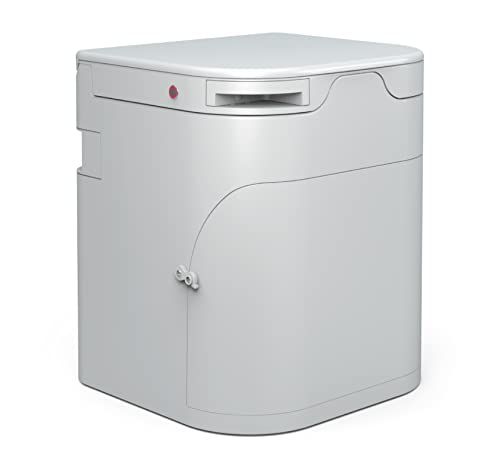
OGO Origin Compact Composting Toilet
Badge: Best for Small Outhouses
Strengths
- A 15-inch footprint fits the genuinely tiny outhouse or shed where larger units cannot stand.
- Full composting pattern — diversion, medium, agitation — in the smallest body in this guide.
- No cartridge supply line, which suits remote sites reached on foot or by boat.
Trade-offs
- Compact chambers need brisker attention under the same number of users.
- Small stature compromises comfort for larger users on long stays.
- Still needs the vent and routine every composting toilet needs.
Mini spec box
- Type: compact composting toilet
- Footprint: 15 inches
- System: waterless, urine-separating composting
- Plumbing: none required
- Settings listed: van, RV, and boat — and small outdoor shelters
Some outhouses are small because land is precious and some are small because they were built by hand a lifetime ago; either way, the OGO Origin is the composting pick that fits them. Its 15-inch footprint was designed for vans and boats, and that same compactness drops neatly into a narrow shelter where a full-size composting toilet would crowd out the user’s knees. The process inside is the full one — urine separated and bottled, solids worked into medium — so the site keeps composting’s supply-light independence.
Respect the trade it makes: smaller chambers, prompter emptying. For one or two regular users that is a mild rhythm; for a busy shared site it becomes a chore schedule, and the larger Nature’s Head picks are the better answer. Matched to its scale, the Origin is the pit toilet’s smallest respectable successor.
Best for: tiny outhouses, sheds, and one- or two-person remote sites / Not suited for: busy shared sites

Nature’s Head Self Contained Composting Toilet with Foot-Spider Handle
Badge: Best Composting for High-Use Sites
Strengths
- The foot-spider handle suits busy sites where hands are full, gloves are on, or bending is best avoided.
- Self-contained composting absorbs steady daily use without a consumable supply chain.
- Sealed, vented operation keeps a shared outhouse fresher than any open pit could.
Trade-offs
- High use still means a high urine-bottle rhythm; someone must own that job by name.
- Needs venting and the standard composting routine, taught to every regular user.
- Close relative of the close-quarters model above; choose on handle and space, not concept.
Mini spec box
- Type: self-contained composting toilet
- Handle: foot-spider handle design
- System: waterless, urine-separating composting
- Plumbing: none required
- Settings: cabins, boats, and off-grid sites
Where the close-quarters model is shaped by a small room, this variant is shaped by busy hands. The foot-spider handle lets a user work the agitator with a foot — a small detail that matters at a working site: a farm outhouse used with boots and gloves, a shared cabin with a queue on a summer morning, a care setting where hand contact should be minimized. The composting system beneath is the same proven pattern, sized for continuous rather than occasional duty.
High-use composting succeeds or fails on ownership. One named person checks the bottle, the medium level, and the vent on a schedule, and the system rewards them by simply working, season after season, with no pit beneath and nothing leaching toward the well. If your site has that person, this is arguably the most pit-toilet-like pick in the guide: permanent, unglamorous, and dependable.
Best for: farms, shared cabins, and busy rural sites with a named maintainer / Not suited for: unattended sites with no routine keeper

TROBOLO WandaGO Composting Toilet
Badge: Best True Portable Outhouse-Style Toilet
Strengths
- A portable urine-diverting dry toilet — the closest modern relative of the classic outhouse seat.
- Height adjustment makes one unit serve adults and children across a site or a family.
- No power, no cartridges, no plumbing: the simplest mechanism in this guide.
Trade-offs
- No powered vent, so it belongs in a ventilated shelter or open-air setup, not a sealed room.
- Solids are collected and covered rather than actively composted in a chamber; disposal is the owner’s job.
- Portable build trades the anchored feel of a fixed unit for go-anywhere flexibility.
Mini spec box
- Type: composting dry toilet, urine-diverting
- Format: portable, outdoor and camping use
- Feature listed: height adjustment
- Power: none required
- Plumbing: none required
The WandaGO is the pick for purists: it keeps the pit toilet’s essential simplicity — a seat, separation, a shelter — and removes only the hole. Urine is diverted forward, solids drop into a container where they are covered, and the adjustable height means the same unit serves a tall farmer and a small grandchild across one summer. It needs no battery to forget, no cartridge to run out of, and no fan to wire, which makes it the natural toilet for the far shelter, the garden’s end, the campsite that becomes a smallholding.
Its limits are the honest shadow of its simplicity. Without a fan, the shelter’s own ventilation does the odor work, so site it in a building with high and low vents, as traditional outhouses always had. And because solids are stored rather than processed, the emptying task is rawer than a composting chamber’s — gloves, a lidded container, and a plan. Owners who accept those terms get the most repairable, longest-lived, least dependent toilet in this guide.
Best for: gardens, camps, smallholdings, and anyone wanting pit-toilet simplicity without the pit / Not suited for: enclosed indoor rooms or users wanting sealed, no-contact emptying
Comparison Table
| Pick | Badge | System | Key attributes | Link |
|---|---|---|---|---|
| LOO SEAL R1808 | Best Sealed Replacement in a Permanent Outhouse | Dry flush, sealing | Swivel top; fixed-style; rechargeable; self-contained | Check on Amazon |
| Modiwell LE-310 Smart | Best No-Dig Alternative for Rotating Users | Dry flush, sealing | One-click sealing; rechargeable; portable | Check on Amazon |
| Nature’s Head Close Quarters | Best Composting Outhouse Toilet | Composting, self-contained | Close quarters spider handle; urine-separating; waterless | Check on Amazon |
| OGO Origin | Best for Small Outhouses | Composting, compact | 15-inch footprint; urine-separating; waterless | Check on Amazon |
| Nature’s Head Foot-Spider | Best Composting for High-Use Sites | Composting, self-contained | Foot-spider handle; urine-separating; waterless | Check on Amazon |
| TROBOLO WandaGO | Best True Portable Outhouse-Style Toilet | Dry toilet, urine-diverting | Portable; height adjustment; no power required | Check on Amazon |
How to Choose a Pit Toilet Replacement
Decide whether you are retiring a pit or starting fresh. Retiring an existing outhouse is its own project: the old pit should be filled and made safe according to local guidance — typically filled with soil and mounded once the structure above is dealt with — and the building inspected for floor integrity before a new unit sits where the seat was. Buyers researching the logistics often start from practical questions like Best Place To Throw Away Toilets for removing an old fixture and Best Place To Find Toilets when comparing what replaces it. Starting fresh is simpler: choose the shelter site first, with the same instincts a pit demanded — distance from wells and water, a path that stays passable in mud season, and ground that drains — even though nothing will be dug into it.
Match the system to the site’s supply line. A pit toilet’s great virtue was needing nothing delivered. Composting preserves most of that virtue: medium is bulky but light, stores for seasons, and can often be sourced locally. Dry flush trades it for cartridges, which are compact but must arrive forever, on a road, in all weathers. Walk the supply line honestly — distance, season, vehicle — and let it vote. A site supplied by boat or snowmobile in winter is a composting site; a farm with a weekly town run can run either.
Count users and assign an owner. Every self-contained system has a rhythm, and rhythms need a person. A family outhouse with a named maintainer can run composting beautifully for a decade. A site toilet used by rotating crews, hunters, or guests should seal itself, because no one in that cast will agitate a chamber or notice a brimming urine bottle. This single judgment — is there an owner? — predicts satisfaction better than any feature comparison in this guide.
Check the rules that survive the pit. Removing the hole removes the largest regulatory concern, but urine dispersal, compost burial, and sealed-waste disposal are still governed locally, and organized land — parks, leased hunting ground, community sites — may impose its own sanitation standards. A short check before installation is the adult version of the old rule about digging carefully.
How to Convert an Outhouse and Maintain Its Toilet
Converting a pit outhouse to a self-contained toilet is a weekend-scale project. First, retire the pit properly: remove the old seat structure, fill the pit with soil in compacted layers following local guidance, and let the ground settle before flooring over it. Second, give the building a real floor — level, washable, and strong — because every pick in this guide sits on a floor rather than over a hole. Third, fix the shelter’s ventilation: traditional outhouses vented the pit; the new building must vent itself, with high and low openings, and a composting unit adds its own vent hose through a wall. Fourth, position the toilet, run through its first setup — medium and bottle for composting, cartridge and charge for dry flush — and stock the shelter with paper, a lidded bin, gloves, and handwashing supplies.
Maintenance thereafter is the rhythm described throughout this guide, with an outhouse accent: in summer, service earlier than instinct suggests, because a small sun-heated building amplifies any delay; in winter, accept that composting slows and treat the chamber as storage until spring; always, keep the path and the shelter door in good repair, because a toilet people avoid using is a failed toilet however well it works mechanically. Spares deserve a shelf in the shelter itself — medium sealed against damp, a cartridge beside the dry flush unit, and the small parts any toilet eventually needs, the same instinct that sends indoor owners to guides like Best Place To Get Parts For American Standard Toilets when a plumbed fixture needs attention.
Troubleshooting. Problem: the outhouse smells despite a sealed or composting unit → check the shelter’s own vents before blaming the toilet; a building that cannot breathe makes every system seem guilty. Problem: flies gather in the shelter → waste is exposed somewhere: a compost chamber too wet, a bundle left unsealed, or the old pit not fully retired beneath a floor gap. Problem: a composting unit’s chamber stiffens in cold weather → it is storing, not composting; add medium, turn when temperatures allow, and plan the deep emptying for spring.
Keeping a Traditional Pit Where Rules Allow: An Honest Word
This guide’s picks are replacements, but honesty requires a paragraph for the original. Where land is suitable — deep, well-drained soil, generous distance from wells and surface water, a low water table — and where local rules permit, a traditional pit under a well-built, well-vented outhouse remains a workable, nearly free sanitation system with a finite life measured in years. Its genuine virtues are the ones this whole category descends from, and plenty of rural properties run one without incident.
The reasons properties move on are equally genuine: a well drilled closer than the old-timers planned, a water table that rose, a county that changed its rules, grandchildren who will not use it, a pit that filled faster than expected. When any of those arrives, the six picks above are how the outhouse survives the transition — same building, same walk down the path, new machinery under the seat. Shoppers at that decision point often compare widely before settling, and a resource like Best Place To Shop For Toilets is a reasonable companion to this guide’s specific recommendations.
Soil, Water, and Setbacks: The Science Under the Outhouse
A pit toilet worked — when it worked — because soil is a filter: a properly sited pit in unsaturated, medium-textured earth lets liquid percolate while pathogens die off before reaching groundwater. It failed when that chain broke: sandy or fractured ground that filtered nothing, clay that kept everything at the surface, a water table that rose into the pit in spring, or a well inside the safe radius. Those same variables explain why modern rules care about setbacks, and they still govern parts of a self-contained setup: where urine is dispersed, where finished compost is buried, and how far the shelter stands from the water you drink.
The self-contained toilet’s environmental claim is that it shortens the chain of trust. Waste is held in a manufactured vessel, handled deliberately, and released — as sealed trash, dispersed urine, or finished compost — at times and places the owner chooses, rather than continuously and invisibly beneath a building. That is a real improvement in control, and it is why regulators who restrict new pits often welcome these systems. It is not a license to stop thinking: the owner has simply inherited the soil’s old job, and should do it consciously.
Building the Shelter Right: The Outhouse Itself
Every pick in this guide performs inside a building, and the building deserves the same care as the machine. A good modern outhouse is a small exercise in applied comfort: a roof with enough overhang to throw rain clear of the door; walls that shed weather and a finish inside that can be wiped down; a floor raised slightly above grade on a solid base so meltwater and mud stay outside; and ventilation in two places — low, to feed air in, and high, ideally through the roof, to let warm, moist air out. That high-low pairing is what made the best traditional outhouses tolerable, and it matters even more now, because a self-contained toilet in a sealed, stagnant box will be blamed for the box’s failures.
Size the interior for the servicing task, not just the sitting task. The person emptying a chamber or changing a cartridge needs room to kneel, to set down a lidded container, and to work with gloves on; a shelter that is charming at midnight and impossible at servicing time will be serviced late, and late servicing is the root of most outhouse unhappiness. Add the small furnishings deliberately: a hook for a coat, a shelf for the medium bin or spare cartridge, a holder that keeps paper dry in a damp building, a battery lantern or a wired light, and a latch that works with cold fingers. In snow country, orient the door away from the prevailing drift and keep a shovel by the main house that is understood to belong to the path. None of this is expensive; all of it is the difference between an outhouse that is a small daily pleasure of rural life and one that is endured.
Wildlife, Weather, and the Four Seasons of an Outhouse
An outhouse lives outdoors in a way no indoor bathroom does, and its toilet shares that life. In summer, heat and flies are the twin pressures: heat accelerates every odor process inside any system, and flies prospect any gap. The defenses are rhythm and sealing — service earlier than the calendar says, keep the shelter door latched, screen the vents where the design allows, and never let waste, cartridges, or medium sit open in the building. In autumn, the work is preparation: a deep clean, seals inspected, batteries brought to full charge, consumables counted against the winter, and the roof and path made ready for the months when a small leak becomes an ice sheet.
Winter is the season the self-contained toilet quietly beats its ancestor. A pit in frozen ground simply receives and holds; a composting chamber does much the same, its biology asleep until spring, which is fine as long as the household plans capacity for storage rather than breakdown. A dry flush unit keeps sealing through the cold, though its battery will want charging more often and its cartridges store best in the warm. Spring is the reckoning and the reward: the deep emptying, the vent check, the wash-down, and the discovery that a building serviced on rhythm comes back to life in an hour. Wildlife, finally, is mostly a storage question — medium and cartridges kept sealed and, in bear country, kept with the same respect as food — because a closed self-contained toilet offers animals nothing like the invitation an open pit once did.
What Ownership Feels Like After the First Year
Buyers reasonably ask what living with these systems is like once the novelty fades, and the honest answer is that it fades into the property’s ordinary rhythm, alongside the woodpile and the water filter. The composting households describe a background awareness — medium bin checked when the porch is swept, bottle emptied on set days, chamber turned without thinking — that costs minutes a week and returns a bathroom indistinguishable in smell and dignity from a plumbed one. The dry flush households describe something closer to owning a printer: nothing, nothing, nothing, then a cartridge change and a restock, then nothing again. Both groups tend to become quietly evangelical, not because the technology is thrilling, but because the feared alternative — the open pit, with its smell, its flies, and its slow claim on the groundwater — has been retired without giving up the outhouse life they chose the property for.
The dissatisfied owners, in the feedback we weighed, are almost never dissatisfied with a brand. They are dissatisfied with a mismatch: composting installed where no one would run it, cartridges expected at a site the road forgets in winter, a compact unit asked to serve a crowd, a shelter built as an afterthought. That is why this guide spends as much of its length on sites, seasons, and owners as on products — in pit-toilet country, the product is the easy half of the decision.
Pit, Septic, or Self-Contained: Choosing at the Property Level
Step back from the outhouse and the choice among sanitation systems is really a property decision with a toilet attached. A septic system is the conventional answer where soil, space, setbacks, and budget allow: invisible, familiar to every guest, and kind to resale, at the price of a major installation, a water supply to feed it, and a tank that needs professional care on its own schedule. A traditional pit is the minimal answer where rules still allow it: almost nothing to install, nothing to power, and a finite life with an environmental question attached. The self-contained toilet sits between those poles, and for a growing number of properties it is not a compromise but the point: no excavation beyond a floor, no water demand, no tank, and a waste stream the owner controls completely.
The properties that choose self-contained deliberately share a pattern. The building they serve is secondary — a cabin, an annex, a workshop, a barn — or the land itself argues against digging: rock, a high water table, a small parcel where setbacks from the well cannot be met, a lease that forbids permanent works. In each case the question is not “which toilet is best” in the abstract but “which system respects this land and this building,” and the six picks in this guide are the product-level answers once that property-level answer is self-contained. Properties with a plumbed main house make the same calculation in miniature when they add an outhouse by the garden or a bathroom in the far shed: the drain cannot go there, so the toilet must not need one.
There is also a resilience argument that rural owners understand instinctively. A self-contained toilet works when the power is out, when the well pump fails, when the septic is being serviced, and when the road is closed — because it was never connected to any of those things. As a property’s only system it asks for a routine; as a property’s second system it is close to pure insurance. More than a few households in this guide’s audience will end up with one of these units not as a statement about pits at all, but as the bathroom that always works.
Common Buying Mistakes
- Assuming a replacement still needs a hole. Every pick here is self-contained; digging for one misunderstands the product entirely.
- Retiring a pit carelessly. Fill and settle the old pit properly before flooring the outhouse, or the building inherits a sinkhole.
- Choosing composting for a site with no owner. Rotating users and composting routines do not mix; seal instead.
- Ignoring the supply line. Cartridges must reach the site in February too. If they cannot, compost.
- Forgetting the building. Ventilation, floor, door, and light decide how the toilet feels; budget for the shelter, not just the unit.
- Skipping the rules check. Urine, compost, and sealed waste all have local rules even when no pit exists.
Final Recommendation
For a permanent outhouse on rural land, our first recommendation is composting: open the Check on Amazon listing for the close-quarters Nature’s Head if your shelter is small, because a sealed, vented composting chamber keeps everything the pit toilet promised and removes the hole, the leaching risk, and the eventual second dig. If your site has rotating users or no one to own a routine, choose sealing instead — the LOO SEAL R1808 as the fixed installation, or the Check on Amazon LE-310 Smart while the site is young. And if what you loved about the pit toilet was its utter simplicity, the TROBOLO WandaGO is its truest modern heir: a seat, a shelter, and no hole in the ground.
Frequently Asked Questions
Do any of these toilets actually need a pit?
No — that is the point of the guide. All six picks are self-contained: composting models hold waste in a sealed chamber inside the unit, and dry flush models seal each use into a liner. They install on a floor inside an outhouse or shelter. If you specifically want a traditional dug pit, the products here are the modern alternatives most buyers now choose instead.
What should I do with an old pit when I convert?
Retire it deliberately: remove the seat structure, fill the pit with soil in compacted layers, mound it slightly to allow for settling, and follow any local guidance that applies to decommissioning. Only floor over the area once the fill has settled. Never simply board over an open pit — the hazard and the smell both survive that shortcut.
Is a composting toilet really better for groundwater than a pit?
Yes, in the specific sense that matters: waste is contained in a vessel rather than deposited continuously into the soil, and what is eventually released is handled at a chosen time and place. The remaining responsibilities — where urine is dispersed and where finished material goes — still deserve the same setback thinking a pit demanded.
Which pick works where there is no power at all?
The TROBOLO WandaGO, which diverts urine and collects solids with no fan, battery, or mechanism to charge. Composting units with vent fans and all dry flush units use small amounts of power. In a shelter with good natural ventilation, the WandaGO’s simplicity is a genuine system advantage, not a compromise.
How long does a self-contained toilet last in an outhouse?
These are durable, mostly mechanical products, and an outhouse is a kind environment for them — dry, shaded, and stationary. Longevity is governed less by years than by care: seals kept clean, batteries maintained, chambers serviced on rhythm, and consumables stored dry. Owners should expect many seasons of service from any pick here when the routine is kept.
Can one of these replace a pit toilet at a shared hunting camp?
Yes, and camps are a classic use case. If the camp has a reliable caretaker, a composting unit handles the season with minimal supplies. If use is by rotating parties with no caretaker, a dry flush unit is the safer choice because every visitor can use it correctly and the waste leaves sealed with whoever closes up camp.
How do I stop a composting outhouse toilet from smelling in summer?
Work the causes in order of likelihood. First, the shelter itself: open the high and low vents and confirm air actually moves through the building on a still day. Second, the vent path of the unit: a fan that has stopped or a hose that has kinked removes the system’s main defense. Third, the chamber’s moisture: contents that look wet need dry medium and a thorough turn, and usually mean urine has been reaching the solids, which points back to how users are sitting. Fourth, the urine bottle, which should be emptied earlier in hot weather than in cool. Worked in that order, the checklist resolves nearly every summer complaint without replacing anything — and it is worth taping inside the outhouse door, because the person who notices the smell first is rarely the person who read the manual.
What does an outhouse need besides the toilet?
A level washable floor, a roof and a latching door, high and low ventilation, a light, a handwashing arrangement, and a stocked shelf: paper, a lidded bin, gloves, cleaner, and the unit’s consumables. The toilet is the machine; the building is the bathroom, and the two succeed or fail together.


