Disclosure: topratedkitchenware.com is reader-supported. When you buy through links on our site, we may earn an affiliate commission from Amazon and other retailers, at no extra cost to you.
Where to buy
These six picks answer the search for best pressure and slow cookers: the linked models are sold on Amazon, and the prose-only profiles are included so the comparison stays honest. Start with the shortlist here, read the full guide further down, and use any Check on Amazon link to see the live listing for that exact model before you buy. Read the full guide ↓
- Hamilton Beach 6 Quart Slow Cooker 33665G — Best Overall Slow Pick. Check on Amazon
- Crock-Pot Programmable Slow Cooker 8-Quart, Black Stainless Steel — Best for Crowds and Batch Days. Check on Amazon
- AROMA Digital Rice Cooker ARC-914SBD, 4-Cup Uncooked — Best Compact Multicooker. Check on Amazon
- Cosori Rice Cooker 10 Cup with Fuzzy Logic — Most Versatile Single Pot. Check on Amazon
- BLACK+DECKER Rice Cooker 6-Cup Cooked — Best Simple Rice Sidekick (Prose-Only) (prose-only profile, not linked in this guide).
- AROMA Rice Cooker ARC-363NG, 3-Cup Uncooked — Best for Singles’ Grains and Soup (Prose-Only) (prose-only profile, not linked in this guide).
Finding the best pressure and slow cookers starts with a confession this guide will not hide: pressure cooking and slow cooking solve the same weeknight problem in opposite ways, and the verified shortlist behind this guide covers one of those ways far better than the other. Pressure cooking is sealed, fast and hands-off once the lid locks. Slow cooking is gentle, forgiving and planned hours ahead. A household that understands which rhythm fits its evenings will choose well; a household that buys a function list will often choose twice.
Here is the honest position of this shortlist. None of the six verified picks is a true sealed pressure cooker. Four of them genuinely serve the slow side of the search: three are dedicated stoneware slow cookers from Crock-Pot and Hamilton Beach, and one is a fuzzy-logic rice cooker whose verified listing includes a dedicated slow cook mode alongside saute and steaming. The final two picks are small, capable rice cookers. They are profiled in full, but they are not linked in this guide, because a plain rice cooker is neither a pressure cooker nor a slow cooker, and linking it as though it were would mislead you. They stay in the comparison so you can see exactly what a grain specialist does and does not add to a pressure-and-slow kitchen.
That disclosure shapes everything that follows. The slow cookers here are reviewed hard on their real merits: capacity honesty, lid behaviour, timer discipline, stoneware care and how their results taste after a full workday on the counter. The pressure side is covered in prose throughout, explaining what genuine pressure speed would add to the same meals, which dishes lose the least when they move from pressure to slow, and which dishes should send you shopping for a separate, true pressure cooker instead. Readers weighing the head-to-head question directly will also want our companion comparison of Best Pressure Cooker V Slow Cookers, which isolates the method differences without a product shortlist attached.
Prices are not printed anywhere in this guide, because listings change too often for a printed figure to stay honest. Every linked pick instead carries Check on Amazon links so you can see the live listing for the exact model. Tiers are described in words: the manual stoneware pick sits in the value tier of this group, the programmable and fuzzy-logic models sit in the middle, and the largest programmable stoneware pot carries the premium positioning of the slow side here.
Key Takeaways
- No pick in this verified shortlist is a true sealed pressure cooker, and this guide says so plainly rather than dressing slow cookers up as pressure models.
- Best slow-cooking pick for most households: the Hamilton Beach 6 Quart Slow Cooker, a straightforward stoneware pot with three settings and dishwasher-safe parts.
- Best for crowds and batch cooking: the Crock-Pot Programmable 8-Quart, whose verified listing pairs the largest capacity here with a digital timer that runs up to 20 hours and an automatic warm setting.
- Most versatile single pot: the Cosori Rice Cooker 10 Cup, whose verified 18-in-1 listing includes saute, slow cook, steaming and a ceramic-coated inner pot.
- Two small rice cookers are profiled prose-only and deliberately not linked: they cook grains well but serve neither pressure nor slow cooking, the two jobs this keyword names.
- Decide the method before the model: pressure wins on speed for dried beans and tough cuts on the day; slow wins on walk-away timing, gentle braises and food that is ready when you walk in.
In this guide
Quick Picks
The table below puts all six profiled models side by side with the badge each one carries through this guide. Note the two prose-only rows: they are part of the comparison, not part of the linked shortlist, and the reason is stated wherever they appear.
| Badge | Pick | Key specification | Best for |
|---|---|---|---|
| Best Overall Slow Pick | Hamilton Beach 6 Quart Slow Cooker 33665G | 6-quart stoneware; 3 cooking settings; dishwasher-safe crock and glass lid | households that want the classic slow-cooking job done simply and cleaned easily |
| Best for Crowds and Batch Days | Crock-Pot Programmable Slow Cooker 8-Quart, Black Stainless Steel | 8-quart for 10+ people; digital timer up to 20 hours; automatic warm; dishwasher-safe parts | large households, batch cookers and hosts who need capacity plus a timer |
| Best Compact Multicooker | AROMA Digital Rice Cooker ARC-914SBD, 4-Cup Uncooked | 4-cup uncooked / 8-cup cooked; 2 Qt; steamer, grain cooker and multicooker positioning | small households wanting grains, steaming and light one-pot cooking in one compact body |
| Most Versatile Single Pot | Cosori Rice Cooker 10 Cup with Fuzzy Logic | 10-cup uncooked / 20-cup cooked; fuzzy logic; 18-in-1 with saute and slow cook; ceramic-coated pot | grain-centred households wanting saute, slow, steam and rice in one sensed pot |
| Best Simple Rice Sidekick (Prose-Only) | BLACK+DECKER Rice Cooker 6-Cup Cooked | 6-cup cooked; steaming basket; removable non-stick bowl | grain-first shoppers who already own a slow or pressure solution |
| Best for Singles’ Grains and Soup (Prose-Only) | AROMA Rice Cooker ARC-363NG, 3-Cup Uncooked | 3-cup uncooked / 6-cup cooked; 1.5 Qt; oatmeal cooker and soup maker; automatic keep warm | single cooks wanting rice, oatmeal and soup in the smallest footprint |
How These Picks Were Chosen
These picks were chosen from a verified research pool for the wider cooker category, and every specification printed in this guide comes from the verified listing data for that exact model: capacities, settings, timer ranges and materials are quoted only where the listing itself states them. Where a listing is silent, this guide is silent too. That discipline matters most on this keyword, because cooker listings routinely borrow vocabulary across methods, and a shopper who trusts borrowed vocabulary ends up with a rice cooker when they wanted pressure.
Each candidate was scored against the two jobs in the keyword. For the slow job, the tests of merit were usable capacity after the fill line, whether the lid seals heat and moisture evenly, whether a timer can end cooking and hold food warm safely, and how punishing cleanup is after a starchy braise. For the pressure job, the test was binary and unforgiving: does the verified listing describe a sealed pressure-cooking function? None did, so no pick was credited with one, and the two picks that serve neither job were moved to prose-only profiles rather than linked recommendations. That is the same standard applied in our wider guide to Best Pressure Cookers And Multi Cookers, where multi-function claims are checked line by line against listing data.
This is a research-led guide, not a hands-on laboratory report, and it does not pretend otherwise. The judgements combine verified specifications, manufacturer documentation for each platform, and the accumulated pattern of owner experience for long-running cooker families such as the Crock-Pot stoneware line and the Hamilton Beach oval line, both of which have been sold in recognisably similar forms for many years.
The 6 Best Pressure and Slow Cookers, Reviewed Honestly
Each review below follows the same honest pattern: what the verified listing actually promises, where the model is strong, where it asks you to compromise, and a plain verdict about who should and should not buy it. Badges match the Quick Picks table exactly. Pressure performance is never claimed for any model here, because none of these listings describes a pressure function; where a meal is usually pressure-cooked, the review says how the slow or grain method handles that same meal instead.

Hamilton Beach 6 Quart Slow Cooker 33665G
Badge: Best Overall Slow Pick
Strengths
- Dead-simple three-setting control that anyone in the house can run without a manual
- Dishwasher-safe stoneware and glass lid remove the worst chore in slow cooking
- Six-quart class is the sweet spot for family dinners with leftovers
Trade-offs
- No programmable countdown, so an unexpectedly late evening can overcook a dish
- No locking lid for transport to potlucks or shared meals
- Slow cooking only: no pressure, no saute and no grain program
Key specifications (from the verified listing)
- Capacity: 6 quart, per the verified listing
- Cooking settings: 3, per the verified listing
- Vessel: stoneware crock, described as dishwasher-safe
- Lid: glass, described as dishwasher-safe
- Finish: silver; model 33665G
The Hamilton Beach earns the lead badge by refusing to be clever. Its verified listing promises three cooking settings, a stoneware crock and a glass lid that can go in the dishwasher, and that short promise is exactly what most slow cooking actually needs. There is no app, no probe theatre and no menu tree between you and a pot of beans; you load it, turn it, and the day happens. In a category where feature inflation is the norm, that restraint reads as confidence, and for the planned-ahead dinners this keyword is really about, it is the right temperament.
In daily terms, the 6-quart working size is the one most households should default to. Filled to its sensible two-thirds, it carries a family stew, a shoulder for pulling, or a bean batch that becomes two dinners and a freezer portion. The glass lid matters more than it looks: judging a braise without lifting, and losing the accumulated heat, is a small mercy you will appreciate weekly. Cleanup, the silent killer of slow-cooker habits, is as easy as this category gets, because both the crock and the lid are described as dishwasher-safe in the listing itself.
The honest limitation is timing discipline. Without a programmable countdown that drops to warm, this pot trusts you to be home roughly when the food is done, and a commute that doubles in length will show in the texture of chicken or vegetables left cooking past their moment. Households with unpredictable evenings should weigh the programmable Crock-Pot below. Everyone else gets a pot that will still be working, unchanged and unconfused, long after smarter appliances have been retired by dead displays.
Best for: households that want the classic slow-cooking job done simply and cleaned easily / Not suited for: anyone needing a set-and-forget timer, or anyone expecting pressure speed
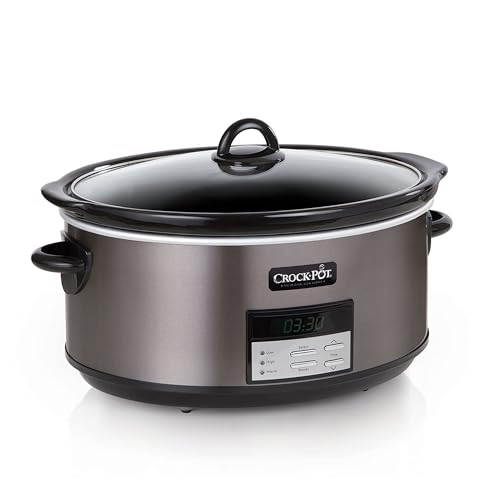
Crock-Pot Programmable Slow Cooker 8-Quart, Black Stainless Steel
Badge: Best for Crowds and Batch Days
Strengths
- Largest capacity in this guide, sized for crowds, batch days and freezer stocking
- Programmable timer with automatic warm solves the late-evening problem
- Dishwasher-safe stoneware and lid keep the big-pot cleanup honest
Trade-offs
- A large, heavy footprint that small kitchens must measure before buying
- Oversized for two-person daily cooking unless leftovers are the plan
- Slow cooking only, with no pressure or browning function in the listing
Key specifications (from the verified listing)
- Capacity: 8-quart, described as serving 10+ people
- Timer: digital, up to 20 hours, per the verified listing
- Warm: automatic warm setting after cooking
- Vessel and lid: stoneware pot and lid described as dishwasher-safe
- Finish: black stainless steel
This is the slow cooker for the household whose cooking happens in events: the Sunday batch that stocks the freezer, the game-day chilli, the holiday side that must feed a table and a half. Its verified listing leads with scale, an 8-quart capacity described as serving ten or more people, and then answers the obvious objection to scale, which is timing, with a digital timer that runs up to 20 hours and an automatic warm setting that takes over when the cook ends. That pairing of bigness with discipline is the whole argument for the model, and it is a strong one.
Programming changes the emotional contract of slow cooking. Instead of dinner depending on someone arriving home at a particular hour, the pot itself manages the boundary between cooking and holding, which suits staggered family evenings and hosts who cook ahead of guests. The black stainless finish also earns its place here: a pot this size lives on the counter whether you plan for it or not, so it may as well look deliberate there. Dishwasher-safe stoneware and lid, both stated in the listing, keep the aftermath proportional.
The limitation is the mirror of the strength. An 8-quart stoneware vessel is heavy empty and serious when full, it wants a permanent home rather than a high cupboard, and cooked at a quarter fill it will not treat a small stew kindly. Buy it for the cooking you demonstrably do in bulk, not for the feast you imagine twice a year, because the feasts can borrow capacity while the daily pot cannot borrow smallness.
Best for: large households, batch cookers and hosts who need capacity plus a timer / Not suited for: small kitchens, couples cooking fresh daily, or pressure seekers

AROMA Digital Rice Cooker ARC-914SBD, 4-Cup Uncooked
Badge: Best Compact Multicooker
Strengths
- Compact 2 Qt body that earns a place in small kitchens and dorm-adjacent setups
- Steamer and grain functions stretch one small pot across whole meals
- Digital programs remove the guesswork from everyday rice and grains
Trade-offs
- Far too small for family braises or batch slow cooking
- Its multicooker positioning does not include a pressure function
- Grain-first design means soups and stews are supporting acts, not the headline
Key specifications (from the verified listing)
- Capacity: 4-cup uncooked / 8-cup cooked; 2 Qt, per the verified listing
- Functions named in the listing: rice cooker, steamer, grain cooker, multicooker
- Exterior: stainless steel
- Model: ARC-914SBD
The AROMA ARC-914SBD is the bridge pick of this guide: a digital rice cooker whose verified listing also claims steamer, grain cooker and multicooker roles, in a compact 2 Qt body with a stainless steel exterior. It earns its link on the multicooker side of that claim, because a small household that cooks rice, steamed vegetables and a modest one-pot grain dish in the same vessel across a week is genuinely being served by this design, even though neither pressure nor stoneware-style slow cooking is on its menu.
Judged as a small-kitchen anchor, its virtues compound. Eight cups of cooked grain is a family side or a couple’s meal-prep base; the steamer function turns the same session into vegetables or dumplings without a second pan; and digital programming means the pot manages absorption and resting in a way a stovetop saucepan rewards only with attention. For a first apartment, a small household, or an office-adjacent kitchenette, this is the kind of appliance that gets used four times a week precisely because it asks for so little room and thought.
Its limits are size and specialisation. Two quarts will not braise for six, will not hold a whole chicken comfortably, and will not pretend to be the family slow cooker this keyword also names. Buy it as the grain-and-steam centre of a small kitchen, pair it mentally with a separate slow or pressure solution for big dishes, and it will not disappoint; buy it as a universal pot and its capacity will correct you within a week.
Best for: small households wanting grains, steaming and light one-pot cooking in one compact body / Not suited for: family braises, large batches, or anyone shopping for pressure cooking

Cosori Rice Cooker 10 Cup with Fuzzy Logic
Badge: Most Versatile Single Pot
Strengths
- The only pick here whose listing explicitly combines saute and slow cook in one vessel
- Fuzzy logic forgives small measuring errors across rice and grain varieties
- Ceramic-coated pot and steamer basket widen the menu beyond plain rice
Trade-offs
- A rice platform first: its slow cooking suits grains, soups and modest pots, not giant stoneware braises
- Coated pot needs gentle utensils and non-abrasive cleaning to stay at its best
- Function depth means a learning curve the simple dial pots do not impose
Key specifications (from the verified listing)
- Capacity: 10 cup uncooked / 20 cup cooked, per the verified listing
- Logic: fuzzy logic control
- Functions named in the listing: 18-in-1, including saute and slow cook
- Inner pot: ceramic coating, described as non-stick
- Timing: 24H keep warm and delay timer, per the listing
- Accessory named in the listing: stainless steel steamer basket
If one model in this guide argues that the future of the category is the sensed, multi-function pot, it is the Cosori. Its verified listing is unusually explicit: fuzzy logic control, an 18-in-1 function set that names saute and slow cook directly, a ceramic-coated inner pot, a stainless steel steamer basket, and timing that includes a delay timer and a full day of keep warm. That combination lets a cook brown aromatics, slow a soup, steam vegetables and produce a large batch of rice in a single vessel across a single day, which no other pick here can claim in its own listing language.
The slow cook mode deserves precise framing. It will handle soups, porridges, bean-adjacent pots and modest braises with the patience the method requires, and the saute function means the flavour base can be built in the same pot rather than in a pan you then wash separately. What it is not is a stoneware slow cooker: the vessel, heat pattern and capacity logic are those of a rice platform, and a household whose slow cooking means huge hunks of meat in an oval crock should buy the crock. Judged on its own terms, though, this is the most complete single-pot answer in the guide.
Care and learning are the prices of versatility. The ceramic coating rewards wooden or silicone tools and punishes metal and scouring pads over time, and eighteen functions means the first week involves the manual in a way the Hamilton Beach never demands. For cooks who enjoy a capable instrument and cook grains several times a week, that trade is gladly made; for cooks who want to turn a dial and leave, it is friction without benefit.
Best for: grain-centred households wanting saute, slow, steam and rice in one sensed pot / Not suited for: stoneware purists, very large braises, or anyone who hates menus
BLACK+DECKER Rice Cooker 6-Cup Cooked
Badge: Best Simple Rice Sidekick (Prose-Only)
Strengths
- As a rice cooker, it is admirably direct: grains in, dinner side out
- Steaming basket adds vegetables or dumplings to the same session
- Removable non-stick bowl keeps serving and washing simple
Trade-offs
- Not a slow cooker and not a pressure cooker, so it sits outside this keyword’s two jobs
- Small cooked capacity suits sides and small households only
- No slow, saute or programmable depth in its verified listing
Key specifications (from the verified listing)
- Capacity: 6-cup cooked, per the verified listing
- Accessory named in the listing: steaming basket
- Bowl: removable, non-stick
- Finish: white
This BLACK+DECKER is profiled, deliberately, as the guide’s example of an honest mismatch. As a rice cooker it is perfectly respectable: six cups of cooked grain, a steaming basket for the vegetables that turn rice into a meal, and a removable non-stick bowl that serves and washes without drama. A household shopping for a small grain cooker could choose it happily and be well served for years.
But this keyword does not ask for a grain cooker. It asks for pressure and slow cookers, and this model’s verified listing describes neither function, no slow mode, no pressure, no multicooker claim to lean on. Linking it here would invite exactly the mistaken purchase this guide exists to prevent, so it appears as a prose-only profile: fully described, fairly judged, and not sold to you under a false flag. If your kitchen already has its slow solution and simply needs the rice side handled cheaply and simply, you now know what this model is; buy it for that job under its own name, not under this keyword.
Best for: grain-first shoppers who already own a slow or pressure solution / Not suited for: anyone arriving here actually needing slow or pressure cooking
Prose-only profile: this model is covered for comparison, but it is not linked in this guide because it does not serve the main job this keyword names. See the sources note published with this guide for the reasoning.
AROMA Rice Cooker ARC-363NG, 3-Cup Uncooked
Badge: Best for Singles’ Grains and Soup (Prose-Only)
Strengths
- Genuinely small footprint for one-person and two-person cooking
- Oatmeal and soup roles suit breakfast-and-lunch kitchens
- Automatic keep warm holds a small batch at serving readiness
Trade-offs
- Not a slow cooker and not a pressure cooker under any reading of its listing
- Capacity is a side dish or a solo meal, never a family main
- No programmable or multi-function depth beyond its named roles
Key specifications (from the verified listing)
- Capacity: 3-cup uncooked / 6-cup cooked; 1.5 Qt, per the verified listing
- Roles named in the listing: small rice cooker, oatmeal cooker, soup maker
- Keep warm: automatic keep warm
- Finish: white; model ARC-363NG
The little AROMA ARC-363NG is the second prose-only profile in this guide, and it earns its place the same way its BLACK+DECKER neighbour does: by being a good example of the wrong category. Its verified listing describes a 1.5 Qt small rice cooker that also presents itself as an oatmeal cooker and soup maker with automatic keep warm, in white. For a single cook, a student, or a small household that eats grains and soups in modest quantities, that is a sweet, honest specification.
What it is not, in any stretching of language, is a pressure cooker or a slow cooker, and so it is not linked in a guide answering this keyword. Its inclusion still does useful work: it marks the small end of the cooker spectrum, it shows how far listing vocabulary can drift from the search that summoned it, and it gives grain-first readers a fairly described option to pursue under the right keyword. Everyone else should let their eyes travel back up the page to the stoneware and the Cosori, where this keyword’s actual jobs are done.
Best for: single cooks wanting rice, oatmeal and soup in the smallest footprint / Not suited for: slow cooking, pressure cooking, or family-sized mains of any kind
Prose-only profile: this model is covered for comparison, but it is not linked in this guide because it does not serve the main job this keyword names. See the sources note published with this guide for the reasoning.
Comparison Table
The comparison strips each model down to the attributes that decide daily use: honest capacity, control style and what kind of cooking the body is really built for. Read the capacity column with the fill-line rule in mind: a slow cooker delivers its best results filled between half and two-thirds, so the working capacity of every stoneware pot here is meaningfully smaller than the headline figure on its box.
| Pick | Badge | Capacity | Control style | Listing |
|---|---|---|---|---|
| Hamilton Beach 6 Quart Slow Cooker 33665G | Best Overall Slow Pick | 6-quart | 3 settings, manual-style simplicity | Check on Amazon |
| Crock-Pot Programmable Slow Cooker 8-Quart, Black Stainless Steel | Best for Crowds and Batch Days | 8-quart | Programmable digital timer with automatic warm | Check on Amazon |
| AROMA Digital Rice Cooker ARC-914SBD, 4-Cup Uncooked | Best Compact Multicooker | 2 Qt / 8-cup cooked grain | Digital rice, steam and multicooker programs | Check on Amazon |
| Cosori Rice Cooker 10 Cup with Fuzzy Logic | Most Versatile Single Pot | 10-cup uncooked grain | Fuzzy logic with delay timer and keep warm | Check on Amazon |
| BLACK+DECKER Rice Cooker 6-Cup Cooked | Best Simple Rice Sidekick (Prose-Only) | 6-cup cooked grain | Simple rice cooking with steaming basket | Prose-only |
| AROMA Rice Cooker ARC-363NG, 3-Cup Uncooked | Best for Singles’ Grains and Soup (Prose-Only) | 1.5 Qt / 6-cup cooked grain | Simple cooking with automatic keep warm | Prose-only |
How to Choose Between Pressure Speed and Slow Patience
Start with time, because time is the whole argument between these methods. A pressure cooker compresses the cooking of dried beans, tough braising cuts, stock and whole grains into a fraction of their conventional time, and it does so on the day you decide to eat them. A slow cooker moves the work earlier: food is loaded in the morning or the night before, cooks gently for hours, and is ready at the moment you are. Neither is better in the abstract.
Capacity maths comes second, and it punishes optimism. For slow cookers, count roughly one quart of headline capacity per adult eater for a main dish with leftovers, then remember the fill rule: the pot should sit between half and two-thirds full for even cooking, which means a 6-quart pot is really a four-quart working pot, ideal for four to five eaters, while the 8-quart class earns its counter space only in homes that batch cook, host, or freeze portions as a habit. Rice-led models measure differently, in cups of uncooked grain, and a 10-cup uncooked platform like the Cosori cooks far more grain than most families will eat in a sitting, which is precisely why its slow and steam modes matter more than its headline rice figure.
Controls decide how a cooker fits a workday. A manual dial with high, low and warm is the most robust control ever fitted to a slow cooker: nothing to program, nothing to reset after a power flicker, and no electronics to fail in year six. Its weakness is timing, because a manual pot will keep cooking until someone turns it, which can overcook a dish held too long after a delayed commute. Programmable models answer that with a countdown that drops to warm automatically, and the largest Crock-Pot here extends that logic with a timer range up to 20 hours in its verified listing. Fuzzy-logic rice platforms take a third path, adjusting heat through the cook based on sensor feedback, which forgives small measuring errors in grain and porridge in a way a fixed dial never can.
Lids and vessels deserve more attention than they usually get. Stoneware crocks hold heat beautifully and go from counter to table gracefully, but they are heavy, they dislike sudden temperature shocks, and a chipped rim compromises the lid seal that slow cooking depends on. Glass lids let you check a braise without lifting and losing heat, which sounds minor until the twentieth time you do it. Locking lids, like the one on the programmable Crock-Pot platform in the wider pool, matter if the pot travels to potlucks or moves house often. Non-stick and ceramic-coated metal inner pots, as on the Cosori, are lighter and saute in the same vessel, but they ask for gentler utensils and no abrasive scrubbing if the coating is to last.
Finally, price the tier, not the fantasy. In qualitative terms, the value tier of this category buys you a sound vessel, a simple control and no timer; the middle tier adds programming, better lids and multi-function range; the premium tier adds sensing logic, coatings and finish. None of those steps adds pressure. If, after reading this far, genuine pressure speed is the thing your cooking actually lacks, the correct move is to treat the slow picks here as your planned-ahead benchmark and shop separately among true pressure models, using our overview of Best Pressure Cookers as the starting frame for what that separate purchase should include.
How to Slow Cook Well: Setup, Timing and Care
Slow cooking rewards a small amount of technique applied consistently. The method is simple, but the difference between a silky braise and a watery one is decided in the first fifteen minutes and the last five, not during the unattended hours in between. The routine below is written for the stoneware picks in this guide and adapts, with the notes given, to the slow mode on the Cosori platform.
- Brown with intent, or skip browning honestly. Searing meat and blooming spices in a pan before loading builds the deep flavours a gentle pot cannot create on its own. If you skip it on a busy morning, compensate with tomato paste, soy-based seasoning or smoked spices rather than pretending the results will be identical.
- Load in order: dense root vegetables and aromatics at the bottom near the heat, meat in the middle, delicate vegetables and dairy near the top and late. Liquid should come partway up the ingredients, not cover them, because slow cookers add almost no evaporation and ingredients release their own juices.
- Respect the fill line. Aim for the pot to sit between half and two-thirds full. An underfilled pot cooks hot and fast at the edges; an overfilled one heats slowly through the centre and can linger too long at lukewarm temperatures on its way up.
- Choose the setting by the clock you have, not the one you wish for. Low is the flavour setting for braises and beans when the day allows it. High is a legitimate tool for shorter windows, but converting a low recipe to high is not a simple halving of time, and delicate vegetables suffer first.
- Leave the lid on. Every lift releases a meaningful amount of accumulated heat and steam and extends the cook. Use the glass lid to judge, and lift only to stir where a recipe genuinely needs it or to add late ingredients.
- Finish actively. Skim fat, reduce a thin cooking liquid in a pan if the dish needs body, and brighten with acid, fresh herbs or a salty garnish at the end. Slow cooking mutes top notes; the last five minutes are where they come back.
- Hold and store safely. Use the warm setting for short holding at the table, not as an all-evening storage plan, and refrigerate leftovers in shallow containers once the meal is done rather than leaving the crock to cool on the counter for hours.
Cleaning decides whether a cooker gets used weekly or exiled to a cupboard. Stoneware crocks and glass lids on the Hamilton Beach and the large Crock-Pot are described in their verified listings as dishwasher-safe, which removes the biggest friction in the category, though hand washing remains kinder to rims and seals over years. Soaked-on starch yields to a warm soak far better than to scouring. The ceramic-coated inner pot on the Cosori wants a soft sponge and no metal utensils in daily use. Bases should never be immersed; a damp cloth is the whole routine, and keeping the heating plate free of dried spills prevents the scorched smell that otherwise perfumes the next three meals.
A note on adapting pressure recipes, because many readers arrive with a favourite pressure dish in mind. The conversion is real cooking, not arithmetic: liquid quantities usually need modest increases for the long cook even though evaporation is low, dried beans need soaking or a pre-boil depending on the variety, and delicate vegetables, pasta and dairy move to the final stretch. Our bean-focused companion guide works through the legume conversions in detail. What never converts is the clock: a dish that pressure finishes inside the hour will take the slow pot most of the day, and planning, not impatience, is the skill this method teaches.
Troubleshooting
Problem: food is watery and bland after a full cook → too much starting liquid and no finishing step are the usual causes. Start with less liquid than a stovetop recipe suggests, then reduce the cooking liquid in a pan at the end and season again after reducing, because flavours concentrate as the liquid does.
Problem: meat is tender but dry, especially chicken breast → the cut, not the pot, is the problem. Lean breast meat overcooks in a long gentle bath; thighs, shoulder cuts and other well-marbled options stay succulent, and adding breast meat late in the cook rescues a mixed dish.
Problem: the dish is not ready at dinner after a power flicker → a manual dial pot resumes cooking when power returns but has lost track of time, while a programmable pot may have reset entirely. If the food sat lukewarm for an unknown stretch, treat safety conservatively, and consider a programmable model with automatic warm if outages are common in your area.
Pressure Cooking vs Slow Cooking: What Actually Changes at Dinner
Strip away the marketing and the two methods differ in three physical ways. Pressure raises the boiling point of water inside a sealed vessel, so food cooks hotter than any open or vented pot can manage, and that heat is what collapses connective tissue and hydrates dried legumes quickly. Slow cooking holds food at a gentle simmer for hours, so the same tissues relax gradually and flavours marry in the liquid rather than being driven into the ingredient. Steam and grain cooking, the third family in this guide, works at ordinary boiling temperatures with precise water management, which is why rice platforms judge doneness by absorption rather than by time alone.
Those physics show up on the plate in predictable places. Pressure wins outright for dried beans from scratch on the day, for stock with real body in an evening, for tough cuts when the decision to cook them was made at five o’clock, and for grains that otherwise demand soaking and supervision. Slow wins for braises that benefit from a long melding, for sauces that should taste cooked-together rather than assembled, for keeping a meal at serving readiness across a staggered family evening, and for the simple emotional fact of dinner being done when you walk through the door. The overlap zone is large: stews, soups, curries, pulled meats and most bean dishes can be cooked beautifully by either method, with the recipe adjusted, which is why so many households searching for Best Pressure Cookers Combos discover that a two-pot answer, one fast and one slow, covers more real life than any single compromise appliance.
Energy and attention follow the same split. A pressure pot concentrates its work into a short, hotter window and then is done; a slow pot sips power gently for hours and asks for none of your attention in between. Neither profile is wasteful in a way that should decide the purchase on its own. What should decide it is the shape of your failures: if your failed dinners are last-minute, pressure fixes them; if your failed dinners are evenings when nobody had time to cook at all, a loaded slow pot in the morning fixes them. Name your failure honestly and the method chooses itself.
Building a Two-Method Kitchen Without Buying a True Pressure Pot Yet
Many readers of this guide will end up, at least for now, with the slow side covered and the pressure side postponed, and that is a perfectly workable kitchen if it is built deliberately. The slow pot takes ownership of braises, soups, bean batches and pulled meats on planned days. The grain platform, whether that is the Cosori with its slow and steam modes or a small dedicated rice cooker of the kind profiled prose-only below, takes ownership of rice, oats and steamed sides, which are the accompaniments those slow dishes most often want. A heavy lidded pot on the stove covers the urgent braise imperfectly but honestly, at the cost of your attention.
What this arrangement cannot fake is speed with dried legumes and stock, and the guide will not pretend otherwise. If those two jobs matter weekly, a true pressure cooker stops being a postponement and becomes the correct next purchase, and the slow picks here remain valuable rather than redundant, because the two methods divide the week between them instead of competing for it. Households shopping from outside the United States should also check the regional frames in our guides to Best Pressure Cookers Australia and Best Pressure Cookers Canada, since voltage, plug and model availability change the shortlist even when the cooking advice does not.
Storage planning is the unglamorous final step. A stoneware slow cooker is a large, heavy resident wherever it lands, and the 8-quart class in particular should be measured against its shelf before purchase, not after. Buy for the kitchen you have, keep the pot you will use within arm’s reach of the counter, and the method you chose will actually get used, which is the only specification that finally matters.
Common Buying Mistakes
- Buying a slow or rice cooker while expecting pressure speed. The listings in this category borrow each other’s vocabulary. Check for an explicitly described sealed pressure function before assuming one exists; if the listing does not describe it, the pot does not do it, whatever the search result that led you there implied.
- Sizing by the headline capacity alone. Slow cookers cook best between half and two-thirds full, and rice capacities are quoted in uncooked cups that roughly double when cooked. Both conventions make headline numbers look larger than the working reality.
- Filling the pot to the brim for a crowd. An overfilled slow cooker heats unevenly and spills at the simmer. For a genuine crowd, the largest pot here, cooked at a sensible fill, beats a smaller pot filled to the lid every time.
- Treating the warm setting as storage. Warm holds food for serving; it is not refrigeration and it is not an overnight plan. Cool leftovers promptly and refrigerate them in shallow containers.
- Lifting the lid to check progress repeatedly. Each lift dumps the heat the pot spent an hour accumulating. Judge through the glass, and open only when the recipe asks you to add or stir.
- Scouring coatings and shocking stoneware. Ceramic coatings want soft tools, and stoneware wants gradual temperature changes. A cold crock under hot water, or a hot crock on a cold stone counter, is how hairline cracks begin.
Final Recommendation
For most households, the first choice in this guide is the Hamilton Beach 6 Quart Slow Cooker: it does the central slow-cooking job without complication, its verified listing promises dishwasher-safe stoneware and lid for painless cleanup, and its working capacity fits the four-to-five-eater dinners that make up most real weeks. It is the pick that asks the least of you after purchase day, and in this category that calm is a genuine feature.
Choose the Crock-Pot Programmable 8-Quart instead if your cooking is defined by crowds, batch days and freezing portions, and choose the Cosori Rice Cooker 10 Cup if your kitchen needs one body that sautes, slow cooks, steams and masters grains with sensor-guided patience. The two prose-only rice profiles suit grain-first households that already own their slow solution. And if your honest conclusion after this guide is that pressure speed is the missing piece, act on it directly: buy a true pressure cooker for that job rather than asking any model here to impersonate one. Start with the top slow pick here:
Check on Amazon: Hamilton Beach 6 Quart Slow Cooker Check on Amazon: Crock-Pot Programmable 8-Quart Slow Cooker Check on Amazon: AROMA Digital Rice Cooker ARC-914SBD
Frequently Asked Questions
Are any of these picks true pressure cookers?
No. The verified pool behind this guide contains slow cookers, rice cookers and one rice platform with a slow cook mode, and none of the listings describes a sealed pressure-cooking function. This guide reviews the picks for the jobs they genuinely do and explains the pressure side in prose, rather than crediting any model with a function its listing does not describe.
Can a slow cooker replace a pressure cooker?
For planned-ahead cooking, largely yes: braises, soups, stews, pulled meats and soaked beans all cook beautifully in a slow pot, with recipes adjusted for time and liquid. For same-day dried beans, fast stock and last-minute tough cuts, no: the time compression is the entire point of pressure, and no setting on a slow cooker reproduces it.
Which pick is best if I mostly cook for two?
The Hamilton Beach 6 Quart is the smallest dedicated slow cooker here and still suits small households that welcome leftovers; for genuinely small daily cooking, the Cosori platform cooks modest grain and slow batches in one body. Avoid the 8-quart class unless you batch cook, because a large pot cooked nearly empty heats unevenly at the edges.
Is the Cosori a slow cooker or a rice cooker?
Its verified listing describes a rice cooker first, built on fuzzy logic with a ceramic-coated inner pot, whose 18-in-1 function set includes a dedicated slow cook mode alongside saute and steaming. Treat it as a grain specialist that can slow cook, not as a stoneware replacement for very large braises.
Why are two picks not linked?
The BLACK+DECKER 6-Cup and the small AROMA rice cooker are honest grain cookers, but this keyword names pressure and slow cooking, and neither model serves either job. They are profiled so the comparison is complete, and left unlinked so no reader buys one by mistake for a job it cannot do.
How do I convert a favourite pressure recipe to the slow pot?
Keep the aromatics and seasonings, modestly increase the liquid, soak or pre-boil dried beans according to their variety, move delicate vegetables, pasta and dairy to the final stretch, and plan hours instead of minutes. The flavour destination is similar; the road and the clock are entirely different.


