Disclosure: topratedkitchenware.com is reader-supported. When you buy through links on our site, we may earn an affiliate commission from Amazon and other retailers, at no extra cost to you.
Where to buy
Five of the six grills in this best propane grills under 1500 guide were verified against Amazon’s catalog data and are sold on Amazon; use the links to confirm the exact configuration on the listing before ordering. The sixth entry is a charcoal grill included deliberately as a fuel alternative for readers reconsidering propane — it is covered in prose only, with no purchase link, for exactly that reason. Start with the picks, then read the full guide ↓.
- Nexgrill Propane 4-Burner Gas Grill with Side Burner, 60,000 BTU, 626 Sq. In.
- IdeaMaxx 3-Burner Propane Gas Grill with Cast Iron Grates, 38,200 BTU
- Weber Spirit E-425 Gas Grill, 4 Burners, Sear Zone with Boost Burners
- Nexgrill Propane 4-Burner Gas Grill with Side Burner, 52,000 BTU, 526 Sq. In.
- AMERLIFE 6-Burner Propane Gas Grill with Side Burner, 60,000 BTU, 650 Sq. In.
- Realcook Charcoal Grill with Offset Smoker, 800 Sq. In. — prose-only fuel alternative (see its review below)
Shopping for the best propane grills under 1500 is a pleasantly strange exercise, because the under $1,500 ceiling sits far above what a capable freestanding propane grill actually requires. In this band, the question stops being “what can I afford” and becomes “what is worth wanting”: premium heat architecture from an established maker, maximum capacity for a household that cooks at event scale, or a mid-band grill bought with so much headroom left over that the entire outdoor kitchen around it — cover, tools, a second specialty cooker — fits in the same budget. This guide covers all three postures honestly. Five of the six picks are verified propane grills spanning that logic, from the Weber Spirit E-425’s deliberate sear-zone design to a six-burner AMERLIFE with 650 square inches of stage. The sixth is different on purpose: a charcoal grill with an offset smoker, included in prose only because some shoppers who set a generous ceiling are really deciding between fuels, and a propane guide that hides the alternative is not doing its job. It carries no link and no image — our rule for picks outside the verified propane pool for this keyword — but it gets a full, fair review. If your search is also running through Best Outdoor Propane Gas Grills or Best Outdoor Bbq Grills Propane, the same framework applies: in this band, fit and design quality decide, not the ceiling.
Key Takeaways
- Under $1,500 is headroom, not a target: most households should land well below it and fund the whole outdoor station instead.
- The Weber Spirit E-425 is the design-led pick — sear zone with boost burners, porcelain-enameled cast-iron grates, and the deepest support network here.
- Capacity scales honestly in this guide: 526, 626, and 650 square inches across the Nexgrill pair and the AMERLIFE six-burner.
- The Realcook charcoal offset smoker is covered prose-only as a fuel alternative — charcoal buys smoke flavor and ritual at the cost of speed and convenience.
- Grate material remains the highest-frequency decision: cast iron in bare, matte, or porcelain-enameled form dominates this lineup.
- At this ceiling, configuration checks matter most: model families span trims, and the listing is the contract.
In this guide
Quick Picks
| Pick | Badge | Best for | Link |
|---|---|---|---|
| Nexgrill 4-Burner, 626 Sq. In. | Best for Entertaining | Hosts who want cabinet-grill capacity with room to spare in the band | Check on Amazon |
| IdeaMaxx 3-Burner with Cast Iron Grates | Best Compact Sear Pick | Small patios that refuse to compromise on the sear | Check on Amazon |
| Weber Spirit E-425 | Best Overall | Buyers who want the most deliberate heat design in the group | Check on Amazon |
| Nexgrill 4-Burner, 526 Sq. In. | Best Mid-Size All-Rounder | Households between family dinners and gatherings | Check on Amazon |
| AMERLIFE 6-Burner, 650 Sq. In. | Most Capacity | Event-scale households wanting maximum burners and area | Check on Amazon |
| Realcook Charcoal Grill with Offset Smoker | The Charcoal Alternative (prose-only) | Readers deciding between propane convenience and charcoal smoke | Prose-only — see review |
How These Picks Were Chosen
This guide is research-led and verification-first. The five propane picks were confirmed against Amazon’s Creators API catalog data — model, brand, ASIN, image, and stated specifications — and assessed against what a generous band should deliver: heat architecture rather than raw burner counts, grate materials with known cooking behavior, cooking area matched to real household scales, and support depth for the parts that wear. We did not cook on these grills, and we do not present research as testing. The Realcook was handled under a different rule, stated openly here and in its source notes: it appeared in the verified pool for this keyword, but it is a charcoal grill, not a propane grill, so it cannot honestly be linked in a propane guide. Rather than drop it silently or mislabel it, we review it in prose as the fuel alternative some readers are genuinely weighing, with no Amazon link and no image. Prices are absent beyond the band in the keyword itself, because this tier’s pricing moves with season and promotion; the links exist so you can check the current figure on the exact configuration. One more selection note: in a band this wide, we deliberately did not fill the list with near-identical premium grills. The spread — design-led, capacity-led, compact, maximal, and one fuel alternative — is the honest map of the decisions a shopper with this ceiling actually faces.
The 6 Best Propane Grills Under 1500 (Plus One Fuel Alternative)

Nexgrill Propane 4-Burner Gas Grill with Side Burner, 626 Sq. In.
Badge: Best for Entertaining
Strengths
- 626 square inches of cooking area turns the band’s headroom into the host’s scarcest resource: space.
- 60,000 BTU across the burner set, electronic ignition, and a lid thermometer properly support the size.
- The double-door stainless cabinet keeps a large grill tidy — tank and tools out of sight.
Trade-offs
- A substantial assembly and a permanent footprint; measure patio and gate before ordering.
- Small households will heat empty grate on weeknights.
- Capacity this size asks for the largest cover and the most cleaning surface in the propane group.
Mini spec box
- Burners: 4 main plus side burner
- Output: 60,000 BTU
- Cooking area: 626 sq. in.
- Body: stainless steel with double-door cabinet
- Ignition: electronic; built-in thermometer
In a band with room to spare, the big Nexgrill is the capacity argument made cleanly: if your household’s defining cooks are gatherings, the correct use of a generous budget is to remove the space constraint entirely, and 626 square inches does that. A full party menu fits in a single layer with zones intact — burgers working, chicken finishing, vegetables in the gaps, finished food holding at the cool edge — and the side burner keeps the sauce in the same operation. The cabinet format suits the tier: a grill this size is a permanent patio resident, and the double doors keep it looking like furniture rather than equipment. What the band buys beyond the grill itself also matters here: at this ceiling, the Nexgrill plus its fitted cover, a serious tool set, and a spare tank still leaves the budget breathing, which is the correct way to buy big. The cautions are scale’s usual ones — assembly is a project for two people, preheat for a two-person dinner is inherently wasteful, and six hundred square inches of grate is six hundred square inches of brushing. Hosts will call that a fair trade every single weekend. Everyone else should read on: this band offers smaller grills that leave even more headroom for the rest of the outdoor kitchen.
Best for: regular hosts whose constraint is space / Not suited for: small households or small patios

IdeaMaxx 3-Burner Propane Gas Grill with Cast Iron Grates
Badge: Best Compact Sear Pick
Strengths
- Cast iron grates deliver the heat retention and crust that define serious searing.
- 38,200 BTU across three burners is strong output for the class.
- Foldable side shelves make it the storage-friendliest full grill in this guide.
Trade-offs
- Cast iron’s maintenance contract applies in full: seasoning, warm brushing, dry storage.
- Three burners cap area and zone complexity below the four- and six-burner picks.
- A newer brand with a developing long-term record.
Mini spec box
- Burners: 3
- Output: 38,200 BTU
- Grates: cast iron
- Shelves: foldable side shelves
- Finish: black
The IdeaMaxx looks like the modest entry in a generous-band guide, and that is exactly its lesson: a high ceiling does not oblige anyone to buy a large grill. For the cook on a mid-size patio whose ambitions run to crust and char rather than headcount, this three-burner spends everything on the surface that matters — cast iron grates with the mass to hold a sear — backed by healthy output and a footprint that folds down when the patio needs to be a patio. The headroom it leaves in an under $1,500 budget is not leftover; it is opportunity. It funds the best cover, the best tools, a quality thermometer, and still leaves room for a specialty second cooker if the household’s interests grow toward smoking or pizza. The obligations are cast iron’s standing ones, and in this band they deserve one extra sentence: a buyer with this much budget has no excuse for the rust outcome, because the cover and the brush belong in the same order. Choose the IdeaMaxx if your cooking is intimate and intense; choose it proudly over bigger grills if your patio says so. The band serves the cooking, never the reverse.
Best for: sear-focused cooks on smaller patios / Not suited for: crowd cooks or owners who skip grate care

Weber Spirit E-425 Gas Grill
Badge: Best Overall
Strengths
- The Sear Zone with Boost Burners is the most deliberate heat architecture in this guide — maximum heat, exactly where you put it.
- Porcelain-enameled cast-iron grates combine cast iron’s searing mass with an easier-care surface.
- Weber’s support and parts depth is the strongest long-horizon ownership proposition here.
Trade-offs
- Premium positioning means the band’s headroom shrinks fastest here — the ecosystem still needs funding.
- Weber Works rails encourage accessory purchases beyond the grill.
- It wins on design, not dimensions: two Nexgrills and the AMERLIFE all offer more raw area.
Mini spec box
- Burners: 4, with Sear Zone and Boost Burners
- Grates: porcelain-enameled cast iron
- Extras: Weber Works rails
- Finish: black
The Spirit E-425 is what a generous band is for. Not more square inches — several grills here beat it there — but more intention: a four-burner layout where one zone is engineered to run hotter than the rest, so searing becomes a place rather than a setting; grates that marry cast iron’s thermal mass to an enamel surface that shrugs off the maintenance anxiety; and a maker whose parts pipeline turns the year-five igniter or grate question into a routine order. Cooking on a design like this feels different in a specific way: the hot work and the gentle work stop interfering with each other. Steaks sear in the boosted zone and finish in calm territory; chicken crisps at the end instead of burning at the beginning; the whole cook runs as a sequence rather than a negotiation. For the under $1,500 shopper, the Weber is also the discipline test. It will likely consume more of the band than the Nexgrills, and the correct response is to let it — while still funding the cover and tools from what remains, because even the best grill ages faster naked. Buy it if your cooking rewards precision. The hosts and the maximalists have their own picks in this guide, and the Weber’s owners will not envy them.
Best for: precision-minded cooks who value design and support depth / Not suited for: buyers maximizing area per purchase
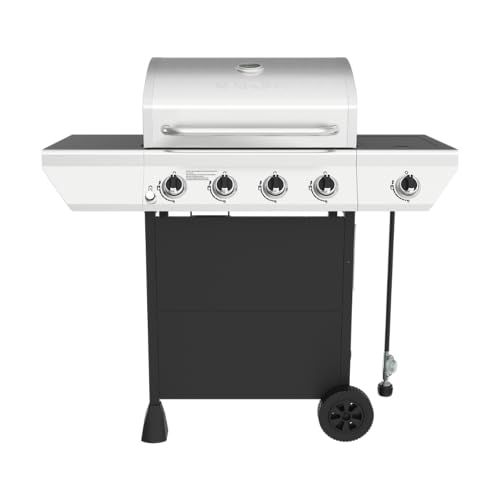
Nexgrill Propane 4-Burner Gas Grill with Side Burner, 526 Sq. In.
Badge: Best Mid-Size All-Rounder
Strengths
- 526 square inches is the balanced stage: family dinners with room, small gatherings without stress.
- Matte-finish cast iron grates bring searing quality to the middle of the range.
- 52,000 BTU, electronic ignition, thermometer, and side burner form a complete control package.
Trade-offs
- Cast iron grate care applies — season, brush, keep dry.
- True event-scale cooks will still outgrow it; that is the 626’s job.
- No specialized sear zone like the Weber’s.
Mini spec box
- Burners: 4 main plus side burner
- Output: 52,000 BTU
- Cooking area: 526 sq. in.
- Grates: matte-finish cast iron
- Lid: stainless steel; built-in thermometer; electronic ignition
The mid-size Nexgrill is the guide’s answer for the household that refuses both extremes: too serious for a compact, too sensible for a monument. Its 526 square inches and four burners cover the realistic span of family life — weeknight dinners with zones to spare, weekend gatherings of eight without batch anxiety — and its matte cast iron grates give the cooking a quality that purely size-driven picks often skip. In the context of this band, its virtue is proportion: it takes a moderate share of a generous budget and returns a grill with no obvious weakness, leaving deep headroom for everything around it. If the Weber is the connoisseur’s allocation and the 626 is the host’s, this is the steward’s — the purchase that will look wise in every season rather than brilliant in one. The maintenance notes are the cast-iron ones, and the sizing note is the mirror of its sibling’s: the household that regularly feeds fifteen should step up to the 626 or the AMERLIFE rather than batching on this stage forever. Everyone else can stop measuring. This is the size class where most American grilling actually happens, executed here with the right grates and the right hardware.
Best for: households wanting one balanced, long-lived grill / Not suited for: event-scale hosts or sear-zone specialists

AMERLIFE 6-Burner Propane Gas Grill with Side Burner, 650 Sq. In.
Badge: Most Capacity
Strengths
- Six burners and 650 square inches — the maximum stage and the most zones in this guide.
- Cast iron grates and a warming rack support staged, event-scale cooking.
- 60,000 BTU, built-in thermometer, and regulating valve give the size a working control set.
Trade-offs
- The largest footprint and assembly in the guide; a two-person project with measuring beforehand.
- Small households pay for capacity in fuel, preheat time, and cleaning on every cook.
- Maximum hardware at a value position demands extra diligence on configuration and warranty verification.
Mini spec box
- Burners: 6 main plus side burner
- Output: 60,000 BTU
- Cooking area: 650 sq. in.
- Grates: cast iron, with warming rack
- Extras: built-in thermometer, regulating valve
The AMERLIFE is the maximalist’s candidate, and in a band this generous it deserves a fair hearing rather than a raised eyebrow. Six burners is not a spec-sheet flourish for the right household; it is a workflow — searing zones, roasting zones, a holding zone, and a warming rack above, all running simultaneously for the kind of cook where twenty people eat in waves and the grill never empties. Six hundred fifty square inches makes that workflow physical. The supporting details are present: cast iron under the food, a thermometer in the lid, a side burner for the pot that always accompanies a big cook. The diligence this pick demands is proportional to its promise. Verify the complete configuration on the listing, read the burner warranty as the maker’s own forecast, plan the assembly with a helper and a free afternoon, and measure the patio, the gate, and the cover size before the box ships. Then apply the standing test: if your largest regular cook would leave three burners cold, those burners are not capacity — they are overhead wearing a badge. The households that pass that test honestly will find this the most grill this guide can point to, with budget headroom still intact for the station around it.
Best for: event-scale households that will genuinely use six zones / Not suited for: small families, small patios, or minimalists
Realcook Charcoal Grill with Offset Smoker, 800 Sq. In. (Prose-Only)
Badge: The Charcoal Alternative (prose-only)
Strengths
- An offset smoker box adds the one capability no propane grill in this guide offers: true low-and-slow smoking with wood and charcoal.
- 800 square inches of total cooking space is the largest figure in the guide, spread across grill and smoker chambers.
- Charcoal flavor is its own argument — the taste profile many grillers consider the point of outdoor cooking.
Trade-offs
- It is not a propane grill: no push-button ignition, no instant zones, and a learning curve measured in cooks, not minutes.
- Fire management is manual and continuous; a long smoke is an attended event.
- As a prose-only entry it carries no link or image here — research it as a category decision before shopping it as a product.
Mini spec box
- Fuel: charcoal (not propane)
- Format: barrel grill with offset smoker
- Cooking space: 800 sq. in. (per listing)
- Coverage: prose-only in this guide
We include the Realcook to honor a real fork in the road. A shopper with a generous ceiling who has cooked on gas for years sometimes discovers, mid-search, that what they actually want is smoke — brisket with a bark, ribs that take an afternoon, the ritual of building and tending a fire. No propane grill in this guide, at any point in the band, delivers that experience; propane’s gifts are speed, precision, and weeknight practicality. A barrel grill with an offset smoker delivers the other set: charcoal flavor, genuine low-and-slow capability, and 800 square inches of combined space, at the price of everything propane makes easy. Fires take time to build and constant judgment to hold; temperature control is a craft of vents and fuel, not dials; cleanup involves ash. Neither set of gifts is superior — they are different hobbies sharing a patio. Our handling of this pick follows the guide’s rules: because it is not a propane grill, it is not linked or pictured here, and we present it as the category alternative it is. If its description is the one that quickened your interest, the honest move is to research charcoal offset smokers as their own category — including the Best Natural Gas Grills Under $1500 shopper’s parallel question of whether convenience or character matters more — before spending this band on any grill at all.
Best for: readers whose real desire is smoke flavor and the charcoal ritual / Not suited for: anyone who wants propane’s push-button weeknight speed
Comparison Table
| Pick | Burners | Output | Cooking area | Badge | Link |
|---|---|---|---|---|---|
| Nexgrill 4-Burner 626 | 4 + side burner | 60,000 BTU | 626 sq. in. | Best for Entertaining | Check on Amazon |
| IdeaMaxx 3-Burner | 3 | 38,200 BTU | See listing | Best Compact Sear Pick | Check on Amazon |
| Weber Spirit E-425 | 4 + sear zone | See listing | See listing | Best Overall | Check on Amazon |
| Nexgrill 4-Burner 526 | 4 + side burner | 52,000 BTU | 526 sq. in. | Best Mid-Size All-Rounder | Check on Amazon |
| AMERLIFE 6-Burner | 6 + side burner | 60,000 BTU | 650 sq. in. | Most Capacity | Check on Amazon |
| Realcook Charcoal Offset | Charcoal | — | 800 sq. in. | The Charcoal Alternative (prose-only) | Prose-only |
The table maps the band’s real choices: design (Weber), balance (Nexgrill 526), capacity (Nexgrill 626, AMERLIFE), focus (IdeaMaxx), and fuel philosophy (Realcook). Notice that price never appears — at this ceiling, the differences that matter are the ones in the columns.
How to Choose a Propane Grill Under $1,500
With a ceiling this generous, choose by philosophy before product. Ask which of four buyers you are. The design buyer values heat architecture, grate quality, and support depth, and lands on the Weber. The capacity buyer counts guests and lands on the Nexgrill 626 or the AMERLIFE. The steward buys proportion — the Nexgrill 526 — and banks the rest of the band for the station and the future. The focused cook buys the IdeaMaxx and lets the patio, not the budget, set the size. Once the philosophy is set, the standard checks apply with premium-tier rigor: confirm the exact configuration on the listing, because model families at this level span many trims; verify grate material, since it decides daily cooking feel; read the burner and grate warranty terms as the maker’s own lifespan forecast; and measure the installation — patio, gate, and cover — before the largest boxes in the category arrive at your door. Finally, allocate the remainder deliberately. In this band the remainder is often the most interesting money: a fitted cover, a serious tool set, a spare tank, perhaps a specialty second cooker. A grill bought at the ceiling with nothing around it is a lesser purchase than a grill bought below it as the center of a complete station. Readers cross-shopping fuel types will find the parallel discipline in Best Ng Grills Under $1500 — generous bands reward the same patience everywhere.
How to Set Up, Cook On, and Maintain a Premium-Tier Grill
Setup. Treat assembly as part of the product: two people for the cabinet and six-burner formats, fasteners loose until the frame is square, doors aligned before the tank goes in, and a soapy-water leak test on every connection regardless of how premium the fittings look. Run the empty burn-off, then season cast iron or condition enameled grates as their material requires before the first cook.
Cooking. Use the architecture you paid for. Preheat fully, then cook in deliberate zones — the sear zone for crusts, the middle for cooking through, the cool edge for holding. Keep the lid down and let thermometers do their jobs: the lid gauge for the firebox, an instant-read probe for the food. On multi-burner grills, light only the burners the meal needs; restraint is a feature of control, not a failure of ambition.
Maintenance. Brush grates warm after each cook and keep cast iron seasoned and dry. Empty the grease tray on a schedule scaled to your cooking volume — event cooks fill it faster than the calendar suggests. Each season, inspect burner tubes, igniters, and the hose; each year, deep-clean the firebox and shields. A grill in this band should be covered between uses without exception: the cover is a rounding error in this budget and the single largest longevity lever you control.
Troubleshooting.
- Problem: heat feels uneven across a wide grate → map the hot corners with a simple bread-toast test at medium heat, then plan food placement around the map while you schedule a burner-port cleaning.
- Problem: the sear zone seems less fierce over time → check its burner ports and the grate’s seasoning or enamel condition; high-heat zones accumulate carbon fastest and respond to cleaning first.
- Problem: ignition becomes intermittent → clean the electrode area and confirm the battery or piezo mechanism before assuming a failed module; ignition issues are usually contact issues.
What a Generous Band Should Change About How You Shop
Most grill advice assumes scarcity, and scarcity thinking — maximize specs per dollar, grab capacity when it is cheap — actively misleads at this ceiling. With headroom, the correct questions become subtractive. What will you not use? A six-burner stage for a household of three is not a bargain at any discount; it is a permanent tax on fuel, cleaning, and patio. What will you not maintain? Cast iron in the hands of a cook who will not season it is not an upgrade; it is a countdown to rust, and the porcelain-enameled and coated alternatives exist precisely for honest owners. What will you not outlive? Support depth matters in proportion to how long you keep things, and a household that replaces grills every few years values different things than one buying a decade-long appliance. Subtractive shopping also reframes the prose-only entry in this guide: the Realcook is not a lesser pick but a different desire, and a generous band is exactly when desire deserves a hearing — the household that truly wants smoke should buy smoke, and the household that truly wants Tuesday-night convenience should buy propane and never apologize. The band’s gift is not abundance. It is the freedom to match the tool to the life without the budget voting against the match.
Built-In Dreams and Freestanding Reality
One question follows shoppers at this ceiling home from the store: whether to skip freestanding grills entirely and put the band toward a built-in outdoor kitchen. The honest comparison favors the freestanding picks in this guide for most households, for reasons that compound. A built-in commits you to masonry, gas-line work, and a fixed footprint before the first burger; its grill insert alone can consume a band like this one, and the surrounding structure is a construction project with permits in many areas. The freestanding grills above deliver the cooking — zones, sear architecture, capacity, cast iron — as appliances that arrive in a box, move when you move, and can be replaced without a contractor. The built-in route makes sense for a settled homeowner building a permanent outdoor room around the grill, with a total project budget well beyond the grill itself. For everyone else, this band buys more cooking per commitment in freestanding form, and the remainder funds the elements that make an outdoor kitchen feel finished — shade, seating, lighting, storage — without a single footing poured. If the built-in dream persists after that accounting, pursue it as the construction project it is, with the grill insert chosen by the same standards this guide applies: architecture, grates, and support, in that order.
The Second-Cooker Strategy: Spending the Remainder Like a Chef
Here is the allocation that experienced outdoor cooks most often recommend to friends with this ceiling, and it is worth stating plainly because it reorganizes the whole guide. Buy the grill that fits your dominant cooking — for most households, the Weber or the mid-size Nexgrill — and then spend the substantial remainder on a second, specialized cooker that covers the dominant grill’s blind spot. The classic pairing is a propane grill plus a dedicated smoker: the gas grill owns weeknights, burgers, and everything time-sensitive, while the smoker owns the weekend’s ribs and brisket. The Realcook’s presence in this guide gestures at the same logic from the charcoal side, though a household taking the pairing seriously will usually choose a purpose-built smoker rather than a combo. Other pairings serve other lives: a grill plus a portable for travel, a grill plus a flat-top for breakfast and smash-burger households, a grill plus a pizza oven for the family that has genuinely become that family. The strategic point is that specialization beats accumulation. One appliance asked to do everything does most things adequately; two appliances chosen for their strengths do their own things excellently, and in this band the budget honestly stretches to excellence twice. The discipline is sequencing: live with the main grill for a season before choosing its partner, because a season of cooking tells you which blind spot is actually yours — smoke, travel, flat-top work — rather than the one a showroom imagined for you.
Resale, Warranty, and the Decade View
A generous band also buys a different relationship with time, and it is worth shopping with the decade in view. Premium-adjacent grills hold their condition — and their usefulness — in proportion to three things the buyer controls at purchase: the maker’s parts pipeline, the warranty’s coverage of burners and grates specifically, and the availability of fitted covers and replacement components for that exact model line. Read the warranty the way an insurer would: the burner term is the maker’s own actuarial statement about its product, and a long burner term in writing outweighs any amount of showroom confidence. Register the purchase the week it arrives, keep the manual and receipt with your household documents, and photograph the model plate; the owner who does these small things converts a year-six parts question into a ten-minute errand, while the owner who skips them starts every repair with an archaeology project. There is also a quiet financial point: a well-kept grill in this class is a sellable, giftable, hand-down-able object in a way that budget grills are not, because its second life is real. College apartments, lake houses, and adult children’s first patios are full of premium grills on their second owners, still cooking. Buying with the decade in view does not require spending the whole band — the mid-size Nexgrill will hand down just as happily as the Weber — but it does require choosing models whose makers expect them to be repaired rather than replaced. That expectation, visible in the parts catalog before you buy, is the truest luxury this ceiling offers.
Gas Line Envy: Propane Versus Natural Gas at This Ceiling
Because this band overlaps the cost of a professionally installed gas line, some shoppers pause here to ask whether the grill money should become plumbing money instead. The comparison deserves a calm answer. Propane’s case is flexibility: the grill goes where the patio works best, moves when you do, and asks for nothing but a tank you can exchange anywhere. Natural gas’s case is permanence: no tanks, no mid-cook surprises, a fuel supply that simply exists — at the price of a fixed location, professional installation, and a grill built or approved for the fuel. At this ceiling, the deciding factors are rarely financial; they are residential. A homeowner settled for a decade, with the grill’s home obvious and permanent, is the natural-gas candidate, and should shop that category directly rather than converting a propane model after the fact. A renter, a mover, a rearranger, or anyone whose patio plan is still evolving is the propane candidate, and loses nothing by it — every pick in this guide cooks identically to its natural-gas cousins, because heat is heat once the fire is lit. What you should not do is split the difference with an unapproved conversion: orifices and regulators are fuel-specific, and the savings are imaginary next to the risk. Choose the fuel that matches the life, then choose the grill that matches the cooking, in that order, and this band will serve either decision well. One practical footnote for propane households at this level: the generous band comfortably includes a second tank, and the cook who has never watched a gauge die in front of guests cannot fully appreciate what a small, unglamorous line item that spare tank is. In a budget built for permanence, continuity of fuel is part of the appliance. The same logic extends to a second cover in a harsh climate and a spare igniter in the drawer: at this ceiling, redundancy for the small failure points is not paranoia but the cheapest insurance a premium purchase can carry, and it is available precisely because the band leaves room after the grill itself is chosen well.
Common Buying Mistakes
- Spending the whole band on the grill. The station — cover, tools, tank, thermometer — is part of the purchase; a naked flagship ages faster than a dressed mid-band grill.
- Confusing capacity with quality. Six burners you never light are overhead, not excellence. Buy the zones your cooking uses.
- Ignoring the fuel question until after purchase. If smoke is the desire, propane will not satisfy it at any price in this band — decide the fuel first, as the Realcook entry argues.
- Skipping the configuration check. Premium model families span trims; the listing, not the brochure, is what arrives.
- Neglecting support depth. At this ceiling you are buying years; parts availability in year five is a feature, and it is not evenly distributed across brands.
- Under-measuring the installation. Cabinet and six-burner formats need patio, gate, and cover measurements confirmed before shipping, not after.
Final Recommendation
For most buyers in this band, the answer is the Weber Spirit E-425: the most deliberate design, the best grates compromise, and the deepest support — the grill this ceiling exists to make comfortable. Hosts should take the Nexgrill 626 for capacity with a cabinet’s tidiness, or the AMERLIFE 6-Burner if event scale is truly the household’s normal. The balanced steward’s pick is the Nexgrill 526, and the focused small-patio cook should take the IdeaMaxx and invest the deep remainder in the station around it. And if the prose-only Realcook was the entry that held your attention longest, believe it: research charcoal offset smokers as their own category before this band gets spent on the wrong fuel. Whatever you choose, verify the configuration on the listing, check the current price there, and fund the cover and tools in the same decision. Under $1,500, spent with intent, should end the grill question for years.
Frequently Asked Questions
Do I need to spend anywhere near $1,500 for a great propane grill?
No — and this guide’s structure says so. The band buys choice, not obligation: a design-led grill like the Weber, a capacity-led grill like the Nexgrill 626, or a mid-band grill plus a complete station around it. Most households will land below the ceiling and should feel no pressure upward. The ceiling’s value is that it removes price from the decision so that fit, design, and support can make it instead.
Is a built-in grill a better use of this budget than a freestanding one?
For most households, no. A built-in project adds masonry, gas work, and permanence, and the insert alone can consume the band. Freestanding grills in this guide deliver comparable cooking — zones, sear architecture, capacity — with mobility and simpler replacement. Built-ins suit a settled homeowner funding a full outdoor room; everyone else gets more cooking per commitment from the freestanding route.
Why is a charcoal grill in a propane guide?
Because it was in the verified pool for this keyword and because it represents a real decision shoppers in this band face: propane convenience versus charcoal smoke. We cover it in prose only — no link, no image — and label it plainly as the fuel alternative. If it is the entry that interests you most, the right next step is researching charcoal offset smokers as their own category, not forcing a propane purchase.
Four burners or six — how do I decide?
Count the zones your largest regular cook actually uses. Four burners run a sear zone, a cooking zone, a holding zone, and a cool refuge — enough for the great majority of households, including most hosts. Six burners pay off when event-scale cooking is routine and simultaneous staging is the workflow, as with the AMERLIFE here. Burners you habitually leave cold are not capacity; they are cleaning surface and fuel overhead.
What grate material should I choose at this level?
Porcelain-enameled cast iron, as on the Weber, is the balanced premium choice: cast iron’s searing mass with a surface that is easier to keep. Bare or matte cast iron, as on the Nexgrills, AMERLIFE, and IdeaMaxx, sears superbly and asks for seasoning and dry storage in return. Choose by maintenance honesty; in this band the grates are good enough that your routine, not the material, will decide your satisfaction.
How long should a grill bought in this band last?
With a cover, scheduled grease and burner maintenance, and prompt attention to wear parts, a grill in this class should serve for many years of regular use — the band’s construction and support depth are precisely what converts care into longevity. The predictable wear items are igniters, burner tubes, and grate surfaces; choosing brands with clear parts pipelines, as this guide weighted, is how the long life gets realized in practice.
Should I consider natural gas instead at this budget?
If your home has a gas line where the grill will live and you never plan to move it, natural gas removes tank management forever — a genuine quality-of-life upgrade at this level. Only choose models built or approved by the maker for natural gas, and have the line work done professionally. Our Best Natural Gas Grills Under $1500 coverage addresses that field directly; this guide’s propane picks remain the flexible choice for everyone else.


