Disclosure: topratedkitchenware.com is reader-supported. When you buy through links on our site, we may earn an affiliate commission from Amazon and other retailers, at no extra cost to you.
Where to buy
The six verified picks for this guide to best ratings for pressure cookers are listed below. Each name links to its Amazon listing, where you can check the latest price on Amazon, confirm the current configuration and included accessories, and read the newest owner feedback before you decide. Start with the first pick if you want the shortest route: Check on Amazon.
- MICHELANGELO Stovetop Pressure Cooker Stainless Steel 4.2 qt — Best Rated for Small Households
- Peterboo Stainless Steel Pressure Cooker 6 Quart Stovetop — Best Rated for Induction Kitchens
- RVGMBO Pressure Cooker 12 Quart 18/8 Stainless Steel Pressure Canner — Best Rated for Bulk Cooking
- Peterboo 3Qt Stainless Steel Pressure Cooker 8-in-1 Multi-Cooker — Best Rated Mini
- Instant Pot Duo 6 Qt 7-in-1 Electric Pressure Cooker — Best Rated Electric Overall
- Cosori Pressure Cooker 6QT 9-in-1 with Ceramic Coating Pot — Best Rated for Versatility
Read the full guide ↓ for how these picks were chosen, an honest review of each one with its limitations stated plainly, a comparison table, a full buying guide, a practical how-to section and answers to the questions buyers ask most.
Finding the best ratings for pressure cookers is harder than the headline lists suggest, because this category mixes sizes, formats and control styles that suit completely different households, and a pick that is wrong for your kitchen will disappoint you no matter how well it cooks for somebody else. This guide takes the slower route: six verified picks, each reviewed on its own merits, each with its badge, its strengths, its trade-offs and a plain statement of who should skip it.
This guide treats the keyword as a question about how to judge, not just what to buy. Shoppers searching for the best ratings for pressure cookers are usually trying to work out which feedback to trust — and the honest answer is that raw scores tell you little until you know what owners were rating: the seal after a year, the valve that clogged, the gasket that was easy or impossible to replace. So the six picks below were selected from the verified pool and then examined through the things long-term owners consistently praise or criticise, and the sections after the reviews teach the rating-reading method itself. For a straightforward ranked list, compare Best Rank Pressure Cookers; for the electric-only field, see Best Rank Electric Pressure Cookers.
Key Takeaways
- Read ratings for patterns about seals, valves, gaskets and parts — the things that decide year two — not for opening-week enthusiasm.
- A mature model with a long feedback history is easier to judge than a new launch with a thin one; both appear in this guide, labelled by their evidence base.
- Electric and stovetop ratings are not directly comparable: owners rate automation in one and durability in the other.
- The most useful reviews name a meal, a household size and a time owned. Weight those; discount the rest.
- Every pick here is rated in this guide on fit for a stated household, which is the only rating that should decide your purchase.
In this guide
Quick Picks
If you are in a hurry, this table is the whole guide in miniature: the six picks for best ratings for pressure cookers, the badge each one earned, its defining specification from the verified listing, and the household it suits. The detailed reviews below explain every line of it.
| Pick | Badge | Key specification | Best for |
|---|---|---|---|
| MICHELANGELO Stovetop Pressure Cooker Stainless Steel 4.2 qt | Best Rated for Small Households | 4.2 qt | small households, induction users, and anyone who finds 6-quart stovetop pots oversized |
| Peterboo Stainless Steel Pressure Cooker 6 Quart Stovetop | Best Rated for Induction Kitchens | 6 quart | induction and mixed-hob kitchens, and buyers who want a readable pressure indicator |
| RVGMBO Pressure Cooker 12 Quart 18/8 Stainless Steel Pressure Canner | Best Rated for Bulk Cooking | 12 quart | home canners, bulk stock makers, and large-batch cooks with storage space |
| Peterboo 3Qt Stainless Steel Pressure Cooker 8-in-1 Multi-Cooker | Best Rated Mini | 3Qt | singles and couples, small kitchens, and first-time pressure cooking on a small scale |
| Instant Pot Duo 6 Qt 7-in-1 Electric Pressure Cooker | Best Rated Electric Overall | 6 Qt | first-time buyers, value-focused households, and anyone who wants the deepest accessory ecosystem |
| Cosori Pressure Cooker 6QT 9-in-1 with Ceramic Coating Pot | Best Rated for Versatility | 6QT | buyers who want sous vide without a second appliance, and ceramic-pot preferrers |
How These Picks Were Chosen
This guide was built by research, not by inventing hands-on claims. Each keyword was matched against a verified pool of real, currently listed products for its category, and every pick below is one of those verified products, with its Amazon listing linked so you can confirm the current configuration, the included accessories and the manufacturer’s own specification before you buy. We compared the picks on the things that decide ownership satisfaction — capacity measured honestly, control type, inner-pot material, scheduling features, safety design, and the depth of the brand’s parts and accessory support — and we weighed the trade-offs of each model rather than copying a headline order from anywhere else.
Badges were assigned by fit, not by price. The Best Overall badge goes to the pick we would hand to the widest range of buyers asking this exact question. Other badges mark the pick that wins a specific brief: a budget, a household size, a cooking style, a feature. A pick can be excellent and still carry an honest limitation, and every detailed review below states one plainly, along with a Best for / Not suited for verdict, because the fastest way to buy the wrong cooker is to buy a good one that fits somebody else’s kitchen.
Two honesty notes apply to the whole guide. First, manufacturers revise models and listings, so treat the listing linked from each pick as the final word on what is in the box. Second, we do not print prices or fixed ratings in these guides, because both change constantly; the linked listing shows today’s figure, and the reviews explain the durable reasons a pick earns its place, which change far more slowly.
The 6 Best Options for Best ratings for pressure cookers
Badges match the Quick Picks table, and every review follows the same order — strengths, trade-offs, the specifications verified from the listing, the review itself, and a verdict — so you can compare like with like as you read down the list.
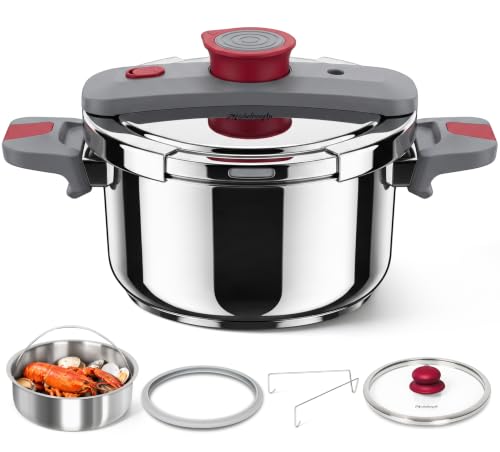
MICHELANGELO Stovetop Pressure Cooker Stainless Steel 4.2 qt
Badge: Best Rated for Small Households
Strengths
- Compact 4.2-quart stovetop size, rare in a category biased toward 6 quarts and up
- One-hand easy-open lid is a genuine daily-use convenience
- Glass lid included, so the pot converts to everyday covered cooking
Trade-offs
- Smaller capacity rules out large joints and big batches
- A less-established name than the legacy stovetop brands
- Two pressure settings still require manual heat management
Key specifications (from the verified listing)
- Capacity: 4.2 qt
- Material: 304 stainless steel
- Safety: 6-fold safety system named in listing
- Lid: one-hand easy-open lid
- Settings: 2 pressure settings
- Includes: steamer basket and glass lid; induction compatible
Most stovetop pressure cookers start at 6 quarts, which is why this 4.2-quart MICHELANGELO stands out: it brings the format down to the size a small household will actually use weekly. The construction list is modern — 304 stainless steel, a six-fold safety system, two pressure settings, induction compatibility — and two details lift it above a spec sheet. The one-hand easy-open lid matters every single time you cook, especially with the other hand holding a spoon or a plate, and the included glass lid and steamer basket turn the pressure pot into an ordinary covered saucepan and a steamer when pressure is not needed, which means one less pan in the cupboard. The limits are capacity and provenance: 4.2 quarts will not take a large chicken or a double batch of stock, and the brand does not carry the multi-decade parts history of the oldest stovetop names. For one to three people who want stovetop pressure cooking without a giant pot, it is the most proportionate option in this guide.
In day-to-day terms, this pick is built for small households, induction users, and anyone who finds 6-quart stovetop pots oversized. Its specification list tells the same story as its review: capacity: 4.2 qt, and the design choices behind it are consistent rather than accidental. Read its trade-offs as carefully as its strengths — they are the difference between a cooker that suits your household and one that merely suits this list.
Best for: small households, induction users, and anyone who finds 6-quart stovetop pots oversized / Not suited for: large families and buyers who prioritise a decades-long brand parts record

Peterboo Stainless Steel Pressure Cooker 6 Quart Stovetop
Badge: Best Rated for Induction Kitchens
Strengths
- 3-ply composite base spreads heat evenly across induction, gas and ceramic hobs
- A visible pressure indicator removes guesswork about when pressure is reached
- Dishwasher-safe construction lowers the cleanup cost of stovetop cooking
Trade-offs
- Manual heat and timing management, as with all stovetop models
- Less-established brand, so long-term gasket supply is a fair question
- No electric programmes — it is a pressure pot, not a multicooker
Key specifications (from the verified listing)
- Capacity: 6 quart
- Type: stovetop pressure pot
- Base: 3-ply composite base
- Features named in listing: pressure indicator, multi safeguard devices
- Compatibility: induction, gas and ceramic stoves; dishwasher safe per listing
This 6-quart Peterboo is a modern-spec stovetop pressure pot: a 3-ply composite base for even heating, a pressure indicator you can read at a glance, multiple safeguard devices, and compatibility across induction, gas and ceramic stoves. The base is the engineering story. Stovetop pressure cookers live or die by heat distribution, because a hot spot under a thick stew can scorch the layer that seals in the pressure-cooking liquid; a composite base spreads burner heat across the floor of the pot and makes the design behave on induction, which is the least forgiving hob type. The pressure indicator answers the beginner’s constant question — is it at pressure yet? — without lifting or guessing, and dishwasher-safe construction is not a trivial point on a pot this size. As with every stovetop entry here, you trade automation for simplicity and durability, and the brand’s long-term spare-gasket story is less documented than the legacy makers’. For a buyer whose hob is the centre of their cooking, it is a well-judged modern take on the format.
In day-to-day terms, this pick is built for induction and mixed-hob kitchens, and buyers who want a readable pressure indicator. Its specification list tells the same story as its review: capacity: 6 quart, and the design choices behind it are consistent rather than accidental. Read its trade-offs as carefully as its strengths — they are the difference between a cooker that suits your household and one that merely suits this list.
Best for: induction and mixed-hob kitchens, and buyers who want a readable pressure indicator / Not suited for: anyone wanting electric presets, timers or keep-warm functions

RVGMBO Pressure Cooker 12 Quart 18/8 Stainless Steel Pressure Canner
Badge: Best Rated for Bulk Cooking
Strengths
- 12-quart capacity is in a class of its own in this guide
- Built to double as a pressure canner, opening home-preservation work
- 18/8 stainless steel and one-hand locking at a very large scale
Trade-offs
- Far more pot than weeknight cooking for most households needs
- A full 12-quart vessel is heavy and demands storage space
- Canning use requires following current tested preservation guidance, not improvisation
Key specifications (from the verified listing)
- Capacity: 12 quart
- Material: 18/8 stainless steel
- Format: 3-in-1 pressure cooker and pressure canner per listing
- Lid: one-hand locking
- Compatibility: induction and gas stovetop
- Includes: glass lid and steamer rack
The RVGMBO is the specialist giant of this line-up: 12 quarts of 18/8 stainless steel, designed as a 3-in-1 pressure cooker and pressure canner with one-hand locking, a glass lid and a steamer rack, for induction and gas stovetops. Its reason to exist is scale. Twelve quarts is stock in serious quantity, a whole harvest of tomatoes, or a canning session — and the canner role is the real differentiator, because pressure canning low-acid foods is a job ordinary pressure cookers are not built or rated to do. Anyone heading down that road must follow current, tested preservation guidance for their altitude and food type; the cooker is the tool, not the method. For ordinary cooking the same capacity is a commitment: storage, washing and the weight of a full pot all scale with it, and small households will reach for something else on a Tuesday. But guides should include the tool that fits the biggest job, and for canning and bulk work nothing else here is in this class.
In day-to-day terms, this pick is built for home canners, bulk stock makers, and large-batch cooks with storage space. Its specification list tells the same story as its review: capacity: 12 quart, and the design choices behind it are consistent rather than accidental. Read its trade-offs as carefully as its strengths — they are the difference between a cooker that suits your household and one that merely suits this list.
Best for: home canners, bulk stock makers, and large-batch cooks with storage space / Not suited for: everyday small-meal cooking, small kitchens, and anyone put off by heavy pots

Peterboo 3Qt Stainless Steel Pressure Cooker 8-in-1 Multi-Cooker
Badge: Best Rated Mini
Strengths
- The smallest pressure cooker in this guide, honestly sized for one or two people
- Stainless steel build rather than coated aluminium at the mini size
- A long safety-feature list for a compact, lower-cost format
Trade-offs
- 3 quarts caps you at small portions — no whole birds, no batch cooking
- Mini-format accessories and gaskets are a narrower market
- Listing claims a very wide role set; judge it as a small pressure cooker first
Key specifications (from the verified listing)
- Capacity: 3Qt
- Format: 8-in-1 multi-cooker per listing, stovetop and electric compatible per listing
- Material: stainless steel
- Safety: 8+ safety features named in listing
- Sized for: 1-2 people, per listing
Mini pressure cookers are usually an afterthought; this 3-quart Peterboo is designed for the one-to-two-person household from the start. Three quarts is the right volume for a two-portion stew, a small batch of beans or rice for two, and it reaches pressure quickly with modest liquid, stores in a shallow cupboard, and washes in a small sink — the unglamorous details that decide whether a cooker gets used three times a week or three times a year. Stainless steel construction and a safety list the listing counts at eight-plus features are reassuring at a size and tier where aluminium and minimal safeguards are common. The listing’s 8-in-1 multi-cooker language should be read sensibly: this is a small pressure pot that can also serve general stovetop duties, not a replacement for a full electric multicooker with programmes. Within that honest reading, it fills the smallest niche in this guide better than a half-empty large cooker ever will.
In day-to-day terms, this pick is built for singles and couples, small kitchens, and first-time pressure cooking on a small scale. Its specification list tells the same story as its review: capacity: 3qt, and the design choices behind it are consistent rather than accidental. Read its trade-offs as carefully as its strengths — they are the difference between a cooker that suits your household and one that merely suits this list.
Best for: singles and couples, small kitchens, and first-time pressure cooking on a small scale / Not suited for: families, batch cooking, and anyone who needs programme automation

Instant Pot Duo 6 Qt 7-in-1 Electric Pressure Cooker
Badge: Best Rated Electric Overall
Strengths
- The original 6-quart formula: the size and function set that defined the category
- Huge owner community, accessory range and spare-parts availability
- Sterilize mode included even in this simpler 7-in-1 version
Trade-offs
- Seven functions is the leanest electric set here — no extras beyond the core
- An older-generation control layout compared with newer models
- Sealing rings need replacing over time and pick up strong odours
Key specifications (from the verified listing)
- Capacity: 6 Qt
- Functions: 7-in-1 electric pressure cooker
- Build: stainless steel
- Modes named in listing: slow cook, rice, yogurt, steam, saute, warm, sterilize
- Extras named in listing: companion app with a large recipe library
The Duo in its 7-in-1 form is the cooker that taught a generation of households what an electric pressure cooker was, and its formula has not needed to change: 6 quarts, stainless steel, and the seven jobs — pressure, slow cook, rice, yogurt, steam, saute, warm and sterilize — that cover the overwhelming majority of real use. There is a strong argument that this leanness is a feature. Every function on the panel is one owners actually press, the controls are the most documented and imitated in the category, and the surrounding ecosystem of spare lids, rings, pots, trivets and recipes is deeper than for any rival in this guide. Against its own Plus sibling you give up a couple of functions and refinements; against the smart cookers you give up guidance and connectivity. What you keep is the most proven answer to the question most buyers are really asking, which is simply: which electric pressure cooker should a normal household buy and keep for years?
In day-to-day terms, this pick is built for first-time buyers, value-focused households, and anyone who wants the deepest accessory ecosystem. Its specification list tells the same story as its review: capacity: 6 qt, and the design choices behind it are consistent rather than accidental. Read its trade-offs as carefully as its strengths — they are the difference between a cooker that suits your household and one that merely suits this list.
Best for: first-time buyers, value-focused households, and anyone who wants the deepest accessory ecosystem / Not suited for: buyers who want the newest interface, extra programmes, or smart guidance
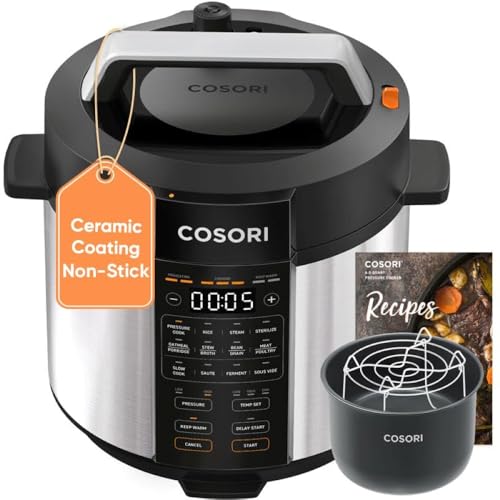
Cosori Pressure Cooker 6QT 9-in-1 with Ceramic Coating Pot
Badge: Best Rated for Versatility
Strengths
- Sous vide mode is a genuine extra none of the other electric models here list
- Ceramic-coated pot for buyers avoiding conventional non-stick
- A named 12-point safety feature set, the longest list among the electric picks
Trade-offs
- Sous vide in a pressure-cooker form factor will not match a dedicated circulator for big baths
- Ceramic coating needs non-metal utensils to stay at its best
- Cosori’s pressure-cooker line is younger than its air-fryer reputation
Key specifications (from the verified listing)
- Capacity: 6QT
- Functions: 9-in-1
- Inner pot: ceramic coating pot
- Safety: 12 safety features named in listing
- Power: 1100W per listing
- Modes named in listing: rice cooker, slow cook, sous vide, saute
- Build: stainless steel exterior, silver
Cosori’s 6QT entry takes the standard electric pressure cooker formula — 9-in-1 functions, 6-quart capacity, stainless steel body — and adds two distinctions: a ceramic-coated inner pot and a sous vide mode. Sous vide is the interesting one. Precise low-temperature water cooking is normally a separate appliance, and while a cooker-based version will not run the largest baths a dedicated circulator can, for eggs, chicken breasts, fish and small steaks it removes a purchase entirely. The ceramic pot continues the theme of this guide’s newer models, giving easy release with a coating many buyers prefer, and the listing’s 12 safety features are the longest named set among the electric picks here, covering the lid-lock, release and over-pressure safeguards a modern cooker should have. At 1100W it sits in the normal power band for the size. The fair caveats are that the brand’s deepest reputation is in air fryers rather than pressure cookers, and ceramic wants gentle utensils. For a buyer who wants one appliance to cover pressure, slow, rice and sous vide, it is the most versatile electric pick here.
In day-to-day terms, this pick is built for buyers who want sous vide without a second appliance, and ceramic-pot preferrers. Its specification list tells the same story as its review: capacity: 6qt, and the design choices behind it are consistent rather than accidental. Read its trade-offs as carefully as its strengths — they are the difference between a cooker that suits your household and one that merely suits this list.
Best for: buyers who want sous vide without a second appliance, and ceramic-pot preferrers / Not suited for: purist sous vide cooks with large containers, and stainless-pot traditionalists
Comparison Table
Side by side, with the honest limitation of each pick kept in the table where it belongs. Prices and ratings are deliberately not printed here — both change constantly, and the linked listing shows today’s position.
| Pick | Badge | Standout specification | Main limitation | Listing |
|---|---|---|---|---|
| MICHELANGELO Stovetop Pressure Cooker Stainless Steel 4.2 qt | Best Rated for Small Households | Material: 304 stainless steel | large families and buyers who prioritise a decades-long brand parts record | Check on Amazon |
| Peterboo Stainless Steel Pressure Cooker 6 Quart Stovetop | Best Rated for Induction Kitchens | Type: stovetop pressure pot | anyone wanting electric presets, timers or keep-warm functions | Check on Amazon |
| RVGMBO Pressure Cooker 12 Quart 18/8 Stainless Steel Pressure Canner | Best Rated for Bulk Cooking | Material: 18/8 stainless steel | everyday small-meal cooking, small kitchens, and anyone put off by heavy pots | Check on Amazon |
| Peterboo 3Qt Stainless Steel Pressure Cooker 8-in-1 Multi-Cooker | Best Rated Mini | Format: 8-in-1 multi-cooker per listing, stovetop and electric compatible per listing | families, batch cooking, and anyone who needs programme automation | Check on Amazon |
| Instant Pot Duo 6 Qt 7-in-1 Electric Pressure Cooker | Best Rated Electric Overall | Functions: 7-in-1 electric pressure cooker | buyers who want the newest interface, extra programmes, or smart guidance | Check on Amazon |
| Cosori Pressure Cooker 6QT 9-in-1 with Ceramic Coating Pot | Best Rated for Versatility | Functions: 9-in-1 | purist sous vide cooks with large containers, and stainless-pot traditionalists | Check on Amazon |
How to Choose the Right Model for Best ratings for pressure cookers
Capacity is the first decision, and it should be made in cooked food, not in quarts on a box. A 6-quart cooker is the settled family size: a whole chicken, a family stew, or a generous batch of soup fits with the headroom pressure cooking requires, because a pressure pot should never be filled beyond about two-thirds for most foods, and less for foaming foods like beans and grains. A 4-quart or smaller model suits one to three people and reaches pressure faster with less liquid. An 8-quart or larger model is a batch tool: double recipes, big joints and stock in quantity. Buying one size up from your everyday need is reasonable; buying two sizes up means slower pressure build-up for small meals and a pot that dominates the sink.
Electric or stovetop is the second decision, and it is about how you cook, not which is better. Electric models programme the pressure, the timing and the keep-warm, and they free a hob and your attention. Stovetop models put heat control in your hands, sear over real burner power, double as stockpots, and contain no electronics to age. Households that cook several things at once on the hob often prefer electric; confident stovetop cooks who value longevity often prefer the pot. Neither answer is wrong, and this guide deliberately includes both.
Inner-pot material is the third decision. Stainless steel is the durability choice and handles metal utensils and hard searing, at the cost of more sticking with rice and grains. Non-stick and ceramic-coated pots release food easily and wash quickly, and they ask for wooden or silicone utensils and gentler washing in return. If a cooker will cook rice several times a week, pot material will shape daily satisfaction more than the preset count will.
After that, weigh the features against your actual week. A delay timer matters if you load the cooker before work. Keep-warm matters if your household eats in shifts. Yogurt mode matters only if you will genuinely make yogurt twice a month or more. Sous vide, sterilize and guided cooking are real differentiators for the households that use them and pure cost for those that do not. Count the functions you will press weekly, and let that number, not the biggest number on the box, rank your shortlist.
Finally, think about ownership. Sealing rings are consumables that absorb odours and lose elasticity; lids, valves and gaskets should be replaceable, and the brand’s parts availability is a legitimate buying criterion. Check cupboard height with the lid open, counter depth, and whether the inner pot fits your dishwasher. A pressure cooker is a weekly-use appliance for most buyers, and the small frictions — storage, washing, a missing spare ring — decide long-term satisfaction more than any single cooking result.
How to Use, Clean and Troubleshoot Your Pressure Cooker
Start with the water test, whichever model you choose: a cup of water, sealed lid, a short pressure cycle. It teaches you how your cooker signals pressure, how its release sounds, and how long things take, with nothing at stake. Read the manual’s fill lines before your first real recipe — two-thirds full for most foods, half full for beans, grains and anything that foams — and treat those lines as hard limits, not suggestions.
For everyday cooking, the sequence becomes habit. Saute aromatics and brown meat first when the recipe benefits, because pressure cooking adds no browning of its own. Add liquid — every pressure cooker needs a minimum amount of thin liquid to build steam — then layer dense ingredients below delicate ones. Seal, set the time, and let pressure build without peeking. When the timer ends, choose the release deliberately: natural release for large cuts, beans and foamy foods, where a sudden release can toughen meat or spray starch; quick release for vegetables and seafood, where extra minutes mean overcooking.
Cleaning is simple but specific. Wash the inner pot and lid after each use; remove the sealing ring regularly and wash it separately, because it holds the memory of every curry. Keep the steam-release valve and anti-block shield clear — a clogged valve is the most common cause of a cooker that will not pressurise properly. Store the lid upside down or ajar so the ring relaxes and odours dissipate, and replace the ring when it stays stretched, cracked or permanently scented.
Problem: the cooker counts down but food is undercooked → what to do: check the liquid level first; too little thin liquid is the usual cause, followed by an overfilled pot. Add liquid, reseal and give it a few more minutes under pressure rather than restarting the whole cycle. Problem: steam leaks from the lid edge → what to do: stop, release pressure, and inspect the sealing ring for food debris, twisting or wear; reseat or replace it before the next cook. Problem: a burn or scorch message on an electric model → what to do: release pressure, check for food stuck to the pot base, add liquid, and deglaze thoroughly before restarting; thick sauces should be layered on top, not stirred into the liquid, until after cooking.
Ratings also teach maintenance: the most common mechanical complaints — failure to pressurise, steam at the rim, scorched bases — trace back to rings, valves and fill levels. The cleaning and troubleshooting steps in the how-to section are written directly from those patterns, so following them is how you end up leaving the satisfied kind of review.
How to Read Pressure Cooker Ratings Without Being Misled
Start by ignoring the average and reading the distribution of complaints. On any widely sold cooker, a band of one-star reviews will describe delivery damage and buyer’s remorse about size; neither tells you about the appliance. The reviews that matter cluster around repeatable themes: a lid that gets harder to seal, a valve that clogs with starchy foods, a coating that marks, a gasket that is out of stock. When the same theme recurs across months of ownership, it is a property of the product. When it appears once, it is an anecdote.
Then separate the format before comparing scores. Stovetop owners rate a pot they may keep for decades, and their praise runs to weight, steel and simplicity. Electric owners rate a system — programmes, timers, app behaviour, keep-warm — and their criticism runs to electronics and rings. A stovetop cooker and an electric cooker with identical averages are not equally good at the same job; they are differently good at different jobs, which is why this guide keeps its verdicts household-specific. The same reading method applies across the cooker cluster, including the quicker models in Best Reviewed Quick Cookers.
The Ownership Issues Ratings Reveal — and the Ones They Hide
Long-term feedback is excellent at surfacing consumables: how fast a ring absorbs odours, whether a non-stick or ceramic pot survives metal utensils in a busy household, whether the replacement gasket for a less common brand is actually obtainable. Those are the costs of year two and three, and they are exactly what a feature list cannot tell you. This guide has weighted them accordingly — note how often the trade-off lines below mention parts depth and coating care rather than cooking performance, which is broadly strong across all six picks.
What ratings hide is fit. A compact cooker collects complaints from buyers who needed 6 quarts; a 12-quart canner collects them from buyers who needed a weeknight pot. Both may be excellent at their intended job. Read every negative review with one question — did the product fail, or did the purchase mismatch the household? — and you will find your own shortlist forms quickly. It is the same discipline we recommend for slow cookers in Best Reviewed Slow Cookers, where size mismatch dominates the complaint pattern in exactly the same way.
Five Questions to Ask of Any Pressure Cooker Review You Read
However you found this guide, you will read more feedback before you buy, so take a portable method with you. First: how long had the reviewer owned the cooker? A fault reported at month fourteen outweighs praise at day two. Second: what did they cook? A seal complaint from a daily bean cook tells a pressure buyer more than a general verdict from a monthly user. Third: is the complaint about the product or the purchase — size, format and expectations mismatched to the household produce negative reviews of perfectly good cookers.
Fourth: does the same theme repeat across different reviewers and different months? Repetition is what turns anecdote into evidence, for faults and for virtues alike. Fifth: could the maker fix it — a replaceable ring, an available gasket, a spare pot in the catalogue? A cooker whose known weakness is a cheap consumable is a better long-term bet than one whose rare weakness is terminal. Ask those five questions of the feedback on any pick in this guide and you will reach roughly the verdicts printed here, which is the most any ratings guide can honestly promise.
One More Thing Worth Knowing
It is worth stating plainly what this guide did with ratings in the end: it used them the way an experienced friend would — as a screen for recurring faults and a source of ownership detail — and then ranked on fit, construction and the evidence available for each model. That is why a newer stovetop design can outrank a famous electric one for a stated household here, and why the famous one still takes the electric crown. If you remember nothing else from these sections, remember the mismatch question — did the product fail, or did the purchase miss the household? — because it will protect every appliance decision you make after this one, in categories far beyond pressure cookers.
Common Buying Mistakes
- Buying capacity by the headline number without translating it — quarts, uncooked cups and cooked cups are different measures, and a cooker mostly used far outside its comfortable range disappoints daily.
- Filling a pressure cooker past its safe line, or a grain cooker past its foam line. The markings inside the pot are engineering limits, and ignoring them is the most common cause of messy lids and poor results.
- Choosing by function count alone. A programme you never press is not value; the two or three modes you will use weekly should drive the decision, with extras treated as a bonus.
- Ignoring the inner pot. Coating type, utensil rules and replacement availability shape years of daily use far more than the control panel does.
- Forgetting storage and washing. Measure the cupboard with the lid open, check the pot fits your sink, and be honest about whether a very large appliance will actually come out on a weeknight.
- Skipping the manual’s first-use steps. A water test on a pressure cooker, or a first rinse-and-discard batch on a rice cooker, teaches the machine’s signals cheaply and safely.
Every one of those mistakes is easier to avoid before ordering than to forgive afterwards, and the verdict lines in the reviews above are written to catch them: if a pick’s Not suited for line describes your household, believe it, and choose the pick whose strengths match the way you actually cook.
Final Recommendation
Use the ratings method, then the verdicts: the Instant Pot Duo is the safest electric answer and the easiest ownership story; the Cosori is the versatility pick if sous vide and a ceramic pot appeal; among stovetop models, choose the Peterboo 6-quart for a modern indicator-led design, the MICHELANGELO for small households, and the RVGMBO only for genuine bulk or canning work. The best-rated cooker is the one whose recurring praise matches your cooking and whose recurring complaints do not.
Our first choice: MICHELANGELO Stovetop Pressure Cooker Stainless Steel 4.2 qt. The strongest alternative for most readers: Peterboo Stainless Steel Pressure Cooker 6 Quart Stovetop. Check the latest price on Amazon for either, confirm the current configuration on the listing, and buy the one whose verdict line sounds like your kitchen.
Frequently Asked Questions
Should I only buy the pressure cooker with the highest rating?
No. Averages compress different households, formats and expectations into one number. A slightly lower-rated cooker that fits your size, hob and cooking style will satisfy you more than a top-rated one bought against your needs. Use ratings to screen for recurring faults, then decide on fit.
Why do new models have fewer and sometimes stranger ratings?
Early feedback over-represents enthusiasts and people with problems, and the sample is small, so averages swing. For newer picks like the stovetop models here, weight the specifics of construction — steel grade, safety system, base design — more heavily, and re-check feedback volume before you buy.
What faults should make me rule a cooker out?
Recurring reports of lids failing to seal, valves clogging despite cleaning, coatings peeling early, or replacement gaskets being unavailable. Single reports of almost anything are noise; the same mechanical complaint across many owners over months is signal.
Are brand-name cookers always better rated in the long run?
They tend to accumulate more feedback and better parts support, which shows up as steadier long-term satisfaction — the Instant Pot Duo pick here is the example. But several less-established picks in this guide earn their place on construction merits; the honest trade is a thinner evidence base, stated plainly in their reviews.
How many reviews are enough to trust a pattern?
There is no magic count, but treat patterns as provisional until you can find the same theme raised independently by multiple owners across different months. One detailed, specific review that names meals and months owned can outweigh a pile of one-line verdicts.
Do ratings differ between electric and stovetop models?
Yes, in what they measure. Electric ratings judge programmes, electronics and rings; stovetop ratings judge build, heat behaviour and gaskets. Compare within a format first, then use a guide like this one to make the cross-format decision on fit rather than on scores.


