Disclosure: topratedkitchenware.com is reader-supported. When you buy through links on our site, we may earn an affiliate commission from Amazon and other retailers, at no extra cost to you.
Where to buy
The six models below are the machines assessed for this guide to the best raw food dehydrators. Raw-food drying lives or dies on one specification — a genuinely low, stated temperature floor — so this guide applies a strict rule: a pick is linked only when its listing title states a low temperature range suitable for low-heat drying. Four picks meet that standard and link to their Amazon listings, where you can check the latest price on Amazon. Two well-regarded machines whose listings state only a top temperature are reviewed in full as prose-only picks, clearly marked, with no link and no image, because their low end cannot be verified from the listing data.
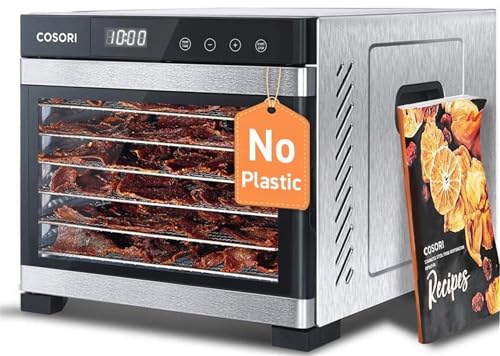
- Cosori Food Dehydrator, 6 Stainless Steel Trays — Best Overall for Raw Food Drying
- Cosori Food Dehydrator, 5 Stainless Steel Trays (prose-only — low end of range not stated in listing)
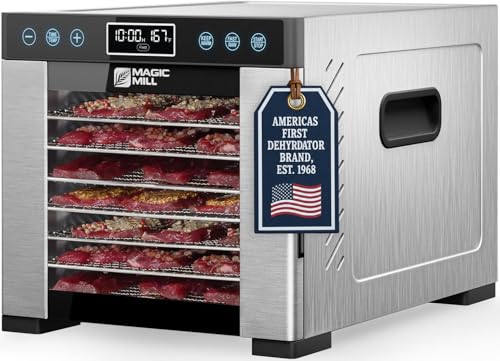
- Magic Mill Pro Food Dehydrator Machine, 7 Trays, Rear Fan — Best Even Drying at Low Heat
- PSIIDAN Food Dehydrator, 8 Full-Size Stainless Steel Trays — Best for Large Raw Batches
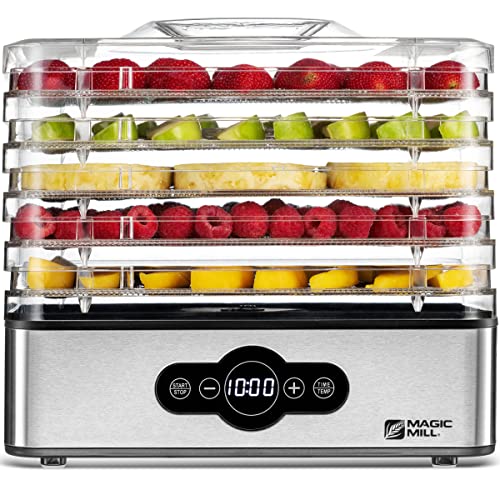
- Magic Mill Food Dehydrator Machine, 5 Stainless Steel Trays (prose-only — low end of range not stated in listing)
- FOHERE Food Dehydrator, 5 BPA-Free Trays — Best Compact Raw Starter
Read the full guide ↓ for why the low-temperature floor matters more than any other figure, how each machine’s stated range maps to real raw recipes, and the technique that makes low-heat drying succeed.
The search for the best raw food dehydrators starts from a completely different premise than ordinary dehydrating. Raw-food practice holds that food should be dried gently, at low temperatures — practitioners commonly work at or below roughly 115–118°F, a ceiling they associate with keeping heat-sensitive enzymes and flavours intact — which turns the dehydrator from a cooker into something closer to warm, moving air and patience. Whether or not you subscribe to every part of raw-food philosophy, the practical consequences for buying are concrete and non-negotiable: the machine must be able to run accurately at the bottom of its range, it must hold that gentle heat evenly for many hours, and it must do so for the long, slow cycles that low-temperature drying demands, because drying at 105°F takes far longer than drying at 150°F. A machine whose low end is vague, or whose thermostat hunts up and down, does not fail loudly; it quietly cooks your crackers while telling you it did not.
That is why this guide is stricter than its siblings. Four of the six machines assessed state a 95°F floor in their listing titles — the Cosori six-tray, the rear-fan Magic Mill Pro seven-tray, the eight-tray PSIIDAN, and the compact FOHERE with its stated 95–158°F range — and those four carry links. The compact Cosori five-tray states a 176°F ceiling with no low end in its title, and the five-tray Magic Mill states control up to 167° with no floor; both are capable machines for general drying, and both are reviewed honestly below, but neither can be verified as a low-temperature instrument from its listing data, so neither is linked as a raw pick. If you are comparing this discipline against the broader market, Best Recommended Food Dehydrators shows the general-purpose ranking, while Best Food Dehydrators For Making Vegan Bread covers the closest neighbouring craft, where low steady heat also rules.
One clarification before the details: this guide uses “raw” the way the raw-food community uses it — as a preparation method defined by a temperature ceiling — and it judges machines against that method’s requirements. It does not evaluate diets, and it does not repeat health claims for any style of eating. What it does insist on is mechanical honesty: a machine recommended for a temperature-defined method must state, in its own listing, that it can reach and hold that method’s temperatures. Four machines here do. Two do not say. The guide treats those as different categories of evidence, because for this keyword, they are.
Key Takeaways
- For raw drying, the stated low end of the range is the whole purchase: every linked pick here states a 95°F floor in its listing.
- Two otherwise good machines are prose-only in this guide because their listings state only a top temperature — an unverifiable low end is not good enough for raw work.
- Low heat means long hours: a 48-hour timer, present on all four linked picks, is close to mandatory for raw crackers, wraps, and leather.
- Even airflow matters more at low temperatures, where there is no excess heat to hide unevenness; rear-fan and horizontal designs lead here.
- Mesh screens and fruit roll sheets are essential raw accessories for seeds, granola, and purees — confirm them on the listing for your pick.
- Check the latest price on Amazon for the linked picks, and verify the stated range on the listing itself before ordering.
In this guide
Quick Picks
| Pick | Badge | Raw-relevant evidence | Listing |
|---|---|---|---|
| Cosori, 6 Stainless Steel Trays | Best Overall for Raw Food Drying | Stated 95–165°F precision control, horizontal airflow, 6.5 ft², 48H timer. | Check on Amazon |
| Cosori, 5 Stainless Steel Trays | Best Compact Design (Prose-Only) | Horizontal airflow and no plastic contact, but title states only a 176°F ceiling — low end unverified. | Prose-only — see review |
| Magic Mill Pro, 7 Trays, Rear Fan | Best Even Drying at Low Heat | Stated 95°–176° range, 600W rear fan even-drying system, keep warm, ETL listed. | Check on Amazon |
| PSIIDAN, 8 Full-Size Trays | Best for Large Raw Batches | Stated 95°–167° range, eight full-size stainless trays, 650W, 48-hour timer. | Check on Amazon |
| Magic Mill, 5 Stainless Steel Trays | Best General-Purpose Alternative (Prose-Only) | Stainless trays and 48H timer, but title states control only up to 167° — low end unverified. | Prose-only — see review |
| FOHERE, 5 BPA-Free Trays | Best Compact Raw Starter | Stated 95–158°F range and 48H timer in a small 400W stackable design. | Check on Amazon |
How These Picks Were Chosen
This is a research-led guide, not a hands-on laboratory test, and its method for this keyword is a verification exercise before it is a ranking exercise. Each machine’s listing title was read for one specific claim: a stated temperature range whose low end reaches the gentle territory raw recipes require. Raw-food references differ in detail, but the working consensus among practitioners is a ceiling somewhere around 115–118°F for enzyme-conscious drying, which means a useful machine must not merely reach that zone but be settable and stable below it — a stated floor of 95°F gives the control room to work at 105–115°F with confidence. Machines stating that floor were eligible for links. Machines stating only a maximum were not assumed to share the same floor, however likely it seemed, because assuming a core specification is exactly how a raw buyer ends up with a cooker.
Eligible machines were then ranked on the qualities low-heat drying punishes most: airflow design, because gentle heat exposes every dead spot; tray count and area, because raw batches — crackers, wraps, kale chips, activated nuts — are bulky for their weight; timer length, because low-temperature cycles routinely run overnight and beyond; and tray material, with stainless preferred for the constant washing that sticky raw purees impose. The two prose-only machines were kept in the guide rather than deleted because a raw-curious reader may still choose one for general drying with open eyes — but their reviews state the verification gap in the first paragraph, not in a footnote.
The 6 Best Raw Food Dehydrators, Assessed on Low-Temperature Evidence

Cosori Food Dehydrator, 6 Stainless Steel Trays
Badge: Best Overall for Raw Food Drying
Strengths
- A stated 95–165°F range with precision control, giving real headroom below the raw-practice ceiling.
- Horizontal airflow dries across the trays, protecting the evenness that low heat cannot fudge.
- 6.5 ft² of stainless drying space with a 48-hour timer and quiet operation under 48 dB, per the listing.
Trade-offs
- Six trays is family scale, not a raw-food production line.
- The 165°F ceiling is ample for raw work but lower than the top-heat picks if you also make jerky.
- Cabinet format needs permanent counter or shelf space.
Mini spec box (from listing data)
- Trays: 6, stainless steel; 6.5 ft² drying space
- Temperature: 95–165°F precision control
- Airflow: horizontal; power 600W
- Timer: up to 48 hours; noise under 48 dB (per listing)
The Cosori leads this guide because it treats low temperature as a specification rather than a hope. A stated floor of 95°F with precision control means you can set 105°F for crackers or 115°F for fruit leather and trust the dial means it, and horizontal airflow means the tray at the back dries at the same gentle pace as the tray at the front — at low heat there is no surplus warmth to mask a lazy corner, so airflow architecture is the difference between a batch and a gradient. The 48-hour timer quietly matters as much as the range: raw wraps and thick leathers can occupy the machine for a full day and night, and a timer that spans that cycle lets the process run while you live your life.
Who it suits: committed raw households, and mixed households whose drying is mostly raw with occasional conventional batches. The honest limitation is scale and ceiling — six trays will serve a family’s raw routine beautifully and a small production hobby adequately, but high-volume raw preparers will want the PSIIDAN’s eight full-size trays, and dual-purpose jerky makers should note the 165°F top end. As an all-round raw instrument whose every relevant figure is stated in its listing, it is the benchmark the rest of this guide is measured against.
Best for: raw households wanting verified low control and even airflow / Not suited for: very large raw batches or highest-heat jerky work
Cosori Food Dehydrator, 5 Stainless Steel Trays (Prose-Only)
Badge: Best Compact Design (Prose-Only)
Strengths
- Horizontal airflow and stainless trays in a compact 3.1 ft² cabinet.
- A no-plastic-contact drying chamber, per the listing — a design many raw buyers actively seek.
- Four presets and a 48-hour timer in a small footprint.
Trade-offs
- Prose-only in this guide: the listing title states 176°F temperature control without stating the low end of the range.
- Five compact trays are a small-batch canvas.
- Its high stated ceiling is a general-drying virtue that says nothing about raw suitability.
Mini spec box (from listing data)
- Trays: 5, stainless steel; 3.1 ft² drying space
- Temperature: control up to 176°F (low end not stated in listing title)
- Airflow: horizontal; 4 presets; 48-hour timer
- Design: compact; no plastic contact with food (per listing)
This is the guide’s hardest editorial call, so it gets a full explanation. On design alone, the compact Cosori would be a tempting raw pick: horizontal airflow, stainless trays, a chamber where food touches no plastic, and a footprint a small raw kitchen can house. But this keyword turns on a single verifiable fact — how low the machine is stated to go — and the listing title states only its 176°F ceiling. A ceiling tells you nothing about the floor; machines with identical ceilings ship with different low ends, and raw buyers setting 105°F cannot shop on inference. The machine is therefore reviewed, respected, and not linked.
Who it suits: a buyer who confirms the low end directly on the listing or with the maker and finds it suitable — at which point its design makes it a genuinely attractive compact raw machine — or a general dryer who values its materials and airflow for conventional work. The honest limitation is precisely the verification gap: within the evidence this guide is allowed to use, its raw suitability is unproven, and raw food dehydrating is the one category where “probably goes low enough” is not a recommendation.
Best for: compact kitchens, if you verify the low end yourself / Not suited for: buyers who need a stated low-temperature floor before purchase

Magic Mill Pro Food Dehydrator Machine, 7 Full-Size Stainless Steel Trays
Badge: Best Even Drying at Low Heat
Strengths
- A stated 95°–176° range — the widest verified span in this guide — with a true gentle floor.
- A named 600W rear fan even-drying system aimed directly at uniform results.
- Keep warm and auto shutoff, with ETL listing, across seven full-size stainless trays.
Trade-offs
- Seven trays is mid-size; raw production households may want more.
- No drying-area figure is stated in the title data.
- No mesh or fruit roll accessories are named in the title.
Mini spec box (from listing data)
- Trays: 7, full-size, stainless steel
- Temperature: 95°–176°
- Fan: 600W rear fan even-drying system
- Timer: up to 48 hours; keep warm; auto shutoff; ETL listed
If the Cosori is the benchmark, this Magic Mill Pro is the specialist: everything about its stated design addresses the raw dryer’s core anxiety, which is uniformity at temperatures too low to forgive mistakes. A rear fan pushing air across full-size trays is the layout least likely to leave a damp centre tray of crackers, and the 95° floor is stated in the same breath as the 176° ceiling, so the whole working span is on the record. Keep warm deserves a raw-specific note: a batch of wraps that finishes at 3 a.m. can be held rather than left to sit in cooling, humid air until morning, which protects exactly the texture low-heat drying worked a day to create.
Who it suits: raw preparers whose repertoire is tray-sensitive — crackers, wraps, flatbreads, and leathers that must dry as sheets, evenly, edge to edge. The honest limitation is capacity and accessory silence: confirm mesh screens for seeds and small items on the listing, because raw granola and activated nuts need them, and they are not named in the title data. For sheet goods at family-plus scale, this is the most convincing low-heat instrument in the guide, and the pick the team cross-references in Best Food Dehydrators For Making Wheatless Vegan Bread, where even low heat is likewise the entire craft.
Best for: raw crackers, wraps, and leathers needing sheet-even drying / Not suited for: maximum-volume raw production

PSIIDAN Food Dehydrator, 8 Full-Size Stainless Steel Trays
Badge: Best for Large Raw Batches
Strengths
- A stated 95°–167° range with the gentle floor raw work requires.
- Eight full-size stainless trays — the largest verified raw capacity here.
- 650W and a 48-hour digital timer matched to long, low cycles.
Trade-offs
- The title names no fan layout, so airflow architecture must be confirmed on the listing.
- No accessory bundle is named in the title data.
- A less familiar brand than the Cosori and Magic Mill names around it.
Mini spec box (from listing data)
- Trays: 8, full-size, stainless steel
- Temperature: 95°–167°
- Timer: 48-hour digital
- Power: 650W
Raw food preparation is batch-hungry in a way conventional drying is not: kale chips are mostly air, crackers and wraps each claim a whole tray, and a week of raw meal preparation can fill a mid-size machine twice over. The PSIIDAN answers with the largest verified capacity in this guide — eight full-size stainless trays — behind a stated range that starts exactly where raw buyers need it to start, at 95°. The 650W output and two-day timer suit the reality that eight trays of produce at 110°F is a long, slow project, and stainless trays take the constant washing that raw purees and nut mixtures impose without holding odours between batches.
Who it suits: raw households cooking for several people, small raw-food sellers and class teachers, and gardeners processing low-temperature harvests in volume. The honest limitation is the thinner stated detail around the core figures: the fan layout is not named in the title, so a buyer for whom airflow architecture is decisive should confirm it on the listing before ordering. On the two facts this keyword cares about most — a stated gentle floor and serious capacity — it is fully verified, and it earns its place on evidence rather than reputation.
Best for: high-volume raw preparation with a verified low floor / Not suited for: buyers who need the airflow layout confirmed in advance
Magic Mill Food Dehydrator Machine, 5 Stainless Steel Trays (Prose-Only)
Badge: Best General-Purpose Alternative (Prose-Only)
Strengths
- Five stackable stainless steel trays with a 48-hour digital timer.
- Adjustable temperature control for general jerky, fruit, and treat drying.
- A compact footprint that suits mixed-use kitchens.
Trade-offs
- Prose-only in this guide: the listing title states temperature control up to 167° without stating the low end of the range.
- Five trays fill quickly under raw batch volumes.
- Stackable format typically asks for tray rotation on uneven loads.
Mini spec box (from listing data)
- Trays: 5, stackable, stainless steel
- Temperature: adjustable, up to 167° (low end not stated in listing title)
- Timer: digital, up to 48 hours
- Listing highlights: jerky, fruit, dog treats and general preserving
The five-tray Magic Mill is a proven general-purpose design — it leads the value ranking elsewhere in this programme — and it appears here for completeness and honesty. Its listing states adjustable control up to 167° and a generous 48-hour timer, both genuinely useful, but it does not state how low the range begins, and raw drying is decided at the bottom of the dial, not the top. Many owners undoubtedly dry gently in machines like this; a buying guide, however, can only recommend what it can verify, and the floor of this machine’s range is not in the listing data provided.
Who it suits: the mixed household whose drying is mostly conventional — jerky, fruit, dog treats — with occasional low-temperature experiments, or the raw buyer willing to verify the floor directly on the listing before purchase. The honest limitation is the same verification gap as the compact Cosori’s, stated as plainly: for a dedicated raw kitchen, choose one of the four picks here whose 95° floor is on the record, and let this capable machine do the general work it is verified for, as it does in Best Food Dehydrators For Sale roundups of all-purpose models.
Best for: general-purpose drying households / Not suited for: dedicated raw buyers who need a stated low floor

FOHERE Food Dehydrator, 5 BPA-Free Trays
Badge: Best Compact Raw Starter
Strengths
- A stated 95–158°F range — one of only four verified gentle floors in this guide.
- A 48-hour timer, essential for low-and-slow raw cycles, in a compact stackable body.
- Modest 400W draw suits day-long low-temperature runs.
Trade-offs
- BPA-free plastic trays rather than stainless; raw buyers with a strict no-plastic preference should choose accordingly.
- Five 11.42-inch trays are a starter capacity for raw batch sizes.
- The 158°F ceiling limits conventional high-heat sidelines like some jerky methods.
Mini spec box (from listing data)
- Trays: 5, BPA-free, 11.42-inch, stackable
- Temperature: 95–158°F
- Timer: up to 48 hours
- Power: 400W
The FOHERE closes the linked list by proving that a verified raw floor does not require a big machine or a big commitment. Its stated range starts at 95°F — the same floor as the flagship picks — and its ceiling of 158°F, a limitation for jerky makers, is simply irrelevant to raw work, which never goes near it. What remains is a compact, gentle, long-timer instrument for exactly the foods a raw beginner makes first: fruit leathers, kale chips, herb drying, small cracker batches, and activated nuts and seeds in modest quantities. The 400W draw is a quiet virtue across the 12-to-24-hour cycles raw recipes routinely demand.
Who it suits: raw-curious beginners, small kitchens, and anyone adding a dedicated gentle machine beside a conventional one. The honest limitation is materials and scale: the trays are BPA-free plastic rather than stainless, which some raw buyers specifically avoid — those readers should take the Cosori or Magic Mill Pro above — and five compact trays will be outgrown by anyone who catches the raw-preparation habit in earnest. As a verified, low-floor starting point, though, it does the one thing this keyword demands and does it on the record.
Best for: beginners and small kitchens starting raw drying on a verified low range / Not suited for: no-plastic households or large raw batches
Comparison Table
| Pick | Badge | Stated low end | Trays | Listing |
|---|---|---|---|---|
| Cosori 6 | Best Overall for Raw | 95°F stated (95–165°F) | 6 stainless; 6.5 ft² | Check on Amazon |
| Cosori 5 | Best Compact Design (Prose-Only) | Not stated in title (176°F ceiling stated) | 5 stainless; 3.1 ft² | Prose-only |
| Magic Mill Pro 7 | Best Even Drying at Low Heat | 95° stated (95°–176°) | 7 full-size stainless | Check on Amazon |
| PSIIDAN 8 | Best for Large Raw Batches | 95° stated (95°–167°) | 8 full-size stainless | Check on Amazon |
| Magic Mill 5 | General-Purpose Alternative (Prose-Only) | Not stated in title (up to 167° stated) | 5 stainless, stackable | Prose-only |
| FOHERE 5 | Best Compact Raw Starter | 95°F stated (95–158°F) | 5 BPA-free, 11.42-inch | Check on Amazon |
How to Choose a Raw Food Dehydrator
Begin with the floor, and be literal about it. Your machine must state a low end at or near 95°F, because raw recipes cluster between about 105°F and 118°F and you need setting room below your working temperature, not at its edge. If a listing states only a ceiling, treat the machine as unverified for raw use — that single rule, applied without exceptions, is what separates this guide’s linked picks from its prose-only ones. Second, airflow: at gentle temperatures, evenness is everything, so favour horizontal or rear-fan layouts and full-size trays for sheet goods. Third, the timer: low heat multiplies drying time, so 48 hours of set-and-forget capacity is the practical standard, and every linked pick here meets it. Fourth, trays and accessories matched to raw foods specifically — stainless for constant washing, mesh screens for seeds, small fruit pieces, and granola, and a fruit roll sheet for purees and leathers; confirm these on the listing for the machine you choose, because raw repertoires use them weekly, not occasionally.
Fifth, size for the raw batch, not the conventional one. Raw foods are bulky and light: a head of kale becomes a tray, a cracker recipe becomes two, and wraps for a week become four. Households regularly preparing raw meals should start their thinking at six to eight trays, while beginners testing the lifestyle are honestly served by the compact FOHERE’s five. Finally, hold the philosophy and the physics apart. This guide takes no position on health claims made for raw diets; it simply recognises that if your recipes specify low temperatures, your machine must verifiably deliver them, and it ranks only machines whose listings prove that they can.
How to Dry Raw Food Well: Setup, Technique, and Troubleshooting
Set the machine where its vents breathe freely, wash trays, and — the step raw beginners skip — let the empty machine settle at your target temperature while you prepare food, so the first hour is not spent climbing. Work at the temperature your recipe specifies, commonly in the 105–118°F band for enzyme-conscious raw practice, and resist raising it to hurry: the entire point of the method is the ceiling, and a batch dried at 135°F in half the time is a different food by raw standards. Slice produce uniformly, spread crackers and wraps to an even thickness with a spatula or offset knife, and leave airflow gaps around every piece. Expect long cycles — leathers and thick wraps can run a full day — and judge doneness by texture: leathers peel cleanly and feel dry but pliable, crackers snap, kale chips shatter, activated nuts taste dry and crisp all the way through after cooling.
Flip sheet goods partway through when a recipe calls for it, peel leathers from their sheets once set and finish them directly on the tray, and cool everything fully before storing in airtight containers away from light. Troubleshooting follows the pattern. Problem: crackers are crisp at the edges and bendy in the middle → the layer was thicker in the centre or airflow is uneven; spread thinner, and rotate trays on long runs. Problem: fruit leather sticks and tears → it was peeled too early or poured too thin at the edges; let it set longer and pour with a slightly thicker border. Problem: nuts or seeds taste stale a week later → they were stored warm or under-dried; cool completely, dry to full crispness, and store airtight. Low-temperature drying rewards patience with texture that high heat cannot imitate, which is why its practitioners accept the hours.
Raw Drying and Energy: What Long, Low Cycles Mean in Practice
New raw buyers sometimes worry that day-long cycles must be extravagant to run. The arithmetic is gentler than the fear: the compact pick here draws a listed 400W and the larger linked machines 600–650W, and a dehydrator’s element cycles rather than blazing continuously once the cabinet is warm, so a long low run is a modest, steady draw rather than a spike. The honest comparison is not against a fast hot batch — raw method forbids that shortcut — but against buying the equivalent foods prepared, where crackers, wraps, and activated nuts carry premium prices for exactly the labour and time you are supplying yourself. Planning, described above, is the real efficiency: a full machine drying eight trays of food at once uses its warm air completely, while a half-empty cabinet spends the same hours on half the food. Load fully, batch wisely, and the energy question largely answers itself.
The Raw Repertoire: What These Machines Actually Make
A raw dehydrator earns its place through a specific repertoire, and it is worth picturing yours before choosing a size. Crackers and flatbreads — flax, seed, and vegetable-based — are the staple, spread as sheets and dried until crisp. Wraps and raw breads follow, pliable sheets that hold fillings, the craft explored in depth in Best Food Dehydrators For Making Vegan Bread. Fruit leathers turn ripe and overripe fruit into portable snacks with no cooking at all. Kale chips and seasoned vegetable crisps convert garden gluts into the snack raw eaters actually crave. Activated nuts and seeds — soaked, seasoned, and dried back to crispness at low heat — are a weekly ritual in many raw kitchens and the reason mesh screens matter. Add granola, raw cookies and energy bars, marinated and dried vegetables for texture, and the occasional batch of sprouted-grain preparations, and the pattern is clear: this is a machine for transformation at low temperature, used several times a week, in batches that fill trays by area rather than by weight. Choose the pick whose stated floor, tray area, and timer match that picture, and the machine disappears into the routine exactly as it should.
Temperature Stability: The Specification Behind the Specification
A stated floor earns a machine its link in this guide, but stability at that floor is what you will actually live with, and it deserves its own discussion. Low-temperature drying is a long exposure: a cracker batter sits at your set temperature not for minutes but for most of a day, so even a modest thermostat swing repeats hundreds of times across a batch. Machines built around a named fan system and precision control — the language the Cosori and the rear-fan Magic Mill Pro use in their listings — are designed to move air constantly and hold a set point evenly across the cabinet, which is precisely the behaviour raw work rewards. You can audit your own machine in its first week without any instruments beyond an inexpensive oven thermometer placed on a middle tray: check it at the start, middle, and end of a long run and note the spread in your drying log. A machine that holds its gentle set point across a full cycle has proven the thing raw buyers actually pay for, whatever its other specifications say. A machine that wanders is not necessarily a bad dehydrator — it may dry jerky beautifully — but it is not the instrument this keyword is shopping for, and discovering that in week one, while returns are painless, is the delivery-day discipline the quality guides in this programme keep recommending.
Planning a Raw Drying Week: Time Is the Main Ingredient
Because low heat stretches every timeline, raw households succeed by planning in batches rather than batches in isolation. A workable rhythm looks like this: soak nuts and seeds overnight, then dry them through the following day; spread cracker and wrap batters on the evening the machine frees up, since they occupy trays longest; run leathers and chips in the gaps, because they tolerate being scheduled around the sheet goods; and keep one tray’s worth of capacity mentally reserved for the glut — the ripe bananas, the garden herbs — that arrives uninvited. The 48-hour timers on every linked pick exist for this rhythm: they let a two-stage project, like wraps that dry, rest, and dry again, run across a weekend without negotiation. Notice how this planning interacts with size. A six- or eight-tray machine is not really about bigger batches; it is about overlap, the ability to keep crackers drying while tonight’s kale chips join them, which is why raw households outgrow five trays faster than conventional dryers do. The compact FOHERE remains the right starter precisely because it teaches this rhythm cheaply in space and commitment — and because its stated floor means the rhythm it teaches is the real one.
Storage and Food Sense for Low-Temperature Drying
Low-temperature drying preserves by removing water, and storage discipline decides whether the result keeps. Cool everything completely before sealing, because residual warmth condenses inside containers. Condition fruit and leathers in jars for several days, shaking daily and checking for any sign of moisture, and return anything doubtful to the machine — at low temperatures the margin between “pleasantly pliable” and “under-dried” is a judgement call you should make conservatively, erring toward longer drying for anything destined for a shelf. Store crackers and chips airtight and away from light, and eat the most delicate items first. Perishable preparations — anything built on fresh produce mixtures that a recipe intends for refrigeration — should be stored exactly as that recipe directs, fridge or freezer included; a dehydrator is not a steriliser, and raw practice at its best is careful about that distinction rather than casual. Follow the storage guidance of the specific recipe you used, keep a dated label on every jar, and treat your nose and eyes as instruments: off smells or visible mould retire a batch without debate. Done this way, low-heat drying is a calm, safe, repeatable craft, and the machines in this guide are simply its most verifiable instruments.
Common Buying Mistakes
- Assuming a low end from a high ceiling. A stated 176°F maximum says nothing about the floor; two picks in this very guide are prose-only for exactly that reason.
- Buying by tray count without tray area. Raw batches are area-hungry; full-size and square-foot figures matter more than the tray number alone.
- Under-buying the timer. Low heat means long cycles; a short timer turns raw drying into shift work.
- Forgetting mesh screens and roll sheets. Seeds, granola, and purees are core raw foods, and the accessories they need should be confirmed before, not after, purchase.
- Raising the temperature to save time. It saves hours and spends the entire point of the method; patience is the recipe.
- Ignoring tray material preferences until checkout. Stainless, BPA-free plastic, and no-plastic-contact chambers are all represented here — decide which your household requires first.
Final Recommendation
For most raw households, the first choice is the Cosori Food Dehydrator, 6 Stainless Steel Trays: a stated 95–165°F range, horizontal airflow, and a two-day timer in a complete, verifiable package. Sheet-goods specialists should take the Magic Mill Pro Food Dehydrator Machine, 7 Trays, Rear Fan for the widest stated range and an even-drying fan system. Volume preparers get the PSIIDAN’s eight full-size trays, and beginners get the FOHERE’s verified gentle floor in a compact body. The two prose-only machines remain good general dehydrators — but for raw work, buy the floor you can read in the listing, and let everything else be a bonus. That discipline costs you nothing: the four verified machines cover every size from a compact five-tray starter to an eight-tray production cabinet, every one of them stating the same gentle 95-degree floor. In a category where the defining specification is a number at the bottom of a dial, a guide that shows its verification work is worth more than a longer list — and a kitchen equipped on verified evidence will still be drying confidently long after a guessed-at purchase has been quietly replaced.
Frequently Asked Questions
What temperature counts as raw when dehydrating?
Raw-food practice commonly treats roughly 115–118°F as the ceiling for enzyme-conscious drying, and most raw recipes specify working temperatures somewhere between about 105°F and that ceiling. This guide takes no position on the underlying health claims; it simply requires that a recommended machine state a low end — 95°F in every linked pick here — that lets you work comfortably in that band.
Why are two machines in this guide not linked?
Because their listing titles state only a top temperature (176°F and up to 167° respectively) and never state the low end of the range. Raw suitability is decided by the low end, so rather than assume it, this guide reviews both machines in full as prose-only picks and links only the four whose gentle floor is stated in the listing data.
How long does raw drying take compared with normal dehydrating?
Considerably longer — the same food dried at 110°F instead of 150°F can take roughly twice as long, and thick items like wraps and leathers can occupy the machine for a full day or more. That is why a 48-hour timer is treated in this guide as a core raw feature rather than a luxury.
Do I need mesh screens and fruit roll sheets for raw food?
For much of the repertoire, yes. Mesh screens keep soaked seeds, granola, and small pieces from falling through as they shrink, and roll sheets hold the purees that become leathers and wraps. They are named in some listings and not others, so confirm them for your chosen pick before ordering.
Can a raw food dehydrator also make jerky or dry herbs?
The linked picks span both worlds to different degrees: the Magic Mill Pro seven-tray states a ceiling of 176°, and the Cosori and PSIIDAN reach 165–167°, so conventional work is available when you want it. Herbs, of course, are native raw territory — the same gentle floor that protects raw recipes is ideal for them. The compact FOHERE’s 158°F ceiling is the one real conventional limitation in the linked list.
Can I trust a machine’s low setting without testing it?
Trust, then verify once. A stated floor tells you the machine is designed to work in the raw band; a simple first-week check with an inexpensive oven thermometer on a middle tray, read at several points across a long run and noted in your drying log, tells you how your individual unit behaves. Every linked pick here earned its place on stated evidence — the home check is about your unit and your kitchen, not about re-litigating the specification.
What raw foods should a beginner make first?
Start with the forgiving teachers: fruit leather from ripe fruit, kale chips, and a simple flax cracker. Leather teaches pouring and peeling, chips teach seasoning and quick cycles, and crackers teach the long, even, low-temperature drying that defines the craft. Graduate to wraps and activated nuts once your machine’s timing feels predictable, and keep notes — at low temperatures, your log becomes your most valuable recipe.
Is stainless steel important for raw drying?
It helps: raw purees and marinades are sticky, trays wash constantly, and stainless resists the staining and odour retention that repeated washing punishes. It is not a raw requirement, though — the FOHERE’s BPA-free trays earn a linked place on the strength of their verified range — while the prose-only compact Cosori shows the opposite priority, a no-plastic-contact chamber whose low end simply could not be verified here.