Disclosure: topratedkitchenware.com is reader-supported. When you buy through links on our site, we may earn an affiliate commission from Amazon and other retailers, at no extra cost to you.
Where to buy
The best recommended toaster ovens are not a single ranking — they are six different answers to six different kitchens, and this guide is organised that way on purpose. Every pick below was verified against Amazon’s catalogue data, so the capacities, functions and features in each review come from the confirmed listing title for that exact model, and every pick is linked so you can check its live price on Amazon and confirm the specification before you buy. Start with the recommendation that matches your household — compact, mainstream, extra-large, simple or space-saving — and read its full review; the buying-guide section then shows the reasoning, so you can test our recommendation against your own cooking before spending anything. Read the full guide ↓ for the detailed reviews, the how-to section and the questions shoppers ask most.
- BLACK+DECKER TO1313SBD Toaster Oven — Best Compact Recommendation
- Oster Extra-Large French Door Air Fryer Oven — Best for Entertaining
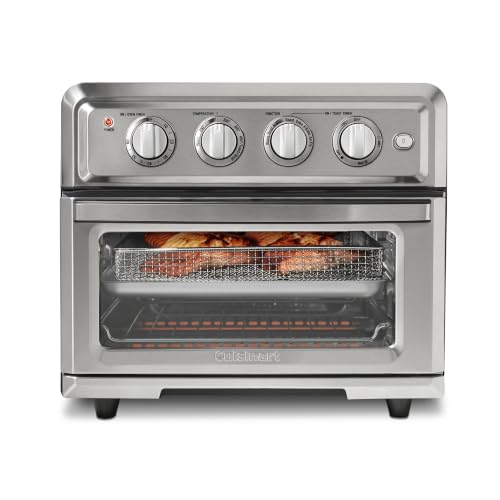
- Cuisinart Air Fryer Toaster Oven Combo TOA-55 — Best Overall Recommendation
- Emeril Lagasse 26QT French Door Air Fryer Toaster Oven — Best for Big Households
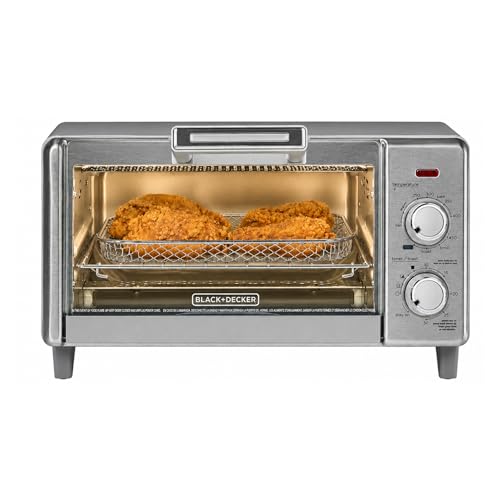
- BLACK+DECKER 4-Slice Air Fry Toaster Oven — Best Simple 4-Slice
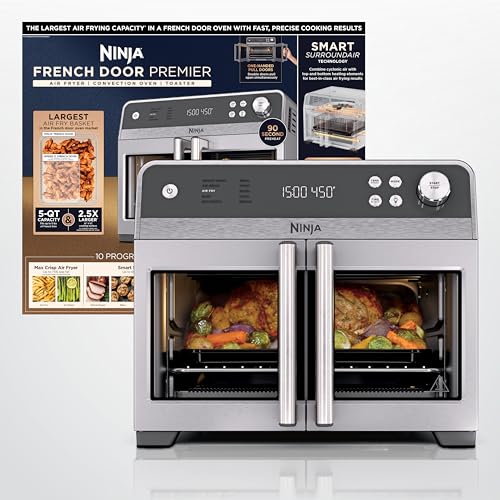
- Ninja Digital Air Fry Countertop Oven SP101 — Best Space-Saving Recommendation
A recommendation is only as good as the question it answers, so here are the questions behind this list. Which oven should a one- or two-person household buy and stop thinking about? The compact BLACK+DECKER. Which should a mainstream family buy as its only countertop oven? The Cuisinart TOA-55. Which should a household that hosts and cooks in pans buy? The Oster. Which should a big, busy household that fills large interiors weekly buy? The Emeril 26QT. Which should a small household that wants air frying without presets and panels buy? The 4-slice BLACK+DECKER with EvenToast. And which should a kitchen whose counter is its scarcest resource buy? The Ninja SP101, which flips up and away against the wall when breakfast is over.
Notice what kind of list that is: no pick is recommended in the abstract, and the overall recommendation — the TOA-55 — is crowned not because it wins any single category but because its specification sits at the category’s centre of gravity, where most households actually live. Seven functions, full 1800W power, convection, a 12-inch pizza fit and a 0.6 cubic foot stainless interior cover the mainstream repertoire without excess in any direction. If your household is not mainstream, the overall crown is not your recommendation; one of the five specialists is, and this guide’s job is to route you to it honestly.
Readers who like their recommendations seasoned with long-form owner experience can cross-check these verdicts against Best Reviewed Toaster Ovens, where the same category is weighed from the commentary side.
Key Takeaways
- Best overall recommendation: the Cuisinart TOA-55, for its centred specification — 7-in-1 functions, 1800W, convection and a 12-inch pizza fit in 0.6 cu. ft.
- Best compact recommendation: the BLACK+DECKER TO1313SBD, a 15.47-inch-class convection oven that fits a 9-inch pizza and keeps cleaning simple.
- Best space-saving recommendation: the Ninja SP101, whose flip up and away storage returns counter depth no fixed oven can match.
- Best for entertaining and big households: the Oster, which fits 15 x 12 inch pans, and the 26-quart Emeril with its 24 presets and six included accessories.
- Best simple 4-slice: the BLACK+DECKER Air Fry model, five functions with EvenToast and no panel to learn.
- Every recommendation here is conditional on household size, counter space and cooking frequency — the buying guide shows how to test each one against yours.
In this guide
Quick Picks
| Pick | Badge | Why it stands out | Check price |
|---|---|---|---|
| BLACK+DECKER TO1313SBD Toaster Oven | Best Compact Recommendation | Compact convection with a 9-inch pizza fit, timer and removable crumb tray | Check on Amazon |
| Oster Extra-Large French Door Air Fryer Oven | Best for Entertaining | Fits 15 x 12 inch pans behind elegant French doors, with six presets | Check on Amazon |
| Cuisinart Air Fryer Toaster Oven Combo TOA-55 | Best Overall Recommendation | The centred specification: 7-in-1, 1800W, 0.6 cu. ft., 12-inch pizza fit | Check on Amazon |
| Emeril Lagasse 26QT French Door Air Fryer Toaster Oven | Best for Big Households | 26 quarts, 24 one-touch presets and six cooking accessories included | Check on Amazon |
| BLACK+DECKER 4-Slice Air Fry Toaster Oven | Best Simple 4-Slice | Five functions with EvenToast technology and room for a 9-inch pizza | Check on Amazon |
| Ninja Digital Air Fry Countertop Oven SP101 | Best Space-Saving Recommendation | Eight functions and 1800W in a design that flips up and away for storage | Check on Amazon |
How These Picks Were Chosen
This is a research-led guide; it claims no hands-on testing and invents no specifications. Every pick was drawn from a verified product pool confirmed against Amazon’s catalogue data through the Creators API on 2026-11-20, and each review states only what that pick’s confirmed title states — the TO1313SBD’s compact dimensions class and crumb tray, the Oster’s pan dimensions and presets, the TOA-55’s wattage, volume and temperature ceiling, the Emeril’s quart capacity, preset count and included accessories, the 4-slice model’s EvenToast technology, the SP101’s wattage and flip-up format. Where a title is silent, the review is silent.
Recommendation logic then did the sorting. Each pick had to be the defensible answer to a real household question, with a specification that supports the answer and an honest limitation that bounds it. That discipline produces a list with no filler: two compact answers differentiated by air frying, one mainstream champion, two large-format answers differentiated by pans versus presets, and one space specialist whose hinge is its whole argument. Models that were merely good at everything and best at nothing were excluded, because a recommendation list that cannot route is just a catalogue with adjectives.
The verdicts also respect frequency, the variable shoppers most often omit. A feature used weekly is worth paying for; a feature used twice a year is a rental you bought. Each detailed review therefore names not only who a pick suits but the usage pattern that justifies it, and the scenario section further down pressure-tests all six recommendations against five concrete households, so you can find your own kitchen in the text before you find your oven in a cart. Households shopping for a second, smaller space can see the same routing logic applied under tighter constraints in Best Small Toaster Ovens For Rv.
Best recommended toaster ovens: the six picks in detail
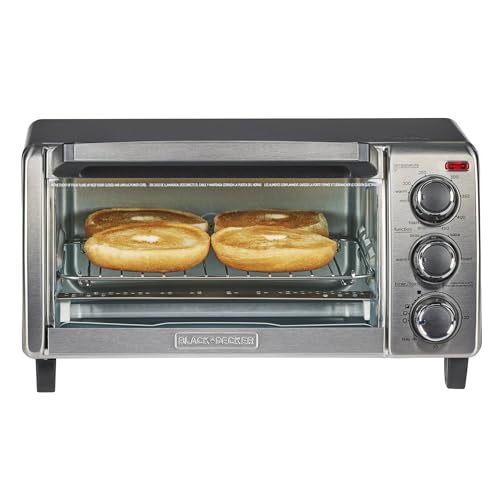
BLACK+DECKER TO1313SBD Toaster Oven
Badge: Best Compact Recommendation
Strengths
- A compact convection cabinet in the 15.47-inch class — the smallest footprint among these recommendations.
- Fits a 9-inch pizza, so it covers personal dinners as well as toast and reheating.
- A removable crumb tray, timer and stay-on function keep daily ownership friction low.
Trade-offs
- No air fry function is stated in its verified title; crisping specialists should look at the 4-slice Air Fry model.
- Compact capacity is a hard ceiling for households beyond two people.
- The silver, simple presentation is functional rather than decorative.
Mini spec box
- Size class: 15.47 inch; compact
- Capacity: fits a 9-inch pizza
- Type: convection toaster oven
- Features: timer, stay-on function, removable crumb tray
- Finish: Silver
This is the recommendation for the household that wants the question closed. A single person, a couple, a student kitchen, an office — anywhere the cooking is toast, reheating and the occasional personal pizza, the TO1313SBD covers the brief in the smallest cabinet on this list, with convection to keep results even and a crumb tray that slides out instead of demanding a shake over the sink. Its recommendation rests on restraint: it does not promise air frying, presets or family capacity, and in exchange it asks for little money, little counter and little thought.
The limitation is the same as its virtue — size. The day a third person joins breakfast regularly, this oven starts working in shifts, and the honest upgrade path is the mainstream TOA-55 below rather than a bigger compact. Buy it sized for the household you have, and it will be the least regretted appliance on the counter.
Best for: singles, couples, offices and small kitchens wanting dependable basics / Not suited for: families, air fry enthusiasts and batch cooking

Oster Extra-Large French Door Air Fryer Oven
Badge: Best for Entertaining
Strengths
- Fits 15 x 12 inch pans — your existing casserole and sheet pans work whole.
- Six cooking presets and an auto-shutoff timer suit busy hosting and family schedules.
- Elegant French doors load heavy dishes gracefully and present well in open kitchens.
Trade-offs
- Extra-large dimensions demand measured counters and storage for big trays.
- Small daily jobs — one slice, one mug cake — are inefficient in a cavity this size.
- Air fry positioning serves tray loads; basket-style snack specialists may prefer a smaller cavity.
Mini spec box
- Capacity: extra-large; fits 15 x 12 inch pans
- Presets: 6 cooking presets
- Safety: auto-shutoff timer
- Format: French door air fryer countertop oven
The Oster is recommended to the household whose cooking is social. Its defining specification is not a function but a dimension: 15 x 12 inch pans fit, which means the lasagne dish, the sheet pan of vegetables and the casserole that feeds a table all cook in the countertop oven while the main oven stays free — or stays off. French doors make that loading graceful, and six presets with an auto-shutoff timer make it manageable when the cook is also the host. If your kitchen’s big moments involve feeding people from pans, this is your recommendation.
Its limitation is weekday scale. A large cavity for a single portion is slow theatre, and households that mostly cook small will feel the mismatch daily. The Oster rewards the kitchen it was sized for and taxes any other, which is the definition of a specialist recommendation.
Best for: hosts, casserole and sheet-pan cooks, families who entertain / Not suited for: small counters and mostly-solo cooking

Cuisinart Air Fryer Toaster Oven Combo TOA-55
Badge: Best Overall Recommendation
Strengths
- The centred specification: 7-in-1 functions, 1800W, convection and a 450°F ceiling in 0.6 cu. ft.
- Fits a 12-inch pizza — the family benchmark — in a stainless interior with a removable crumb tray.
- Its mainstream size means accessories, recipes and advice are all written for exactly this class.
Trade-offs
- Balance means no single crown: rivals beat it on capacity, presets, price tier or footprint individually.
- Oven-format air frying asks for single-layer discipline to crisp properly.
- Stainless steel rewards a wipe-down habit to stay handsome.
Mini spec box
- Interior: 0.6 cu. ft.
- Functions: 7-in-1 with convection capability
- Power: 1800W
- Maximum temperature: 450°F
- Capacity: fits a 12-inch pizza
- Features: removable crumb tray
- Finish: stainless steel
- Model: TOA-55
The TOA-55 earns the overall recommendation the honest way: by being the answer for the largest number of real kitchens. Its specification reads like the category’s median voter — seven functions covering toast through roast, full power for assertive air frying, a family pizza fit, an interior volume that handles weeknight trays without swallowing the counter. A household buying its first countertop oven, or replacing a dead one without wanting a research project, can stop here with a clear conscience. This is also the pick whose ownership experience is easiest to predict, because the mainstream class generates the deepest pool of recipes, accessories and shared know-how.
The honest limitation is that centred is not maximal. Hosts should take the Oster’s pans, big households the Emeril’s quarts, repertoire collectors a deeper function list, and small kitchens the compacts or the flip-up Ninja. The TOA-55 is recommended overall precisely because most kitchens are none of those extremes — and if yours is one of them, this guide has already routed you onward.
Best for: mainstream families and first-time buyers wanting one oven that does everything well / Not suited for: extreme capacity, tiny counters and specialist repertoires
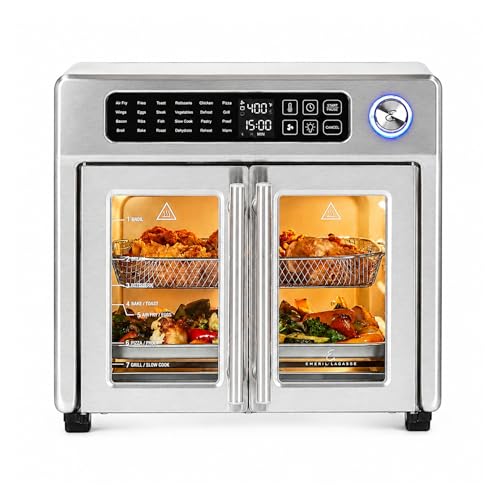
Emeril Lagasse 26QT French Door Air Fryer Toaster Oven
Badge: Best for Big Households
Strengths
- A 26-quart extra-large interior — the biggest capacity in this guide — built for volume cooking.
- Twenty-four one-touch presets guide a wide repertoire for cooks of mixed experience.
- Six cooking accessories are included, so the capacity is usable from day one.
Trade-offs
- Its footprint dominates counters and demands cabinet-clearance measurement.
- Most households will use a fraction of the 24 presets regularly.
- Six accessories need a storage plan in the kitchen.
Mini spec box
- Capacity: 26QT; extra-large interior
- Presets: 24 one-touch preset options
- Type: countertop convection cooker
- Format: French door multi-function air fryer toaster oven
- Included: six cooking accessories
The Emeril 26QT is recommended where volume is the household’s defining fact: large families, multi-generational kitchens, batch cooks who fill trays on Sundays, hosts whose gatherings are measured in dozens. Twenty-six quarts changes what a countertop oven is — from a helper to a second oven — and the 24 presets matter here more than anywhere, because big households contain cooks of every confidence level, and presets let the least experienced of them produce the family’s staples reliably. The included accessories complete the argument: the capacity arrives equipped, not theoretical.
Its limitation is commitment. This oven will be the largest object on your counter and the centre of your kitchen’s geography, and households that fill it rarely will feel its presence as a tax. Recommend it where the volume is real and weekly; admire it from a distance where it is not.
Best for: large families, batch cooks and frequent hosts / Not suited for: small kitchens, solo cooks and occasional users
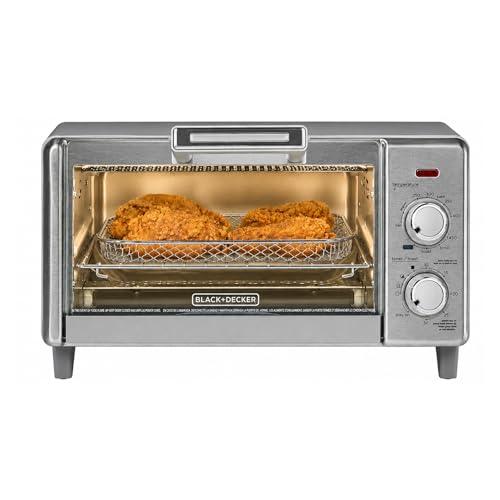
BLACK+DECKER 4-Slice Air Fry Toaster Oven
Badge: Best Simple 4-Slice
Strengths
- Five functions — air fry, bake, broil, toast, keep warm — add air frying to the simple compact formula.
- EvenToast technology targets the compact class’s oldest complaint: uneven browning.
- Room for a 9-inch pizza keeps it a genuine small dinner appliance.
Trade-offs
- The 4-slice class caps portions; family air frying happens in batches.
- No preset library or digital display is stated in its verified title.
- Its simplicity is the point — cooks wanting guided programs should step up a class.
Mini spec box
- Capacity: 4-slice; fits a 9-inch pizza
- Functions: 5-in-1 — air fry, bake, broil, toast, keep warm
- Technology: EvenToast
- Format: countertop oven
Recommended against its compact sibling above on a single question: do you want to air fry? If yes, this is the small household’s answer — the same 4-slice, 9-inch-pizza practicality, plus an air fry function for the fries, wings and roasted vegetables that dominate small-household cooking, with EvenToast addressing the browning consistency that makes or breaks a toaster oven’s reputation at breakfast. It remains a simple appliance: no panels to learn, no preset library to scroll, just the daily repertoire done in a small cabinet.
Its limitation is portion scale, honestly stated: air frying for a crowd in a 4-slice cavity is a batching exercise, and households that regularly feed four or more should take the mainstream recommendation instead. For one or two people who cook real food in small quantities, it is the sweet spot of this entire list.
Best for: small households that air fry, simple-operation fans, first apartments / Not suited for: families and preset-guided cooks

Ninja Digital Air Fry Countertop Oven SP101
Badge: Best Space-Saving Recommendation
Strengths
- Flip up and away storage reclaims counter depth — a feature no fixed-format rival can imitate at any price.
- Eight functions, from air fry and air roast to bagel and dehydrate, cover a wide repertoire.
- 1800W of stated power supports fast preheats and assertive crisping.
Trade-offs
- The wide, low cavity suits flat foods and limits tall items.
- Flipping it up requires the habit of keeping its top clear.
- Digital controls bring a short learning curve for dial loyalists.
Mini spec box
- Functions: 8-in-1 — air fry, air roast, broil, bake, toast, bagel, dehydrate, keep warm
- Power: 1800W
- Format: XL countertop oven, flip up and away storage
- Finish: Silver
- Model: SP101
The SP101 is recommended on a resource argument: in many kitchens the scarcest commodity is not money but counter depth, and this is the only oven in the guide that gives depth back. Cook breakfast, flip the oven up against the backsplash, and the counter returns to service for the rest of the day. Around that hinge sits a genuinely capable appliance — eight functions, full power, a bagel setting, a dehydrate mode — so the space saving does not demand a cooking compromise for the flat foods that dominate weeknight cooking: fillets, trays of vegetables, toast, frozen snacks, reheated pizza.
Its limitation is geometry: the low, wide cavity is the wrong shape for tall roasts and deep casseroles, and the flip-up habit must survive contact with real life — an oven whose top becomes a shelf will not be flipped. Kitchens with disciplined surfaces and flat-food repertoires will find it transformative; kitchens of tall pots should take the mainstream pick. Space-pressed shoppers can also compare the approach in Best Rv Toaster Ovens, where the same geometry questions are asked in an even smaller room.
Best for: small kitchens, flat-food cooking and anyone who values reclaimable counter / Not suited for: tall roasts, deep casseroles and cluttered-top households
Comparison Table
| Pick | Recommended for | Capacity signal | Standout feature | Check price |
|---|---|---|---|---|
| BLACK+DECKER TO1313SBD | Compact basics | 9-inch pizza; 15.47-inch class | Removable crumb tray | Check on Amazon |
| Oster Extra-Large French Door | Entertaining | Fits 15 x 12 inch pans | 6 presets; auto-shutoff | Check on Amazon |
| Cuisinart TOA-55 | Overall / mainstream | 0.6 cu. ft.; 12-inch pizza | 1800W; 7-in-1 | Check on Amazon |
| Emeril Lagasse 26QT | Big households | 26QT extra-large | 24 presets; 6 accessories | Check on Amazon |
| BLACK+DECKER 4-Slice Air Fry | Simple small-household air frying | 4-slice; 9-inch pizza | EvenToast technology | Check on Amazon |
| Ninja SP101 | Space saving | XL wide, low format | Flip up and away; 1800W | Check on Amazon |
How to Choose Your Recommended Oven
Route yourself with three measurements and one honest list. Measurement one is people: count the breakfasts. One or two people point to the compact class; three to five to the mainstream; six and upward, or regular hosting, to the large formats. Measurement two is pans: find your largest everyday dish and let its dimensions arbitrate — the Oster’s 15 x 12 inch claim exists because standard pans are the unit of real cooking. Measurement three is counter: width, depth and the cabinet height above, plus the discipline of the surface, which decides whether the SP101’s flip-up promise is real in your kitchen. The honest list is your last ten countertop-oven meals, written down. Match the list against function lists and the recommendation usually names itself.
Tier logic follows the routing. The compact tier buys competence and quiet; the mainstream tier buys the full weekly repertoire; the large tier buys capacity as a household service; the premium features — deep presets, included accessories, flip mechanisms — buy specific conveniences that must map to weekly behaviour to be worth their keep. Where two recommendations both fit, choose by failure mode: the oven whose limitation you will encounter less often. A family that rarely roasts tall items can ignore the SP101’s low cavity; a family that rarely hosts can ignore the Oster’s weekday overkill. Recommendations are, in the end, predictions about which limitation will bother you least, and the scenario section below makes those predictions concrete.
Cleaning belongs in the routing too, because it decides whether a recommendation survives month three. Removable crumb trays appear in both BLACK+DECKER and Cuisinart specifications here for a reason, and households that know their own habits should weight tray systems and interior access as heavily as functions. The upkeep-led view of the category is developed in Best Self Cleaning Toaster Ovens for shoppers who want to start from that end.
How to Use and Care for Your Toaster Oven
Whatever you choose, set it up for airflow: clearance on every side, a heat-safe surface, a direct wall outlet, and one empty heat cycle before the first meal, following your model’s manual. Test your pans for fit immediately, position the rack centrally for toast and baking, and spend the first week learning your oven’s pace — countertop elements sit close to food, so full-size-oven recipes often finish early, and a note on the recipe card converts that learning into permanent reliability.
Technique is three habits. Preheat fully for baking. Give air fried food a dry surface, a single layer and a halfway shake or turn. And resist opening the door to check; use the light, the window where fitted, or the timer you have learned to trust. These habits, not specifications, explain most of the gap between delighted and disappointed owners of identical ovens.
Care is a rhythm of small acts: crumb tray emptied after toasting, interior wiped while warm after fatty cooks, trays washed promptly, vents kept clear, hinges wiped monthly on French-door models. Never immerse the oven body and avoid abrasives on coated interiors. Five minutes a week keeps any pick in this guide performing like its first month.
Troubleshooting: three common problems
Problem: toast is uneven from one side to the other → what to do: rotate slices halfway, centre the rack, and allow a full preheat before the first batch; compact ovens especially reward the halfway turn.
Problem: air fried food is limp → what to do: dry the surface, spread a single layer with gaps, raise the temperature rather than the time, and cook a second batch instead of crowding the first.
Problem: the oven smokes during high-heat cooking → what to do: cool it down, clean the crumb tray and interior grease film, and place the baking pan under fatty foods so drips land on a washable surface.
Five Households, Six Recommendations: A Scenario Check
The studio flat: one person, a counter shared with a kettle and a cutting board, cooking that is toast, eggs-adjacent reheats and a personal pizza on Fridays. Recommendation: the TO1313SBD if air frying is not a hobby, the 4-slice Air Fry BLACK+DECKER if it is. Both fit, both clean easily, neither apologises for its size because the household never asks it to be bigger.
The young family: two adults, two children, weekday dinners in twenty-minute windows and a pizza night that anchors the week. Recommendation: the TOA-55, the overall pick, because its 12-inch pizza fit, full power and mainstream interior match the brief exactly, and its repertoire covers the children’s expanding menu without a second appliance. If counter depth is the binding constraint, the SP101 is the sanctioned alternative, trading tall-item capacity for a counter that clears itself.
The hosts: a couple whose dining table seats eight and whose kitchen performs on weekends. Recommendation: the Oster, because their cooking is pan-shaped — casseroles, sheet-pan vegetables, gratins — and its interior accepts the pans they already own, while the main oven stays free for the roast. The Emeril 26QT enters the conversation only if their hosting is weekly and volume-led rather than pan-led.
The big household: three generations, batch cooking, teenagers with appetites and opinions. Recommendation: the Emeril 26QT, whose capacity and 24 presets serve many cooks of many skill levels, with accessories included so the volume is usable immediately. The multigenerational kitchen is also where presets stop being a luxury: they are how the household’s standards survive being cooked by its least experienced member.
The small serious kitchen: a keen cook in a compact flat, cooking flat foods beautifully — fish, vegetables, flatbreads, reheated pastries — and valuing workspace over all. Recommendation: the SP101, whose flip-up storage is a daily dividend and whose eight functions cover the repertoire, with the honest caveat that tall roasts belong to friends’ kitchens and restaurants. Popularity data supports none of these routings by itself, incidentally — the patterns behind Best Selling Toaster Ovens show what sells, while this section shows what fits, and fit is the better oracle.
What a Recommendation Cannot Do
A recommendation cannot measure your counter, taste your toast or know that your household’s real breakfast is reheated rice and yesterday’s soup. It compresses other kitchens’ experience into a routing, and routings have error bars. Treat this guide’s verdicts as strong defaults: follow them when your household resembles the scenario, depart from them when it visibly does not, and in both cases verify the final model’s specification — model code, capacity claim, function list — on its live listing before buying. The shoppers who end up happiest with any appliance are not the ones who found the perfect ranking; they are the ones who matched a good appliance to a honestly described life. These six are good appliances. The describing is yours.
Matching Controls to Cooks: The Recommendation Inside the Recommendation
Every recommendation in this guide has a second, quieter recommendation inside it, about controls. The two BLACK+DECKER picks represent the simple pole: direct, familiar operation that a guest, a grandparent or a half-awake teenager can run without instruction. The Oster and the Emeril represent the guided pole: presets that encode decisions, so the household’s least experienced cook produces the household’s standard result. The TOA-55 and the SP101 sit between, offering structure without a library. Neither pole is better; they serve different social kitchens. A household of one expert should buy simplicity and spend the savings on ingredients. A household of five mixed-ability cooks should buy guidance, because guidance is what makes the appliance a household utility rather than one person’s instrument.
Think about your kitchen’s actual cast. Who cooks breakfast on weekdays? Who reheats at midnight? Who is learning? If the answers span generations and confidence levels, weight presets and legible controls heavily — they are the features that convert an oven from a purchase into infrastructure. If the answers are one name repeated, weight capacity, evenness and cleaning, and let controls be as plain as they come. This single audit explains a large share of recommendation regret in the category: ovens bought for an imaginary household of experts, or for an imaginary household of beginners, by shoppers who never listed their real cast. List yours, and the control question answers itself before the capacity question even begins. Shoppers whose cast includes children cooking independently may also want the compact-first view in Best Small Size Toaster Ovens, where simpler machines lead the list.
Year Two: What Ownership of Each Class Actually Feels Like
Recommendations are usually written from month one, but you will live with your choice in year two, when novelty has burned off and the oven is simply how breakfast happens. Compact ovens age gracefully in year two because their promise was small: the TO1313SBD and its 4-slice sibling ask little, clean quickly and occupy their corner without negotiation. Their year-two risk is household growth — a partner, a child, a new air frying habit — which turns a right-size oven into a bottleneck through no fault of its own. Mainstream ovens like the TOA-55 age the most invisibly, which is the compliment their class aims for: big enough for the repertoire, ordinary enough to disappear into routine, with the crumb tray and stainless care as the only recurring appointments.
Large ovens have the most dramatic year two, in both directions. In the right household — the Oster’s hosts, the Emeril’s big family — they become load-bearing: gatherings, batches and celebrations route through them, and their owners speak of them the way they speak of the dining table. In the wrong household they become geography: a large, warm monument that smaller cooking orbits resentfully. The SP101’s year two hinges on a habit rather than a household: kitchens that kept the flip-up discipline describe a counter that still feels new; kitchens that let its top become a shelf describe a wide oven like any other, its dividend spent. None of this is visible in a specification table, which is why this guide keeps returning to the same unfashionable instruments: a tape measure, a headcount, a list of real meals and an honest description of your household’s habits. Year two is decided by those, not by features.
The Two-Oven Question and Other Upgrade Paths
Sooner or later, keen households ask whether two countertop ovens beat one — typically a compact for daily small jobs and a large format for events. The honest recommendation is: occasionally, and only when both halves of the pattern are weekly. A compact-plus-Oster pairing genuinely serves the household that toasts for two on Tuesdays and casseroles for ten on Saturdays, because each oven works at its efficient scale and neither idles through the other’s job. But two ovens double the cleaning, the counter negotiation and the accessory sprawl, and most households that ask the question actually need one mainstream oven and permission to use the main range for the twice-a-year extremes. Buy the second oven after the first has proven a weekly bottleneck, not in anticipation of one.
Upgrade paths within the list are equally simple. Compact owners outgrow upward into the TOA-55. Mainstream owners specialise outward — toward the Oster’s pans, the Emeril’s volume or the SP101’s storage — rather than upward in price. Large-format owners rarely upgrade at all; they replace in kind, which is the surest sign the original routing was right. And owners at every level should treat accessories as the cheapest upgrade: the right pan for your interior, a second tray for batch flow, a thermometer for honesty. Appliances are replaced in years; accessories improve them by Friday.
Read This List Backwards: Start From Your Limitation
Most shoppers read a recommendation list from the crown downward, asking whether they can justify the winner. A more reliable method reads it from the limitation outward. Name the binding constraint of your kitchen first. If the constraint is counter depth, only two picks survive contact with it — the compact BLACK+DECKER and the flip-up Ninja — and your decision is a two-way choice about air frying and repertoire, settled in minutes. If the constraint is headcount, the large formats lead and the only question is pans versus presets. If the constraint is cooking confidence across a mixed household, presets lead and capacity follows. If there is no binding constraint — the happy mainstream case — the overall recommendation exists precisely for you, and deliberation beyond verifying the TOA-55’s specification is leisure rather than diligence.
This backwards reading also inoculates against the category’s favourite marketing trick, which is to manufacture a limitation you do not have and sell you its cure. Few households need twenty-four presets; fewer need a rotisserie; almost none need both in a compact. When a feature is presented as essential, ask which of your last ten real meals required it. Features that fail that test are not bad features — they are other households’ recommendations, photographed well. Keep your own limitation at the centre of the page and the list sorts itself, which is, in the end, all a recommendation can honestly promise: not the best oven, but the best-matched one, verified down to its model code.
Common Buying Mistakes
- Buying the overall winner for a specialist life. The TOA-55 is the mainstream answer; hosts, big households and tiny kitchens have their own picks in this guide for a reason.
- Skipping the pan measurement. Your largest everyday dish is a specification; ovens that cannot accept it will frustrate weekly.
- Paying for repertoire you will not open. Count the functions in your real week, then buy the list that covers them with a little headroom.
- Ignoring the counter’s discipline. Flip-up storage and French doors both presume habits and clearances; audit yours honestly.
- Forgetting the second cook. Households with several cooks of different confidence benefit from presets and simple controls more than solo experts do.
- Treating cleaning as an afterthought. Crumb trays and tray systems decide month-three satisfaction; choose them deliberately.
Final Recommendation
If you buy one oven from this page without another thought, buy the Cuisinart TOA-55 — it is the centred, mainstream answer most kitchens need. If your kitchen is small, buy the BLACK+DECKER 4-Slice Air Fry for simple small-household cooking, or the Ninja SP101 when counter depth is the scarce resource. If your kitchen is large and social, buy the Oster for its pans or the Emeril 26QT for its volume. Every one of those sentences is conditional, and that is exactly what makes them recommendations rather than rankings.
A final word on confidence: a conditional recommendation can feel less satisfying than a coronation, but it is the only kind that survives contact with a real kitchen. The six ovens above are all recommendable — each is the best answer this verified pool offers to a question real households ask — and the work of choosing is simply deciding which question is yours. Decide it honestly, verify the model code at the listing, and the oven you bring home will feel less like a purchase and more like a conclusion.
Frequently Asked Questions
Which toaster oven is recommended for most families?
The Cuisinart TOA-55, this guide’s overall recommendation. Its 7-in-1 functions, 1800W power, convection and 12-inch pizza fit inside a 0.6 cu. ft. stainless interior match the mainstream family repertoire — breakfasts, weeknight dinners, pizza nights — without excess capacity to heat or repertoire to ignore.
Which toaster oven is recommended for a small kitchen?
Two answers divide by priority. For the smallest footprint with simple operation, the compact BLACK+DECKER TO1313SBD. For a fuller repertoire that returns its counter after use, the Ninja SP101, which flips up and away against the backsplash. Measure your counter and your cabinet clearance, then choose by whether storage or simplicity matters more.
Is a 4-slice toaster oven big enough?
For one or two people, yes — especially the air fry model in this guide, which covers toast, reheating, small roasts and a 9-inch pizza. For families it becomes a batching appliance, workable but wearing; households of three or more who cook daily should start at the mainstream class.
Are French-door toaster ovens worth recommending?
For cooks who load heavy trays, yes: one-handed opening and wrist clearance are real ergonomic gains, and both large picks in this guide use the format. They ask for width and front clearance in return, so the recommendation is conditional on the counter, as most good recommendations are.
Do I need presets on a toaster oven?
Presets help households with multiple cooks, newer cooks, or varied repertoires, because they store reliable starting settings. Solo confident cooks often prefer simple controls and their own notes. The Emeril’s 24 presets and the Oster’s six show the two scales of the idea; choose the scale that matches your household’s spread of experience.
Can a countertop oven replace my main oven?
For many households, mostly: the larger picks here bake, roast, broil and air fry complete dinners with far shorter preheats. Holiday volumes, simultaneous dishes and very tall items still belong to the main oven. The common pattern is the countertop oven as the daily driver and the main oven as the occasional specialist — the division these recommendations assume.
What if my household sits between two recommendations?
Then choose by the limitation you will meet more often, because recommendations fail at their edges and you should pick the edge you visit least. A family between mainstream and large should ask how many weekly meals genuinely need the big interior; if the answer is one, the mainstream oven plus the main range covers it, and the large oven’s daily footprint tax is not worth paying. A household between compact and mainstream should count breakfasts on the busiest morning of the month, not the average one, because appliances are remembered by their worst mornings. Between two good answers, frequency is the tiebreaker that never lies.
How do I verify a recommendation before buying?
Open the pick’s listing and match three things to its review here: the model code, the capacity claim and the function list. If all three agree, you are looking at the appliance this guide recommended. If any disagrees, you are looking at a variant — pause and re-route, because recommendations attach to exact models, not to names.